




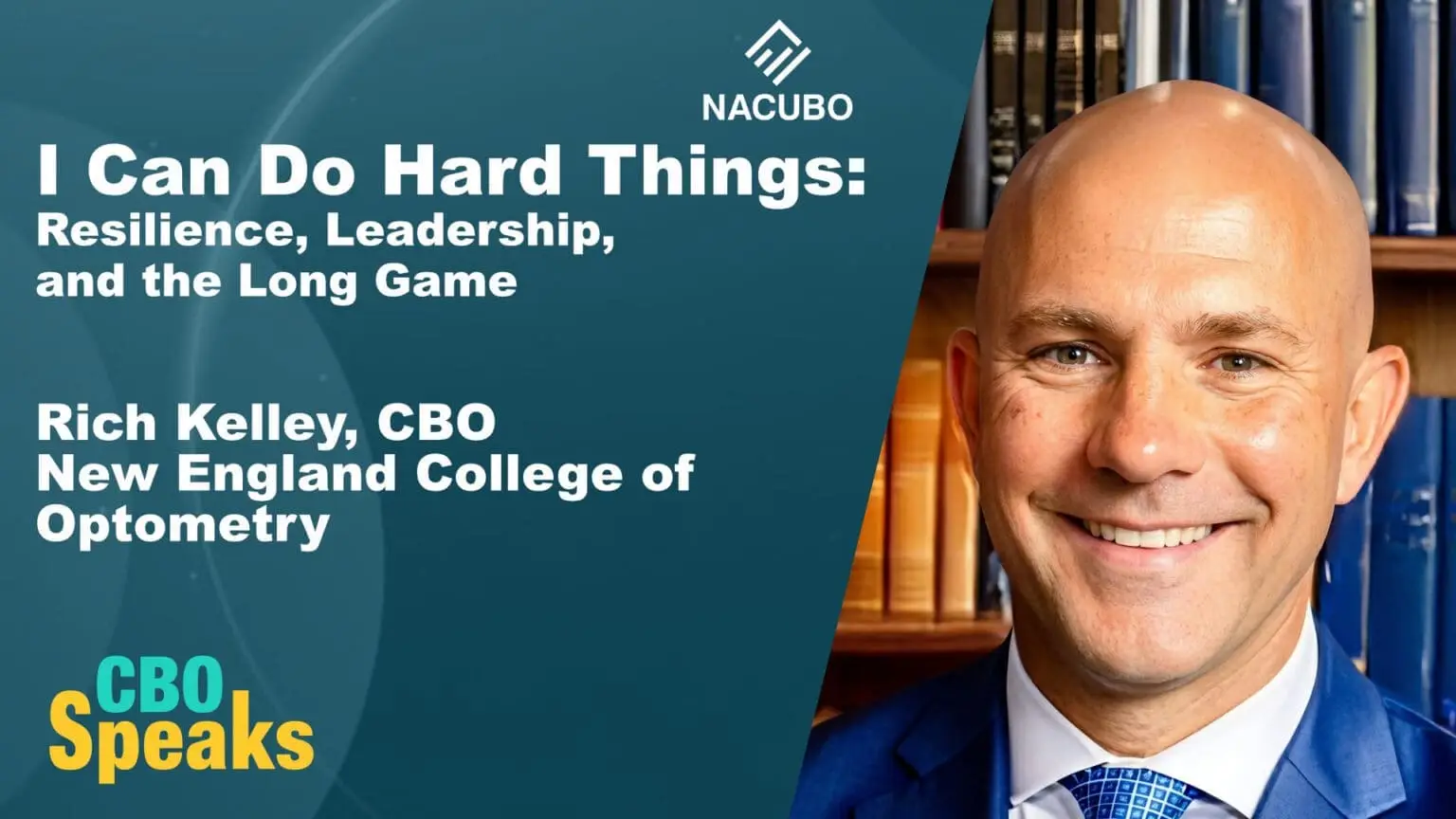
Rich Kelley is chief financial officer at New England College of Optometry in Boston. In this episode, Kelley joins host Melissa Farley to talk about the leadership philosophy he calls transparent accountability, the financial planning challenges facing tuition-dependent institutions, and the lasting value of mentorship and professional networks in higher education.
“I started to realize that the more important skill is creating the conditions to help others arrive at the right answer,” Kelley says—whether that means a provost, a president, or someone in admissions. This shift in perspective, from needing to have every answer to empowering others to find them, forms the foundation of a leadership approach he calls transparent accountability. “That just means that I’m as clear as I can be about what I expect, as clear as I can be about what I know, and transparent about the things that I don’t know.” Kelley goes on to discuss how this philosophy has helped him build credibility and trust across the institution, from the finance office to the senior leadership table.
Join us for a conversation with Kelley as he discusses how endurance athletics have shaped his professional resilience, why financial jargon can become a barrier to collaboration rather than a badge of expertise, and what he sees ahead for higher education as institutions navigate demographic pressures, federal uncertainty, and the rise of artificial intelligence.
Connect with Rich Kelley
Check out NACUBO’s other podcasts!