This transcript is produced using transcription software and reviewed for quality. Despite our best efforts, some passages may be incomplete or contain errors due to audio quality or software limitations.
Andy Nelson:
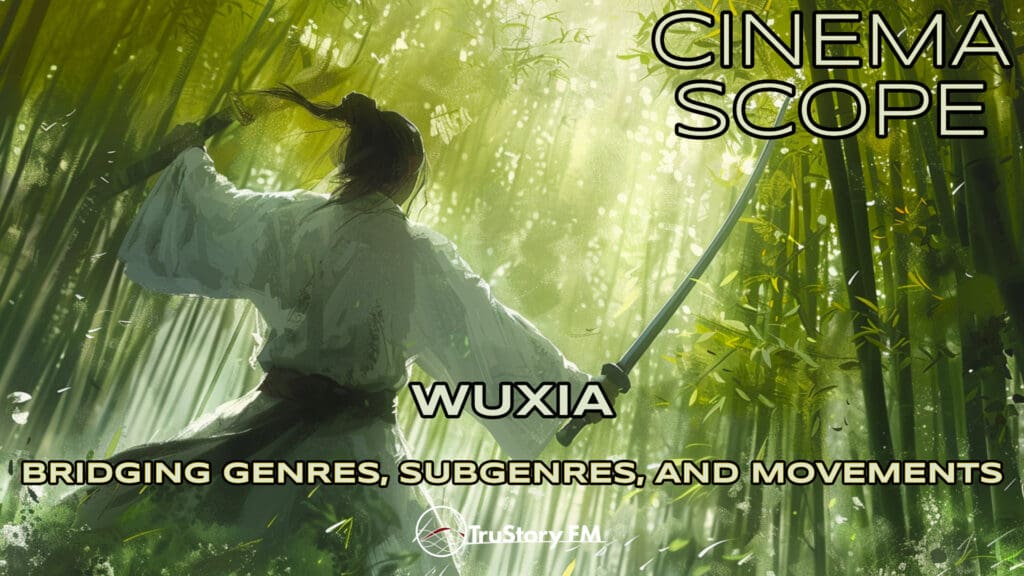
Welcome to Cinema Scope, where we slice through the mystique of cinema’s genre landscapes. I’m Andy Nelson, your guide on this journey to bridge film genres, subgenres, and movements, ultimately deepening our understanding of them all. Today, for our inaugural episode, I’m very excited to talk about this one. We’re diving into Wuxia to discover how its blend of philosophy, action, and legend captures our imagination across cultures and eras. Joining me today, I have two guests that it will be a lot of fun to talk about this with. I have Leon Hunt and Chris Hamm.
Chris Hamm:
Hello, everybody.
Andy Nelson:
Both of you have studied Wuxia. You’re both professors, you teach it, you have written about it, you have a firm understanding. Let’s start with you, Leon — a quick background on you and Wuxia and how it came into your life.
Leon Hunt:
I was probably later discovering Wuxia than the version of the martial arts film that was the first one to sort of break out in the West, which was the Kung Fu film. I very much came in through the Kung Fu door. I was just the right age for the Kung Fu craze, as they called it, of the seventies. I was watching Bruce Lee films and all the other Hong Kong martial arts films that I could see. The first Wuxia film that I saw was actually A Touch of Zen — talk about starting with one of the easy ones. Let’s start with the three-hour one that doesn’t have any fighting for the first hour. And I was aware immediately that that was very different from the martial arts films that I was more accustomed to. I wasn’t yet familiar with the term Wuxia, and I wouldn’t discover that until many years later — this was sort of about the mid to late seventies. And significantly, the book I wrote about martial arts films has got Kung Fu in the title. That was my way into the genre. And my understanding of Wuxia really came along later.
Andy Nelson:
And then how about you, Chris?
Chris Hamm:
Well, first let me say, Leon, it’s a pleasure to meet you, in part because I’ve used your book. I co-teach a course on martial arts cinema with a colleague in the Cinema and Media Studies Department, and we’ve used chapters from your Kung Fu Cult Masters in that course. So it’s a pleasure to meet you.
Leon Hunt:
Oh, that’s good to learn. Thank you.
Chris Hamm:
But yeah, I too grew up with Bruce Lee, but years later when I was in graduate school studying Chinese literature, I actually never thought too much about Wuxia cinema, about Wuxia film. But I got interested in Wuxia fiction, martial arts fiction, and was originally intending to do a sober dissertation on some topic in modern Chinese literature — but was reading martial arts novels in my spare time. And my advisor said, you know, a lot of people read these things and no one’s ever written about them, and maybe somebody should do a dissertation. So I ended up writing my dissertation and publishing my first book on martial arts fiction. I’m not really a cinema scholar. I’m a literary scholar. But I teach martial arts film in some of my courses, and I do co-teach a big martial arts film course with a colleague from the cinema studies department. I kind of got back into martial arts film through the medium of literature and written fiction.
Andy Nelson:
It’s such an interesting world, what Wuxia is, the way that the stories unfold. I definitely want to dig into your experience and understanding, Chris, with the novels and how all of this really began and got started. Before we do that, though, I just want to talk a little bit about why we’re talking about Wuxia as our first episode of the show. Like you, Leon, I hadn’t heard of it until Crouching Tiger, Hidden Dragon came out. And that was the first time that in popular culture people were like, oh, it’s a Wuxia film. My college roommate was from Malaysia, and when that movie came out, I was talking with him and he’s just like, what is it with you Americans? This has been around forever. And I hadn’t heard of it. And without realizing it, when I was young, one of my favorite films was Big Trouble in Little China. And there are certainly elements that you can see that John Carpenter used — some of the elements of Wuxia in that film. I don’t know if I’d call it a Wuxia film, but it’s definitely something that has some of those elements. And then, seeing how, when you start understanding what it is, you can see there are elements of it in The Matrix, and you can see pieces of it woven through a lot of action cinema outside of martial arts films. I think it’s an interesting genre to talk about. It’s definitely a unique one, and I think it’s very important to explore it in the context of global cinema. So for the two of you — looking at where it started, how does Wuxia reflect the cultures and values from where it came, and why is it still relevant today?
Leon Hunt:
I think its lasting relevance — well, you mentioned films like Big Trouble in Little China, and I think certainly what global cinema has taken from the Wuxia genre, as opposed to the Kung Fu films, is the spectacle, the more fantastical elements, which sort of caught the imagination. I think when Carpenter was making Big Trouble in Little China, he’d probably seen films like Zu: Warriors from the Magic Mountain and A Chinese Ghost Story — those more special-effects-driven films. I think Crouching Tiger, Hidden Dragon also probably had more of that kind of philosophical dimension associated with the genre, which doesn’t necessarily always turn up in the Chinese films. Some are much more straight-ahead for the action. And what I’ve seen of the few silent Wuxia films that have survived from the 1920s — because I don’t think many of them did survive — they don’t look massively different from the sort of swashbuckler films. I’ve seen it said that Douglas Fairbanks was kind of an influence on them, that it was a way for the cinema of Shanghai to think, well, we could make films like this. We’ve got genres that will fit this sort of adventure-action template.
Chris Hamm:
Thinking about Wuxia, I think the meaning of it and the history of it is different for what we might think of as native audiences and international audiences. For international audiences, it’s perhaps in many cases a variant of action film, an adventure film that has this oriental gloss on it — and also, maybe going back to the Kung Fu TV series, the sense that it’s not just oriental action, but that by being oriental action it also carries this kind of mystical or philosophical weight that Western action genres generally don’t. And that was part of its appeal — that tie-in with the Eastern mysticism of the sixties and seventies and the interest in that. For what we might think of as native audiences, I think it’s a little bit different, because there is this perception that the cinematic versions of all this are somehow grounded in a literary and cultural tradition that goes back hundreds or thousands of years. A perception that is in some ways true, and in some ways I think not so true. Because Wuxia cinema as we know it — and Leon suggested this in his comments about Douglas Fairbanks — really is taking some material that’s familiar to Chinese audiences from the opera stage or from literature, but then wedding it to not just the technology of cinema, but to the aesthetics and technical capabilities of Hollywood cinema. We see that in the twenties with the early Wuxia films that really are kind of Chinese versions of Douglas Fairbanks swashbuckler films. But then again in the sixties, where the Wuxia genre is reinvented at Shaw Brothers and elsewhere — really as a kind of conscious effort to come up with a Hong Kong or Chinese competitor to the Japanese samurai films and the Spaghetti Westerns and the spy movies and stuff like that. So it’s a combination or wedding between this inherited material and the very specific possibilities of the cinema.
Andy Nelson:
And it’s so interesting how it’s even evolved. I suppose we should maybe take a quick step back — for people who are listening to this who are hearing us say this name and might not actually be familiar with Wuxia, maybe we should just really quickly describe what the key elements are. How would you describe Wuxia to somebody who hadn’t heard about it before?
Leon Hunt:
Well, the easiest way is probably to start with the name, which points to the two defining things of the genre. On the one hand, there are people who have martial or military ability — they are fighters of some sort. But at the same time, that is wedded to a certain set of values. Chivalry is the way it often gets loosely translated — that they have particular qualities of heroism. They’re altruistic, they’re loyal, they defend the weak, they stand up to corruption, they stand up to corrupt governments and authority. They can sometimes be seen to embody a kind of rebellious spirit that doesn’t just kowtow to authority.
Chris Hamm:
Yeah. One of the interesting things about the term xia in particular — the second component — so the first component, wu, is martial or military fighting, basically. And then xia is the element of the compound that suggests this altruistic, heroic character. One thing that you see is that when superhero characters — even going back as far as Zorro — are translated into Chinese, often this term xia is used to designate them, or to translate the term. So it does carry this sense of a hero, of a superhero, of a kind of superman who is coming in to save people, who has some sort of higher ideal.
Andy Nelson:
That’s interesting, because obviously, as you both brought up, some of the early silent Wuxia cinema — a lot of it is just not available. It’s very tricky to track down a lot of those early ones. So when we start talking about some of the films specifically, we’re starting in the sixties.
Leon Hunt:
Yeah.
Andy Nelson:
Because that’s generally where it’s easier to start at this point. I think, Leon, as you were saying, unless you’re going to a specialty screening of one of these that’s still around, it’s really hard to track them down.
Chris Hamm:
Yeah, most of them are just lost.
Leon Hunt:
Yeah.
Chris Hamm:
Much of the early production of the Shanghai cinema in the twenties and into the thirties was lost, partly by time but partly through war. There’s just very little of that archive that still survives and exists.
Andy Nelson:
Which is — even with American cinema, so many of the films before the fifties are just gone now. It’s such a shame. There’s this element of kind of a superhero sort of piece of the story. And obviously with some of those earlier films we’re not necessarily getting things like the wire work, but definitely as we start progressing, they started adding elements that — how did it come into being? Like this element of a state of mind, a state of understanding and connection with the world, where suddenly these characters can kind of move through air, they can run up walls and all of that.
Leon Hunt:
Well, that arrived in cinema surprisingly quickly, actually. The films from the twenties that I have seen have got an early version of a lot of that. Flying. There’s at least one surviving episode of a film called Red Heroine where she’s kind of flying through the air. It looks not unlike the kind of flying effects that you see in very early Superman films — somebody lying in front of a screen and a sort of moving sky behind them — and sort of magical effects. The magical effects were one of the things that the government seemed to object to about the films when they fell out of favor in the nineteen thirties. It was that kind of superstitious and magical element that they seemed to have a particular dislike of — that they were encouraging superstition, that there were rumors of people thinking that they could gain magical powers or whatever. I’m sort of reminded of Batman in the nineteen sixties warning children not to climb up walls. But yes, that seemed to be one of the things that drew them out of favor for a while.
Chris Hamm:
Well, to go back to your previous question about what is Wuxia — in some ways it’s these supernatural, or what we might think of as supernatural or magical elements, that’s one of the dividing lines. And it is a porous boundary, but one of the dividing lines between the Wuxia genre and say the Kung Fu genre is that the Kung Fu genre tends to focus more on hand-to-hand combat and on what’s intended to be seen as realistic fighting. I mean, it’s not — but the idea is that these are actually people using their fists and their feet, and this is what a fight might look like. Whereas Wuxia is much more open, first of all, to the use of weaponry. There are lots of swordsmen — the sword is kind of the archetypal weapon of the Wuxia world. But then also this notion that martial skills extend into what we might think of as supernatural powers — the manipulation of your qi, your energy. This is part of where the Star Wars Force comes from. The training is not just physical training, but mental and spiritual training, and that’s what gives you the ability to stand on top of bamboo fronds and fly through the air and project your energy to blow up things many paces away. So it’s that supernatural element that in part defines Wuxia and separates it from the Kung Fu subgenre.
Andy Nelson:
Chris, you have a real understanding of a lot of the literary works, which obviously were from before cinema was around. Do you have an understanding of the evolution of Wuxia through the written word — what was going on in China that led to that? Cultural influences, other literary influences, things that contributed to the birth of it as a story form?
Chris Hamm:
Stories about these kinds of powers — and “supernatural” is maybe the wrong word, because the word supernatural carries our own prejudices about what’s real and what’s not real, but to use it as a kind of shorthand — you can find this kind of tale flourishing as early as the Tang Dynasty, the seventh through the ninth centuries, but there are traces of it much earlier even than that. The image of the swordswoman — I think this is another element that’s maybe more typical of Wuxia than of Kung Fu — is that often the warriors are female. As early as the eighth to ninth century, you get classical-language tales about beautiful, mysterious females with extraordinary powers that reveal themselves at crucial moments in the story. So there are elements of this that go quite far back. They’re not called Wuxia. The term Wuxia itself doesn’t really coalesce until the early twentieth century. The elements of it — wu is around and xia is around — but that compound Wuxia, to designate a particular genre first of literature and then of film, that usage doesn’t really appear until the early twentieth century. And it’s borrowed in part from Japan, where there was a genre of popular adventure novel that used the Japanese equivalent of that term.
Andy Nelson:
You mentioned a few of the dynasties. When you’re watching these films — I’m trying to think, all of the ones that we’re talking about are period pieces, right? I can’t speak to whether they’re all in the Tang Dynasty. I’m not sure on the different dynasties myself, but I think they’re all period pieces, right?
Leon Hunt:
Yeah, Tang and Ming seem particularly popular.
Chris Hamm:
Yeah, and again, I think that’s one of the ways you can kind of field-guide the subgenres — one of the ways you can spot a Wuxia film that’s distinct from a Kung Fu film is that Kung Fu films tend to be set in modern or sort of early modern, early twentieth-century periods. But once you get the gowns and the funny hair and the hats and stuff like that, you know you’re probably in Wuxia territory. They’re period dramas, they’re costume dramas.
Andy Nelson:
I also noticed, going through all of these, there’s a lot of political turmoil — a lot of warlords and stories about corrupt officials, elements like that. In those particular dynasties, were there a lot of these sorts of issues that, reflecting on their own history, they wanted to tell as a key part of the story?
Chris Hamm:
Well, yeah. In its various forms, it is a genre about conflict, and there has been no shortage of conflict in Chinese history, as in anybody else’s history. And these martial tales are one of the ways to both address those issues and to some extent sublimate them, or at least make them into good rollicking stories. And in the twentieth century, there’s also been a strong association between both Kung Fu and Wuxia films and various nationalist concerns.
Andy Nelson:
Leon, you’ve definitely studied Kung Fu quite a bit. Chris, you’ve brought it up a few times. In the scope of this big cinematic family tree — all of this falls under the umbrella of action films, and then there’s a subgenre of martial arts films, and under that there’s a whole variety, especially as we start getting into different countries releasing their own types like Muay Thai or things like that. There’s a lot of really interesting subgenres under the martial arts umbrella. But it does seem like Kung Fu and Wuxia get tied together a lot in conversation. I’ve talked to some people and they just refer to them all as Kung Fu films, which — as I’ve been exploring this — it seems like that name has just become so broadly defining of all of this. Even to the point where we’ve got Kung Fu Panda 4 playing in theaters as we record this. And it seems like that film also integrates a lot of Wuxia into the way these characters are behaving and moving. So is that just a misunderstanding of the two, with a lot of people, especially Western audiences, just merging them?
Leon Hunt:
Well, people have been familiar in the West with the term Kung Fu for a lot longer. Very few people in the West, unless they were actually studying it, were familiar with that term before the early 1970s. And then suddenly, as you say, we’ve got David Carradine on television, we’ve got Bruce Lee in the cinema, Marvel Comics quickly gets on board with some Kung Fu comics — we’ve got Shang-Chi and Iron Fist. And it’s got that history behind it. Then Crouching Tiger, Hidden Dragon was hugely important in making people more aware of the idea of Wuxia, because fewer of those films had been shown. Some of them did get released in the West in the seventies, but they were often kind of smuggled in as though they were Kung Fu films, and sometimes even retitled. Golden Swallow, for example, had its title changed to The Girl with the Thunderbolt Kick — probably to make it sound more like the kind of films that Angela Mao Ying was doing during that period. New One-Armed Swordsman was released as well. Because film distributors don’t lose a lot of sleep over whether they’re using the right generic category for something. Just that umbrella — oh, it’s martial arts, it could be Chinese, it could be Japanese, it could be a Chuck Norris film — you could bundle them all in together. And there was a perception that there was a loyal audience who were happy to watch those films.
I think, as Chris was saying, one of the things that distinguishes the Kung Fu film is it’s much more interested in the actual martial arts. They’re often actually about the martial art in some way — even if they don’t show them accurately, and it’s a very fanciful version that you tend to get, they tend to refer to styles of Chinese martial arts that actually exist or have existed. So they’re doing Wing Chun or they’re doing Hung Gar or Praying Mantis or something like that. It’s not the sort of exploding Buddha’s Palm or whatever that you get in the Wuxia film, where they’re firing thunderbolts or making trees split in half with a sword that isn’t even touching them. That kind of more fantastical element is played down in Kung Fu films.
Chris Hamm:
We had a list of films that we were going to talk about today, and I tried to sort of work my way through them in preparation for today’s conversation. I didn’t make my way through all of them, so some of them are still a little bit hazy in my memory. But just last night I was rewatching The Bride with White Hair — which I don’t think I’d watched since it came out in the early nineties, ’93 or something like that. And I was struck by how little of what one would think of as martial arts there is in that film. It’s sort of set in this world of martial artists and warring sects and things like that, and there are one or two sequences where people twirl around with swords or make things blow up, but there’s very little actual performance or representation of the practice of any kind of martial art. It’s more about the setting and the vibe and the kind of associations of that world, of the Wuxia world.
Leon Hunt:
Yeah.
Andy Nelson:
And that speaks to — even with a subgenre like Wuxia, it has its own subgenres too. As I was researching this, there are smaller little niches — some are more like the fairy-tale ones, some are a little more romantic, some have more of a nationalist theme. And then there’s the new Wuxia movement that kind of started with Crouching Tiger, Hidden Dragon. So there is this variety. But I guess at this point, looking at the key elements that are within Wuxia films — this chivalrous hero who is fighting for what’s right over the course of the story, the period setting, the fantastical elements — what are some of the other key characteristics that we haven’t touched on? Because I feel like there are some other key elements.
Leon Hunt:
I think a big one that we haven’t talked about yet is the idea of Jianghu, which the characters will often talk about explicitly — but often it’s evoked in a more indirect way. It comes up a lot in the dialogue in Crouching Tiger, Hidden Dragon, where the characters talk about entering Jianghu or leaving Jianghu. It’s quite an abstract idea, and it’s always difficult to kind of pin down what it actually is. But there’s a sense that the Wuxia genre inhabits a particular world — it’s sometimes referred to as a subculture, or it’s a kind of alternative world. It’s outside of the official world of the state and politics. It has its own rules. It has its own places — a lot of inns, a lot of bamboo forests and lakes. It literally translates as “rivers and lakes.” And the sense is that this is where these characters really live. They have their own rules, their own codes. It’s a world that can be represented in different ways in different films. They can have a different take on it. And I guess that’s maybe why it’s difficult to pin down — different narratives interpret it in a different way — but it’s certainly one of the core things of the genre.
Andy Nelson:
Is that why we have, in a number of the films, a monk character or kind of a holy character? Because it’s like that’s an element of them kind of working toward achieving this other state of being?
Leon Hunt:
It’s not necessarily a spiritual thing, because it’s full of lots of different sorts — swordsmen and swordswomen, bandits, bodyguards. Crouching Tiger, Hidden Dragon is like a cast list of all the kinds of people who live in Jianghu. Michelle Yeoh’s character is a kind of security guard. Chow Yun-fat is a Taoist sort of Wudang expert. We spend a lot of time in forests and inns. The spiritual thing is kind of in there somewhere, but I don’t know if it’s necessarily the key defining thing of it.
Andy Nelson:
Gotcha.
Chris Hamm:
Yeah, I think Jianghu is a very interesting concept, and I’m glad that Leon brought it up. Literally, it does translate as “the rivers and lakes,” and in the most general sense it refers to the margins of society — both the geographic margins, but also the social and even the ideological margins of society. So there are various forms that it can take. The spiritual world, the world of monasteries and monks, can either be part of the Jianghu or it can be a kind of parallel version of it. Because of course the spiritual world — when you decide to give up the ordinary life, whether it’s the family life or the life of politics or the life of worldly success — that’s a kind of spiritual retirement from the mainstream world. In some ways that echoes what Jianghu represents: if you’re not in the game, the political game or the success game or whatever it is, then one of the options available to you is Jianghu.
And Jianghu is also interesting because it links the genres we’ve been talking about very directly with another major genre of Hong Kong film in particular — and that’s the gangster film. Because the same concept, Jianghu, the rivers and the lakes, then becomes a way of referring to the criminal underworld. And so in films like A Better Tomorrow and whatnot, they’re still talking about Jianghu. Because that’s the way they think about the world that they inhabit. They’re outside the law, and yes, they are struggling for power and success and wealth, but they’re doing it outside of the mainstream and outside of the boundaries of the law — and therefore in a sense they too are in Jianghu. So it’s a very interesting concept in the way that it carries across what we think of as distinct cinematic genres and very different worlds.
Leon Hunt:
Yeah. John Woo has said a couple of times that he sees those gangster films virtually as Wuxia films — that they’re about the same things as the martial arts films he was making in the seventies. They’re still about people who, even if they’re gangsters, stand up for what’s right, self-sacrifice, and stand by their friends. In those films it’s not so much cops versus gangsters — it’s good cops and good gangsters, bad cops and bad gangsters. Have you got the right sort of values?
Chris Hamm:
Yes. Principle versus people without principle is kind of what it boils down to.
Leon Hunt:
Yes.
Andy Nelson:
Yeah, it’s an interesting moral-code element that’s woven into all of this. Another element that I couldn’t help but notice as I was watching these — at least in not necessarily the more serious ones like Crouching Tiger, Hidden Dragon — they’re very violent and they sure have a lot of fun with the blood in these films.
Leon Hunt:
Yeah. I think that was one of the things that Shaw Brothers particularly really ramped up when they renewed and repackaged the Wuxia film — what they called the Wuxia Century — in the mid-sixties. This was going to be a new kind of film. They talked about them being more realistic, although they probably don’t seem terribly realistic to modern eyes, but compared to what had gone before, they were a little bit more grounded. But yes, in Come Drink with Me, watching it again, I’d forgotten about the young boy who has a dart thrown into his eye — he’s sort of screaming in agony, and then moments later these cackling bandits finish him off. And actually King Hu’s later films, I don’t think, are anywhere near as violent as Come Drink with Me. And then of course we have Chang Cheh’s films as well, which really go in for the bloodshed, the spurting blood, the mutilation, and so on.
Chris Hamm:
The dismemberment, yes.
Leon Hunt:
Yes, yes.
Andy Nelson:
Yeah, drawing and quartering people and bloody scenes. They do it in a fun way. It’s in the scope of that sort of action. It’s not like a horror movie. It’s kind of like the giant spurts that just kind of make you chuckle. I mean, it’s a horrible thing to be watching, but there’s something funny about the blood use in these.
Leon Hunt:
Yes.
Andy Nelson:
They’re designing it to be fun in its gore, I suppose you could say.
Leon Hunt:
I think that’s also one of the things they brought in — and Chris mentioned the influence of Japanese cinema from that period. They were very much looking to Japan as a kind of model for how they could raise their game, because Japanese cinema was much more established and had auteur directors like Kurosawa and stylists. I think it’s Sanjuro where there’s a climax where the sword fight ends with blood gushing out of someone’s chest after a single blow from Toshiro Mifune.
Andy Nelson:
And you look at stuff like Harakiri, which is incredibly bloody too.
Leon Hunt:
Yeah, yeah.
Andy Nelson:
So seeing how there are these samurai elements that they pulled into these, and looking into how it’s evolved — we’re going to be talking about a number of films from the beginning and all the way up through some much more recent films. How has it evolved to the point of today? When you look at what the modern filmmakers are doing with Wuxia films, do you see much in the way of how the stories and the style have evolved?
Chris Hamm:
I’ll confess that I know there are many of these films and also many television serials. I think a lot of the center of gravity has shifted towards television serials in the last decade or so. I have to confess that I haven’t kept up — there’s just so much. But my general sense is that what characterizes the most recent crop is, on the one hand, of course, the dependence on CGI — the fact that you can now just, anything that you can imagine you can represent, not necessarily convincingly, but you can put it up there on the screen. And then there does seem to be a shift towards the fantastic and the romantic elements that really characterizes the most recent films and television serials. And people talk about the xianxia genre — that they don’t even talk about it as Wuxia anymore. Or rather, maybe it’s a different genre that is sort of taking over. The xian in xianxia being the immortals — an even greater shift towards stories that are set entirely in a kind of fantasy world. And we see perhaps to some extent the effect of things like the Peter Jackson Lord of the Rings films — this idea that what we have here is not the Chinese past, which was one of the assumptions of earlier Wuxia films, that we are making films about the Ming Dynasty or the Tang Dynasty or whatever. But rather we’re making films about this fantasy world that’s not necessarily China in any historic sense. It’s more of a mythic or fantastic version of Chinese culture.
Andy Nelson:
Gotcha. And that was — what was the name of, like the Zu —
Leon Hunt:
Oh, Zu: Warriors from the Magic Mountain, yes.
Chris Hamm:
Yeah, which was based on a serialization from the 1930s and 1940s, which really sort of moved things in that direction.
Andy Nelson:
Let’s start talking about some of these movies. We’ve touched on them a little bit. Come Drink with Me is the earliest of the films we’re talking about — King Hu’s film. This is a story about a woman warrior, Golden Swallow, who is the daughter of the governor. She’s on a mission to go rescue her brother who’s been kidnapped. And Cheng Pei-pei plays her — she’s also in Golden Swallow, the sequel to this, and then she turns up in Crouching Tiger, Hidden Dragon as well, which I never knew when I first saw Crouching Tiger, Hidden Dragon, but going back and looking at these, it was so exciting to see that thread of her being woven through all this.
Leon Hunt:
Yeah.
Andy Nelson:
We get to see a lot of fantastic combat scenes in this film. Starting out of the gate, we are given a female protagonist who is incredibly skilled at everything she’s doing. Especially for a film in the sixties, it definitely seems, from an Americanized perspective, to be challenging traditional gender roles — which was really fun to see. And something that, Leon, you had mentioned, and we’ll certainly be talking about a little bit — there is also this element of, I don’t think cross-dressing is quite the right way to put it, but disguising themselves as the other gender periodically to accomplish their mission, which I found interesting in this film.
Leon Hunt:
Yeah. There’s very much a tradition of that — obviously a long tradition, as Chris was saying, of fighting women in the Wuxia genre. It’s something that — when Crouching Tiger, Hidden Dragon came out and a lot of Western audiences were like, oh, this is new, it’s about women, the fighting women — Chinese audiences were thinking, yeah, we’ve seen quite a lot of these over the years.
Andy Nelson:
Right, right.
Leon Hunt:
And in fact it seems that the earliest film that people seem to agree on as probably being a Wuxia film — although it’s one of the missing ones — is a film called Swordswoman Li Feifei, from, I think, 1925. So a lot of those silent ones are about fighting women. But yeah, the cross-dressing thing is interesting. We can think of Hua Mulan as well — someone who adopts a kind of male outfit to enter a masculine world. There are some very interesting examples of this kind of cross-dressing in the sixties. I can remember when there was a season of films that originally UCLA put together and which then went out on tour of Wuxia and Kung Fu films. And they showed an episode from one of the film serials from the sixties called Six-Fingered Lord of the Lute, which was adapted from a Wuxia novel. And there’s an actress in that called Connie Chan who often actually just played male characters — not even a female character dressing up as a male, but actually played male characters. But in the same film, you also have female actors playing female characters who are pretending to be men. As an outsider, you think, well, this is amazing. But I suspect local audiences would be very familiar with this and not bat an eye at it — which is why, even though Cheng Pei-pei does not look remotely like a male swordsman when she goes into the tavern, any more than Zhang Ziyi does in Crouching Tiger, Hidden Dragon —
Andy Nelson:
Right, right.
Leon Hunt:
Just tie your hair up, put a hat on, and everyone immediately goes, “Oh, come in, sir, have a table.” It’s a convention of the genre.
Andy Nelson:
To the point where when I saw Crouching Tiger, Hidden Dragon, I don’t think I even realized that that was what was supposed to be happening with Zhang Ziyi’s character.
Leon Hunt:
No, no.
Andy Nelson:
It wasn’t there to tell us, oh, I guess this is a thing.
Leon Hunt:
Yeah. And I think that scene in Crouching Tiger, Hidden Dragon is very knowingly nodding to that scene in Come Drink with Me. So much of that scene is buildup — and she’s enormous. They’re all trying to intimidate her, or him as they think she is. She doesn’t bat an eye. She does the trick with the coins and captures them in her fan. It’s beautifully shot, composed in depth, lit to perfection. I think one of the reasons King Hu didn’t remain at Shaw Brothers for very long is that by and large they preferred things to be churned out a bit more quickly than he intended. But yes — Chinese cinema, and the Wuxia film most of all, has the longest tradition of fighting women in world cinema that I know of. I can’t think of any other national cinema that was doing it earlier or that has been doing it for so long.
Chris Hamm:
Yeah, and I think there are a couple of factors contributing to that. One of them is this tradition in literature of fighting women that goes back at least to the seventh or eighth century. Within the literary tradition, this concept of a fighting woman — a woman who turns out to be a deadly assassin or to have these powers — these Tang Dynasty tales from the seventh through the ninth century in which we find these characters, a lot of the emphasis is on the bizarre, the alien, the other. Many of them are about supernatural events. And then we have the tales that sort of introduce the fox spirits, which we’re familiar with from film and anime and everything else. But the fact that there are these women who can kill, who have extraordinary skills, is I think part of the alienness of those characters in the tales. So there’s this association of the martial and the female and the supernatural — they all intertwine as expressions of something extraordinary and something a little bit unsettling from the perspective of the patriarchal mainstream.
But then when we get to the films of the 1960s, another tradition feeding into the presence of female warriors on screen is the operatic tradition and the cinematic renditions of the operatic tradition. Because Shaw Brothers, even before they were doing martial arts films or Wuxia films, were also doing opera films — these Huangmei Diao films, a kind of cinematic modernized version of a particular form of Chinese opera. In those films and in that operatic tradition, the male characters were played by women. And so for instance in one of the most famous of these films, The Love Eterne — it’s a love story, and both of the protagonists, the male and female, are played by female performers. That’s just one of the conventions of this particular form of opera — if you have a young male character, a sort of handsome, white-faced male character, it’s going to be played by a female performer. And so there is already this cinematic tradition and an underlying operatic tradition that allows for women to play men. And I think that then feeds directly into the openness of the martial arts films to imagine female characters appearing on stage and being taken as men.
Andy Nelson:
That’s a really interesting element that they were able to pull and use to their advantage as they tell these stories and play with disguises and identities and all of these different things. And we haven’t really talked about how there’s also this element of the names that these characters have, because the names themselves seem like an entity of their own. Before people meet her, they don’t realize “oh, you’re actually Golden Swallow,” right? They have this idea of who Golden Swallow is — this amazing warrior — until they finally meet her and go, oh, you’re Golden Swallow. And then we also have Drunken Cat in this film. The names — we’ll eventually have Jade Fox when we get to Crouching Tiger, Hidden Dragon. There’s a lot of fun they have with really creative character names that kind of define the person as they’re known in Jianghu.
Chris Hamm:
Yeah, very much so. An element of the rivers and lakes, of Jianghu, is your reputation — which is often embodied in a name, a sort of nom de guerre that you’re known by in that environment.
Andy Nelson:
There’s also this element with Drunken Cat as a character — these characters who come into the stories who you don’t know have the level of skill that they actually reveal themselves to have. And I think that’s an interesting element with him, because he just seems like this drunk at the tavern, but then he sees what’s going on and he keeps subtly helping her out without her realizing it. It’s really fun to watch that relationship between the two of them evolve as he eventually reveals how much he can do, and then the two of them work together. It’s a fun element that we definitely see throughout this — all the way up into Crouching Tiger, Hidden Dragon.
Leon Hunt:
Yeah.
Chris Hamm:
It also ties into the basic narrative structure of Come Drink with Me, which is a simplified version of a narrative structure that we see in many of the martial arts novels. When we start watching the film, the conflict seems to be about these bandits who have kidnapped the governor’s son for ransom — that seems to be the storyline. And then through the character of the Drunken Cat, it turns out that that’s actually just peripheral to the real story. And the real story has to do with the struggle for mastery between two disciples of the great master of the past generation. So the drama shifts from this — I won’t say everyday, but fairly predictable, cops-and-robbers kind of conflict — to a conflict that has to do with power and mastery in the world of Jianghu. And by the end of the film, that’s really what’s going on. The final showdown is between the two disciples who are trying to claim this position as the inheritor of their master’s role. And that’s very typical of the Wuxia genre, both in literature and in film.
Leon Hunt:
Yeah. Golden Swallow just sort of disappears for about the last ten to fifteen minutes of the film, which is sort of indicative of what was about to happen to the swordswoman over the next few years, I think, as we’ll probably see with the next film we’re going to look at.
Andy Nelson:
Yeah. And definitely we’ll be talking about some of these films in our member bonus content — we’ll talk about Golden Swallow there, the direct follow-up to this one. But there’s definitely a shift between when King Hu is telling a story with her and then Chang Cheh.
Leon Hunt:
Yeah.
Andy Nelson:
Who directs this next film we’re talking about, which is New One-Armed Swordsman from 1971. This is about Lei Li, an amazing swordsman, but he loses his right arm in a duel, and he says he’s never going to fight again and changes his ways. Then after he sees all of this oppression — he’s just working as an assistant at this bar-restaurant — he sees all of the suppression and eventually decides he has to pick up his sword once again. Using his left hand now, he’s going to fight for what’s right. And continuing the thread of bloody stories, this is definitely a very bloody story — a lot of fun. But we’re definitely seeing the shift, because now we’ve got Lei Li as our protagonist, and the female in the story doesn’t really have as much agency. She feels very much more like a love interest sort of element.
Leon Hunt:
Yeah. And in some ways barely even that, because another characteristic of Chang Cheh’s films is — if you’re looking for the love story, it often is between the guys. He’s sort of associated with these very homosocial male-bonding narratives.
Andy Nelson:
Yeah, right, right.
Leon Hunt:
He was very vocal about the fact that Hong Kong cinema had been too dominated by women. We needed to get men back into the center of films. And by this point — 1971 is an interesting year still to be making a film like this — it’s kind of the year the Kung Fu film is about to really take off. In ’71, Bruce Lee made The Big Boss. Shaw Brothers made a film called King Boxer, also known as Five Fingers of Death, which was the first of the Hong Kong films to really take off in the West. Warner Brothers picked it up. But yeah, here it’s about the guys. And these two actors that Chang Cheh had discovered — David Chiang, who plays Lei Li, has a small blink-and-you’ll-miss-it role in Golden Swallow. But at this point they were the two guys he was working with a lot, pairing them up. They always worked really well together. This is the third of the One-Armed Swordsman films. He’d done two already with Jimmy Wang Yu. But what I like particularly about this one is the fact that it’s got David Chiang and Di Long in it — this pair of actors who made lots of films together.
Andy Nelson:
Yeah, they’re great.
Leon Hunt:
The fact that it’s a classic example of Chang Cheh’s male-bonding narrative — because what really drives him back into Jianghu is the death of his friend. Talk about blood-soaked endings. He’s literally cut in half by the bad guys. I also think this film has a wonderful villain, because he doesn’t actually cut Lei Li’s arm off. He defeats him with his three-section staff and then says —
Andy Nelson:
Right, yeah.
Leon Hunt:
I know you said you’d cut off your arm if you lost, but I’m not going to hold you to that. He’s well aware this is a guy who’s going to keep his word. There’s no way Lei Li is going to go, oh, all right then, great. And so he actually cuts off his own arm, which is left pinned to a tree, and we see it several years later in skeletal form.
Chris Hamm:
It’s a great scene. He cuts off his own arm, and then as it falls towards the ground, he kicks it through the air and throws his sword and impales his eyes.
Andy Nelson:
A lot of fantastic shots of swords, needles, darts — all sorts of things whisking through the air at incredible speed to do things like pin an arm to a tree.
Leon Hunt:
Yeah.
Andy Nelson:
Yeah, there’s a lot of that.
Leon Hunt:
And he has to pull off this extraordinary technique at the end, because he’s failed to defeat the villain with his three-section staff and two swords. Now with one arm, he’s somehow got to figure out how to use three swords. He’s figured out that’s the only way he can defeat him — use three swords. I’ve seen this film many times and I still don’t fully quite understand how he pulls it off. It’s this kind of weird juggling trick he does with three swords.
Chris Hamm:
Yes, yes — there’s this theme of juggling. He’s a waiter in the tavern, and he’s learned how to clear the table by throwing cups up into the air in order to stack them, and so he uses his juggling skills.
Leon Hunt:
Yes.
Chris Hamm:
Leon, I was actually going to ask you — you’ve partly answered this question — but I was curious, as I was looking over the list of films, why you had chosen New One-Armed Swordsman rather than the original One-Armed Swordsman from, I think, 1967, which is one of my favorite films. I really love that one. But this one is also great — I’m not saying it’s inferior in any way. But I think you’ve partly answered that question in terms of the representation of male bonding, which is so central to New One-Armed Swordsman and typical of Chang Cheh’s films. The original 1967 One-Armed Swordsman is more about father-son and master-disciple relationships rather than male friendship as such.
Leon Hunt:
Yeah. And he’s much more of a kind of loner-outcast hero in that film. How he loses his arm in that film is pretty extraordinary as well, because the master’s daughter just gets in a strop and cuts his arm off.
Andy Nelson:
Wow.
Leon Hunt:
And there is Chang Cheh’s view of women in a nutshell, really.
Chris Hamm:
Yep, yep.
Andy Nelson:
Yeah. Well, it’s funny you brought that up with this one. I had mentioned it’s kind of a love story, but it really isn’t — her purpose of being there is really to kind of help him see the path he needs to take. She has the sword and she is there essentially just to get him back on track once his friend dies, so that he knows what he has to do. And that’s kind of her role in the story.
We go from that film to returning to King Hu with A Touch of Zen, which my understanding is that when it was released, it was actually released in two parts and then eventually they combined the two into one three-hour film. And this one feels so different from those previous two films. It definitely feels more in line with where Ang Lee would take it with Crouching Tiger, Hidden Dragon — it’s a much slower film, much more philosophical and thoughtful. It takes its time to tell its story. We’re still getting a noblewoman who is hiding out in this haunted fortress, and it takes its time. We’re following this young artist who — he and his mom are living at this abandoned part of the town because they’re too poor. He’s doing his art, and then he ends up meeting, as we learn, the antagonist of the story as he’s doing his painting. But it’s this very slow relationship that builds between him and this antagonist and the girl who’s living across the way, who turns out to be this noblewoman. It’s really her story that we’re going to be following, but so much of it is told through his eyes. And it’s such an interesting way to enter this story that ends up feeling very different from what we’d experienced so far in these first two films.
Leon Hunt:
In retrospect it’s almost like the first art-house Wuxia film. It was shown at the Cannes Film Festival in 1975 — it won one of the prizes. I don’t think it was necessarily designed to be an art-house film, but it seems to have many of the qualities that we now associate with the Ang Lee or the Zhang Yimou sort of martial art-house films that have come along in the last twenty years. As you say, it’s got a slower pace. It’s very aestheticized. It takes its time. It’s a very perfectionist film. It’s a little bit mystifying at the end. I remember watching it as a teenager, not quite understanding what was going on in the last bit, but not really minding because it was so fascinating. As you say, it is a very different kind of film.
Chris Hamm:
I think it’s an art-house film also in its self-awareness or self-referentiality. In a sense, it’s the story of the woman warrior, but we get her story through the eyes of the male protagonist — which is the way you put it. And as I was rewatching this one, I was struck by the extent to which it’s structured visually and narratively around eyes, around who sees what. Much of the film — both in terms of the way the story develops, but just in the way that the camera moves and what the camera shows us — is really built on who’s looking at what. There are long sequences that consist just of people looking at things, and the camera showing us the person looking and showing us what the person is looking at, and then giving us a different perspective. It’s sort of about seeing, about the cinema, about the representation of reality through this visual lens.
Andy Nelson:
It’s an interesting way of describing it, because there’s definitely that element of — we’re watching him watch her watch this other guy as he’s following him around the streets. There really is this entrance to the story where it takes its time, but by the time we get into that story, it’s so funny how the storytellers recognize that he’s not the story. Because by that point we’re like, okay, here’s your baby, you can go. And he’s kind of almost dismissed from the story — then we go, okay, now we’re going to have our actual resolution with the characters who are the main thrust of it.
Leon Hunt:
Yeah.
Chris Hamm:
Yeah, but he’s still there really as the witness, and we’re sort of with him, right?
Leon Hunt:
Yeah.
Chris Hamm:
In a sense, we as the watchers are with him, because he’s just standing there — holding the baby — as these bizarre events unfold with the golden blood gushing out of the abbot, and the swordswoman seems to be moving on to some sort of spiritual other state or something like that.
Leon Hunt:
Yeah.
Chris Hamm:
And he’s just standing there watching it, right, while all of these bizarre things happen.
Leon Hunt:
And the other thing about it, as well as this emphasis on looking, is actually how little dialogue there is in it. That was one thing that struck me again watching it alongside Come Drink with Me — how talkative Come Drink with Me seemed to be by the standards of a King Hu film, where often the characters communicate through these looks. They look, they show things to people, they give little signals, or they catch sight of someone across a tavern. It was surprising watching Come Drink with Me again to see people having conversations and communicating verbally, which they don’t do quite so much in A Touch of Zen.
Andy Nelson:
Yeah. I haven’t seen many King Hu films — I might have seen another one in my watching of other films. But would you say more of his films are more like Come Drink with Me, or more like A Touch of Zen?
Leon Hunt:
I would say a bit more like shorter versions of A Touch of Zen.
Andy Nelson:
Oh, okay. Gotcha.
Leon Hunt:
Dragon Inn was another big success.
Chris Hamm:
Dragon Inn, yeah. Wonderful film. But the focus really is on the action, the choreography, the glances — more than dialogue as such.
Andy Nelson:
Yeah, yeah. From there we’re jumping several decades to 1992 with Swordsman II — also known as The Legend of the Swordsman — because, you know, I was like, why aren’t we starting with the first Swordsman film?
Leon Hunt:
Yeah.
Andy Nelson:
For one, it’s much harder to find, interestingly.
Leon Hunt:
Yeah.
Andy Nelson:
And two, it’s not really much of a direct sequel.
Leon Hunt:
No. They recast all the roles.
Andy Nelson:
Right, right. This one has Jet Li in it. He’s a fairly carefree guy riding around, and he stumbles upon a plot to overthrow the government by this cult he runs into. This one is interesting because we have an antagonist that is much more gender fluid, and it’s definitely an interesting element — introducing the fantastical with this story. What about Swordsman II? Why did we put this one on the list, Leon?
Leon Hunt:
The early nineties — Wuxia and Kung Fu make a comeback very much, and that’s often interpreted in connection with the impending return to Chinese sovereignty in ’97. Some of the political themes in the films — the subtext can be read in that way. I think this is one of the most remarkable ones from this period. The producer of the film who really is the key figure in bringing both genres back is Tsui Hark — who would also make the Once Upon a Time in China series, also with Jet Li. And I think he really was responsible for turning Jet Li from someone who was a very good martial artist but maybe not quite a film star yet into a genuine film star in the nineties. And I think he also kind of molded the career of another interesting star here: Brigitte Lin, who plays the character of Dongfang Bubai. This figure who transitions in the course of the film — who starts off as, because the figure of the eunuch often appears in these narratives as a figure in the sort of royal court — and this character transitions, it seems, into a woman in the course of the film, following this kind of sacred scroll. And Brigitte Lin specialized for a period in these kinds of roles. She plays a not dissimilar role in Wong Kar-wai’s film Ashes of Time, where she plays a character with a split personality who has both a male and a female persona. She’s been written about quite a lot as this kind of interesting figure in terms of gender fluidity, as you say. And now we would say she’s playing a transgender swordswoman, essentially, in this film — certainly in the second half.
Andy Nelson:
Definitely going through the transition, though, because early in the film the voice is dubbed male, and then when Jet Li encounters her, she never speaks, so he never hears that voice.
Leon Hunt:
Yeah.
Andy Nelson:
He just thinks this is this amazing, beautiful woman I’m in love with. But over the course of the film, eventually her voice changes — and I thought that was really interesting to explore in this film.
Leon Hunt:
Yeah.
Chris Hamm:
There’s another transition that might be worth mentioning here, just in terms of drawing a continuity between the films we’re talking about. Swordsman — the first one — is a much less successful film, but it’s interesting because it was originally intended to be King Hu’s comeback. He was enlisted as director and basically didn’t get along with Tsui Hark. Even though his name still appears on the credits, he basically distanced himself from the project. It’s much more of a Tsui Hark film than a King Hu film. But there is this kind of transition from the King Hu films and what was intended to be a King Hu comeback — that instead led us into this very different era of the Tsui Hark vision of the Wuxia film, which we see coming to bizarre fruition, as it were, in Swordsman II.
Andy Nelson:
Which he only produced at this point.
Leon Hunt:
Yeah, he was a very hands-on producer.
Andy Nelson:
Interesting. We’re going to talk about another of his films — a very interesting one, The Butterfly Murders — in our member bonus content. For now, let’s wrap up this conversation. We’ve already been talking about Crouching Tiger, Hidden Dragon quite a bit through the course of this, but this is definitely kind of a rebirth. Is it fair to say that this kind of kicked off a new Wuxia movement and got us going with things like Zhang Yimou’s films, and really pushed this into world notice? What else about Crouching Tiger, Hidden Dragon? There’s a lot going on with this story — it’s a really interesting one — but what else is it doing for this genre and what else is it saying?
Leon Hunt:
It certainly globalizes the genre. As we were saying earlier, it’s thanks to Crouching Tiger, Hidden Dragon that many more people became familiar with the term Wuxia. It was an introduction for a lot of people to what that was. It establishes — we talked about A Touch of Zen as kind of an art-house film, but this really seemed to solidify the idea of a kind of art-house martial arts film, by the fact that it’s got an auteur director attached to it. And then of course you know Zhang Yimou’s Hero and House of Flying Daggers a few years later. And for a time that becomes almost the dominant form of the Wuxia film — a prestige movie, with an auteur director, big names from Chinese cinema, from Hong Kong, from the mainland, from Taiwan. I do still think Crouching Tiger, Hidden Dragon is by far the best of these films. I was watching it again last night and it felt like it had held up tremendously well. Whereas over time I did get a little burnt out on some of those sort of big-budget prestige Wuxia films with increasingly samey-looking CGI fight scenes. The action scenes in Crouching Tiger, Hidden Dragon seemed to get a nice balance between the special effects and some actual physical skill also on display.
Andy Nelson:
And much less bloody action scenes.
Leon Hunt:
Yeah, yeah. And I think it was a martial arts film that lots of people saw who perhaps wouldn’t otherwise go and see a martial arts film. I think particularly because of the gender aspect of it — even though, as we say, that was nothing new — it’s presented in a more self-conscious way. It’s a film that is more knowingly about the restrictions that women face in Jianghu as well as in respectable society. Zhang Ziyi’s character believes she’ll have complete freedom if she enters Jianghu, and Michelle Yeoh sort of says, no, you’re going to find it tough there as well. Look at me and Chow Yun-fat — why do you think our relationship hasn’t worked out?
Andy Nelson:
Chris, any thoughts on this one?
Chris Hamm:
Oh, lots of thoughts. But I think — to pick up a previous thread — we again see the persistent influence of King Hu, because in so many ways this film is an homage to King Hu. Most obviously perhaps in the bamboo forest fight towards the end of the film, which is a nod — more than a nod — to the spectacular bamboo forest fight in A Touch of Zen, which is such a central part of that film that we see it twice. Or at least in the versions of the film I’ve watched, the first half of A Touch of Zen ends with the fight in the bamboo forest, and then we get the second half of the film and we get to watch the same fight again. Because it’s just so spectacular, not only central to the narrative, but just such a wonderfully staged and filmed combat sequence.
Andy Nelson:
So good.
Leon Hunt:
Mm-hmm.
Andy Nelson:
Yeah.
Chris Hamm:
What I think Ang Lee is so successful at in this film is really bringing out the melodramatic and human aspects of the Wuxia tradition in a way that some of the more frenetic earlier films perhaps are not so successful at. Crouching Tiger, Hidden Dragon is based on a novel — a series of novels by an author from the thirties, Wang Dulu, who on the one hand wrote martial arts fiction and on the other hand wrote romance novels. So he was very much a writer who was about human relationships and kind of romantic melodrama. And I think Ang Lee, who is himself so skilled at representing relationships and the intricacies and subtleties of relationships on film, is the perfect person to do this wedding of the spectacle and special effects we associate with the martial aspects of Wuxia on the one hand, and on the other hand these intense human dramas. And I think a lot of the success of the film — both as a Wuxia film, but also as something that caught the attention and appreciation of much wider audiences — lies in his success at making that fusion.
Andy Nelson:
Yeah, it’s an incredible film and it really holds up. So as we kind of wrap up this conversation, looking at Crouching Tiger, Hidden Dragon and Ang Lee and that kind of shift — how has Wuxia at this point influenced other genres, other film movements, and how can we see its imprint in cinema? Can you pinpoint particular elements that are starting to get pulled out?
Leon Hunt:
Some of the thematic elements I think are difficult to pull out because they do seem so culturally specific. I think the spectacle is obviously the easiest thing for other forms of cinema to pull out — the wire work and the kind of weightless flight that we see. Things like The Matrix and other films like that. One of the more interesting attempts to sort of do — I’m trying to remember the title of it now, but there was an English-language film that Jackie Chan and Jet Li did together that I’ve forgotten the title of.
Andy Nelson:
Was it The Forbidden Kingdom?
Leon Hunt:
That’s the one, yes. It’s like Hollywood has been trying to figure out: how can we do an English-language version of something like Crouching Tiger, Hidden Dragon when we don’t understand the historical period and we don’t particularly want everyone to be speaking Mandarin? And so this idea of someone who’s a fan of Kung Fu and Wuxia films having this kind of Wizard of Oz type experience that takes him back into ancient China — and he’s with Jackie Chan and Jet Li, and there’s a kind of Golden Swallow-type character in it. That was kind of an interesting attempt to think, how can we take something from Crouching Tiger? And weirdly enough, there was also an English-language Crouching Tiger, Hidden Dragon sequel directed by Yuen Woo-ping — which has Michelle Yeoh, yes, straight to streaming.
Andy Nelson:
Straight to Netflix, right.
Leon Hunt:
Donnie Yen is in it as well.
Chris Hamm:
Blade of Destiny, or something like that, yeah.
Leon Hunt:
Yeah, yeah, something like that. But other than that, I think it’s a tough one to sort of take the more thematic elements of it.
Chris Hamm:
Yeah. And in particular the kind of historical and cultural elements, because yes, you can reproduce the spectacle and the action, and you could even make an attempt at reproducing some of the philosophical pretensions. Leon mentioned The Matrix, and I think that the end of The Matrix — where the protagonist, Neo, sort of sees through reality — that almost echoes the ending of A Touch of Zen, right?
Leon Hunt:
Yes.
Chris Hamm:
Where there’s this play between the black and the white, and the female character seems to be not only vanquishing her opponent but somehow entering a higher level of reality or a higher perception of reality.
Andy Nelson:
Yeah, a new spiritual plane.
Chris Hamm:
Yeah, yeah.
Andy Nelson:
Right, yeah.
Chris Hamm:
So I think that’s one element that filmmakers in other genres take from Wuxia or at least aspire to. But there are other elements — and again, especially the kind of historical grounding or even the sense of historical identity, even if it’s constructed or invented or false — that just doesn’t carry over for non-Chinese audiences in the same way.
Andy Nelson:
Well, to that end, let’s hope that the genre as its own entity continues, because I do find these films really enjoyable to watch. I want to see that people continue making Wuxia films. Would you say it’s a genre that fluctuates in its popularity but is still alive and well?
Leon Hunt:
Yeah. It has its periods of popularity, and there was very much a period in the early seventies when the Kung Fu film pushed it to one side. That was the thing up to at least the mid-seventies. Then it made a comeback. It largely went out of fashion in the eighties, where modern-day action was much more popular — the Jackie Chan films, the John Woo gangster films. And then Tsui Hark brought it back in the nineties. So it always comes back.
Andy Nelson:
Always comes back. Well, this has been a fantastic conversation with the two of you about a fantastic subgenre of action film that is a thrill to watch. I certainly hope that this has enticed you listening to go check out some of these films and explore the genre some more. Before we close, the two of you — I know you have some books. Do you have anything you’d like to plug?
Leon Hunt:
It’s on a completely different subject — not martial arts related. My most recent book is a book about Mario Bava, the Italian horror director. It’s called Mario Bava: The Artisan as Italian Horror Auteur. So if anyone listening is interested in Italian horror or Giallo cinema or Mario Bava, it’s now frankly much more affordable than it was when it first came out in an overpriced hardback.
Andy Nelson:
I’ll have to have you back when we talk about Giallo. It’ll be fun to dig into those too.
Leon Hunt:
Oh yeah, please do.
Andy Nelson:
Chris, you’ve got a book about the Wuxia novels.
Chris Hamm:
Yeah. It’s a real pleasure to talk about film like this. I’m kind of here under false pretenses because I’m not a film scholar — I do Chinese literature and Chinese fiction. But I do have a book from almost twenty years ago now about Jin Yong, one of the foremost Wuxia novelists. And then a more recent book which is about the martial arts fiction of the Republican era in China — that is the nineteen twenties — which is the period in which both the literary genre and the Wuxia film really came into existence, or at least took the beginnings of their modern shape. So they’re academic works and they’re on literature rather than film, but they’re also great, so I recommend them to your listeners’ attention.
Andy Nelson:
Fantastic. We’ll put links for those in the show notes. Leon, Chris — both of you, thank you so much for joining me here today.
Chris Hamm:
Thank you, it’s been a pleasure.
Andy Nelson:
Absolutely. And before we close, members, don’t forget about our special bonus segment. We’re going to talk a little bit more about five other films: Golden Swallow, The Magic Blade, Last Hurrah for Chivalry, The Butterfly Murders, and The Bride with White Hair. These titles offer a richer perspective on the martial arts epics that we love. If you’re not yet a member but are eager to learn more, visit thenextreel.com/membership to access the exclusive content. Next month, we will be venturing into the shadowy world of German Expressionism. We’re going to explore how this movement’s stark, angular visuals and deep psychological themes dramatically shaped the course of cinema and continue to influence filmmakers today. So join us as we dissect the dark allure and lasting legacy of one of the most visually striking movements in film history. Thank you for joining us on Cinema Scope, part of the TruStory FM Entertainment Podcast Network. The music is Junkie Monkey by ORKAS and Fireflies by Lux Inspira. You can find our show and the entire Next Reel Family of Film Podcasts at trustory.fm. We’d love for you to follow us on Facebook, Twitter, Instagram, Threads, and Letterboxd at @thenextreel. We greatly appreciate your ratings and reviews, so if your podcast app allows it, please let us know how we’re doing. And as we part ways, remember, your cinematic journey never ends. Stay curious.