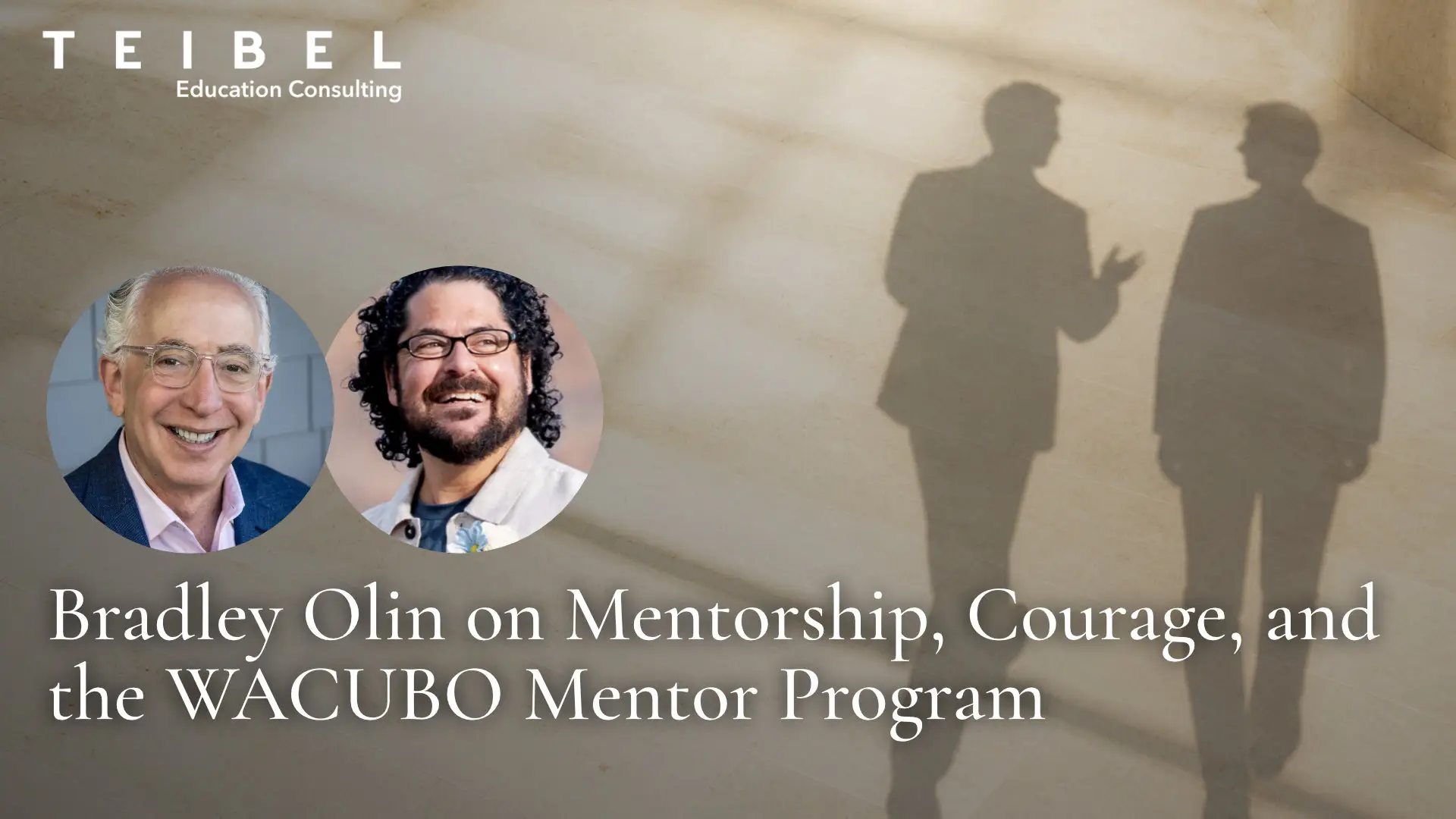
Howard Teibel: Thank you, Pete. How are you, Bradley?
Bradley Olin: Doing great. It’s a great day.
Howard Teibel: Yeah, why is it a great day, Bradley?
Bradley Olin: I got married today.
Howard Teibel: Tell me how this happened. You woke up at what time?
Bradley Olin: Woke up at 4 a.m., got picked up by a black Suburban at 5:10, and hauled out into Red Rock Canyon for a private elopement ceremony with my beloved. We had a witness, a photographer, an officiant, and a little Bluetooth speaker, and that was it. And a gorgeous sunrise.
Howard Teibel: And what people don’t know is that I was downstairs getting coffee this morning, and I’d seen you from the mentorship program, which we’re going to talk about. And I just wanted to say hi, ’cause you were walking away and you and your now-wife were holding this bouquet, and I’m like, what is this?
Bradley Olin: That’s right. It was kind of wild, and a little bit surreal to be walking around in our wedding attire in the casino, just riding that high.
Howard Teibel: So you are coming off of a year of being a mentor in the WACUBO Mentorship Program. Tell us about this.
Bradley Olin: The WACUBO Mentorship Program is really geared toward aspiring leaders, whether it’s future CFOs, AVPs, directors — people who want to advance but maybe don’t have somebody helping them navigate all of the process that it takes to get there. Whether it’s even just the self-awareness and courage, or knowing how to put yourself out there and take risks, or feeling like at some point you step out beyond your mastery level in terms of portfolio and you have to supervise areas that you know less about. And that takes some courage and some conviction, I would say. So I think the program is helpful in guiding people to resources, and to others who’ve navigated that journey.
Howard Teibel: Very cool. How’d you become a mentor?
Bradley Olin: That’s a funny story. I got approached by my alma mater, USC, after finishing my master’s degree. They were looking for people who had their master’s degrees to come back and mentor current master’s students. I was early in my career, so a lot of what I was mentoring students on at the time was, hey, get that internship, don’t worry about your grades. Your next employer — if they care about your grades, you probably don’t want to work for them. So go for the internships, go for the work experience, go for the networking, get decent grades. I’m not saying C’s get degrees, but kind of. Get the practical experience, ’cause that’s what’s gonna propel you into your career. And it just sort of blossomed from there.
Howard Teibel: And did you get approached from WACUBO to ask if you’d be a mentor?
Bradley Olin: I saw an email go out that they were looking for mentors, and I was like, this is right up my alley. Of course I’m in.
Howard Teibel: That’s beautiful. Now, you said alma mater or prior job — tell us about where you were last, because I think you’re in between right now.
Bradley Olin: I’m in between right now, but at my last institution I was at Cal State Channel Islands, and my mentee was at Montana State, in the system-wide office doing budget.
Howard Teibel: This is a fascinating story.
Bradley Olin: It’s really fascinating. She wasn’t quite sure what she was going to do, wasn’t necessarily ready to make a move, and it just so happened that she decided to take a leap and applied for a job where I was friends with the current CFO. Small worlds collide in such interesting ways. And not to say she didn’t get that job all on her own — she’s an amazing human being. But just having that interpersonal connection adds a layer of depth and complexity to that mentoring relationship now.
Howard Teibel: My experience with mentoring — and I’m curious if you find the same thing — is that in many ways it’s about helping them build confidence. In many ways they already know what they need to do, but they might not have the confidence to go there.
Bradley Olin: I would agree with that, and I think it goes back to one of the principles I really practice whenever I’m mentoring. I don’t even remember where I picked up this strategy, but it was about this idea of personal strategic planning — going back to those core values, and really spending time in reflection and introspection on what’s most important to me, what’s most important to me now and in the future, and then how do I align important decisions about my life in a way that upholds those values. I think we forget to check in with our own strategic plans. We’re so busy at institutions doing this dynamic leadership, moving whole institutions forward, and yet we don’t have our own compass really dialed in.
Howard Teibel: Totally. And sometimes you can’t see it — you need somebody else to just reflect it back to you. In many ways, what we share with folks is common sense, but we forget it under pressure. We don’t take the time to think about some of these things. And I just love the way it sounded like you engaged with her — that it made it possible for her to uncover how she wants to grow.
Bradley Olin: It was really a beautiful thing to watch unfold, because it started off on a much more exploratory level — not really sure what I want to get out of this program, I know I want to do something different, but I don’t know what that is. And just through a sort of narrative inquiry of regular meetings and asking questions — like you said, holding up the mirror and just letting her reflect — she already had the answers. It was just a matter of helping frame the questions in such a way that she could access it.
Howard Teibel: There’s an article in the Chronicle that is specifically about this emergence of interim CFOs. It’s an amazing piece from Lee Gardner, and it speaks to the fact that there’s so much more accelerated financial urgency and what people claim are crises. In some cases they are genuine crises. But somebody comes in interim, which gives them some freedom to make tough decisions, and it points to the importance of the role of the CFO. When you look at somebody looking to grow in their career in that kind of capacity, what do you think some of the skills are that CFOs or business officers really need to start embracing?
Bradley Olin: So one of the books that one of my mentors gave me early on in my journey into management was called What Got You Here Won’t Get You There. It was all about people who come up through the ranks as excellent technicians, salespeople, or whatever, but don’t thrive as managers. And oftentimes it’s because they haven’t translated into the management mindset — they’re still working as individual contributors or technicians or high performers, and the whole game has changed around them. I really appreciated the reframing, because it allowed me to start thinking about how to delegate, how to communicate, how to clarify expectations, roles, responsibilities, how to have difficult conversations. There’s so much complexity in these assignments, and some of it you just learn by doing.
I remember an early experience I had. I was trying to encourage one of my best performers to consider management, and she wanted nothing to do with it. And I was like, but you’re so brilliant, you have so much potential. I wanted it for her, but I couldn’t want it more than she did. That was so important for me to understand, because there are people who just want to be an accountant, as amazing as they could be. Learning where those boundaries sit, and then figuring out who you can cultivate, who does want to grow — versus who you’re pushing into it who would maybe flounder, or regret, or even resent you for pushing them.
Howard Teibel: I use that all the time with people — what got you where you are today is not gonna get you where you need to go. It’s very provocative, because what it reminds you of is that even the things that have maybe held me back got me to this point. Being very project-management oriented made me a really great project manager. But if you’re trying to be in a world where there’s a great deal of uncertainty, then those skills are not necessarily what you’re looking for.
Bradley Olin: You can’t project-manage your way through uncertainty. And you can’t promise certainty when it doesn’t exist. The best you can hope for is transparency. And even that — there’s a learning curve to being transparent, because there are parameters around what you can and should say even then.
Howard Teibel: So I’m gonna ask you a more personal question. Have you always been comfortable public speaking?
Bradley Olin: No.
Howard Teibel: ‘Cause you come across as so — you’ve got a good story there.
Bradley Olin: I started a Toastmasters club at my last institution because I wanted to give the gift of public speaking and leadership to others who could benefit from it, because it really transformed my career. When I started off in the profession, I was working as a city planner, bringing presentations of a variety of projects to city council and planning commission, and I would read from a script. I was shaking in my boots, reading a script, looking at my monitor. My colleagues said, you need to come to Toastmasters. And at first it was like, oh, you need to do this for work — but I was hooked. I came and I was like, I see what they’re doing here, I believe in it, and I’m on this journey.
Howard Teibel: If you think about the nature of the work people are doing here — they speak publicly as a necessity. It’s not their objective, for the most part, to become public speakers. However, there’s no getting around the fact that whether you’re speaking to a small group or a room full of people, there’s an element of having to stand up and communicate something with comfort. So what for you became a game changer?
Bradley Olin: One of my mentors taught me this idea: in the world of finance we use rounding as a technique to make numbers clean and easy to understand, and we can apply the same to our presentation techniques. So rather than having everything scripted out and dialed in exactly as you want to say it, think about rounding up your ideas. Use an outline, or a way to frame even your PowerPoint presentation, as reference points for things you want to touch on. They can guide the conversation, which leaves you much more flexibility with your audience — to respond in real time to questions, energy levels, etcetera — versus if you’re scripted, you’re locked in, and it’s much harder to deviate. So giving yourself that flexibility by rounding your ideas has carried so much weight for me.
Howard Teibel: So when I got married, I drove to Connecticut from Boston to ask my then-girlfriend’s father’s permission. Does that still happen today? I don’t think in the same way.
Bradley Olin: I didn’t think so. This is neither of our first rodeos, so there was no permission required.
Howard Teibel: There you go.
Bradley Olin: Unfortunately, my would-be father-in-law passed several years ago due to pancreatic cancer. I never got the chance to know him, but I remind her in some ways of him, which is sweet in its own right. But we’ve been calling today “a new hope,” in honor of Star Wars Day.
Howard Teibel: You’re a big Star Wars fan, aren’t you?
Bradley Olin: The closest thing to cosplay was a little Old Republic Jedi Order pin. We weren’t gonna do full costume, but we wanted to have a little bit of fun and a nod to the day.
Howard Teibel: Your wife is gonna hear this. What would you like to say to her on your wedding day, sitting here on an unexpected podcast?
Bradley Olin: I would just say I love you, and I’m doing exactly what I’m here to do. And I’m so glad I got to meet you. And I’m really thrilled now that we have this connection that you and I have made, Howard, because the serendipity of being in the mentoring space, closing out that meeting, connecting in the hallway on our way back from our nuptials, and even just sitting here in these chairs talking freely about mentoring and growth — it all feels serendipitous and rewarding in its own right.
Howard Teibel: And I just want to be clear — when Bradley said I love you, he was talking to her.
Bradley Olin: Absolutely. But I think the world of you as well, Howard.
Howard Teibel: Thank you so much for doing this.
Bradley Olin: Oh, it’s been my pleasure.