*This transcript is produced using transcription software and reviewed for quality. Despite our best efforts, some passages may be incomplete or contain errors due to audio quality or software limitations.*
Krissy Lenz:
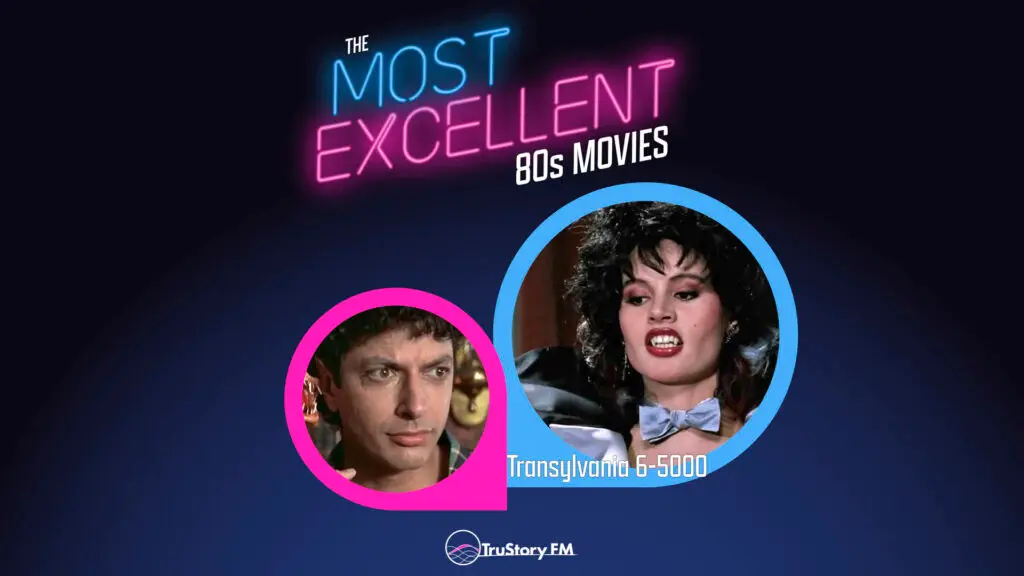
Hello, and welcome to The Most Excellent 80s Movies, the podcast where a filmmaker, a comedian, and their spooky guests make our way through the 80s movies we think we love — or might have missed — to find out how they hold up. Today we’re talking about Transylvania 6-5000, a movie selection from 1985, about which Letterboxd says: “Wanted: two thrill-seeking reporters, brains optional, looking to dig up the story of the century. For information, call…”
Two reporters travel to a strange castle in Transylvania to investigate the apparent reappearance of Frankenstein, and encounter the sensitive Wolf Man, the vampire Odette, and a whole cast of other weirdos.
I’m Krissy Lenz, director at the Neighborhood Comedy Theatre in downtown Mesa, Arizona.
Nathan Blackwell:
And I’m Nathan Blackwell. I’m a prisoner against my will, blinking several times, asking for help. And I’m an independent filmmaker.
Krissy Lenz:
It’s true. And joining us today is one of our favorite guests. He’s a podcaster, a pod bust, an author, and a many-hyphenate of awesome things. It’s Pete Wright! Yay.
Pete Wright:
Hi, team! Hi. How are we going abroad today?
Krissy Lenz:
Well, let me start by apologizing.
Nathan Blackwell:
No, no — let me start by accusing. So who picked this one?
Krissy Lenz:
I did, because — like I say in the intro — we need to visit the movies we think we love. That’s true. I saw this movie as a kid and I loved it, and I watched it frequently, and I hadn’t come back to it in a long time. I just assumed it would be silly, good fun. But it’s not.
This is gonna be a unique episode. Do you guys remember the last time we hit on a movie from the eighties that so appropriately nails the intro?
Nathan Blackwell:
Right? This movie represents the bottom of the barrel of those movies. And I want to say, in Krissy’s defense — I’m in exactly the same place you are, Krissy, on this one. I saw it as a kid and I was dying. And that tells me I was not a very bright child.
Krissy Lenz:
You were a stupid, selfish child.
Nathan Blackwell:
I was a child. A stupid, stupid child. But I had a hell of a time with this. And now that I’ve done some reading up on the movie — and, well, I’ll say it, watched it —
Wow. What a weird, problematic film this ended up being. This was my first time seeing it.
Krissy Lenz:
Oh, I’m so sorry.
Nathan Blackwell:
You don’t even have the benefit of the — no, like the dumbfounded, double-take surprise, almost apologetic. I kind of feel like — what, in the past, has been like that for us, Krissy?
Krissy Lenz:
Well — like Spies Like Us.
Nathan Blackwell:
That was a disappointment. That was like, “oh, nuts.” But okay, what were you saying that I hated?
Krissy Lenz:
You hated Grease, too.
Nathan Blackwell:
Well, yes, yes. That was the first time I’d seen it. It was just like the worst parts of 1941, where it’s confusing noise and motion for comedy.
Krissy Lenz:
Oh my god, you brought up 1941. Look, Spielberg’s my guy.
Nathan Blackwell:
Yeah. But — yeah.
Krissy Lenz:
Well, I have to say, too — I took the least amount of notes I’ve ever taken for a movie, for this movie. Usually I take five or six pages, and this is like a page and a half, and it’s just what happened in the movie, interspersed with me writing, “this is not funny.”
Nathan Blackwell:
Yeah, most of my notes are repeats of what I said previously, or I don’t even finish the note. Like, “the leading lady is—” and the rest of the sentence is unfinished. My very first note, which I must have written about five minutes into the movie, is that the premise of this film is that Jeff Goldblum is trapped in this movie.
Krissy Lenz:
Yes. Well, but the cast is huge.
Nathan Blackwell:
Yeah — okay, we’ve got Jeff Goldblum. We have Ed Begley Jr., Geena Davis, Carol Kane.
Krissy Lenz:
The wonderful Carol Kane, who’s the bright spot of this movie. I’d say she and Geena Davis are the bright spots.
Nathan Blackwell:
Right. The brightness is also part of the problem with this movie. The whole thing is shot during the day, with just lights blasting down on them, like a student film — no shadow anywhere. This movie should have taken place at night. It’s about Transylvania and monsters jumping out of the bushes, but it’s all shot during the day.
Krissy Lenz:
Yeah, yeah, yeah.
Nathan Blackwell:
There’s a real problem with its target. When you think about great horror-movie spoofs — obviously the one I go to, from my era, is Young Frankenstein. Mel Brooks was one of the greats of the spoof genre. And this is a movie trying to do that, made by people from Brooks’s camp trying to do what he was able to do — but there’s no target here. It just sort of parodies monsters generally, and it never lands any of the jokes. It’s edited so sloppily that none of the timing works. It’s just vamping everywhere — like they think they’re improvising these great gags, but we don’t care, it’s not funny, they’re just filling time. If you told me this movie was shot in four days, I would have believed you. I’m actually a little stunned at how it got made, and — that explains some of its sins. It doesn’t absolve anything. That’s where we land.
Krissy Lenz:
Well, yeah. Because he wrote it for Tom Hanks and the Bosom Buddies guys — the writer wanted to write it for TV, for those two. He got Jeff Goldblum and Ed Begley Jr. instead, so he didn’t do too bad. I’m sure the makers of this movie were like, “we’ve got a killer cast.”
Nathan Blackwell:
Isn’t it funny that we also got both Michael Richards and Jeffrey Jones in this movie, who both ended up having a very public, complete breakdown?
Krissy Lenz:
Uh-huh.
Nathan Blackwell:
The result of this movie… yeah, it sells it.
Krissy Lenz:
Our third movie with Jeffrey Jones in a short period of time.
Nathan Blackwell:
Uh-huh. And our double, back-to-back Jeff Goldblum.
Krissy Lenz:
Yeah — spooky season is Jeff Goldblum and Geena Davis. Okay.
Nathan Blackwell:
Here’s the silver lining of this movie: Jeff Goldblum and Geena Davis met on this movie.
Krissy Lenz:
That’s right.
Nathan Blackwell:
That’s the stupidest meet-cute, but it’s adorable. I’m glad they exist as a result of this movie. You’re welcome, Jeff and Geena. Pete, do you want to tell us more about how this movie got made?
Pete Wright:
Okay — this movie was the weirdest petrochemical accident of accounting. That’s what this movie was about. It exists because of Yugoslav law. This is my understanding, so please check me when I start to sound like I’m lying, because it gets very complicated.
Yugoslav law prevented Dow Chemical from repatriating money it had accumulated in the country, in dinars. So Dow used that frozen, unrepatriated money to invest in a film production inside the country — a way to recuperate profit, and essentially launder petrochemical profit by way of a domestic film production. It’s like — what was the Ben Affleck movie about getting hostages out of a country that didn’t exist? It’s that kind of movie.
The best part is the movie was announced in 1980 under Krofft International — and Krofft International, you’ll remember, of course, as fans of the ’80s, as the H.R. Pufnstuf parent company. Delightful. So they spent a lot of time trying to sell the idea to New World Pictures, and once they got Mace Neufeld and Thomas H. Brodek on board, they ended up making this movie — shot in Zagreb, Samobor, and Mokrice Castle — and not once did I feel like they were on an exotic location.
Krissy Lenz:
Yeah.
Pete Wright:
It doesn’t look good. Not once.
Krissy Lenz:
Well, there was the wine festival.
Pete Wright:
Okay, it’s a wine festival.
Krissy Lenz:
Where they dance and dance and dance forever, and you’re just like, “okay, is the end of this movie gonna be a wine festival with people dancing?”
Pete Wright:
Yeah, yeah. The interior of their hotel rooms felt like a large, huge, theatrical indoor space, and they only ever move horizontally around it, not into it — probably because it was a really large space with only two or three walls built, and they just threw a blanket of light over it. So when they were inside, there was light everywhere and no shadow anywhere. It was the most amateur setup — they’d just film the whole scene in one take, with the camera zooming in a bit and out a bit, like, “we’ve got twenty pages to shoot today, let’s just throw up all the lights and run around.” It felt like a Roger Corman production —
Krissy Lenz:
Take that back, sir.
Pete Wright:
Well, it felt like less than a Roger Corman production, because they actually did shoot — what was the one — Rocky Horror, Little Shop —
Krissy Lenz:
Little Shop of Horrors.
Pete Wright:
Yeah — they actually filmed the original of that in four or five days, on a borrowed set, and that had more production value than this did.
This is one of those things where you put a guy like Rudy De Luca — who was again in Mel Brooks’s orbit, and was co-writer on Silent Movie and High Anxiety — on a project, and you can see how the money people would say, “oh, he’s from Brooks’s camp, so we’ll put him on this movie, and he’ll be awesome, because anybody hanging around Mel Brooks would osmose some of Brooks’s skill and natural talent.” Surely that’s what would happen.
Geena Davis absolutely destroyed him in her memoir. The cast was apparently told he was an absolute genius, and then he seemed totally unfamiliar with his own script. He urgently once demanded, quote, “wind on some curtains,” before everyone realized he was looking at the wrong window — and apparently he had a habit of falling asleep as soon as the camera rolled.
Krissy Lenz:
Oh, great.
Pete Wright:
Her audition story is delightful, too — you’re gonna love this, given we’re talking about movies that hold up. For her audition, she says he insisted she act out the scene where Odette presses Begley’s face into her chest, with him sitting on her lap. He’s the writer-director, and he wanted to sit on her lap.
Krissy Lenz:
No — right. There’s just not a lot to appreciate about what’s going on in the world.
Now he’s gone to bed — he’s still here? Okay, you’re back. What happened? [inaudible]
Nathan Blackwell:
[inaudible] The movie is — I think it is.
Krissy Lenz:
Anyway, there’s not a lot to appreciate about what’s going on in this movie. And the more you read into it, the worse it gets. I’m certain some people listening to this episode are in the same boat I used to be in, thinking, “no, Transylvania 6-5000 — that was so cute, that was so funny.” It’s all goofy fun, and there’s an explanation for every monster — the mummy’s a hot chick once you cut her bandages off.
Nathan Blackwell:
And she never expected… bazungas. Oh my gosh, you guys. I know — but let’s speak to those people right now. We have sympathy for you. Two of us used to be you.
Pete Wright:
Not me.
Krissy Lenz:
I want to absolve myself of any responsibility in believing it. It’s just — I made a joke once where someone didn’t like something I’d made, and my response was, “well, I was just really going for the appearance of entertainment.” I didn’t realize I was speaking prophetically about this movie. If you mute it, it looks like there’s funniness happening — people are opening doors and doing a zany thing, and closing the door, and grabbing each other, and running around the room, and then a wolf man jumps out and says something, and it appears like something fun is happening. But it all feels like filler, and none of the jokes land. Gene Siskel said this movie has a one-percent hit ratio, and I kind of feel like that’s generous.
Nathan Blackwell:
Yeah.
Krissy Lenz:
It’s not the jokes that work — it’s the performers, who occasionally are just charming, and if anything you feel sympathy for them, enduring it, the way Jeff Goldblum is trapped in this movie. I’d like to drill down on one performance I found more like a curiosity in a cabinet of curiosities — Michael Richards as Fejos. Apparently Begley recommended — sorry, Goldblum recommended Begley, and Begley recommended Michael Richards. So it was a real trickle-down casting event. I’m curious your take on Richards’s physical comedy.
Nathan Blackwell:
I thought it was ridiculous — it wasn’t funny, and I love him in UHF.
Krissy Lenz:
He’s using a lot of the same chops you see in UHF here, too — there’s almost a continuity in the style. Kind of like watching Paul Reubens, or early Jim Carrey, where they’re using that muscle they eventually broke out with.
Nathan Blackwell:
Yeah. And that’s the Michael Richards we end up with on Seinfeld — so much of Seinfeld is a refinement of this kind of physical comedy: sliding into rooms, shaking the head. In this case, it’s all over the top. It’s like “can’t walk upstairs” as a bit. And it’s one of those things where you can tell the character is trying to do a bit for the guests, but it’s at no point a bit for us. It’s an inside physical joke that I think is an absolute misfire every time.
Krissy Lenz:
It absolutely is. I think of the moment with the puppet at the door — no idea where that was going. It’s this hideous little puppet, and he’s always like, “this is good, right?” And we’re like, no. It was not good. Please stop.
Nathan Blackwell:
And you can almost tell it’s not good because no one on screen is reacting like it’s funny. Even Begley and Goldblum don’t really seem to think the bits land for them.
Krissy Lenz:
Right. And if they’re supposed to think it’s lame, they communicate that. The problem is, it truly is.
Nathan Blackwell:
It truly is lame. But I thought Carol Kane was good and cute and lovable and funny. Her jokes just don’t go anywhere — she’s obsessed with her husband, Radu, so she’ll appear on the other side of the window while he’s cleaning it and go, “no, Radu — do here, do here.” Reportedly, the reason she’s a highlight is that the script just told those two, “chop vegetables, serve food,” and they came up with all the rest themselves. So she saves her own scenes every time — she’s delightful.
Krissy Lenz:
Well, maybe they should have just let people improvise more.
Nathan Blackwell:
No, no, no — I feel like that was most of the movie. I think the problem was that no one wanted anything, and there was never any conflict.
Krissy Lenz:
Well, Goldblum wanted to get with the other American lady. That’s what he wanted.
Nathan Blackwell:
As sleazy as he was about that, that was the only time I found myself thinking about him as a character.
Krissy Lenz:
Although — I thought it was really funny that when the daughter goes missing while they’re having a picnic in the weird woods, Jeff Goldblum says, “you go to the police, mother of the child — me and two strange men you’ve only known for a day will search for your daughter.” And she’s like, “well, okay.”
Nathan Blackwell:
Okay.
Krissy Lenz:
Leave the scene where your daughter went missing! We’ll cover more ground than you? You cannot cover more ground than a mother looking for her own child, Jeff Goldblum, no matter how long your legs are.
Nathan Blackwell:
I don’t think we ever even find out what happens while the daughter is gone. There’s that nice bit where she and Frankenstein are playing cards, and she mugs the camera nicely explaining why she’s so good at cards — so there are bits, mostly with the child, because cute. But I don’t think anybody really knew what they were doing. The problem is the premise of this movie is so much better than the execution. I kind of dig the “monsters as misunderstood patients” take, but the whole twist is so convoluted, and the film spends like ninety percent of its runtime treating them as gags before we get any story — any message. And the Dr. Jekyll, Mr. Hyde mad-scientist character only turns into the mad scientist when he crosses the threshold of his laboratory door.
Krissy Lenz:
What was that about?
Nathan Blackwell:
We should not be asking that question, Krissy. That should never be the question raised by this character, and yet here we are.
Krissy Lenz:
Yeah, I was like — it’s not until about the tenth time it happens that it even hints at what’s going on. He just messes up his hair as he crosses the threshold and talks a little more urgently. And there’s that scene where Geena Davis says, “you have to get him out of the lab,” and they take him out, and he walks back in, and they take him out again, and he walks back in — like, do we not see what’s happening here?
Nathan Blackwell:
And then he explains everything at the end, while they’re about to burn Frankenstein alive — which should never be anyone’s go-to move. That’s your guy!
Okay — can we talk a little bit about Begley and Goldblum as a comedic duo? Because I keep thinking of it as a Laurel and Hardy dynamic, which may be wrong, since the movie doesn’t give me a whole lot to work with — who’s the cut-up, who’s the straight man?
Krissy Lenz:
I think Goldblum is the straight man. There’s one sequence, I think, playing affectionately, where Begley gets to be the suitable cut-up — when he breaks into the sanatorium.
Nathan Blackwell:
That was my favorite part. If I had to pick a favorite part, that would be it, because it’s the only part that sort of worked.
Krissy Lenz:
It sort of works. And that’s where you can start to see the pattern of what they might have been going for in the script. I can’t think of another moment where those two work well together — is there any other hint?
Nathan Blackwell:
There’s that scene in the newspaper office where Ed Begley Jr. says, “I love crap, I’ll do crap,” and Jeff Goldblum’s like, “I’m a serious journalist.” I still thought the movie was going to be good at that point.
Krissy Lenz:
Jeff Goldblum always seemed like he was operating at a level above the movie — like he was staying in character as a real person as much as possible, and couldn’t shave down the quality of his performance. Whereas Ed Begley Jr. completely dropped down into the quality of the movie and synthesized it — he was on that same dumb level. So who’s the true practitioner in that case — the guy who truly understands the movie he’s in, or the guy who knows that as soon as the shoot wraps he’s going back to grad school to become a chaotician so he can study dinosaur theme parks?
Nathan Blackwell:
I can tell you which one I actually enjoyed watching — it was Jeff.
Krissy Lenz:
Me too. Because at least when he was upset, he seemed upset, and when he was frustrated, he seemed frustrated. There wasn’t enough conflict — not enough of what the character wants. I’m not trying to be a drama teacher about it, but comedy depends on friction: someone wanting something and not getting it, and it being funny. Or us expecting a social norm with a repercussion — like if someone’s stuck in a chicken outfit and has to walk through a wedding, we’re thinking about the social implications, and the more we care about the people or how bad the situation is, the funnier it is. It’s not just the concept that’s funny — there has to be friction.
Nathan Blackwell:
Ostensibly, you put a guy like Jeff Goldblum’s character in — you can feel from that opening newspaper-office scene that he’s going to be the fish out of water in a bizarre environment. I think he plays the character maybe too seriously up front, or too cynical and jaded, so the comedy never really lands on him. There’s no sense that his allegiance to the unraveling story has been tested — it’s just a light goes off, and suddenly, “oh my god, there’s a real wolf man.”
Pete Wright:
Yeah, it takes a wolf man grabbing him from behind for him to buy into the whole supernatural plotline — and this is toward the end of the movie.
Krissy Lenz:
Yeah, it’s right at the end — and the wolf man turns out to just be a hairy guy.
Nathan Blackwell:
A hairy guy with hairspray.
Krissy Lenz:
What did you guys think of the psychic character who reads the crystal ball and then thumps her head through the table?
Nathan Blackwell:
Possibly the most Mel Brooks–coded comedy beat in the whole thing — this is the most absurd thing you can imagine happening, where she smashes her head through the table, and then an aide comes out and brings a replacement table and crystal ball, like it’s routine. That’s about as Mel Brooks as this movie gets — it didn’t land for me, but it made me go, “oh, adorable, he likes Mel Brooks.”
Krissy Lenz:
Well, if only we had a little more Mel Brooks. But this movie was a moderate success — it wasn’t a flop, it wasn’t a failure. It made seven million dollars on a three million dollar budget, so people did go see this movie. People looked at the poster, like me, and thought it looked fun.
Nathan Blackwell:
Oh, I definitely saw it in the theater — Cinema 180, Colorado Springs, Colorado. Probably opening weekend.
Krissy Lenz:
I thought it was cute and funny. I remember showing this movie to friends, saying, “you want to see something silly?” I watched it with my husband, Dorian, and our son, Rocket, and they were both just like, “what are we doing? What’s going on?”
Nathan Blackwell:
I watched it with my kiddo, and they were asleep before the first scene ended — so bored by the energy on screen — and they woke up at the end and asked if it was good, and I said, “don’t worry, it isn’t.”
Krissy Lenz:
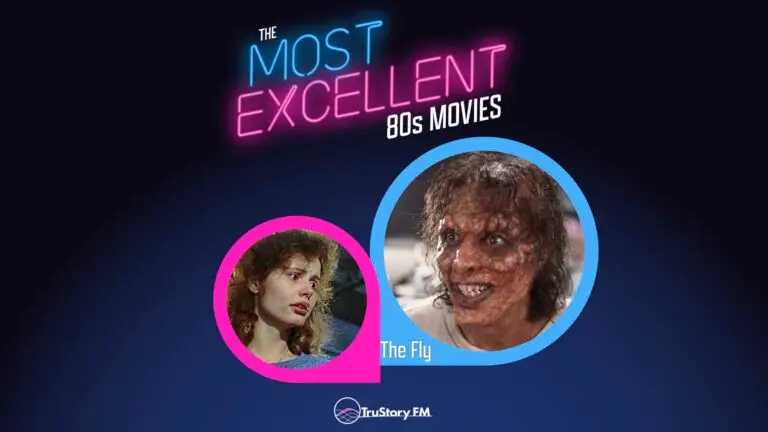
Yeah, well, like I said, I apologize. I really thought this was going to be — this is our first spooky-movie choice for October, and I thought we’d be so dead-on pairing Transylvania 6-5000 with The Fly: go into it with a comedy, Jeff Goldblum and Geena Davis being silly and laughing it up, have a cute, funny time, and then go into The Fly and see the same two of them and go, “look what happened.” I was actually way more nervous about watching The Fly, to be honest, because I’m not a body-horror enthusiast — but it turns out that movie is way better than this one.
Nathan Blackwell:
Oh, it’s a movie that knew what it was going to be, right?
Krissy Lenz:
Yeah. So — there’s not much more to say. Leonard Maltin gave this movie a one-word review: “stinks.” “Transylvania 6-5000 stinks” is all he said.
Nathan Blackwell:
And the thing he did — I don’t remember if it was on Good Morning America, or one of the other morning shows — he actually played “Pennsylvania 6-5000,” and then screamed “Transylvania!” as the song was playing, and then said “stinks.” That’s it.
Krissy Lenz:
Yeah, it is. I’m searching through my notes, searching my mind, to see if there’s anything I can say to find a moment that was good about this movie — I don’t know why I feel so obligated, because I’m the one who made you guys watch it.
Nathan Blackwell:
And I feel just dreadful about that.
Krissy Lenz:
I don’t even — you know, normally we’d do this later, but I’d say, on a scale of one blank to ten blanks — and I don’t even have a thing to put in that blank. On a scale of one Frankenstein to ten Frankensteins, I guess.
Nathan Blackwell:
And well — and the swamp contortionist. Don’t forget that classic Transylvanian trope.
Krissy Lenz:
Oh, yeah — I wrote about the pretzel guy, and I was like, “okay, so he’s just a Cirque du Soleil performer?” Are people scared of people who can contort their bodies? I’m not.
Pete Wright:
I’m sure you’re scared of guys who—
Nathan Blackwell:
—live underwater and grab your junk out of nowhere when you step into the water. That’s what they’re scared of. Nobody should do that to other people — that’s not polite.
Krissy Lenz:
Things have changed — that was their fatal flaw with all these monsters: they weren’t polite. And that’s why they deserve to be burned at the stake.
Nathan Blackwell:
Emily Post, Robert’s Rules — we need decorum.
Krissy Lenz:
We do. It’s the truth. So — there was a moment at the end, too, where they’re revealing the truth behind every monster, and they’re like, “but look at these hunchbacks!” And it’s Radu and Carol Kane. And I thought, “they were supposed to be hunchbacks?”
Nathan Blackwell:
Not hunchbacks. There’s that heartwarming moment where Carol Kane talks to her son, who’s just bending over, and says, “straight,” and he stands up straight — and now are they all supposed to be seven feet tall? I don’t think so. They did not commit to the hunchback bit — nor did anybody really commit to accent work.
Krissy Lenz:
No — accents were tough.
Nathan Blackwell:
Well, I mean, would you try super hard if you were in this movie? Accents are hard.
Krissy Lenz:
Accents are hard. Just sticking to it.
Nathan Blackwell:
They made an Amadeus choice.
Pete Wright:
Oh — they’re all just actual Americans speaking American, and then the Transylvanians also speak American.
Krissy Lenz:
So, on a scale of one Frankenstein to ten Frankensteins — how many Frankensteins do you give it? I’ll give it one. Nathan?
Nathan Blackwell:
[inaudible — appears to be Nathan giving a score of one]
Krissy Lenz:
Are you gonna give it the lowest score we’ve ever given a movie? I don’t think we’ve ever gone under four. Yes? Then — yes. Wow.
Pete Wright:
I’m not giving it a one. I’m giving it a two, just because of Geena Davis, Carol Kane, and Jeff Goldblum. If this movie didn’t have that, it’d be a one. Look — I understand if this was a fun movie when you were a small child, but if you’ve revisited it and you still like it, you should go straight to prison.
Krissy Lenz:
Oh, it’s bad news — I think I’ll stand with two, too, for the same reason, and because of nostalgia, and because — right there, now do — right there, now do — that was funny. That was cute, it was what it was. Actually, I’m gonna go slightly higher and give it a three.
Pete Wright:
That’s fifty percent more than us. Wow — that’s a lot more.
Krissy Lenz:
Just to be a contrarian.
Pete Wright:
Wow. I mean, are you gonna be able to sleep tonight?
Nathan Blackwell:
Not living in prison.
Krissy Lenz:
I feel so bad for picking this movie — now Nathan’s never gonna let me choose again. I’ve been pushing to do Some Kind of Wonderful, and he keeps saying no. Now he’s really never gonna let me choose Some Kind of Wonderful.
Pete Wright:
Oh, I’d vote for Some Kind of Wonderful. I like that movie so much.
Krissy Lenz:
Oh — what if it’s like a real Transylvania 6-5000? What if you decided to just do the soundtrack instead?
Nathan Blackwell:
Yeah — well, to be fair, I’ve never seen Some Kind of Wonderful, so I’m not basing my opinion of it on anything real, just my prejudice against it. It’s purely based on the fact that Krissy really wants to see it — that makes me suspicious.
Krissy Lenz:
Yes, I know — he’s never gonna trust me again. Outstanding.
Nathan Blackwell:
Maybe I’ll trust you one last time. Okay.
Krissy Lenz:
I think Some Kind of Wonderful is good — I think you’re gonna like it, and we’re definitely gonna do it next season, so buckle up.
Nathan Blackwell:
I’m not saying it holds up.
Krissy Lenz:
No, it’s good, it’s good.
Nathan Blackwell:
I’ll go for that. Okay.
Krissy Lenz:
So — what about a deep-cut recommendation?
Nathan Blackwell:
I really struggled — but I came up with a few. More quantity than quality, honestly. The not-so-deep cut is Young Frankenstein, if you want it. But I’ll go a little deeper — something that touches on the same spookiness, and even the theme of bad filmmaking and art — one of my favorite movies, Tim Burton’s Ed Wood.
Krissy Lenz:
I just love that movie. It’s also a great movie about moviemaking and misfits forming their own family — it’s got a lot of that fifties, sixties feel, and Bela Lugosi’s in it, and they’re making their own monster movies. It has some connective tissue, but —
Nathan Blackwell:
— if you just want to take a shower and see something in the same Halloween zone, Ed Wood or Young Frankenstein will satisfy.
Krissy Lenz:
Okay, good choice — as always, coming through on the picks. What do you got, Pete?
Pete Wright:
Well, I went the other direction from comedy and decided — what if we just lean into the horror parts, because if you’re not gonna be funny, at least try to be scary, especially in the season where we’ve got Zach Cregger’s take on Resident Evil in theaters this weekend. Let’s see what it’s like to be a little bit scarier. So I went with 1988’s Waxwork, an Anthony Hickox film, written and directed — it’s a take on a wax-museum proprietor unleashing evil on the world, and all of his exhibits are different monsters, creatures, evildoers, and it stars Zach Galligan, who we know and love from Gremlins.
Krissy Lenz:
And let me just add — David Warner is in it. He was Master Control from Tron. We like David Warner a lot. It’s also got John Rhys-Davies and Miles O’Keeffe in it.
Pete Wright:
It’s one of those fun, off-the-beaten-path picks. And I’ll tell you right now, it has a six-point-one on the IMDb scale.
Krissy Lenz:
And I’ve said often that on the IMDb scale, anything below a six is questionable watchability — anything below, like, a three is unwatchable. I didn’t check what Transylvania 6-5000’s actual score is. It’s a one, Pete.
Pete Wright:
It’s a one on the IMDb scale. Yes — just spiritually. Well, you definitely need to see it. No, it’s a five.
It’s a five on the IMDb scale. And Waxwork is definitely better — objectively better — than Transylvania 6-5000, and it’s got some real scares in it, so it’s fun.
Krissy Lenz:
That’s great, I’ve never heard of that. We’ll do it a couple years from now, for Halloween, for sure.
I went the comedy-horror route, and thought — if you really want to see horror mixed with comedy done right, my two favorites are Happy Death Day —
Pete Wright:
Ugh. Perfect.
Krissy Lenz:
— and Freaky. But I also wanted to recommend — I don’t know, are those close enough — Buffy the Vampire Slayer, as a show that gets the monster tropes right. It has all these monsters represented, except maybe the swamp-pretzel man — though I’m sure in six seasons they dealt with it at some point. I think my true deep-cut recommendation is Buffy the Vampire Slayer. If you want to see monsters and comedy mixed the expert way, watch Buffy the Vampire Slayer. Are we done with deep cuts? I have more.
Pete Wright:
Go for it. Sometimes you’re just struck by lightning — you guys, Dead Heat. Have you seen Dead Heat? Treat Williams and Joe Piscopo are detectives, and one of them is a zombie.
Krissy Lenz:
That was late ’80s, right?
Pete Wright:
Yeah. And if you want the same cast, better movie, you’ve gotta see Earth Girls Are Easy.
Krissy Lenz:
I’m doing one this season.
Pete Wright:
Oh my gosh, okay — all right, so there’s that. And there’s Vamp — Grace Jones as a vampire stripper. How do you go wrong with Grace Jones as a vampire stripper? You don’t, is the answer.
Krissy Lenz:
I don’t see how. I don’t see a way.
Pete Wright:
All right, that’s it — that’s all I got right now.
Krissy Lenz:
Awesome. Well — we did it, guys. We got through it. We got through it.
Pete Wright:
We avoided prison, at least — Transylvania 6-5000, we definitely contributed to podcasting. We did.
Krissy Lenz:
We did. Pete, where can people find and support your other endeavors?
Pete Wright:
Well, as long as we’re talking about horror movies — purportedly horror movies — check out Sitting in the Dark. You can find it at TrueStory.fm. Sitting in the Dark is our panel show where we talk about collections of horror movies across the ages. I just did a collection of non-brain-eating zombie movies — non-Romero zombies, the ones with no soul, forced to work on a sugar plantation. Not great, but it’s also weirdly not scary and terrifying at the same time. So, yeah, check us out — Sitting in the Dark, it’s a good show. We’ve got smart people on that panel who love talking about why the things that scare us, scare us.
Krissy Lenz:
I love it. I want to know — have you seen the new Resident Evil yet?
Pete Wright:
Not yet — I’m doing an entire deep dive on it as my next pick, which comes up in a couple of months, when it’s my turn again. Resident Evil is kind of my jam. So I don’t know much about it yet, but I’m very excited.
Krissy Lenz:
I’ve seen it. I won’t spoil anything — it’s incredibly entertaining.
Pete Wright:
Yeah. Everything I’ve heard is that Zach Cregger understood the assignment, which is not something you can say about the people who made this movie.
Krissy Lenz:
It’s true, it’s true. Nathan, where can people find your wonderful filmmaking?
Nathan Blackwell:
Squishy Studios dot com, for all things Squishy Studios.
Krissy Lenz:
And you can contact him there if you want to defend Transylvania 6-5000 — just wait, those emails are gonna roll in, Nathan. Thanks. And you can find me at the Neighborhood Comedy Theatre in downtown Mesa, Arizona, doing improv comedy every Thursday, Friday, and Saturday night. Or you can find me on Gank That Drank, a supernatural drinking game — another show that gets horror and comedy right, most of the time. It’s the podcast where we make up drinking-game rules for our favorite episodes of our favorite shows — Supernatural — and it’s also a product of TrueStory.fm, so check that out.
And if you’re here at the end of the pod, and you want to support the pod — you also watched Transylvania 6-5000, and you agree with us, and you want people to know that we’re honest podcasters, and we’re not gonna pretend to like something even though it’s bad — so, rate, review, subscribe, tell a friend, tell a neighbor, tell your local swamp-pretzel guy. And if you want even more, we’re gonna do some bonus content tonight — we’re gonna talk about our favorite Halloween costume memories. That’s the bonus content you only get if you become a member at TrueStory.fm — click on our little podcast, click the little “join” button, and you get every episode early and ad-free, with bonus content. And, you know, when you’re out there in the world, please keep The Most Excellent 80s Movies Podcast motto in mind: be excellent to each other, and —
Krissy Lenz, Nathan Blackwell, and Pete Wright:
Party on, dudes!
Nathan Blackwell:
Nailed it. Nailed it.