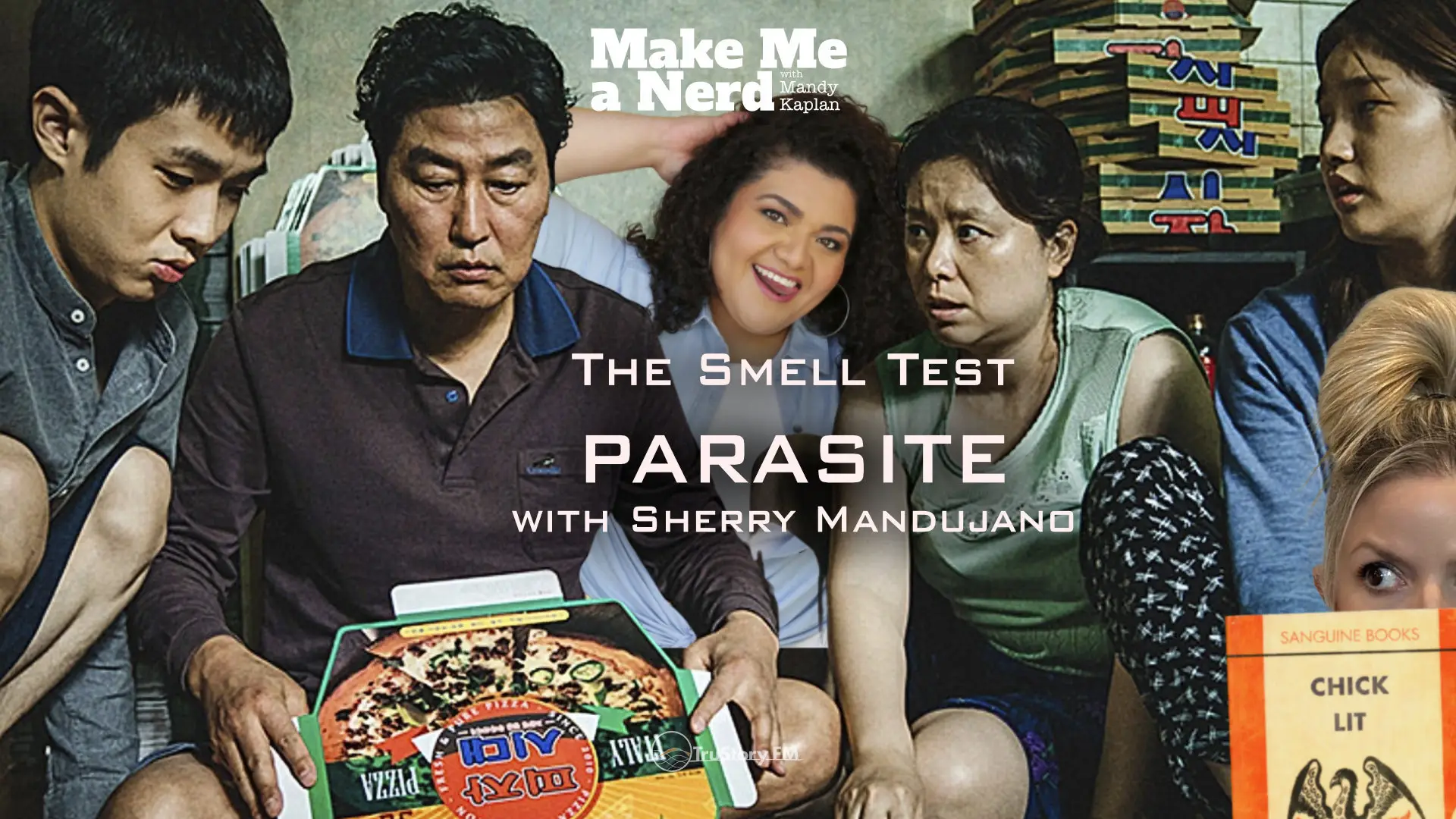
Mandy Kaplan:
Hello everybody, and welcome to Make Me a Nerd. I’m Mandy Kaplan. I’m a mainstream mom whose mission it is to explore the world of nerd culture that I’ve been missing out on, and frankly afraid of, my whole life. If you are new to this podcast, first of all, welcome. Here’s the deal, guys. I’ve for some reason led a very sheltered life that consists of housewives and Taylor Swift. And now, at my ripe old age of 50-something, I’m ready to embrace sci-fi, fantasy, romantasy, video games, foreign films that won Best Picture and I’ve never seen for some reason. I’m ready to explore the world and get nerdicated by fantastic guests like my guest today.
I’m very, very excited. She’s an excellent human being, first and foremost. She’s an actress, a singer, a director, and oft a performer in Miscast LA with me. Give it up for Sherry Mandujano.
Sherry Mandujano:
Hi, Millie. I’m so excited to be here.
Mandy Kaplan:
I’m excited that you had something you wanted to nerd out about. But before we get to Parasite, I want to ask you about your level of nerdery in general. Are you into some of those things I just mentioned or not?
Sherry Mandujano:
Yes, for sure. I’m dealing with—
Mandy Kaplan:
D&D. I’m gonna give you a police interrogation. Are you into D&D?
Sherry Mandujano:
No. No. Yes.
Mandy Kaplan:
Cosplay? Have you ever been to a Renaissance fair? Oh, stop down. You’ve been to a Ren Fair?
Sherry Mandujano:
No. Yes, one. One. I’m not like a Ren Fair person, but I’ve been to one.
Mandy Kaplan:
Okay. Okay, okay. Star Wars.
Sherry Mandujano:
Oh, bov. Okay.
Mandy Kaplan:
Love Star Wars. Star Trek. Starship Troopers.
Sherry Mandujano:
No.
Mandy Kaplan:
Okay. Magic: The Gathering. Okay, I just wanted to get a sense of where your nerdery lies. So if you see a movie you love that just gets you excited, like Star Wars, how many times have you seen Star Wars?
Sherry Mandujano:
Oh my gosh. I had the bed sheets growing up of Star Wars. I used to have the box set of Star Wars when I was a kid. Somebody stole it. I’m pretty sure it was one of my sister’s friends. But I was obsessed with Star Wars. I think I’ve seen Star Wars, I don’t know, maybe like 500 times in my life.
Mandy Kaplan:
Okay. Okay. So this is one of those things that I’m discovering, is like this nerd culture that, if you are nerdy about something, you can’t get enough. You watch it over and over, you read magazines about it, you buy the memorabilia, and you have precious things in the box that you’re not supposed to open. And that’s not my personality. So I love diving in with someone who is like that.
Sherry Mandujano:
And you know what’s really funny is that I did notice that about you, is that you don’t really have a lot of tchotchkes in your house, which I respect, because I’m not a clutter person per se myself.
Mandy Kaplan:
Mm-hmm.
Sherry Mandujano:
But usually when somebody is really nerdy about something, the evidence will be there.
Mandy Kaplan:
I do have some Golden Girls shit.
Sherry Mandujano:
I mean, but that’s just—
Mandy Kaplan:
I have the bobbleheads and a mug and a t-shirt and a blanket and the magazine and the crossword puzzle. The trivia.
Sherry Mandujano:
I mean, but The Golden Girls is essential to learning how to be a friend.
Mandy Kaplan:
Thank you. Thank you for understanding. So I said to you, I said, Sherry, I need you on the podcast because frankly, I adore you. And what do you want to nerd out about? And you said Parasite.
Sherry Mandujano:
Parasite.
Mandy Kaplan:
This movie is so beloved, and it won Best Picture at the Oscars. Foreign film, and just flat out Best Picture.
Sherry Mandujano:
Yes. It actually won the Palme d’Or at Cannes. It won Best Picture at the Oscars. It won Best Director. It won Best Screenplay and Best International Film. All of the Oscars. They swept.
Mandy Kaplan:
Right. And here I am going, oh, I’ve never seen it. Is it good?
Sherry Mandujano:
Yeah, that’s cool.
Mandy Kaplan:
So how many times have you seen Parasite?
Sherry Mandujano:
I saw it three times in the theater. I would have gone more, but, you know, time and life. But I own it. I’ve watched it, I think, at least 20 times on my own. And they just won the Oscar in 2020, so it’s pretty fresh.
But yeah, and I loved that I had to watch it again to get prepared for the podcast, because I’ve actually, believe it or not, I’ve actually never been able to really nerd out about this movie with anyone in a dedicated conversation. And I am so excited.
Mandy Kaplan:
Well, that’s what I love about the podcast. Look, I could talk about Taylor Swift for hours. No one wants me to do that. If I’m at a dinner party, it’s three minutes, four minutes. Have you heard the latest album? What’d you think? Moving on. So this is a chance for us to dive deep and nerd out. And that, I think, is where the secret sauce is of this podcast, because it gives you a real chance.
Sherry Mandujano:
Yeah.
Mandy Kaplan:
So I pressed play, and I was immediately taken by the visuals. This does not look like any other movie.
Sherry Mandujano:
No, it’s really a feast. The choices that director Bong made with this really set you up to experience, because technically, the way that they classified this movie, they classified it as a comedy and a thriller and a horror.
Mandy Kaplan:
Almost all of my notes, Sherry, are: what the hell genre is this movie? Because I think it changes every 10 to 15 minutes.
Sherry Mandujano:
It does. And he said that in several interviews, where they’re like, how did you navigate that when you were writing this? Because it really does have a lot of comedic elements, and then it goes into thriller, and then it goes into a horror towards the end. And he’s like, well, what did he say? He said that that’s not my decision. I let the story go where it needs to go. And I was like—
Mandy Kaplan:
Mm-hmm. She’s making weird hearts on her cheeks.
Sherry Mandujano:
That’s such a—when you think about your favorite directors, when you think about your favorite movies, they pull out so many different emotions from you.
Mandy Kaplan:
Miss Congeniality, yep, I’m with you.
Sherry Mandujano:
It’s not just all the things. They have nuances to them, and those are the movies that really stick with you. And Parasite just knocked me off my feet when I saw it.
Mandy Kaplan:
Yes. Did watching it with an eye for, oh, what’s Mandy gonna ask me about, or I wonder what she’s thinking about this sequence—how did that affect your enjoyment of the movie?
Sherry Mandujano:
Actually, okay, so that was the thing. I was actually really excited because you said you’ve never seen this.
Mandy Kaplan:
Never.
Sherry Mandujano:
And being able to share that with somebody that’s never seen something that’s one of your favorite things. I wish I could have been there sitting with you, being like, did you see that? Did you see this? Oh my god, wait till you see this.
Mandy Kaplan:
We should have done that.
Sherry Mandujano:
I would have loved it, because there are just—like the opening scene. Just the opening scene. It really sets up the family and how they live, like their neighborhood. It’s congested.
Mandy Kaplan:
It felt dystopian. I thought, oh, I get it. There was a parasite that knocked out the rest of the world and they’re trapped in this little basement apartment. And Pete, if you could put up this first picture—they have a toilet loft. It’s open, first of all, so they have to do their business in front of the rest of the family.
Sherry Mandujano:
Yeah, I think that’s a good idea.
Mandy Kaplan:
In this picture that I sent you, they are huddled up on the loft. And I got Being John Malkovich vibes from the design.
Sherry Mandujano:
Yeah, I can see that, yes.
Mandy Kaplan:
Which, by the way, I saw when it came out and I didn’t understand it. If anybody out there wants to come on and make me a nerd about Being John Malkovich, I am down. But it was so visually different.
Sherry Mandujano:
Yeah, it was really amazing. So I did read—because I was obsessed—I did read that when they were setting up the neighborhood to establish where the family lived, to establish their apartment, they actually scavenged all those front doors and all those side awnings for the other apartments and buildings that you see outside their window. They scavenged those from actual neighborhoods in South Korea that are dilapidated neighborhoods that are getting torn down and turned into high-rise condominium buildings.
They pulled those. And everything that you see in the scenes where the family is at home, where the Kim family, where our working class family is, those are real.
Mandy Kaplan:
Well, you want to say hero family, but you can’t really say that about them, can ya?
Sherry Mandujano:
No one is a hero. No one is a hero, in my opinion, in this. There’s no such thing. Everyone is so human and so complicated, and there’s their paradox, and just wrapped in an enigma. It’s such an incredible movie.
Actually, the physical set of the apartment and the doorways of the neighbors, that’s real. But everything on the side of the street that you’re looking at, everything on the right side, is a green screen.
Mandy Kaplan:
Oh, really? Oh, I would never know that.
Sherry Mandujano:
I know, you would never know. And they did such an incredible job. But the way that they set up their apartment, and you see the opening shot of the socks drying from the ceiling, it tells you so much, the way that the family is just cramped.
Mandy Kaplan:
Yep. Yep, it tells you so much. And they fold pizza boxes to make a little cash.
Sherry Mandujano:
Yes, they’re folding those boxes. But that was the thing that I was really interested in, because we’re American, right? So we’re watching a foreign film.
But I think the thing that sometimes—maybe not for everybody, but I think the thing that sometimes gets lost for people when they watch foreign films is that you’re watching a film about people that live at home in their own country. So these are not immigrants. This is not an American immigrant story. These are people—it’s as if you’re watching an American family that’s from America and they’re living destitute, but at the same time, they have all the benefits of being from that country. So I kind of see that they have the capability to work. They have the capability and they have opportunities to get jobs, but they don’t have the follow-through. They couldn’t even fold those pizza boxes right.
Mandy Kaplan:
Right. I know. And it’s so voyeuristic. I mean, we feel like we’re crammed in that apartment with them. We can almost smell the smells and feel the moisture in the air. It’s really vivid. The world building is spectacular in this movie. Before the plot takes off, when it’s just getting to know where we are and how they live, I thought, this is a nerd’s paradise, because in all the nerd stuff I’ve been watching, the world building is so crucial.
You need to be dropped onto a spaceship that’s involved in a space war. And you need to get a sense of all of that. And this movie does it with precision and care. And it makes you lean in, because you understand where you are, but you want to know more, and how you’re gonna get out.
Sherry Mandujano:
Yeah, exactly. How are you gonna get out? Because that’s what we see right away. Their phones were cut off. They’re holding the phone up near the corner of the toilet to try and catch free Wi-Fi from the new coffee shop that opened down the street. The pizza boxes that they’re just trying to hurry up and fold so that they can get money to turn the phones back on.
But at the same time, they’re not really striving for more. So you’re like, how are you gonna get yourself out of this? You’re doing the bare minimum here, guys.
Mandy Kaplan:
Mm-hmm. Well, then they finally—and names are not gonna be my specialty—Ki-woo, the young male leading character, finally leaves and he meets his friend. And in the shots—I sent you another picture if you want to refer to it—as they’re meeting at a restaurant, the whole world is tilted. I’m doing a little “I’m a little teapot” tilt here. And I thought, well, that’s strange. Is that part of this? Are we gonna find out there was an earthquake and the whole world tilted?
But it seems so much more metaphorical than that. This is a tilted world that we are about to enter into. This story is twisted and tilted, and it just made me feel uncomfortable. I didn’t know if I was supposed to, but I felt deeply uncomfortable with the camera. I don’t know how they shot that, but it literally looks like the houses and the street are just off kilter.
Sherry Mandujano:
It really does. And for me, that was really the first shot that set up this foreshadowing. Because here comes Min. Ki-woo and Min are school friends. And based on my own friends that I know that are from Korea, friends that are here in LA whose family is Korean, there is a very, very blatant classism that goes on in South Korea, in the country of South Korea. And it’s just accepted.
Mandy Kaplan:
At least we don’t have that here. Eye roll.
Sherry Mandujano:
Obvious. But over there—the fact that Min drove to their house and is carrying a gift of, what’s it called, the scholar stone. He’s carrying this gift. And from what I’ve heard, those scholar stones, that’s not a thing. That’s not a thing.
Mandy Kaplan:
No, it feels fantastical.
Sherry Mandujano:
No, no, no. I mean, they’re real. The stones are real, but gifting that to someone outside of your own family is not a thing. That would never happen.
Mandy Kaplan:
Oh. And it potentially having some kind of power to bring them luck. I mean, that felt like the premise of the movie, like a movie thing, not a real thing.
Sherry Mandujano:
Right. Yeah, exactly. And it was the catalyst. But here comes Min, and the drunk guy is just about to pee on the family’s stoop, and he’s like, get out of here, and really chases them off.
And the family’s like, oh, Min, what a great guy. But he’s coming here under his own selfish reasons. He is, in my opinion, not the good guy that the family really thinks that he is. He came here to try and use Ki-woo to protect his interest in the—
Mandy Kaplan:
In the girl. Oh. I wanna investigate that right after this.
Welcome back, everybody. While I have your attention, I want to let you know that Make Me a Nerd is a production of TruStory FM. Engineering by the peerless Pete Wright. My theme song is “Wonderstruck” by Jane and the Boy. You can get me on Instagram at Mandy underscore Kaplan underscore Klavens, both with K’s, or on TikTok at Mandy Miscast. And if you’re feeling supportive and you want to join the club, go to makemeanerd.com/join, and that will get you your episodes ad-free and early.
And if you’re listening on Apple Podcasts, please, please leave me a review and I will give you a shout out. Like KotoMan1964: “Mandy is a great hostess. She really gets the conversation revved up because she doesn’t miss a thing.” Thank you, KotoMan. So please, please, these reviews help more people find the podcast. And that’s the whole idea. Enough of my BS. Here we go.
I know that Min might have been selfish in saying, keep an eye on the daughter for me, keep her warm, even though Ki-woo ends up falling for her anyway. Which is also—it’s what people say, the ick, because she is a school age girl, and I know they’re only like nineteen or whatever, but still. I didn’t get that Min had devious intentions. Did you?
Sherry Mandujano:
I mean, for me it didn’t click until, I think, maybe the third or fourth time that I watched this movie, and not even until towards the end. But Min shows up, he hands this supposed gift from his grandfather of a scholar stone that nobody would ever, ever, ever give outside the family. And he uses it as the pretense to come in and offer Ki-woo this supposed really great gig.
However, he is doing it, one, to protect his interest in—what’s her name—Da-hye, the daughter of the Park family. But in the same breath, he’s like, no, I don’t want to get one of these other guys from my college. I don’t want them slobbering over her.
Mandy Kaplan:
So he thinks Ki-woo’s safe, right? Like you’ll tutor her a little bit, but you won’t make a move.
Sherry Mandujano:
Because he’s poor. There’s no way someone from a family that poor would ever have a chance with the rich Park family. And so for me, it really felt like, yes, he enjoys Ki-woo’s company, he has a good time with him, but he does not see him as an equal.
Mandy Kaplan:
Equal. Sure. That makes sense. So Ki-woo gets this job tutoring this very rich teenage girl at the Parks’ house, and immediately I marveled at the switch between struggling people trying to get by and Machiavellian geniuses. I think I just wanted to say Machiavellian, but this family—so he manipulates Mrs. Park and says, oh, I know a tutor for your younger son, an art therapist for your younger son who’s got some sensory issues. And he gets his sister in there, who is like an Oscar-winning actress when she goes for her interview.
And she almost seems like two different actresses playing the loud, brash, desperate girl who’s folding pizza boxes, and then she goes into this home and comes across as intelligent and educated and opinionated.
Sherry Mandujano:
I think the aloofness was really what drew in the mom.
Mandy Kaplan:
Oh. Was there a scene that I didn’t highlight where Ki-woo explained, here’s what you gotta do to get in with this family? Or did she just sense that?
Sherry Mandujano:
No, it went straight into it. Ki-woo had the light bulb go on when he was looking at the little boy’s art, and he already knew. He was like, I know what I’m gonna do. And so he had already started formulating the idea while he’s walking down the steps to leave. He’s like, I’m gonna get my sister in here. And it goes right into him bringing her into the house under the guise that she’s just some girl.
Mandy Kaplan:
Yeah, his cousin’s classmate.
Sherry Mandujano:
His cousin’s schoolmate.
Mandy Kaplan:
Yeah. So it’s really The Talented Mr. Ripley times two. And then times three, this is where their scruples are lost. They frame the rich family’s driver, get him fired so that Dad can now become the chauffeur, and then they nearly poison the housekeeper.
Sherry Mandujano:
They poisoned the housekeeper with the peach fuzz.
Mandy Kaplan:
With peach fuzz, so that Mom can become the maid. And now that the transformation is complete, the Kim family has infiltrated the home completely and totally. And then the Park family says, we’re going away camping, see ya. And the Kim family gets disturbingly drunk and uses and abuses the house, and they’re outside cavorting, which I’m thinking, wouldn’t the neighbors see them?
Sherry Mandujano:
I know. Yeah, that was one of the interesting introductions that I saw in the film that director Bong did. When we see Ki-woo first, on his first meeting with the Park family, he’s looking for the address. He did a wide shot so that we could see how open these streets are and how tall the walls of these houses are. Just such a huge contrast to the confined and suffocating neighborhood that he comes from. And then he’s coming to this neighborhood where the rich family lives and they have all the space in the world.
Mandy Kaplan:
Yes.
Sherry Mandujano:
And I was like, what an incredible way to establish that.
Mandy Kaplan:
And what a bizarre house. It’s so cement and cold and dimly lit. It is like a museum. There’s that wall of—you said tchotchkes, but probably fine art.
Sherry Mandujano:
But you only saw those two little arrows that she’s like, oh, you see, now it’s full of—
Mandy Kaplan:
It’s a playpen, right?
Sherry Mandujano:
Yeah, but there’s no evidence that anybody lives there except for the pictures on the wall.
Mandy Kaplan:
Oh, yeah. I mean, you get the sense that this family is not a happy, loving, warm family. I almost want a prequel to get to know the Park family and how they came to be who they are.
Sherry Mandujano:
Yeah, I know, I would really love that, because there’s a line later on in the movie when the dad is driving Mr. Park, and Mr. Park is complaining about something, and then the dad says, oh, but you love her. And then Mr. Park says, sure, we’ll call it love. I was like, okay.
Mandy Kaplan:
Wouldn’t that—oh, let’s write that.
So I’ve seen The Talented Mr. Ripley. I think I know where this movie’s going. I think they’re gonna try to kill off this family and live in this house and take over their lives, or scam them out of all their money. This is where I think it’s going. And then—ding dong—what’s her name?
Sherry Mandujano:
Right, the old housekeeper.
Mandy Kaplan:
Moon-gwang. What an actress. Let’s talk about Lee Jung-eun. I hope I said that remotely right. She rings the doorbell and says, I left something behind, can I just come in real quick and grab it from the basement? If you have not seen Parasite, stop this podcast right now. Go watch it and come back.
Sherry Mandujano:
Go watch it, go watch it.
Mandy Kaplan:
She has been harboring her fugitive husband in the basement for years.
Sherry Mandujano:
Years.
Mandy Kaplan:
Yeah, it’s unbelievable. And he’s living in squalor down there, but she’s sneaking him food and taking care of him.
Sherry Mandujano:
And I was like, what an incredible surprise twist. Because again, in one of his interviews, one of my favorite things that they had asked director Bong was, why did you choose the name Parasite? And he said, because you think that the word parasite is gonna be referring to the Kim family, but it’s not. It’s referring to all of the families.
Because it’s capitalism, essentially. It’s a reflection of our society, of our economy, in that the poor and working class are constantly struggling, and hustle culture and everything. But that struggle is invisible to the millionaire and billionaire class. But at the same time, neither one can exist without the other. It’s a parasitic, homogeneous existence, and it’s terrible.
Mandy Kaplan:
Right. It’s when the movie just becomes next level.
Sherry Mandujano:
It really does.
Mandy Kaplan:
Because up till then, I don’t want to say I knew what was gonna happen. This is me smoking. But then it just gets so much more twisted.
Sherry Mandujano:
So much more wild, it’s so crazy.
Mandy Kaplan:
Wild. And I will say that when the Kim dad goes down in the basement and sees it, and he says, oh, how have you been living like this, this is disgusting—first of all, it’s hilarious, because his life situation is no better. But second of all, I thought, I know how this movie’s gonna end. I predicted it.
Oh, so there’s just this battle royale in the house between Moon-gwang and her husband and the Kim family.
Sherry Mandujano:
Right.
Mandy Kaplan:
It’s insane. And Moon-gwang is quick, and she films them, and she’s like, so now I have the proof that you were in the house when the Park family is away.
Sherry Mandujano:
Oh my gosh, that was so good. That was the thing that killed me, is that I was like, she got footage of them. Now she’s got one above them. But wait a minute. She’s gonna out herself too. None of you are gonna keep this job. You’ve been hiding your husband in the basement. They can’t trust you either. And all of them really messed up, because they could have easily worked together to really take this Park family for a ride for as long as they could have.
Mandy Kaplan:
Absolutely. I think the Kims are incapable of that kind of foresight and collaboration. Everybody’s out to get them, so they’re just gonna try to screw you before you can screw us.
Sherry Mandujano:
Honestly, when you go through the movie and you’re watching it, you just see the desperation. You see the moral decline that leads to their deception of the Park family, and then it leads to all the violence. The slippery slope happened early on, and then they just went for it. They just went full out.
Mandy Kaplan:
And then there’s that shot when Moon-gwang—oh God, the names—when she comes in and she goes down to the basement, the way she can get to the secret bunker, she has to climb the wall and be parallel to the floor to push the bookcase. And you’re like, what am I watching?
Sherry Mandujano:
It was so hilarious.
Mandy Kaplan:
But it’s also so bizarre and ugly and dark and seems impossible.
Sherry Mandujano:
I know, because you’re like, what is she doing?
Mandy Kaplan:
What is she doing? This woman is climbing the walls. This movie was not what I thought it would be at all, and I’ll tell you why right after this.
When you hear best foreign film, or best film in a foreign language, I should say, because they’ve changed that, and you hear this won Best Picture at the Oscars—I didn’t think it was going to be a popcorn, action-packed, hilarious—it’s just not a hoity-toity, artsy-fartsy film the way I thought it might be.
Sherry Mandujano:
Yeah, the way that they shot it, the cinematic artistry of it really is. But the storylines of the families are so raw and just so off-putting most of the time that you’re like, it’s so ugly.
Mandy Kaplan:
Ugly. Yeah.
Sherry Mandujano:
It really is. And I really feel like that’s what really resonated with audiences. That’s what resonated with me. Because I love beautiful, artsy movies, but when something is so real and when something really resonates with me, it’s because it feels like real life, and I’m like, oh my god, that’s us.
Mandy Kaplan:
Like when the Kim family gets drunk. They’re all laying around eating everything in sight and drinking fine liquor, and it’s gross.
Sherry Mandujano:
Yes, they’re slovenly.
Mandy Kaplan:
And the daughter—Park So-dam, is that the right one? Yeah.
Sherry Mandujano:
Oh yeah, that’s how you’re gonna do it.
Mandy Kaplan:
Ki-jung. She is munching on what we think is beef jerky or fruit roll-ups, and then she looks down and she’s like, oh, these are the dog’s treats. She’s been laying on the couch munching on the dog treats. I laughed so hard. And they just keep raising the stakes in this film. When you think, well, okay, now I get it, this is as crazy as this is gonna get. Mm-mm.
Sherry Mandujano:
Not even close.
Mandy Kaplan:
It gets crazier and crazier.
Sherry Mandujano:
Not even close. I mean, they really got to the point where they were very on par with Icarus. They just got so comfortable and they were like, we’ve got it. What else can we take from the Park family? What else can we do?
Mandy Kaplan:
I don’t know what Icarus is other than I know he flew too close to the sun.
Sherry Mandujano:
He flew too close to the sun, and that’s exactly what they did. They got too comfortable. They got way too comfortable. They let down their guard. Yeah, I saw it coming too. I was like, you guys could have had it all, man. You guys could have had it all.
Mandy Kaplan:
Yeah, but you don’t want them to. I’ve never watched a movie, I don’t think, where I loved everybody and hated everybody as much. There’s no one to jump on and go, okay, at least I’ve got them to root for.
Sherry Mandujano:
No, yeah.
Mandy Kaplan:
I mean, maybe Moon-gwang, because she’s trying to protect her husband and she did take good care of the Park family. But she’s batshit, so I don’t know that she feels comfortable to root for.
Sherry Mandujano:
No, she’s also an enabler. He had all these debts and she’s covering for him. She’s married to an obviously emotionally avoidant man, like so many of us have dated.
Mandy Kaplan:
Coming up on a very special Make Me a Nerd: Sherry, talk about your feelings. Tell me, honey.
Sherry Mandujano:
Yeah. Well, we could go on a tangent on that with the guys I’ve dated. But yeah, man, this movie was—you know, the other thing for me, my favorite, favorite scene in this entire movie—
Mandy Kaplan:
But I’m going to say that.
Sherry Mandujano:
—was after that fight, when the Park family cuts their camping trip short and everybody has to scramble, and they have to trap the old housekeeper and her husband downstairs, and the violence ensues. Then essentially they inadvertently murder her, you know?
Mandy Kaplan:
No, she’s alive after that.
Sherry Mandujano:
No, the mom is getting ready for the Park family’s arrival and she has the pot of ramyeon.
Mandy Kaplan:
Yeah, and she kicks her down the stairs.
Sherry Mandujano:
And she kicks her down the stairs, and she gives her a concussion. She dies down there.
Mandy Kaplan:
Oh, okay. But I think she does make one more horror movie comeback before she dies.
Sherry Mandujano:
Yep, she does. She does try.
Mandy Kaplan:
Okay, cause I wrote, oh shit, she’s alive.
Sherry Mandujano:
Yeah, she tries to free her husband. She’s trying to bite through the tape that the dad used to tie him up to the pipes.
Mandy Kaplan:
If you haven’t seen this movie and you’re listening, this must sound like a terrible game of yes-and, where we’re just making shit up. Like, yeah, and then she’s cooking and she kicks her down the stairs, and then she’s trying to bite through the tape. It is wild.
Sherry Mandujano:
It’s a real wild ride, this movie, and it’s so worth it and it’s so amazing. But so there’s the scene once the Park family arrives. The Kim family has to try and escape, and they’re hiding under the coffee table in the living room while the Park family is watching their little boy camping in the backyard. And then they have their own good time on the couch while the Kim family is underneath the table.
Mandy Kaplan:
The parents are fingering each other.
Sherry Mandujano:
They’re fingering each other.
Mandy Kaplan:
So that is the moment at which I thought, this movie is so tense. It is not a movie you relax and put your feet up and watch.
Sherry Mandujano:
No.
Mandy Kaplan:
I found myself unable to breathe, unable to blink. Is that a feeling you like? Are you like a roller coaster rider?
Sherry Mandujano:
Oh yeah, I love it. I love that. I mean, not in my personal life, as we discussed 20 minutes ago. But for movies, I’m like, if I don’t know what the f is gonna happen next, you have me.
Mandy Kaplan:
Yeah. But you know what’s gonna happen is gonna be dangerous, disastrous, calamitous. This movie’s not gonna have a happy ending.
Sherry Mandujano:
I know.
Mandy Kaplan:
You know these people are not gonna come out well.
Sherry Mandujano:
And the great thing about that is that I tend to really love watching Korean TV shows because they always have a happy ending. But this movie does not.
Mandy Kaplan:
Have you seen a little thing called Squid Game?
Sherry Mandujano:
Yeah, I know, but that one is an exception. But The Potato Lab, one of my favorite Korean TV shows, so cute, full of romance and adorable. But this was—you know it’s not gonna end happy.
Mandy Kaplan:
Not such a happy ending. Yeah.
Sherry Mandujano:
And I loved it. I love everything about this movie.
Mandy Kaplan:
Well, I just have to say I did an episode on Squid Game with the amazing podcaster Jimmy Aquino, and I couldn’t even handle it after a few episodes. The violence was just too much and too senseless. This violence in Parasite doesn’t bother me because it’s motivated, and these people are fighting for their lives. I don’t know why I could handle this violence.
Sherry Mandujano:
There’s a reason. I don’t know if this is gonna be true for you, but it’s true for me, that it’s because this parallels real people’s struggles.
Mandy Kaplan:
Yes. I felt like, for my family, I would stab the guy to protect my family.
Sherry Mandujano:
Yes, it’s in a very over-dramatized way, in an exaggerated way. But absolutely, if it came down to having to survive—if I was in this situation, I could absolutely see this happening.
Mandy Kaplan:
Right.
Sherry Mandujano:
But going on, so once the Kim family sees that the Park mom and dad are passed out on the couch, they’re finally able to escape the house without getting caught. And this was cinematic artistry, like just the epitome of having the most beautiful shot ever. You see them coming down from the rich neighborhood, and we’re following them in this metaphorical way.
Mandy Kaplan:
Torrential downpour.
Sherry Mandujano:
Yes, the torrential downpour. And you see them going through the streets, and you see them going further down and further down and further down. It’s like the archaeological strata layers, where you see them coming from the rich neighborhood and it gets dirtier and dirtier and grimier, and the water is just pouring further and further down.
Mandy Kaplan:
It’s sewage water.
Sherry Mandujano:
Yeah. It’s sewage water. And they finally get to the—
Mandy Kaplan:
And it’s up to their necks in their apartment.
Sherry Mandujano:
They are literally drowning in shit. Literally. And I was like, this is the most incredible metaphor for society that I have seen in a long time. The way that all the neighbors are struggling to bale the sewage water out of their house. These people, the working class neighborhood, is struggling to protect what little belongings they have in order to hold on to their livelihoods and everything. And I’m like, what an incredible way to depict the disparity between the rich family and the poor family.
Mandy Kaplan:
Yeah. It’s a gut punch, all of it. So the family ends up in a shelter, but the mom stays back, because the Park family still thinks Mrs. Kim is their housekeeper and she’s gonna stay on board. And then Mrs. Park decides to throw her little son a surprise get-together in the backyard. And this is where it’s like Barefoot Contessa, Martha Stewart—they throw this little impromptu afternoon party that is off the charts. I wanna write “no big deal.”
Sherry Mandujano:
Right, no big deal. And she’s like, yeah, we have to get all this stuff.
Mandy Kaplan:
We see Mrs. Park’s closet, and I was so jealous. I hate that house with all my heart, but that closet. I don’t have a closet, so I want her closet so badly.
Sherry Mandujano:
But her closet—I want her closet.
Mandy Kaplan:
But they invite the tutor and the art therapist and the driver to the party. Here’s a question. How do they get cleaned up? They’re covered in sewage water, out of a shelter. They don’t even have belongings. How did they spruce up for the party?
Sherry Mandujano:
I mean, honestly, I don’t think they could. At the gymnasium where everyone took shelter, they were handing out all that leftover clothing right there. I’m assuming there were volunteers that were bringing people clean clothes.
Mandy Kaplan:
Okay.
Sherry Mandujano:
But there’s the scene when Mrs. Park and Mr. Kim were driving in the car. He had just driven her to the grocery store to get all the fancy food, the wine and everything.
Mandy Kaplan:
The wine, oh yeah.
Sherry Mandujano:
And she’s on the phone in the back, and you see her put her finger up to her nose because she smells him, and then she opens the window. And he notices that, and he sniffs his shirt. And that was a running theme for them, because the husband had made the comment earlier in the movie about how he smelled.
Mandy Kaplan:
His driver smelling. Yeah.
Sherry Mandujano:
And earlier than that, the little boy had mentioned that the whole family smells the same.
Mandy Kaplan:
With the sensory issues. No, he doesn’t know they’re a family, he just says, my art therapist smells like my sister’s tutor. And they smell like—oh my God, I got chills head to toe. I loved that moment. That he’s gonna pick up on this before this dumb rich family, the dumb rich adults.
Sherry Mandujano:
Yep, yeah.
Mandy Kaplan:
So now they’re at this fancy backyard birthday party for a little kid, and it turns into what I assume the Red Wedding was like from Game of Thrones. Now, I did an episode on Game of Thrones back in the beginning of this podcast with my amazing husband, Jeremy Klavens. Everybody should go listen to that episode. But I certainly didn’t make it all the way to the Red Wedding, which I was all over socially. It was just such a pop culture phenomenon to say Red Wedding, right?
Sherry Mandujano:
It really was. That was such a great episode, but also I had to cover my eyes for a little bit.
Mandy Kaplan:
Okay. So yeah, mayhem ensues at this party. People get stabbed. People die. Dogs eat meat off of dead bodies.
Sherry Mandujano:
Yes. It was all because they inadvertently murdered the old housekeeper, and the husband just lost it. He’d been down there for so long, but without her, he was like, well, that’s it. And he went after Chung-sook, the Kim mom.
Mandy Kaplan:
But the dad, Mr. Kim, ends up killing Mr. Park because Mr. Park comments that the guy smells, right?
Sherry Mandujano:
Yes.
Mandy Kaplan:
It’s triggering.
Sherry Mandujano:
It’s triggering. So Mr. Kim is there trying to put pressure on his own daughter’s wound, and Mr. Park doesn’t care. He wants the keys because his little boy’s having a seizure. And honestly, I think any one of us would be like, are you serious? He doesn’t know that she’s his daughter, but she’s bleeding out.
Mandy Kaplan:
Right, right, yep.
Sherry Mandujano:
And I’m like, yeah, if at any point in time you’re gonna snap, it’s gonna be when your kid’s life is in danger.
Mandy Kaplan:
I think you said something earlier that really resonates. I was trying to get to this point but I didn’t connect the dots. The violence doesn’t bother me because it feels like, well, I would do that too. And so it’s relatable violence, which is so strange, because I’m not a violent person.
Sherry Mandujano:
It is, though. It is.
Mandy Kaplan:
But one major question I have, and then we are wrapping up, which I cannot believe.
Sherry Mandujano:
Wow, and then we’re back.
Mandy Kaplan:
But I know time passes in this movie, a lot of time. And a lot of people being trapped in a basement. But no one grows facial hair.
Sherry Mandujano:
I mean, well, I’m just gonna—they’re Asian.
Mandy Kaplan:
I looked it up. Korean men can grow facial hair.
Sherry Mandujano:
You know what? I am not an expert on Asian men’s facial hair, but I have seen lots of really cute Asian guys with facial hair. Just most of the guys I know are not able to grow it. Most of the Asian guys that I know are not.
Mandy Kaplan:
Okay. Well, I literally Googled—look, when you type in “can Korean men grow facial hair,” it just autofills. Yes, Korean men can grow facial hair, but genetics often result in slower growth, lighter density, and patchier coverage compared to Western or Middle Eastern men.
Sherry Mandujano:
Yeah, that seems accurate.
Mandy Kaplan:
So if you’re trapped in a basement for year after year after year, you would have some facial hair. If we want to call director Bong after this, I’m filing an official complaint.
Sherry Mandujano:
You know what? I think we could probably call the WGA just to inquire.
Mandy Kaplan:
Okay, let’s do that.
Sherry Mandujano:
Yeah.
Mandy Kaplan:
This movie, aside from that, which is just a huge mistake—
Sherry Mandujano:
Huge plot hole. Huge.
Mandy Kaplan:
Huge. No, Sherry, thank you for giving me the gift of Parasite. I cannot believe I hadn’t seen it, and it might be a movie I go back to, because I just think it’s so layered and fascinating and gripping. It’s a great, great film.
Sherry Mandujano:
It’s an incredible film. It’s brilliant. The way that he writes—this is not the only movie that he’s written where he addresses classism, but this is by far my favorite of his.
Mandy Kaplan:
I’ll say it. You’re a goddamn delight, and I want you to come back and nerducate me about other things. Or just come over and watch stuff with me and we don’t have to podcast about it.
Sherry Mandujano:
I’ll just sit there and stare at you, being like, what did you think of that part?
Mandy Kaplan:
All right. Thank you, Sherry Mandujano. I adore you. And thank you, everybody who’s listening. I adore you as well. Until next time.