*This transcript is produced using transcription software and reviewed for quality. Despite our best efforts, some passages may be incomplete or contain errors due to audio quality or software limitations.*
Nathan Blackwell:
Hello and welcome to The Most Excellent 80s Movies. It’s the podcast where a filmmaker, a comedian, and their fabulous guests compose ourselves as we make our way through the 80s movies we think we love or might have missed.
Krissy Lenz:
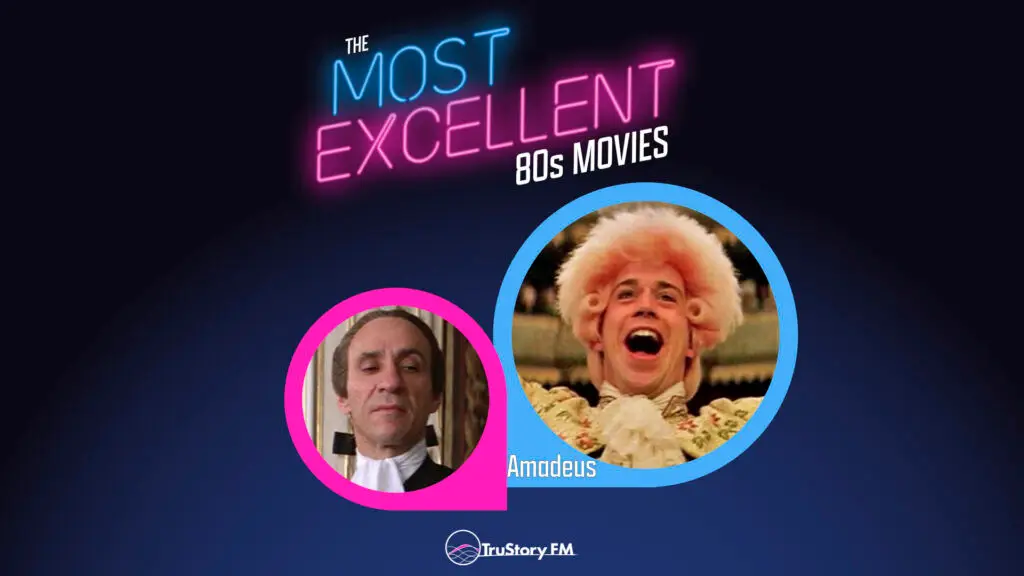
And today we’re talking about Amadeus, a movie selection from 1984, about which Letterboxd says: “The man, the music, the madness, the murder, the motion picture. Disciplined Italian composer Antonio Salieri becomes consumed with jealousy and resentment towards the hedonistic and remarkably talented young Salzburger composer, Wolfgang Amadeus Mozart.” And that’s literally all it says, which is so funny, because sometimes they give you the whole movie in the description, and this time they’re just like, yeah, it’s about Salieri and Mozart, what do you want, watch the movie. I’m Krissy Lenz, one of the directors and a performer at the Neighborhood Comedy Theatre in downtown Mesa, Arizona.
Nathan Blackwell:
And I’m Nathan Blackwell, an independent filmmaker with Squishy Studios.
Krissy Lenz:
And today we’re being joined by a new guest, a photographer and filmmaker. It’s our new friend, Aaron Kes.
Nathan Blackwell:
Yay, yay, we love Aaron.
Krissy Lenz:
And we’re so happy to have you to talk about Amadeus. Oh my goodness. So I think I kind of was avoiding this one a little bit. Like when we schedule the pod, we move things around, and I think I definitely moved this one around a couple of times because I was nervous to watch it. I’ve never seen it, and it just seems like such a serious movie to me. It won so many Academy Awards and stuff like that. So this is my first time watching it.
Nathan Blackwell:
You felt like you were walking into Goodfellas or something like that, right?
Krissy Lenz:
Yeah, it felt like homework a little bit. In the end it didn’t feel like homework, but going in, I was worried that it was gonna be homework. So have you seen this movie before, Nathan? Is it a favorite of yours?
Nathan Blackwell:
I wouldn’t call it a favorite. It’s been a while, but it is so early in, you know, as you’re learning about movies and seeing different types of movies, you’re kind of introduced to, oh, these are the best picture type movies, these are the Oscar movies.
And I feel like this was one of the first ones I was aware of as a Best Picture film. It probably took me — I’m sure I didn’t see it right away as a six-year-old or an eight-year-old — but I think this was one of my earlier Best Picture films.
I probably saw it as a pre-teen. But yeah, this is one of those ones I kind of — there’s another one which I think I’m just gonna default as my deep cut recommendation, that I would put in kind of a similar category. It’s almost a biopic. It’s almost like a music biopic, but not really a music biopic — it’s like a pre-form of what we know as the music biopic. But there’s a couple of other movies that are like this. That are kind of like, this is a life, we are now going to talk in flashback about an important person’s life. Another movie like this from the same era that reminds me of this is Gandhi.
Krissy Lenz:
Which I’ve also never seen, for the same reason.
Nathan Blackwell:
Right. To be honest, I don’t know if I’ve ever finished it. I think I caught it on TV as adults were watching it. But yeah, I would not call it — this is probably the second time I’ve seen it. The last time was like twenty-five years ago or something. But twenty-five years — that means thirty years.
But yeah, I would say I look back on it fondly, and then re-watching it, I was surprised at how fun it is too, like how comedic it is.
Krissy Lenz:
And what about for you, Aaron? Had you seen this? Is it a favorite? Do you love Oscar movies?
Aaron Kes:
I do love Oscar movies. Excuse me. I do love Oscar movies, I definitely like the pretentious arty stuff. But similar to Nathan, I’ve seen it probably a few times as a kid, actually.
I definitely saw it. Yeah, it’s probably been twenty-five or thirty years, so not a favorite of mine, though I quite enjoyed it on a revisit, and I’m glad I’m whatever age I am now to have seen it again, and I think I can appreciate it more. But yeah, right away you start off with the scene with the dessert that they try to bring Salieri, and you can just tell that this isn’t gonna be a straight drama, with that guy licking the cream out of the little container. That was so gross — just putting his tongue right in it. But you couple that with all the parts of it that are very artistic, and the cinematography and the costumes and the lush music and the performances — but yeah, it’s also kind of farcical in a way, and that laugh, my God. So yeah, I quite enjoyed it on a rewatch, and it had been on my list for quite a while to rewatch with my wife. And then you guys offered that as a potential possibility due to the podcast, and I was quick to jump on that because I’ve been wanting to rewatch it for a long time and I’m glad I did it. I quite liked it.
Krissy Lenz:
Yeah, I think it — I was really pleasantly surprised because of that little comedic quality. It wasn’t like a very, very dry biopic. It wasn’t like a history class homework assignment.
Nathan Blackwell:
No. If anything, this movie is subversive. I mean, with how they’re portraying Mozart and how they’re portraying Salieri — they’re taking a hard swing. They’re not doing what one of the problems with modern — and you can see so many film essays on this, on the music biopic — is that they see everyone as above us, and they have these magical moments. All music biopics are basically Walk Hard, you know — let me rethink all of my entire career before I go out on every performance.
That’s the problem that a lot of these fall into. And Amadeus is really just telling a small section of his life.
Krissy Lenz:
Salieri’s life, or — because he’s going to be all about Mozart.
Nathan Blackwell:
Yeah, it’s interesting because it’s really about Mozart, but it’s all seen through the point of view of Salieri.
Aaron Kes:
He’s really Mozart’s — really held at bay in a way. You don’t get to know him very well, in a sense.
Krissy Lenz:
Yeah, definitely. And he is definitely this larger-than-life character, but he’s not the main character. It’s like the Salieri show.
Nathan Blackwell:
Yeah, yeah, because it’s really seen through him, his envy.
Krissy Lenz:
Yes, his consuming jealousy and rage. Which was what made it so fun. Like, I love that he’s like, you know what? I don’t love God anymore, because — all I ever asked God to do was give me the gift of music so that I could honor him, and now this idiot giggle machine has all the talent I wish I had.
And he — why would he take all this beautiful talent and put it in the body of — what does he call him? He calls him so many funny names.
Aaron Kes:
He calls him a creature a lot.
Krissy Lenz:
Why would God choose an obscene child to be his instrument? An obscene child, a creature — and I love it. He slowly throws his crucifix into the fire, and he’s like, well, you know what, God, you’re my enemy now, because I’m gonna destroy this creature that you’ve made. And yeah, I love that it went there, and he just immediately abandoned everything. But there’s not a ton of scheming.
Aaron Kes:
There’s a little bit of subtlety — like when he’s trying to move some pieces around, but not too directly put his hand on that scale, I guess.
Krissy Lenz:
Yeah, it’s almost like he’s not very good at it. Like, he brings up to the Emperor that Mozart is writing The Marriage of Figaro, which is banned, but then he helps him get it through.
Nathan Blackwell:
Because I think he wants him to fail.
Krissy Lenz:
Right, but it’s like — I just felt like he was not very good at all this manipulation.
Nathan Blackwell:
To be fair, it’s his first murder scheme. I think he was definitely always pulling at the strings, but I think he was also conflicted, too, because he is genuinely deeply moved by Mozart’s work. And the thing Salieri says is, I only did it for you, God — I commit — this is all for you, but it’s not all for him, and it’s pretty apparent, the subtext is apparent, he wants to be special. He feels like he was not special, and this makes him special, because when he first asked to do this for the glory of God, he also wants to be spotlighted as something that is special and that other people treat with respect. That’s really why he’s doing this. And so he’s torn, because he genuinely, secretly goes to all of Mozart’s performances — he’s moved by it.
Aaron Kes:
Well, I would say one of my favorite scenes in the film is the one where Constanze, his wife, brings the fanned-out pages, brings the work to Salieri to look at, and he can hear it in his head, and you can see how moved and how in love he is with the music, and how quickly that turns to rage as well.
Nathan Blackwell:
That’s so much more interesting than if he’d stolen the work and destroyed it, because he’s conflicted. He’s pulled in those directions.
Aaron Kes:
And it’s not even — it’s not even, “here’s this upstart who is breaking all the rules and I hate this music because it’s too many notes,” as the other people say — too many notes! No, he genuinely realizes that this is the greatest musician or composer that the earth has ever seen, according to him, and yet it enrages him because of the buffoon that he is also.
Nathan Blackwell:
And really, he’s angry at God for mocking him, you know? Because he acknowledges the work is fantastic. He acknowledges that it is God who has made it fantastic, and that to injure God, he will kill his messenger.
Aaron Kes:
Yes. Do you think, if Mozart wasn’t such a fool to him, that he actually would have liked him — or do you think he still would have been resentful that it wasn’t him chosen to be Mozart by God?
Nathan Blackwell:
I think he would have still been resentful, but not have killed him. I think he just would have sunk into depression.
Krissy Lenz:
Well, but he didn’t really kill him, correct?
Aaron Kes:
And did he even want him to die, in the very end?
Krissy Lenz:
So you think, Nathan, that he is responsible for—
Nathan Blackwell:
I think he is responsible for setting up the chain of events, yes, but again, this — he’s engineering these pressure points on Amadeus and setting him up for the situation. He’s working him to exhaustion on something that is emotionally depleting him, which was his intent.
Aaron Kes:
So nothing he could be convicted on, but he’s definitely responsible.
Nathan Blackwell:
And he says, “I am responsible.”
Krissy Lenz:
Right. It just seemed to me like that was guilt talking. Mozart was drinking too much and working himself to exhaustion and doing all that stuff before Salieri came along and was like, finish this.
Nathan Blackwell:
It’s the equivalent of giving an addict more hits and more opportunities. The addict is still doing the work, but Salieri knows exactly what he’s intending.
Aaron Kes:
Except his actual intention was to strangle him — to actually physically kill him and take the work. So he was pushing him. I don’t think this was the intended result, or the intended way for it to go down.
Nathan Blackwell:
Right, it’s a lot of circumstantial evidence.
Krissy Lenz:
Right, no jury in the world would convict.
Aaron Kes:
Right. And also to note, none of this is really historical.
Nathan Blackwell:
It’s not a biopic. There are rumors of a lot of this, or some of this, but a lot of it I think has been debunked or debated. But really it’s kind of a movie just about stuff in the end, rather than about Mozart.
So I think this was based on a play, right?
Aaron Kes:
Correct.
Nathan Blackwell:
The Broadway star who played Amadeus was Mark Hamill, and he was surprised and upset that he didn’t get the movie role. But it’s because he was too famous as Luke Skywalker. And I honestly cannot imagine — Tom Hulce just crushes this so hard. I cannot imagine anyone else.
Aaron Kes:
Yeah, he’s wonderful in it, and he was really good in Parenthood, and those are literally the only two movies I can remember him from.
Krissy Lenz:
Same!
Aaron Kes:
So after this, I was like, what else has he been in? ‘Cause I remember him from Parenthood and he’s pretty good in that, right? And then I see him in this and I’m like, this guy’s incredible, how is he not more famous? I looked him up — apparently he plays a doctor in Stranger Than Fiction, the Will Ferrell movie with Emma Thompson. I think it’s one scene where the doctor’s just checking him out, where Will Ferrell’s sitting against the clouds. It’s a really cool scene, but I can’t even picture him in that, or what he looks like now, probably. But he seems incredibly talented, and those are the only two things I know him from. I’m sure he’s done much more.
Krissy Lenz:
And he was nominated for the Academy Award. So this is, as we said, a big Academy Award movie. Hold on, I have it — it won for Best Picture, it won for Best Director, it won for Best Actor for F. Murray Abraham, who plays Salieri, and Tom Hulce was nominated but did not win. It won for Best Screenplay Based on Material from Another Medium, it won Best Art Direction, it was nominated for Best Cinematography, it won Best Costume Design — I said Best Art Direction already — it won Best Makeup, and it won Best Sound.
Aaron Kes:
I went in knowing that Abraham won, and I was like, it started, and I’m like, well, yeah, he’s great, I’ve seen him in a lot of things, he’s wonderful, probably deserved. And after the movie I was like, I don’t know — he’s great in the movie too, so either of them I’d be okay with, but Hulce was just electric, and such range he had to play within one person — tormented and giddy — oh yeah, I just thought he was wonderful.
Krissy Lenz:
I agree.
Krissy Lenz:
And I especially love the parts where Mozart’s father comes to town, and he has this contentious relationship with his father. His father tells him not to marry Stanzi, but he does anyway, because the Emperor’s like, well, why don’t you just get married? And he’s like, well, I gotta go with the Emperor on this one, we’re gonna go ahead and get married. And then his father finally shows up, and the house is a mess, and Stanzi is still asleep, and it’s just this chaos scene, and I love how he’s sort of trying to put a pretty face on everything. He’s like, oh yeah, no, Stanzi can’t keep up with me, she could only do so much, but she insisted over that we not get a maid and all this — and you can tell he’s used to smooth-talking his way out of situations.
Nathan Blackwell:
It’s so — this movie — there’s all these tropes and cliches, especially in the famous-musician-biopic genre, and this movie always takes the other direction, and keeps it complex and interesting. In a very tropey version, he would hate his dad, and try to get away — “get away, Dad” — but he’s always “Papa, Papa,” he’s trying to — he both doesn’t want his dad to control him, but he’s always trying to make his dad be proud of him and happy.
Go ahead, Aaron.
Aaron Kes:
I was just gonna say, I think it totally shows you how he is just a grown-up child, because he’s been under his dad’s thumb, or whatever you want to call it, for so long, and he basically hasn’t grown up as a result, even though he’s the most brilliant composer of all time, or whatever.
Krissy Lenz:
Yeah, he’s like a Disney kid — famous and made to perform since he was like four years old, and never out of the spotlight, and never really learned how to life.
Aaron Kes:
Just like Justin Timberlake.
Krissy Lenz:
Exactly the same — in fact, my deep cut recommendation is just Justin Timberlake.
Aaron Kes:
As a man.
Krissy Lenz:
As a man, yeah. And I really liked — we sort of went past it — but at the beginning, when F. Murray Abraham’s Salieri is talking about life before Mozart came to court, and he’s like, everybody liked me and I liked myself and he was happy — but what really moved me the most was that Salieri is still having success, he’s still doing successful operas and having his operas proclaimed by the Emperor to be the best opera that’s ever been, and given like a necklace or a medal or something, and he’s still burning with this desire to destroy Mozart. It’s like — because he knows.
Nathan Blackwell:
He knows that the thing that makes him special is nothing compared to what Mozart is able to do.
Aaron Kes:
And Mozart belittles him, and the Emperor gives him praise, but the Emperor is clearly shown to not really know music.
Nathan Blackwell:
Right, yeah.
Aaron Kes:
Mozart, who knows music unlike any other, doesn’t think much of Salieri’s work, it seems.
Nathan Blackwell:
Yeah, that’s true.
Krissy Lenz:
But maybe there’s a way for Salieri to find a shred of happiness. He can’t do it though. He can’t do it. And he’s in love with the opera singing woman, and he’s like, I never laid a finger on her, love for her was completely chaste — and then we realize that Mozart probably had an affair with her, and I think that’s a pretty sick burn on Salieri.
Aaron Kes:
Another — I thought I read that Mozart was actually a pretty good family guy, from all accounts.
Nathan Blackwell:
Yeah, this is definitely a dramatic swing, and that’s the advantage that a couple hundred years can give you — there’s pretty much no proof that any of these things happened, but darn it, it’s a good story.
Krissy Lenz:
Yeah, I read a quote that was like, Salieri may not have killed Mozart, but the author of the play definitely killed Salieri.
Nathan Blackwell:
Well, I read that after the movie came out, his work had a little bit of a rebuttal — people were finding Salieri’s music again, because I think he’d been a little forgotten to time.
Krissy Lenz:
It’s Pushkin — Salieri didn’t murder Mozart, but Pushkin for sure murdered Salieri.
Salieri’s music had a resurgence, and people were like, who’s this Salieri guy? And I just love it as a cliche now, that you can say someone is the Salieri to your Mozart, or the Mozart to your Salieri — it’s so meaningful because of this movie. And my favorite scene was the scene at the end, where Mozart is laying on what’s to be his deathbed, and he’s dictating the music to Salieri, who’s constantly like, you go too fast, you go too fast — do you have it, do you have it — you go too fast. I think that was my favorite part, ’cause I’ve seen it parodied so many times.
Aaron Kes:
Really?
Krissy Lenz:
Yeah. There’s a whole scene in 30 Rock where they parody all of Amadeus, like really closely. And so I had that in my head, ’cause I love a parody, and I love to see the source material. And so that was just in my head the whole time I was watching that scene.
Aaron Kes:
I need to rewatch that episode now.
Krissy Lenz:
I can’t quite remember it — it’s a little gross. Tracy Jordan is making a porn video game.
Aaron Kes:
Oh yeah, do you remember this? Vaguely, yes.
Krissy Lenz:
Yeah, and one of the writers is so jealous that he’s able to accomplish this when so many have tried before, and that’s the crux of it.
Nathan Blackwell:
Yeah, so it’s a little bit gross, but—
Aaron Kes:
So they actually kind of redo the scene where he’s trying to keep up and can’t. That was my other favorite scene in the film — just the end. I thought it was wonderful. I’m not convinced anymore that Salieri wanted him to die. But to see them kind of connect genuinely, but also to see that Salieri can’t keep up ’cause he’s not Mozart — I don’t know, I just thought — and the use of the actual Requiem Mass music after the death scene is just so wonderful, so I thought it ended really well. I will say I thought it sagged a little bit in the last third, but I thought it wrapped up so nicely with that.
Krissy Lenz:
Yeah, I totally agree. There were parts of it for me that were a little slow, and of course, like all the movies we do lately, it’s so long — but I love that in the end, he’s dumped into a pauper’s grave, and they’re just like, throw Mozart in the pauper’s grave, and no one’s like, wait a damn minute — and the only people who are there to mourn him are the very close friends and family, and of course Salieri, but the Emperor’s not there, and the Emperor is not like, let’s give him a state funeral or whatever they would have done. But I read that that’s not true either — that he got a third-class burial.
Aaron Kes:
A commoner’s grave.
Krissy Lenz:
Yeah, but not a pauper’s grave, not a mass grave.
Nathan Blackwell:
I would get a pauper’s grave — it makes me wonder, though, how — this is obviously one of those movies, and it’s great because you still learn about Mozart, because you want to start Googling everything about him. Especially because a lot of it’s not going to be true and all that stuff, but I definitely want to dive more into how well known he was at the time, or how much of a genius — I did think he was, because for someone like that, you’d think he’d be pretty heralded, but to die — even to have maybe not a pauper’s grave, but a commoner’s grave — you’d think he’d be even a little more elevated by that time.
Like a celebrity.
Aaron Kes:
Yeah, absolutely, you’d think so. The thing that blows my mind is that we see everyone in these palaces and their powdered wigs—
Nathan Blackwell:
And the timeline — it all feels so ancient and old-world, but America existed during this time. This was like the late 1700s — he died in 1791 — and America fully existed at this point, which boggles my mind. But I mean, it partly is because Vienna is also so old-world, and you’ve got the — you’re in the Emperor’s court.
Krissy Lenz:
Right, you’re in the Emperor’s little bubble.
Nathan Blackwell:
But I guess I was surprised that Mozart was, quote unquote, this recent.
Krissy Lenz:
Yeah, I was really struck by that too, because I was looking at the timelines and thinking, you know, I know from Hamilton what year things happened.
Nathan Blackwell:
Yeah, so I was sort of comparing the two and being a little bit surprised. And one other thing that surprised me was that they didn’t do any accent work.
Like everyone in this—
Krissy Lenz:
Kevin Costner-ing.
Nathan Blackwell:
Well, it was interesting — there were two official languages, either German or Italian, and it seemed like half the people were German and half were Italian. Well, they weren’t German, they were Austrian — but they spoke German.
And it seemed like the plays were either one or the other. But instead of having everyone doing rough Italian accents, they basically had everyone who was German doing an American accent, and then if someone was called out as being Italian, they had a slight Italian accent, but not much. It was pretty much just straight through, like The Odyssey — straight through American accents.
Aaron Kes:
And the shorthand for these movies, for the longest time, is: you don’t speak with that accent, but you’ll have a British accent even though you’re playing Italian. That means from another place — if you’re British, you’re from another place.
I read that Miloš Forman specifically wanted them to focus on acting the feelings and the parts, rather than how their voices should sound. He wanted them to have their own voice. And I guess with The Odyssey, similar kind of feeling.
Krissy Lenz:
Yeah, it just makes me wonder, though — when you see someone like a Daniel Day-Lewis, who just dives completely into the role and changes everything from head to toe, including vocalization — is that more impressive to you guys than someone who’s like, I’m just gonna focus on the acting, I’m gonna talk the way Tom Hulce talks?
Nathan Blackwell:
I guess both are totally valid, it depends on the effect. With The Odyssey, he specifically didn’t want everyone to do British accents, or slightly Greek accents — he wanted them to do their own accents. It’s not that — the British people are also doing American accents. He wanted it to be that everyone seemed normal and modern.
Krissy Lenz:
He wanted to strip away the artifice of, this is an ancient people who are not like us.
Aaron Kes:
Well, and I think it’s also a very pointed criticism at America, or modern people, so that makes sense. Watching this — I was just gonna say, there were a couple of times when I was like, oh, it’s interesting, speaking of an American accent — but in terms of impressiveness, I walked away being knocked out by both the lead performances, and pretty taken by the movie. So, have they been able to do an Italian accent flawlessly, or whatever, that’s probably one step more impressive, but I still think it was pretty stupendous acting, and a movie overall. But yeah, not everybody could be Daniel Day-Lewis, I guess.
Krissy Lenz:
And thank God — if the world was populated with Daniel Day-Lewises, we would never smile again.
Aaron Kes:
I can’t even imagine hanging out with that guy.
Krissy Lenz:
No, everything would be so serious, so dramatic all the time. And the impressive thing was, you know, both of them nominated for Best Actor, so the people have spoken.
Nathan Blackwell:
But yeah, I really felt like all the elements really came together on this. I would say that for anyone who is intimidated by this movie, it goes down much smoother than you think. It is, first and foremost, an entertaining film.
Krissy Lenz:
Yeah, no, I agree with that. And I was remembering, as I watched it, a story that Pete Wright told me. Pete Wright is a past and future guest of our pod, a frequent guest of our pod — he’s one of the podfathers, TruStory FM. And he told me a story off the pod, where he saw Amadeus when he was like ten or eleven, and was so in love with it that he decided to make it his birthday movie, and brought a whole group of ten- or eleven-year-old boys—
Aaron Kes:
—to come see Amadeus.
Krissy Lenz:
And he was like, I was not the most popular kid after that, but—
Aaron Kes:
I just probably did not love it.
Krissy Lenz:
They did not love it. But I just love that he loved it so much that he was like, you know who’s gonna love this? The rest of the fifth grade boys. The gang, let’s bring the gang, they’re gonna love Salieri. I just wanted to share that story because it was with me, in my heart and in my mind.
Nathan Blackwell:
Right, I could just see the little ten-year-old pointing — it’s like, look, it’s Don Giovanni.
Krissy Lenz:
They’re performing it for the first time. So funny. And I thought it was fun to recognize the music — to hear it and be like, oh, okay, that’s Mozart. I recognize it mostly from Looney Tunes.
Aaron Kes:
When the Requiem Mass playing at the end — I was like, oh, I know this, this is beautiful. And then to find out that’s actually the one he was working on when he died, and just to know that — it just feels extra poignant knowing that. But yeah, maybe the famous part, when Salieri is playing for the priest — a couple of his songs, and the priest doesn’t recognize it, and then he starts playing one of Mozart’s, and the priest is like, yes, I know this one, was that you? No, that’s Mozart. There’s quite a few of those.
Krissy Lenz:
I wouldn’t recognize any of Salieri’s music if you were like, oh, who played this? I know very few classical pieces that I think I could put a correct name to. I’d just mostly be like, oh yeah, that’s Bugs Bunny.
Aaron Kes:
Well, I even started looking up — one of those Google searches — who were supposed to be the greatest composers, and when were they. Bach was before Mozart, Beethoven comes slightly after. I don’t know any of this stuff.
Nathan Blackwell:
Yeah. Bach, Mozart, Beethoven — that’s kind of like they’re just butting up against each other.
Krissy Lenz:
But only one was in Bill and Ted’s Excellent Adventure, and it wasn’t Mozart. No, it wasn’t. It was Beethoven.
Aaron Kes:
I think I had to watch that, because I can’t—
Nathan Blackwell:
I think a big reason is his name is a lot funnier. More fun name.
Krissy Lenz:
It was a lot funnier. Bill and Ted’s holds up to this day. In fact, this is totally besides the point, but I’m gonna tell it anyway — my 16-year-old son had a birthday party yesterday, and I walked into the room at one point, and they were all listening to Green Day and talking about how much they like Bill and Ted’s Excellent Adventure.
Aaron Kes:
That’s awesome. That’s the proudest you’ve ever been.
Krissy Lenz:
It truly was. I was like, yes, I have parented well — even the friends are on board. And I loved one of my favorite parts, at the very end, when they’re wheeling Salieri away from the priest, and he’s like, don’t worry, I know you can’t absolve me, I’m terrible, I threw God in the fire — and then he rolls through the halls of this madhouse and he’s like, I absolve you, mediocrities, I speak for the mediocrities, I bless the mediocrities — and I’m just like, oh, he seems happy.
Aaron Kes:
He dubbed himself the patron saint of mediocrities. That’s awesome.
Krissy Lenz:
I thought it was awesome, and it was really a good fun movie. So, on a scale of one note to ten notes — which is too many notes—
Aaron Kes:
As we know, Mozart has too many notes. The ear can only hear so many notes, sir. Well, we’ll say ten notes is the exact right amount of notes, and one note is not enough. How many notes do you give Amadeus? Who wants to go first?
I’ll say — I would probably say an eight or nine for me. I thought it was quite good, I thought it had quite a lot going for it. I did feel the runtime a little bit towards the end, and it felt a little repetitive. Man — eight point five.
Krissy Lenz:
Yeah, yeah.
Nathan Blackwell:
I’m gonna go the same. It is a great movie. And so there’s like two categories — this is objectively a great movie, and then what is your own personal enjoyment of that movie. So I think my own personal enjoyment is an eight point five. I think it’s better as a movie than any of the other movies I’ve given, probably an eight point five, but that’s my own personal enjoyment level of it.
Aaron Kes:
You might have inspired me to go up to a nine, just from phrasing it that way.
Krissy Lenz:
I think the thing for me is that nine to ten is obviously like rewatchable, one of your staple movies.
Aaron Kes:
But I think it could be that — I think the length hurts it a little bit. It’s hard to throw on a two-hour-and-forty-minute movie once a year. But there are quite a few scenes I would love to rewatch, I’d love to sit with. I did try to watch it twice before doing this, and I got through like one point seven five.
Nathan Blackwell:
It’s a lot — you can’t, to me, at two hours and forty minutes.
Having said that, it is a much smoother ride than some movies we’ve watched that are a hundred minutes.
Aaron Kes:
For sure. I think on rewatch there’s also a lot of little things you can start to pick up on. It’s obviously a very lush, beautiful movie — I think they used real candlelight in all those opera house scenes, and the costuming — and this second time around, when I was trying to get through the second watch, even the — forgive me, I don’t know the character’s name, the person who plays him, he’s a more portly gentleman, plays one of the old stiffs — so many of his facial reactions I’m in love with. I think there’s a lot here. I think it speaks to some things that I really like thinking about, which I’ll get into in my deep cut recommendation. So I think it’s pretty high up there for me, but not a perfect film, and I think the biggest thing for me is probably the runtime — could have been better.
Krissy Lenz:
I completely agree, and I think there’s a sort of cliche that a quote-unquote good movie, or an Oscar movie, has to be damn near three hours, and I’m looking at you, The Odyssey, which was over three hours. Or like just to name some modern movies — the one about the bomb guy, it was named after the bomb guy. Bomb Man. It won a bunch of Oscars. He made the atomic bomb.
Nathan Blackwell:
Oh, Oppenheimer.
Krissy Lenz:
Yes.
Aaron Kes:
He’s a bomb guy — I’m thinking small-scale bombs, not the biggest bomb ever dropped.
Krissy Lenz:
Yeah, yeah, yeah.
Aaron Kes:
[laughter] Obama bin Laden.
Krissy Lenz:
That’s a really long movie.
Aaron Kes:
Well, I need to have thought of One Battle After Another, which was pretty long, and he was the explosive guy in that, so I was like—
Nathan Blackwell:
Wait—
Krissy Lenz:
There are so many movies where it flies by, though.
Nathan Blackwell:
Yeah, yeah, the bomb.
Krissy Lenz:
The capital-B Bomb, not “a” bomb.
Aaron Kes:
I feel like some of them earn it, and some of them you don’t feel it as much as others. Honestly, I didn’t feel that much — I felt like One Battle flew by pretty well for me, I was so enraptured with the filmmaking side of it. But yeah, some of them can be a slog.
Nathan Blackwell:
Yeah, like The Irishman.
Krissy Lenz:
Yeah, sure, good point. But there’s this feeling that you have to make a super long movie in order to make a movie that has value, and I just bristle at that, because it is so hard to rewatch, it’s so hard to just throw on — and I think the only exception would be like Lord of the Rings, which you could just throw on and be like, oh, has it been four and a half hours, I hardly noticed. I’m curious to look at Best Picture winners by runtime.
Aaron Kes:
Shortest Best Picture winners — so the most current one is 1986. But that’s Platoon, at a hundred and twenty minutes. And then going down to the shortest — the five shortest would be Platoon at a hundred and twenty, The Broadway Melody from 1929 at a hundred minutes, Grand Hotel from 1932, which I don’t know — Annie Hall, that’s a good one, 1977, at 93 minutes. And then Marty, a movie from 1955, at 90 minutes. So not a lot of short ones.
Krissy Lenz:
Yeah, not a lot of short ones. The Oscars are like three hours, or you’re not getting in.
Aaron Kes:
And if Platoon is the fifth shortest, at 120 minutes, that feels crazy. That’s two hours — so basically all but four were two hours or more.
Nathan Blackwell:
Yeah, right, that’s the bottom of the bell curve — two hours.
Krissy Lenz:
Oh my god. So it takes so much time, and especially when you’re going to see the movie in the theater — like when we were going to see The Odyssey, it’s like, I can’t, I gotta carve out three and a half hours out of my — that’s like my whole day. It’s a challenge.
All right, so — what about, speaking of deep cut recommendations — oh, you didn’t rate it yourself!
Nathan Blackwell:
Oh, I didn’t — you’re right, oh my gosh, I do that all the time, where I get too few notes, Krissy.
Aaron Kes:
Too few notes, too few notes. We need another note from you.
Krissy Lenz:
I agree with 8.5, I think it’s an 8.5. It’s a beautiful movie, it’s really, really good, but is it rewatchable? I don’t think so. I would recommend it to people, absolutely.
Nathan Blackwell:
Right. I feel like this movie, compared to like when we saw The Right Stuff, that had a lot of what I call clip moments, where you could rewatch that five-minute clip a bunch of times. The Right Stuff was a little decentralized, but I felt like there’s a lot of clip moments in this movie as well — when I was dipping my toe into it before I watched the movie, I just watched a clip of Amadeus, and I felt totally hooked. I was like, what? This was like a nine-minute clip, it just went by — it was Amadeus’s first introduction into the court and meeting everyone. But yeah, I feel like this has a lot of clippable moments, where there are a lot of really juicy, rewatchable moments in this movie. But the tough part is taking the full two hours and forty minutes.
Aaron Kes:
And did you know there’s a Director’s Cut? I believe it’s three hours.
Krissy Lenz:
Oh boy.
Aaron Kes:
We put more in.
Krissy Lenz:
I need more! More dessert eating, please. The desserts were beautiful — like, of course, the costumes so beautiful, the cinematography so exciting — but just the set decoration and art direction, mm.
Aaron Kes:
Okay. Very lovely to look at.
Krissy Lenz:
It was, for sure — which helped it not feel like an eternity.
Aaron Kes:
Yeah, I think it’s got a lot going for it. And for me, feeling as ignorant as I am about classical music — I think if you’d told me what it was about, and the runtime, I would have thought it would have felt even longer than it did. So I think they did a good job, but they could have done a slightly better job there.
Krissy Lenz:
Yeah, I agree.
So, what about a deep cut recommendation, Aaron? What have you got for us?
Aaron Kes:
Can I give two? One’s a little filler, I guess.
Krissy Lenz:
Yeah, I’ve got two as well.
Aaron Kes:
So we need to come up with a second one. All right, stand by. My first one is just in performance — I’m gonna recommend The Americans, because as the movie started playing, I realized how in love with F. Murray Abraham’s performance of Salieri, particularly as the older man — he has this very soft and deliberate way of talking. And the Stan Beeman character in The Americans, Noah Emmerich, has this delivery that is very similar, and I find it so freaking pleasing, for some reason.
Krissy Lenz:
It’s like ASMR for you.
Aaron Kes:
Yeah, I guess that’s what it is — it might be a little bit of that. It’s just, I feel like, as a performance, to give it some kudos beyond just that it kind of tickles me in a way, I think it’s that most people aren’t gonna be that slow and deliberate about their performance anymore. And so seeing that, I really liked it, and Noah Emmerich does that in The Americans, in a lot of scenes at least.
But my deep cut recommendation for another movie to pair with this thematically is The Banshees of Inisherin, because I think they both speak to an artist’s view of themselves — Banshees of Inisherin is a little bit more about, as you get older, your legacy, and this one’s a little bit more about your talent. And these are things that, as I get older, and I’m trying to be a creative in the world, I think about a lot — my own mediocrity, or lack of a legacy. And I think as I get older I see how silly it is to think about some of those things, rather than just doing stuff for the love of it. And I think both of these movies show you how dumb it is to focus too much on that, and so I quite like them. And in Banshees of Inisherin, there’s literally a funny Mozart reference, so I thought it was a nice tie-in.
Krissy Lenz:
That’s high — yeah, perfect, great. Two picks I never would have pulled out — so deep cut indeed, really wonderful. Nathan, what have you got?
Nathan Blackwell:
So I’ve only got one — shame on my household. This is less of a — I guess this is more of a personal connection, rather than — so it’s like the other movie — this movie was one of those first movies that made me aware of great movies, or quote-unquote Oscar movies. And the other movie was The Last Emperor. Which is dramatic, it’s very heartfelt, it’s beautiful to look at, but that’s another one that kind of wrote the DNA early on of these Oscar films. And it’s also a life being told through these moments — we see more of it because it’s this emperor, a child emperor who is the last of a dynasty, who was basically overthrown by the communists and then just became a normal person, disappeared into society. He’s put on the throne as a baby. But yeah, I would say, if you want to see another eighties, like, Best Picture film with a lot of journey to it, I feel like the ones that go well into that bin — kind of like looking at a life through someone else’s point of view — Amadeus goes in that bin, The Last Emperor goes in that bin. I can’t quite recommend Gandhi, because I haven’t seen the whole thing, but that also kind of goes in that bin as well.
Krissy Lenz:
Alright, lovely.
So, I responded mostly to the idea that Salieri was really competing with Mozart, but Mozart was not competing with Salieri, and just this idea of someone who is so caught up in the success or failure of another person that their own life suffers — that reminded me of two things. The first one I already mentioned, which is Hamilton, because the Aaron Burr character is so caught up in what Hamilton is doing, and Hamilton’s just like, yeah, man, live your life, I’m gonna do what I do — and it consumed him and killed him eventually. And the other one I thought of was I, Tonya, because of Tonya Harding’s fierce rivalry with Nancy Kerrigan, whereas Nancy Kerrigan’s just like, hi, I’m a skater, do you want to be friends? So those are my two deep cut recommendations.
Aaron Kes:
I haven’t seen I, Tonya. I feel like I need to see that one.
Krissy Lenz:
It is good — and her performance is so — Margot Robbie is like, you’re really like, wow, I think she can do anything.
Aaron Kes:
She’s got the goods, and also, as one of the most stunning people to ever walk the earth, you’re just like — it makes me so envious.
Krissy Lenz:
I’ll ruin you, Margot Robbie — she doesn’t have a survival now.
Aaron Kes:
I want to be Barbie so bad, but I lost out.
Krissy Lenz:
It made me think of that funny phrase you hear sometimes, where it’s like, I’m her best friend, but she’s not my best friend — it just made me think of that the whole time.
Aaron Kes:
Is that from something?
Krissy Lenz:
It is from something, but I don’t know off the top of my head what.
Nathan Blackwell:
I think it’s been used more than once.
Krissy Lenz:
Yeah, I think so too.
Okay, so thank you so much, Aaron, for being a guest with us — it was so fun to have you, I hope we get to have you again. Thank you, Nathan, as always, for being here. Thank you, listeners, for listening and being with us here at the end. Aaron, tell us where the people can find your work, or if you have anything you want to plug — plug time, plug away.
Aaron Kes:
Sure, you can follow most of my work — I don’t really have a website at the moment, but you can follow Aaron Kes, that’s just K-E-S, on Instagram, it’s just my first name and last name.
Then, a lot of what I would want to do — a lot of what I’ve done in my volunteer time over the last couple of decades almost now — is my work with film festivals. I’ve worked with the Phoenix Film Festival for years, doing education stuff for them, so please go out and support the Phoenix Film Festival. And now that I live in Cincinnati, I’ve been working with an independent film festival here. I don’t know when this episode will release, but mid-September — so, September 16th, 17th, 18th, 19th, I think, is this independent film festival here in Cincinnati, which I’ll be doing some education events for, putting on some classes and deep dives with filmmakers. And yeah, just get out there and support your local film festival, that would mean a lot to me.
Krissy Lenz:
Awesome. Yeah, wonderful, we love the Phoenix Film Festival, and this independent film festival sounds fantastic, I love it. Nathan, where can people find and support your wonderful work?
Nathan Blackwell:
SquishyStudios.com, which — okay, so I’m gonna dedicate — I’m gonna start revising that website, I need to start revising it, so check it out now before it changes. But yeah, I need to start pivoting and merging my freelance work and my narrative work and put it all together under a Squishy Studios banner. But it’s tough, because I do a lot of stuff that’s not necessarily in the same voice — it’s more straight, normal corporate stuff, rather than fun, silly stuff. So I need to find a way to put it under one umbrella, and there’s gonna be some transformation there. But yeah, our short films — Squishy Studios is also on YouTube, so you can find our web series Voyage Trekkers, and our feature film The Last Movie Ever Made, which is on Tubi and Amazon and Apple.
Krissy Lenz:
Awesome. And you can find me also in an audio format on Gank That Drank, a supernatural drinking game — it’s the podcast where we make up drinking game rules for our favorite episodes of our favorite show, Supernatural, which is also a product of TruStory FM, available wherever the finest podcasts are procured.
If you’re here with us at the end, it means you want a little more of The Most Excellent 80s Movies Podcast. If you want to go the supportive path that takes nothing from you, like, rate, review, subscribe, tell a friend, tell a neighbor, tell somebody that you’re envious of who doesn’t know you’re envious of them, about the podcast, and help us spread the word. If you have some extra money to throw around, become a member, and you get every episode a week early and ad-free, and you also get some extra special bonus content with us and the guests after the show. And today, I don’t want to give it away, but I have two different questions that I’m gonna ask you guys, and we’ll see which one you like to answer more.
So thank you so much for listening. And when you’re out there in the world, please keep The Most Excellent 80s Movies Podcast motto in mind: be excellent to each other, and…
Both:
Party on, dudes.