Tyler Brooker
Welcome back to Botox Cowboys. I’m here today with Andrew, and we have a special guest today. Andrew, who is it?
Dr. Andrew Dargie
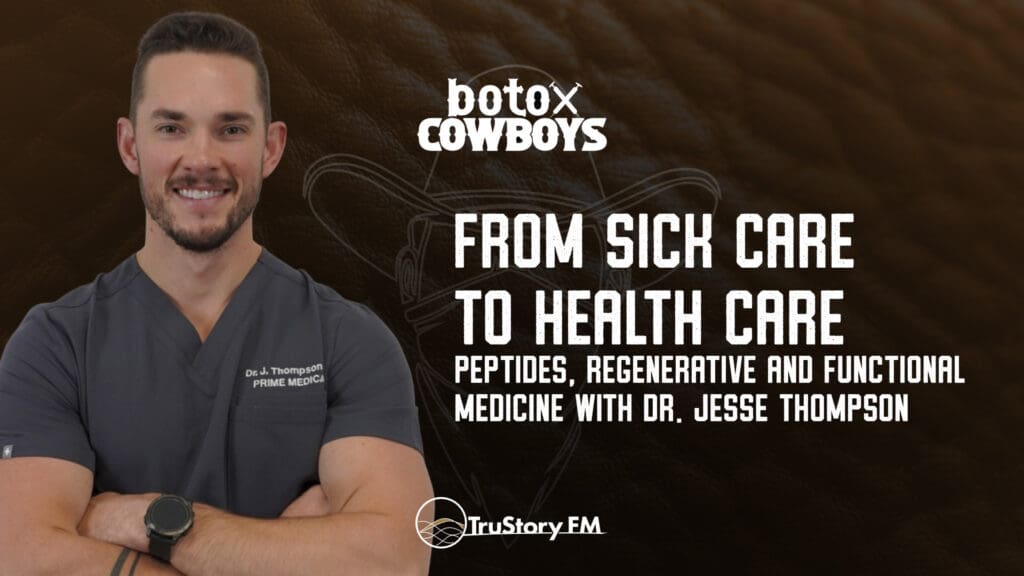
We’ve got my man, Dr. Jesse Thompson, out in Rossland, BC. Jesse’s a very well-rounded physician who I’ve had the pleasure of getting to know over the last six years. Dr. Thompson, thank you for finding time to join us today. Can you introduce yourself to our listeners?
Dr. Jesse Thompson
Yeah, what’s up, guys? Happy to be here. I’m a doc working in a small ski town in the interior of BC. My practice is split into three branches: pain and regenerative medicine, integrative and functional medicine, and aesthetics. So, I’ve got a lot of other arrows in the quiver personally, but that’s my medical life.
Tyler Brooker
How did you have the misfortune of meeting Andrew?
Dr. Jesse Thompson
Oh yeah—God, he hit me with his car.
Tyler Brooker
Standard.
Dr. Jesse Thompson
No, no. I did his training course in Vancouver and went from there.
Dr. Andrew Dargie
Now, Jesse, before we get started, where can our listeners find you? What’s your social media handle and your website information?
Dr. Jesse Thompson
Yeah, so my clinic’s called Prime Medical. That’s where you can find everything for us online. Our website’s very comprehensive, and so is our Instagram. We’re available for everybody there.
Dr. Andrew Dargie
Is it @PrimeMedical, or what’s the actual handle?
Dr. Jesse Thompson
I think it’s Prime Medical Rossland.
Dr. Andrew Dargie
I take it you don’t run it yourself.
Dr. Jesse Thompson
Yeah. You see how acquainted I am with it, eh?
Dr. Andrew Dargie
Yeah, 100%.
Tyler Brooker
Well, that could be the first “A” on Botox Cowboys.
Dr. Andrew Dargie
Okay—so talk to me first about how we met through the Botox course and the filler course. Botox Cowboys is a podcast themed around aesthetic medicine. Tell me a little bit about your aesthetics journey—how you came into it—and what it’s been like for you so far.
Dr. Jesse Thompson
Sure. I started injecting Botox for medical reasons before aesthetic reasons. I do a lot of stroke, migraine, dystonia, blepharospasm in my medical practice. I was getting pressured to inject aesthetically, so I went on a hunt for the best course in North America and settled on your Botox course. That’s what led me to you guys, and it’s kind of taken off from there.
I’d say aesthetics is about 15 to 20% of my practice right now. Definitely not the majority, but quite a bit of energy goes into it day to day.
Dr. Andrew Dargie
Amazing. As this aesthetics journey has evolved, what have you liked about it? What have you not liked about it? And how has it factored into the many different things you’ve got on the go?
Dr. Jesse Thompson
It’s been really fun because this is the part of my business that I run entirely with my wife. We work together with every patient. She does all the behind-the-scenes work for those patients in our practice, and she’s with me when I see all of them. It’s been good to work together in that capacity.
We’ve gone through several clinic locations and built up practices in different towns that we’re still maintaining. It’s really nice to see healthy people and have positive conversations all the time. It’s a really good vibe in the clinic.
In terms of what I don’t like, the first thing that comes to mind is seeing some of the results I see from other injectors when patients come in brand new. Seeing people sometimes get taken advantage of—they don’t get what they’re asking for. But it presents us with an opportunity to correct that, so there’s a silver lining.
Tyler Brooker
If it’s 15 to 20% of your business, is it a really competitive market where you are, or is it just not all that popular? And if it’s the second, are you doing anything to encourage those treatments in your area?
Dr. Jesse Thompson
I’d say there are definitely other injectors around. It’s not like we’re the only game in town. But I like to think we’re the best.
We don’t do a whole lot to recruit and attract patients. We don’t do a lot of advertising. We let our work speak for itself, and word of mouth spreads naturally. I’d say we’re as busy as we want to be for that side of things.
And you’ll see on our social media: I’m very particular about saying I don’t push this on people. When we have new patients, we prompt them to take a very small initial step—just to make sure they’re psychologically comfortable with what they’re getting themselves into, and they feel good before and after about their decision. So we really slow-play it, just out of morality, I think.
Dr. Andrew Dargie
Tyler, that was a good question. This is a nuanced point within aesthetic medicine we haven’t touched on previously. There’s medicine and there’s medical aesthetics—comprehensive in nature.
Jesse is a very talented injector. I’ve seen him over the years. I’ve done many sessions with him. He trains with us now as a lead educator at the Botox course, so his work speaks for itself.
But there’s a key point here: he doesn’t have to upsell people. He does integrative medicine, emergency medicine, pain management—many different things. He doesn’t have to convince people to get treatments. And as you mentioned, Jesse, people come in with problems because they’ve been oversold.
And this is something Tyler knows about me and my practice—and anyone who works with me: I’m there to listen, see how I can optimize their aesthetic needs, and do it without upselling them into things they don’t need.
Tyler Brooker
Man, you’ve been trying to get me to do a lip flip since I met you.
Dr. Jesse Thompson
Oh, don’t do it. Don’t do it.
Dr. Andrew Dargie
No, no, no—
Tyler Brooker
Thank you. I got another “yes, thank you,” Jesse.
Dr. Jesse Thompson
Don’t do it.
Dr. Andrew Dargie
No, no, no. This is actually really funny. I’ve got you two guys on the call—this is why I wanted to do Botox Cowboys—because both of you are very much guys’ guys. You’re outdoorsmen.
Tyler Brooker
Prefer not to drool. Yeah, that’s right.
Dr. Andrew Dargie
Yeah. Well, here’s the thing: it’s a good procedure. Jesse actually got one of my lip flips and we really enjoyed it.
Dr. Jesse Thompson
I was gonna say something different about it. Maybe one of the biggest regrets of my life. No—it was bad. It was real bad. You shouldn’t do it.
Tyler Brooker
What did you feel? I mean, obviously I haven’t done it and I won’t—so thank you. That’s the confirmation I needed.
Dr. Jesse Thompson
It wasn’t as much about what I felt. It’s that every time my wife looked at me, she would burst out laughing for about two months.
Tyler Brooker
So it was very effective.
Dr. Jesse Thompson
Yeah. I think I’m the wrong person for the treatment. I didn’t need any more volume. I didn’t need any more lip paralysis. But hey—it changed my perspective.
Tyler Brooker
It’s good you did it once. If you’re injecting it, you should.
Dr. Andrew Dargie
Exactly. Tyler, you’re up, buddy. I almost got Tyler the other day—because he’s down in Texas now, so I couldn’t do his treatment. He said, “Andrew, send me the right treatment so someone doesn’t mess up my face.” And he didn’t realize I included the lip flip on it.
Tyler Brooker
I get down there—and actually I was in Texas, but I was all the way down south in Colombia. So I had to explain to this lady—A, because he didn’t actually make points on a face or draw anything. He just wrote it out. So I had to explain in a second language what he was talking about. Then I had to explain that I didn’t actually want a lip flip.
And he had done the math all the way down on how many units, so then she thought I needed X number of units at the bottom. I’m like, “No—minus the units for the lip flip,” making sure I get the right amount in all the areas. It was a big mess. Thank you. I really appreciate it. It did make me laugh, though. It made her laugh too, in the end.
Dr. Jesse Thompson
She just allocate the lip flip units to your scrotox?
Tyler Brooker
Well, that’s what I was worried about.
Dr. Andrew Dargie
Yeah, I didn’t really specify which part “the lower” meant it was intended for.
Tyler Brooker
Yeah.
Dr. Andrew Dargie
All right. One thing I wanted to talk about is integrative medicine. I’ve actually gone to see Jesse to learn more about what he does—comprehensive wellness, regenerative medicine, bioidentical hormones. There’s a lot of buzzwords around this right now. Jesse, could you talk to us a little bit about what comprehensive functional medicine and all of that means?
Dr. Jesse Thompson
Yeah, absolutely. The idea behind integrative medicine—integrative and functional medicine are often used interchangeably—is looking at the person as a whole from a foundational health perspective, in the light of longevity.
Everybody defines this differently, but in our clinic we’re looking at a 360-degree approach to healthcare for the long term. Every patient we see, we bring them in based on short-, medium-, and long-term goals, and where they’re currently at.
A lot of people come to us 95% optimized and want that last little bit of performance or health edge. A lot of people come to us with a lot of work to do, and a lot of easy work they could maybe do on their own, but they need support, motivation, and accountability—simple lifestyle, base-pillar optimization.
One thing I’ll say about this space: it’s very similar to aesthetics. People practice it very differently. People market the heck out of it and will sell patients grand schemes and packages—lots of testing—but there’s not a lot of long-term planning involved. I feel like that’s a disservice. We try to really plan to follow people and get involved in their life, and commit them to positive change.
Dr. Andrew Dargie
A large component of what you’re doing is effectively preventative medicine and optimization. That’s very different than what you find in the Canadian healthcare system, which is often reactive and does nothing proactively.
So when you’re thinking about optimizing someone, can you break that down a little bit for us?
Dr. Jesse Thompson
Yeah. A great example is metabolic health. The traditional medical system will measure your three-month average blood sugar once you turn a certain age—usually in your 40s or 50s for your first measurement. It’s a very blunt look at how your body is handling carbohydrates and sugars.
Generally, nothing is done or suggested until you hit a pre-diabetes cutoff—an arbitrary number—or maybe even a diabetes cutoff.
But there are other biomarkers we can measure to understand how your body is handling those same macronutrients much earlier in the process. We’re using fasting sugars as a spot check, but also looking at how your body’s using insulin. We do a fasting insulin number, and that’s the first marker of what your metabolism is doing.
So when your three-month average is still well below the pre-diabetes cutoff—and maybe your fasting sugar is within an acceptable range—we’ll pick up people starting to have insulin resistance and metabolic problems, and we’ll start to treat that before it becomes an issue in the conventional medical system.
And generally, what we’re using for treatment is exercise, diet alterations, sleep optimization, and sometimes peptides and medications and supplements. But certainly not waiting until people are in a designated disease category.
Tyler Brooker
RFK likes this.
Dr. Jesse Thompson
Yeah, you know what? It’s not like that. That’s where people popularly see this idea, but this is happening everywhere. It’s becoming much more popular because it makes sense.
I think we’ll see this become mainstream in a number of decades. But the financial motivation of the powers that be—it’s a difficult shift from sick care to health care. I can’t begin to say I have the solution to that problem. It almost requires a multi-generation plan. But we’ve been trying to do our part here.
Tyler Brooker
Well, there’s no study in the world, I don’t think, that shows anything but positivity for exercise. So yeah—keep that going.
Dr. Andrew Dargie
I like that: “sick care to health care.” That’s great.
Two spot questions for you, Jesse—quick hitters. Peptides. This is the buzz. I get asked about this literally every day now. Give me your Coles Notes.
Dr. Jesse Thompson
Sure. Peptides are not new. Peptides are very trendy. And peptides do many different things.
The key is identifying what you’re trying to do, then looking at the peptide that may do that for you, and then looking at other options you have for doing the same thing.
A good example is BPC-157. You have X injury—BPC-157 is great for some injuries in some contexts, as long as you can get a formulation that has what it says it has in it and isn’t contaminated with lipopolysaccharide, and then you’re being directed on how to use it appropriately for your specific injury.
But I have lots of people who ask about lots of different peptides who are planning on using them for something that’s just not going to work.
It’s interesting because these have been around a long time. They’re just now getting the marketing machine behind them. I don’t want to discount the whole category—lots are useful—but they’re not the fountain of youth and they’re not the be-all, end-all of medicine.
Tyler Brooker
Do you think if they’re used inappropriately or for the wrong reasons they just don’t work? Or can they actually be harmful?
Dr. Jesse Thompson
The most common thing I see is: people come to me and say, “Oh, I did this,” and it did nothing. They wasted their money.
Usually these are by injection and people are doing them at home. Anytime you put a needle in your body there’s risk: infection, hitting something you don’t want to hit—unlikely, but possible.
There’s also a growing concern in Canada with these research-only labs producing peptides: they can be contaminated with something called lipopolysaccharide—an inflammatory compound that needs to be filtered out when peptides are made. It seems like a lot of these companies aren’t filtering that out properly. People using peptides from certain sources with lipopolysaccharide for long periods are coming in with inflammatory reactions.
Tyler Brooker
And that’s for injectables. My feed’s full of oral options—are they just a complete waste of money in your mind?
Dr. Jesse Thompson
It depends what it is. If you have ulcerative colitis and you’re going to take BPC-157, you want to take that orally because you want to get it on your guts.
But like any medication, when you take it orally it has to go through your detoxification system—your liver—before it gets to your bloodstream. Injectable versions bypass that. They take your liver and metabolic system out of the equation. Often they’re a bit more potent. Not necessarily more effective. It depends on the compound.
Dr. Andrew Dargie
I just got a text here from Brooksy saying, “Ask him if there’s a peptide for gray hair.”
Tyler Brooker
Man, I’m just happy to have hair.
Dr. Jesse Thompson
We’ll hook up offline.
Tyler Brooker
There’s nothing wrong with this color. You know how much people pay for this color?
Dr. Andrew Dargie
Okay, Jesse—what are your thoughts on metformin as an anti-aging therapy?
Dr. Jesse Thompson
This was very popular maybe a decade ago. Since then, lots has come out about how metformin can, quote unquote, block the effects of exercise. The very slight lactic acidosis we get from metformin use can diminish the positive effects of exercise in some way.
So I don’t use it carte blanche for longevity. However, it is a useful tool for insulin resistance and creating more insulin sensitivity if that’s the patient’s problem, and we haven’t been able to handle it by other routes.
But I’d say, going back to peptides, I’d probably rather use a tirzepatide—Ozempic, Mounjaro—rather than metformin for insulin sensitivity promotion at this point, in light of that lactic acidosis.
And that’s not anything new to somebody in this realm. We’ve been seeing this with self-experimentation people have been doing over the last five or so years with GLP-1s, even at “micro-doses,” just to promote insulin sensitivity rather than weight loss.
Dr. Andrew Dargie
Amazing. I get really excited talking about preventative medicine and comprehensive wellness.
What would you say is one of the biggest problems with the Canadian healthcare system as it currently stands, and how it relates to the health and wellness of the Canadian population?
Dr. Jesse Thompson
To put it shortly: it seems like 95% of our dollars go to the 2% sickest people. There’s not a lot of resource left over for preventative health education and support.
Education and support is what’s required for the first 90% of your health. You need to understand what good sleep looks like and how to attain it. You need to understand what a good exercise program and nutrition program look like for your life. People just don’t know these things.
If we could get this in everybody’s hands, we’d see a lot less hypertension and hyperlipidemia—things that need to be managed in primary care. Right now there’s so much of it that a lot goes mismanaged, grows into bigger problems, and that’s why our hospitals are full.
Broad strokes, but it seems like all our resources are available as soon as you’re on death’s door—no holds barred in terms of care at that point. But to give you a personal trainer through our medical system is unheard of. It seems backwards, but I don’t have the solution for how to get out of that problem.
Tyler Brooker
Well, you kind of said it—you both have. Canadian healthcare is abysmal, and there’s absolutely no preventative maintenance. So what can you do? Exercise, like you said. Take preventative maintenance into your own hands. You don’t necessarily need a trainer to go walk more, attempt a gym, do pushups.
People starting out with five pushups off their knees a day and progressing—whatever they can—would have a positive effect and maybe prevent something down the line. If your healthcare system denies you anything meaningful from that perspective, then you should get doing stuff.
Dr. Jesse Thompson
Yeah—how’s it going for you? Are you at ten yet? We started on five last week.
Tyler Brooker
From my knees I can do ten, yeah.
Dr. Jesse Thompson
Okay, good man.
Tyler Brooker
Yeah.
Dr. Jesse Thompson
Hey—progress is progress.
Tyler Brooker
That’s right. I’ve never felt better. A little sore. My boobies are sore.
Dr. Andrew Dargie
You’ve hit on a couple really important points. I could talk about this forever.
I think I have a very good solution to how to fix the big problem in Canadian healthcare. We’ve got great doctors, we’ve got great nurses. This system is unfortunately set up to fail, hemorrhage money, be inefficient, and cause significant morbidity. It’s bad.
And then you talked about how early education could help someone’s development, and all I could think about was: man, just think if we educated Tyler the right way—where he’d be in his life right now.
Tyler Brooker
I turned out okay.
Dr. Jesse Thompson
He’d already have had twelve lip flips, right?
Dr. Andrew Dargie
A hundred percent.
Now Jesse, what’s it like being a guy in a female-dominated field?
Dr. Jesse Thompson
I don’t feel it that much here. We’re kind of in our own world in our clinic. We have other injectors in the region, but it’s great.
All of the negatives I could think of being a male injector, I’ve mitigated because I do all my work with my wife. There’s always both of us in the room. That’s been amazing.
My practice wouldn’t be what it is without her. Maybe I wouldn’t even do it. She’s the relatable one, the personable one—the one everybody can text and talk to and review results with. She probably brings most of the value to the practice, not me.
So I haven’t really felt that asymmetry in the gender stream of aesthetics, because we stay in our own little world.
Dr. Andrew Dargie
That’s a great answer—and a segue.
We always try to give pro tips to injectors and patients out there. There are male physicians I know who practice out of the basement of their home. They don’t have an assistant. That’s a big risk. I’d be very cautious.
Jesse, you have an amazing wife who I’ve had the pleasure of meeting. You’re very synergistic, you contribute to the business together, and you have a beautiful family.
Talk to us briefly about what it’s like balancing being fit, staying active, running your different medical practices, and raising some beautiful kids.
Dr. Jesse Thompson
Happy to talk about that. I have three kids. They’re two, four, and six. I also have four or five businesses on the go aside from medicine.
You can be as busy as you want to be, and I had to make very conscious cuts in work hours about four years ago, and then another cut about three years ago—two and a half years ago—where I really narrowed down my work time to time that I otherwise can’t be with my kids. They’re at school, they’re at preschool.
So now I work four days a week. When I’m at the office, I don’t stop. I don’t take breaks. It’s very efficient, and everything’s optimized around getting as much done as possible.
But when the day is done, I’ve made time to coach my kids’ sports, be at their piano, make sure we get lots of family time, and have every weekend off.
It’s certainly not easy, but it’s possible if you’re very strict about your calendar. You have to make tough choices. You cut out the work meeting that’s a flight away that takes you away from your family for two nights. You cut out other commitments you don’t absolutely have to do. I’ve done a lot of delegating.
And again, my wife runs a lot of the administrative pieces of each of the businesses. That’s her full-time job. Without her, I’d have to hire multiple full-time assistants. So: lots of irons in the fire.
Tyler Brooker
It’s good to hear you’re busy, though.
I have two quick questions. One to get back to aesthetics for a second: do you do fillers and biostimulants also, just so people in your area know?
And of all the treatments—and you can include exercise and whatever else—what’s the best value treatment? Maybe you could do two: one for overall appearance and one for cost-wise.
Dr. Jesse Thompson
Yeah, I have a pretty full-spectrum aesthetics practice. Pretty much everything injectable we use.
Best bang for your buck is hard, because you have to start early. But in my opinion, if you’ve been fit and healthy your whole life and you’ve never been overweight, that’s the best thing you can do in terms of anti-aging. Most of the 60- and 70-year-old males and females you see where you think, “Wow, you look great”—if you ask them if they’ve been active and normal weight their whole life, they’ll usually say yes. I ask everyone.
That’s kind of a cop-out because you can’t go back and redo. So in that light, I’d say resistance training is probably the best conservative thing you can do for mental and physical health and appearance.
Tyler Brooker
That’s a really good answer.
Dr. Jesse Thompson
You want me to tell you what’s the best injection?
Dr. Andrew Dargie
Yeah—what’s his favorite injection?
Dr. Jesse Thompson
The lip flip.
Tyler Brooker
Yeah, I don’t know.
Dr. Jesse Thompson
I’m not gonna give you a straight answer on that one either. It depends on the patient and the stage of life.
Lately I’ve tended to go more toward biostimulators over fillers—sometimes blending when you want a little more volume. I like replacing structure conservatively. So temple biostimulator mixed with some filler in the temples when people start to get hollowing there—that’s a great way to reverse first signs of aging, and it lasts a really long time. People love it.
Tyler Brooker
That is a super good answer. And advanced. Everybody in Rossland is lucky to have you near them.
One more—my final question: what is it like working with Andrew on the Botox course? Can you give me some impression on what he looks like up there, or sounds like up there, or does? Give it like—throw some dirt.
Dr. Jesse Thompson
Yeah, you know—it’s a dream come true. It’s just a miracle to be in the presence of genius whenever I get the opportunity.
Dr. Andrew Dargie
Such an idiot.
Dr. Jesse Thompson
No, I mean—you can hear him coming from three blocks away with his exhaust.
No, it’s great. Fully honestly: I admire his dedication and how crazy it’s been to grow a thought to what it is now, and to have such a comprehensive, excellent product that prevents people from going down the wrong path with their career, and educates them appropriately for the industry. I’m super grateful I get to be a part of it.
Whenever anybody asks me who they should train with, it’s always Andrew’s organization, without a doubt.
Tyler Brooker
Not exactly “thrill and dirt,” but that’s nice.
Dr. Andrew Dargie
Well, I appreciate it.
Dr. Jesse Thompson
Yeah—we’ve got a couple stories, but we’ll save them.
Tyler Brooker
Yeah.
Dr. Andrew Dargie
All right—last thing for me.
For our listeners: give me three fun facts about Jesse Thompson that no one knows. Maybe not no one knows, but three fun facts our listeners should know about you.
Dr. Jesse Thompson
My sport growing up was archery. I competed very seriously—shooting all over the world—and managed to win our Canadian championships a few times and get a silver medal at the World Championships. I’ve turned that into a store in a town nearby with an archery range. We’ve got 50 to 60 kids going through our program learning how to shoot archery, compete, and hunt responsibly. That was a big part of my life for a long time, and still is. I still hunt with a bow.
Second: I’m an avid hunter. I’m out there with a rifle and with archery equipment every year, and I managed to shoot a nice elk this year. A lot of people don’t know that about me.
Third: I’ve got three little boys—two, four, and six, like I said. They’re awesome, and they’re already getting into sports. I’m already trying to plan my calendar around what theirs is gonna look like down the road, because I have a feeling they’re all gonna play hockey, and that’s gonna be a mess. But yeah—that’s the nutshell.
Dr. Andrew Dargie
Amazing. Between you and me, we could teach Tyler how to aim and shoot a gun.
Dr. Jesse Thompson
Yeah.
Tyler Brooker
Oh my God. Listen to this.
Dr. Andrew Dargie
Anyways—no, that’s awesome.
Dr. Jesse Thompson
We’ll send him—just go to Walmart, get a water gun first, and practice in the bath, right?
Tyler Brooker
Listen to this.
Dr. Andrew Dargie
Yeah.
Tyler Brooker
Shooting ducks—shooting rubber ducks.
Dr. Jesse Thompson
Yeah, you got it.
Dr. Andrew Dargie
Oh man. Well listen—Jesse, we really appreciate your time joining us today.
Fun fact about Tyler: Spotify brings out their Wrapped of the year where they showcase your most listened-to artist. Tyler’s was Taylor Swift this year. I’m not totally surprised.
Tyler Brooker
Don’t even use Spotify.
Dr. Andrew Dargie
All right. Needless to say.
Tyler Brooker
All right, let me wrap this thing.
Dr. Andrew Dargie
No—I gotta wrap it real quick, and then you wrap it. I wrap it and you wrap it.
Tyler Brooker
Well, you wrap it then.
Dr. Andrew Dargie
Okay. I’m wrapping it.
Dr. Jesse Thompson, everyone—check him out: Prime Medical. If you want a great treatment, this is your guy. And if you’re looking for comprehensive care, I can speak for it myself—having learned from him—incredible physician, well-rounded, and high-integrity guy. Dr. Jesse Thompson, Prime Medical. Really appreciate you joining us.
Dr. Jesse Thompson
Yeah, thank you guys.
Tyler Brooker
Yeah, that’s awesome.
Okay, so that’s it for Botox Cowboys this week. Thanks again to Pete Wright from TruStory FM, who still won’t let Andrew inject him. Maybe Jesse—you have a better chance of that.
As always: hit subscribe, follow Andrew on Instagram at TheAestheticsCoach, and check us out at BotoxCowboys.com.