




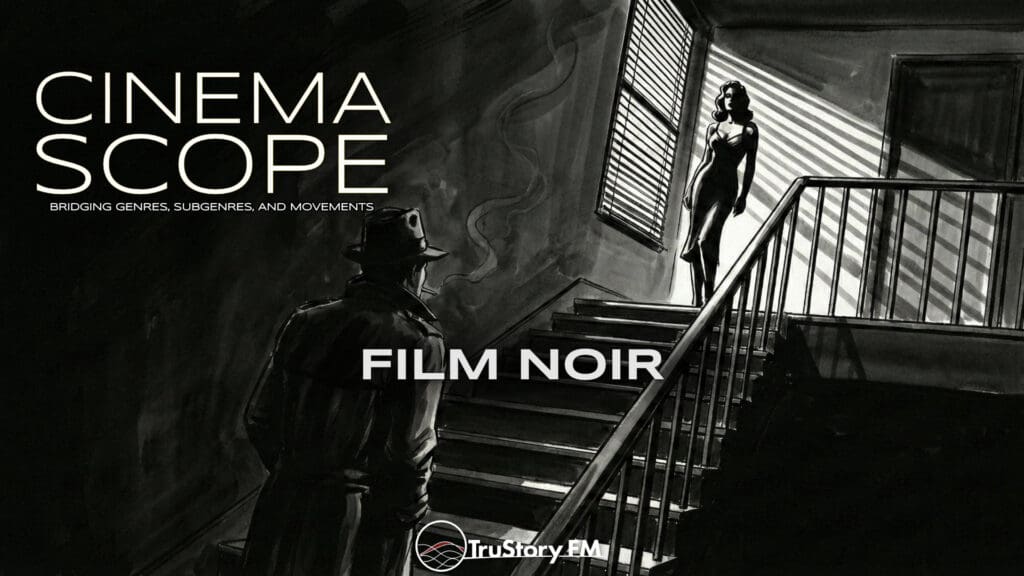
The Shadows Move Inside: Film Noir
Film noir is more style than genre, more infection than category—and in this episode, Andy Nelson and film historian Foster Hirsch trace exactly how it spreads, from the wartime dislocation that seeded it in the early 1940s through the operatic self-destruction that closed it out in 1958. Moving chronologically through ten essential films, they map the noir arc from fatal romance and ordinary men crossing into crime, to Cold War dread and a cycle that ends by consuming itself. By the end, you’ll have a practical framework for watching these films and a clear sense of why they still feel so immediate.
What Noir Is—and Why It Won’t Let Go
Film noir is best understood as an elastic style built on a single core question: how does an ordinary, law-abiding person slip into criminal behavior? That gap between the respectable citizen and the noir criminal whirlpool—what draws someone across it, and what it costs them—is what gives these films their lasting charge. Foster Hirsch traces the style’s dual DNA: hard-boiled American vernacular from Hammett, Chandler, Woolrich, and Cain on one side; the chiaroscuro visual language of German expressionism, imported to Hollywood by émigré directors like Fritz Lang, Billy Wilder, Robert Siodmak, and Otto Preminger on the other. The result is a cycle that emerged not after the war ended, as is often assumed, but during it—and then extended through the 1950s because the Cold War, the Hollywood blacklist, and the McCarthy era kept the culture’s underlying anxiety fully stocked. Hirsch locates the source of that darkness in the gap between surface prosperity and what lay beneath it: “the darkness within, the anxiety beneath the apparently and deceptively well-organized, well-functioning surface.”
Five Essential Films
- Double Indemnity (1944): Apple TV | Amazon | Letterboxd
- Scarlet Street (1945): Apple TV | Amazon | Letterboxd
- Out of the Past (1947): Apple TV | Amazon | Letterboxd
- Kiss Me Deadly (1955): Amazon | Letterboxd
- Touch of Evil (1958): Apple TV | Amazon | Letterboxd
View Our Full List on Letterboxd
View the Discussion on YouTube
Members: The Full Noir Arc
The member version extends the conversation to cover all ten films in the episode’s chronological sequence. The five additional titles push the arc in important directions: Detour strips noir to its most fatalistic and arbitrary form; In a Lonely Place relocates the danger entirely inside the protagonist’s own psychology; Sudden Fear and The Steel Trap—both personal all-time favorites of Hirsch—round out the picture in contrasting ways: Sudden Fear centers on an innocent woman thrown into a murder conspiracy against her own life, while The Steel Trap follows a respectable bank VP who impulsively steals a fortune and spends a desperate weekend trying to outrun the consequences, with his marriage as the moral pressure valve; and Sweet Smell of Success raises the question of whether moral corruption in plain sight qualifies as noir at all (Hirsch’s verdict: noir-stained, not full noir, though he calls it terrific). Together, the ten films trace a complete evolution from mid-1940s fatal romance to late-1950s psychological and institutional collapse.
Additional films discussed:
- Detour
- In a Lonely Place
- Sudden Fear
- The Steel Trap
- Sweet Smell of Success
Support the show: Become a member of the Next Reel family of film shows for extended and bonus conversations, access to member-only Discord channels, and early ad-free releases.
About Our Guest: Foster Hirsch
Foster Hirsch is a film historian, author, and Professor of Film at Brooklyn College. His work on noir includes The Dark Side of the Screen: Film Noir and Detours and Lost Highways: A Map of Neo-Noir. His most recent book, published by Alfred A. Knopf, is Hollywood and the Movies of the Fifties: The Collapse of the Studio System, the Thrill of Cinerama, and the Invasion of the Ultimate Body Snatcher—Television. His other books include Otto Preminger: The Man Who Would Be King; Kurt Weill on Stage: From Berlin to Broadway; Acting Hollywood Style; and A Method to Their Madness: The History of the Actors Studio. He is a regular presence at film noir festivals and repertory screenings.
- Website
- The Victoria Wilson/Foster Hirsch Podcast
- Hollywood and the Movies of the Fifties
- More to Explore: Foster Hirsch’s Recommended Films
How to Listen
This episode is built for deep listening. Feel free to pause, return, and follow the threads over time—like a great book you can pick up again.
If You Want to Keep Going
Cinema Scope
- Earlier in this post-war miniseries: Post-War Westerns: The Moral Turn and 1950s Science Fiction: Atomic Age Anxiety
The Next Reel
- The Next Reel has covered many of the films in this episode—browse The Next Reel’s Film Noir series