*This transcript is produced using transcription software and reviewed for quality. Despite our best efforts, some passages may be incomplete or contain errors due to audio quality or software limitations.*
Andy Nelson:
Welcome to Cinema Scope. I’m Andy Nelson. Each episode, we map one genre, subgenre, movement, or mode—what defines it, what shaped it, and what it influenced.
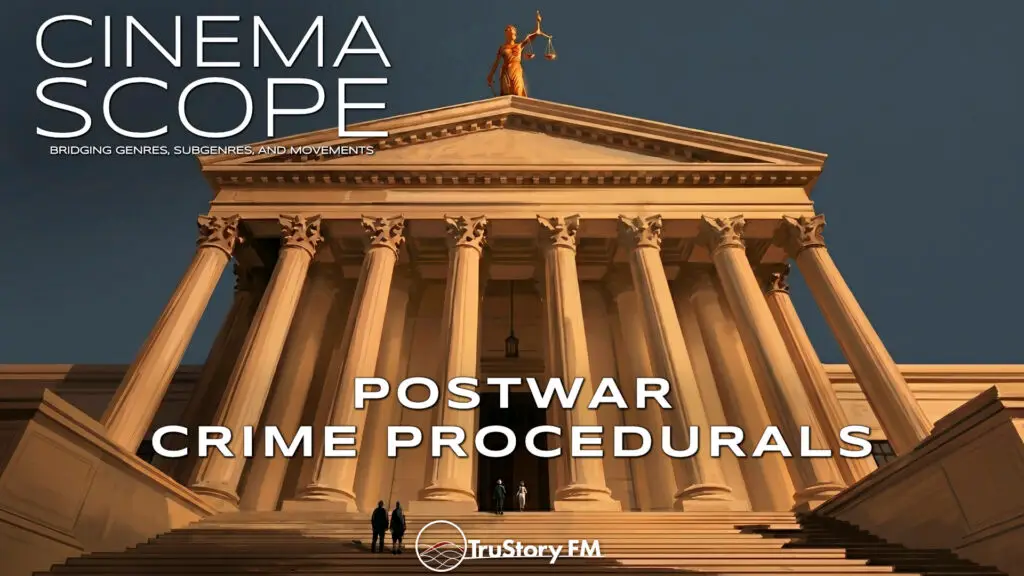
Today we are closing out a chapter. Over the past several episodes, we’ve been tracing how World War II and its aftermath reshaped Hollywood genre by genre—from the moral crisis on the Western frontier, to atomic dread externalized as invasion and mutation in science fiction, to the urban shadows of film noir, to the pressure-cooked American home of domestic melodrama, to the paranoid apparatus of the Cold War thriller. Today we land on the final entry in that arc: postwar crime procedurals.
These films don’t externalize anxiety into monsters or spies, and they don’t trap it inside a marriage. They take American society at its word and put it on trial. The courtroom, the precinct, the jury room, the prison—these are the institutions the postwar era built to deliver justice. And these are the films that watched them work and measured what they cost.
We’re going to be moving chronologically through eleven films, six on the main show, five more in the extended discussion for members.
My guest today joined me earlier in this miniseries for our Film Noir episode, and there’s no one better suited to close it out. Foster Hirsch is a professor of film at Brooklyn College and the author of numerous books on film and theater, including The Dark Side of the Screen: Film Noir, Otto Preminger: The Man Who Would Be King, and his most recent, Hollywood and the Movies of the Fifties: The Collapse of the Studio System, the Thrill of Cinerama, and the Invasion of the Ultimate Body Snatcher, Television.
Foster, welcome back to Cinema Scope.
Foster Hirsch:
Thank you. Good to be here.
Andy Nelson:
I’m thrilled to have you again with your fantastic book, Hollywood and the Movies of the Fifties. With all the research and everything you did in the postwar period, I’m curious—we’re going to be talking specifically in this episode about postwar crime procedurals. With all of the studying you did across everything going on in the fifties, is there anything that drew you specifically to the procedural mode of films we’re going to be talking about? Something with the crime procedurals that you’re drawn to, that you’re really passionate about?
Foster Hirsch:
Well, I’m a big crime film fan. Film noir is sort of my—I wouldn’t say specialty, but I do host film noir series, I’ve written about it, and I’ve gotten to learn more about it. But I actually saw a lot of these films when they came out, because I’m old enough. And I was very drawn to the postwar crime film. I’m not particularly drawn to the gangster story and the thirties gangster films, which I recognize are well done, but they’re not of great interest to me. But I am interested in the postwar period—and actually during the war as well. So we’re talking about the forties, the fifties, and the sixties.
Andy Nelson:
Right, into the sixties, exactly.
Foster Hirsch:
Into the sixties.
Andy Nelson:
Well, for our conversation, we’re going to be moving chronologically through eleven films. We’re going to talk about six on the main show and five others we’re going to save for members. The films we’re discussing: from 1947, Boomerang!, directed by Elia Kazan. The Naked City, from 1948, directed by Jules Dassin. Also 1948, He Walked by Night, directed by Alfred L. Werker and Anthony Mann. 1954, Riot in Cell Block 11, directed by Don Siegel. Also 1954, Night People, directed by Nunnally Johnson. 1955, we’ve got two films: Trial, directed by Mark Robson, and The Phenix City Story, directed by Phil Karlson. Then 1956, The Wrong Man, directed by Alfred Hitchcock. 1957, Sidney Lumet’s Twelve Angry Men. And then this should be right in your camp—1959, Anatomy of a Murder, directed by Otto Preminger. And last, 1967, In Cold Blood, directed by Richard Brooks.
If you’d like to access the member bonus content, you can join for five dollars a month or fifty-five dollars a year. Just head to trustory.fm/join to learn more. We’ll be right back.
Let’s talk about this mode of procedural films we’re looking at here. I want to talk big picture first—what makes this particular postwar period stand out? What makes it distinct? Is it a belief in the system? Is it trying to figure out if the system actually works? We’ve talked about the postwar westerns, where we saw the heroes operating alone. Film noir kind of bypassed institutions entirely. And then in the paranoia thrillers, it really made the institutions the enemy. So is this saying, here is the machinery—let’s watch it run? Theoretically it’s going to work, but sometimes it doesn’t. Is that where we are?
Foster Hirsch:
What you just said is accurate. Sometimes it works, sometimes it doesn’t. And these procedural films look at institutions from a variety of perspectives. Some supportive—yes, in the end the system works. Others questioning whether the system works, or in fact showing how it can be undermined or challenged. So it’s not one response or point of view; it’s a variety of points of view.
And some of the most challenging films—I’m tempted to say that Trial is the most challenging film we’ll be talking about. There are real questions there about the integrity of the system and how it can work with so much pressure on it. That’s a fascinating mid-fifties film. Not the most successful film artistically on our list—maybe the least—but the most challenging.
Andy Nelson:
Yeah, there’s a lot to talk about with that one in particular.
Foster Hirsch:
There’s so much going on in that film. I saw all the films again, Andy, to prepare for our talk, so they’re all fresh in my mind. And I have to say that Trial was the most problematic and the most challenging. And if I may jump ahead, the best is actually In Cold Blood, which I think is a masterpiece.
Andy Nelson:
Having never seen it before—I’d only read the book—I was blown away completely. The way that Richard Brooks—yeah.
Foster Hirsch:
It’s an extraordinary film by the very underrated Richard Brooks. But we’ll get to that.
Andy Nelson:
Yeah, we’ll get to that. But it is a stunning piece of filmmaking, for sure.
So we’re at this postwar period in America. I guess the question is, are they trying to show confidence in the institutions? Because this is people coming back from the war, trying to give a very documentary sense of how things worked. Very documentary—to the point where we’re looking at the opening of Phenix City Story, which literally is a documentary for the first fifteen minutes of the actual film. Is that part of it—just trying to make it as real and authentic as possible?
Foster Hirsch:
These thrillers are part of a postwar documentary and semi-documentary movement where film noir—and we’re talking about streams of film noir here—took a turn to the documentary, inaugurated by Louis de Rochemont, the famous producer of postwar semi-docs, Call Northside 777 as a template. And these films participate in that. They’re also influenced in their documentary authenticity by postwar Italian neorealism, which had an enormous influence on American filmmaking in the postwar period—more than I think most people realize. So these films are under two historical movements: a turn to documentary in film noir, and the influence of location shooting and natural lighting—and to some extent, non-professional acting—in Italian neorealism.
Andy Nelson:
Interesting. And especially with soldiers having come back from Europe—certainly you could see that they had probably seen some of that neorealism over there and recognized it as something that was in the storytelling they’d been looking at.
Foster Hirsch:
Absolutely in the storytelling. And it’s often overlooked that in the postwar period, American films went in two directions: the great spectaculars in color and widescreen, but also small-scale documentary realism—because realism is always qualified in movies. So it’s two different strains. What we’re talking about in this list of films is the neorealist semi-documentary strain, which applies to each of the films we’re going to be talking about. They all have a documentary cast to them, wouldn’t you say?
Andy Nelson:
Oh, absolutely.
Foster Hirsch:
Every one of them.
Andy Nelson:
Every single one of them. Is there an element—and again, this is something we’ve talked about in a lot of these episodes—this is definitely the period of the Hays Code, and the way that filmmakers were required to show things a certain way, with very much an anti-communist sentiment running through things. Is there also an edge of an ideological push for these films? A statement of faith in the institutions? Because I know we definitely see the dark side of institutions, but I think a lot of it is the ideal of what we’re striving for.
Foster Hirsch:
Well, I think the Hays Code handed down a very strict doctrine: crime does not and must not pay. So if you committed a crime, you’re going to be brought to justice. And so the institutions that the film presents are elements of the state that bring wrongdoers to justice. Under the Hays Code, the criminal could not get away with it. After the Code was lifted, it becomes a different story in the late sixties, and it opens up the film to a much more complicated moral designation. But in this period, crime could not pay—but some filmmakers very cleverly outwitted that. Very prominently, our friend Otto Preminger in Anatomy of a Murder.
Andy Nelson:
I was going to say, that’s a great example.
Foster Hirsch:
Otto Preminger was a great foe of the Hays Code and the Production Code, and he was instrumental in knocking it down with The Man with the Golden Arm and The Moon Is Blue in particular, but also with Anatomy of a Murder.
Andy Nelson:
Yeah. Let’s use the Hays Code as a jumping-off point to look at the origins of these postwar crime procedurals—or crime procedurals in general—because you already brought up the gangster films, how that’s not something you’re as much a fan of, but there’s definitely an element of the gangster film that led to where we are now. Likewise, wartime, there were plenty of documentary filmmakers making projects. Prominent Hollywood filmmakers were going over and making documentaries.
Foster Hirsch:
Yes, some of the greatest filmmakers made World War II documentaries.
Andy Nelson:
Exactly.
Foster Hirsch:
John Huston’s World War II films are extraordinary. And he was not the only one.
Andy Nelson:
Right, there were a number of them. On top of that, there were also procedurals being told on the radio—Gangbusters, Dragnet, some radio shows before TV really came about. How do you see the journey from those types of films and storytelling styles to where we’re expanding federal law enforcement, the FBI building its public image through Hoover—all of that in this postwar period?
Foster Hirsch:
I think Dragnet and that kind of show had an enormous influence on these procedural films, where the process itself became almost the star of the film. You feel that in The Naked City and He Walked by Night, the immediate postwar films. Very much about the procedure of catching a criminal. How do they go about it? How does a criminal get caught? Here’s how the institutions work. The law enforcement processes are in place in order to catch the bad guys. Isn’t that what those films are about and celebrating?
Andy Nelson:
Yeah, exactly.
Foster Hirsch:
I’m drawn to the fifties films like Trial and Anatomy of a Murder, which are ambiguous. He Walked by Night and The Naked City are not ambiguous. There’s a bad guy, and the bad guy has to be brought to punishment, and here’s how the system is set up to catch them. No matter how elusive they might be, no matter how tenuous the clues, our institutions are strong enough and clever enough and technologically gifted enough to catch them. And the ambiguous morality of the later films, which I find more interesting, are not there in The Naked City and He Walked by Night and Boomerang!.
Andy Nelson:
And Boomerang!, correct.
Foster Hirsch:
That’s a little different, but—
Andy Nelson:
There’s a little more pushing back on that one, I’d say. Is there an element of the blacklist—which was also happening at this point in time—that was driving some of the filmmakers toward these semi-documentary types of stories, because perhaps it was a way to say, I’m just filming reality, what’s really here? A little more—I don’t know if they could say apolitical—but still find ways to critique things using a style that seemed more realistic. You kind of alluded to that already with Otto Preminger, as far as the way that he was playing the system, maneuvering a little bit. Do you see that as something that was going on?
Foster Hirsch:
Yes. And the blacklist in this period is almost unavoidable, whether it’s dealt with directly or more often obliquely or indirectly. This was the blacklist period, where if you were accused of being a communist or fellow traveler, your career could and would be destroyed. That permeated filmmaking from 1947 to 1955 in particular. That hangs over all of Hollywood filmmaking. It was unavoidable.
Hollywood was under fire by the House Un-American Activities Committee for alleged communist infiltration. And were there communists in Hollywood? Yes, there were. And most of the people they accused of being communists were communists—not all of them, but most were, or fellow travelers. And the next question would be, so what?
Andy Nelson:
Right.
Foster Hirsch:
But you couldn’t ask that question in that period. Does that hang over the sensibility of our crime films? Yes. Even not at the first level—beneath the surface.
Andy Nelson:
Right, but it’s still something that is there. It’s interesting, because we definitely talked about that a lot in our last episode about paranoia thrillers. There was a lot of the communism element that arose. We don’t see that as much here. I mean, we definitely will see it in some films—like Trial; you already brought that one up. You definitely see some of it in Night People, right? There’s an element of—
Foster Hirsch:
Very much so.
Andy Nelson:
—of that particular story. But in so many ways these stories are more about just crime and the procedure of trying to stop it. And so it is interesting when the blacklist and the communist elements do weave into them.
Foster Hirsch:
Well, look—The Naked City was directed by Jules Dassin, a communist who had to leave this country to continue his career. Are there left-wing touches in the film? Yes, there are. There is a depiction of an absolutely empty-headed Park Avenue matron—a rich person. I think that rich person was written by, conceived by, a lefty.
Andy Nelson:
Interesting—the portrayal, yeah.
Foster Hirsch:
The portrayal is from the point of view of a left-winger who would be anti-capitalist, anti-the-wealthy. If you live on Park Avenue and you’re rich, you’re either stupid like this woman or corrupt.
Andy Nelson:
Interesting.
Foster Hirsch:
So I think the film does show some left-wing prejudice or bias—or perspective, if you want to keep it neutral. But it’s not a film about the blacklist.
Andy Nelson:
Yeah.
Foster Hirsch:
It’s not a film about communism.
Andy Nelson:
No, right.
Foster Hirsch:
But it was a film made by communists and fellow travelers.
Andy Nelson:
And that’s an interesting one because, as we just said, that was an earlier film that doesn’t have as much of those ambiguities that you like so much in the fifties. But it is interesting that it still has those elements you can pull out to see some of what Dassin was saying.
Foster Hirsch:
It dissects class in this film, in this country at that time. It’s about different class levels in New York—from the very wealthy to the really disadvantaged and marginalized. Not in terms of minority groups, but in terms of economic status and social status. That class division is very much a part of the film. But the criminal is a criminal. He doesn’t represent anything. And just as the criminal in He Walked by Night—the madman played memorably by Richard Basehart—doesn’t represent a political point of view. He’s a nutcase.
Andy Nelson:
He’s just bad, right.
Foster Hirsch:
And he’s a bad guy and he’s got to be caught. He’s a loner. There’s something seriously wrong with him, and it’s the job of the law enforcement figures to catch him.
Andy Nelson:
That’s an interesting one, and we’ll talk about it, I’m sure. But when you look at something like In Cold Blood and how the criminals are portrayed there—twenty-odd years later, the work to try to create some sympathy or empathy with these killers so that you could get into their heads a little bit and try to understand their story. And it hints at that in He Walked by Night—we’re getting a sense that there’s some psychological damage this guy has, but it’s not something they explore at all. It’s not something they were interested in at that point in time, but they are later.
Foster Hirsch:
Not at that point in time. Whatever values you’re talking about—possible audience understanding or empathy—comes largely from the presence of the actor. But it isn’t something that’s written into the script, or an essential element. In Cold Blood is essentially trying to understand these characters who would at first glance be simply beyond the normal—but why and how? They don’t care about that in He Walked by Night. He’s a nutcase.
Andy Nelson:
Not at all, exactly.
Foster Hirsch:
And he’s got to be caught. He’s got to be stopped.
Andy Nelson:
That’s the whole point.
Foster Hirsch:
He’s pathological. Do we know why? Not really. Do we care? Not really. There’s some slight attempt to understand him, but very slight. It’s not the film’s focus.
Andy Nelson:
That’s not what we’re looking at. Well, I always like talking about where things fit in the cinematic family tree and what makes them distinct from other styles we’d say are adjacent. Or—as you said when we talked about film noir—that have stains of it. I definitely would say you can see film noir stains through a lot of these postwar crime procedurals.
Foster Hirsch:
Just about every one of them, really.
Andy Nelson:
Yeah, exactly. There’s also crime thrillers. You can look at social problem films and see how some of that weaves its way into here. And then even courtroom drama, if you look at that as its own category or subgenre, you can see how it falls into this as well. Likewise, we talked about the semi-documentary elements, stories about the wrong man. And then prison stories—that certainly would become a whole other genre or subgenre down the road as far as prison pictures, often B pictures. And then by the time we’re looking at In Cold Blood, you’re getting to a point where it’s more investigative realism. Do you see other things—like any other genres or subgenres—threading into these postwar crime procedurals?
Foster Hirsch:
Well, I see—for instance, He Walked by Night, which you mentioned—two directors: Alfred L. Werker and Anthony Mann. I think it’s been pretty established that Anthony Mann was the dominant director.
Andy Nelson:
He’s the main one.
Foster Hirsch:
It has his touch, his film noir touch. The extraordinary thing about He Walked by Night—overriding everything we’ve said about procedural—is the cinematography by John Alton, which is extraordinary. There are dozens of shots in that film that could be extracted from the film and shown in a photo exhibition at a museum. Museum-quality chiaroscuro images of high contrast between light and shadow. That film is an example of Hollywood’s version of German Expressionism.
Interesting that we talked about Italian neorealism in the context of He Walked by Night—there are two visual strains that go into the making of that film. The procedural elements of the film are often very documentary-like and neorealist. And then when we are with the maniac, the main character, his world is depicted in sharp contrast between light and dark, with virtuoso compositions of light and shadow. Part German Expressionism, part Italian neorealism, part semi-documentary—but part highly stylized postwar film noir thriller. The film is schizophrenic visually.
Andy Nelson:
Well, John Alton handles it well. He’s able to do that dance between all of it. And I liked that we also ended that story—we’ll get to it—ending it in the sewers, in another of these great films from this period, similar to The Third Man, where we end up shooting a beautiful chase sequence in the sewers.
Foster Hirsch:
And to go to another genre—do you know the 1954 thriller Them! about the giant ants?
Andy Nelson:
Oh, yes.
Foster Hirsch:
Which ends in the sewers under the Los Angeles River. Same virtuoso compositions of tunnels receding into the distance. Some of those tunnel shots in He Walked by Night are absolutely thrilling visually. You’re almost thrown out of the film and the story, and you see the mastery of Alton’s artistry.
Andy Nelson:
Yeah. Alton—just beautiful photography, and truly a great film noir photographer who also works well in these stories. Do you see in this postwar period—specifically in the postwar crime procedural, the mode that we’re in right now—much in the way of evolution? From where we’re starting in the semi-documentary Naked City, He Walked by Night, Boomerang!, all the way to the mid-sixties where we’re talking about In Cold Blood?
Foster Hirsch:
If you’re talking about visually—no. Because He Walked by Night already has the two strains that are essential. It’s very stylized and it’s also documentary-like. Hitchcock’s The Wrong Man is, for the most part, documentary-like. The Trial is documentary-like and isn’t at all a fancy film visually—it’s very procedurally oriented about how you conduct this kind of a trial, this kind of a court case. Anatomy of a Murder is wonderfully objective and detached visually as Otto Preminger often was—although he could certainly do the film noir styling—but it doesn’t at all look like a typical film noir. It looks like the postwar semi-documentary. And In Cold Blood has the two strains that we’ve talked about in He Walked by Night.
Andy Nelson:
Yeah, a little of both sides.
Foster Hirsch:
Conrad Hall’s magnificent cinematography—I think he won the Oscar for it, I believe he did. Magnificent. But it has both the location shooting, which makes a big difference, as it does right from the beginning with The Naked City, which has some of the best on-location New York City filming ever.
Andy Nelson:
Yeah, that whole climax is just stunning to watch still. Incredibly put together.
Foster Hirsch:
But not film noir style—documentary style.
Andy Nelson:
Yeah, right, exactly. Even then, at that point, it’s still more of a documentary style. Anything else on its evolution? I know we start talking about some courtroom films, but I’m not sure—when TV starts coming in, does it start creating some of the shift in what we’re looking at in the postwar crime films?
Foster Hirsch:
I’m not sure I agree with the shift. I think the template is set in a film like He Walked by Night.
Andy Nelson:
So it stays pretty solid through this entire period.
Foster Hirsch:
I think it stays pretty solid. Anatomy of a Murder doesn’t have visual stylization. It’s very detached and objective, as it should be for telling that story of following a case from almost beginning to end. In Cold Blood has the mixture of styles. But I don’t see that as an evolution. I see that as a brilliant articulation of what was already established in 1947, ’48.
Andy Nelson:
Yeah, right.
Foster Hirsch:
So I’m resisting a little bit trying to trace an evolution. I’m not sure I agree.
Andy Nelson:
No, well I’m not saying there is one. I’m just curious if there’s anything that changes over the course of this, or if it does stay pretty consistent.
Foster Hirsch:
I think what changes is the infusion of politics and blacklist and the communist threat—the Red Scare, so to speak.
Andy Nelson:
Well, and the ambiguity that you like so much, obviously.
Foster Hirsch:
And the moral ambiguity, and a franker sexual content—In Cold Blood has language that you wouldn’t have heard in the forties, for instance. There’s that kind of evolution.
Andy Nelson:
Gotcha. All right. Well, before we get into the films, a quick note: the conversation you’re hearing today is the public episode—six films, a full exploration of this style. But Foster and I actually discussed eleven films total. The five you won’t hear today—Boomerang!, Riot in Cell Block 11, Night People, Trial, and The Phenix City Story—are part of the extended member discussion. If you want access to that and to every other member episode, you can join for five dollars a month or fifty-five dollars a year at trustory.fm/join. Check it out. We’ll be right back.
Let’s start digging into the movies. Let’s jump into The Naked City, Jules Dassin’s film from 1948. This is in many ways the foundational postwar crime procedural. Boomerang! definitely had a lot of these elements, but this film really seemed to establish the mode’s visual language, the structural template, and the fundamental claim that the real machinery of urban policing is inherently dramatic.
The story: a young woman is found murdered in her Manhattan apartment. Detective Lieutenant Dan Muldoon leads the investigation through the actual streets of New York, interviewing witnesses, following leads, building a case through patient, methodical police work, until the killer is finally cornered on the Williamsburg Bridge. Again, location shooting, very much a documentary style. We start and end the film—and have it throughout—with producer Mark Hellinger narrating and telling us, giving us this voice that feels like some sense of authority. That’s really emphasized with this film.
Foster Hirsch:
Absolutely. With that New York-tinged accent of that period. So he sounds like a real reporter—the voice of a contemporary authority figure. And even as you’re recounting the summary, the film has no moral ambiguity.
Andy Nelson:
No—nothing, not at all.
Foster Hirsch:
It’s a bad guy who commits a murder, and the whole film is predicated on how the law enforcement system follows its own procedures to track him down. They’re good, they’re efficient, they’re persistent, they don’t stop, and they get him. That’s it. And for me, frankly, the story isn’t all that compelling. But seeing New York is what holds the film together.
Andy Nelson:
Yeah, that’s very true. A question about that—Jules Dassin was somebody who had to leave and go over to Europe to film. Has a sense of European sensibilities. Is there something about him shooting New York that makes it seem different?
Foster Hirsch:
The French like to refer to him as Jules Dassain. No—he was a Jewish boy from New York. A local boy who understood it—born in New York, went to school in the Bronx. He understood New York. He’s an American. He didn’t have a European sensibility at that point at all.
Andy Nelson:
Right, because he hasn’t left yet.
Foster Hirsch:
He hasn’t left yet. And he goes to Europe, and on the run, he makes a fantastic companion film to The Naked City called Night and the City. Do you know that one?
Andy Nelson:
Yep, the wrestling story, yeah. Fantastic film.
Foster Hirsch:
That’s also a film set in a city and about a city. But that film is postwar London, and London is treated expressionistically—not in documentary style. New York in The Naked City is treated documentary style.
Andy Nelson:
Yeah. We just talked about The Naked City over on our other podcast, The Next Reel. And I don’t think that came up as far as that film having more of an expressionist tone, as opposed to this film. That actually makes me want to revisit it, now that I have The Naked City fresh in my head, just to see that comparison. But I think it’s interesting that he chose to shoot this one and that one in such different styles for each of the cities.
Foster Hirsch:
Completely different styles. And I think part of it was he was a New Yorker and New York was home ground. The value of that film now for me is as a documentary portrait of New York in that exact time frame.
Andy Nelson:
It’s fascinating to see, yeah.
Foster Hirsch:
Whereas if you go to Night and the City for a documentary treatment of 1950 London, you’ve gone to the wrong film—because it’s not a documentary London. It’s an expressionistic, subjectivized version of this man, played brilliantly by Richard Widmark, on the run. So that film has a psychological complexity that The Naked City doesn’t have. We don’t get involved in those characters. They’re not complicated or enthralling characters. The title of the film tells you the focus of the film. It’s about the city.
Andy Nelson:
True, very true. Does the narration add to that as far as keeping us distant?
Foster Hirsch:
Objectivity, sure. I’m reporting it as it happens. I’m sharing with you our procedures for getting the villain. Mark Hellinger had just the right voice to be the narrator in this postwar semi-doc.
Andy Nelson:
Really interesting. This film came out the same year as He Walked by Night—another semi-documentary police procedural, different studio, different city. What does it tell us that two films with essentially the same structure and style appeared simultaneously, looking at opposite coasts?
Foster Hirsch:
Well, The Naked City is major studio—that’s Universal International. And He Walked by Night is Eagle-Lion, Poverty Row. It’s amazing that the film looks as good as it does. They probably had a budget of twenty-five dollars. [laughter]
Andy Nelson:
Yeah, right.
Foster Hirsch:
And even the expense of location shooting was very limited, I’m sure. The film was made for practically nothing. It was all about style. Whereas The Naked City is an expensive production. Those location shots took a lot of work. It may look spontaneous, but those big scenes were staged, requiring a lot of preproduction and a big technical staff. He Walked by Night depends on the genius of John Alton, working in close collaboration with Anthony Mann and the other director, Al Werker.
Andy Nelson:
Right. Let’s start talking about He Walked by Night. Again, Alfred L. Werker, Anthony Mann—a toss-up with the direction of the film. This film, based on the true story of Irwin Walker, a former police technician who used his knowledge of police procedure to evade capture after killing a highway patrol officer. The LAPD investigates with the same technical rigor the killer brings to his crimes—composite sketches, forensic analysis, systematic witness interviews—in a cat-and-mouse procedural that ends in the storm drains beneath the city.
This film—and your book subtitle loves this—The Collapse of the Studio System, the Thrill of Cinerama, and the Invasion of the Ultimate Body Snatcher, Television. My understanding is that this film really kind of spawned Dragnet, as far as taking the police procedural and delivering it to mass audiences on TV. Do you see that line—this film being the one that really brought that to the forefront?
Foster Hirsch:
In a way, I’d see The Naked City as more of an influence on Dragnet, because Dragnet was pretty much documentary style. And Jack Webb with that unforgettable deadpan—
Andy Nelson:
That feels very much like the voiceover, right?
Foster Hirsch:
With the voiceover of Mark Hellinger. Super masculinized, but no range in the voice. It’s very monotone. Part of the effect of it.
Andy Nelson:
True.
Foster Hirsch:
As if men couldn’t have expressive voices—their masculinity was encoded in having voices that weren’t expressive. Deadpan. I think The Naked City and Dragnet have more in common. But He Walked by Night, as we talked about, is schizophrenic, because a lot of it is very much procedurally based. And the investigative agents in He Walked by Night really don’t have any personality at all. As is often the case.
Andy Nelson:
From what I read, Jack Webb actually met the technical advisor during production of this film. And that conversation inspired him to create the radio show, which then turned into the TV show. So I guess that’s the thread I was talking about. But you’re right.
Foster Hirsch:
He’s literally in the film, after all. Jack Webb is in this film.
Andy Nelson:
He plays Lee Whitey, yeah.
Foster Hirsch:
And he already has the deadpan style. He’s very much secondary in the investigative team, but he’s there. And if you know your Jack Webb, you spot him immediately—and he’s already Jack Webb, which means very little expression in the face or the voice. But that was his calling card. Very little expression. It worked for him at that time.
Andy Nelson:
Is there something about these films where they’re getting these buy-ins from the institutions—like this one working with the LAPD? Does that compromise the objectivity in any way? Or is the authenticity it produces worth the cost?
Foster Hirsch:
It’s probably a little bit of both. It certainly supports authenticity, in quotes. The police department is working with the film, giving technical advice, on the premises. And then if you step back from that, you say—well, if they’re cooperating, they’re surely demanding that the depiction be favorable. And of course, in terms of the screenplay, it is. Everything they do leads to identifying and capturing the killer. So the system that’s in place works. It’s a justification and an endorsement of the system.
Andy Nelson:
Yeah. I think that’s an interesting element—we’re kind of endorsing the system. But what’s fascinating, and I guess we’re not seeing it as much in these films, is the ambiguity that you start to see: questions within the institutions, like are they abusing their power? How are they manipulating the system to get what they want? I don’t think we’re seeing that too much yet. Maybe Boomerang!, maybe Boomerang!.
Foster Hirsch:
Boomerang! is more complex. But the two films we’re talking about now, the system itself is left untouched—and the films are made to celebrate the fact that the system is strong, inviolate, and gets the criminals. It’s designed to capture the criminals.
Andy Nelson:
Very much so.
Foster Hirsch:
The investigative work and the scientific work is very meticulous. And the fact that the investigators don’t seem to have much personality or emotion is part of it. They are their job. And they’re good at their job.
Andy Nelson:
Great way to describe them. They very much just are their job. That’s what we get out of those characters.
Foster Hirsch:
We don’t go home with them. We don’t see emotional depth or complexity. We see them on the job. The Scott Brady character wants to avenge his partner, and there’s a little bit of emotional motivation there, but it’s kept at a certain distance. We don’t get to know him. He’s an investigator. He wants to avenge his friend. But beyond that, we don’t get to know him—and the implication is we don’t need to know him. We need to know the process of hunting down the killer.
Andy Nelson:
I will say an interesting element of all of these films, including this one, is that because of the documentary approach—the semi-documentary approach—we’re getting a really interesting glimpse into how policing worked at that particular time. I chuckled quite a bit through these early films seeing when they would do the prisoner lineups and have them stand up and have the witnesses point them out—all in the same room together, which has obviously changed these days, where you’re looking through something so they can’t identify who’s pointing them out. It’s funny to see the things that were done then that led to other changes within our procedures.
Foster Hirsch:
But the film, just as you describe it, is very confident that the institutions work—that the systems in place at the time the films were made are strong, solid systems with a big success ratio.
Andy Nelson:
Yeah.
Foster Hirsch:
What we have leads to success. That’s what the films tell us.
Andy Nelson:
Truly.
Foster Hirsch:
What we do, how we operate, we’re going to get the bad guys. These institutions are strong. The questioning comes later. Not now.
Andy Nelson:
Let’s shift gears and talk about this interesting one for the list—Alfred Hitchcock and The Wrong Man. Certainly something that feels different for Hitchcock in the scope of his films, although it is a crime film. Some people say that as a person who always grew up with a fear of the police, this could be perhaps the most biographical of his films.
Foster Hirsch:
And also, he was a Catholic. And this film turns on faith, believe it or not.
Andy Nelson:
Right. This film follows Manny Balestrero, a musician at the Stork Club, who is mistakenly identified by employees as the man who robbed them. The cops arrest him, the DA prosecutes him, and the system grinds on correctly, following its own procedures at every step, while Manny and his family are destroyed. This is also based on a true story. Where does this fit in with Hitchcock—shifting gears to do something that’s a little less of his traditional style and more of this semi-documentary approach?
Foster Hirsch:
It’s very much a shift in gears for Hitchcock, and the film suffered commercially for it. It was a disaster commercially. I’m old enough to have seen it when it came out in 1956. I remember going downtown to the Hollywood, to the downtown Paramount Theater, with a friend—first Saturday matinee of the film. It was a theater that seated, I believe, three thousand. If there were more than fifteen people in the audience, that would have been something.
Andy Nelson:
Yeah.
Foster Hirsch:
And people came out of the film—the fifteen of us—sort of shaking their heads. The audience immediately, as soon as the film opened, decided it was not how they wanted their Hitchcock, and they didn’t want to see the film. It was a disaster at the box office. And it is only recently that it has begun to receive the recognition it deserves.
Andy Nelson:
Well, what’s fascinating about the film is—in one way you could say the system is not doing anything wrong, right? They’re following their procedure. Everything is by the book. Is that why this ends up being one of the most disturbing films we’re talking about? Because an innocent man is essentially almost completely put away?
Foster Hirsch:
But there’s something wrong with the system. The police investigations are biased. Almost inhumane. And the witnesses—
Andy Nelson:
Although all the witnesses—every single one of the witnesses—say that was the guy.
Foster Hirsch:
So many of our films actually—we could have a subtopic about the reliability of eyewitness reports.
Andy Nelson:
Yeah, for sure.
Foster Hirsch:
I think every one of our films, eyewitnesses are shown to be wrong. And the reliability of eyewitness reporting is demolished. Correct me if I’m wrong—in every one of the films?
Andy Nelson:
Yeah—if not every one of them, quite a lot of them for sure.
Foster Hirsch:
Quite a lot. Almost the reversal hinges on a clever lawyer exposing eyewitnesses as being mistaken.
Andy Nelson:
Yeah, true.
Foster Hirsch:
Twelve Angry Men, for instance.
Andy Nelson:
Very much the case. Yeah, very much.
Foster Hirsch:
Essential to Twelve Angry Men.
Andy Nelson:
Yep.
Foster Hirsch:
Essential to Boomerang!.
Andy Nelson:
Yeah. Well, I find it interesting—but I wonder, what is Hitchcock saying as far as when we get to the end of the film? Because you’re right—Catholicism, the act of prayer, all of that kind of comes in as a moment here. The real Manny is vindicated, but his wife isn’t. She ends up in an institution because she’s taken this so personally. She kind of breaks. Does the film earn its resolution?
Foster Hirsch:
Yes. It does. You mean the happy ending?
Andy Nelson:
Yeah—mostly happy ending, right.
Foster Hirsch:
Mostly happy ending. With the title telling us that it was two years before the wife recovered, and we see the family in long shot walking on a beautiful street in Miami. They’ve left New York forever. And all of that’s accurate, by the way. It’s all true.
Andy Nelson:
Right, based on a true story, yeah.
Foster Hirsch:
And I think Hitchcock was adamant in maintaining the truth. But I think what you said at the beginning, Andy, is central in terms of placing this as a Hitchcock film. Hitchcock was very open about his distrust of and fear of the police. And this film is very much about the intimidation tactics of the police. The police are the villains in this film.
The Manny Balestrero character is innocent. But the police convict him on some very flimsy pretexts. And when he walks out at the beginning of the film—when the character walks out of the Stork Club, down the street, and he’s framed by two policemen—do you remember that shot at the beginning?
Andy Nelson:
Yep, yep.
Foster Hirsch:
He’s almost physically entrapped by these two policemen. That tells us something. That’s a preview of coming attractions.
Andy Nelson:
And a very Hitchcockian shot, too.
Foster Hirsch:
Very Hitchcockian shot. But it’s very much a film about the unreliability of police work. If in our earlier films—The Naked City and He Walked by Night—we talked about how scientific and technical and competent and truthful the law enforcement figures are, in this film they’re very corrupt.
Andy Nelson:
Very different.
Foster Hirsch:
Very different. They’re the criminals in the way they treat this innocent man. And after all, if the police had any reading of human nature, they’d look at the Henry Fonda character and say he couldn’t possibly have done what he’s being accused of. And even if he had—doesn’t the punishment exceed the crime? What did he do?
Andy Nelson:
Yeah, right.
Foster Hirsch:
He didn’t kill somebody. It was a holdup for a certain amount of money. Okay—but that doesn’t require the kind of incarceration and interrogation that he’s given, as if he’s a mass murderer.
Andy Nelson:
Very different, yeah.
Foster Hirsch:
Or—
Andy Nelson:
Let’s follow the Fonda path—talk about Twelve Angry Men, directed by Sidney Lumet. Twelve jurors retire to deliberate on the murder case of a teenage boy accused of killing his father. Eleven vote guilty immediately, and one—juror number eight—votes not guilty, not because he’s certain of innocence, but because he thinks the case deserves examination. The film is the ninety-five minutes of argument that follow.
This is a fascinating single-room film—pretty much entirely in the jury’s deliberation room. It’s been read as both an endorsement of the American jury system and a critique of it. Do you find one of those readings more persuasive than the other? Or is it open-ended?
Foster Hirsch:
I don’t agree—no, I think it’s a fabulous film. But I think it’s the most pat of all the films we’ve talked about. In the sense that I think it’s absolutely an endorsement of the system, unambiguously, with no complexity whatsoever. The system works.
Andy Nelson:
Not really?
Foster Hirsch:
That’s how I feel.
Andy Nelson:
It only works because of the one guy, though. If he hadn’t been there, the whole thing could have collapsed.
Foster Hirsch:
But when you’ve got twelve people, it’s very likely you’re going to have one who will do what the Henry Fonda character does. I think it’s very contrived, it’s very set up. It’s very easy. It’s the least morally challenging and ambiguous probably of all the films we’re talking about. And it’s an extremely well-made film—I think it’s terrific. But I think it’s a little simple. It’s too easy.
Andy Nelson:
It is pretty easy. But what’s interesting is by the end, we still don’t know if the defendant is actually innocent. And I think that’s what’s interesting about the end of the film—we’re left like, is he guilty? How are we reading that?
Foster Hirsch:
I’ll tell you how I read it. That shot of the young man at the beginning of the film, when you see him looking into the camera with those big eyes—and then his image sort of melts away. His image hangs over the entire film. He’s innocent.
Andy Nelson:
Okay.
Foster Hirsch:
That kid is innocent—or a victim of circumstance. And I think it’s very, very manipulative. We see this enormously sympathetic figure with those big—you know, sometimes you see a dog with eyes you can’t resist.
Andy Nelson:
Yep—same sort of face.
Foster Hirsch:
That kid, same sort of face. That’s brilliantly cast, but very manipulatively cast. He’s innocent.
Andy Nelson:
Okay, okay. Well, let’s talk about one that’s a little more complex. Let’s go to Anatomy of a Murder, 1959—Otto Preminger. Very complex. And you, having written a book about Otto Preminger, you certainly will have a lot of thoughts regarding this film.
In this film, we follow a rural Michigan lawyer who takes on the defense of an army lieutenant charged with murdering a bar owner who may have raped his wife. The case turns on legal definitions—irresistible impulse as a defense for temporary insanity—and on the competing performances of lawyer, client, and witnesses in a courtroom where the truth is always at least partly a construction. Such a fascinating film.
Is Preminger actually interested in whether justice is served, or in just the mechanics of the system itself?
Foster Hirsch:
Preminger was by training a lawyer.
Andy Nelson:
Oh, really? I didn’t know that.
Foster Hirsch:
His father was a very prominent lawyer in Vienna. He went to law school in Vienna and got a law degree.
Andy Nelson:
Okay.
Foster Hirsch:
And was always very interested in American jurisprudence. He loved our system of trial by jury. He loved it. And the Arthur O’Connell character—Arthur O’Connell, quite justifiably, was Oscar nominated for that glorious supporting performance. In that speech near the end, which is I think the finest moment in all of Otto Preminger’s work, he says in effect—he makes a tribute to the American system of trial by jury. You bring twelve strangers together, and most of the time they make the right decision.
The film is about belief in the system—and the system is strong enough and sturdy enough and resilient enough to withstand and overcome, even as in the case of this film, a decision that’s wrong. I think the Ben Gazzara character is guilty.
Andy Nelson:
Yeah.
Foster Hirsch:
He’s a slimy, sleazy character. I knew Ben Gazzara. I interviewed him a number of times, and I said: every time I see you, I always think you should be arrested because you got away with a murder. And he laughed. He knew what I meant.
Andy Nelson:
Yeah, yeah, right.
Foster Hirsch:
He got away with murder. But the system is strong enough to withstand a case where justice perhaps is not served.
Andy Nelson:
Yeah, right.
Foster Hirsch:
You agree with that? You think that character is guilty?
Andy Nelson:
Oh, I absolutely think he’s guilty.
Foster Hirsch:
Yeah, and he gets away with it.
Andy Nelson:
And I think Jimmy Stewart is—maybe it’s controversial for Jimmy Stewart—playing a character who is so cynical and self-serving. His whole thing about coaching the defendant on how to phrase things—like, don’t say it like that, talk about it like this. I’m like, wow, he is really playing the sleazy lawyer here. I kind of enjoyed seeing that.
Foster Hirsch:
He’s playing the sleazy lawyer, and he’s doing more than that. He’s putting on an act as a country bumpkin. In other words, he’s showing us the James Stewart persona and exposing it as an actor’s masquerade.
Andy Nelson:
It’s just a performance.
Foster Hirsch:
Just the performance. And he says: trials are won by which lawyer is the better actor. And James Stewart gives a glorious Oscar-nominated performance. He’s acting James Stewart, the country bumpkin. It’s a performance. And Otto Preminger very much believed that trials are a performance—that lawyers in the courtroom are actors playing roles, and the ones who play their roles with the most impact and forcefulness are the ones who win.
Is the system perfect? No. Can it be eroded from within? Up to a point. But Otto, who was a very proud, naturalized American citizen, said we had the best system of justice in the world. And he absolutely believed in the system of trial by jury. And the film is about that—but brilliantly and ambivalently introducing a case where justice is not served, but the system continues anyway.
Andy Nelson:
It keeps working. Fascinating. Let’s talk about our last film on the list. We’re jumping all the way to 1967—Richard Brooks’ In Cold Blood. Kind of really the capstone of all of this whole series.
On November 15th, 1959, two ex-convicts murdered a Kansas farm family for a small amount of money and a safe that they believed existed but actually didn’t. Truman Capote followed the case for six years—through investigation, capture, trial, appeals, and execution—and wrote In Cold Blood, the work that effectively invented the true crime literary form. Richard Brooks’ adaptation follows the same arc, with Perry Smith and Dick Hickcock as human beings rather than simply as killers.
We end up with the semi-documentary mode we’ve been following, extended into this literary journalistic approach to the story, which paints an interesting portrayal—particularly of Perry Smith. We really get into his psychology, his history, his past, that makes this so much of a darker story. We’re seeing the awful crime they committed, but we’re also getting a sense of what led them to this point.
Foster Hirsch:
And that is extraordinarily powerful. And it would be disingenuous to ignore another layer that the film has acquired—and that is, Robert Blake, who plays Perry Smith unforgettably, was very likely involved in a real-life murder case.
Andy Nelson:
Yeah, right, right.
Foster Hirsch:
Killing or arranging to have his wife killed. He was a real-life criminal—a deeply troubled man. And is it even sacrosanct to say that his performance in this film is a great performance? That scene at the end, with the rain coming down his face—
Andy Nelson:
Beautiful cinematography, yeah.
Foster Hirsch:
And he talks about his relationship with his father, and how he hated his father and loved his father. It is one of the greatest acted scenes I have ever seen in a movie. And you can’t watch that scene without crying. It’s so powerful.
Andy Nelson:
Truly, truly.
Foster Hirsch:
It must have come from something deep within the actor himself, who was obviously a deeply troubled man. But who was a brilliant actor. That is a great performance.
Andy Nelson:
It’s a great performance in a film that is so well structured and put together and edited—just the way it flows back and forth from the investigators trying to figure out what’s going on to the killers as everything builds to that head, and then we jump into the flashback to see what actually happened. It’s a very dark story, but beautifully told. And like some of our other films in this series, it has the semi-documentary approach but also gets into the more psychological, darker, more expressionistic elements.
Foster Hirsch:
We talked at the beginning about how in The Naked City and He Walked by Night the criminals are kept at a distance. Here the criminals are brought up close. We get their backgrounds. We get to know their families a bit. Superb performances by the fathers in each case. And we understand how damaged these characters are and how probably beyond reclamation and redemption they are—but the film asks for some sympathy for them.
And on the other hand, deliberately and controversially, the film keeps us very far from the Clutter family. We don’t get to know them very well.
Andy Nelson:
True—very little bits, very little bits.
Foster Hirsch:
Very little, enticing little bits, and their averageness is on display. But we don’t really get to know them. Whereas we do sort of get to know the criminals. And then in the end, the film is an indictment against capital punishment—again, asking for some sympathy for these criminals.
And what’s also fascinating is that Scott Wilson is superb in his role. Superb as the all-American, with that ingratiating smile—and he’s insane. He doesn’t commit any crime—I mean, he’s there, but he doesn’t kill the family. It’s the more sympathetic character who goes crazy.
Andy Nelson:
Yeah, that’s fascinating.
Foster Hirsch:
He kills the Clutters because for a moment he disconnects—and we see that he regards Mr. Clutter as his father. As a father in place of his father. Just a flash. It illuminates the psychological derangement of that character.
I just saw it again recently, preparing for our talk today. It’s an American masterpiece. It does not have the reputation it deserves. It’s a stunningly well-made film.
Andy Nelson:
I completely agree. It really blew me away—just how perfect of a story it was and how it crafted everything. And upsetting. Very upsetting film.
Foster Hirsch:
It doesn’t give you the happy ending and resolve things. Anatomy of a Murder ends with an ironic, ambiguous note, but so does this. It asks for sympathy for the devil. And that’s a very hard course to pursue, but the film does pursue it. It asks for sympathy for the devil.
And Robert Blake—a tormented life, a tormented man. That scene in the rain when he talks to the reverend, to the priest, the confessor—is one of the greatest scenes I’ve ever seen. I put it up there with Marlon Brando in the taxi scene in On the Waterfront. It really is.
Andy Nelson:
On the Waterfront, yeah.
Andy Nelson:
Let’s wrap up the conversation by just talking about where things went from here, if we can. Obviously it seems like TV really kind of absorbed this mode entirely. We jump into Dragnet and these other TV shows, and then you can see all the way through Hill Street Blues, Law & Order, The Wire—it’s a thing that continues forever. Same thing with courtroom dramas: Perry Mason all the way through things like Better Call Saul. And then true crime—true crime in and of itself has become a huge part of what people want. Clearly, people are drawn into true crime stories. The podcasting industry was taken over by true crime with Serial and other shows. It’s shifted into this element of people wanting things that feel semi-documentary—Investigation Discovery, a whole channel about that; Dateline; 48 Hours.
Foster Hirsch:
But notice, Andy—you’re not talking about movies.
Andy Nelson:
Well, right. Is there still a thread? I mean, we still get courtroom dramas and investigatory police stories. Sidney Lumet certainly follows that a number of times—with Serpico, Prince of the City. All the President’s Men, I suppose you could say, is kind of looking at—
Foster Hirsch:
Yes, but those films are a while ago. Tell me a film in the twenty-first century that follows the patterns we’ve been talking about for the last few hours.
Andy Nelson:
Well, it might not be as semi-documentary, but if you look at something like David Fincher’s Zodiac, I wonder if that might be the most influenced by what we’ve been talking about. Because it certainly also doesn’t have any easy answers, and it could be read as fairly ambiguous.
Foster Hirsch:
That’s a very strong film. Also Seven.
Andy Nelson:
Seven, yep, yep. David Fincher clearly is a fan.
Foster Hirsch:
But I would say they’re relatively rare.
Andy Nelson:
Yeah.
Foster Hirsch:
It isn’t a common narrative mode in contemporary filmmaking.
Andy Nelson:
That’s pretty interesting. I wonder why.
Foster Hirsch:
But there’s a huge appetite for it on podcasts and TV, yes.
Andy Nelson:
Well, I wonder if that’s why—just because people’s appetites are getting satiated in these other places, and so the film stories just aren’t as prevalent.
Foster Hirsch:
Very possible.
Andy Nelson:
Yeah. Well, it was a fascinating conversation, Foster. Thank you so much for joining me and being here for all of this. Again, your book, Hollywood and the Movies of the Fifties, has been a huge resource for me in this miniseries I’ve been doing. It’s available—everybody should check it out. We’ll have a link in the show notes to it. And anything else you want to plug before we head off?
Foster Hirsch:
Well, I’m working on the sixties now.
Andy Nelson:
Are you really?
Foster Hirsch:
Next time, yeah. And certainly In Cold Blood is going to be prominently discussed in the new book.
Andy Nelson:
Excellent, excellent. And I should also call out your Otto Preminger: The Man Who Would Be King—that’s one worth checking out as well. All right, Foster, again, thank you so much for joining me.
Foster Hirsch:
Thank you. Bye-bye.
Andy Nelson:
That is a wrap on our postwar miniseries. Six episodes, six genres and modes, and the full arc of how one war reshaped what Hollywood could imagine, fear, and say. It has been one of the most rewarding creative runs I’ve done on Cinema Scope, and none of it would have been possible without the guests who brought their expertise to each conversation.
I don’t have a next episode date yet. I’m going to be taking a break after this run and will surface when I’m ready. Please stay subscribed.
Thanks for joining us on Cinema Scope, part of the TruStory FM Entertainment Network. Music by ORKAS and Roie Shpigler. Find us and the entire Next Reel family of film shows at trustory.fm. Follow @thenextreel on social media, and if you’re enjoying the show, please leave us a rating and review wherever you listen. And as we part ways, remember—your cinematic journey never ends. Stay curious.