Andy Nelson:
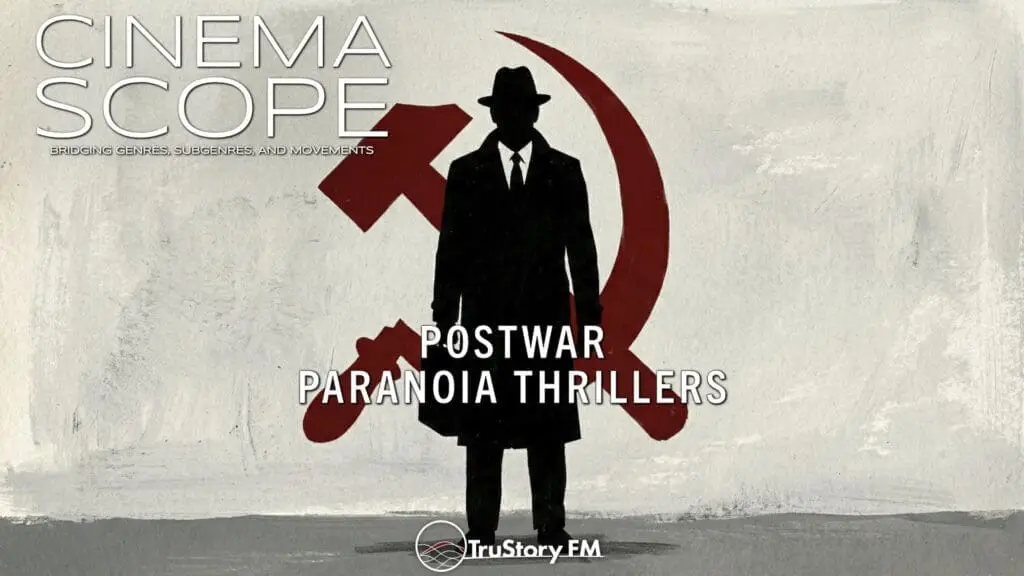
Welcome to Cinema Scope. I’m Andy Nelson. Each episode we map one genre, subgenre, or film movement — what defines it, what shaped it, and what it influenced. Today, we are diving into postwar paranoia thrillers. These are films built on a single, unsettling premise: the enemy isn’t out there. It’s in here, among us, maybe inside us. And the Cold War gave Hollywood the perfect pressure system to dramatize that dread. We’ll move through the cycle thematically rather than film by film, mapping the DNA of paranoia as a cinematic mode, tracing how it evolved, and asking what it meant that an entire era of filmmaking was built on the question: who can you actually trust? Joining me is Tony Shaw, Professor of Contemporary History at the University of Hertfordshire and author of Hollywood’s Cold War. Tony, welcome to the show.
Tony Shaw:
This is great. Thanks, Andy.
Andy Nelson:
Before we really dig in — your work sits particularly, with this book, sits right at the intersection of Hollywood and Cold War propaganda. What drew you to looking at that particular territory? And how did this cycle of films fit into this larger story that you’ve been telling as far as propaganda goes?
Tony Shaw:
I’ll just go a little back. I studied at Leeds University in the north of England in the eighties. And that was one of the few history departments at the time which, in a revolutionary way, taught historians how to deal with film and media and how to take cinema seriously, which for a lot of historians was quite new. So I learned a lot about the use of film as propaganda in the 1930s and ’40s — Goebbels, Nazism, Stalin, communism, and so forth. And I carried the baton a little by writing about propaganda in the Cold War, in that great battle for hearts and minds after 1945.
Plus I’m a sort of kid of the seventies and eighties raised on James Bond and Rambo films. So it’s fun to look back at those as a historian — films which I knew as a child. But more broadly, I’m interested in how the Cold War was won, essentially. And whereas historians used to write that it was won on the battlefield or by diplomacy or by military means, more recently historians, especially cultural historians like myself, have said maybe the Cold War was won and lost in the media, or on the sports field, or in the shopping malls. And in particular I’m interested in looking at the role of film. I’m an archive digger, but I’m interested as much in what was going on behind the scenes of these films as what appeared on the screen. And so these, if we’re going to call them paranoid films of the first twenty years of the Cold War, really fit nicely into that.
Andy Nelson:
Fantastic. That’s fascinating to recognize that there’s so much to talk about when it comes to propaganda in film, which still goes on today. Like you can still find plenty of examples of propagandistic films — it’s not necessarily the same sorts, but I think there are still arguments to be made that some films are more propagandistic than designed for pure entertainment.
Tony Shaw:
Yeah, that relationship between entertainment and information, or entertainment and persuasion, is at the heart of what I’m doing. And I’m sure, you know, in twenty or thirty years to come there’ll be plenty to write about — the war between, let’s say, Iran and America at the moment, or between Ukraine and Russia, and the way in which the media has played a really important part in that. Obviously we’re in a period of social media where film and cinema probably isn’t as important as the period that we’re going to be talking about today. Certainly when we’re talking from the thirties through to the fifties, cinema is at its height of influence.
Andy Nelson:
Absolutely. Well, we’re going to be talking across ten films today. Rather than going one by one, we are going to be grouping them thematically to trace what this cycle was doing and how it evolved. And a quick note: this episode, we are releasing the entire conversation to everyone. No member split, no bonus content held back.
So here’s the full map. We’re starting in 1949 with Carol Reed’s The Third Man, jumping to 1952 with Leo McCarey’s My Son John, 1953 with Carol Reed’s The Man Between, 1954 with John Halas and Joy Batchelor’s Animal Farm, 1955 with Peter Glenville’s The Prisoner, 1959 with Stanley Kramer’s On the Beach, 1962 with John Frankenheimer’s The Manchurian Candidate, 1964 with Sidney Lumet’s Fail Safe, also 1964 with John Frankenheimer’s Seven Days in May, and ending with Martin Ritt’s 1965 film The Spy Who Came in from the Cold.
And while there’s no member bonus content in this episode, if you’d like to support the show and get early access and exclusive content on future episodes, you can join for five dollars a month or fifty-five dollars a year. Just head to trustory.fm/join to learn more.
So let’s talk a couple of minutes about why this is an important — we’ll just call it a mode — of paranoia thrillers in this postwar period. It’s kind of like right at the hinge of the postwar moment. The war is over, but the dread hasn’t gone anywhere. It’s just kind of shifted from the Nazis to suddenly now we have this Cold War, from an external enemy with a face to this internal threat that might not have one.
We looked last episode at how the postwar domestic melodrama turned conformity and repression inward into the home. The paranoia thrillers turn that pressure outward — into institutions, ideology, questions of who you can trust. And the Cold War is such an interesting backdrop for all of this. It forms the logic of this entire thing. It’s a world in which information is weaponized, loyalty is suspect, and the thriller’s central mystery shifts from who did it to who controls what you’re allowed to know. So I’m just curious, from you — a big picture question — what is it about this particular historic moment, the late forties through the mid-sixties, that made paranoia such a dominant register, particularly in the world of cinema?
Tony Shaw:
Well, the Cold War on screen and the sense of paranoia one could argue started way before the end of the Second World War. The Cold War in a cultural sense started — you could say obviously with the Bolshevik Revolution — and Hollywood is involved, and great Soviet filmmakers are making movies about the enemy, whether it’s capitalism or communism, from 1917 onwards.
There are some really interesting Hollywood films in the 1930s. For instance, Ninotchka, from 1939, which is a romantic comedy about what it was like for a Soviet female envoy to visit Paris, who falls in love with Paris and wants to — and does — defect to the West. So the Cold War in a cultural or cinematic sense starts way before the Second World War, but of course it heats up after the Second World War.
You’ve got various factors at play. You’ve got Hiroshima — in other words, atomic secrets can lead to disaster. There was a genuine sense that there were Soviet atom spies in the United States. We now know there were — not as many as Hollywood perhaps imagined, but there were, and they did play a role. Think about it: the US becomes the great nuclear superpower in 1945. The American government didn’t think the Soviets would be able to get the bomb until probably the mid-1960s. And yet, by 1949, the Soviet Union is a nuclear power. So there’s a sense within the American government and amongst the American people that there are subversives within who could have played a role in allowing the Soviet Union — the great enemy by now — to become the major threat. It’s one thing if spies are working in your midst and finding out about your military arsenal. But if that leads to the enemy being able to destroy you with bombs in one fell swoop, that’s very different indeed.
So Hiroshima changes the approach towards war. Then you’ve got, as I’m sure you’ve talked about in previous episodes, the Red Scare and McCarthyism. And there are elements of that in Britain, because we’re going to be talking about some British films here. There’s no equivalent of Joe McCarthy in Britain, but there is a sense in the British government that the media has to be looked at, examined, assessed, surveilled, and British filmmakers are influenced by that. Over in the US, HUAC of course is making major attacks on Hollywood — blacklisting, Hollywood’s under siege. So that’s another element. Some filmmakers are reacting to that, projecting and perhaps being forced to put fears of communism on screen.
And perhaps there’s a sense that the Second World War never really ends in many ways. We see a continuation of the huge use of propaganda during the war. It’s easy for all governments to carry on with that machinery of propaganda. And the strong relationships that the American government — through the Pentagon or the FBI — had built up during the Second World War with Hollywood could be extended as the Cold War went on. So there are lots of things going on, both within the film industry and outside it, to produce a sense of paranoia on screen.
Andy Nelson:
Absolutely. And I think it’s interesting the way you describe it — there’s a before and after Hiroshima moment that really kind of like sets this up. What is it about this internal threat? I mean, everything kind of speaks to this idea that the threat really isn’t just external anymore. That it’s much more of an internal concern that people have.
Tony Shaw:
Well, I think the the way the American political system works feeds into that as well. I mean, the the reason why there are communists, if there are communists who are loyal to a foreign power within the United States and perhaps other Western states, is partly to do with the economic depression of the 1930s. You had lots of people becoming interested in the Communist Party as a genuine alternative to capitalism. And quite a few of those people, not many, but quite a few who had been communists or fellow travelers in the 1930s — including some Hollywood writers and directors — were still working in the 1940s. And that’s one of the reasons why HUAC could pick up on those individuals and say, look, you know, they were communists in the thirties, they may still be communists in the forties. There’s also a sense that those who are subversives within, the threat within, for Hollywood, is focused mostly on that throughout this period really, rather than overseas. But I mean we can play around with that perhaps and see whether I’m right about that. I don’t know.
But certainly historians talk of there not being one Cold War, but two. They argue the first Cold War starts, let’s say, from 1947 with the Truman Doctrine and the Berlin blockade of 1948, through to the Cuban Missile Crisis of 1962, which frightened the heck out of everyone. And then there’s a thaw, a détente, from the mid-sixties through to the late seventies, which then — you get Cold War II from the Soviet invasion of Afghanistan in 1979 through to Gorbachev coming to power in 1985.
So in other words, what you’re saying is that the John le Carré film, The Spy Who Came in from the Cold, which comes out in the mid-sixties, is a sort of endpoint — or the beginning of something new. Le Carré’s film is a critique of both sides, of course, and what espionage is doing to everyone. Whereas that first period, from 1947 through to the early sixties, is a high point of what we might call Cold War paranoia.
Andy Nelson:
Yeah, right, right. Well, let’s get into the films themselves. Like I mentioned, instead of going one by one we’re going to put them in thematic buckets. I want to start with our first bucket, which I called The Landscape of Distrust. This has The Third Man, The Man Between, and The Spy Who Came in from the Cold in it. All three of these are set in physically divided cities — this morally compromised Cold War geography. We’ve got Vienna, we see Berlin. The landscape really embodies the paranoia, and really there are no heroes, no clean exits in these films.
Starting in these cities — cities that we’re looking at in these movies were literal front lines of the early Cold War, physically divided between ideological blocs. How accurately would you say these films are capturing what those spaces felt like to people living through those occupations?
Tony Shaw:
Pretty well, I think. Pretty well. What is interesting about The Third Man and The Man Between in particular — Carol Reed there is going to great lengths to try and capture the reality of effectively divided cities. Vienna in 1948 is divided by the four powers at the very outset of the Cold War. Berlin in The Man Between — by 1953 when that film is written, you’ve got a divided Berlin. Not a divided Berlin with a Berlin Wall, of course — the wall isn’t built until 1961 — but it’s divided east and west nonetheless.
I think Reed does a great job in capturing the destruction of both cities, particularly in The Man Between, I think. It captures that really well. And you get some interesting stories — I’ve looked into the making of both The Third Man and The Man Between in some detail, and you get some really interesting context. Both films are produced by Alexander Korda, a big British producer. And the writing of The Third Man, for instance, is done by Graham Greene, who interestingly worked for MI6 — was a spy in World War II. And there are rumors still — we don’t know the truth — that Graham Greene wanted to be involved in the writing of The Third Man so he could go to Austria and Czechoslovakia where the filming was done, to spy informally on the edge of Moscow’s sphere of influence.
Andy Nelson:
Interesting.
Tony Shaw:
Graham Greene knew a guy called Peter Smollett, who was a Times correspondent for Central Europe, who was a probable Soviet mole and a friend of the British Soviet double agent Kim Philby — the guy who defected to the East in 1963. And Philby, I think, provided the inspiration for Harry Lime, the Orson Welles character.
Andy Nelson:
Interesting.
Tony Shaw:
And Philby was doing similar things to what Harry Lime is portrayed as doing.
Andy Nelson:
Talk about that for a minute, because that was an interesting element with this movie that I think also speaks to just the portrayal of this world — how it’s perhaps easier for people to fall into the crime that they’re doing. Here Harry is stealing pharmaceuticals and selling them for profit. And people who are sick are potentially not getting the medications they need because of this. I feel like that was an interesting element to this story that isn’t treated as the primary plot, but it certainly is a core part of what he’s up to. And I think that’s an interesting piece that we’re seeing in the way these stories are being told.
Tony Shaw:
Yeah, he’s what the British called in the Second World War — particularly — a spiv. I don’t know whether you’ve come across that word, but basically a low-level criminal who’s in a racket. And he’s trying to make not huge amounts of money. People who during the Second World War in Britain were profiteering from shortages — he was seen very much by British audiences as a spiv, a sort of low-life cinema gangster. And in doing that, he connects to the Second World War for audiences, for British audiences in particular, and he seems more real.
I mean, Philby — Kim Philby, the double agent — in the thirties was helping dissidents escape Vienna through the city’s sewers and had married an Austrian partly to give her the safety of British nationality. And that’s a sort of same storyline that comes with Harry Lime to an extent. He’s a self-seeking opportunist. He’s not working for the Soviets — he’s working with the Soviets, but not for the Soviets. So the Cold War themes here are a little more opaque, certainly compared with The Man Between. In The Third Man, you’ve got a good-hearted British major played by Trevor Howard — the Brits are presented as good, the Soviets are ruthless in terms of their occupation strategy — but there’s no clear civilized West versus totalitarian East.
So whilst this could be seen as the first British Cold War film proper, it’s not got the clear good-and-bad, east-versus-west that you would get in later films and particularly in The Man Between, where the messages are a lot clearer in political terms.
Andy Nelson:
These films also kind of end — is it fair to say? — with dark resolutions, or without resolution. And I feel like that’s certainly an element in these stories. I’m wondering if the way they end is a statement in and of itself: it’s a dark time, and things might get resolved in some capacity, but it’s not necessarily a happy ending.
Tony Shaw:
Yeah, I mean that was the intention, I think. Obviously with le Carré, there’s no doubt about that.
Andy Nelson:
Yeah, yeah.
Tony Shaw:
The film is very close to his book, and I think we’re all aware of what le Carré’s take on Cold War espionage was — deeply pessimistic. And the same with The Man Between. And maybe there’s a part to play in this — you asked about what it was like to film in these cities, or to depict them. I think that had a role. Given the divided nature of the cities and the pessimism and the fear that there was, the sense of scrutiny, everyone looking over one another, it probably would have been almost impossible to present a different sort of picture. In the case of all three films, we’re trying to project some sort of reality. So I think the location work has an influence on the political messages and also on the worldview of the filmmakers themselves.
None of these filmmakers — none of the directors or the producers of these three films — are what we’d call ardent right wingers. And there are some directors we’re going to touch on in the other films who were. So they didn’t want to present a tidy picture. They wanted perhaps the messiness of the Cold War to be projected on the screen.
Andy Nelson:
Well, speaking of those right wingers, let’s move into bucket B. I called this one The Enemy Within, and the films I’ve put here are My Son John, Animal Farm, and The Prisoner. We’re moving into more intimate spaces — the family home, an allegorical collective, the interrogation cell. We don’t have a foreign army that’s necessarily the threat. It’s the person you thought you knew, the ideology you thought you understood, the institution you thought you could trust.
I want to start with My Son John, which is a hard film to watch — not an easy one. It is so designed to be the anti-communist story, the mom who suspects her own son. What does this film reveal about the HUAC cultural climate specifically? I know Leo McCarey was very much a right-wing filmmaker. This is a very religious story as far as its framing — the son who’s abandoned his church, gone to college, and now he’s a communist. The things this film is saying are pretty dark by today’s standards. How does this connect to how anti-communism was being sold to people going to the theater to watch it?
Tony Shaw:
You mentioned HUAC. There are a number of films that were produced perhaps directly in reaction to HUAC — certain filmmakers may have wanted to prove that they were loyal to the American cause. That’s not the case with Leo McCarey, as you say. He was a known right winger, a supporter in many ways of what HUAC was doing or what McCarthy was saying. Very religious, an ardent Catholic. And I think there are so many elements of Leo McCarey’s own worldview in this film. He wrote it, he produced it, he directed it — it’s his movie.
And I think that religious angle — presenting John’s mother as deeply religious, and she’s just broken when she finds out what she’s suspected throughout the film, that her favorite son has turned against her religion, is a communist spy — couldn’t have done anything worse in being unpatriotic and anti-Christian. The husband is deeply religious as well. We see scenes of the father smiting John the son with a Bible.
You’re right about watching this now. I show this to my students and I warn them beforehand. It’s an over-two-hour film and it’s slow in elements. But they just about hang on in there and they get a sense of what the film is capturing of the period — the real sense of, you might call it, paranoia. Though I’d want to question that word overall. I mean, I wouldn’t want to suggest that all fear of communism in the United States in this period was paranoia, was a myth. There were communists — not many, but there were. There were spies. We don’t want to be too dismissive in calling it a paranoid film. But you’re right in the sense that the tropes it uses, the way it presents its fear of communism, suggests that threat is all-encompassing.
Andy Nelson:
It really comes across that way in the film. And it’s really interesting in how it’s specifically depicting the family and the sons. We have two sons who are not going off to college — they played football, they were football all-stars at high school, and now they’re joining the navy and going overseas to do their part. They are depicted very much as, I guess you’d say, the typical American we wanted to see these boys be. They’re religious, they’re not getting any additional education. And then you have John, who is the one who did go get an education and who through that has decided to step away from his religious upbringing to find a different path. In the scope of the film it happens to be communism, but it really speaks to how McCarey saw the delineation of how you got to be a communist. It speaks against higher education for sure. And it speaks to just doing whatever your government says and going along with it.
Tony Shaw:
Yeah, the two — John’s two brothers — of course are not just going to have to join the navy. They’re going to fight in Korea. This is during the Korean War, so they’re going to potentially die for their country when they leave. They only have a small role at the start of the movie, and then the stage is set for John to appear.
Yeah, it’s an anti-intellectual picture without doubt. There clearly was a wide spectrum of opinion across the US that Marxists had to be intellectuals — they were overthinking things, if you want to put it that way. And John has been influenced into becoming a communist by his college professor. We never see the college professor up close, but we see him at a distance, interestingly. But he’s clearly a bad influence. John talks about him quite a lot. His father is jealous of that, because the professor has become some sort of father figure — in other words, the intellectual has crept into the family to change it.
There’s also a big issue about what the mother represents. There’s a lot of momism here — a phrase which was used at the time, and I have to explain to my students that the mother character is Helen Hayes, a well-known actress, especially on stage, who came out of retirement to play this part and would have attracted a lot of people to watch it. She’s overbearing, and John has become too close to his mother and has become perhaps too soft — because of the influence of his mother, the perception is that some mothers could be too close to their sons and could make them weak.
And I don’t think there’s much doubt that there were hints of this by some reviewers at the time: that John is not heterosexual, should we put it that way. So there’s that homophobic element to a lot of American and British Cold War culture — the idea that these people are deviants, whether it’s politically or sexually. And all of which was not down entirely to Leo McCarey, but one can see why McCarey might want to be projecting this sort of message. John’s a deviant, he’s a hypocrite, he shows no respect to his parents, and ultimately he’ll be murdered by his comrades.
Andy Nelson:
Well, it’s an interesting — it’s a hard film to watch again, but interesting. And it does pair with The Prisoner as another example, because here we have religion being used as the battleground, as opposed to the family suspecting its son. Here we have the state breaking a cardinal and trying to crack down on him. A similar vibe, although a lot of things are flipped.
But I want to step back from those for a second and talk about Animal Farm, and get the story behind this one, because I think the production history is really why it’s on this list. It’s a prominent book that George Orwell wrote, but I think the nature of this animated adaptation speaks to this entire situation we’re looking at. Can you give us a brief rundown of why this film got made?
Tony Shaw:
So Animal Farm as a novel came out in 1945 and was a massive hit in America and in Britain. Orwell was a man of the left. This is an allegory, a fable for what happened after the Bolshevik Revolution, when Stalin took over and turned the Soviet Union into a dictatorship. But like 1984, his novel which came out in 1949, both 1984 and Animal Farm were intended as critiques of totalitarianism and dictatorships broadly, whether of the right or the left. So they were very popular, very well known.
Orwell dies in 1950 — very early, of tuberculosis. And then pretty much immediately you get people interested in turning both Animal Farm and 1984 into films. We now know — and I think I was among the first scholars to really dig into this, into particular archives in the UK — that Animal Farm, as it was turned into an animation film and came out in 1954, was made by a British animation team called Halas and Batchelor. And digging into their archives, I found that the CIA had essentially paid for the film, helped produce it, and had a large part in scripting it.
So here we have the CIA working, of course secretly, to produce a British film. Better than using Disney, right? If you use Disney, it comes across as American propaganda. So their fingerprints weren’t all over it. No one knew at the time the film came out that the CIA had been involved.
What the CIA wanted to do was to turn Animal Farm into an anti-totalitarian story, an anti-Soviet story. And Animal Farm the movie does this in lots of different ways. But the best way to see it is just to look at the end of it — the last five minutes. The last part of Orwell’s book sees the pigs, who basically are Stalin and his allies, having taken over the farm and having a meal with the humans — so they’ve joined those they revolted against. At the end of the film, the other animals — the goats, the birds, the horses — rebel, revolt, and crash into the farmhouse and destroy it. What this was intended by the CIA to do was send a message: those who are living under communism should revolt against it. It was designed as a scare story for people thinking of becoming communists — this is what life will be like — and for those living under communism, even in the Eastern Bloc: this is what you should do. This is the mid-1950s, when the American government is trying to generate dissent and rebellion in the Eastern Bloc.
Andy Nelson:
And now we have a 2026 version coming out. And I don’t know if it’s even trying to say anything. After watching the trailer, I’m honestly not sure.
Tony Shaw:
Right. I don’t know about that myself.
Andy Nelson:
It just looks like they’ve completely lost touch with the original messaging.
Tony Shaw:
Yeah? Really?
Andy Nelson:
Yeah. Maybe I’m wrong, but the trailer didn’t sell it well to me.
Tony Shaw:
I mean, the 1954 film was a great film, a landmark film — the first British animation feature. It was widely watched. It was not watched in the Eastern Bloc, though — the CIA should have known that, like most Western films, it wasn’t shown there.
Andy Nelson:
I’m sure, yeah. Right.
Tony Shaw:
But from a personal perspective, I found it interesting because as a school kid in the seventies and eighties, I was shown that film to learn about George Orwell as a school child.
Andy Nelson:
Huh. Interesting.
Tony Shaw:
So, whatever — thirty-odd years later, I found out that the film had been made by the CIA. And my interpretation of George Orwell was… [laughter]
Andy Nelson:
Totally different, yeah. Skewed a bit, yeah.
Let’s move into bucket C. I called this one The Mind as the Battlefield, with The Manchurian Candidate in it. I feel like this one kind of synthesizes so many of the things we’re talking about. You’ve got domestic infiltration, you’ve got media spectacle, there’s brainwashing — which we haven’t really talked about at all — and then the machinery of democracy kind of turning back on itself. This film critiques McCarthyism and communism. It’s paranoid about both sides. What is it really telling us about where American political anxiety was in 1962?
Tony Shaw:
Of all of the films that we’re talking about, I don’t think there’s any doubt this is the one film that’s been talked about most by scholars.
Andy Nelson:
Sure, yeah, right, right.
Tony Shaw:
And it’s the one film that scholars and mainstream viewers probably argue about as to what its overall message is. And of course there’s no overall message we can all agree on — and we don’t have to agree. Frankenheimer was a really interesting director, and Richard Condon, the novelist, deliberately wrote a very ambiguous novel.
So it’s very much connected to what we were talking about, the Korean War, when we were talking about My Son John.
Andy Nelson:
My Son John, yeah.
Tony Shaw:
The Korean War — and this is directly related to The Manchurian Candidate — a significant number of American POWs who were captured by the North Koreans during the Korean War defected or came back saying critical things about their country. From that came this notion that these men, these soldiers, could only have done that because they’d been brainwashed by the Chinese. Which of course fits into long-standing stereotypes about the representation of Chinese people on the American screen. There’s not much truth whatsoever behind this, but it really captured the imagination of lots of people in the West, particularly in America in the nineteen fifties. And that’s what the film is playing on, more than anything else — the idea that the apparent villain in the film is working as a sleeper agent for the Chinese because he’s been brainwashed a decade earlier.
That is its guiding spine. And I think that’s what makes it a truly great and interesting Cold War film, because brainwashing and mind control touches beautifully on what we’ve been talking about — the Cold War being a war on men’s minds, whether through propaganda, espionage, or information control. But at the same time, you’re right — it’s also critical of McCarthyism and the hysteria of McCarthyism. So it’s critiquing the very paranoia we’ve been discussing for the last half hour. Which makes it a film with so many different interesting levels. It’s got a lot going on as The Manchurian Candidate.
Andy Nelson:
How — obviously things were very raw when this film came out. What’s interesting is the real world history of it: after the Kennedy assassination, it was pulled. This movie wasn’t seen for decades because of how sensitive everything felt. I know there’s the connection between Sinatra and Kennedy, and I’m sure there was some thinking there, but I think it also speaks to just raw anxiety people were still feeling.
Tony Shaw:
I have to confess I don’t know loads about its afterlife, but that doesn’t surprise me, given the shock of the Kennedy assassination. And you’re right about the closeness that a number of those involved in the film had towards Kennedy. I presume there was a fear that there could be copycats who might do something similar.
Andy Nelson:
Yeah, right, right.
Tony Shaw:
So it very much fits in with that. And you know, it is coming towards the end of the period we highlighted at the outset — the Cold War is beginning to ease a little. How, to a degree, filmmakers are showing perhaps less interest in the Cold War as détente starts to emerge, a sense of relaxation of relations between east and west. So perhaps there was less of a value for it, or a sense that people would want to watch. But I get your point about it feeling like bad taste.
Andy Nelson:
Yeah. Yeah, yeah, yeah.
Tony Shaw:
Yeah. Yeah.
Andy Nelson:
Let’s jump into our last bucket. I’ve called it When the System Fails. We’ve got three interesting films: On the Beach, Fail Safe, and Seven Days in May. Two of these are nuclear stories, and one is a story about the institution collapsing in on itself.
I guess we’ll start with the nuclear elements. On the Beach is interesting because there’s really no conspiracy. Everything is stripped down to the endpoint — the world is ending because of decisions that have already been made by a system no one controls, and that puts a mood over the entire film. When we pair it with Fail Safe, which is much more at the point where the decisions are getting made — everything is malfunctioning, and do we have to make these decisions? Obviously there’s the whole Dr. Strangelove side of the conversation with Fail Safe, but Fail Safe certainly stands as a brilliant film on its own. Talk about where we were in terms of the nuclear fears that generated both of these films.
Tony Shaw:
Something’s happened, hasn’t it, by the late fifties and early sixties, for these two films to get made. You’ve got a number of films made in the late forties and early fifties — even into the late fifties — many of them supported by the Pentagon, showing the American Air Force and its nuclear bombs as protectors of the peace, or atomic energy as something wonderful and progressive. By the late fifties, you’re starting to get the emergence of anti-nuclear groups like SANE and the Campaign for Nuclear Disarmament in Britain. In part connected to nuclear testing — there are a number of accidents, there’s the famous Lucky Dragon nuclear test near Japan in 1954 in which a number of Japanese sailors are caught up in the fallout. In other words, by the late fifties, people are beginning to question nuclear weapons and nuclear strategy in particular.
Because HUAC has largely disappeared from the scene, and TV — as you mentioned right at the outset — is more of a competitor, filmmakers are having to make more interesting films about nuclear weapons. Independent studios have emerged. Stanley Kramer, who makes On the Beach, is an example of an independent producer. So politically things have changed, the industry has changed, and you’re getting really quite radical films.
I mean, some people would probably disagree, but I think On the Beach is a really radical film for its time.
Andy Nelson:
Sure, yeah.
Tony Shaw:
A really moving take on the threat of nuclear Armageddon. The inevitable end, yeah — the war has already pretty much taken place, in contrast with Fail Safe. You have scenes with Anthony Perkins, who plays an officer in it, essentially talking to his wife about what they’re going to have to do — commit suicide and kill their child in the process because the alternative is a horrible, prolonged death. You’ve got Fred Astaire’s character, the nuclear physicist, gassing himself with car exhaust fumes. I mean, this film doesn’t pull punches.
Andy Nelson:
No, it’s a dark one, yeah.
Tony Shaw:
And it’s not surprising, therefore, how — I mean, the Pentagon was asked to provide support. They of course said no. But the CIA even played a role — the CIA was asked to root around in the production to find out whether there was a communist element. They found there was none whatsoever. So the Eisenhower administration decided — they didn’t want the film made, but once it had been made, they decided they’d dump all over it. Eisenhower’s administration wanted to do it openly, but then decided to do it more subtly, by briefing against it, saying this is not how things ought to work in reality.
Andy Nelson:
Right, right, of course.
Tony Shaw:
And it’s politically deeply controversial.
Andy Nelson:
Of course not, yeah. And then Seven Days in May is an interesting one — a military coup against a sitting president. It’s interesting to throw into this grouping because Kennedy was apparently wanting this film to get made because he thought it was a plausible scenario. And then he is assassinated, and this comes out the year after his assassination. The president himself felt this was a conversation worth having publicly — and I find that to be an interesting element that fits into all of the paranoia we’re seeing, within the system itself.
Tony Shaw:
Yeah, yeah. I mean, you could argue it’s an extension of The Manchurian Candidate — the threat to government, but this time from within. And there was much talk about the power of the military in this period. It fits in with what even Eisenhower was saying just before he stepped down as president about the threat of the military-industrial complex. The broad outlines of that story would fit in. And the way in which Fail Safe, for instance, points a finger at the number of nuclear strategists who seem to be almost running the government’s nuclear policy — you can see why films like Seven Days in May could get made as well.
Andy Nelson:
Absolutely, absolutely. Let’s just wrap up our conversation by looking at where this cycle goes after all of this. After all this paranoia hits kind of this peak around 1965, the way I saw it, there seem to be two potential roads. There’s the darker road that leads into the seventies conspiracy thrillers — The Parallax View, Three Days of the Condor, All the President’s Men, The Conversation. And then there’s the release valve side. We already mentioned James Bond with Dr. No showing up in 1962. There’s definitely a shift with all of that.
You had mentioned Bond in our emails when we were talking about these early British Cold War films. Do you see Bond as a reaction to all this, or is it just a parallel track that happened to win the popular culture war?
Tony Shaw:
I don’t think there’s necessarily a direct connection. I don’t think there’s a sudden stop and start. The Fleming Bond novels had been written long before the films appear. And some Bond films are more about the Cold War than others. And the Bond films — there’s much about Britain trying to show that it can still flex its muscles on the international scene, perhaps.
Andy Nelson:
Right, right, right.
Tony Shaw:
But perhaps there’s a sense that yeah, the representation of the Cold War in cinema has to change.
Andy Nelson:
Yeah.
Tony Shaw:
To a more entertaining angle. And you do get a number of — you know, these are largely British films — but you’re starting to get even American-made Cold War comedies like The Russians Are Coming, which are coming out —
Andy Nelson:
Right, right, exactly.
Tony Shaw:
— which can’t — yeah. So the Cold War can be played around with in a freer way than the orthodoxy would have allowed, particularly in the late forties and fifties. And then the Alan Pakula films and others — they’re less about the Cold War to me. They’re more about, and hugely connected to, Watergate.
Andy Nelson:
Well yeah, and I guess what I meant is just that the paranoia moves out of the Cold War and shifts into other conspiracies.
Tony Shaw:
Yeah.
Andy Nelson:
Yeah.
Tony Shaw:
I get that. Yeah. Although, you know, the likes of Three Days of the Condor, the Robert Redford film — he’s very much digging at the enemy within. Now it’s not communism, but it is the CIA.
Andy Nelson:
Yeah. Yeah. Right, right, right. Well, it’s just an interesting fork that kind of shifts how culture was processing Cold War anxiety by the mid-sixties. It makes sense that after some interesting stories, we’re going to find other ways to explore them. So yeah, it’s all very fascinating, I think.
Well, Tony, this has been a genuinely illuminating conversation. Thank you so much for bringing all this depth to this cycle, this period of paranoia thrillers. I really appreciate it.
Tony Shaw:
Thank you, Andy.
Andy Nelson:
Anyone who wants to go deeper, check out Hollywood’s Cold War — Tony’s book. Again, Tony, thank you so much for being here.
Next month, we are wrapping up this postwar miniseries with a look at postwar crime procedurals — the semi-documentary tradition, the institutional thriller, films that trusted the system even as they exposed its pressures. That’s what’s coming next month.
Thank you for joining us on Cinema Scope, part of the TruStory FM Entertainment Network. Music by ORKAS and Max Hixon. Find us and the entire Next Reel family of film shows at trustory.fm. Follow @thenextreel on social media, and if you’re enjoying the show, leave us a rating and review wherever you listen. As we part ways, remember: your cinematic journey never ends. Stay curious.