Pete Wright:
In 2007, Marvel published a story called One More Day. In it, Peter Parker makes a deal with the devil, Mephisto. He trades his marriage to Mary Jane, the love of his life, to save Aunt May and erase the world’s knowledge of who he is. What came next, in Amazing Spider-Man #546, March of 2008, was Brand New Day. Dan Slott and Steven McNiven reset Spider-Man to a bachelor with a secret and no history behind him. Readers have been arguing about it for eighteen years, mostly because it took a character’s hard-won growth and largely put it back in a box.
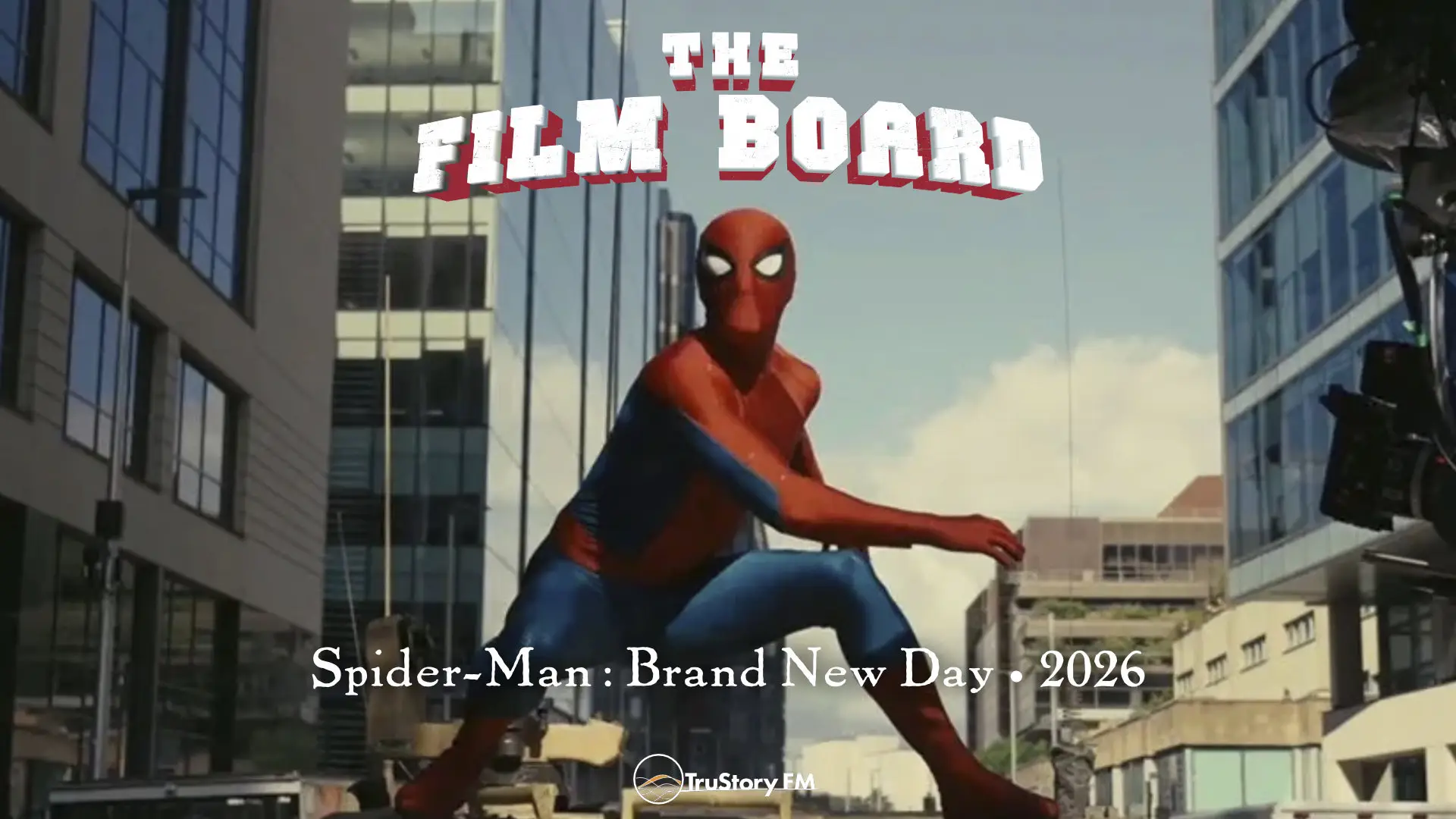
Spider-Man: Brand New Day keeps that reset. Four years ago he asked a wizard to make the world forget him, and the wizard said yes. And this weekend we get to find out what that cost him.
Oh, and he’s also got the Punisher along for it, which is actually a smaller swerve than it sounds.
Ocean Murff:
And why do we have to bring people to help people?
Pete Wright:
Frank Castle’s first appearance was Amazing Spider-Man #129 in 1974.
So here we are. Destin Daniel Cretton directs, script by Chris McKenna and Erik Sommers, rewritten by Justin Kuritzkes. Brett Pawlak shooting, Michael Giacchino scoring, Jackie Chan Stunt Team on the fights. I’m Pete Wright, and this is The Film Board, where once a month we take apart a new release with a room full of smart film people with opinions.
Today’s panel: Justin “JJ” Jaeger, Tommy Metz III, Steve Sarmento, Ocean Murff, and Matthew Fox. Welcome.
And let us begin with opening thoughts around the table, in brief. Beginning with Matthew Fox. How you doing? How’d you like it? Can you do it in brief?
Matthew Fox:
No. So imagine you’re really sick of — like, all the restaurants in your town always serve the same entree and you’re sick of it. You hear about a new restaurant, it’s serving something totally new. You go there, the decor is great, the flavors are great, the flavor pairings are great, the appetizers, the drinks. And then you find out it’s serving the same red-headed entree that every other restaurant you’ve been to is serving, and that you’re kind of sick of.
I loved so much of this movie. I think it is a great movie outside of the MCU, with the exception of the Jean Greyness of it all. Within the MCU, I have some concerns.
Pete Wright:
Concerns abound. Tom.
Tommy Metz III:
Hello, it’s me.
Pete Wright:
Hi.
Tommy Metz III:
I, as the least Marvel-ous person on the podcast, would like to just say that I adored this movie.
Pete Wright:
Okay.
Tommy Metz III:
I teared up. I laughed. It actually has jokes. It actually has characters. It’s outstanding. I thought it was really, really, really thrilling.
This and The Odyssey back to back — this is a good time for The Film Board. Sorry, The Finest Hours or whatever that other movie was called.
Pete Wright:
I was gonna say, don’t worry. We’ve got a lot of movies ahead of us.
Matthew Fox:
I don’t think that’s a good thing.
Pete Wright:
Okay. JJ.
Justin Jaeger:
So I really liked this movie too, and I think I’m gonna make some bold claims about where it sits in the MCU. I’m really excited to talk to Matthew about this, because one of the things that I really liked about this movie was that it felt like one of the more complete films within the MCU. And I kind of get that vibe from Matthew when he says that it kind of is a standalone film.
And it does something that I think is really interesting, because there’s a lot of complaints about the MCU that sometimes it’s too shallow, sometimes it’s too deep, sometimes it’s too comic book-y, sometimes it’s too connected to all of the through lines of what we’re experiencing in the world. I think this movie does all of them very, very well.
And that really goes with the theme of the film when we get into spoilers and we start talking about, are you Peter or are you Spider-Man? And he says, I’m both. Holy cow. That’s what this movie was for me. This was Marvel saying, I’m all of what I am.
And in the result of that, for me, it harkens back to early Marvel days before the MCU. What I loved about the Fox X-Men movies, when they were really essentially comic book movies where you saw the frames on screen. They deliberately put that in this movie and I loved it. So I’m all about this movie.
Pete Wright:
Okay. Ocean.
Ocean Murff:
Visually, it is outstanding. I do think the movie is entertaining. And to keep it brief, I’m trying to wrestle and reconcile with this fact that Spider-Man has been rebooted, but I have not.
Matthew Fox:
We’re grateful for that latter fact, but I see the problem.
Pete Wright:
That is modeling some incredible self-awareness, self-insight, Ocean. I’m really impressed. And we shall begin your session.
Ocean Murff:
Thank you, thank you.
Pete Wright:
The clock starts now.
Ocean Murff:
Thank you. I’m on the couch, ready.
Pete Wright:
All right. Mr. Steve.
Steve Sarmento:
Yes. So every time I walk into a movie, I try to approach it: I’m gonna take this as the text it is itself. A standalone piece. What does that mean in and of itself, separate from all the other things? I’ll look at all that later. Let me just take this as presented. Assuming I don’t need to know anything else going in, any of that, whatever.
With that in mind, what I thought about this movie was that Brand New Day takes on a variety of character-focused story elements and explores them in the context of that small Sony corner of the MCU, and it slightly brushes up against that larger MCU. But it was really firmly grounded in Peter’s personal struggles.
And when you have something so character-focused like that, that is something that to me is a truly compelling and rewarding film, because it stands on its own feet with those things. The rest is extra dressing and sprinkles and sparkles that may or may not add flavor. It doesn’t need it. It may add something to it. Without it, solid. With it, great. It may take it to another level for some people.
Pete Wright:
Okay. I appreciate that stance. I think I’m somewhere in the middle. I would say my emotional experience with the movie was superlative. I deeply enjoyed my time. I found myself continuously looking at my watch — not because I thought it was too long and the pacing was rough. It’s because I wanted my watch to agree with me. I wanted it to slow down. I wanted to make sure time wasn’t passing too quickly, because I was having a blast with it.
I want to talk about the comic mischievousness of this film, and I want to gate it in this first major segment that we’re calling “Is Peter Parker the Problem?”
And this is going to be your chance, Matthew and Ocean, to present the case that Peter keeps choosing to change the world instead of changing himself. Is he really an adult, or is he a kid who has never once had consequences modeled?
Because this is now the fourth standalone film. I can’t remember in Homecoming if he had this problem. But I think every single one of these movies, he has this opportunity to change himself, and he chooses to change everybody else instead. And I’m really curious where you stand on some of these more comic elements. And then I promise we will turn it off and talk about craft in the movie. But we gotta get this on the table. Who would like to begin?
Ocean Murff:
Yeah, I have the hot take that I think Spider-Man’s really the villain. The villain is never the villain of his own story. We’re watching Spider-Man’s stories, and we’re watching the story of a character that doesn’t consider consequences for his actions. He doesn’t really care about anything else. Anytime he has the opportunity to change and grow, he decides, nope, let’s do everything else.
So the basic examples, which Pete did brush on. Let me start with Brand New Day, start with this movie. Basically, instead of trying to work out his problems with Jean Grey, he decides, hey, let me create a device that would end all mutants. Let’s revisit X-Men 3 and then cancel out everybody’s powers.
And why am I making that? Well, turns out I’m changing a little bit. I don’t like it. I could get help to handle this, but instead of that, let me build something that then suppresses me, and then think, oh, how can I suppress everybody else? Because I want to be a control freak and control everything and make sure everything stays my happy way.
And now, the premise of that — why are we in Brand New Day? Because of No Way Home. He was like, oh, my best friend and my girlfriend can’t get into MIT. So what am I gonna do? I could ask, hey, counselor, could you maybe give them a second chance and don’t blame them for knowing me? No. Instead of that, let me think about what I should do. Oh, I know the next logical step. Let’s brainwash the entire world into not knowing who I am. Because it’s inconvenient for everybody to know who I am — even though I live in an MCU, and at this point I am still in the MCU, where heroes don’t have secret identities. Everybody knows who everybody is.
So it’s not like it’s something that I have no role models for, no examples of this, no way that I could grow as an individual to accept that, hey, I can be both. Because Tony Stark is both Tony Stark and Iron Man. Captain America is both Captain America and Steve Rogers, etc., etc., etc. Except for Thor. Thor’s just Thor and that’s the way it’s gonna stay.
But outside of that, he could have done all of these other things to grow as an individual. Instead, he’s like, hey, let me do this world-cataclysmic thing because I want to control everyone else as opposed to growing as myself.
Matthew Fox:
I like it.
Ocean Murff:
And the seeds of that started in Far From Home, where he has a powerful AI that was left to him by his mentor who just died saving the universe. And he recognizes, or somewhere along the way I guess, that he can’t handle it. And instead of saying, hey, let me set it to the side and wait till I can handle it and grow and mature as an individual — let me just give it away to someone else and hopefully you can fix everything, because I’m too busy trying to, I don’t know, hang out with my girlfriend.
And so I think that basically, anytime anything in the world inconveniences him, what he decides to do is, I’m going to change everybody else. And that is some straight villainous activities.
Pete Wright:
Okay. We’ve got applause in the jury. Matthew, where does that put you?
Matthew Fox:
I’m gonna completely agree, and then “yes, and,” because I think everything that Ocean said is right.
Pete Wright:
Got it.
Matthew Fox:
I think clearly we are going to have an MCU X-Men movie at some point soon, where the Spider-Man device is going to be the primary MacGuffin that is used against the X-Men. And I think it’s worth noting: he didn’t invent this. Bruce Banner did.
Pete Wright:
Right, right.
Matthew Fox:
But Bruce Banner was just like, it’s for me and it’s really dangerous for anyone else and I’m not gonna do it for anyone else. It’s Spider-Man who took it and kept running with it.
And I think what a lot of it underlines is something that has been a theme. It’s that it is a lot Peter Parker’s fault. It’s also Tony Stark’s fault, because Bruce Banner is a fully formed adult. Peter Parker is a kid. He is now a legal-to-drink-and-vote kid, but he is still very much a kid. He’s still the sixteen-year-old, or fifteen-year-old, whatever it was, that Tony Stark came along and said, hey, you’ve got a power, let’s throw you into a war. And has never stopped since. And I say the Tony Stark part partially in jest, but partially in truth.
But I think think about how many great villains are people who have a very sympathetic reason for doing their villainy, but they’re still villains. And along comes this person —
Justin Jaeger:
Especially Spider-Man villains. But yeah, keep going.
Matthew Fox:
Yeah. And along comes this person who, through the Daredevil school of magic, has managed to do massive explosions and car crashes, but somehow we haven’t seen a dead body. But her body count is high.
Tommy Metz III:
Oh, shit.
Matthew Fox:
But oh, she did it because of her sister, and Damage Control is also bad, so she must be a hero after all. And I just thought he was fundamentally wrong for that. And we’ll get into more of it, and obviously there’s a lot more to her side of it. But yeah, I think he is a lovable, relatable, incredibly understandable, brilliantly acted villain.
And I thought I had had enough of Jon Bernthal mentoring Tom Holland. I hadn’t. I loved seeing it again. But I just think he’s ethically really problematic, because he’s a kid and he doesn’t know what he’s doing.
Pete Wright:
If there is a bandwagon on which to jump, I choose this point, which is: structurally, the movie picks up effectively right after the events of the last movie, and then it moves us forward four years.
Matthew Fox:
Yeah.
Pete Wright:
Because MJ and Ned get into MIT and they do their four years, and we check in with them by social media. Meanwhile, Spider-Man is completely absorbed in his work as Spider-Man. He has a terrible social life and does a ton of doomscrolling, but my God, is he peak Spider-Man. And I do adore that.
The thing that I think is challenging with this movie is that it is exactly your point, Matthew — he is still a kid, but the movie wants us to believe he is an adult. He’s out of college age. He is brilliant. It’s not as if he desperately needed the intellectual pursuits of college, but he totally needed the maturing pursuits of college. He totally needs his brain to keep baking for a little while longer. Because to Ocean’s point, every single one of his choices in these past movies, including this one, are teenage impetuousness.
And that just feels to me like we get a kind of a lovely mix of the high school Spider-Man that I loved so much from Homecoming, and we get to see him still fighting those demons. But that’s the part that feels sort of emotionally repetitive, I think, for me. I don’t know what they wanted me to believe about how he had matured, but I’m not sure that I saw as much of it as maybe I was ready for. Was I ready for Jake Johnson Spider-Man? Not quite. I didn’t want that one. Steve.
Steve Sarmento:
So this is one problem I have. There’s a lot of things going on in this film and they’ve got to tie up story ends, and that’s the one that I think I personally wanted to see more on. Because yes, he’s gotta go out in the world, he’s gotta adult. So he throws himself a hundred and ten percent into being Spider-Man, to the point where it’s like, dude, you need to have balance in your life. You can’t just always do this. And it’s taking a toll on you.
To me, I think that feeds the storyline of, are you Spider-Man? Are you Peter Parker? And I needed more to see how he resolves that. It leads to his decision about the inhibitor, all that. And so the resolution is, who are you, Peter Parker, Spider-Man? It’s taken science for him to try to balance things out. He’s got hormonal imbalances. He’s got different powers that conflict. And the resolution — how this all gets fixed — is he says, I can be both. That’s all we need to know.
There was — I didn’t see anything that got him to that point, or what he had to give up and sacrifice, what it cost him, what he had to accept and take on to create this balance. And that’s the one part where I thought, that’s the story I wanted, because that’s what this really is about.
He was immature in those earlier movies, so he has to grapple with how to function as an adult in the world and take on responsibility, because just being Spider-Man is not sustainable. He needs that Peter Parker. And how to balance that has got to be more than just, well, I’ve decided, so it’s so.
Pete Wright:
Yeah, in fact it’s more stress that led him to this reconciliation. He is deeply addicted to work. He has no balance and he never found balance. He just stumbled on it, right? I think they wanted us to see it.
And let me say, I don’t really care, because I loved it so much when his web shooters blew off his wrists and he started oozing web fluid. That was great. They had me.
Ocean Murff:
You didn’t have the gross reaction that they had in No Way Home, when they found out that the Tobey Spider-Man could do that and they were like, how does that work?
Pete Wright:
Oh God, I loved it. That is the greatest gift of Sam Raimi, I think — just, let’s be done with web shooters. I think that’s absolutely fantastic and I’m here for it. JJ, where do you weigh in on all of this stuff?
Justin Jaeger:
Well, I think these are all really great observations. And one of the things that I think is interesting is, I had never considered that these are really villainous actions by them. But I’m extremely deep on the whole X-Men universe.
So one of the interesting things that I’m considering now about Spider-Man, that I have always kind of applied to all the X-Men, is that some of the subversion of the story here is the fact that within the heroes as first-person protagonists, we have the rest of the world experiencing what the heroes do as antagonists.
So yes, this story, even the story that we have here in Brand New Day, is somewhat valorizing or justifying what Jean and Peter are doing here. But the reality is, outside observers — they are outcasts and freaks that are continually destroying people and society and all these things. And that is the essential conflict that sits within Peter Parker’s character over the course of his things.
Matthew brought up the idea that all of these villains sort of have these pure intentions when they begin, but they’re all of Peter’s idols that turn out to be terrible incarnations of what mutation can do. And if you look at the X-Men — yes, Jean is extremely problematic for everything she’s doing here. And potentially, I and my kids were very excited to see her driving upstate at the end of the movie to make her way to the school. But that’s really the concept of mutants in general. Everyone’s terrified of them because they do these terrifying things.
And it’s important, I think, an important part of the story is to see that they are human too. And that’s kind of the beauty of what is expressed to us in this movie. You can definitely see them as a villain, even though I didn’t think that. I think it’s a great hot take. But I’m on the side of the outcast here, and wanting to figure out a way to understand their humanity even in their power. So I love it. I think it’s a great take and I think it’s a great thing to consider about the movie. And I’m still a fan of all the characters.
Matthew Fox:
And I just want to add to that, because I think it actually solves one of the oddest problems of having the X-Men in a larger universe. Which is that a lot of the time it feels like people are super happy with every kind of superhero, many of whom are genetic mutations just through outside forces. But the X-Men, who have this naturally evolving gene — they’re so crazy and weird.
And I mean, I lived in New York City. Renter’s insurance was already bad. In this world, it’s going to be a lot worse. Property damage is just really common. And I don’t think the act-of-God clause works for Loki or Thor.
But I think the idea of a world that might want to limit the powers of X-Men is of course gonna want to limit the powers of Dr. Banner, who is also a mutant. He’s a mutant for another kind of reason. And so while I have a lot of issues with how this is kind of introducing the X-Men, I did think that connection of Banner — if anyone’s gonna be wanting to give you restraint, it’s Banner more than anyone else, certainly more than the X-Men.
And then let’s talk about that problem of who should be doing the restraining, and what happens if they’re using that power, and all those ethical questions that you’re bringing up. That was one of the things I loved most about this movie. And I thought one of the most interesting twists on the stories we’ve heard before.
Pete Wright:
I want to lean into the Jean Grey effect, and I’d also like to remind you all that Tom is still here.
Tommy Metz III:
I’m enjoying listening. This is fun.
Pete Wright:
I’m curious from your perspective, Tom, because you’re the one who is least connected to all of this stuff. Do you feel like the movie needs you to know who Jean Grey is in order for it to work?
Justin Jaeger:
Good question.
Tommy Metz III:
That is a good question. When they turn around and they go, we finally have a name, and it turns around the computer screen and says Jean Grey — I was like, uh oh. That was my first — because I was in a pretty full theater and there was a good amount of people that were like [gasps]. And it reminded me of when some bearded guy in Lord of the Rings showed up and everyone’s like, it’s his brother, and I’m like…
That being said, I was able to — I think it’s my experience with the TV show Legion that let me understand this person is just so powerful. And it is sort of an amalgamation of a bunch of different powers and able to do so many different things, that I was able to latch on pretty much immediately.
So no, I didn’t know who that was. I still don’t know who that is, but I respected it, and I loved to have such a powerful character but then to show the powers manifesting in such an analog, beautifully analog way. It made it so accessible to me.
It reminded me of the movie Fallen, from Denzel Washington, where you’re just able to look at someone and they become them. Watching them — in the credits, they call them the Inhabited. That was a really cool way to show all the Inhabited in a race across a city. That helps me as a newbie idiot reach out and be like, okay, I can meet this movie, because it’s not just sort of floating craziness. It’s really practical stuff involving real people. So I hope that answers your question. I didn’t know who it is. I knew it was important, but it didn’t matter. It worked. They held me in the right hand, which was great.
Ocean Murff:
I think that’s one of the great things — at least I will say very positively about this movie — is that in reality, the way they structured it and all that, Jean Grey’s history, backstory, and all that stuff really is irrelevant. They did a really good job of establishing kind of what she could do in this universe, enough of who she is. They made up a sister, and then they just built together a good origin story for the supervillain team-up.
And so I don’t think that you needed to know who she was. And I honestly appreciated that. I’m glad that they weren’t throwing in a bunch of things that, even though I know who she is, it’s like, well, yeah, I understand this because I know who it is, but now I have to explain to my wife what’s going on. And so I didn’t have to do that. They did a really good job with that. And I look forward to what they do with it moving forward.
But even standing alone in this story, I do think it is an interesting, problematic thing that she has then become sympathetic because the real bad guy is Shield USA branch office — what is it, the Department of —
Matthew Fox:
Damage Control.
Pete Wright:
Damage Control.
Ocean Murff:
Damage Control. Like, they make them the villain in a sense in the movie, and then you know that she’s just kind of trying to find her sister again. That whole storyline — that part for me did not resonate with me that well. I was like, okay, well fine, she’s just doing that. But it was a good origin for her.
And again, I did find it was entertaining and visual. But at the same time, I did like how they brought Spider-Man back to meager potatoes, and had a character that you didn’t need to know everything about. Because that is a problem with some of the Spider-Man movies, or MCU movies in general — they introduce characters that if you don’t already know who they are, then everything they’re doing is confusing. And I think this movie did improve upon that.
Pete Wright:
This may be one of the great gifts of the final, ultimate collaboration between X-Men and MCU. Jean Grey, historically Professor Xavier’s first student. She’s on her way up to Westchester, presumably, where the school does not yet exist. There is great fodder for helping us structurally to again earn our wizards, to build in X-Men cinematically in a way that I think we don’t have to do a lot of homework for.
So on that front, I’m kind of on board. There is a giant Doomsday-Secret Wars-shaped hole between here and there that I’m very nervous about, Matthew.
Ocean Murff:
Yeah, I think they’re gonna wreck it, because I see Patrick Stewart in the trailers, so we’re not rebooting with that.
Pete Wright:
Yeah. We’re trying to end the multiverse here.
Ocean Murff:
So, yeah.
Pete Wright:
Do we need a bigger explosion? Matthew, you had a point. Your hand was raised.
Matthew Fox:
I just want to quickly give my “why I’m sick of chicken parm” argument. And I love hearing that for folks who haven’t seen her story a bunch of times — or even who have — they really loved it. I think for me, I kind of audibly groaned when I saw who it was.
And I think it’s just because I like Jean Grey as a character, but so often the only story we get from her is that she is a woman who is so powerful and so full of emotion that she needs a guy to talk her down somewhat before she harms the world. And we’ve seen that in — she’s now the third actress in the X-Men franchise to do that. We’ve seen the same story with Dark Willow in Buffy. We saw it with Eleven in Stranger Things. Apparently it’s shown up in Charmed. It’s just one of the most common tropes of a powerful woman character. And I just would have loved to see something else. So there’s that part of the rant.
And then the other thing — and here’s where it’s the MCU of it all — I did go into this thinking, this is the last movie before Doomsday. What are we gonna do to set it up? And so unfortunately, once I heard it’s Jean Grey, there’s a part of my brain that’s now thinking, okay, so what are you gonna do? Where’s the Tesseract of this movie? The last movie before Avengers introduces the big plot point that becomes so important to Avengers. And so I kept thinking, okay, well, how is this the gateway into the rest of the X-Men, or into how the X-Men are in this universe, or something like that.
And I just found it very — and I think if I watch it a second time not knowing it, I’m probably gonna like it a lot more, because I won’t have that. I think this would have been much better — I would have enjoyed it a lot more if it wasn’t the last movie before Doomsday, and I didn’t have all that Doomsday nervousness.
Pete Wright:
Yeah.
Matthew Fox:
But I just think that’s for me why — I think the Jean Grey story is great. And frankly, I think this is the best version of it that we’ve seen. And I think Sadie Sink is fantastic as this character, and I want to see more of it.
Pete Wright:
Yes.
Matthew Fox:
And I’m really glad we didn’t hear the words Dark Phoenix — except that that means maybe we’ll do this again. I used to love chicken parm. It’s such a good dish, but I’ve just had it so many damn times. That’s why I was not in love with that part of it. And if other folks aren’t there, that’s fantastic, and I’m so glad for it.
Steve Sarmento:
When I saw Jean Grey, I let out an audible gasp. And then I thought — not forward to Doomsday, because I don’t care about that, that looks like just such a muddled mess. But I went to New Avengers. And what was so fresh about that is, let’s look at how we deal with emotions, or don’t deal with emotions, and all that.
And I thought, teenage Jean Grey or whatever — okay, this is where Marvel’s taking this wing of this universe, where it’s a little bit more of the Fox-Sony ownership, those pieces. And instead of this big overblown cosmic rays and intergalactic stuff, I’m like, we’re dealing with people dealing with human emotions and how they grapple with them. And I thought, that’s interesting.
And maybe it was the presence of Florence Pugh that just helped sort of solidify that connection. I thought, this is the corner of the MCU that I’m really enjoying what’s going on. I don’t need everything to blow up. I just need people to grapple with themselves and each other.
And so I’m hoping we get that phase of Jean. I’m curious, as Pete brought up, of sort of rebooting that X-Men — I think it gives us a different angle. We’re not beholden to owning everything that came before and having to connect to that. We’ve broken it off enough that I think it can be its own thing and people will be okay with that, I hope.
Pete Wright:
I think this is a great way to sort of transition into some craft stuff. Because for me, we have some massive characters in this movie, and I would like to hear how you guys feel they were handled.
We start with Jean Grey. Obviously we’ve talked about how that works. The character itself isn’t introduced until really about forty minutes into the movie. We have a lot of Peter stuff, trying to figure out his angst, early in the movie. The pacing for that for me worked really well.
But we also have, I would say, a significant cameo — maybe probably more than a cameo, depending on your cameo canon rules — from Yelena. We have Banner-Hulk. We have a significant presence of Hulk, and I’m frankly very interested in how that hits. And obviously the Punisher. I would like to know how well you thought those were woven in. Are they earned? Are they expected? Are they things you’d like to see more of? How did they all fit into a Spidey movie? JJ, you go first.
Justin Jaeger:
Well, I think the thing that I love about it here is that, regardless of my impressions of the way they’ve done it before, everything seemed to fit well here. So each of — let’s just call them cameos, even though we can quibble over the semantics of what that means — but their purpose in the film made a lot of sense, both in a story way and for advancing what we wanted from this individual movie.
We got comic relief in some respect from them, and yet they also were really integral to what we were talking about. Specifically like what Steve was talking about in his last comment about the emotional pieces that are here. It was a connective through line to what we found from Thunderbolts, from the New Avengers. And I am never gonna complain when Florence Pugh is on screen. She is fantastic and charismatic and captivating with everything she does.
Now, Jon Bernthal is a great New Yorker. Pete put here in the show notes the aspect of the emotional nature of the Punisher. I agree, he’s not the book Punisher for me. But my kids loved him, and they love that — whether it’s caricature or not, whether it’s completely skewing Tom Holland’s accent or not — it ends up being extremely likable for what’s in there.
So in what I would take for cameos, this film does it better than most MCU movies. And because of that, I’m happy with the presence of everyone here. It all seemed relevant. And that’s the nature of the IP. If you look back to comic books, they’re dropping in the relevant IP characters when they make sense for the story. And here I feel like they got it right in a way that they hadn’t got it right before.
Pete Wright:
Tom. Jarring, not jarring, structurally sound?
Tommy Metz III:
Not jarring. I completely agree with all of this. JJ started in his opening thing saying this feels like the most complete movie. People have brought up meager potatoes. That’s what worked in this movie for me. You don’t have to blow up the entire — and what Steve is saying, now I’m just sort of saying what everyone else said, but now it’s my turn — not everything has to be a galactic shove-down-your-throat epic event.
This is a New York story about New York people. And not all of New York, and New York isn’t taking off and being sent into space or anything like that. It works because, just like JJ’s saying, everyone’s there for a reason. Sometimes emotional, a lot of times story-wise. And so it doesn’t feel like people are just sort of popping in for no reason. That’s what I loved so much about this — it wasn’t trying to, like you’re saying, Pete, put its arms around the entire MCU world.
That’s why at the post-credit scene of Ned’s thing, and showing Spider-Man’s in space, the only thought I had was, well, that was fun while it lasted. Like, oh well. Okay, whatever’s coming up next. I don’t understand what Doomsday is or what’s happening, but I could already tell it’s not going to be as for me as this movie was. Because this movie’s super New York-y and that’s really cool. To have the end credits just be a bunch of B-roll of the city. It’s a gritty, cool movie. I like it. I was very happy with it.
Matthew Fox:
Two things, one quick, one long. The one non-New York moment: Tom Holland grew up in New York City. He’s in New York City. He does not get his pizza from Little Caesars. I don’t care how much product placement that was, that was offensive and wrong.
Tommy Metz III:
He’s just swinging by Sbarro and you’re like, okay.
Matthew Fox:
Come on, there’s a local place.
Pete Wright:
Oh, look, a mall.
Matthew Fox:
There’s a local — but no, I completely agree with that. I think again, it’s that my enjoyment of the movie is harmed by just being too MCU’d, because I think everything you just said is perfect. The small potatoes, big potatoes was great. It addressed that question.
I think again, I was just waiting for the help me. I am so nervous about Doomsday and I wanted this movie to be the on-ramp to it. And I think I’ll enjoy it more because it didn’t try to be, but I was frustrated in the moment that it wasn’t, because it means, yeah, Doomsday is going to be a complete and total wreck.
And then the flip side was — Steve, you were making that great point about like the teenager-ness of it. And it got me again. I think it’s the larger context, because I did think most of the cameos were great. I could have done without the Hulk, but I get why it’s there. But I was also thinking, if you’re telling a story about teenagers in the MCU, where’s Kate Bishop? Where’s Kamala Khan? You’ve done so much to introduce the New Avengers. So yeah, it’s once again for me the same thing of, I think the more we can separate this from the larger pace of the MCU, it is a fantastic movie. I don’t get where it fits. And maybe that’s the whole point, is that it shouldn’t.
Pete Wright:
Yeah. I think that’s maybe the best point, Matthew. And I feel like I’m on the other side of it. I’m so nervous about Doomsday and Secret Wars that I found myself so relieved that this movie didn’t lean too heavily on it. That this movie can exist as a Spider-Man gem in a series of Tom Holland Spider-Man movies that are all in their way gems. And this movie just landed really well.
I think this specifically — the big potatoes, small potatoes. Yelena exists in this movie. That means there’s a connection to the New Avengers, Thunderbolts, whatever. We constantly come back to the same refrain when we talk about superhero movies: here’s a massive thing going on, why aren’t X superheroes joining the fight? And here we are. We have a great big thing that’s happening. Bruce Banner is knocking down a building in the middle of Manhattan. And Yelena just told us why — because now we know what is a big potato and what is a meager potato.
Matthew Fox:
Good job.
Pete Wright:
And I low-key love that she is hanging out in a bathhouse while the city is being destroyed, because the bathhouse is bigger potatoes for her than the kind of destruction that Peter’s dealing with. That’s fantastic structurally — just from the perspective of getting these characters on the page without it feeling super muddied, giving all of the hero moments big things to do and think about, and all the cameos significant time on screen without feeling clumsy or shoehorned into the story. I think it’s a real hit. Ocean.
Tommy Metz III:
I would see the movie Yelena Cole in Office Hours.
Pete Wright:
Oh.
Tommy Metz III:
I would be fine with that. That’s the only problem that I had with the bathhouse scene. I was like, can everyone just stand up? Just air dry. It’s like the most beautiful room in the entire world. Sorry, Ocean.
Ocean Murff:
No, no, I was gonna — yes, first off, I would like to have an appointment at the Yelena bathhouse for an office visit, for any duration of time. I’m free and available and I’ll clear my schedule accordingly.
The one thing that, when it came to all of that, that I felt did feel shoehorned in was the Hulk. And that for me took me out of it a bit. Because I am kind of getting tired of — okay, so every time you put the Hulk on film, he’s different and vastly different. Because we had the Smart Hulk, which is in my opinion the best incarnation of Hulk, where he is both Bruce Banner and the Hulk. He’s big, he’s green, he’s smart, that’s great.
And then we went back to Savage Hulk for no real apparent reason. We shoehorned him into a movie where he doesn’t need to be, because the only logical plot point you could say is that whole thing about the inhibitor device. But then you could have just used Dr. Connors and brought him in, because he had the lizard guy. Lizard guy’s doing the same thing — he’s just trying to augment your DNA, where he’s like, well, what if I wanted to reverse it? Like any good villain would. Let me reverse what you’re doing. So you could have used existing Spider-Man characters, kept the small potatoes and left it there.
Having the Hulk in there just makes it where now you’ve entered this confusing element that is not necessary. You don’t need his power to get into whatever the building is that Jean Grey is trying to get into, because the Hulk doesn’t get in somehow. Somehow this building can resist the Hulk, but nothing else can. He remembers, in air quotes, Peter at some point somehow, and then doesn’t snap his neck, which he easily could have done. He’s twice as big for no apparent reason.
And so the whole Hulk thing just felt like, hey, we just needed this cool CGI thing to throw in here, guys. Let’s just do this. And then that does make it confusing again, because now the next time I see the Hulk, I’m sure he’ll be completely different. There’ll probably be Grey Hulk, the fixer guy that’s working for the mob somewhere in Brooklyn.
Pete Wright:
I’m okay with that. I’m down for Grey Hulk. Hashtag release the Grey Hulk cut.
Ocean Murff:
Yeah, exactly. Don’t get me wrong, there’s part of me that wants that too. But at the same time, of the different cameos, the movie has a couple areas where I think it loses its way on what it’s trying to be. It’s trying to be meager potatoes. I applaud that. But now you’ve thrown in the Hulk, the exact antithesis of meager potatoes. He is so big and so powerful and such a big presence and a big force.
And is he now the character that’s in the most MCU movies? Because he’s in everything without his own standalone thing. And by making him different and regressing him for no real apparent reason, he just kind of creates this big confusion that doesn’t really have a big payoff. But the other cameos I thought were great.
Pete Wright:
That’s interesting. I actually find I like Ruffalo’s portrayal of Hulk almost in succession, almost every time, a little bit more. I like seeing Ruffalo as Banner. I like seeing Ruffalo as CG interpretation of massive Hulk. I actually like that they acknowledged it. I didn’t know you could get that big. I don’t know why he got that big. Is that because he is regressing? Is that because Jean possessed him? The film is kind of doing both.
And by the end he has that solemn puppy dog face as he lets himself fall off the side of a building. That was a good moment for me. That played.
Steve Sarmento:
Yeah, I enjoyed Hulk for two things. I again have to remember everything, but Hulk possessed by Jean is trying to get into the room, and I think she doesn’t — I mean, operator error. She doesn’t know what he’s capable of. She’s just gonna try and smash the door. So I’m thinking that’s one way to logic through why Hulk isn’t getting in there, because Jean Grey is operating this behemoth of a thing.
And I did appreciate, going back to the inhibitor, Banner’s one line of, you’re trying to inhibit all these things, maybe some things do need to be expressed. And I thought that sort of laid the ground for Peter’s acceptance of this. So I’m gonna just touch on that just to throw those points out there.
But I really dug into Punisher on this, because I thought that was the interesting piece. There was so much about whatever happened on Staten Island, and I hadn’t watched The Punisher: One Last Kill, that little special event thing.
Ocean Murff:
Don’t. No, don’t watch it.
Steve Sarmento:
So I was like, oh, did I miss something? So I went back and watched that.
Pete Wright:
Yeah, okay.
Steve Sarmento:
And here’s the thing. It absolutely makes sense. Frank Castle’s dealing with, I have completed my mission, I have completed my vengeance. What has it done to me? What type of person am I? Grappling with that emotional arc, which puts him in a place I think very appropriate for Peter’s story of, if you are the workaholic that’s so driven by one thing and one thing only, that will destroy you.
Now Frank doesn’t have that conversation, but I think it was a nice parallel for those story arcs. If Peter just becomes Spider-Man, he’s going down that same dark path Punisher did, where you can do all the things but it won’t satisfy the feelings.
And I thought that was enough. Yes, he may be a lighter, softer, gentler Punisher than in the books, but I think it fit well. It gave Peter something to play off of. It brought a little bit of heaviness to the story. And again, both dealing with loss, having something to connect to, to have that moment of Frank losing his family, Peter losing May — which is a key piece regarding his motivation, a secondary motivation for, people that get close to me, people that know who I am, if everybody knows who I am, it puts everyone I love in danger.
Matthew Fox:
Yeah, that’s a good one.
Steve Sarmento:
And so I thought that cameo made sense for me. I think we’ve touched on the others enough. I just wanted to sort of highlight that little bit about Punisher there.
Pete Wright:
Number one is just the expression of Spider-Man in this movie, because that’s a thing we haven’t even mentioned. His spider puberty is causing his arachnid DNA to express itself in a way that allows his eyes to go black and his spidey sense to get super activated. And he gets his wrists to go bonkers, and now he becomes Peter too.
I was a little bummed that the marketing of this movie embraced the hero fight against the Hand quite so thoroughly, because man, I was moved by that fight scene on the big screen. I thought that was one of the best things going on in this movie. The sort of dance mechanic of the Hand as they were attacking him. Obviously that’s the Jackie Chan stunt performers right there. They are brilliant with their rope work. And the final expression of Peter being able to allow his arachnid self to come forth, I thought, hit home really, really well. JJ, why are you smiling so big?
Tommy Metz III:
That was my favorite — oh, I’m sorry.
Pete Wright:
Tom? Yeah?
Tommy Metz III:
That was my favorite sequence as far as non-emotional action sequence, is when they embrace their inner Wachowski. And there’s that part where he spins and the camera spins with him 180. Now he’s on the ceiling fighting them while they’re all down there. I just started laughing out loud. I’m in a theater full of people, and I was like — it was just neat in ways that I don’t feel like when Red Hulk is — when Harrison Ford is beating up Hulk, in the epitome of fake on fake in a cherry orchard. Like this, everything seems practical and cool, and it really felt Wachowski-esque. It was really neat. I loved that.
Justin Jaeger:
Well, and that’s the thing. Like in that fight scene, and then the other thing is, throughout the film, the action sequences, the action camera work in this movie was superior. They integrated things about — as silly as it sounds — the basic aspect of Spider-Man, the swinging through the city. I feel like this was the best version of it that we’ve seen in any Spider-Man movie yet.
And it integrated pieces and different things from all of the Spider-Man games that are out there. You’ve got the Sony PlayStation version of swinging. How did the filmmakers choose to make first-person swinging things? It’s something that we see in gameplay, but they’ve integrated it now into the film in a way that we haven’t seen in any of the other movies.
So yes, that fight scene, because all of that action that you mentioned, all of these great motion control shots that are being done to kind of bring you into the Spider-Man experience — which is something that we first experienced with Into the Spider-Verse, where they’re saying, oh, everybody can be Spider-Man. Now they put that in the live action here. You see, as Spider-Man is hurt, everybody is taking on the Spider-Man mantle and stuff. And they do it as part of the experience of watching this film.
It’s that kind of stuff that made me lead my belief to this being one of the more complete films. Because we sometimes on this show, and on any of our shows, will talk about in the negative that a film is like a ride. This was a ride and a film in the way that I enjoyed every part of it. It was exciting to be a part of this film. It was exciting to go on this ride. And at no point felt superficial or shallow in the way that it expressed it.
Matthew Fox:
And just to add to that, to me the best part of all that is that it also contains what I think is the most Peter Parker moment I’ve seen from Tobey, Andrew, or Tom. Which is that ninety-nine percent of the world, when a whole bunch of sword-wielding ninjas are leaping at you, are not gonna say, man, that’s cool. But Peter Parker will.
And I have never seen him capture that essence of, in the midst of a fight — and like, yes, we had some of it all the way back in Civil War when he was introduced. But I haven’t seen it again. And that moment, I literally cheered. I was so happy. And it just set up the fight so well, knowing that Peter is like, these guys are badass and I get to fight them and that’s okay. Now let me survive. The whole thing was perfect, and it was so practical, and everything you guys just said.
Pete Wright:
You know what else I found myself really lingering on as I walked out of the movie is just how often Spider-Man, Peter in suit, is on the ground. Do you know how many doors he walks through in this movie? He goes into buildings in the front door in the suit. He has to walk through a metal detector. When does he do that? Usually he swings, he attaches himself to a building, he climbs through a window, or he comes in through the roof.
This Peter was on the ground, and I low-key loved it. I loved his relationship with the detective. When he’s always down in a crime scene walking around, hands on hips, what do you think? It was weird in the best way, for my money. I’m delighted in it.
So back to the expression of Spider-Man. We also have these moments, I think, as Peter Parker, where again he gets to challenge the spell, challenge the memory loss. And he does that with MJ. He does that with Ned. And the end of the movie is a hard cut on Ned, who frankly isn’t in the movie all that much compared to his man-in-the-chair role in some of the other ones. Where do you stand on the trio’s relationship in this one? Steve, you want to take it?
Steve Sarmento:
It’s an interesting thing going — if we’re gonna do resets on things, how do we do that and do we make progress? I love the moment of Spider-Man just sitting down putting together Legos with Ned, because it’s giving us that dynamic. It’s giving the character Spider-Man that balance in life he needs. That, I don’t have to carry the burden, I can just be a guy doing something he enjoys with his friends.
And going into this, I thought, how can we bridge this? They can’t remain completely indifferent to each other the whole time. How do we get there? And it made enough progress, I felt like, okay, we bridged that. And it worked.
And the dynamic between them — I love to see the journey from just observing to being able to interact in a new way of, I’m Spider-Man, I’m gonna connect with you on this way, versus I’m Peter first and then Spider-Man. He is now Spider-Man first and then, oh, you are also this guy. And so I like that little twist about that. It brought something for me that’s new and fresh to that, while still feeling true and honest to the characters as we’ve known them.
The allusions — Ned refers to the other movies, of maybe you’re somebody we know because you were at all these places. He’s got his board, he’s putting those things together. So it’s not like a magical, the veil is lifted, but we’re getting little incremental progress towards understanding. And for me, that worked really well.
Tommy Metz III:
And it’s important to take the time to do that, because this — and the connection with Yelena for me was, with this movie, Thunderbolts and this movie are both about mental health. Thunderbolts was about depression, and this movie is largely about the loneliness epidemic, especially for a teenager growing into a man. And so that’s just really important, to have the patience and take the time to show really the difference between workaholic Spider-Man and friends Spider-Man, which is great.
Matthew Fox:
I think the scene where Zendaya — sorry, MJ — finds the letter and reads it, and then doesn’t fall back in love with him, was my favorite in the whole movie. For so many reasons, but especially because we talk about the first Tobey Maguire Spider-Man as really starting a new era of superhero movies. And one of the things that it got us was this idea that you can’t be the hero and get the girl. Like he walks away from MJ.
And at the time, I think we all loved it. And I think that has become really played out, in part because we’ve started to wrestle with, this is someone taking away the agency. He’s not letting her be a part of the decision. And so for her to come back at him and say, I get why you did it, but you didn’t give me agency, you didn’t tell me — to me, it felt like not a critique of that original one, but a “look, that made sense twenty years ago, but today we’re in a new era of understanding relationships, and we’re gonna have something fundamentally different.”
And it’s interesting. I’m curious if the way I see this is different from everyone else. To me, it didn’t feel like — I kind of wish we were gonna get more of the “she’s slowly starting to fall in love with him all over again.” The fact that she remembered his face enough to draw his face in that drawing, even though he’s wearing the mask — brilliant. But I think what we’re supposed to take away is that part of what Jean Grey’s mental stuff did is jogged something loose.
Justin Jaeger:
So that’s the conspiracy theory that I’ve seen on the web now, and that’s why she has the tear during her frozen part. The whole thing about Jean Grey, when she can help people remember things, she can put things back in people’s minds — is that based on what she’s done with Peter and what she’s learned about being with Peter, she chooses to give MJ back the feeling or the memory of that.
Now again, it’s just a conspiracy theory. It’s a way to interpret what happened there, but I think it’s beautiful. And it also is set in this thing that I’ve sort of watched online, to explain why MJ at the end is on top of the roof with the dahlia and having her emotional moment there. Which I think is a great way to potentially take the story.
Matthew Fox:
I thought that was just clearly what the movie was saying, especially since Ned at the end also has his memory kind of awakened. But anyway, I’ve said enough.
Justin Jaeger:
Yep, I love it.
Pete Wright:
Okay. Finally, just so we can get it out before we move to Letterboxd, let’s talk about the post-credits scene. It’s a post-credits graphic, is what it is. It’s Ned’s app, and it’s the Spidey Tracker, and there are no spider sightings on the graphic, and then it zooms out, there’s a spider sighting, and it’s in the far reaches of space. Maybe, dare I say, another in the multiverse.
Did any of you — and I’m gonna start with Tom — have any wishes, hopes, dreams, prayers, insights as to what that meant when you saw it?
Tommy Metz III:
I think I already sort of said mine when I said it was nice while it lasted. I don’t want Spidey in space.
Pete Wright:
Got it.
Tommy Metz III:
I’ll take Spidey anywhere, mostly in that bathhouse. But putting him in space is a step in the wrong direction for me.
Ocean Murff:
Worst post-credit scene ever.
Pete Wright:
Anybody else have any hopes? Worst post-credit scene ever.
Ocean Murff:
Worst, yes. Because of the information, it gives you stuff you already knew. Of course he’s coming back. And then the second thing is, why go through all the trouble of rebooting him back to normal if you’re just gonna put him back into space? So it is the worst.
No, I thought it was an awful idea. It does make it sound like he’s gonna be in Doomsday, which — why? Because cramming him in there doesn’t even make sense, because no one knows who he is. So why would he be there? So, worst ever.
Justin Jaeger:
So there’s a whole bunch of theories out there that it’s not Tom Holland that’s actually going to be in space.
Pete Wright:
So many.
Justin Jaeger:
It might be Tobey Maguire. That also could be something about the story aspect of Patrick Stewart and James Marsden. The idea of Doomsday — and it’s really the Doomsday trilogy now, because we’re talking about one Doomsday movie and potentially two Secret Wars movies — but what they’re trying to do is tie up all the old timelines. And since we know nothing about the tracker, it could be also telling us about Tobey Maguire and not Tom Holland.
I agree that it was a terrible end scene, and it told me nothing that I didn’t already kind of know. And it put me on board with all of you guys on this, where it was like, I love this movie and now I’m terrified about what’s gonna happen next.
Pete Wright:
I just have — go ahead, Matthew.
Matthew Fox:
I was gonna say, I got to the last third of the movie and went, all right, this movie isn’t gonna set up Doomsday. I’ll wait for the post-credit scenes to do that. Because remember, that’s where Thanos was introduced, was in all that.
Pete Wright:
Yeah.
Matthew Fox:
And I ended it going, okay, cool. So what this tells me is, I’m really excited for Spider-Man. I’m probably not gonna go — I mean, of course I’ll go see Doomsday, who am I kidding? But that was your last chance. That was the last piece of cinema that will happen before Doomsday comes out. And we still know nothing. We don’t have a Tesseract. We don’t have him reaching for the glove. I was baffled by it. I was like, I don’t understand what you people are doing here.
Pete Wright:
Here’s my wishcast. And it is, I think, substantiated by a couple of points, but I’m not gonna go into those specifics. My wishcast is — and again, leaning heavily on the Doylist interpretation of the MCU — Tom Holland is signed on for, I believe, five additional films now. He’ll be thirty-seven, I think, when he does his last one.
Doomsday, apparently, if he’s in it, it is a very minor role, because they were filming Doomsday while he was filming this. So he was just not largely available for the movie. So if he’s in it, it is gonna be small.
What this got me excited for is what happens after Peter Parker Spider-Man. Because at some point there is going to be, as the result I think of the Doomsday-Secret Wars wrap-up of Phase Six, a uniting of Peter Parker and Miles Morales. And for me, giving us a Spider-Man trilogy post-Tom Holland with a Miles Morales lead is the only Spider-Man future for Sony. It has got to be that.
MJ and Peter are friends, sure. I would love it if the next two movies introduce Black Cat. I would love all that. But at the end of this, I want to see Miles Morales in the black suit swinging around New York. That would be — that’s my wishcast. And I think there’s a chance that maybe the Spidey Tracker isn’t tracking anything related to Doomsday, but it’s actually just talking about the next Spider-Man movie writ large. That gives me more hope.
Justin Jaeger:
Interesting.
Pete Wright:
How about that? Okay. We’ve got to — I’ll take it. We’ve got a Letterboxd. We’ve got to give our ratings out of five stars. Half stars count, for all of you. And you can also, of course, give it a heart to show your glowing, glowing enthusiasm for those five stars. Steve, where do you start?
Steve Sarmento:
I start with, this is probably one of my favorite Spider-Man movies. I love the story. Had a great time. As I said, I love that it just brushes up against MCU, just sits with Spider-Man. Four stars. Solid, solid four stars and a heart.
Pete Wright:
That’s going up, right? We all know that’s going up for you. That’s just you being four-star Steve on a first watch, right?
Steve Sarmento:
Yes, it’ll probably creep up. But first watch was really enjoyable. I mean, if you can’t get into a screening of The Odyssey, definitely go see this. This is so much fun.
Pete Wright:
Okay. Ocean.
Ocean Murff:
Yeah, I think that for me — visually it was great, the story was great, it’s entertaining. You don’t have to know everything to know what it is, and I think that there’s something to be said for that. Even though I am a complete comic book geek — or I guess nerd. I’ve always been offended by the term geek, but that’s just me. Anyway, so I’m a complete comic book nerd. I’m into having it be super complicated. I like all the Easter eggs and all that.
But at the same time, I think that this movie is good in the way it is. I have my quibbles with it, but I do like the introduction of new villains into the MCU — or old villains. And I’m gonna stand on this: Spider-Man’s a villain. And I like villains. So I like the villain movie here. So I give it four stars and a heart.
Pete Wright:
Four stars and a heart from Ocean. All right, JJ.
Justin Jaeger:
I’m sticking around the four spot as well, and I do give it a heart. When I talk about sort of my favorite MCU movies, this is definitely in the top ten. And it’s a very special movie. And I only say the top ten because I haven’t done the evaluation of what’s there and what’s better than it. It was so important to have this movie here now.
And I want to say — we’re recording this what, four days after it opened? Is that right?
Pete Wright:
Mm-hmm.
Justin Jaeger:
It’s already made $350 million?
Pete Wright:
Fifty-five, yeah.
Justin Jaeger:
Holy smokes. This is a good one. And I think it’s worth it. Everybody should go see it. It’s a lot of fun.
Pete Wright:
All right, Thomas.
Tommy Metz III:
I’m going to give it an extra 0.5 than I normally would, because it has all the trappings of the things that I don’t like, and instead makes it work in a way that I found so enjoyable. So I’m actually, with a heart, giving it four point five stars.
Pete Wright:
Wow, bold.
Tommy Metz III:
I’m a little bit higher.
Pete Wright:
Okay. All right, Matthew.
Matthew Fox:
Yeah, I think my problems with it are just that it’s the last MCU movie before Doomsday. And so I think, on its own, as its own movie, it is far and away my favorite live-action Spider-Man. I still do think that the Spider-Verse movies are the best, and I wish they were more integrated.
But where it sits in just cinema, and everything else that’s happening, it is for me a 3.5 with a heart. If I can divorce it from it — I think after Doomsday, when I can go back and just watch this on its own, it is a 4.5 with a heart. I think it is easily top ten, probably top five MCU movies, if Doomsday wasn’t gonna be such a garbage fire.
Tommy Metz III:
Are we already rating Doomsday?
Pete Wright:
We’re pre-hot-taking.
Matthew Fox:
Well, I don’t know, I mean, Doomsday might blow me away. It’s just that — yeah.
Pete Wright:
I feel like I’m gonna have to be the spoiler, I guess. Is that what it is? Because none of you did it. I break glass on five.
Matthew Fox:
Five stars.
Tommy Metz III:
Wow.
Pete Wright:
I had an absolute blast. It just reignited my adoration of Tom Holland in the role. I like everybody in this, the way it was cast. We didn’t even talk about Scorpion. I like Scorpion getting the crap kicked out of him on the street. That was fantastic.
Matthew Fox:
I just want him to speak Spanish.
Pete Wright:
Yeah, right. It’s the only thing left, right? I think Destin Daniel Cretton is on a roll. I loved Wonder Man. And I think this movie is fantastic, and I think having him as a part — Amy Pascal speaks such volumes about his contributions to this era of the MCU. I’m really excited to see what comes next. So that’s it.
Matthew Fox:
Well, we won’t see him doing Wonder Man season two.
Pete Wright:
No, I know, I know. Pour one out. Pour one out for Wonder Man. What a fantastic show. Here’s hoping he actually gets some play. I’ll bet we cameo him somewhere else.
All right. Thank you, everybody, for hanging out and listening to the show. We appreciate your time and your attention. If this conversation sent you down a rabbit hole, or reminded you of some other films circling the same ideas, we do a lot of that work here on The Next Reel family of film shows. You can find everything we do as part of the family of podcasts at TheNextReel.com.
And if this is your first time here because of this movie, stick around, subscribe. We only do this once a month, and we’re on a roll of good movies. And that’s not always true. So now’s a great time to start, where you can gaslight yourself and think that all we pick is great movies. It’s not a good pitch. I don’t know.
I’ve got links in the show notes for everybody on this show. You’ve got to check out The Ethical Panda. You’ve got to check out Sitting in the Dark. You’ve got to check out all of the other shows that we’re doing over here. And we’ve got the long legacy of Steve and JJ here at The Next Reel, involved on seemingly every foundational podcast we’ve done.
On behalf of Steve Sarmento and Ocean Murff and Justin “JJ” Jaeger and Tommy Metz III and Matthew Fox, I’m Pete Wright, and we’ll see you next month, right here on The Film Board. Meeting adjourned.