This transcript is produced using transcription software and reviewed for quality. Despite our best efforts, some passages may be incomplete or contain errors due to audio quality or software limitations.
Megan Hunter
Welcome to It’s All Your Fault on TruStory FM, the one and only podcast dedicated to helping you with the most challenging human interactions — those involving someone with a high conflict personality. I’m Megan Hunter and I’m here with my co-host Bill Eddy.
Bill Eddy
Hi, everybody.
Megan Hunter
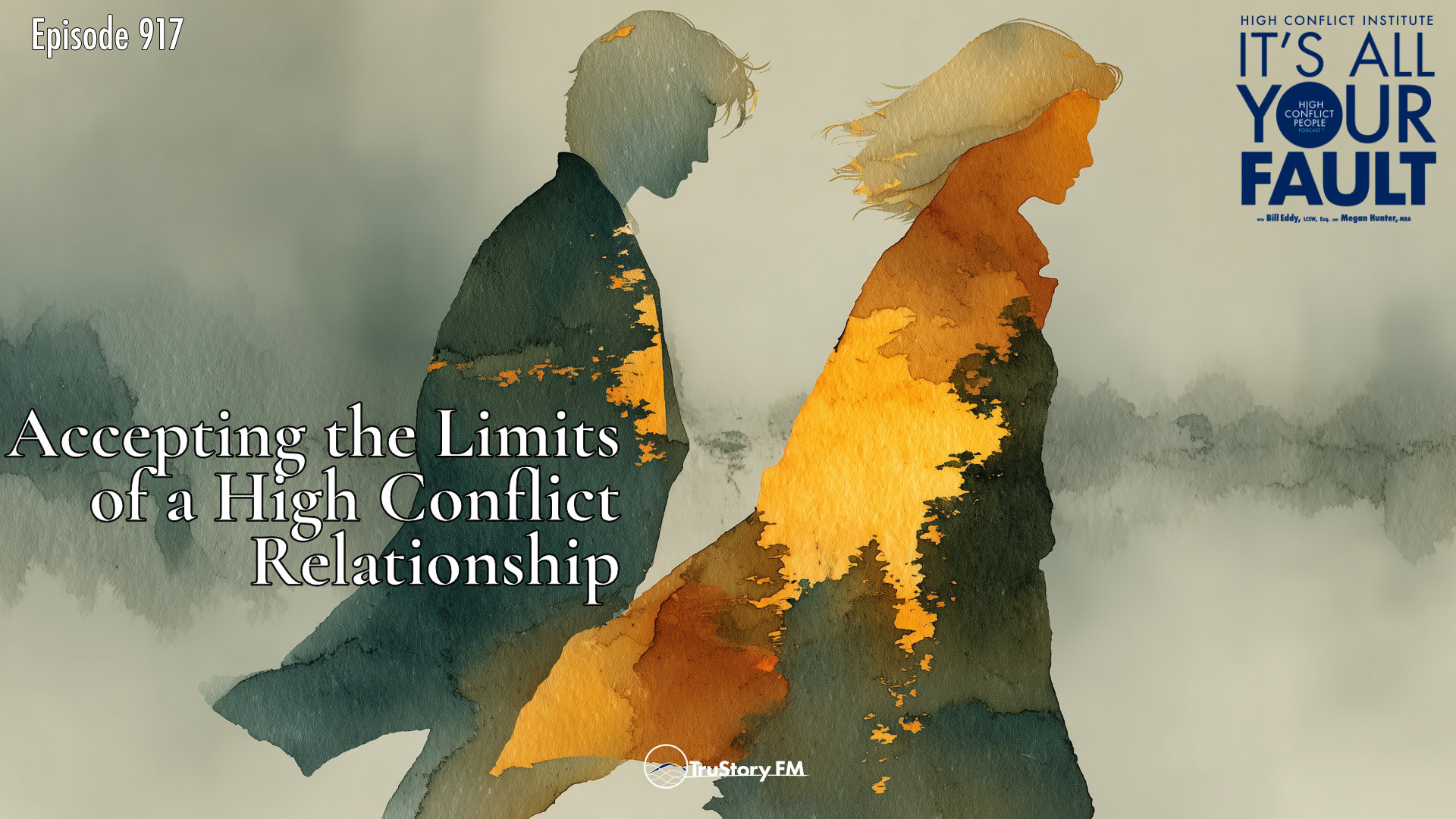
We are the co-founders of the High Conflict Institute and ConflictInfluencer.com, where we focus on training, consulting, coaching, classes, and educational programs and methods all to do with high conflict. Welcome, listeners. Thank you for joining us in your canoe today. So today we’re talking about one of the most painful, painful realizations people can face in a high conflict relationship — accepting that the relationship may never become what they hoped it could be. Whether it’s a parent, adult child, spouse, sibling, co-parent, friend, colleague — many people spend years trying harder, explaining better, forgiving more, walking on eggshells, or waiting for insight, empathy, and accountability or emotional reciprocity that never fully comes. And eventually many reach the end of their rope and begin grieving something incredibly difficult — not just the relationship itself, but the loss of the relationship they wish they could have had. Here at HCI we talk, and often talk, about unmanaged emotions, all or nothing thinking, and a preoccupation with blame. But underneath that can also be real limitations in emotional capacity, self-awareness, empathy, flexibility, or relationship skills. So we’re going to talk about the grief, the guilt, anger, confusion, and relief that people experience when they finally stop trying to force a healthy relationship with someone — someone who may simply be unable or unwilling to participate in one. So, Bill, I’ve been talking to a lot of people lately who are in this exact situation. And it’s really, really a hard, hard thing. And I know our hearts just go out to people who experience this. And often they’ve been in kind of a tumultuous relationship with this other person, or sometimes it’s more than one person. Maybe it’s a whole family. They just keep trying harder and maybe waiting it out and hoping. And I find that there are those who, number one, really haven’t come to fully accept that there are people in this world who don’t really have the capacity to give you what you need in a healthy relationship. You know, I think even going down another layer is that oftentimes this is the people in our — perhaps in families — who we’re supposed to go to for soothing and for, you know, acceptance and not being judged. And it can kind of be a double whammy and be difficult to work through. So, you know, that’s a little bit about the why behind people staying. But why do you think that? Why do people stay emotionally invested for so long in relationships that consistently hurt them?
Bill Eddy
I think it really is a lot what you said about kind of the fantasy of what this could be, the dream of what our relationship could be like. And I’m also seeing that a lot these days, especially with adult children and their parents, especially as parents are aging. Well, adult children are aging too. But there’s this sense of I always wanted to have a close relationship with my mother, or a close relationship with my father, that I never really had before, and I was hoping this would happen. And what happens is it’s just not happening, people say. And so they just try, they keep trying, try harder. Let me quickly tell you a little story that I think helps demonstrate what we’re talking about. I was contacted for a consultation by three women in their thirties. And they said, we’ve been reading on the internet, we’ve come across your stuff, and now we understand our mother’s problem. She has borderline personality disorder. So we got together, planned to go home. You know, they lived in different cities, planned to go home for the holidays. And we’re going to tell our mother, and we did. We said, mom, we figured you out. Your problem is you have borderline personality disorder.
Megan Hunter
Oh dear.
Bill Eddy
So how do you think she responded? What she said is, get out of my house. I never want to see you again. And the father was there, was kind of blindsided, and he said, well, do what your mother says. And so they contacted me a week or two after that. And they said, what should we do? What can we do? And I said, you know, first of all, you might be right. I don’t know. But if your mother has that kind of roller coaster personality, what I would suggest is you really learn to accept this is as far as you’re going to go with her. They said we wanted to have a close relationship with her and it just never could happen, and we hoped as she got older that it could. And I said, I think you probably need to accept that what you have been having is as far as she can go. And they said, yeah, but she’s cut us off. I said, I don’t think that’s going to last. There’s an up and down.
Megan Hunter
Think of the roller coaster.
Bill Eddy
Yes, the roller coaster. But I think what you have to do is start back slowly in a friendly and superficial way. Send her cards for the holidays or different things, and slowly work your way back to having communication with her. Never bring up borderline personality disorder again.
Megan Hunter
Let’s really make a point about that. Never mention borderline personality disorder again.
Bill Eddy
Don’t bring it up, and she probably won’t either. And she’ll probably miss you and be glad that you’re reaching out to her again. And talk about anything else, but don’t try to push it to be a closer relationship, because that’s when these blow up. And I think that probably would work. But often it’s accepting you’ve gone as far as you can go — but don’t lose that. Hold on to that. And what I think in adulthood is you choose your family. For most people their family they grew up with is a big part of their adult family and that’s wonderful. But maybe 10% of people just aren’t going to have that. Try to understand them, learn about them, but realize that they can’t give you the unconditional love. They can’t be emotionally accessible. And they may have rages from time to time, and you set limits on that and excuse yourself if they get into that kind of behavior. But a lot of it’s going through the grieving process. So five stages of the grieving process. And some people say there’s six stages. This doesn’t have to be exact. But first tends to be denial. It can’t be true, I don’t believe this is happening. Second is anger. If this is happening, then I’m mad as heck about it and I’m going to fight this every inch of the way. The third is bargaining. Well, what if I do this? What if I do that? What if I tell her she has borderline personality disorder? Then suddenly we’ll break through and be warm and close again. Well, it’s bargaining against the inevitable loss. Fourth is depression. And this isn’t clinical depression. This is depression about something — and that’s the loss of this relationship. And that’s a real part of the process here. And then getting to acceptance. And people go through this — it depends on the kind of loss, how close you were to the person, etcetera. But those are the five stages. Well, guess what? High conflict people and people with personality disorders don’t seem to go through that. And high conflict people get stuck in the anger stage, which is what that mother did — she was instantly angry. And so they’re not going through that. You try to go through that yourself, to help yourself accept I’ve gone as far as I can go, but I don’t want to lose what I have. And you mean so much to the people who are difficult. I think try to find what’s the amount of closeness and distance that can make this a fairly stable relationship, and then live with that and get those emotional needs met somewhere else.
Megan Hunter
Yes, you know, I think often the people that we talk to and try to help think that going no contact — like sort of their own all or nothing solution — is the only path. And they’re kind of surprised that maybe there can be a balance, right? There could be an alternate path where there is some sort of arm’s length relationship. So you do have choices between continuing down the path you’re on, which isn’t working for you and has put you in a lot of pain — and that’s the word we hear so much: this is just painful, really painful to be rejected by the closest people to you. So that’s one path — just stay in it. Another path is to find that balance and use, you know, good conflict communication skills like EAR statements, setting limits and imposing consequences, and all BIFF responses. Or some do choose to go no contact because maybe it’s been too painful or they see no hope of any type of relationship. So I guess what would be sort of the criteria for choosing that no contact option? Is there a set criteria, or does it depend on the situation and the people involved?
Bill Eddy
I think it depends. First of all, I think it’s good to — especially if it’s a family member that should ideally be a close relationship, like a parent or an adult child or brother or sister — that you talk with a counselor, talk it through with a counselor to get a sense of what are my options here, and what can I expect, and what do you think about their personality style? Here are some of their characteristics. But I think there are extreme cases where it makes sense that people have no contact, especially if it was a truly abusive relationship. Some parents were really horrible to their kids. I mean, antisocial parents who didn’t just physically abuse their kids but emotionally really abused them — you’re worthless, you’ll never amount to anything, you’re a piece of dirt — all these things. And it may be you just have to not have contact with them. But I think in most cases it’s learning to go through your own grieving and healing process and then having a relationship that may not be as close but still has some stability. We all need to know that there are people that like us and love us in our lives. And it’s part of your community. You know, if your parents can be part of that, if your adult children can be part of that, don’t throw it away. But maybe you have contact twice a year or something.
Megan Hunter
Right. And be prepared.
Bill Eddy
And be prepared, but find the balance in each relationship. I think this is true with friends too. There are closer friends, farther friends, but you don’t necessarily need to get rid of your friends. It’s just you’re not in as regular contact with some as you are with others.
Megan Hunter
Right, right. So what I was kind of thinking about with being prepared is, you know, if you’re going home to stay with your parents and you’ve chosen the path of limited contact — well, just know, I’m going to have a 24-hour rule. I just stay one night. Or I stay in a hotel when I go to their city, or I stay with a friend. I don’t stay there — to kind of limit that exposure until you get more practiced up at using good communication skills with them, ones that work for high conflict people. Because a lot of times, even if you’ve done some work on yourself and you’ve adjusted your expectations and you’ve had radical acceptance that this person is not very likely to change or to be the person that you need them to be for you — it can still, you know, they can still rent a little space in your head. And you can get into wishful thinking and trying to be hopeful again that, well, maybe this time it’ll be a little bit different. It’s just those expectations can be a little bit hard to completely get out of your brain. But over time I think it does help. And we all heal at different speeds, right? In different paces. And so, you know, for some it may be that once you have this understanding, then it’s an easy leap into, okay, I have to do something different now. I have to handle this differently. And the grieving process isn’t very long. But for others it may take longer. So it’s okay to just go at your own pace — as long as you’re not in that wishful thinking that this person is going to change, because I try harder, because I diminish my own personality, because I just keep my mouth shut, because I basically just try harder. Or sit down to have that emotional conversation and just hash it out. And I just tell them how I feel. I’ve been hearing that a lot lately — I just want to tell them how I feel. Well, that often backfires, because for a high conflict person, they don’t — and I don’t say this in a mean way — but they don’t care how you feel because they care how they feel.
Bill Eddy
Right, right. And that’s a big mistake people make with family members, with friends, and with partners when they decide they want to end the relationship — they want to convince the other person to feel good about it. And they’re just not going to feel good about it. Well, let me explain. Let me tell you how hard it’s been on me and what I’ve been feeling. If you’re ending a relationship, that’s one of the first things to go — talking about your relationship. And actually, when you’re entering a relationship, that’s one of the last steps — to talk about your relationship. And so this is something that people mix up all the time. If you’re ending a relationship, be respectful, be empathetic. But don’t try to talk at that personal feelings level, or you keep reopening the wound of the end of the relationship. Let that heal. And you can have a less close friendship or a less close family relationship. But don’t try to get into the feelings with that person. That’s what you do with a therapist — say, I feel terrible about ending that relationship. But if you tell the person you’re ending it with that you feel terrible about ending it, they’re going to think maybe you don’t mean it.
Megan Hunter
Yeah, or they will use that to kind of take advantage of you. And then that can be even more painful, right? Or not even take advantage, but just kind of put you down a little bit more. It opens the door somewhat to allowing someone to be hurtful to you again when you’re trying to just explain how you feel, and then they say, well, you don’t have a right to feel that way. I’m the one who has the hurt feelings here. You’re the one who hurt me. And then you’ve just opened that door to being abused again, or being made to feel badly about yourself. So you want to avoid — as much as you want to think that this person can sit down and have a rational conversation — no. Just adapt your problem solving into a different form of problem solving. And I find this is really hard for a lot of people we work with, because most of us are problem solvers and we’re living in logic land. And so the things that help with 90% of the people we’re around — sit down and have a conversation and say, well, here is my perspective — that person can usually take on your perspective and they’re willing to listen to it, consider it, make adjustments, find a middle ground or whatever. So we have this expectation of other humans in our lives, and then you run across this high conflict personality that is like, no, no, I need this to be all about me and really nothing about you and how you feel. So it’s tricky, but don’t put on that problem-solving hat in the same way that you do with 90% of other people. It’s a new problem-solving hat — of all the things we’ve talked about: managing the relationship, limiting the interaction, being prepared. So I guess the question might be — we talked in our last episode about gradually limiting time and exposure when you’re trying to leave a high conflict relationship. So let’s say in this case you’re not leaving, you’re not going no contact, but you’re finding that middle ground, and you have some guilt over it. And maybe that other person is making you feel guilty. You might be feeling some sadness or even shame. You’ve been raised, you know, to respect your elders. And now that rings in your head, and you start to think you’re not respecting your elders. And you start to feel that shame. So how do we kind of get out of that shame spiral, and blaming ourselves, and back into the middle ground of — this isn’t about me. So how am I going to survive this and get through it?
Bill Eddy
I think of two things in particular. The first is what we call encouraging statements — think of two or three short phrases that you can tell yourself, that you’ve always liked when other people have told you things like, you’re a caring person. I’m a caring person. And so when someone says, well, you don’t care, you’re an uncaring person — it’s less likely to hook you, because you go, no, I am a caring person, but I do have to set limits here. And you don’t have to say that out loud — you can just say that to yourself. So: I am a caring person, but I have to set limits. Something else is: what they’re saying about me isn’t really about me. They’re saying you’re rude and inconsiderate — I forget some of the words you used, Megan — but [the HC person says things like] “oh, the guilt, you should feel guilty.” And [you should] have some things that say, you know, that’s their issue, not mine. I’m being reasonable. Or whatever phrase — just short phrases. And if you repeat the same simple phrase — put it on a post-it sticky on your desk or on your bathroom mirror — then when you’re under stress, remind yourself of that. When someone is criticizing you, remind yourself of that. And your voice will be louder in your head and their voice won’t be as loud.
Megan Hunter
Another one is to remind yourself of all the good relationships that you do have. Because when high conflict people get in our heads, we do start to doubt ourselves. So a quick hack is just to remind myself — at work, do I get along with people? Do people like me? Do I have friendships? When I go to the store, am I kind to people? Am I respectful? Do I have empathy for others? Do I consider their perspective? All of those things. And that can so easily get you back into the right frame of mind.
Bill Eddy
Yeah, like most people think I’m a caring person. And so when this person says I’m not, I go, most people say I’m a caring person — things like that that help. But here’s the other thing I want to say, and that’s trying to understand why this person is limited in the way they are in relationships. And most of the personalities we talk about are on a continuum. Some people may have traits of a personality disorder but don’t have a disorder. Some people may have a severe disorder. Mostly we talk about narcissistic, borderline, antisocial, and histrionic personalities. In the diagnostic manual, those are the four cluster B personalities. If they have the disorder, it’s a cluster B personality disorder, which has characteristics including being erratic, being dramatic, and being very emotional. And often that’s what pushes people away. It’s not something they choose to have. No one chooses to have a personality disorder. Research also shows us that cluster B tends to engage in domineering behavior, vindictive behavior, and intrusive behavior. And so if you realize these are characteristics, there are millions of people with these characteristics who didn’t choose to have them. It’s sad. And this comes early in life — usually the first five or six years of life, they’re on the road towards these. They’re not set in stone yet till adulthood, but they’re on the road to this. Maybe they had traumatic experiences. Maybe a parent died and they didn’t have the nurturing they needed. Different thing. Maybe they’re born with genetic tendencies to this. I think that helps us have empathy for them — and they’re not happy. And so understanding this isn’t something someone’s choosing to do makes it a lot easier to accept, I think.
Megan Hunter
Yeah. And the thing that’s been ringing in my head a lot lately, Bill, is something that you put in your books and training a long time ago, but it I guess it just recently has resonated with me more — and that is that these are just people who are seeking relief from this internal frustration of about everything, and in relationships for them. So they’re not in a good way able to address their own frustrations. The result of that is very difficult relationships for those around them. And they’re seeking that relief from frustration from others. So you can give that to them by using an EAR statement when they’re escalating or blaming you for something. You can set limits — all these things. It is hard, right? One of the hardest parts of high conflict relationships is recognizing that love, effort, logic, patience, or sacrifice alone may not be enough to create a healthy connection. And sometimes the deepest pain comes from finally accepting the limits of what the other person is able to bring into the relationship. But with that acceptance comes a lot of clarity — and, I think, probably a lot of emotional growth. Many of us grow up when we finally reach that acceptance level that those around us aren’t capable of being a healthy part of the relationship. So we stop chasing impossible expectations. When we do that, we can begin to reclaim our emotional stability, identity, boundaries, peace. Doesn’t mean you don’t care about the other person. It just means you’re caring in the right way. That’s it. So, you know, look, we believe that people can learn to approach these relationships with more understanding, structure, emotional regulation, and realistic expectations, while still protecting your own well-being. You matter. You get a seat at the table. We’ll put some books and courses in the show notes — Calming Upset People with EAR, 5 Types of People Who Can Ruin Your Life, SLIC Solutions, and our BIFF books, of course — and the links to New Ways for Families and Conflict Influencer training. If you’re looking for training or consultation for about a high conflict situation for your organization, visit us at highconflictinstitute.com, including if you’re interested in making your organization conflict competent and confident. If you have a high conflict situation in your personal life, visit conflictinfluencer.com. Keep learning and practicing the skills. Be kind to yourself and others while we all try to keep the conflict small and find the missing peace. It’s All Your Fault is a production of TruStory FM. Engineering by Andy Nelson. Music by Wolf Samuels, John Coggins, and Ziv Moran. Find the show, show notes, and transcripts at trustory.fm or highconflictinstitute.com/podcast. If your podcast app allows ratings and reviews, please consider doing that for our show.