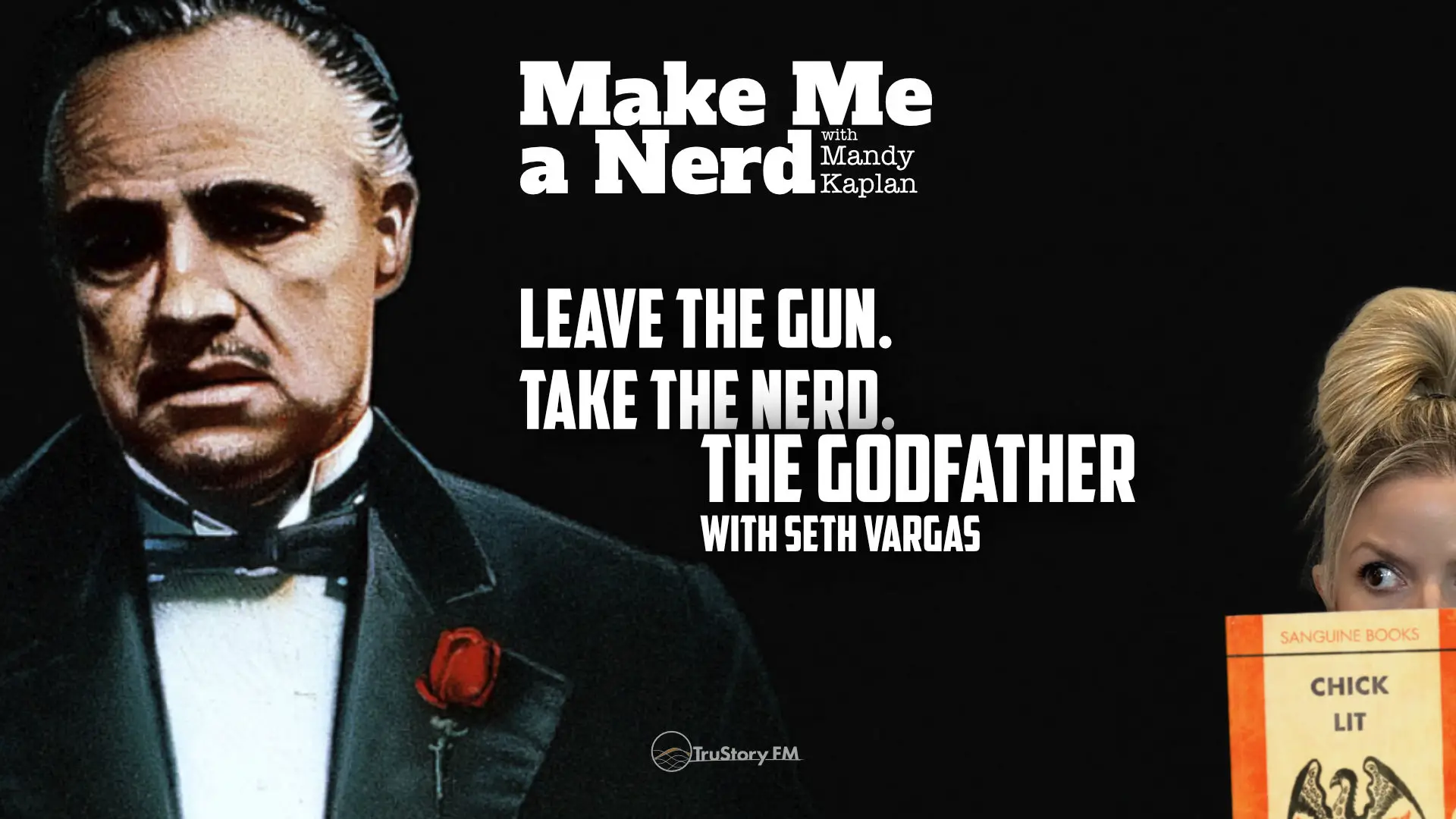
Mandy Kaplan:
Hello everybody, and welcome to Make Me a Nerd. I’m Mandy Kaplan, a mainstream mom whose mission it is to explore the wor— I won’t keep doing it, but I want to do the whole episode in that voice. I’m a mainstream mom whose mission it is to explore the world of nerd culture that I’ve been missing out on and afraid of my whole life. And I have a real primo movie nerd on the podcast with me today, and it gets me very excited. Let me tell you all a little bit about Seth Vargas. He is one half of the Movie Friends podcast. He is a writer and film lover with a passion for making movies and their history accessible to everyone. Ladies and gentlemen, paisanos, it’s Seth Vargas!
Seth Vargas:
Hello.
Mandy Kaplan:
Yay!
Seth Vargas:
Hey, thank you for having me back.
Mandy Kaplan:
So, to remind my audience, you and your partner Michelle came on and really nerdicated me about Ed Wood and Plan 9 from Outer Space.
Seth Vargas:
Yes, absolutely. We were here what feels like yesterday, you know. And unfortunately Michelle is not here with me today. So if any of you listened to that episode and thought, “Gee, what a fun team,” you will now see how unfun one of us is.
Mandy Kaplan:
Is it like a mafia situation? Is she in the car with a bullet through her brain?
Seth Vargas:
No, no, no, never, never. But I’m also happy to be back here to discuss one of the great American films.
Mandy Kaplan:
Well, I get to determine that, really. That’s the whole point of Make Me a Nerd. I get to decide what—
Seth Vargas:
That’s right. You are the arbiter of taste.
Mandy Kaplan:
Yes. Well, look, Rotten Tomatoes says it all. Ninety-seven and ninety-eight percent on Rotten Tomatoes. And I’m wondering who the hell are the three percent that didn’t rate it. How am I— you don’t know me that well. I’m an adult woman who lives in the world. I’ve never been in prison, so it’s not like I lost years of my viewing life. And I’ve never seen The Godfather.
Seth Vargas:
Listen, you can’t see them all, okay? But who decides the ones? You might be able to go out on a limb and say that there are a hundred “the ones.”
Mandy Kaplan:
Miss Congeniality.
Seth Vargas:
Miss Congeniality, of course. Miss Congeniality Two, questionable. But for every Godfather, there are films from other countries that most people haven’t seen, or there’s films from before the 1970s that people haven’t seen. So I just am happy that you are on a journey of discovery, no matter what it is, and that you are pushing yourself. Because so many people are very content with where they are, and they wouldn’t bother to think that they have some type of lack in their life — and I might be putting words in your mouth with that one. But my point is, don’t feel bad. Don’t feel bad.
Mandy Kaplan:
It’s not that I feel bad. For me it was violence. I really do struggle with watching violence.
Seth Vargas:
Of course. And I thought of you. I thought of you the whole time I was re-watching, because I knew that.
Mandy Kaplan:
But the older I get, I think the more I’m able to see some of it as art and contextualize it and be okay with it, if it’s not gratuitous and just masturbatory — let’s see how much ass-kicking we can get into a film. If this violence is artistic, I could appreciate it. But I think that’s what I’ve been avoiding. And I think I might have told you this when you were on, or maybe just subliminally across coast to coast in the weeks ensuing. But violence that is very realistic and unpredictable — the fact that the Corleones are sitting over dinner or having a drink and then everything blows up — that scares me so deeply, much more so than the cartoon-like Tarantino violence, which feels not as realistic.
Seth Vargas:
I don’t know if you want to start there, but did the violence that loomed large in your mind live up to the looming? Or were you like, “Yeah, this is actually okay”?
Mandy Kaplan:
Oh, I handled it, but there were a few times I went, “Oh god, oh, oh.” It’s visceral. But enough about me, Seth.
Seth Vargas:
Yes, absolutely.
Mandy Kaplan:
What is your history with The Godfather? You’re a young man. It’s not like you saw it in the theaters when it came out. When do you remember seeing it for the first time, or did you read the book?
Seth Vargas:
I do. I think I probably saw this maybe 2020, 2019, something like that. I’ve been a film fan my entire life. I’ve gone through multiple periods where I would watch up to four films a day over the course of my life — as you know, different jobs and family living situations allow, right? But unlike you, who describes yourself as a mainstream mom, I was very much not a mainstream person, and so I gravitated towards the Ed Wood films rather than the Godfathers. I kind of purposefully avoided those things because my very wrong way of thinking was, “Well, if that many people like it, it can’t possibly be that good.” And that’s beyond foolish.
Mandy Kaplan:
No, but it is a very— I’m sorry to interrupt — it’s a very nerd culture mentality. I have indisputable facts, because my sister will often say, “Oh, that movie, everybody loved that movie. I’m not gonna see that movie.” It’s like you want to have something that’s yours and not just do what everyone else does.
Seth Vargas:
Yeah. Well, there’s such a difference in discovery versus buying in. So there are movies that are presented to you. You walk down the street and you see a billboard, or you see an ad online — these movies are presented to you. But when you find something, when you click on something that just looks insane on Tubi, or you’re looking through a director’s filmography that you like and you’re like, “I’ve never heard of this movie,” and then you watch it and you find the goodness for yourself — there is nothing like that. Because at that point you’re only following and rewarding your curiosity, where buying in is taking a risk. So if Hollywood, capital-H Hollywood, is saying to you, “This is the movie of the summer,” you say, “Okay, we’ll see.”
Mandy Kaplan:
You resist.
Seth Vargas:
You resist a little bit. And when you spend so much time finding the hidden stuff and you find that rewarding, you are kind of wary to go out on the popular limb. But friends, don’t be like me. Don’t spend your life in a Godfather-less world. So I watched this probably about five, six years ago, and was completely enraptured by it, and was immediately like, “Oh yeah, the classics are a classic for a reason.” Now, I will say there are some movies that I don’t think stand the test of time and aren’t as good as they’re made out to be, but The Godfather is fortunately not one of those. I do think it lives up to its legacy. But do you think that? I mean, we’re here for you.
Mandy Kaplan:
Well, spoiler alert, I frickin’ loved it. I’m not gonna be coy and wait till the end of the podcast. I am a human being with a mind and a heart, and therefore I was entranced and moved. I have my thoughts, as I often do, about, “Oh, I would have done that differently,” but it opens with the scene from Zootopia. And it is precisely the scene from Zootopia, and that shows you how far-reaching and influential this film is — that it’s even in a Disney movie from ten years ago.
Seth Vargas:
Yeah, I don’t want to think about that, but I think you’re probably about right.
Mandy Kaplan:
It’s actually like twelve years ago. But there’s not a person around who doesn’t know some quotes from The Godfather, or who can’t, if you make any reference, go, “Oh, I know exactly what you’re talking about.” It is so influential in film and in culture.
Seth Vargas:
Absolutely. It’s one of those films that was not only celebrated critically but was a massive, massive financial success. So until Jaws, this held the record for the most successful movie of all time when it came out. It was the highest-grossing film that had ever been made up until that point — and we’re in the early 1970s. I can’t remember, did we talk about the Hays Code last time?
Mandy Kaplan:
Yes, we did.
Seth Vargas:
Okay, cool. So this is a part two. You didn’t realize that the Ed Wood listeners would be primed for the success of The Godfather. But by 1972, we are well past the production code, or what’s called the Hays Code, which dictated what could be shown on film, so that it could be released to every market in America — because films used to be released in different markets based on their content. And so the Hays Code, or production code, if it had the stamp of approval, that meant it could be shown anywhere and everywhere. So it behooved filmmakers and studios to comply with this code.
Mandy Kaplan:
Was that before the rating system? Did I ask that last time?
Seth Vargas:
Yes. So the Hays Code was basically because movies were getting protested and shut out of different theaters. Movies used to be incredibly salacious and sexy and violent — and very interesting. If you watch movies between, you know, 1925 and 1932, you’ll be shocked at what was in movies. Because we think, “Oh, that was old-timey, they didn’t have sex back then.” And they did. But when movies started to draw the ire of moralistic people, they decided to impose their own rules rather than have the government come in and say, “You can’t show a movie,” because they wanted to make money. And so they said, “Okay, we’ll be good boys and girls. We’ll make good movies, the bad guys will never win, we’ll never show interracial relationships, we’ll never show clergy or law officers in a really bad light.” Things like that.
Mandy Kaplan:
Sure.
Seth Vargas:
So the 1970s hit, and they replaced the Hays Code with the rating system. It’s like, “Okay, actually we’re gonna make movies however we want and let the people decide. We’ll rate the movie, and then you can decide what you want to come and see.” And so the 1970s for American cinema explodes — like just completely explodes. And with The Godfather being, up until that point, the movie that more people had seen than anyone else in America, it now became the movie to emulate and to reach for, both critically — artistically, you want to make something as good as The Godfather — and commercially. Now we’re showing, “Hey look, guys, we don’t need to just make Hello, Dolly! and Sitting in the Rain. People will come and see this. So let’s shoot for this.” And so, yes, influential is the word.
Mandy Kaplan:
And they’d been waiting for it. The seventies felt like an explosion of counterculture movies and pushing the limits. I did The Exorcist on the show, and that’s one of my favorite movies. That was stuff we hadn’t seen, and the seventies were willing to go there, and I guess maybe allowed to go there.
Seth Vargas:
Yes, allowed to.
Mandy Kaplan:
And that’s why so many of these movies that influenced film for the next fifty years came out of a time when it was like, “We’re free.” Rosemary’s Baby, all of this stuff.
Seth Vargas:
Yes. Because it would be more revelatory than seeing color for the first time. You’re not seeing just something technical, you’re seeing the truth of human expression in art, where it had been stunted and shined up. So of course there are great films throughout the thirties and forties and fifties, and the sixties really start to get much looser. But it wasn’t fully what someone wanted to say and do. And so that’s why the 1970s for American cinema is one of the best — it’s probably the best movement in American film history.
Mandy Kaplan:
I will not argue.
Seth Vargas:
And then it goes on, like you said, The Godfather. The people who grow up to make Zootopia remember the greatest movie of all time. And that’s why this has that kind of name or reputation. I do not think that that’s remotely true. This is a fantastic film. It’s not the greatest movie of all time, but for a generation, it was.
Mandy Kaplan:
And if you want to disagree with Seth, please reach him at the Movie Friends podcast, because I’m not willing to back you up on that.
Seth Vargas:
That’s right.
Mandy Kaplan:
Well, one thing that came up — I recorded yesterday about Dr. Horrible’s Sing-Along Blog, and henchmen factored into that, and they factored heavily into The Godfather. And I’m fascinated by henchmen. So I think it’s funny, two episodes in a row, people who devote their lives to like, “I’ll just stand quietly in the corner looking menacing, and I’ll do whatever you tell me, even if it puts my life at risk.” What kind of job is that? It sucks.
Seth Vargas:
I agree with you. That’s where the culture— it goes far beyond just a job, right? And that’s why throughout the film we’re not dealing with the mafia and the mob. I don’t know if you know anything about the backstory of that part of it.
Mandy Kaplan:
Not really.
Seth Vargas:
So Mario Puzo, author, starts writing this book called The Godfather. Paramount buys the rights to the book before it’s even finished. The book comes out — smash success, huge success. So much so that the film studio said, “We’re not going to make the movie, because it can’t possibly live up to the book in people’s minds.” Can you imagine?
Mandy Kaplan:
Wow.
Seth Vargas:
A film studio—
Mandy Kaplan:
I wish more people would say that. I wish fewer adaptations were happening.
Seth Vargas:
Right. Exercising restraint instead of being like, “Pump it out, quick, pump it out.” And so obviously the book is dealing with the mafia and the mob and Italian Americans. And in 2026, I think it’s hard for us to connect with how Italian Americans were viewed in the fifties, sixties, and even early seventies.
Mandy Kaplan:
Well, might I interject — spoiler alert, I did watch the second one. I couldn’t stop myself. And Michael’s meeting with some guy and he’s like, “Let me cut to the chase here. I’m disgusted by you Italians, when your silk suits come into our country trying to pretend you’re honest citizens.” So he laid it all out — all those preconceived notions or negative stereotypes, it’s all in there.
Seth Vargas:
And so in real life — I can’t remember the name of the guy, but this guy, who’s connected to the mafia in real life, forms the Anti-Italian Defamation League, raises $500,000 at a rally at Madison Square Garden to stop the production of The Godfather, because it will reinforce negative stereotypes about Italian Americans. Now, secretly, they were like, “We don’t want Hollywood to go telling a realistic story about actual mob families.”
Mandy Kaplan:
Lifting the veil, right?
Seth Vargas:
Right. It’s all under the guise of, “Oh, this is racist, it’s caricatures.” Meanwhile, I was like, “We’re actually doing this stuff.”
Mandy Kaplan:
Right. And all publicity is good publicity, so I’m sure the filmmakers were like, “Go ahead, protest.”
Seth Vargas:
So they meet with them and they come to the agreement: “We will not call it the mafia or the mob.”
Mandy Kaplan:
Okay, the family.
Seth Vargas:
It will always be called the family. And they make that one concession, and then they’re like, “Yeah, okay, you can make your movie.” Then different members are actually in the film. So Luca — the dude who gets a knife through the hand — he was an arsonist and enforcer for one of the crime families.
Mandy Kaplan:
Whoa, fun fact. That’s so cool.
Seth Vargas:
And Carlo was also working with multiple crime families, and he even has a podcast talking about his experiences in the mafia.
Mandy Kaplan:
But he has a huge role.
Seth Vargas:
So the movie does this odd parallel thing where the first storyline that departs us from the Corleone family house is Hollywood — Johnny Fontane, who’s kind of a stand-in for Frank Sinatra, who was always rumored to be tied in with the mafia.
Mandy Kaplan:
Yeah, I got that.
Seth Vargas:
And so the movie is kind of commenting on Sinatra and how the mafia influences Hollywood, while also working hand in hand with the mafia to make this movie about that. It’s a very interesting self-eating snake.
Mandy Kaplan:
Meta. Wow.
Seth Vargas:
And Coppola specifically— well, he didn’t want to make this movie, first of all. He had no interest in making a big commercial movie like this. Coppola is a famous film director, but he has always been more on the artistic side. Most people haven’t seen a lot of his movies, because they’re heady and strange. I mean, his last film, Megalopolis, is the definition of a head-scratcher. I don’t know if you saw that one.
Mandy Kaplan:
No. I saw Peggy Sue Got Married and The Outsiders, but most of these I haven’t seen.
Seth Vargas:
The Outsiders is one of my favorites. So good. But he agrees to do it. George Lucas convinces him to do it, because I think they were four hundred thousand dollars in debt to WB for George Lucas’s first film, THX 1138. They make it, doesn’t make money back. And so he was like, “Look, just direct The Godfather and make some money, and then we can go back to making our little art movies.” Which George Lucas would depart and make his little art movie, Star Wars.
Mandy Kaplan:
What? I don’t know what you mean.
Seth Vargas:
So Coppola decides, “Okay, fine, yes, I will do this, but we’re gonna make this movie about Italians, by Italians, for Italians.” And I think that’s part of the cultural impact — not just doing, “Eh, see, gangsters,” but making them humans that we live with for three hours.
Mandy Kaplan:
Right.
Seth Vargas:
And yes, they’re all horrible and horrifying and do terrible things, but they’re shown to be complicated human beings.
Mandy Kaplan:
Well, I think a lot of that has to do with how the movie opens with a wedding, which is such a relatable, celebratory event. And I want to dive into the movie right after this. So this is the longest wedding on screen — it is 27 minutes of wedding footage. And you know what? I liked it. I’m glad we got to get to know the family, and you see how much they appreciate their children and how close they are. But I could have used ten minutes less of dancing and world-building. It was a long-ass wedding sequence.
Seth Vargas:
It’s very long. And the entire— you’ll see this as you re-watch this, which I think — Mandy said off-mic this will be an annual watch for you. June first of every year, you’re gonna go back and rewatch The Godfather?
Mandy Kaplan:
Did I say that? Wait, what is in this can of sparkling water? I don’t remember saying that. I would definitely rewatch it, yeah.
Seth Vargas:
The whole movie is contained in the wedding. The opening — I don’t want to say it gives it all away, but it’s not just setup, it’s actually everything. The movie starts with the great monologue that really sets up what the movie is about: “I believe in America.” And you have this undertaker who says— what it boils down to is, “Why do bad things happen to good people?” And that is a universal theme that everyone wrestles with probably every day, right? Why do the evil prosper and the good suffer? “I did what I was supposed to do. Me, as an Italian, who came to this country, I forsook everything. I forsook you, Godfather. I tried to do what I was meant to do. And when wrong came to me and I sought justice, justice was denied me.” And so if we think of Don Vito as the devil, which he pretty much is—
Mandy Kaplan:
Oh, I would disagree, but yeah.
Seth Vargas:
Well, that’s the movie. Here’s this nice family man, and yet he’s completely fine with flooding the Black neighborhoods with drugs, because they are “not people as we are.” And so this undertaker — and that’s not me saying that, obviously, that’s the Italian murderer’s family saying this — comes to his senses and realizes that he has to bow down to the devil in order to get what he wants. And that’s the end of the movie. Michael becomes the devil. Michael becomes the Godfather. He becomes the one holding the strings. Also in the wedding, you have Michael doing the opposite of what he’s meant to be doing. He shows up with Kay and he’s explaining everything to her: “Oh, that’s Luca Brasi, he does this. Oh, that’s this guy.” He’s spilling all the beans.
Mandy Kaplan:
Well, first of all, I was like, “Is he just naming pasta dishes?”
Seth Vargas:
And then when we come back around—
Mandy Kaplan:
There are so many names in this movie, it’s hard to keep track. But when Michael tells Kay, “Yep, that’s my father, this is what you’re getting into,” I was like, “Get the F out of there, Annie Hall! What are you doing?” And not only does she say, “Okay, I’ll keep dating you,” but then when he does leave her and comes back to her, she knows everything. He never keeps her in the dark. And she willingly enters into it. I’ve backed out of relationships for way less than that. What’s up with that, Kay?
Seth Vargas:
Well, I don’t know if you were ever in a relationship with a 1972-era Al Pacino. Talk about a smoke show.
Mandy Kaplan:
I came close a couple of times.
Seth Vargas:
You dated Al Pacino in 1996?
Mandy Kaplan:
No, and now I’d be too old for him. Isn’t he dating like a 30-year-old? His wife is like a child. It’s gross. But I find those dynamics really interesting, although unfortunately I find the female characters horribly underwritten, and Kay is just like a sack of potatoes. She just is like, “Michael,” and— oh, it drives me insane.
Seth Vargas:
Absolutely. We literally don’t get the reaction of almost any of the events — except for Connie — the women are kind of held back from us seeing their reaction. Their mother, Carmela, we don’t see her reaction to Sonny’s death, we don’t see her reaction to Vito’s death. So yes, they’re definitely very much sequestered and put to the side.
Mandy Kaplan:
Gosh, he is tough to take. But interestingly — I know I’m bouncing all around, but while we’re here — what’s the last shot of the movie? It’s Diane Keaton watching her husband become the Don, and afraid of what’s happening in the future. So I wrote, “Oh, is the second one going to be more about the women?” And the answer is no, not at all. In the second one, she just whines and cries and leaves him.
Seth Vargas:
Oh no! I love Kay in the second one. And I’m in the minority there. She’s the only one who’s able to get anything out of Michael, including in this movie. Al Pacino — we all know he’s a bit of, I think Al Pacino likes a stage because he can fill it up. I don’t want to say he’s an over-actor—
Mandy Kaplan:
But he’s understated in the first one.
Seth Vargas:
He is so reserved, calm, and quiet. There’s a fantastic example in the cinematography of this movie, when Sonny is just losing it. This is after the assassination attempt on Vito. They’re in Vito’s office, and Sonny is roaming all around the room, raving, yelling at Tom, and the camera’s following him. And then the camera stops as Michael talks. It doesn’t move, but it slowly pushes in on him. And you see the difference in control. The person who has to fight for control versus the person who just has it. And throughout everything — even pressed for time, assassins coming to kill his dad — he’s talking to this nurse and he’s like, “Listen, you’re gonna help me.” He talks to the guy to go outside: “Listen, this is what you’re gonna do.” There’s no excitement. He’s so calm and reserved throughout the whole film, until Kay asks the one thing that he cannot do, which is tell the truth. Because when he goes with Kay to the wedding, he is above everything. He’s talking down: “That’s my father’s business.”
Mandy Kaplan:
He has left the family.
Seth Vargas:
“That’s this person.”
Mandy Kaplan:
He is like, “That’s not me. I’ve gotten out, I’ve escaped, I’ve made better choices.” And I found it to be like a flip when he is like, “I’ll put bullets in the two guys’ heads.” I was wondering if in the book we get into his mindset, if we know more why Michael flips. Do you have a better sense of that?
Seth Vargas:
So I always thought that the flip in the film was — not rushed, but I was just like, “Wow, why does this happen?” And then probably the second or third time I watched it, I realized it’s not a choice of desire, it’s a choice of security. So Michael is completely uninvolved. Like we said, he’s above it, he’s separate, he is meant—
Mandy Kaplan:
He’s been off fighting. He’s like a war hero.
Seth Vargas:
And we also learn through the second and third film that from the beginning, Vito’s plan was for Michael to be separate and to not be part of this, because he has the two sons who are already messed up. And then here comes the third child — the good one, the one that we’re going to invest in. And so Kay and Michael are seeing a film, they see the newspaper, obviously you’re gonna rush home. Okay, Sonny says, “Look, you gotta stay here for protection.” Michael’s like, “No, I’m fine.” Michael just goes to the hospital just to visit his dad. He has no intention whatsoever of getting embroiled in a murder plot and being punched by a cop. None of that. But when he gets there and realizes, “Oh my God, we are still in it,” and if it weren’t for Michael going there, Don Vito would have died — he would have been killed that night. And Michael realizes — there’s a great moment where you see the flip. Michael gets close to Don Vito and he says, “I’m with you, Pop. I’m with you. I’m here. I’m going to protect you.” And Don Vito smiles. And so Michael switches — not because he’s like, “I want to be a bad guy.”
Mandy Kaplan:
I just got chills.
Seth Vargas:
No, it’s out of preservation for his family and for himself. And he realizes, “These guys are idiots. Fredo can’t take care of this, Sonny can’t take care of this. No one can take care of this but me.” And I have seven siblings.
Mandy Kaplan:
You do?
Seth Vargas:
So there’s a lot of family dynamics involved, I guess I’ll say. And I can tell you that there are many situations where I find myself, quote-unquote, rising to the occasion. Perhaps I don’t want to, but you realize, “Oh, no one else is gonna do this.” And so I believe that’s really where the switch happens. And then we see kind of evil Michael revealed in that scene with Sonny where he’s like, “I’ll just kill the guys.”
Mandy Kaplan:
Yes. You— so I never say this, because I’m not really a rewatcher. That is part of my mainstream mindset. Nerds are like, “I want to deep-dive and watch it again and again and keep discovering more.” But you are making me want to rewatch. So I am vowing to you and all my listeners that I will rewatch this June first next year, because I want to see these things. I want to get a little deeper, because watching it for the first time, you’re just trying to keep track of names and who’s mad at who and who is behind the hit. You’re not able to dive into some of the psyche, like you’re saying.
Seth Vargas:
Yes. You really do feel like, “Who was that? How are they related?” Because names are thrown out without a face. But again, when you watch—
Mandy Kaplan:
There’s the macaronis and the rigatonis and the pennes, and you just gotta keep it all straight.
Seth Vargas:
Yes. And when you watch the whole thing and then you watch it again, you’ll see those people at the wedding, or you’ll see different ideas introduced. It does make it easier. But it also doesn’t hurt — next time you rewatch it, go read the plot summary on Wikipedia. It’s actually pretty concise. And it does help you. Like, “Okay, what is the story?” Well, the story is that there are five mafia families. A guy comes to town who wants to sell drugs. One of the families backs him, one of the families doesn’t. The family who backs him says, “Let’s get rid of the family who doesn’t.”
Mandy Kaplan:
Right. If you break it down.
Seth Vargas:
Simple as that. And then the movie takes place over ten years. And they don’t explain that to you. They don’t say “five years later,” “two years later.”
Mandy Kaplan:
No, that’s— oh, Seth, we are right there, but I do need to take a break for commercials, so we are gonna dive in after this.
If you’re listening to Make Me a Nerd, you are a person who likes movies. That’s pretty obvious. Or you’re just a huge Mandy Kaplan fan and you just can’t get enough. But if you like movies, and if you like genre movies, and you like my former guests and friends Chelsea Stardust, Tommy Metz the Third, and Pete Wright — check out Sitting in the Dark. They are doing deep dives into horror films, and they come up with a theme and they do three films per episode. And they know their shit. It’s really cool. I highly recommend everybody go listen to Sitting in the Dark, anywhere you podcast.
And whilst I’m taking a break, let me tell everybody about Make Me a Nerd. This is a production of TruStory FM, engineering by the peerless Pete Wright. My theme music is “Wonderstruck” by Jane and the Boy. And please, please, if you’re listening to this on Apple Podcasts, leave five stars, write a review, reach out, tell me what you think. I’ll shout you out on the air. And you can get me on Instagram at Mandy underscore Kaplan underscore Klavens — both with K’s — or on TikTok at Mandy Miscast. Seth, where can they hear your podcast? Tell us about Movie Friends.
Seth Vargas:
Absolutely. You can find us everywhere that you listen to podcasts — maybe even some places—
Mandy Kaplan:
Not like in a creepy way. You’re like, “Everywhere.”
Seth Vargas:
You can find us on Instagram and Twitter, Movie Friends Podcast. We have a lot of episodes — that’s really the big draw. Some restaurants will wine and dine you and tell you all about their fancy ingredients and high quality. And then other restaurants just say, “Buffet, all you can eat, $9.99.” That’s us. We’re not smart, we’re not very pretty, we’re not really funny. But my God, there is a lot of us.
Mandy Kaplan:
I have to take up for Michelle. She’s a stunner and she’s very smart, as are you. But it’s a fun, relatable way into beloved old films. And you also cover new films monthly, right?
Seth Vargas:
Yep.
Mandy Kaplan:
So I highly recommend the Movie Friends podcast.
Now, before all of those shenanigans, you said something that completely sparked for me, and I was obsessed with the way they did passage of time in this film. A lesser film would have done a chyron — “two years later” — and shown us. This is all context clues. People’s hairlines are changing, their hair color is changing, they’ve put on some weight, their face is a little saggier. Women are pregnant in one scene, and then a few scenes later they have a toddler. And you’re just watching a family over ten years. It doesn’t take you out like a— oh, I’m so excited by this. If a chyron means, “Oh, I’m watching a movie,” no chyrons means you are in this family. You are at the kitchen table, part of it. Brilliant.
Seth Vargas:
And it’s wonderful to be trusted by a filmmaker to put it together, while also not having it spelled out. You and I have both just said the movie is hard to follow at first. Like, genuinely, you’re like, “What is happening?” But if you stick with it, they will show you exactly what’s happening. It will all come together. And then on a second watch it will be better. So sometimes audiences need things really spelled out for them, and Coppola was like, “No, we’re not gonna do that at all.” And I think it’s a better movie for it.
Mandy Kaplan:
Thank you, Coppola, for giving us enough credit. Can we dive into— well, first of all, they showed a beautiful horse, and I was like, “Oh no, I know what’s gonna happen to the beautiful horse.” So culturally, when you know references like a horse’s head, I knew that was coming. But oh, was that effective.
Seth Vargas:
Do you know the story behind that? Do you want to know?
Mandy Kaplan:
No. Is it real? No, it’s not real. They didn’t really decapitate a horse.
Seth Vargas:
Well, they didn’t decapitate a horse, but there’s a reason why you don’t see the horse before that scene, and that’s because they had reached out to a dog food company who at that point, I think, were processing around two hundred horses a day. And they said, “Hey, we need some horse heads.” So they got some. And when they filmed that scene with the actor, they used—
Mandy Kaplan:
Oh my god, I’m gonna cry and puke.
Seth Vargas:
They used a fake horse head. They did a few takes with that, and then they did one with the real horse head. Now, this is where we get into how could this possibly be. You’ve been on film sets, I’ve been on film sets — film sets are very slow and boring and drawn out. The idea, or legend, which I have no reason to believe or disbelieve, is that they did a take and they put one of the actual horse heads in the bed, causing an actual response from the actor.
Mandy Kaplan:
Oh God. Whew. I don’t like that.
Seth Vargas:
But Coppola didn’t go out back and cut the head off of a horse. It was dead already. If anything, that horse head was actually utilized much better than its mates who were just turned into dog food.
Mandy Kaplan:
He was a real posthumous star, that horse.
Seth Vargas:
Most famous horse head in film history. Except for, perhaps, Mr. Ed, but I don’t know.
Mandy Kaplan:
Okay, moving right along. I want to talk Marlon Brando. Now, had he done anything before this?
Seth Vargas:
Oh, The Many Saints, of course.
Mandy Kaplan:
Seth, I’m kidding. I’m fucking with you. Oh god, I can’t believe you bought that.
Seth Vargas:
Did I, though?
Mandy Kaplan:
Yes! I’m the Brando of podcast hosts.
Seth Vargas:
Many people have said that.
Mandy Kaplan:
Yes. But he is so magical — and again, not a subtle actor. I have seen many Brando films. He does not hold back. And this performance is so understated and so internal. It’s like you’re seeing and feeling what he’s feeling without him really saying much or doing anything. So, for some reason, the minute he was with his grandson in the garden — there was something about the lighting and the sound — and by the way, I wasn’t talking to myself, I watched it with my husband, who’s a big fan of the film — I was like, “Uh oh, he’s about to die.” The lighting and the sound just felt like his death scene. I don’t know why. But I’m pretty smart. Vito Corleone is such a complex character, and he is so loving and loved, and yet a monster, and violent and evil. But I could see hanging out with him and loving him, the character. There’s always that rage, or that base instinct towards violence, simmering — even when he’s laughing with his little grandson in the yard, and he’s playing with them and they’re shooting water at each other and it’s adorable. But I’m still afraid of him. And that’s all Brando.
Seth Vargas:
Yes, as you should be. I said it before, he’s the devil. There’s a reason that the movie starts out by framing him as a savior. The story that the undertaker tells is horrific. Absolutely horrific. That his poor, innocent young daughter, who did nothing wrong, is savagely attacked. And when the young men are let off, they laugh at the father in the courthouse. That alone — that’s a movie. That’s a movie all by itself, right? And it’s told in three minutes. Vito is shown as a savior and as a good guy, a family guy. There’s a reason it starts at a wedding. They could have started this movie at the docks. This movie could have started at an underground poker club where Vito kills someone. This movie could have started in a lot of different ways, and it doesn’t. It starts with him as a family man. While he’s conducting business, children are running into the office and they’re not being chastised. The family’s singing. It’s meant to be conflicting, and you’re meant to be conflicted all the way up until his death in the garden. And there’s something about Vito — I won’t spoil it for people who haven’t seen the second one, but now that you’ve seen the second one — this guy who comes from another country and is a self-made person, growing up in a rough environment, for him to die among the garden, the garden that he has built in this country, the roots that he has put down — here’s the third generation. It’s very, very poetic and impactful. And so stupid. Like him doing the teeth thing, and Marlon Brando running around a little tomato patch with a little kid. It’s genius.
Mandy Kaplan:
And he’s already got the stuff in his cheeks to do, as part of a character choice that he made.
Seth Vargas:
It’s genius.
Mandy Kaplan:
But I also felt bad for Vito — and I think you’re supposed to — that his whole life is transactional. Everyone who comes to him isn’t coming just to tell him a joke or give him a hug. Everyone needs something from him or wants something from him. Everyone — family, colleagues, friends. Everything is transactional, and it breaks my heart for him. Which I know is strange, because, again, monster. But you feel how lonely he is throughout the film. Anything for the family. He’s surrounded by people all the time, and he is completely alone.
Seth Vargas:
And completely unsafe. At one point in the film we’re told this happens every five to ten years — everybody just goes crazy and starts killing each other. And so how many waves of this has Vito lived through? And again, watch the second one, folks, if you haven’t seen it, because you see from the beginning. The second one, the rise of Vito and the fall of Michael happening concurrently, and where their lives intersect — just the further descent into hell. Because this movie is all about the family, the family, the family.
Mandy Kaplan:
Yeah.
Seth Vargas:
And where we leave off with the second one, it’s like all bets are off, actually. We are just evil people.
Mandy Kaplan:
Right. Well, it’s funny, two and a half hours into the movie I wrote, “Wait a minute, where’s Robert De Niro? What the hell?” Right? And I quickly learned my dumb mistake. But I was proud of myself that there are many times in the movie — and because Jared, my husband, had seen it and knows it fairly well, he hasn’t seen it in years, but I wasn’t gonna spoil anything for him — so I could say, “I don’t buy that Carlo just beat Connie up. It’s a setup. Something’s going on there.” And he was like, “I don’t know.” And then I was ahead of it. I got it. So I did predict a lot of the plot points that were major throughlines. One thing I didn’t predict was when Pacino’s in Italy and the car blows up. And I was like, “Well, she was a nag.”
Seth Vargas:
Oh no, poor Apollonia, come on.
Mandy Kaplan:
“That’s what you get. She’s naggy.” Right? “Monday, Tuesday, Wednesday” — oh, shut up. Blow it up.
Seth Vargas:
That’s my least favorite part of the film, the whole Sicily part. It just goes on a little too long. Again, we do get to see Michael in control, and how powerful and influential he is. But it literally, abruptly blows up, and then we just go back to our main story. So every time I watch it, I’m like, “All right, tighten it up.”
Mandy Kaplan:
You want to fast-forward a little bit through Italy.
Seth Vargas:
But leading into Sicily gives us the best dissolve of all time, where we go from Vito’s mustache to the tree. And I don’t know if you know anything about how dissolves used to be done, but it was very complicated. Literally negatives had to be developed together. So you’d send stuff out to the lab, they would send it back, and then you would view it and be like, “Oh, it’s not really lined up right. We should have run the machine,” because there was a special machine.
Mandy Kaplan:
Is it almost like a double exposure? Because that happened on Golden Girls, so I’m quite familiar with that concept.
Seth Vargas:
Yeah, there you go. You run both through at the same time, and they print over each other. But depending on how you do it, it’s either a very fast dissolve or a long dissolve. And this one is famous — going from Vito in the bed and then his mustache just becomes a tree. And it’s not like close, they are perfectly lined up. And so to film Marlon Brando in one country and then go film a random hillside in another and line them up that way is— I’m not a technical person. I don’t love Avatar, I’m not impressed by special effects and things. I want a story. But this is one of the most impressive technical achievements in the movie, and rightfully so. It’s awesome.
Mandy Kaplan:
Very cool. I didn’t notice that — what a shock, with my attention to detail, how I somehow missed that.
Seth Vargas:
Just Google “Vito Corleone mustache tree” and you’ll see it. There’s GIFs of it all over.
Mandy Kaplan:
Maybe I’ll make that my Halloween costume next year. Somehow.
They do one of these meetings of all the mob bosses, and they go around the table and introduce — “He’s here from New Jersey, he’s here from California, he’s here” — and they introduce each Don. And I thought that is such an iconic thing that I’ve seen in every mob movie. And by every mob movie, I mean Analyze This, the only other mob movie I know. Pretty similar intense storytelling.
Seth Vargas:
You’re not a fan of Mickey Blue Eyes?
Mandy Kaplan:
What’s that?
Seth Vargas:
Oh, Hugh Grant. And James Caan, actually, from this movie. Hugh Grant falls in love with someone who’s involved with the mafia. Mickey Blue Eyes — great fish-out-of-water mob story, romantic comedy.
Mandy Kaplan:
I’m surprised I don’t know that. You’re saying a lot of the words I love: Hugh Grant, romantic comedy, fish out of water.
Seth Vargas:
Yeah.
Mandy Kaplan:
I watched the second one based on my theory that perhaps it was going to focus more on the women in the family. And it doesn’t, but it did allow me to experience Lee Strasberg as Hyman Roth. And I’ve learned in my nerd journey not to IMDb things whilst watching them, because you can get a lot of spoilers — “Wait, why isn’t he in the next episode?” — and then you know that character’s gonna die. So I only did it at the very end of the movie. Because the cake scene in Cuba, where he’s giving out his birthday cake and making a very long speech, I was like, “This is one of the best actors I’ve ever seen. How do I not know this guy?” And I couldn’t wrap my brain around how naturalistic and real this actor was. And then to find out it’s Lee Strasberg. For anyone who doesn’t know, he’s one of the foremost acting teachers in American history. He developed methods. He is behind Brando and many of the people we love. Is that not accurate? Your eyes started—
Seth Vargas:
No, sorry, I’m literally on his Letterboxd just looking at his other roles. But yes.
Mandy Kaplan:
So I couldn’t believe I was watching Lee Strasberg. I’ve actually never seen him in anything, or if I had, I didn’t know. I only know him as the Strasberg Method. In New York City, he’s the best acting teacher on the planet. Well, now I know why. This performance as Hyman Roth was mesmerizing.
Seth Vargas:
Yes. And another guy who’s an older guy — like you said, the cake scene is incredible — you’re kind of like, “I kind of like this guy.” And then in the end, you’re like, “Oh, he’s also the devil.”
Mandy Kaplan:
The source of all evil.
Seth Vargas:
They’re actually all really evil, it turns out. And that naturalism, from two but also one — I mean, Robert Duvall as Tom Hagen is perfection. Maybe my favorite character in both movies.
Mandy Kaplan:
Shocking, though, because I was saying to Jared, I think of Duvall as a scene-eater. He’s a big personality.
Seth Vargas:
All of ’em. James Caan— I mean, Caan does get to do, but that’s his role in this. He is the explosive one. But they’re all so just under, right under where you would maybe think, “I need to fill up the screen.”
Mandy Kaplan:
Naturalistically. I think that’s a very important thing.
Seth Vargas:
They don’t have to fill up anything. They can be as reserved and calm, because they have all the power. And it would go on to influence the performances where naturalism becomes the standard now for acting.
Mandy Kaplan:
Particularly in the seventies.
Seth Vargas:
And Nic Cage talks a lot about kicking against that. Nic Cage, obviously, nephew of Francis Ford Coppola. He has a fascinating take on naturalism versus other styles, and how one isn’t better than the other, and I fully agree with him. But for general audiences, these guys set the tone for what real acting is for a long time.
Mandy Kaplan:
Yeah. And there’s two scenes that I would point to to say, “This is why it’s a cinematic masterpiece.” And I’m sure the debate could go on and on about, “No, it’s these two scenes.” But when Vito dies, his little grandson is giggling, and there’s sunshine, and they’re in a beautiful garden, and there’s giggling. It chills me. And then the baptism massacre, which we don’t have time to go into, but the way it’s intercut with the most joyful thing — and Michael being so loving and holding this baby and vowing to protect this being whilst ordering mass destruction and death outside of the church. I mean, you tell me, had we seen things like that in cinema before? Those are the standards — that’s why this is a masterpiece, not just a good movie. And they’ve been so oft-imitated. Now it’s standard to see a wedding with bloodshed in another place.
Seth Vargas:
Right. It’s, like you said, pulling back the curtain. It is the devil in plain clothes, and how this particular brand of evil infiltrates every area of life and has no respect for any area of life, including the church — where Michael is literally asked, “Do you renounce Satan?” He’s like, “I do.”
Mandy Kaplan:
“I do.”
Seth Vargas:
Meanwhile, seven people murdered left and right. And the psychopath of Michael is kind of revealed here, and I think fully crystallized in that moment. Because Michael is doing everything he feels he needs to do in order to protect his family, not because he wants to. And when Kay pushes him, she is the last connection that he has to his humanity. And if he admits to her what he is now, that’s gone. He has no place to hide. But as long as Kay is in the dark, he can be his quote-unquote real self with her. And so it’s the only time in the movie he slams his hand on the desk and loses it for half a second. And then the great line: “Just this one time, you can ask me my business.” She asks him again. He says, “No, it’s not true.” She says, “Oh, thank God.”
Mandy Kaplan:
Great.
Seth Vargas:
And I do think that Kay is being a little naive here, though she obviously realizes in that final shot. But I think it’s a good picture for us. Like you said, you’ve backed out of relationships, but we all know people who are in situations or relationships that they should not be in. And again, we stop and we say, “How? How? How?” And The Godfather shows us how, through Kay. Why do bad things happen to good people? The Godfather shows us that. How can one person go from a war hero to this? The Godfather shows us that. And that’s why the movie will endure — because as long as we are honest with ourselves, The Godfather taps into something that is ancient, modern, and universal. We just have to be honest and see ourselves in the reflection of the art. And that’s why it’s one of the greatest of all time. Not the greatest, but very great.
Mandy Kaplan:
Well, thank you. Thank you for nerdicating me and nerding out with me. You are very knowledgeable, but you’re also very passionate and just want to rave about this film. And it is a remarkable feat of filmmaking. It does not disappoint, even all these years later, even though I’ve seen it imitated and parodied. It just doesn’t take away from its exquisite artistry.
I do need to point out, before I end the podcast, that from the angle you are sitting at — and people can’t see you, so everybody look at the clip of us on Instagram — Seth has a very close-shaved head. And it looks like Roy Scheider’s mohawk behind you. Can you see it? So he has a poster of Roy Scheider. I’m assuming that’s Roy Scheider.
Seth Vargas:
Roy Scheider from All That Jazz, yeah.
Mandy Kaplan:
All That Jazz. And the way you’re sitting, I keep going, “Is it a black mohawk down the middle?” So I just needed to point that out. And now everyone has to go check out the visual on Instagram.
Seth Vargas:
Yes. Roy Scheider, and next to him, Matt Dillon from The Outsiders.
Mandy Kaplan:
Matt Dillon, The Outsiders.
Seth Vargas:
The two great male performances in American cinema.
Mandy Kaplan:
All right, I wouldn’t go that far about Matt Dillon, but Roy Scheider and All That Jazz is pretty spectacular. All right, my movie friend. Everybody go listen to the Movie Friends podcast. And everybody stay tuned next week for more of my nerdication. Thank you for listening. Thank you, Seth.
Seth Vargas:
Hey, thank you, Mandy. Thank you for having me back.