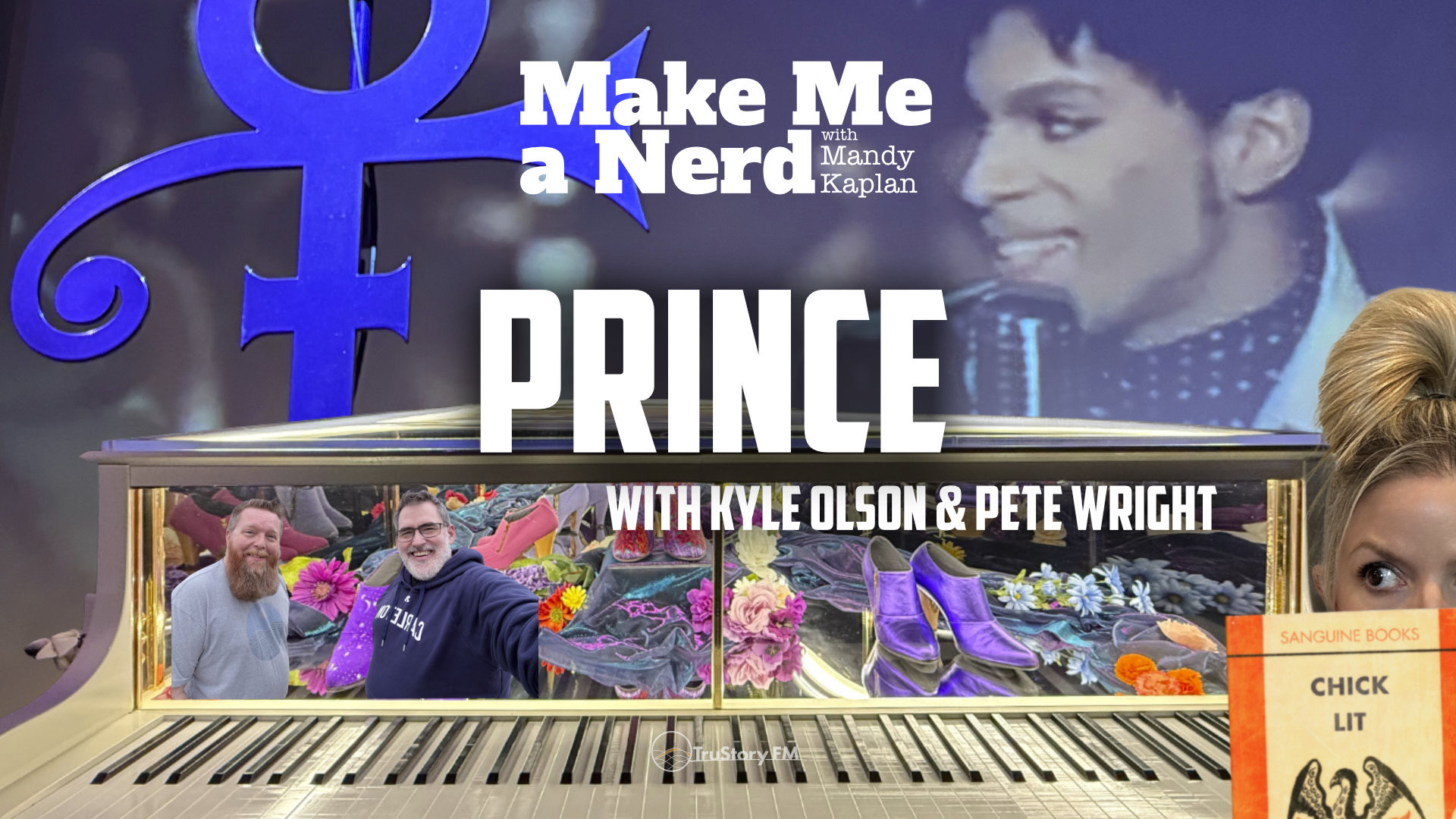
Mandy Kaplan:
Hello everybody and welcome to Make Me a Nerd. I’m Mandy Kaplan, a mainstream mom whose mission it is to explore the world of nerd culture that I’ve been missing out on and afraid of my whole life. If you’re new to the podcast, basically, I’m not all that deep. I invite people on to share their deep, nerdy love for something, whether it be sci-fi, fantasy, music, musicians, whatever it is. I want them to deep dive and share their nerdy love with me and see if I can get nerdy too.
I ask all the time for people to leave reviews for me as I do the show because it helps people find my show. And one of those promises I make when I say that is I’ll give you a shout out on the podcast. So Guy Fandango, you’re up. Guy Fandango gave me five stars. That’s part of the deal. And he, or she, said, “This podcast comes straight out of one of the few bright spots online. It is so refreshing to listen to two people or three people talk about something they genuinely enjoy. Sure, there are some critiques, but always out of appreciation and understanding. I came to this podcast to learn and was truly rewarded with useful knowledge.” Thank you, Guy Fandango, for the review. Look at that.
Kyle Olson:
We genuinely enjoy you, Guy Fandango.
Mandy Kaplan:
Oh, you don’t speak until you’re spoken to, Kyle.
Pete Wright:
I knew that rule.
Mandy Kaplan:
Demerit.
Pete Wright:
I already knew it.
Mandy Kaplan:
Starting with a demerit.
Kyle Olson:
I don’t know what right now. Excuse me, I was talking to the most important person, which is Guy Fandango, but now that we’ve concluded that, we can continue on.
Mandy Kaplan:
Goddammit. Okay, my guests. Fair enough. Oh well, they blew it, but they need no introduction because these guys are up to so many different creative endeavors. I thought I would let them do it themselves at some point in the podcast. They are members of the TruStory FM family. Hell, I’ll say it. They’re members of my family. They’ve been on my podcast many, many times. I’ve been on theirs. I adore these guys. It’s Tommy Metz and—no, I’m kidding. It’s not.
Pete Wright:
God.
Mandy Kaplan:
I could say all of that about him. It’s Kyle Olson and Pete Wright.
Pete Wright:
They need no introduction because hopefully they won’t stay. That’s what I heard. So glad to be here, Mandy.
Kyle Olson:
Thank you for having us back.
Mandy Kaplan:
Guys, you’ll notice I’m dressed up for the podcast.
Pete Wright:
Yeah. You did the whole thing.
Kyle Olson:
Oh, look at that. We’re in the royal purple.
Mandy Kaplan:
Royal purple. Have you seen my screen name?
Kyle Olson:
Love it. I don’t know, but have you seen mine? And do you know what it means?
Mandy Kaplan:
Yours, I don’t understand. Yours is Gemini. I did Dear Mr. Mandy, which required a Google search for a title with “man” in the title.
Pete Wright:
It’s good. It’s good. You’re trying.
Mandy Kaplan:
I’m all about the puns. We’re here today to discuss Prince. Nay, Roger Nelson, is that right?
Pete Wright:
Prince Rogers Nelson.
Kyle Olson:
Prince Rogers Nelson, yeah.
Mandy Kaplan:
Rogers. His first name was Rogers.
Pete Wright:
His first name was Prince.
Kyle Olson:
Oh, his first name was Prince?
Pete Wright:
Yeah, that’s his full name.
Mandy Kaplan:
Oh, I thought that was a stage name.
Pete Wright:
Nope.
Mandy Kaplan:
Okay.
Pete Wright:
You’ve learned something already.
Mandy Kaplan:
Guys.
Kyle Olson:
Look at that. Off to a great start. At three minutes, you’re already learning new stuff. This is incredible.
Mandy Kaplan:
So this was suggested by Pete many moons ago, because he just loves Prince, but he does not love Prince alone. He loves Prince with Kyle Olson.
Pete Wright:
This is so weird. Could you have put it in a weirder way?
Mandy Kaplan:
There is no homophobia on my show.
Kyle Olson:
That is true. I am definitely the Padawan to Pete’s Jedi Master when it comes to Prince stuff.
Pete Wright:
Oh, I don’t know about that.
Kyle Olson:
Like when we first started talking, when we first met and found out we had this mutual adoration for the man from Minnesota, he said, “Well, I need to give you these,” and he sent me a ton of bootlegs of recordings that I had never heard before. He had already gotten to that level of it, beyond just album cuts to people had recorded in clubs and things, and Pete had a bunch of those.
Mandy Kaplan:
Is that not mildly illegal to share bootlegs?
Pete Wright:
Are you asking seriously?
Kyle Olson:
It’s been going on since the Grateful Dead, so I’m not a big believer in “you had to be there.”
Mandy Kaplan:
They’re coming for ya, Pete.
Kyle Olson:
I think all these things should be recorded and preserved.
Pete Wright:
Oh yeah. And Prince has a massive catalog of exactly those.
Mandy Kaplan:
Okay.
Pete Wright:
In fact, some of the bootlegs are straight out of the studio. The Black Album, which I’m sure we’ll get to, was released as a bootleg years and years before it was ever released as an official pressing. So there’s a rich ecosystem of bootlegs for Prince stuff.
Mandy Kaplan:
Do you remember the beginnings of your journey with Prince? I know mine, but do you remember?
Kyle Olson:
Oh yeah, let’s start with yours.
Pete Wright:
Yeah, I think that’s a good idea.
Mandy Kaplan:
Mine was dancing around to Purple Rain in my room when I was very little and thinking Darling Nikki was the sexiest song I had ever heard. It gave me very special feelings that I still don’t understand to this day.
Pete Wright:
Yeah.
Kyle Olson:
That is part and parcel of the Prince experience.
Mandy Kaplan:
And what about you guys? How did it all begin?
Kyle Olson:
Like most of us, we’re of an age, so we were around at the time when Prince was around. I know even some of your listeners, he was gone before they were even around. But Purple Rain was just ubiquitous. You turn on the radio, you’re gonna hear When Doves Cry. It was heavy rotation for years. When those songs were coming out — Let’s Go Crazy, Little Red Corvette, Raspberry Beret — if you put them in the top five, these are the ones that you’re gonna hear all the time. And it was, yeah, those are really good. But I got tired of hearing it. Every time I would hear the opening of When Doves Cry, I’d be like, oh, gonna switch off.
But it was the later stuff. For me, when we got to Sign o’ the Times, this middle period where all of a sudden there was all this really interesting stuff coming out that was beyond just pop hits, it was like, oh no, there’s way more going on than I thought. And obviously Batman was a big thing. I listened to the Batman soundtrack I don’t know how many times — the music that he did for that. But yeah, Sign o’ the Times was the one where I was like, this is a musician like I’ve never heard before.
Mandy Kaplan:
It goes from being fun pop music to: oh wait, he’s a genius. He’s not just a guy who wrote bangers that I like on the radio.
Kyle Olson:
Exactly.
Pete Wright:
He also — what we gave you was a playlist of some of our favorites that come from the era that was sort of the most important. My era would be the mid eighties. So 1999 comes out in ’82. That was a double album that I just burned up. I just loved it. And it went four times platinum. It was extraordinary. And the Revolution — Prince and the Revolution — starts to take shape, and you have Lisa Coleman and Wendy Melvoin, and Dez Dickerson is out, so the band starts to take shape, creating the sound that I first attached myself to. 1999, Little Red Corvette, Delirious — those tracks were my foundation.
So I was already kind of ready. I was a younger Prince fan when Purple Rain came out, and that was huge. But by then, Prince is already running this empire of side acts, right? The Time and Vanity 6, like these things are there.
Mandy Kaplan:
I’m a sex shooter, right?
Pete Wright:
Well yeah, exactly. So these are the things that were defining the era.
Mandy Kaplan:
That is something that interests me. I liked Prince a lot. I liked Purple Rain a lot. I was on board. I did not become a devotee the way you guys did, and the way Jar, my husband, did. He actually wrote to Prince and begged to be part of the Revolution and tour with them. And it was this subculture — he’s gonna love that I just said that on a podcast. But it was this whole subculture. It was like, I could go be one of them at Paisley Park and jam all day and play. It wasn’t just an artist, a guy who wrote great songs. It was a whole movement.
And to some, very, very meaningful — religious. I don’t want to overstate, but it was. Just so much more than a guy with great songs.
Pete Wright:
And there was no internet, right? There was nobody to go talk to in forums. So as soon as I got my license — a buddy of mine and I drove up to Denver every Saturday to Wax Trax to pick up whatever the latest albums were that came out, the bootlegs that came out and were released. For Prince, that’s where I ended up with a purple vinyl that was actually not even music. It was just an interview with Prince that had been cut on an album, cut in the shape of Prince’s silhouette. It was awesome. Like it was just Prince talking and it was my favorite thing. It was a treasure.
The conversations that I had about Prince and about my fandom for Prince happened in the car on the way to and from Denver. It happened with other fans who were showing up at the record store to buy the latest Prince stuff. That’s where the conversations happened. That’s where the fandom grew. And of course I’ve seen Prince live more than any other artist. So it was — I never — there are much bigger fans than I who followed him, but I did have the privilege of seeing him a bunch of times.
Mandy Kaplan:
It’s quite incredible. And the list you guys sent me, it was not short. You guys did not hold back.
Kyle Olson:
No. And that’s just a sliver. We’re gonna — Pete, because this is the same Pete that you often talk to on your show, this is the same guy, he’s going to put the link to the playlist that we created in the show notes so you guys can listen to the thing we put together.
Mandy Kaplan:
Of course he is.
Pete Wright:
He could do it. Yeah.
Kyle Olson:
We went together — when we were on another friend of the show’s show, Krissy Lenz, we were on talking about Purple Rain and she didn’t really know much about Prince. So we put that together to give her an idea of a sampler of our favorites and then some deep cuts of Prince stuff too. And then when you asked us to be on here, we revisited it and did some updates and sent it off to you so you can get an idea of the ones that we think are important and that we love.
Mandy Kaplan:
Yes, and there are so many I had never heard. My fandom did stop after Raspberry Beret or the Graffiti Bridge, like the stuff that was popular. And then I didn’t continue on with him all that much. So one of them I want to talk about, right at the top of your list — My Name Is Prince. This was a brand new song to me. I had a lot of thoughts about this song.
Kyle Olson:
Okay.
Mandy Kaplan:
Okay, first of all, he is sampling his own stuff and putting it in there. And I thought it was going to be like a Joseph and the Amazing Technicolor Dreamcoat megamix. I got pretty excited.
Kyle Olson:
Oh, I have some of those too. I got a couple really good Prince ones.
Mandy Kaplan:
Megamixes? Prince megamixes? Okay. I would love those. But it wasn’t. It was so frenetic, this song. It sounded like several songs fighting each other in one song. What part of his career was this from?
Pete Wright:
’92, right? The reason this is important is because it’s rich with lyrical irony. He says, “My name is Prince and I am funky. My name is Prince, the one and only.” And he says this on the very last album he releases under that name before changing it to the symbol seven months later. This is essentially Prince insisting on his identity before he completely abandons it because of issues with Warner Brothers. So I think it’s — I know this was actually more Kyle’s era than mine. You’re a big fan of the NPG, right?
Kyle Olson:
Yeah, I am.
Mandy Kaplan:
Was that MC Scat Cat on that track or is that just me?
Kyle Olson:
I’m holding back doing all of MC Scat Cat’s verse from him and Paula Abdul because I know that entire thing.
Mandy Kaplan:
Yeah.
Kyle Olson:
But yeah, that’s the exact era. That is exactly that time period. So you’re right with it.
Mandy Kaplan:
Right. It didn’t feel — God, how do I say this without sounding like my nana? It was cacophonous to me. There was so much happening that I couldn’t grab onto a hook or a melody or a lyric that made me feel like, oh, this is a song I can get on board with.
Kyle Olson:
And I think part of that was intentional, because if you go back to stuff like Still Will Stand All Time, or even Darling Nikki that comes up, the soft Prince — this is him coming out really strong to say, I can also do this. Showing us another side of it. In the era, this is sort of in the era of NWA and gangster rap and the rise of that sort of thing. This is Prince coming out saying, look, I can be strong too, but that’s not what I do. But this is very much in your face.
If you look at the way it progresses, it’s intense. But then in the lyrics — “My name is Prince, I don’t want to be king, because I’ve seen the top and it’s just a dream. Big cars and women in fancy clothes will save your face, but it won’t save your soul.” So he’s coming out strong, but also saying, look, none of this stuff matters.
Pete Wright:
Yeah. If you need me to tell you this story in hardcore rap metal fusion, I will.
Mandy Kaplan:
So is it a bit of — I don’t know if you’re familiar with Ben Folds Five, Rockin’ the Suburbs.
Pete Wright:
Oh yeah, yeah.
Kyle Olson:
Yeah.
Mandy Kaplan:
Is there a bit of him making fun of them by doing what they do better than they do it?
Pete Wright:
I would push back on “making fun of.”
Kyle Olson:
A little bit, yeah.
Pete Wright:
Prince was never one to lampoon through musical style — other music or musicians.
Kyle Olson:
That’s true.
Pete Wright:
He lampoons culture all the time. But I think he was much more respectful for the craft. I think he really was just — this is another flex. This is — Kyle said it — this is a demonstration of capability. This is a guy who recorded his first couple of albums by himself playing all the instruments. He is a prodigy. And this was him saying, I’m an adult and I can do whatever you throw at me. If this is how you want me to be heard, I can do it, and I’ll do it with the very best of them.
Mandy Kaplan:
That’s how I should start my podcast.
Pete Wright:
With a flex.
Mandy Kaplan:
With that statement. “I’m an adult and I’ll do whatever I want and I’ll do it better.” With a flex.
Kyle Olson:
Honestly, that could be emblazoned on the walls of Paisley Park, because that is sort of the journey that he went on. What we’re learning now is sort of — what the media covered, what we learned in the ’90s was vastly skewed from the reality of it. I remember I just watched the Lilith Fair documentary, and they had this whole thing about Paula Cole. She won the Grammy for Best New Artist, but the next day all everybody was talking about was the fact she didn’t shave her armpits.
Mandy Kaplan:
Okay.
Kyle Olson:
That was the news story. It wasn’t about this amazing artist and all that, and she was a new voice on the scene. It was that. And the same thing with Sinéad O’Connor tearing up the picture of the Pope. “Oh my gosh, how dare you say anything bad about the Pope?” Well, the point she was making was that the Catholic Church was covering up a lot of really heinous crimes, but all everyone talked about was tearing the picture.
Mandy Kaplan:
Right.
Kyle Olson:
And the same way with Prince, with the whole — when he changed his name, he stopped being Prince. That was in opposition to Warner Brothers music exploiting him and holding him to these ridiculously awful contracts. This was his way of calling attention. But people just made fun of it. “Oh, now he’s a symbol.” And it’s like, this is a predatory company who is exploiting a musician. He is fighting back and you’re siding with the corporation. What are you doing?
Mandy Kaplan:
Right. This is getting into a darker lane, and I want to go there after this. Is there something problematic about Prince’s legacy? There was a documentary that we never saw. Is it okay to ask about that? Or would you rather not discuss those things because we’re celebrating his musicianship and his artistry?
Pete Wright:
Oh, I think there’s a lot of problematic stuff in Prince’s legacy, and he was a troubled, complicated artist who definitely had issues with people, with substances, all of that.
Kyle Olson:
Oh yes, yes.
Pete Wright:
He burned many bridges for sure.
Kyle Olson:
He burned many bridges.
Pete Wright:
He’s definitely one of those people that we have to say — again, you gotta separate a little bit the art from the artist. He is a complicated organism.
Mandy Kaplan:
To my understanding — I’m surprised you had an album of him doing an interview. He seemed a bit like a recluse. There are all these — I have memories of him on talk shows, and it was so awkward for the host to try to drag funny anecdotes out of Prince. Is that an accurate memory or no?
Kyle Olson:
I just don’t think he liked that format. Honestly, I think it came down to: the more successful he got, the more he stopped doing what he didn’t want to do. And what he did want to do is sit with Arsenio for an hour. He would just rather be in the studio working on another song. He got to the point where it’s like, I don’t want to talk to Jay Leno. I would rather write more songs for The Time.
Mandy Kaplan:
Well, who would want to talk with Jay Leno?
Kyle Olson:
This is what I’m saying. When you look at who he would be talking to, do you really blame him for not wanting to go on a lot of the shows?
Mandy Kaplan:
Yeah. No, I just thought of him as shy. I thought of him as not wanting to open up and share the stories behind the music.
Kyle Olson:
I think that’s fair. And he built up that part of it. He was private in a lot of things. There’s a lot of things we don’t really know. And then he goes and does an episode of Muppets Tonight.
Pete Wright:
Yeah.
Kyle Olson:
Just like — not just performing, he was doing comedy with the Muppets on Muppets Tonight, and he was really good.
Pete Wright:
And it was great. It was so good.
Kyle Olson:
So in the midst of this period of “oh, what is this artist, and he’s changed his name and all this stuff,” then he’s making jokes with Kermit. Just when you think you got him pegged, he goes a different direction.
Pete Wright:
And there were interviews he did that I think collectively everybody agrees made him look good — that he was clearly having a good time. Go watch his Larry King interview. It’s kind of the stuff of legend about his career. In fact, it’s so much the stuff of legend that they have it on a loop at Paisley Park playing on a TV in Prince’s office, just constantly looping.
Mandy Kaplan:
Ah. Okay.
Pete Wright:
And it just shows this side of Prince that when Prince wanted to say something, he knew how to do it. He didn’t like doing it in service of what he was creating, like promotionally. He liked talking about things that really mattered to him. That’s my understanding anyway.
Mandy Kaplan:
All right. I appreciate all this insight because I didn’t go that deep. What a shock.
Kyle Olson:
The thing throughout his life, then he just became more prolific. A lot of artists have this period where everything is flowing and everything’s coming out. And then it all kind of tapers off. They sort of end up — if you get a hit album that everybody loves, like already lightning has struck and that’s fantastic. But the idea that he then had that, and again, and then had it again, and then every time it was just something more and something different. He just kept trying different things. Sure, the mainstream sort of moved away, but that didn’t slow him down. He just kept making songs, kept writing songs for other people that he didn’t even take credit for. The fact that Sinéad O’Connor’s biggest song is a Prince song —
Pete Wright:
Yeah, yeah.
Kyle Olson:
And he just gave it to her. Went, “Oh, I think this actually would be better if you did it.” And then just moved on. And then she becomes a platinum-selling artist on the strength of that song.
Mandy Kaplan:
So on your list, you had I Feel for You, and I thought, oh, I don’t know this one. And then it started, and I was like, yes, I do.
Pete Wright:
You sure do. Yeah. Chaka Khan.
Mandy Kaplan:
Chaka Khan. So he had already put that out on his ’79 album, right?
Kyle Olson:
That’s right.
Pete Wright:
Oh yeah, yeah.
Mandy Kaplan:
And that was a hit for him, or —
Kyle Olson:
The original is more of a deep album cut.
Pete Wright:
Yeah. Chaka Khan — even though he started working with Chaka Khan and that partnership ended up being something really special, I Feel for You was the moment when he realized, oh my God, I have so many songs, I can afford to dole them out to others and have them have their way with them. And it’s great.
He was also not shy about covering, for his own personal use — we put A Case of You on there because Prince was a massive, massive Joni Mitchell fan. I mean, massive.
Mandy Kaplan:
Oh, I put a heart next to it, but I didn’t know it was a Joni Mitchell song. But I want to back up, Pete. I really admire that you can say Chaka Khan and not say “Chaka Khan, everybody, everybody, Chaka Khan.” You just said it and you let it go.
Pete Wright:
You gotta — sometimes you gotta let it out. I’ve been saying it all day so that I could just speak normally today.
Mandy Kaplan:
I really appreciate the effort on my behalf. What other songs would it surprise someone like me to know he wrote? I knew about Nothing Compares 2 U.
Pete Wright:
Oh, Manic Monday — Bangles.
Mandy Kaplan:
What other hits? Okay. I remember back to my performing days for a talent school talent show, I did Sugar Walls by Sheena Easton that he wrote, right?
Pete Wright:
Yeah.
Kyle Olson:
Yep.
Mandy Kaplan:
And, oh, of course.
Kyle Olson:
The Glamorous Life, Sheila E. Sheena Easton.
Mandy Kaplan:
But you guys, I just want to say, I was dancing way too slutty for a fourth grader. It was not appropriate. I don’t think I made anyone proud. Okay, but I loved that song, Sugar Walls. Strut, pal.
Pete Wright:
You gotta. Stevie Nicks — he did a track for Stevie Nicks. Stand Back. That was big.
Mandy Kaplan:
Ah, the Little Sympathy.
Pete Wright:
He did a bunch for The Time, but The Time was essentially a Prince band.
Kyle Olson:
Yeah, a bunch for The Time.
Pete Wright:
Yeah, we talked about The Glamorous Life. I Feel for You, Sheena Easton, Love Bizarre — Sheila E.
Kyle Olson:
Tevin Campbell.
Pete Wright:
Tevin Campbell. Oh yeah.
Kyle Olson:
Round and Round comes from Graffiti Bridge.
Pete Wright:
Yep. Art of Noise, featuring Tom Jones — they covered Kiss. Patti LaBelle. Sinéad O’Connor, obviously, Nothing Compares 2 U. That was probably the biggest one just because that song — her cover of that song kind of defined an era, especially her performance of it on SNL.
Kyle Olson:
Yeah, according to this website, there are approximately 322 songs Prince wrote or co-wrote for other artists.
Pete Wright:
Yeah. Oh, Alicia Keys — How Come You Don’t Call Me Anymore? She actually did that one. He released that one as well, but she covered it. That’s a great song. It is different, though, having an artist cover a Prince song that was released versus having a song that he wrote and gave to them and never performed or released after they did it.
Mandy Kaplan:
Sure. It is extraordinary because you’re saying things that cover so many different genres. It’s not just what we think of him with a guitar.
Pete Wright:
Well, that’s one of the reasons I wanted to put — like on that playlist, you’ll see songs on there that just don’t sound like Prince songs, especially when you get into the stuff that he did for the movies, for the soundtracks. Like Venus de Milo is an instrumental piano tune that you would not be able to peg as Prince. But I wanted you to hear that because of the straight-up virtuosity of this guy as a pianist, as someone who —
Mandy Kaplan:
Did he score the films? Do you know that?
Pete Wright:
I don’t know if anybody worked with him on additional score for Under the Cherry Moon. He did obviously all the songs and some of the songs were used as score material. It’s been a long time since I’ve watched the movie, but I’m pretty sure all of the other score music was actually Prince music as well.
Mandy Kaplan:
We’re gonna take a break for a commercial, and then when I come back, I want to get into highlights, favorites, albums, songs, everything that you want to nerd out about right after this.
Pete Wright:
Sure.
Mandy Kaplan:
So if I say pick your favorite album, is that too tough?
Kyle Olson:
Yeah, that’d be too tough.
Mandy Kaplan:
Can you do top threes? Can you do why you love certain albums? Relationships with the music? Is it where you were in your life? Or is it just musically this one is better than the rest?
Kyle Olson:
I think that’s a big part of it, yeah.
Pete Wright:
Big part of it. I gotta start because so many of the songs that were on the playlist are — they’re out of order, but when you bundle them in eras, that first era that I came to after the eighties — this is the late ’70s. These albums — For You and Prince and Dirty Mind and Controversy — those were weirdly my introduction to people singing about sex. Right? Dirty Mind. Songs about incest — Sister. Threesomes — When You Were Mine. Oral sex — Head. The album cover of Prince in a trench coat and a thong.
Kyle Olson:
Yeah.
Pete Wright:
Nobody was playing this music on the radio. This was all like, “Here, we’re just gonna put this on albums and you’ll figure it out.” But critics loved it. Dirty Mind put him on the cover of Rolling Stone. So he blew up pretty fast. When you think about that cultural rocket ship, it happened within just a couple of years of him starting to produce these albums in his house.
Prince ended up opening for the Rolling Stones in 1981 at the Coliseum, and —
Mandy Kaplan:
I didn’t know that.
Pete Wright:
Yeah. The audience booed and threw garbage at him and chicken bones, and Mick Jagger reportedly personally called him and convinced him to come back for the second show. Same thing happened again. And apparently that was the moment he decided, I’m never opening for anybody else ever again.
And that’s the defining era of Prince, the motivating era of Prince. You could say that that LA Coliseum show or that pair of shows defined his relationship with the audience forever.
Mandy Kaplan:
It’s a strange pairing. I understand aesthetically Mick Jagger was also doing a sexy, androgynous thing, but you’re there to see this rock and roll British invasion group, and out comes Prince. I’m not saying it justifies throwing anything or booing him, but I understand the confusion. It’s a shocking pairing.
Kyle Olson:
There have been fascinating pairings all through history. Jimi Hendrix opened for the Monkees.
Pete Wright:
Yeah, right, crazy.
Mandy Kaplan:
I love that.
Kyle Olson:
It’s just these strange eras that cross over that you don’t think about. He was just a young guy trying to make his bones, and it was a good gig. But yeah, those things are fascinating to me — we think of these eras as being entirely self-contained, but oh no, they bleed over from one to another.
Pete Wright:
Yeah. And then you transition to the eighties and we end up in this weird era, the early eighties. We’re sort of transcending the funk of the seventies. Prince and Michael Jackson — you really cannot talk about the ’80s and Prince without talking about Michael Jackson. One of the very cool experiences is going to Paisley Park and being in the studio and being able to play ping pong on the ping pong table where Prince and Michael Jackson used to play ping pong. That’s pretty fun, actually. It is a neat experience walking on hallowed ground.
Mandy Kaplan:
Wow.
Pete Wright:
So MTV — they talk about it as breaking the color barrier when Billie Jean dropped on MTV in 1983. Little Red Corvette had actually been on heavy rotation slightly earlier than Billie Jean, but those were arguably the first videos by Black artists on the channel and ended up defining a lot of the aesthetic of music videos by Black pop and hip hop artists.
This is in an era where synthpop is super dominant. We’re listening to Duran Duran and Eurythmics and Human League and Erasure. Even while new wave is still fresh, we get this injection of funk pop that I think carried really, really well and thus defined the next major era for Prince, which was the Revolution.
Mandy Kaplan:
I didn’t realize that they were friends.
Pete Wright:
Friends, yeah — kind of a roller coaster relationship.
Kyle Olson:
Friends, contemporaries.
Mandy Kaplan:
Played ping pong.
Kyle Olson:
And yet they never collaborated.
Pete Wright:
No.
Kyle Olson:
There was always this rumor that there was going to be something that they were going to do together, and it just never happened.
Pete Wright:
Even standing playing ping pong in a studio with hot mics, they never collaborated on a track. Crazy.
Mandy Kaplan:
Wow, it’s a shonda. Kyle, what about you? Those were two of Pete’s loves.
Kyle Olson:
Yeah, that’s I guess sort of where my stuff comes in. Because as much as — we even put some of them on there — there are some incredibly dirty, frankly… he would be happy with us saying that. Dirty songs. Get Off. Tick Tick Bang.
Pete Wright:
Yeah. Exactly.
Mandy Kaplan:
Tick Tick Bang. You guys, I’m so puritanical.
Kyle Olson:
All these things are like, I cannot believe that you’re allowed to do this.
Mandy Kaplan:
I was like, these are so X-rated.
Pete Wright:
I know. Tambourine.
Mandy Kaplan:
I don’t think I listened to Tambourine.
Kyle Olson:
That is what a lot of people who don’t really know — that’s kind of how they think of it. And that is a valid thing. You could do a whole playlist of just Prince sexy time stuff. That is something he absolutely reveled in and was happy to celebrate in a way that — a lot of times, I think even we’re in a more puritanical time now where people feel like they can’t really talk about these things, they have to hide it under all of these metaphors.
But the other side of it is he was also a really dedicated artist, and would push back against all these things. So a lot of the songs that I really resonate with — stuff like Thieves in the Temple. Or like — New Power Generation. Graffiti Bridge was a big thing to me. It was ostensibly a sequel to Purple Rain, directed by Prince. It is not a good movie, but the actual soundtrack itself —
When he had left the Revolution, he had basically fired them. They found out that they had been fired. He didn’t even call them to say, “Hey, we’re not doing this anymore.” He just put together a new band and started recording stuff. That’s how they found out. So once again, we’re not here to say that Prince never made any mistakes or hurt anyone, because he absolutely did.
But there’s this side of it where in New Power Generation, he says, “We are the New Power Generation. We want to change the world. The only thing that’s in our way is you. Your old-fashioned music, your old ideas — we’re sick and tired of you telling us what to do.” So there’s this real piece of like, he is also an angry man who is tired of being treated badly. There’s a whole other thing we can go through.
Mandy Kaplan:
Was that at the label? Or this was well before?
Kyle Olson:
As a Black man coming up in ’90s America, even with all of his success, he still had to face the same systematic racism that we’re still dealing with today. Just because you’re rich and famous, it doesn’t make you immune. So I think he still had that social part where he wanted to say more than just “I like having sex with women.” He also had this other thing going around.
And also in an era that was defined by masculinity. Him coming up in the era of Rambo, when everything was aggro — this guy comes on stage wearing lace and purple and jewelry and makeup. And was unapologetic to talk about how much he liked getting down with the ladies. It was something we had never seen before. Little Richard was like, “Oh man, I wish I could have done that.”
Pete Wright:
Yeah.
Kyle Olson:
But he couldn’t. He absolutely couldn’t have.
Mandy Kaplan:
Right, of course not.
Kyle Olson:
In his era, he went as far as he could, and Prince went as far as he could.
Pete Wright:
There is — 1984 is widely acknowledged as the biggest year in pop history of the era. You had Madonna release Like a Virgin, which is all sort of hyper-femme. And you have Springsteen release Born in the USA, which is the other direction. And Prince is dancing right in the middle of these two with Purple Rain, coming out of the Twin Cities.
Kyle Olson:
Coming out of the Twin Cities, coming out of Middle America, the flyover states.
Pete Wright:
Right. I find it fascinating, this sort of cultural relevance, and the fact that Prince was defining what it meant to be gender presentation fluid, at a minimum, in an era when we had no language to talk about it. That fluidity was Prince. That was Prince. Everything.
Mandy Kaplan:
One observation I had about him throughout the playlist, and then I was remembering other songs — he often did not sing lead vocals, or he had many other vocalists on tracks. I was wondering if you guys knew why that was. That’s a strange thing for a solo artist. Yes, he had bands, but he would hand over major parts of the song to other people vocally.
Pete Wright:
I think that underscores what is often misunderstood about Prince — that when Prince was working, Prince was a collaborator.
Kyle Olson:
Oh, yes.
Pete Wright:
Especially for Prince fans — that opening jam is dedicated really to Sheila E.’s drum solo. It’s just extraordinary. That is performance generosity to not make it completely about himself. Kyle?
Kyle Olson:
He loved musicians and he loved music. In the same way that he would give these songs to other performers and produce their albums, he loved to jam. It wasn’t just the fact that “I’m gonna go in the studio by myself.” He did that first album alone and never did that again. He basically always wanted to be surrounded by people who were the best of their craft. He would put together multiple bands and multiple incarnations of multiple different styles of things depending on where his musical mood was taking him. So yeah, I think he was happy to be like, “Yeah, bass solo, go for it. I’ll just stand here while you do the thing that you’re good at.”
Pete Wright:
There’s a form of arrogance that comes out in the post-Paisley Park era too, because that aesthetic of always wanting to be surrounded by people and ready to go is exactly what made people crazy, because they had to be ready to go too.
Kyle Olson:
Yes.
Pete Wright:
They were always there. And when Prince was watching a basketball game — because he loved basketball — he might just say, “Hey, now I want to go write a song,” and everybody had to jump to it. That was just — now we’re in the studio. And that ended up wearing thin on a lot of important relationships.
Kyle Olson:
If you watch any of the stuff — Charlie Murphy’s stories on the Dave Chappelle show talking about his time hanging out with Prince. He says all those, and they’re presented comedically, but I believe a hundred percent all those things actually happened.
Mandy Kaplan:
Sure.
Kyle Olson:
And the same way that Kevin Smith tells a long story about his time collaborating with Prince — ultimately fruitless. He was supposed to shoot a documentary, all the footage was taken away and has never been released. But he tells some pretty wild stories too, and I believe all of those as well. He was a complicated person, and he got to that point when he could record at any point, whatever the mood would strike him. So at 2 a.m., suddenly people’s phones would be ringing. He’s ready. And they had to come down in the middle of winter to Paisley Park to start recording.
Mandy Kaplan:
That’s the cult of Prince. That goes beyond, “Oh, I play in a band for this guy.” People were moved to —
Pete Wright:
And he called everyone — they were in the family. He made it super clear when you were in the family. Again, in Paisley Park, his favorite studio — you walk into the studio and it’s plastered with pictures. The walls are wallpapered in giant pictures of 3rdEyeGirl, which was the iteration of the band when Prince died, and a giant, giant picture of Prince — it’s like 25 feet tall — that stands over the instruments.
Mandy Kaplan:
That’s like five Princes.
Pete Wright:
It’s so many Princes, like on top, in a giant trench coat. But Prince — that studio — Prince would redecorate it with pictures of whoever was in the family at the time. So it changed over time, and he apparently found it inspirational to dedicate the recording space to whoever he’s bringing in at 2:30 in the morning to make the music.
He also — this drives me crazy — he also had candles everywhere, which is great, but his candles are on all the electrical equipment and the mixing boards and the computers. As a sidebar, one of the things that I did not know about Prince was his technical prowess, not just as a musician. The dude knew computers. He knew the ins and outs of his editing software, both audio and video, and he spent a lot of time editing his own concerts, his own performances, cutting together tracks, and mixing his own sound. He knew all of it. When he died, Paisley Park was set up with Mac Pros in every room. There are little corners — at any moment he could sit down and start editing. He was always within like 15 feet of an editing booth. Apparently he would do that in the middle of the night, lit only by candles, sit in complete dark and edit. He was a very savvy technician.
Mandy Kaplan:
Well, unlike Prince, I am not technical, and I don’t make this podcast by myself. Make Me a Nerd is a production of TruStory FM. Engineering by the peerless Pete Wright, who I get to look at and say that about. My theme song is Wonderstruck by Jane and the Boy. I’m on social media, on Instagram at Mandy_Kaplan_Klavens — both with K’s — and I’m on TikTok at MandyMiscast. If you’re listening on Apple Podcasts, please, please leave a five star review and let me know what you think. Let me know if you have a suggestion for something you want me to try and I will do it. Let me know if you want to come on and nerdify me. I will invite you. And lastly, if you’re feeling supportive and you want to go on to makemeanerd.com/join, hitting that button will get you your episodes ad-free and early, and my eternal gratitude. More to come after this.
Is there a sense — as I was listening to some of this music, as we got later, Sign o’ the Times, My Name Is Prince, some of the later stuff — was he setting trends or chasing trends later in his career? And is that a blasphemous thing to say?
Kyle Olson:
I think he was absolutely going his own direction and he didn’t really care what other people were doing or if they were following him or not. I don’t think he was really following anybody.
Pete Wright:
Yeah, I agree with that. I think he’s almost trend-proof. He was such a low-key isolationist. I don’t think he was influenced by much because there wasn’t much that touched him. I think he was seriously making art out of his head.
Mandy Kaplan:
Bouncing off of our conversation about My Name Is Prince and how that was the music of the time and it was him saying “I can do this music too” — I didn’t know if he was being influenced to go in a certain direction musically. But I didn’t hear his latest stuff.
Kyle Olson:
I think after the battle with Warner Brothers, he was like, “I don’t want to be a part of pop music anymore. I don’t want to sign another contract. I don’t need to deal with these people at all. I’m gonna do it all myself.”
Pete Wright:
I want to own my masters.
Kyle Olson:
Exactly. Which a lot of artists never get the chance to do. Look how Taylor Swift has had to fight. Look how Kesha has had to fight. These are the same battles that Prince was doing.
Pete Wright:
Had Taylor Swift and Kesha looked at Prince, they would have never had to sign those deals. Prince fought it first.
Kyle Olson:
Yes, right.
Mandy Kaplan:
So you said masters, and I understand what masters are, but a lot of your list were remasters. And I’m a musical person, but I don’t hear a big difference. Can you discuss why a remaster is — how different it is and why you put those on the list rather than the original versions?
Kyle Olson:
It’s what’s available. A lot of these things came off of audio cassette or the early generation of CDs, which were not fantastic. So them going back in and basically trying to make it closer to how it sounded in the studio, as opposed to the compression and everything that had to go through — without getting super technical about it. But these remasters are not new versions.
Pete Wright:
They’re just clean.
Mandy Kaplan:
Oh, okay.
Kyle Olson:
They’re closer to getting to what it was supposed to be like.
Pete Wright:
Yeah.
Mandy Kaplan:
Gotcha.
Kyle Olson:
How it was supposed to sound.
Mandy Kaplan:
I saw that word so much and I thought, I don’t know what the difference is.
Pete Wright:
On our part, there was no intention about thinking through what’s a master version versus a remaster. Functionally, it’s cleaner. They’ve done some work to clean it up.
Kyle Olson:
And he is famous for extended mixes and stuff too.
Pete Wright:
Yeah.
Kyle Olson:
We didn’t put a lot of that on there. There’s Scandalous the song, and then there’s the Scandalous Suite, which is a whole other thing. So we tried to keep it more towards just the three or four minute songs.
Mandy Kaplan:
Which I appreciate. I’m not such a jam person, but that’s my sensibility.
Kyle Olson:
Right.
Mandy Kaplan:
God love you if you are. So as we are nearing the end of our time, which sounds crazy, feels wrong — what is it, if I forced you to say, what is it you love about Prince? And is he your favorite artist or one of many? Talk about your love. And gaze at each other while you do that, please.
Kyle Olson:
Well, I can say — we put our love of Prince into practice, because last year Pete and I took a road trip, both converging from our separate locations, to meet in the Twin Cities to see the world premiere of the Purple Rain musical. We got there on their opening weekend. We got to be there and see the extravagance that it was, and see people trying to emulate not only that movie, but that era. That would be a whole separate podcast talking about the show and stuff. And it was — we saw it essentially as an out-of-town preview. So they have some work to do.
Pete Wright:
It was the second public performance that they had ever done.
Kyle Olson:
Yes. But seeing people taking that and recreating it — I never got to see Prince live. So this is as close as I got, seeing officially, with the approval of the estate. They’re behind the stuff. And the lead actor was very good at sounding like Prince and doing the moves, and the band sounded like it too. So it was the closest experience I had had to seeing him live. So we put our fandom into practice. We went all the way to the Twin Cities just to see this and visited Paisley Park while we were there.
It really gave me a new appreciation. There’s sort of the myth, but then seeing the place — going into part of — we didn’t do the full tour, but Pete has done that. I didn’t know that on that trip. But going in, seeing pieces that were on album covers or famous pictures — like, “Oh, that is actually the thing from the —” And we had very nice tour guides who were happy to show us around. So being in the place where all of this stuff was made was really kind of like, you know, like you’re saying, close to a religious experience.
Mandy Kaplan:
Yeah, I’m gonna go.
Kyle Olson:
For me, that’s creativity. Basically being in a place where someone was allowed to be as creative as they wanted to be, to do the work that they were sent here to do, was pretty incredible. That’s sort of where it comes down to. He was an iconoclast. He was a creative person and he got to do the thing that he was great at doing. How many of us get to do that? Not many.
Pete Wright:
He died on April 21st, 2016. So ten years. It’s one of those celebrities that I feel like was impactful — you spend so much of your time consuming their creative output. I think that creates a different kind of bond than just being a — I don’t know what I’m — a fan. It’s a different kind of fandom when you spend your adult life and your childhood life consuming their creative output.
Mandy Kaplan:
Right.
Pete Wright:
And I will tell you, going into — he died — you walk into Paisley Park, which was his live-in studio. His living quarters were upstairs, his recording studios and things were downstairs. You walk into Paisley Park, there’s a little entry area, and you walk down this hall, and right when you get to the end of the hall, there’s an elevator that was where Prince could come up and down. And you’re standing — I’ve seen the police footage that was released online of Prince’s death when the Minneapolis police found him. And I was standing there at the foot of where he died, and I felt like I’d been just kicked in the chest over and over and over again.
Mandy Kaplan:
Yeah.
Pete Wright:
It was a really emotional experience being there and standing in that atrium. He loved this atrium that’s right next to this elevator, big open kind of pyramid right at the top. And reportedly — though I didn’t see it — reportedly he had a miniature model made of Paisley Park that was the urn where his ashes reside, that was sitting up inside the glass atrium.
Mandy Kaplan:
Wow.
Pete Wright:
And it was all lit with purple lights, so you could see it across Chanhassen, the subdivision where the studio is located. That cemented my experience with Prince. He’s my favorite artist, absolutely. When I need to — it doesn’t really matter the mood. There’s something that I can put on from the Prince catalog that will suit it. My favorite favorite album was the Sign o’ the Times album. It’s consistently an extraordinary listen every time I listen. And it’s one of the albums that I don’t ever jump around in. I start at the beginning, I listen to the end. I think Prince put a lot of attention to how albums are meant to be consumed. And I still have it in my head and in my heart to respect that.
Mandy Kaplan:
And gun to your head, Kyle — favorite songs, favorite album?
Kyle Olson:
Oh man. Sign o’ the Times is actually really hard to beat because it’s just banger after banger after banger. We went together on that mix and it was —
Pete Wright:
Hard not to put all of Sign o’ the Times.
Kyle Olson:
Yeah, exactly. From top to bottom. Same thing, I had it on cassette and wore out my first set. I was happy with CDs because I could get that — I had already worn down listening to that entire thing. So different genres and styles and feelings that it goes through. It’s not just nonstop sex or social justice, whatever it is. And I think it’s right in the middle of his career too. So you kind of get a little bit of where he was and where he was going.
Mandy Kaplan:
Yeah. Well, I have a favorite Prince song, but before I reveal it — I know — this is so exciting. Can you guys, as we wrap up, tell everybody where they can hear you and find you and tell the people?
Pete Wright:
Kyle, Kyle.
Kyle Olson:
Pete and I are proud to announce our new podcast, Pod Unto the Light Fantastic. We’re gonna be listening to every Prince —
Pete Wright:
That’s a lie. One minute at a time.
Kyle Olson:
No, that is absolutely not true.
Pete Wright:
Kyle actually needs a lot of help telling people where he can be found. So he should definitely go first.
Kyle Olson:
It’s true. If you like the two of us together, you can hear us on not only Craft and Chaos, which is our podcast about how you stay creative during these difficult times, but also The Marvel Movie Minute, where we’re talking about different Marvel movies in five minute segments. So if you like the sound of our voices — and I don’t know why you wouldn’t — you can find us over there, all part of the TruStory FM family.
Pete Wright:
Kyle can also be found at the New Play Exchange. He’s a phenomenal playwright.
Mandy Kaplan:
Okay.
Pete Wright:
And he just forgets to put his name on stuff sometimes.
Kyle Olson:
That’s true.
Pete Wright:
It’s a long story. You should listen to Craft and Chaos. You’ll find out about it. So if you happen to be in a position to produce plays, get one of Kyle’s. And I just released my first novella, my first work of fiction. It’s called Lattice. And you can find it on my website at itsmepete.com.
Kyle Olson:
Woo!
Pete Wright:
Thank you, Kyle. Or at Amazon or Barnes and Noble.
Mandy Kaplan:
I have it — well, I’m in my studio, but I have it in the house in the kitchen.
Pete Wright:
Oh, that’s so sweet.
Mandy Kaplan:
So I win too.
Pete Wright:
Yeah, you win too. Everybody wins.
Mandy Kaplan:
Yes, everybody get the novella. And if you’re listening and you’re like, “I love these guys, where are they?” — you guys have been on my podcast together. We did Buffy.
Pete Wright:
Is that the only time that we’ve done it together?
Mandy Kaplan:
Right? Is that the only time?
Kyle Olson:
Yes, this is the only time the three of us have been together.
Mandy Kaplan:
Together. Okay.
Pete Wright:
Another problematic creator.
Mandy Kaplan:
So go back and listen to that.
Pete Wright:
That’s gonna be our stock and trade.
Kyle Olson:
Exactly.
Mandy Kaplan:
Pete, every episode I’m having disclaimers. I’m feeling this acutely these days.
Kyle Olson:
Honestly, yeah.
Pete Wright:
Eventually, yeah.
Mandy Kaplan:
You just — God, people suck. Okay, so my favorite Prince song, I think by far, is Nothing Compares 2 U.
Pete Wright:
Yeah.
Kyle Olson:
Ah yeah.
Mandy Kaplan:
I don’t think I can listen to that song without feeling the heartbreak.
Kyle Olson:
“It’s been seven hours and fifteen days.”
Mandy Kaplan:
It just gets in there in ways that — there are lots of great songs about heartbreak, but that one guts me. I love Sinéad O’Connor’s version, but I also love Prince’s version. I think it’s exquisite songwriting.
Pete Wright:
One of the great gifts — and I know we’re wrapping up, but I just — one of the great gifts of Prince’s career is just how prolific he was. There was — the room is still there. There’s a vault, literally a vault, underneath Paisley Park that was full of over 8,000 unreleased tracks. It included video, audio, cassette, DAT, like any format you can imagine. It was there. That entire vault has been moved to Los Angeles, and it is still being meticulously scanned and remastered and put together in new collections, and finding new things to release. And reportedly as of now they’re about halfway through it.
Mandy Kaplan:
Wow.
Pete Wright:
It’s been 10 years. There will be material coming from the Prince Estate for decades to come. And that’s a huge joy. One of them is the piano — Piano and a Microphone — a re-release or release that was just stuff that he’d put together from the concert that he was working on at the time of his death. I think A Case of You is on there. At Paisley Park they have a piano version of Little Red Corvette that is extraordinary. Any of that stuff that’s coming out, the more intimate Prince alone with an instrument — is, I think, just extraordinary stuff and it’s worth looking at.
Kyle Olson:
And once you’ve listened to every episode of Make Me a Nerd, then there’s also an official Prince podcast put out by the Prince Estate, where they go back and tell the entire story of each album and how it’s put together.
Mandy Kaplan:
Oh. Wow.
Kyle Olson:
They talk to the original artists and people who worked directly with him. It’s pretty extraordinary. They’re trying to tell as complete a story as they can. And they’re allowed to use the music, so it is very well produced.
Pete Wright:
All the music you don’t hear today on this show.
Mandy Kaplan:
Right, exactly. Well, thank you guys so very much for sharing something so meaningful. I really appreciate it. It was eye opening and ear opening.
Pete Wright:
Awesome. Thanks for indulging us.
Mandy Kaplan:
It’s fun to have a base knowledge for me to say, “I know Prince. I’m very familiar,” but to really expand my horizons. So thank you. Thank you everybody for listening. Until next time.