Mandy Kaplan:
Hello everybody and welcome to Make Me a Nerd. I’m Mandy Kaplan, a mainstream mom whose mission it is to explore the world of nerd culture that I’ve been missing out on and afraid of my whole life. Now, I met this lovely lady professionally.
Calley Bliss:
Mm-hmm.
Mandy Kaplan:
Yeah, and I don’t know what made me think, get her on the podcast and see if she can make me a nerd about something. But today I’m excited to nerd out with Calley Bliss, who is a voiceover artist, vocalist, and communications nerd. And fun fact about her, she learned the art of feeling all the feelings during thousands of hours of time on a yoga mat where she healed herself of chronic autoimmune symptoms. Damn! Welcome, Calley Bliss.
Calley Bliss:
Thank you, madam. I gotta say, I’m not entirely sure why you picked me either. I’m totally a dork about a lot of things, but I feel like nerds are a special breed of intellectual. I put them on a higher level, if you will. And I’m like, am I nerdy enough for this? But I was excited that you invited me. So I was like, here we go.
Mandy Kaplan:
Yeah.
Calley Bliss:
We’re gonna do it.
Mandy Kaplan:
First of all, two blonde nerds, here we are.
Calley Bliss:
Yeah. There’s a TV show in the making.
Mandy Kaplan:
I think what I’ve learned on this journey about nerddom is that it’s not necessarily sci-fi, fantasy, or anything like that.
Calley Bliss:
Yeah.
Mandy Kaplan:
It’s how deep you dive, right?
Calley Bliss:
Okay.
Mandy Kaplan:
So for you to say, I love yoga, so I’ve spent thousands of hours. And when I said, what would you want to talk about?
Calley Bliss:
Yeah.
Mandy Kaplan:
You said, I know yoga.
Calley Bliss:
I did say that, yeah.
Mandy Kaplan:
And I just can’t stretch and do yoga, so I didn’t want to do that.
Calley Bliss:
No, yeah, yeah.
Mandy Kaplan:
But that’s what being a nerd is to me.
Calley Bliss:
Fair.
Mandy Kaplan:
If you love something, you love it.
Calley Bliss:
Yeah.
Mandy Kaplan:
You explore it, you live in it, you want to talk about it. That’s what it is.
Calley Bliss:
Yeah, true, true.
Mandy Kaplan:
So welcome, you’re a nerd.
Calley Bliss:
I agree. I agree.
Mandy Kaplan:
And now you’re a Nerdicator.
Calley Bliss:
I’m happy to be. Oh, I have a new title. I’ll take it, thank you.
Mandy Kaplan:
Yeah. So should I back up and do your intro again? Calley is a new Nerdicator.
Calley Bliss:
Yeah.
Mandy Kaplan:
Is Bliss really your last name? No one’s listening, you can be honest.
Calley Bliss:
That’s a great question, and I’m totally honest with everyone who asks me that question, because I get it a lot. Bliss is a family name. It is my legal middle name because it was my paternal grandmother’s last name.
Mandy Kaplan:
Okay.
Calley Bliss:
So it is a last name in the family.
Mandy Kaplan:
Yes.
Calley Bliss:
It was given to me. I have one sibling, and she was given my maternal grandmother’s last name. That’s what they chose to carry on.
Mandy Kaplan:
Yeah.
Calley Bliss:
My family was already on to the maternal wavelength that I feel like the world is seeing now.
So I’m Calley Bliss and my sister is Taryn Abbott. And when I hit college is when I decided, I’m gonna go by Bliss instead of my legal last name. So yeah.
Mandy Kaplan:
Very cool.
Calley Bliss:
Been doing it for 25 years.
Mandy Kaplan:
And you guys got good names, Taryn Abbott and Calley Bliss.
Calley Bliss:
I know, they do. Well, she was born first, so they considered Taryn Bliss and they decided it didn’t roll off the tongue well.
Mandy Kaplan:
Mm-hmm.
Calley Bliss:
So it was kind of just by chance that they wanted to name her Taryn. And so they were like, Taryn Abbott sounds so much better than Taryn Bliss.
Mandy Kaplan:
Yeah. Taryn Bliss sounds like an 80s metal band or something.
Calley Bliss:
So then—
Mandy Kaplan:
I don’t know why.
Calley Bliss:
It totally does.
Mandy Kaplan:
They’re opening for Dokken. Yeah.
Calley Bliss:
And if you knew my sister, you would be like, one of these things is not like the other. She does not belong in an 80s metal band at all.
Mandy Kaplan:
Fair enough.
Calley Bliss:
Yeah.
Mandy Kaplan:
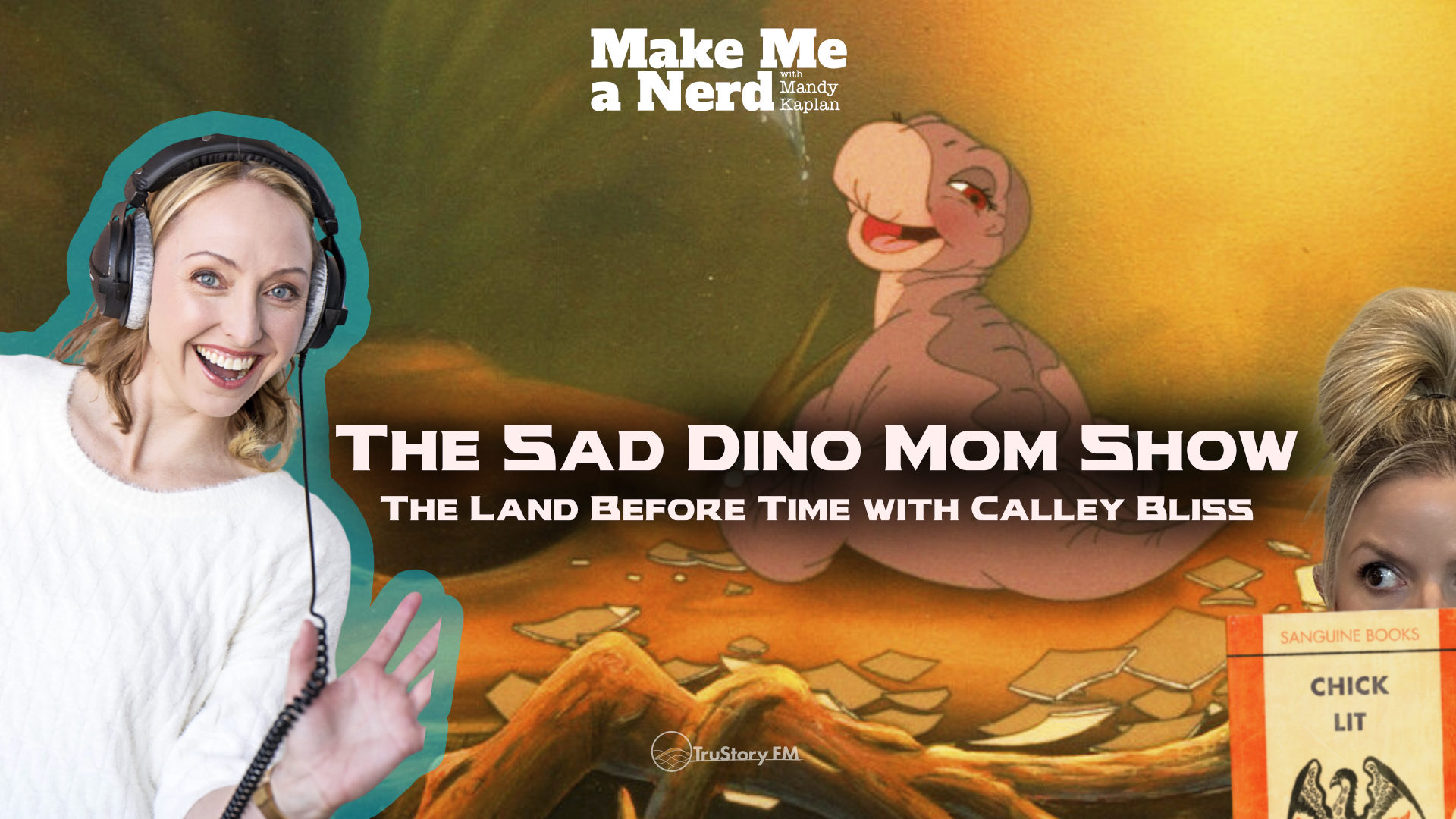
So when I said hell no to yoga as a subject, you said, what about the movie The Land Before Time?
Calley Bliss:
Yeah, fair.
Mandy Kaplan:
What is it about this movie that gets you excited?
Calley Bliss:
Mm-hmm.
So it’s funny, because I actually had to unpack my own attachment to this film in getting ready for this podcast. And I was like, what is it? What is it that I love about this? I have loved this. I used to watch this over and over and over and over as a child, and I’ve watched it a handful of times as an adult. And I think there’s a couple of things. My first career was a singer, and so there’s something about sound that is what captivates me.
There will be certain earworms, or the way somebody says something is what will make it stick in my brain, as opposed to maybe the information itself. So I love the voices in this film. Littlefoot’s mother, all she has to do is say, Littlefoot, and I start crying. It hits me on such a deep, deep emotional level. So I think some of it is just the specific—maybe it’s the casting. The music was played by the London Symphony Orchestra and it was written by James Horner, who has done a ton of orchestrations.
Mandy Kaplan:
Yes. My Heart Will Go On. Yeah.
Calley Bliss:
I’m here. We’re here. You’re here. Wrong lyrics. So some of it, I think, is that when I watch it again, there are phrases that I’m like, oh gosh, I just so deeply remember those phrases and I feel connected to them. And I also think that it’s this beautiful story of characters who don’t belong together coming together to survive. And that is a theme in my life. I love those kinds of stories where you—yes, exactly, found family—in times of—
Mandy Kaplan:
Found family. Yeah. Yeah.
Calley Bliss:
—kind of chaos or need, these characters who don’t belong together, and the world says they don’t belong together, they find each other and they need each other and they learn how to need each other and how to care about each other.
Mandy Kaplan:
Yes.
Yeah, it’s so beautiful and it pulls on the heartstrings. We’ll get into it, but I’m realizing I pressed play and I thought, wait, I have seen this movie. And then I remember distinctly pressing play on it when my son was maybe four or five.
Calley Bliss:
Oh. Okay.
Mandy Kaplan:
And leaving the room because I’m like, ugh, it’s dinosaurs. It’s not me. Too nerdy for me, right? So he watched it, and he watched a TV version of it.
Calley Bliss:
Okay.
Mandy Kaplan:
They did many sequels and spin-offs, and he used to love one that was very musical and it was adorable.
But every time I was like, it’s still dinosaurs. I don’t care.
Calley Bliss:
Yeah.
Mandy Kaplan:
That’s the old me.
Calley Bliss:
Yep.
Mandy Kaplan:
That’s the pre-Make Me a Nerd Mandy. And she sucks. Oh, by the way, did you see my screen name?
Calley Bliss:
Mandy Before Time.
Mandy Kaplan:
Mandy Before Time.
Calley Bliss:
Mandy Before Time.
Mandy Kaplan:
Okay.
Calley Bliss:
Mandy Before Time. Oh my god, hilarious.
Mandy Kaplan:
That’s why I let you pick this movie, so I could make a pun out of the title.
Calley Bliss:
I love it.
Mandy Kaplan:
Yeah, so I actually have seen many things on this journey that I had seen and either disliked or not gotten before.
Calley Bliss:
I approve. Great job.
Yeah.
Mandy Kaplan:
And that’s a pat on the back for me because it’s exciting to open up your mind and say, well, now clean slate, let’s try this again.
Calley Bliss:
Yeah. Yes, agreed.
Mandy Kaplan:
And the animation is so beautiful. It’s very 2D classic animation. I did a Make Me a Nerd episode with the amazing Justine Huxley about Jungle Book. That’s her favorite movie of all time.
Calley Bliss:
Oh, mm-hmm.
Mandy Kaplan:
And these are the animated movies that get in my soul, much more so than Pixar, CGI, 3D.
Calley Bliss:
Mm-hmm.
Mandy Kaplan:
Those are technical feats.
Calley Bliss:
Yep.
Mandy Kaplan:
But something so simple about these drawings and the way the backgrounds are drawn. It’s just a beautiful movie.
And then I looked it up on Rotten Tomatoes and the scores are pretty low. Sixty-five percent for critics, seventy-nine percent for audiences.
Calley Bliss:
Oh really?
Mandy Kaplan:
Yes.
Calley Bliss:
That’s crazy because the little bit of research that I did said that it was the box office hit of 1988. When it got released, it was huge. But maybe over time it’s lost popularity. I don’t know. Does Rotten Tomatoes do a—yeah, yeah.
Mandy Kaplan:
I don’t know how they aggregate their data. I just wanted to say a phrase. But did I use it correctly?
Calley Bliss:
Yeah. Well, can I—
Mandy Kaplan:
I don’t even know.
Calley Bliss:
Aggregate?
Mandy Kaplan:
Sure.
Calley Bliss:
Sure, yeah. I think, yeah.
Mandy Kaplan:
Yeah, yeah.
Calley Bliss:
You found a better word than I was. I was like, how do you say this? Populate information over time. I don’t know how you say that in a single word. But can I piggyback on what you were saying about the visuals?
Mandy Kaplan:
Please, yes.
Calley Bliss:
Because another reason—I always find it fascinating. I’m really, really big into our subconscious and how it shows up in weird ways in our life.
Mandy Kaplan:
I’m gleaning about you that you are far deeper than me.
Calley Bliss:
And I’m always fascinated.
Mandy Kaplan:
Go ahead. I’m all about a fart joke. Carry on, Calley Bliss.
Calley Bliss:
But I’m also a total space cadet who also loves a fart joke and sometimes misses the most obvious things. So, you know, it balances itself out.
Mandy Kaplan:
Yeah.
Calley Bliss:
No, but I found it fascinating as I was doing some of this research, because I was like, oh, I’m gonna be on this podcast, I need to be prepared. I didn’t realize this, that Don Bluth, who was the director and creator of this film, is a Disney defector.
Mandy Kaplan:
Mm-hmm.
Calley Bliss:
So he worked for Disney for 25, 30 years as an animator. So there’s a reason that the visuals are—at least I would assume there’s a reason that the visuals are consistent.
Mandy Kaplan:
Uh-huh.
Calley Bliss:
Because supposedly the lore, and the YouTubers, and all of the people out there commenting on the ways that things happen in the Disney world say that he didn’t feel like Disney was continuing on with the heart of what they had been doing, which was to create beautiful pictures that were thought-provoking.
Mandy Kaplan:
Mm-hmm.
Calley Bliss:
And talked about connection and beauty, and that they were becoming too commercialized. And so he left, created his own production company, and then got the biggest names to be involved, which I don’t want to spoil if you’ve got plans for how you’re gonna release the information about this. But it was—I mean, yeah, it’s a Spielberg movie.
Mandy Kaplan:
No, go. This is a Spielberg movie, right? Yeah.
Calley Bliss:
Like I said, James Horner did the music. It’s George Lucas who was a producer on it.
Mandy Kaplan:
I’ve heard of him.
Calley Bliss:
I mean, yeah. He had Diana Ross sing the theme song at the end, which is very not her usual style at all.
Mandy Kaplan:
Yes.
Calley Bliss:
But he got—oh, you don’t like it.
Mandy Kaplan:
And it’s not a good song. I don’t want to be negative. No, I was not a fan.
Calley Bliss:
I actually feel like Diana Ross was not the right vocal fit for this, but that’s just me being a little bit of a vocal nerd.
Mandy Kaplan:
Sorry.
It was weird and schmaltzy, and I think it took me out, because I was like, is that Diana Ross?
Calley Bliss:
Oh, see, that’s what I love about it.
Mandy Kaplan:
It just took me out.
Calley Bliss:
Yeah.
Mandy Kaplan:
Um—
Calley Bliss:
Oh yeah, yeah, yeah. But see, that’s what I mean. I think her voice, because she’s such a power singer, and it’s not that type of song.
Mandy Kaplan:
Yeah.
Calley Bliss:
I feel like if you had a modern-day, more like Laufey—how do you say her name? The new jazz singer that everyone’s freaking—I don’t know.
Mandy Kaplan:
I’ve always said Laufey. Was that wrong?
Calley Bliss:
I feel like I’ve heard it eight ways.
Mandy Kaplan:
I don’t know.
Calley Bliss:
I have no idea.
Mandy Kaplan:
I pronounce it Taylor Swift.
Calley Bliss:
But you know what I mean?
Someone who’s more—yeah, or even Taylor Swift, someone who’s whisperier and knows how to really tell a story.
Mandy Kaplan:
Yeah, yeah.
Calley Bliss:
But I do love the melody and the—yeah. Anyway, pick me up.
Mandy Kaplan:
Well, while we’re talking music, I think one of the reasons this movie feels old-fashioned is that it is scored wall to wall.
Calley Bliss:
Yeah.
Mandy Kaplan:
There’s not a moment without orchestration.
Calley Bliss:
Yes, without music, yeah.
Mandy Kaplan:
And that to me feels like Snow White. That goes back to Fantasia. A lot of this movie felt like Fantasia to me. And I remember watching Fantasia in school because you learned about instruments and music, and so I have a real soft spot for Fantasia. And in my research, in my fancy research, Lucas and Spielberg initially wanted the movie to be a silent Fantasia concept with no spoken dialogue, similar to the Rite of Spring in Fantasia, and then they decided to add voice actors for a younger audience.
Calley Bliss:
Yeah, I read that too. I heard that too.
Mandy Kaplan:
I would have enjoyed the non-verbalized version of this.
It’s so beautiful.
Calley Bliss:
I think I would have enjoyed it as well, just because I love picture and music, but I’m glad they put the voices on because, like I said, I just have so much heart for all of the main characters, but particularly a couple of them. Yeah.
Mandy Kaplan:
Yes. Well, this movie, like so many animated films, primarily Disney, starts with a dead mom to set up the story.
Calley Bliss:
I know, I know. Well, and I didn’t re-watch this, but in the annals of my memory, there is a documentary on Walt Disney and his trauma with his family and why they think that might be some kind of thematic thing they carried through. Have you heard of this?
Mandy Kaplan:
Oh no.
Calley Bliss:
You gotta find someone who’s a Walt Disney nerd, because he is a fascinating character. His parents—should I give it away? Spoiler.
Mandy Kaplan:
Yes, yeah.
Calley Bliss:
His parents died in, I think it was a fire or an explosion or something, in a house that he built for them after he’d gotten all of his wealth. He was apparently raised very poor, I believe, if I’m remembering correctly.
Mandy Kaplan:
Uh-huh, uh-huh.
Calley Bliss:
And then bought this house for his parents and they died.
Mandy Kaplan:
And then killed them.
Calley Bliss:
And that’s how he felt. He felt like he killed them. But I do think it’s interesting—
Mandy Kaplan:
But no, but did he? I’m a true crime nut. Now I’m like, oh, he definitely lit that house on fire.
Calley Bliss:
Oh, I don’t know. I’ve never heard that angle. I’ve never heard that angle.
Mandy Kaplan:
I’m full of shit.
Calley Bliss:
Maybe. I don’t know.
Mandy Kaplan:
But I had never heard that. And I think that when Disney was at his height, creating all of these stories, Bambi and these movies where the first thing that happens is the mom dies—
Calley Bliss:
Yeah. Yeah.
Mandy Kaplan:
That was before the world was so sensitive to what are we teaching our kids?
And if four-year-olds are going to watch this, how do we handle this? I just think it was more like, that makes for a good story. A kid on his own. Kill the mom, let’s go.
Calley Bliss:
Yep.
Mandy Kaplan:
And now we approach everything—
Calley Bliss:
Yeah.
Mandy Kaplan:
—worrying about the psychological impact.
Calley Bliss:
Yep, agreed.
Mandy Kaplan:
And yet we’re still doing it. So from a modern perspective, there must be value in showing kids you can suffer grief and move on.
Calley Bliss:
I also—
Yeah, I think there’s the other thing that I thought about when I was re-watching this, back to Don Bluth being this defector of Disney and he thought that they were getting away from their primary—on the flip side of it, obviously the mothers are dying and whatever, and this is still a Don Bluth film, so he was following that trait of Disney. But it made me wonder if there has been kind of this strident hero’s journey, right? If you leave a kid without its parents, then they have to go on the hero’s journey. Versus something that’s more about just exploration and connection and community and finding yourself amidst the everyday chaos. The first movie that comes to mind would be—oh my god, what’s the one with the sloth that everybody loves, that is 3D animation and Shakira sings? Zootopia?
Mandy Kaplan:
Oh, Zootopia. Yeah.
Calley Bliss:
You know what I mean?
Mandy Kaplan:
Mm-hmm.
Calley Bliss:
I don’t remember if there’s a death in that one, but I don’t know.
Mandy Kaplan:
I can’t remember.
Calley Bliss:
I think it’s interesting.
Mandy Kaplan:
Judy Hopps.
Calley Bliss:
What’s that?
Mandy Kaplan:
Judy Hopps was her name.
Calley Bliss:
Oh yeah. Yeah.
Mandy Kaplan:
Um—
Calley Bliss:
But yeah, the hero being singular versus community.
Mandy Kaplan:
Well, I immediately think of Luke Skywalker, because now I’m a nerd and I know these things, but he has to leave the moisture farm and go on a hero’s journey, and that goes way back in our storytelling.
Calley Bliss:
Mm-hmm.
Mandy Kaplan:
So I guess it makes sense, but it’s like, first of all, why is it always the mom, you patriarchal assholes?
Calley Bliss:
Yeah, that’s the part that’s weird to me.
Mandy Kaplan:
And it’s just hard to watch. It’s really hard.
Calley Bliss:
Yes, yes, particularly as women in entertainment who are representing these characters, right? Even Cera, the little triceratops—
Mandy Kaplan:
Mm-hmm.
Calley Bliss:
Her mother is nowhere to be found. But then Ducky only has a mom and doesn’t have a dad, and Petrie—
Mandy Kaplan:
Nowhere to be found.
Oh, okay, true. I didn’t make notes on all of their family backgrounds.
Calley Bliss:
All their families.
Mandy Kaplan:
But I did make a note—
Calley Bliss:
I remember them because I love the snuggling scenes, because I’m a sucker for cute characters snuggling. That’s part of what makes me want to cry. I don’t know. I have a cat.
Mandy Kaplan:
Great.
Calley Bliss:
Maybe that means I’m inherently a snuggle person.
Mandy Kaplan:
I have a note about why I hate you, Calley Bliss. My note was, what are you doing to me, Calley? And I’m gonna explain that right after this.
So at one point the mom is dead, and Littlefoot, that’s his name—
Calley Bliss:
Mm-hmm. Littlefoot, yep.
Mandy Kaplan:
—sees her. He sees the shape of her on a rock, her shadow, and he starts to chase it, going, Mama, Mama.
Calley Bliss:
Yes. In the clouds and the rock, yeah. Oh, the rock, the shadow.
Mandy Kaplan:
I was sobbing.
Calley Bliss:
Uh-huh.
Mandy Kaplan:
You are evil for making me watch this. As a mom, I was like, I can’t watch this. It’s not her. It’s her shadow, and he doesn’t know it.
Calley Bliss:
I’m sorry. I’m not sorry, though.
Mandy Kaplan:
Oh.
Calley Bliss:
I know, I know. I have been known since childhood to be kind of a professional crier.
Mandy Kaplan:
Oh.
Calley Bliss:
My parents at one point—I think I watched All Dogs Go to Heaven, also a Don Bluth, ironically—and my parents were like, do we need to turn—
Mandy Kaplan:
Also a Don Bluth, right? Yeah, yeah.
Calley Bliss:
Yeah, I think I had a thing, without knowing it was him, but I really liked his movies as a kid. And I remember my parents being like, are you too upset? We need to turn it off.
And I was like, no, I want to see what happens. I’m very comfortable crying, so you’re welcome. I’m sorry.
Mandy Kaplan:
I’m comfortable crying too. I could recite Steel Magnolias and cry, if that’s what you’re asking.
Calley Bliss:
Mm, mm.
Mandy Kaplan:
I could do that for you.
Calley Bliss:
Okay, but it’s the mother thing specifically.
Mandy Kaplan:
Well, no, I’m a crier too. I love a good cathartic cry, but there’s something about that chasing the shadow. Without getting too deep, I’m in a bittersweet phase because my son is looking at colleges, and it’s like I can’t fathom a time when—
Calley Bliss:
Uh-huh.
Mandy Kaplan:
—he won’t be living here and I won’t be taking care of him. And he doesn’t need much taking care of anymore, you know?
Calley Bliss:
Yeah, yeah.
Mandy Kaplan:
He’s driving, he’s doing his own thing. And I think my mindset is a little different than it would have been if he were six or seven.
Although maybe I would have been hugging him and sobbing and going, I’m right here.
Calley Bliss:
Sure.
Mandy Kaplan:
You’re never gonna lose me. I don’t know. I’m a mess.
Calley Bliss:
Yeah. No, I’m not a parent, so I don’t have a way to relate to that from a parent perspective. But this has definitely—again, not to get too deep or morbid, but re-watching this film made me realize how much I love my mother.
Mandy Kaplan:
Yeah, go there.
Calley Bliss:
When I was watching that same scene where he’s running towards his own shadow because he thinks it’s his mom—
Mandy Kaplan:
Yes.
Calley Bliss:
I’m like, oh my God, my mom’s getting older and I’m gonna miss her. But I’m like, Calley, we got time. Oh, speaking of mothers.
Mandy Kaplan:
Oh, hello.
Hi. Well, I might not be a nerd, but I am a crazy cat lady, so that pleases me tremendously.
Calley Bliss:
You have to hear this, it’s the best. Can you hear this?
Mandy Kaplan:
Yes, I can. What’s her name?
Calley Bliss:
Oh, he’s such a—this is George.
Mandy Kaplan:
He. Hi, George. Very nice to meet you.
Calley Bliss:
His full name is crazy, but we call him George.
Mandy Kaplan:
All right. Is it George Bliss or George Abbott?
Calley Bliss:
It is King George Otis Friday the First.
Mandy Kaplan:
Oh. He’s very cute.
Calley Bliss:
Yeah.
Mandy Kaplan:
Are you a dinosaur person, or is it this movie specifically? Because I, as I said, was anti-dinosaurs. And then I finally saw Jurassic Park about six months ago for this podcast.
Calley Bliss:
Yeah. Oh my gosh.
Mandy Kaplan:
A woman in her fifties having never seen Jurassic Park.
Calley Bliss:
Oh, you hadn’t even seen Jurassic Park.
Mandy Kaplan:
No, because to me it’s history and it’s sciencey and it’s not my thing.
Calley Bliss:
Interesting, okay.
Mandy Kaplan:
But I woke up to how—
Calley Bliss:
Yep.
Mandy Kaplan:
—cool and exciting and scary dinosaurs are. But I gotta say, I prefer a nice, gentle, loving dinosaur like this.
Calley Bliss:
Yeah. Right? Same. No, for me, I am not a dinosaur person.
Mandy Kaplan:
Okay.
Calley Bliss:
I am a total softy at heart. So it’s purely the characters and the story. They could have been fish. They could have been—
Mandy Kaplan:
Mm-hmm.
Calley Bliss:
I’m actually way more—if there is an archetype that I’m attracted to, it’s underwater characters. I love mermaids and fish and sea creatures. Yeah, love those.
Mandy Kaplan:
Oh.
Calley Bliss:
Love The Little Mermaid. I just love that for watching all of the animals. And, you know, Finding Dory, Finding Nemo, blah blah blah, all those. But no, not a dinosaur person. Didn’t have them as a kid, didn’t play with them. I think it’s interesting from an anthropologic background—is that the right word?
Mandy Kaplan:
I think you’re trying to say aggregate.
Calley Bliss:
Yes, yes, that is always the right word, aggregate.
Mandy Kaplan:
Yeah. Yes.
Calley Bliss:
That they were—
Mandy Kaplan:
It’s very interesting.
Calley Bliss:
Yeah, that they were a dominant force on this earth and they became extinct. That’s always been fascinating to me. But I don’t go deep diving into dinosaurs.
Mandy Kaplan:
Well, this movie also touches on prejudice in such a gentle but pointed way for kids to realize. The triceratops—
Calley Bliss:
Yeah, yes.
Mandy Kaplan:
They say, oh, don’t associate with the whatever they are, brontosauruses.
Calley Bliss:
Yeah, the three-horns don’t hang out with the long-necks, and the long-necks don’t hang out with the duckbills. Yeah, yeah, yeah.
Mandy Kaplan:
Yes. Yeah.
Calley Bliss:
And actually, I’m glad you said that, because that’s something that, ironically—it’s probably in my blood. My family is all very, you know, support the proletariat. But—
Mandy Kaplan:
Ya, ya.
Calley Bliss:
I’ve always been very aware of outliers.
Mandy Kaplan:
Mm-hmm.
Calley Bliss:
And again, back to they’re different, they’re characters that didn’t belong together, right? But they figured out how to cross bridges and get over their differences and blah blah blah.
Mandy Kaplan:
Um—
Calley Bliss:
And that’s something that, before I even knew the word prejudice as a kid, I would go find the kids who were hanging out alone and didn’t have anyone to play with and bring him into the group and be like, hey, do you want this? Meet Joe so-and-so. Blah blah blah. He’s yada yada yada.
I just have—I don’t know. I like that notion of learning how to get along despite our differences.
Mandy Kaplan:
And the sense of an underdog, which I’m very sensitive to as well.
Calley Bliss:
Yeah.
Mandy Kaplan:
And I love that about you. You see somebody for whom things are not going well and you just want to jump in and make things go a little better, if you can.
Calley Bliss:
Yeah. Yeah.
Mandy Kaplan:
And that’s my personality as well.
Calley Bliss:
Yeah. And do it in a way—this is the other thing that I think this movie does so beautifully—it’s not coming from a place of, oh, one person has more than the other, and so therefore I’m going to reach down and lend a helping hand. It gets rid of that hierarchical ethos, and instead it’s just, this is the thing that this person has that they bring to the table.
Mandy Kaplan:
Right.
Calley Bliss:
When they’re—spoiler—when all the kids—
Mandy Kaplan:
You can’t spoil a movie that’s forty years old.
Calley Bliss:
Right, yeah. Everyone’s probably seen it at this point too. But when they’re in that scene where they’re trying to kill Sharptooth. Sharptooth is the triceratops. No, not triceratops. The one that everyone’s scared of. Why can’t I think of all these?
Mandy Kaplan:
T. rex. Yeah.
Calley Bliss:
T. rex, thank you. They all use their different skills. So Ducky is little and fast, so she’s the bait. So she goes in to tempt him out of his cage. And then Petrie is ready to lead him over to the deep water where he won’t be able to swim. And then Cera, who’s the triceratops, and Littlefoot, who’s the long-neck, they’re the biggest, and Spike, who’s this spike-tail, they’re the biggest, bulkiest ones, so they’re ready to push the boulder over.
Mandy Kaplan:
Uh-huh.
Calley Bliss:
They each bring their own skill set. And so it’s not about helping from a place of I have more and you have less.
Mandy Kaplan:
Right.
Calley Bliss:
It’s helping from, here’s what I got.
Mandy Kaplan:
They’re equal but different. Yeah.
Calley Bliss:
Yeah, here’s what I got.
Mandy Kaplan:
Which should be all of mankind.
Calley Bliss:
What do you got?
It should be, yeah.
Mandy Kaplan:
It is a very simple story, to be clear. They didn’t muddy it up with a lot of detail.
Calley Bliss:
Yep.
Mandy Kaplan:
And there’s not a ton of dialogue. It’s a lot of sequences of dinosaurs splashing and playing or chasing. There’s not a ton of dialogue, but the—
Calley Bliss:
I actually did a counter on that, because I noticed in the beginning, I was like, oh, nobody actually speaks until six minutes into the movie.
Mandy Kaplan:
Yeah.
Calley Bliss:
You have pictures and music and then a narrator. So I guess that’s speaking, but there’s nothing between the characters until six minutes in.
Mandy Kaplan:
But it’s a beautiful way of storytelling. But I definitely was thinking, don’t they speak in this movie? It was a long time in.
Calley Bliss:
Yes, yes.
Mandy Kaplan:
And I don’t mean to be dark, but there is an absolutely tragic story of one of these voice actors that I want to—
Calley Bliss:
I wondered if you were gonna bring that one up.
Mandy Kaplan:
Yeah, I’m going to, just because the minute you start Googling, it’s everywhere. And I had no idea.
Calley Bliss:
Yeah.
Mandy Kaplan:
And I want to take a break and dive into that when we come back.
Welcome back. Before we talk about tragedy, let’s talk about the joy of Make Me a Nerd, which is a production of TruStory FM. Engineering by the peerless Pete Wright. My theme song is Wonderstruck by Jane and the Boy.
And if you want to get me on Instagram, it’s at Mandy underscore Kaplan underscore Klavens, both with K’s, or on TikTok at Mandy Miscast. If you’re listening on Apple Podcasts, please leave me a review. Five stars. Make a comment. It helps other people find the show. And that’s what we’re doing here. We’re trying to keep the lights on and keep doing this. And if you’re feeling extra supportive, please, please go to makemeanerd.com/join, and hitting that button will get you your episodes ad-free and early, and my eternal gratitude.
That’s all my business.
Calley Bliss:
The best gift, eternal gratitude.
Mandy Kaplan:
Right, right. So the voice of Ducky is a young—they used real kids, which I always appreciate. Judith Barsi is her name.
Calley Bliss:
Yeah. Yeah.
Mandy Kaplan:
And I was just clicking around, like, what else did she do? And where did her career go? And she was murdered by her own father when she was 12.
Calley Bliss:
Yeah. Yeah. Ten? I thought it was ten, but it doesn’t matter.
Mandy Kaplan:
Ten.
Calley Bliss:
Awful. Yes.
Mandy Kaplan:
Awful, awful, awful.
Calley Bliss:
Yeah.
Mandy Kaplan:
A murder-suicide thing for the dad. He killed his wife and kid.
Calley Bliss:
Yeah. And if you dig a little bit deeper, it’s kind of a classic tale of, first, emotional child abuse.
It sounds like Dad had alcoholism issues. Mom was the supporter for a little while, and then Dad got so bad that Mom was taking care of Dad. And by that point, Judith was doing well as a child voice actor. And so they were living off of her income as a child.
Mandy Kaplan:
All too common.
Calley Bliss:
Just terrible. Just absolutely horrific and astonishing. But yeah, really sad.
Mandy Kaplan:
Yeah. Really sad. And I think there are beautiful performances.
Calley Bliss:
But—
Mandy Kaplan:
This was before stunt casting, before everybody had to be Justin Timberlake and Anna Kendrick in animated movies. This was a time when the right people were put in the right parts. And she’s fantastic.
Calley Bliss:
Yeah.
Mandy Kaplan:
And the little boy who plays Littlefoot. Do you remember his name? I don’t have it off the top of my head.
Calley Bliss:
Yep. It’s Gabriel Damon, and he went on to do—I don’t remember what his other credits were, but he continued to act into his adulthood, I think. A lot of them were just kids and then gave it up.
Mandy Kaplan:
Right, but they were so precious, and I think—
Calley Bliss:
So good.
Mandy Kaplan:
I’m sure they were kid actors, but they have a genuine quality to them because it wasn’t showy. The whole thing is—I don’t know—different from something like a Finding Nemo. The colors are muted, the voices are a little more naturalistic.
Calley Bliss:
Yes, yes, it feels—
Mandy Kaplan:
Everything is quaint.
Calley Bliss:
It’s kind of like what we’re seeing now with social media, where you get a glimpse into someone as they are instead of the performer version of them. I felt that in moments of the dialogue. There’s this one line—oh, now this is my crying line. I’m gonna cry just saying it. When Littlefoot’s mother gets injured and he finds her and he goes, Mom, get up. And she goes, I don’t think I can. And he goes, Yes you can. Get up.
Mandy Kaplan:
Mm-hmm.
Calley Bliss:
It’s like the way little kids are, like, well, you’re always on your feet. Just do it. And it’s so authentic and so heartbreaking. It just rips me. But I love that they kept those reads. And who knows? I would love to be a fly on the wall and be like, did that just happen naturally and they captured it? Were they directed into that? I don’t know. But I love that that’s the style.
Mandy Kaplan:
Yeah. Well, I did read that they had a longer, more violent version of this, and they pulled out a lot of footage to make it less scary for little kids. But it still feels quite intense to me.
Calley Bliss:
Oh, yeah.
Mandy Kaplan:
So I was thinking, what the hell were they cutting when they were wading through sludge, lava, and skeletons?
Calley Bliss:
Yeah.
Mandy Kaplan:
That’s intense AF.
Calley Bliss:
Yeah.
Mandy Kaplan:
And, you know, that stayed in.
Calley Bliss:
I know.
Mandy Kaplan:
So what did they cut?
Calley Bliss:
I don’t know. I’m guessing it’s probably more of—well, one of my favorite things. There was an earthquake, right, at the beginning of the movie, and that’s actually—
Mandy Kaplan:
Which they call an earthshake, which is so strange, but yeah.
Calley Bliss:
Yes. I think that was their way of making it like the kids don’t know what it’s called. I remember—I think it was Ducky. That’s Judith Barsi’s character.
Mandy Kaplan:
Mm-hmm.
Calley Bliss:
And she just has this—I can’t do it because I don’t have that style of voice, but she talks like this, and her classic phrase was yep, yep, yep. And she goes, I lost my family.
Mandy Kaplan:
No, isn’t that Cera who says yup yup yup?
Calley Bliss:
Mm-mm, it’s Ducky.
Mandy Kaplan:
Or that’s Ducky. Oh, okay.
Calley Bliss:
It’s Ducky.
They actually put that on her gravestone, which is—I know.
Mandy Kaplan:
Oh god. Oh my god, you’re killing me.
Calley Bliss:
But she says, I lost my family.
Mandy Kaplan:
You’re like the Barbara Walters of podcast guests. You just want to make me cry.
Calley Bliss:
I’m sorry. Let’s talk about modern-day tragedies, shall we, Mandy?
Mandy Kaplan:
Okay.
Calley Bliss:
No, she says, I lost my family in the big earthshake. And I’m like, oh, it’s so cute. They don’t even know the real word for it, you know?
Mandy Kaplan:
Yeah.
Calley Bliss:
But I’m guessing there was probably more drama and destruction in that scene.
Mandy Kaplan:
Okay, so you can see how you’re gonna use—
Calley Bliss:
I’m guessing also more with Sharptooth, because, you know, all of the lava. Would you say lava, bones, and—mm-hmm.
Mandy Kaplan:
Sludge, lava, and skeletons is where I was reading they cut a lot, and I thought, ooh, not enough if they don’t want to scare kids, you know.
Calley Bliss:
I think natural—
There’s plenty of that. Well, and I think that’s interesting about Don Bluth too. His movies are a little more dark. Getting out of the darkness, but showing the darkness. As opposed to Disney, which is like, la la la la la, I found my prince, there’s a white horse. You know what I mean? A little bit different.
Mandy Kaplan:
Right. So this journey is they are trying to find the Great Valley. That’s where they’re supposed to go to live free.
Calley Bliss:
Yes. Yes.
Mandy Kaplan:
And I was picking up on some religious undertones. It felt like a trip to Mecca or something.
Calley Bliss:
Oh, how interesting.
Mandy Kaplan:
The promised land. So I did a very quick Google and found out Don Bluth is FLDS, and this is supposed to be religious. Or I shouldn’t say supposed to be.
Calley Bliss:
Oh my God.
Mandy Kaplan:
The Great Valley is in fact a religious idea.
Calley Bliss:
Yeah. I had no idea. You’re blowing my mind right now. I had no idea.
Mandy Kaplan:
FLDS, because the thing I’m truly nerdiest about is cults.
Calley Bliss:
Same, okay. In Make Me a Nerd, or Make Me Dark and Stormy, your next podcast. At some point you really have to watch—there’s a series on—God, what is it called?
Mandy Kaplan:
I can tell you I’ve watched it, but go ahead.
Calley Bliss:
It’s about the—it was the 80s, 90s, out in Oregon, Washington.
Mandy Kaplan:
I’ve watched—
Yeah.
Calley Bliss:
Gosh, why can’t I remember the name of this?
Mandy Kaplan:
Wild Wild Country.
Calley Bliss:
Wild Wild Country!
Mandy Kaplan:
Yeah. Yeah. No, I’ve seen everything about a cult ever.
Calley Bliss:
Yeah, yeah. Okay, okay.
Mandy Kaplan:
So, yeah.
Calley Bliss:
Oh well, we share that.
Mandy Kaplan:
Or read it. I’m a big reader, yeah.
Calley Bliss:
Yeah, yeah.
Mandy Kaplan:
So it’s just interesting to me that—
Calley Bliss:
Oh my god, I had no idea that Don Bluth was FLDS. Ooh.
Mandy Kaplan:
And that this was disguised enough, if that’s the right word, that the mainstream—
Calley Bliss:
Do we need to tell people what that acronym is? I just realized. FLDS.
Mandy Kaplan:
Go for it.
Calley Bliss:
Maybe people don’t. Fundamentalist Latter-day Saints.
Mandy Kaplan:
Yep.
Calley Bliss:
Otherwise known as fundamentalist Mormons.
Mandy Kaplan:
Crazy Mormons, y’all. Yes.
Calley Bliss:
Yeah.
Mandy Kaplan:
This movie is, as we’ve talked about, so charming. The characters are so endearing and it is so beautiful. I personally wanted more laughs.
Calley Bliss:
Yeah, I hear that.
Mandy Kaplan:
And I’m a little surprised it’s so popular with kids, because I think kids really respond well to laughing.
Calley Bliss:
Yep.
Mandy Kaplan:
And there is very, very little humor in the movie. There’s cute, there’s charming, things that make you go, oh, that’s funny, uh-huh.
Calley Bliss:
That is true. Yep. Yeah, yeah.
Mandy Kaplan:
But there aren’t any laughs.
Calley Bliss:
No, it’s true.
Mandy Kaplan:
I wanna get back into that cut and do a fart pass.
Calley Bliss:
I’m trying to think if there’s a—
Ducky farting would be pretty much the cutest thing ever.
Mandy Kaplan:
Just me?
They’re all so cute.
Calley Bliss:
Yep, yep, yep.
Mandy Kaplan:
Although, as a person who is very sensitive to things that are annoying—I have a million things that annoy me. My poor best friend Meg has to just hear me vent about them all the time. The yup, yup, yups were so cute. I could have done with a few less. There were so many, yeah, yeah.
Calley Bliss:
Really? Oh, I don’t think you’re mean.
Mandy Kaplan:
I know I’m a mean person.
Calley Bliss:
I think maybe you have a stronger sense of direction. Because I am such a softy. In my happiest life, I would probably be 500 pounds and laying on a couch surrounded by cats and—you know what I mean? I love.
Mandy Kaplan:
Take me with you. Are you proposing? This is getting awesome.
Calley Bliss:
I’m too sensitive or too soft for my own good sometimes.
Mandy Kaplan:
Me as well.
Calley Bliss:
So I’ll take all the yep yep yups.
I could just listen. And I’m that way out in public. Maybe I don’t know if it’s because I didn’t have kids, or if it’s just because it’s my nature, or what, but when I hear a little kid’s voice, it literally stops me in my tracks and I’ll be like, oh, just the way they talk is just so cute. I just want to sit there and listen to them. They’re just adorable.
Mandy Kaplan:
They are, and this movie captures that. Their childlike energy.
Calley Bliss:
Yes.
Mandy Kaplan:
It’s beautiful. Again, I just wanted some laughs.
Calley Bliss:
No, I’m with you. I think, yeah, it could have been a little more dynamic. They could have brought in even just a character, right? That’s what you do. You bring in a character who brings the comedy.
Mandy Kaplan:
Yes.
Calley Bliss:
And I feel like they—you know what, actually—
Mandy Kaplan:
Yeah. I mean, Buddy Hackett was in The Little Mermaid, for Christ’s sake. They did it heavy. They went for it.
Calley Bliss:
Yeah, yeah. Well, as you say that, I’m kind of wondering if it was—not to crap on other people’s profession—but if it was a miscast, because I feel like they tried to do that with Petrie. Not Petrie. Yeah, Petrie, the flying one.
Mandy Kaplan:
Yeah, mm-hmm. Yeah, he’s got a lot of energy, but he’s not funny.
Calley Bliss:
But to me he wasn’t—but he’s not funny. Yeah, that’s the thing. He brings a different energy. He’s frenetic and he’s crazy and he’s got a high voice, but he’s not funny.
Mandy Kaplan:
Lovable, and then they killed him, and I was beside myself.
Calley Bliss:
Yep, totally.
Petrie.
Mandy Kaplan:
Yeah, spoiler alert, he’s not really dead. They did the cartoon fake-out, but he dies towards the end.
Calley Bliss:
When?
Mandy Kaplan:
I wrote, now Petrie’s dead, and then he wasn’t.
Calley Bliss:
Oh, you mean—oh, you mean, yeah, yeah, yeah. Yeah, but then he comes back. Yeah, yeah, yeah, yeah.
Mandy Kaplan:
Yes, which is also a pet peeve of mine because it’s so tropey. But, you know, I’ll allow it.
Calley Bliss:
Oh, interesting.
Mandy Kaplan:
I was swept away by the emotion of that, and I thought—
Calley Bliss:
Yeah.
Mandy Kaplan:
So not only are there no laughs, not only did we start with a dead mom, now they’ve killed one of our beloved characters.
Calley Bliss:
Yeah.
Mandy Kaplan:
But they didn’t.
Calley Bliss:
No, they brought him back.
Mandy Kaplan:
Thank goodness.
Calley Bliss:
Yeah.
Mandy Kaplan:
And I talked about how there’s prejudice, which was primarily Cera’s dad, right? He explains, as we talked about, that we don’t—
Calley Bliss:
Mm-hmm. Three-horns don’t associate with the long-necks, yes.
Mandy Kaplan:
Three-horns don’t. Right. And then he never really has to own up to his racist ways and pay for them. Such as me.
Calley Bliss:
Yeah.
Mandy Kaplan:
You want him to have a bit of a comeuppance, and he doesn’t.
Calley Bliss:
No. Yep. No, that is a really good point. And I feel like, again, it is a little myopic, right? The whole thing is just this one journey and these cute characters and you want to root for them. There’s not really any side plot at all except for Sharptooth dying.
Mandy Kaplan:
Okay. Wow, somebody’s saying, Mom, wrap it up.
Calley Bliss:
I have the world’s most vocal cat.
Mandy Kaplan:
I love it. I love his voice. Are there other things you—my last note was, Diana Ross, what? But we’ve already talked about that.
Calley Bliss:
Oh, yeah, we talked about that.
Mandy Kaplan:
Are there other things you want to dive into about this movie? It’s just so sweet and very, very short. It’s like eighty-two minutes.
Calley Bliss:
Yeah, yeah, it’s not that long. No, you know, the only other thing that—God, I’m a little bit blown away by this whole FLDS thing, though. I’m not gonna lie. That’s the part that—it does make me wonder about the tree star. Do you think there’s anything that they are trying to bring up? Do you know what I’m talking about when I say the tree star, the leaf?
Mandy Kaplan:
I can’t remember. Oh yes, the leaf that flows down and falls on him, and it’s so cute.
Calley Bliss:
So they have—yep—there’s these, I think they’re mythical. I don’t know of a tree that has a star-shaped leaf like that. They literally call it a tree star.
And Littlefoot’s mother gives him one right before she dies, or gives him one a few days before, anyway. And it made me wonder if there’s—they didn’t ever close the loop on that. I guess that’s the only thing that I always wondered if there was something that I was missing. And so I don’t know if there’s a theme that’s supposed to go with the tree star that he’s carrying as a token, you know, but then they don’t do anything with it.
Mandy Kaplan:
So of course I had to Google as you were talking. George, just give us two more minutes. And it says the tree star is not religious, that overall the film has religious or allegorical themes comparing the journey to the Great Valley as a quest to heaven.
Calley Bliss:
Yeah, right.
Mandy Kaplan:
But that the tree star is just a special favorite green food and a symbol of comfort, love, and family memory for Littlefoot.
Calley Bliss:
Oh, okay. Like a binky.
Mandy Kaplan:
Google never lies, so yeah, like a lovey or something.
Calley Bliss:
Yeah. Lovey, yeah. Yeah.
Mandy Kaplan:
Yeah.
Calley Bliss:
Oh, it’s funny you say that, because a friend of mine actually has a company called Big Lovey. She made soft, luxurious blankets for adults.
Mandy Kaplan:
Mormon themed. Because Big Love is the TV show about FLDS.
Calley Bliss:
Oh my god.
Mandy Kaplan:
So that immediately made me think, oh, so you buy one for all your wives. Good for her. She really has a niche market.
Calley Bliss:
She’s definitely not FLDS, farthest thing from it.
Mandy Kaplan:
Uh-huh. That’s so funny.
Calley Bliss:
But that’s really funny that there’s these weird little parallels happening here. Hmm. Interesting.
Mandy Kaplan:
They’re everywhere.
Calley Bliss:
They’re everywhere.
Mandy Kaplan:
Oh my goodness, Calley Bliss, thank you so, so much. No pressure, I didn’t ask you in advance. Do you want people to find you on social media or your website? Plug away.
Calley Bliss:
Yeah, yeah. I’m easy to find. It’s just my name everywhere. Calleybliss.com, Calleybliss on Instagram. I don’t do the TikTok because it would eat me and all of my time.
Mandy Kaplan:
Yeah. Agreed.
Calley Bliss:
Yeah, yeah.
Mandy Kaplan:
Thank you so much for coming on my podcast, and we realized we have so much in common.
Calley Bliss:
Yeah, thank you for having me. From one timid am-I-a-nerd to another.
Thanks for letting me come on and step into my nerdication. What did you call me? Nerdicator. Stage of life.
Mandy Kaplan:
Let your nerd flag fly, is what I say.
Calley Bliss:
Yeah, yeah.
Mandy Kaplan:
And that goes for all of you listening. Thank you, Calley. Thank you, everybody. Until next time.