Carrie Fox
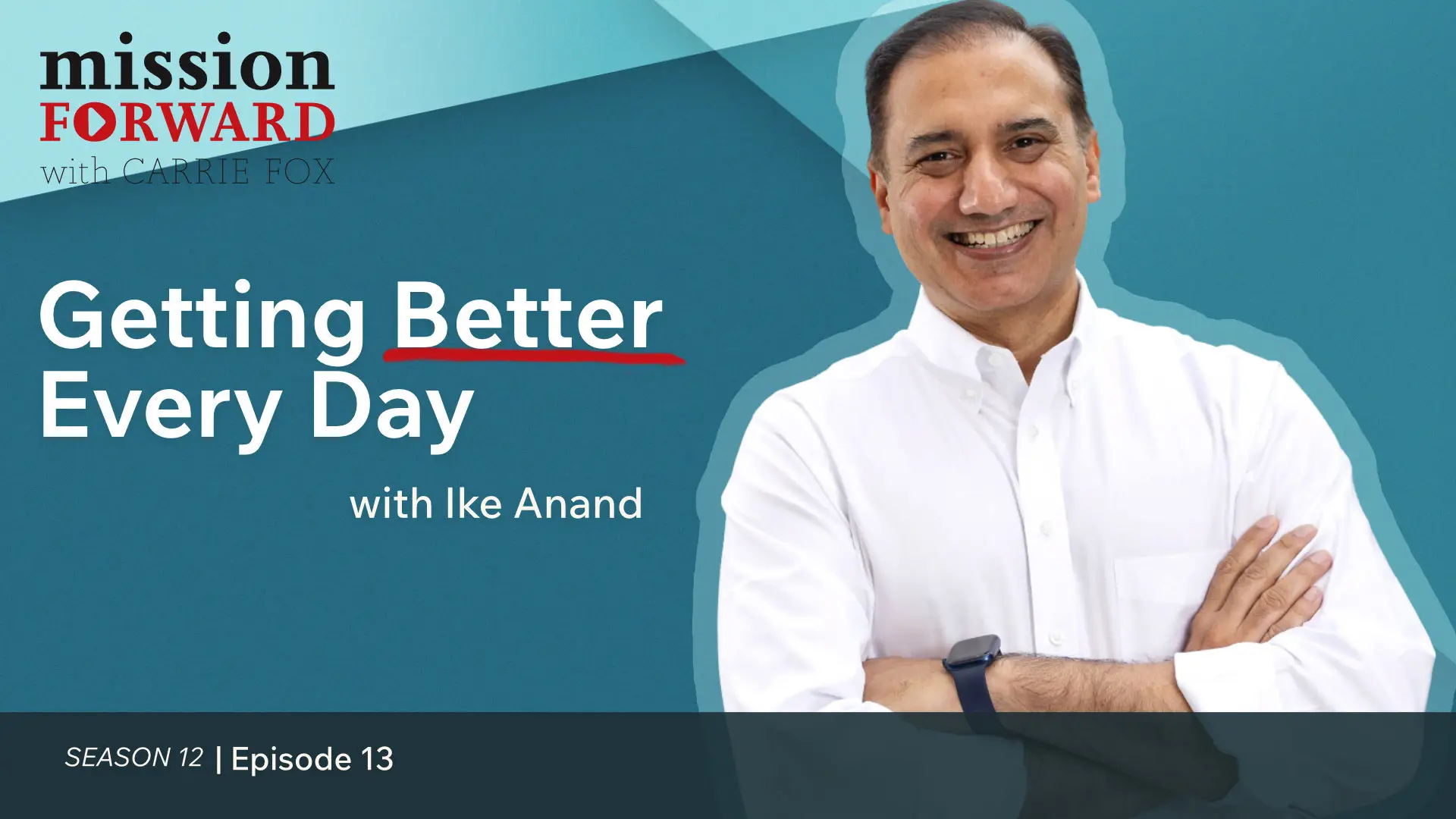
Every so often, a leader steps into a moment that seems built for them. Hi, I’m Carrie Fox, your host and founder of Mission Partners, a social impact communications agency that works with organizations through critical moments of change. And over the past 25 years, I have had the privilege of witnessing leaders rise to such moments. New CEOs appointed days before the COVID pandemic, during economic volatility, or any number of challenges. And it’s like they were made to be there, right? In that moment, to steer the ship calmly through the uncertainty. Today’s guest is one of those people for me. Ike Anand is the president and CEO of ALSAC, the fundraising and awareness organization for St. Jude Children’s Research Hospital.
And having had a special seat to watch his leadership over this past year, I can say with certainty that Ike seems built to lead an historic global organization through one of the most rapidly shifting times of tech innovation, integrating AI into the culture and operations of the beloved brand without ever compromising the value or the heart of St. Jude, and doing it as if he was made for this moment. Today, I have the awesome pleasure of getting to reflect with him on leadership in this moment and think about the future for a bit too, and to share some of his lessons with you.
Ike, welcome to the show, and a belated congratulations on your appointment to president and CEO.
Ike Anand
Well, it is truly an honor, Carrie. I’ve been, uh, I’ve been waiting for this invite for a while. I love the Mission Forward podcast, um, and, uh, and your leadership style. So I’m, uh, I’m really excited about talking to you today.
Carrie Fox
Why don’t you set the scene a bit? Because you’re not necessarily new to St. Jude. You’ve, you’ve been around the brand for many years before being named to your most recent seat. So give us a little background on your arrival to St. Jude.
Ike Anand
Yeah, so, um, I joined St. Jude in the middle of the pandemic, uh, actually around the end of 2020. So I’ve been there close to six years now. Um, and, uh, my background is, uh, basically I spent about 20 years before joining ALSAC St. Jude, I spent in the online travel category. Fifteen of those, uh, with Expedia Group up in Seattle. Um, so mostly involved in technology strategy for what I would call probably the most dynamic online marketing business in the world. And so, really, uh, interesting times.
Um, I joined that industry when it was in infancy and I left it when it was really, really big. Um, but then I joined ALSAC as the chief operating officer here. And then finally, four year— about, sorry, about a year ago, I ascended to the CEO post.
Carrie Fox
And we’re gonna get into some of your personal stories throughout this, but let’s talk about when you arrived, that moment, right? You had come from years in the tech industry, Expedia, right, being a very different kind of organization. So tell us a little bit about what you saw when you showed up at St. Jude, and ALSAC really specifically, that felt missing.
Ike Anand
You know, it was very different, of course, coming from a sort of a West Coast technology firm, um, into a not-for-profit. Even though, uh, a not-for-profit leader— it was very different. But let me start with what really inspired me. This is a mission-first organization, uh, first and foremost. Led by people who care about children, care about catastrophic diseases impacting children and families here in the US and all around the world. And for us, mission always comes first. So this was the number one thing. Number two, it’s really all about trust. So ALSAC St. Jude has built a brand that is second to none when it comes to trust.
We’re the most trusted brand in the US as per Morning Consult, for across all not-for-profits. And so people trust this brand, and the brand has been built by a game of inches, of every day for 60 plus years working to build that trust, to gain that trust. Um, I also saw a team that was second to none. A team that was coming in from all parts of the industries, different industries, really strong, innovative, uh, best at what they do in fundraising. The opportunity I saw was really trying to unleash the potential, right? And using technology in a way that helps us do that.
And so that was what was really unique, is we had the underpinnings and the makings of— we had all the ingredients present, right? It was this unique moment of time, you know, when, um, I remember a story, uh, about Steve Jobs and, uh, when he came up with the iPhone. He said, listen, I didn’t do anything special. What happened was that this was a unique moment. The touchscreen, that technology was coming in, and people were used to BlackBerrys and doing more things on their phone than just talking, and, uh, um, you know, uh, the mobile, uh, infrastructure was getting into the third generation so they could handle internet. And so all these things were coming together. I just put them all together into something that would work. I feel more and more the same way about ALSAC.
Uh, at the time I arrived, everything was there. I just had to put it all together, and it worked really well.
Carrie Fox
You use a really important word, and it’s trust, and we’ll probably keep coming back to it because trust is so core to ALSAC and has been over the course of the entire, um, history of St. Jude Children’s Research Hospital. But I’m gonna bring it connected to this moment, because I talked about at the top that you entered this moment of great technological change and innovation. And we did some research last year working with nonprofits and foundations on what are the issues that are top of mind. And AI came up in every interview and conversation, where we had about half of organizations say, we’re gonna lean into it. We trust it’s part of our future. And the other half who said, mm-mm, not ready to go there. We don’t trust the technology.
We’re going to step back from it. But you’ve really straddled this in a really interesting way, understanding that there’s a way to lean into technology, uh, while actually, um, reinforcing the importance of that trusted brand. So how do you think about that? Introducing new technology, new innovation, without necessarily needing to say goodbye to the old ways of working too.
Ike Anand
Great question. I mean, I think about it a lot. So I would maybe put it in like three different boxes, right? The first is that the advent of artificial intelligence has actually ended up, or is ending up, eroding trust in institutions for people. Right? Like, so people, for example, don’t know what to believe, uh, in terms of what they’re looking at. Is it real or not real, right? And so it is, um, somewhat eroding trust in institutions. So that’s one aspect of it.
The second aspect is, when you think about our business, our mission, our focus, trust is our currency, right? It is our currency. Like, we need people to trust us. Because what we do is really important and it can’t be done if people don’t support us. And so trust is absolutely vital for us. And then the third area is that AI is such a transformative technology that not using it, or ignoring it, is like suicide. Right? Like, so we actually want to embrace it.
Right. So all of those things are true, right? And, uh, so the question is, how do you do it? Um, for us it has always been mission focus number one. So there are many examples I can give you, but artificial intelligence and machine learning models are core to what St. Jude does. It increases the velocity of research. It reduces the time to market when we come up with new protocols, we test new drugs, etc. It really helps in, uh, in diagnosis, right?
So 3D imaging, um, from 3D imaging to new kinds of blood tests and new ctDNA biopsies, uh, liquid biopsies, it really helps in, uh, in diagnosis of, um, of tumors that is more accurate and even earlier in the process. So for us, this is a vital technology that we need to use to accelerate development of cures against cancer and other catastrophic diseases. So that’s one area. The other is, uh, for ALSAC in terms of, um, fundraising and donor experience and partnerships. It is also absolutely vital as we think about offering the best in class experience to our donors who support the mission, and get them involved in our mission. And so the technology is vital for personalization. The technology is, of course, within the bounds of privacy, but the technology is really important from a, um, uh, improving of the entire donor journey across the board.
Also, it is our fiduciary responsibility to our donors and our supporters that, uh, that we do things efficiently. And we know that AI helps in reducing certain costs and automating certain functions, and therefore makes us more efficient and stretches the dollar that the donor gives us to do more of the mission-focused activities for them. So those are all absolutely realities for us. So we had to find our way around, sort of, in those, uh, sort of, uh, constraints. But it— what it hasn’t— I mean, I have one— I want to say this, it hasn’t been like sort of, uh, trying to thread a needle. It has been a complete embracing by our workforce of, um, artificial intelligence. We have 30 plus, uh, tools and models in, uh, in our supply side available to our, uh, workforce.
They— we have almost a hundred percent adoption by our workforce. We have a thousand plus agents running at any given time at ALSAC that are AI-driven agents. And yet, we do not use AI when it comes to donor interactions. We do not use AI when it comes to advertising. We do not use AI when it comes to storytelling. Because in those places, authenticity is the number one, most important thing to us. So, you know, where we can use AI, we use it for, uh, efficiency. But we, uh, we always try to maintain the donor trust in us, and not use it in places where, you know, it could erode that trust.
Carrie Fox
Ike, what I really love about what you’ve just said, because it’s a question that comes up a lot, is, one, it’s not the if we’ll use it, it’s the how we’ll use it. And what you’ve really just been speaking to is the governance of it, you know, setting out the clear boundaries for the here are the ways we have chosen as an organization to use it, and lean into those because they build efficiencies, they build innovation, they help us move forward faster. But there are other categories we don’t go there, right? It’s like the sacred and the taboo of how we think about advancing our mission. And you all have made that so clear. So for organizations who are trying to get there, and that’s a piece that we actually support organizations with, is thinking through that structure of the ethical and the responsible approach. From what you can tell us, how did you all get there? Because it’s hard to align organizations, particularly of your size, around the same set of governance standards.
Ike Anand
One, education is really important. So let me start by that. So when I say that 100% of our workforce has embraced AI, the first thing they do is that they have to sit in compliance training. So if you want to use any AI tool, you have to sit through two, three hours, four hours of training first, to try to understand what your responsibilities are when you use that tool. All of our tools that we provide to our employees for using artificial intelligence are sandboxed, which means any data, any input they put into those tools stays within the boundaries of our institution and is not uploaded on a publicly available source. So those are just some simple stuff that we do. Then how do you really decide, um, you know, in which areas do you want to use it? And sort of, there’s a lot— some of them is black and white and then some of it is gray, right? Like, because, you know, not everything is cut as cleanly.
So for us, and every organization can be different about it, but for us, our brand is our biggest asset. Um, it is a responsibility that I believe, like, I inherited. And whether or not I increase our revenues or raise more funds, what is most important for me is I am carrying the load of this brand for a period of time, to deliver it in good condition to the next person who does it. So for us, that brand is, um, sacrosanct. And so we never take any chance with that. So, simple guidelines: we give people some questions to think about when they’re using AI. And, um, and if the answers for those questions— and I’m not gonna say what those questions are— but if the answer to those questions is, you know, if even if it has even a slightly negative impact on the brand, then we don’t move forward with using that in that use case.
But, um, but what is really important is that our employees see AI as an opportunity to embrace new technologies, to learn, to skill up, to upskill themselves as well as the organization, to, uh, establish growth and more, um, adoption, for our donors to actually love us more in ways that we can now scale that was not previously possible. And more than anything else, I think our employees don’t feel threatened by it. Um, they don’t feel like I’m gonna lose my job because I’m using AI. In fact, they feel like I can do three people’s job and therefore I’ll become more important because I’m using AI. And we’ve not— we’ve never had, um, any reason to, uh, to replace employees with, you know, AI. At the moment, uh, we’ve only grown our employee count.
Carrie Fox
We often say to folks who are feeling uncertain about the technology, uh, a reminder similar to what you’ve just shared, which is if you are the one who was on the edge of the new technology, you’re not going anywhere. You will be more valuable to the team. But know what the technology is, know what it’s capable of, and use it wisely.
Ike Anand
Yeah, I mean, um, I’ve heard this said before, which is AI is not going to take your job, but somebody who uses AI is going to take your job if you don’t use AI, right?
Carrie Fox
Right, right.
Ike Anand
Like, so it is— you all have to use it. And, um, I’m really proud of our team. Really, really proud of our team. They’re coming up with new and new use cases. They’re not afraid to try out new things and make solid, real progress into how— you know, it’s one thing to say, here’s what we do, let’s put AI into the mix. Right? But it’s another thing to say, let’s reimagine how this could be done if this was AI first, right?
Carrie Fox
Right, right.
Ike Anand
And so our team is not afraid to take that latter view and start, uh, sort of, um, reimagining our processes.
Carrie Fox
Well, and perhaps in part that is so strong because you are so mission first, right? You are all— all, everyone I’ve ever met over these past 10 years of this great opportunity of being able to support your mission— people are so deeply invested in that mission. Knowing that any day a family could walk through those doors and hear the words, your child has cancer. And the uncertainty of what a family may feel, but then suddenly the calm that they do feel, knowing that they are in your care. There is something that I think is a muscle that seems to be built inside your organization, of the ability to lean into uncertainty and find calm, right, in that chaos.
Ike Anand
Absolutely. Absolutely. It is a mission-first organization. All we really care about— the first— you know, they say in real estate the three most important things are location, location, location. For us it’s mission, mission, mission. Right? Like, so that’s what we really, really care about. And one of the good things about our mission is our mission is St. Jude Children’s Research Hospital, right?
Research is a very important part of it. It’s finding cures, which comes first in our mission, and saving lives. We are, from the very start of this mission 60 plus years ago, we are embedded in embracing technologies, science, research, and not shying away from it, because we know that the path of saving lives of children, of finding cures, comes through embracing of science and technology. So that’s really, really important. Our culture and our focus on our people remains sort of a paramount importance to us. Right? So this mission cannot continue without the people who have built it and who have led it for so long.
We reward our people who take those steps to embrace new technologies and who are fearless about it. And look, there is just so much opportunity. So much opportunity. We are in a business where we build relationships with our donors. We have 10 million active donors across the country. We can’t scale ourselves, our small team, to build relationships with all 10 million of them. We need the help of technology. So it’s a— you know, there’s just so much opportunity.
Carrie Fox
All right, so let’s zoom out a little bit from technology, but stay with this idea of scaling and scaling frameworks. We talked a bit about AI governance and the framework for that. But you came into the CEO seat with a framework of your own, right? I’ve heard you talk about your four leadership principles and how that’s kind of carried through the— the kind of cultural, or the foundation of how you think about sitting in the seat you sit in. So, um, I’m gonna let you talk about them, because I don’t need to give your four principles to you, but I would love to have you talk through those, because I just love them all.
Ike Anand
That’s great. Okay, thank you, Carrie. So yeah, look, through the course of my, you know, um, almost 30-year-long career, I’ve had the privilege of working with some of the best leaders and some of the most inspirational people. And through those individuals and the way that they manage, I’ve always learned or picked up a few ideas that became central to the way that I live my life and the way that I lead. And these are my principles that are mine alone. Um, I talk about them, I don’t force them on others. But what we’ve seen across ALSAC is that many of our leaders have adopted these principles.
So I’ll just go, uh, one by one. There are four principles and I’ll be really quick on them. So the first one, uh, I like to say is, get a little bit better every day. Be a little better every day. What that means is that you’re not competing against anybody else. You’re competing against yourself. And the race is long, it’s a marathon. Ultimately, you have to be better today than what you were yesterday, and tomorrow you want to be a little bit better than what you are today.
So just a little bit. Find one area, two areas where you can be a little bit better, and then become a little bit better. Use test and learn. Use, uh, sort of your peer feedback as a mechanism to do so. But get a little bit better, and that applies in everything that we do, whether that’s paid search that you’re bidding for, whether that’s technology product that you’re building. Can you be just a little bit better than what you were yesterday? It’s also important to note that in my view, ALSAC is peerless. We don’t have— there is nobody in the market that we are competing against. We think all our other charities are our sister charities, and we actually support many of their missions as well. But what we are competing against is ourselves, what we were yesterday.
So that’s how we motivate ourselves, as we become a little bit better than what we were yesterday. That’s principle number one. Number two is data-driven decision making. We don’t make decisions without data. And data is central to everything that we do. So we are an organization that’s obsessed with data. And we try to do everything as an A/B test, A/B/C test. There’s a test and a control bucket, no matter what you’re talking about, and then we look at performances and then we make decisions. Um, that has become really central to us. Even when you go to an event that St. Jude ALSAC organizes and it’s a gala and you’re sitting down for dinner, the way that your dinner is served, or the tablecloth on their table, it has been tested. And so what you have in front of you is something as a result of data being analyzed. That’s principle number two. Principle number three is freedom within a framework. What I mean by that is, we create a framework, we define people’s responsibilities, but then within that framework, we let them loose. We empower them and we let them loose and we let them make the big impact. This has been absolutely vital for me, uh, as I’ve taken over ALSAC, because with just the same number of people, I want to say we’ve doubled our productivity in just a year or two. So we’ve really increased the velocity of our output, our throughput, because people feel that they are empowered.
And the last one, and probably at the moment the most important one for me, is this principle I picked up from Reed Hastings, who was the founder of Netflix. The principle is, lead with context, not control. What that means is, give people the full context of why you want them to do, or why we are going in a certain direction, or why we think what is the right thing for us.
Give them the full context, the entirety of it all. Help them understand the full business as needed. They will do better with their job, even if their job definition is narrow. When you tell your people, this is all you need to know, you only need to know narrow stuff because this is all that is relevant for you in your job, they can never do it as well. They do it much better when they know the complete picture, right? And that’s how you inspire people. It creates full transparency. It enables people to come up with ideas, it unleashes innovation. And so I’ve always seen that succeed.
And so those are my four principles. Be a little bit better every day, data-driven decision making, freedom within a framework, and then lead with context, not control.
Carrie Fox
I love those. Thank you for sharing those with me. Uh, one of mine— and maybe I’ll share my four with you someday too, but I’ll share one— is, uh, leave it better than you found it. And so that’s why perhaps the get better every day, um, sticks with me so much, because I think we have such responsibility, whether we’re running a small agency like mine or a global nonprofit like yours, that we have this responsibility to think about what we’re leaving behind. And the kind of mentorship and teaching that we’re doing along the way. And so this is where I’m gonna leave us, which is one more question today, which is, um, well, while you noted, um, St. Jude doesn’t necessarily have any competitors, St. Jude Children’s Research Hospital is the North Star for so many nonprofits, right, who look up and admire the incredible work that you’ve done and the impact that you’ve had over so many decades.
And so for those leaders of those organizations who aren’t yet where you are, what kind of advice do you give them when they are thinking about how to navigate the uncertainty with technology and innovation? What kind of advice or guidance might you give them to help us wrap up today?
Ike Anand
We are all in a big market. When you really think about the needs across sort of the world, all the things that we need to do. We can’t rely just on governments to do that job. It is a very vital role that not-for-profits play, both in encouraging the populations and the people to take action, and the governments to take action, and then themselves, in terms of not-for-profits actually taking actions and solving for issues. I think the philanthropy market has been kind of, uh, stuck in this narrow 2% of the GDP area for a really long time. But I really believe that we are at the cusp where we will start breaking that ceiling and start growing. And one of the reasons why I think we will start growing is because we have a lot of good leadership now in a lot of not-for-profits. Our missions are all now getting really crystal clear, and we are able to articulate them better as well.
So there is ability for us to create more demand. And especially as we use new technologies for us to spread the word of our mission better. So the world of technology has really democratized how you go to market. You can now use influencers and go to market through social media in a manner that was not possible before. You have a loudspeaker that wasn’t available to you before. And you’re able to micro-target segments of demographics that were not listening to you before, for example. That’s just one example. So on one hand, we have the ability to use technology to go to market, you know, in ways that we’ve never done before, and opening new doors. But on the other hand, we have ability to now use technology to build out our infrastructure in a manner that we can show a bigger impact to our donors.
So an example I will give you is the way that St. Jude has used our research and our progress in new protocols and new cures to really increase our impact globally. We now have the St. Jude Global Alliance, that is 400 plus institutions across 90 plus countries that are partnering with us, that now are able to use the benefits of our research, are able to consult with our doctors and our nurses, are able to get training with us. They’re also able to get, uh, you know, insights into fundraising and how they can develop their own fundraising engines within their own markets, from us. Uh, there we are also giving them free chemotherapy drugs. We’re now supplying free chemotherapy drugs to about 10-odd countries. And so what we’ve done is, we’ve taken what we have here and just multiplied our impact, or actually exponentially increased our impact, by going global.
And so again, not possible without the use of technology. So on one hand, you can sort of open new doors, grow your demand. On the other hand, you can build infrastructure that amplifies your impact. And when you are able to marry both of them, I’m pretty sure that together we’ll be able to grow the total pie of, uh, of philanthropy across the US and across the world.
Carrie Fox
And talk about what a nice full circle from where we started today. Because as a reminder to us all, right, knowledge is power, and we’ve never had, um, more access to knowledge than we do right now at our fingertips. And for any nonprofit leaders who are listening to realize, oh my goodness, how is ALSAC getting there? Well, they can too, in their own way, right? Because they also have access to that knowledge, and to turn that into, um, power for themselves too. So that’s a great lesson learned. And it also reminds me of something that a friend and mentor said to me a few years ago, really during the height of COVID. She said, don’t forget that diamonds are formed under pressure.
And so in those moments when everything feels really uncertain, that’s actually when the most beautiful things can be formed.
Ike Anand
Absolutely true. Absolutely true. In fact, you know, struggles are what makes us, um, you know, uh, resilient humans. And struggles are what build great businesses and great, uh, institutions and great missions. So, you know, I’m always reminded of the story of Danny Thomas, who originally built the St. Jude Children’s Research Hospital. You know, he started sixty five years ago with just a dream and basically no money in his pocket. But on a daily basis he inspired people, collected the money, and eventually opened St. Jude Children’s Research Hospital.
Carrie Fox
I never had the great opportunity to meet him, but I’ve had the great opportunity to meet you. And what I can say with certainty is that you have that same level of inspiration for me, uh, and for many who get to watch your leadership in action. So Ike, thanks for being with us today and being so generous with your time and knowledge and wisdom. I just so value, uh, you and the organization, and thanks for being with us today.
Ike Anand
Thank you for this opportunity, Carrie, and, uh, I look forward to, um, you know, doing many more of these sessions. Thank you very much.