Carrie Fox
Hello, and welcome to Mission Forward. I’m Carrie Fox. For more than 25 years, I have worked alongside nonprofit and foundation leaders who do the essential work of holding communities together, often in moments of deep uncertainty. This season, we are going behind the scenes of our 2026 Insights on Purpose research, a nationwide look at how nonprofit and foundation executives are making sense of this moment and navigating through it.
What we found in that research is striking. Leaders are under historic pressure, and yet many of them still feel genuinely confident about the future. That tension between the weight of the challenges and the belief that the work is still worth doing — that is the through line for every conversation this season.
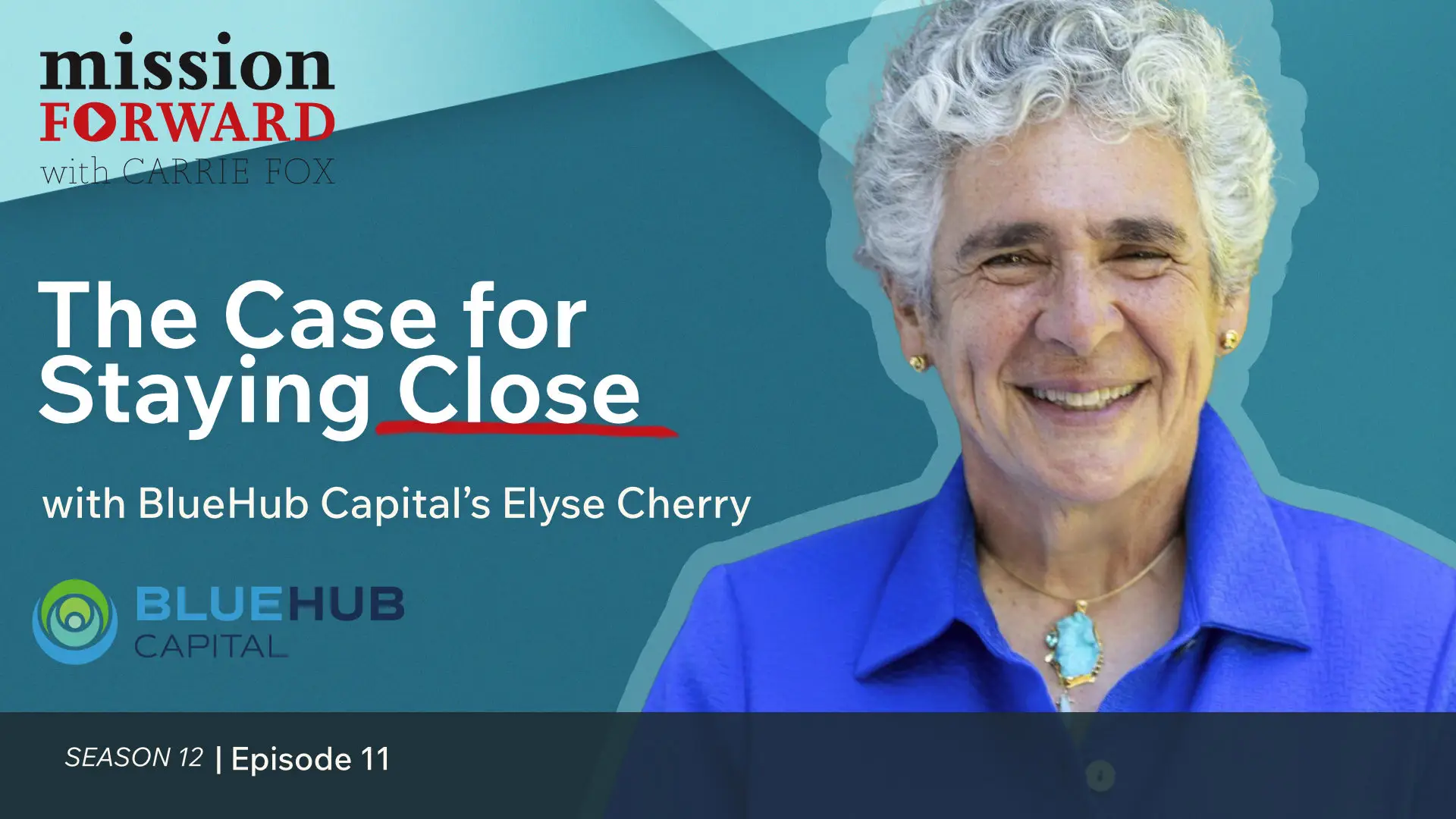
Today’s guest is a grounding force and a shining example of what it looks like to navigate through challenge while remaining steadfast and focused on the future. Elyse Cherry has led through recessions, housing crises, political upheaval, and more for four decades as the co-founder and CEO of BlueHub Capital. Elyse has been advancing social impact consistently along that way too. And in this particular moment, as we reflect on what history is requiring of us now, Elyse has some important things to say.
Quick bit of background on BlueHub Capital. They are one of the nation’s pioneering community development financial institutions, CDFIs, built on the belief that healthy communities are possible everywhere and for everyone. Full stop. We’ve got a lot to cover today and so much to learn from Elyse, so let’s get into it. Elyse, welcome to Mission Forward.
Elyse Cherry
Well, thanks so much, Carrie, and thanks for having me on today.
Carrie Fox
I’m thrilled for this conversation. Let’s dive in, because you have been at this for 40 years, and what I love, Elyse, is that your mission has never changed, right? So when I think about that, BlueHub, you founded it in 1985 with this very clear purpose: to build healthy communities where people of limited incomes live and work. How do you explain that kind of steadfastness to leaders who feel so challenged in this moment, with an ability to say, sure, we can stay on the same path for 40 years? You have done that. How did you do that?
Elyse Cherry
Well, I suppose the thing we really did was to center communities, right? We are helping to build healthy communities. We didn’t center it on the product. We didn’t say we’re going to make loans. We didn’t say we’re going to make grants, which we’ve never done. We said we’re trying to build healthy communities. And so over the years, we’ve thought long and hard about really what makes a community healthy. And every single time we think about a product or a business line or a new direction, that’s the North Star. Does it help create healthy communities? And of course what creates healthy communities changes over the years, right? What created them 40 years ago isn’t the same thing that they need today.
And so I think — and I, you know, I was trying to remember back about how conscious we were about this at the time, but we did have a pretty clear sense that if we weren’t community focused, then we would never quite get there. And so, you know, whether you think about communities needing internet access or better schools or housing or food or whatever it is, right, the ways the communities achieve those goals changes. But if we’re still focused on communities, we can change too, without having to change our mission.
Carrie Fox
So what you just described so well, Elyse, is this difference between the how and the why, right? It sounds like you and your team have been so focused on the why from day one, that North Star as you mentioned. And that’s different from the how. The how needs to change over time. The how evolves. And so it sounds like you have changed the tools over time based on what the work requires, but that why has stayed so steadfast.
Elyse Cherry
That’s a great way to say it. I mean, we’ve had our loan fund, which has been around from the beginning. We had a community development venture capital fund for a while. We had a company we called WegoWise — for water, electricity, gas, and oil — which was really aimed at driving down utility costs. We have the SUN Initiative, which came out of the Great Recession and the problems that people were having with respect to foreclosure. And we have One Percent for America, which is really about driving down the cost of providing a path to citizenship. You can see they’re completely different business lines, but every single one of them aimed at an issue that’s critical to our communities.
Carrie Fox
We’re going to talk a lot about data a little bit further into this conversation, but I get the sense, Elyse, that you are really tracking trends to understand when you need to start changing your how, right? Because there’s probably some lag time there in terms of the work you do. And if you’re going to change the how, how do you know when to do that?
Elyse Cherry
Well, that’s such an interesting question. You know, I often say I grew up in a working class community and then went off to Wellesley College, and I was never willing to give up either one of them. And so I learned early that standing at the intersections, with a foot in many worlds, really was the thing that suited me most. I didn’t want to be ghettoized into anything. I don’t care what the community is, I really want to know what’s going on all over the place. And people, whether we intend to or not, often build organizations in our own images. And so we have this organization that also stands at the intersection. So we’re very comfortable in limited income communities. In fact, we encourage our staff to go off and serve on boards and bring back information and really be out in the neighborhoods, and I do it too. But we’re also comfortable in the halls of power, so to speak, whether it’s the federal government or state government or city government.
And we also understand something I’ve been thinking about a lot recently, are ecosystems, right? You know, we worry a lot about things happening in silos, and you take away the silos and then you have this ecosystem. And the actors in the ecosystem are all critical to the outcome, but they all have slightly different things they want to focus on and slightly different needs. But that’s still this notion of standing at the intersections — it really helps us navigate that. And that’s actually, I think, how we’ve done it. We try to maintain constant awareness about what’s going on in our communities and what they need, and then really try to gin up ideas that we can make work, right? I mean, you can have an idea. I sometimes say — I used to say — an idea and a buck seventy-five buys you a cup of coffee. I don’t think it buys you anything anymore. But, you know, really sort of trying to figure out the idea based on what communities need, and then think about whether we can figure out a way to operationalize that, to pay for it, to finance it, and to get it going.
Carrie Fox
All right, so I want to ask you a little bit about this proximity piece, because we’re going to come back to CDFIs in a minute — I do want you to talk a bit more about CDFIs — but I have heard you talk about, and you’ve just actually talked about it, this importance of staying in proximity. And I love how you talk about the intersections. And, you know, that is good advice for anyone in any sector, to think about sitting at the intersections and understanding a perspective from, or an issue from, different perspectives. But you have also talked a lot, and your work is grounded in this idea of staying close, right? Being in community, staying in proximity to community. Why is proximity so essential to lasting change?
Elyse Cherry
Well, what an interesting question. You know, our offices have always been within the community that we serve, and we think that’s really important. There’s an interesting balance here, I would say. People who live in the communities we’re trying to serve know what they need. Whether they know the how to get what they need is another whole matter, right? You might understand that you need better housing or school, but whether your life experience also helps you understand how to build capital structures is a whole other question. And so part of what we really try to do is to knit these things together. So we have ongoing, incoming information about where the holes are, about what it takes for healthy communities — schools and housing and food and accessible jobs and transportation. And then we start to try and figure out where those things are available or aren’t available. And so we have lots of conversations with folks, whether they’re on advisory boards or people who are engaged in the transactions we’re engaging in.
But we also understand that we bring something else to the table, which — I used to talk, I still talk about it, really, as community values and downtown expertise, right? I trained originally as an attorney. I spent years in a big law firm as a commercial and real estate finance and development attorney. I understand how to build housing and build schools and build grocery stores, but what I don’t necessarily understand is what the community needs. And so I think there are some times when people build things because they’re sure they know, right? We’re not sure we know. We’re fairly sure we don’t know.
So what we try to do is to take all that expertise we have and say, well, okay, how is this going to work? Like, I’ll give you an example. Down in Brockton, we have a big Cape Verdean community, and there are a whole lot of issues around health care and people learning to eat in more healthful ways. So we said, okay, here’s this Cape Verdean grocery store that we can finance, and here’s a community health center that we can finance. What if we put these two things next to each other and actually started to combine the issues of health and food? And so that’s what we did, right? Because we understood from the community that they needed both things. They needed food that was consistent with their own histories and their own palates and everything they knew, how to cook. And then we needed health centers that could actually help them cook those things in ways maybe that contributed to better health. And so we could figure out how to put them together. They could figure out what they needed.
Carrie Fox
That is such a great example, Elyse, and somewhat answers my next question — which I’m going to ask you anyway — which was to think about the flip side of that, right? What happens when you try to lead from a distance? I imagine you would have never identified that example of a food store and a health center needing to be next to each other. But what are your words of caution for someone who’s trying to do this from a distance?
Elyse Cherry
That you don’t know what you’re doing, right? That you really don’t understand the need. I mean, if you think about it, right, take a regular old developer who decides to build housing in a suburb. They don’t do it from a distance. They don’t think, geez, I think people really want to live in this or in that, right? They go and they figure out what’s in the market and what the market requires. And so another way to think about this, that’s maybe a more business way to describe it, is communities are markets, right? And like any other market, they have a set of needs, they have a set of desires. And so to build with the assumption that there’s no market really ignores the reality of what it means to be anywhere, to live anywhere. You know, when we started this work all the way back in 1985, there was actually this notion that markets didn’t impact lower income communities or people. I mean, that was nonsense, but it was 40 years ago and it was hard to know that. And we figured it out pretty quickly and started to realize that we really had to understand communities from the perspective of where they wanted to go and what they needed.
Carrie Fox
It’s really the definition of service too, right, Elyse? I mean, you are doing it not for what’s best for us here at BlueHub, but what is best for this community, and then how do we make it happen?
Elyse Cherry
Without question. But even if we were doing it from a solely business perspective, unless the goal was to get rid of everybody, if we don’t meet their needs and interests, it’s not going to succeed as a business either. So I think sometimes when people with the right skill sets are trying to be helpful, it’s very hard for them to put themselves into the shoes of the people they’re trying to serve. And we’re just very clear: we have to be able to put ourselves into other people’s shoes. You can’t do it otherwise. I mean, I suppose for me it’s, you know, it’s another one of those life stance things, right? It’s how I try to live, in terms of understanding why people make the decisions they make.
Carrie Fox
Okay, we’re going to talk about Roxbury in a few minutes. Before we do, I said we were going to go back to CDFI. I know with certainty we have quite a few listeners who know all about CDFI, but you were there at the beginning. You co-founded what would become one of the nation’s earliest community development financial institutions. And I’m curious what it felt like to build something with so little precedent. And you had such a big idea. So tell us about that a little bit more.
Elyse Cherry
You know, it makes me think a lot about offense and defense, right? When you’ve actually built something of size, like where we are today — we’re at about, I think, about $1.8 billion in assets under management, and we’ve lent three and a half and we’ve leveraged another 17 — you have to think about defense as a fair piece, right? You can’t just kind of charge forward. But if you’re creating something new, there’s nothing to defend. And so you might as well just charge forward, because even if you fail, you’re not going to be any worse off than you were before you started. And so I think we understood that. I remember thinking about that from the very beginning, that there was nothing. And so if you’re going to start to create something, you might as well really try to figure out how to do it without worrying so much about defense.
And when we started — I was a young associate in my law firm at the time — we had a grand total of thirty-five hundred dollars and really not enough good sense to know that you couldn’t build anything with that. And so we started out, but we started out very clearly. I was crystal clear about this: if we’re going to start this, it cannot be one of those, oh, it was a good try, right? We really had to think through what was going to make us succeed. And ultimately we really had to figure out how to grow. And part of that gets back to the ecosystem issue, right? Communities are half of the ecosystem, or some part of it. But the other part is the money, right? You’ve got to figure out how, in the beginning at least, to pull in grants. You’ve got to figure out how to pull in loans. That means you have to figure out how to attach to wealth in your communities and to institutions in your communities.
And, you know, Barney Frank, who was our representative for many, many years, recently died. It’s caused me to remember — I was at his memorial service — and thinking about all the Barney Frank stories. And the one we have is, we invited him to come because we were trying to launch as an organization and we needed to attract a whole bunch of people. And so what better way to attract them than to get Barney to come and agree to speak, right? So Barney agrees, we send out an invitation, we’re at my law firm, the day comes that Barney says, so sorry, I’m stuck in Washington, can’t come. But it didn’t really matter. We referred to it forever after, very fondly, as the non-Barney Frank event. But it worked for us because, of course, since he had been willing to come, everybody showed up.
Carrie Fox
Right.
Elyse Cherry
And it wasn’t until we got there that we were like, oh jeez, you know, we can’t — I mean, he’s not here.
Carrie Fox
Right.
Elyse Cherry
But it was really the way we launched ourselves. We managed to attract political people and bankers and wealth and all of the sort of the other side of the equation that we really needed to get going.
Carrie Fox
Oh, isn’t that great? That’s a great story. What I hear in your words and so many of your stories, Elyse, is this line of resilience, right? That you said, we’ve got a big idea, what do we have to lose? Let’s go for it. We’re going to hit some challenges. We’ll figure it out. We’re going to have an event and our lead speaker won’t be there. We’ll navigate through it. Just keep navigating through it. And that — I have heard quite a few people talking about this season, both through this lens of resilience for us as humans, right? What we need to do to be resilient and to lead, but also the resilience of organizations. And I suspect you have both, right? Your organization has had to navigate through some ups and downs. So tell me a little bit about how you’ve done that. What do you think is the — I don’t know if it’s a special sauce, I don’t know if it’s a principle — but what do you attribute to that steadfastness of BlueHub Capital?
Elyse Cherry
Well, it’s a good question. You know, the thing that frustrates me most in life is when you ask a question and the answer you get back is, all roads lead to no, right? It just can’t be. And so I think what we’ve tried to do from the very beginning is really figure out how to put one foot in front of the other and keep going. So I think, for example, about the downturn of 1992, when the real estate market fell apart and the banking market fell apart. I think a lot of that really had to do with the crash of the savings and loan associations. And we were here in New England. At that point, we were solely in Boston — now we’re actually around the entire country, but we were a good bit smaller. And we were in junior position, often, to banks that had gone out of business. And, you know, we were under tremendous pressure from people who said, ah, you don’t know what you’re doing, you sell all that stuff for 30 cents on the dollar and you put those people on the street. And I thought, damn it, we’re not doing that.
And so we set out. We basically reached back to those folks and said, here’s the letter that’s going to go to the Boston Globe if you really push this. And we really took advantage of the David and Goliath approach here. We were at that point a teeny tiny David, and the banks we were talking about were very large Goliaths. And then the goal we set for ourselves was, we were not going to lose a unit of housing and we were not going to lose anybody’s money either. And we succeeded at that. And, you know, it took a fair bit of creativity. There was a group at the time called Resolution Trust Corporation, which was really charged with taking all of these assets from these various banks that had failed and packaging them up and selling them out in the market. And my colleague Dick Jones, who was our executive director at the time — you know, we sent him down to Franklin, Mass, where the RTC offices were, and said, you know, I know you’ve got our loan in a package, a gigantic package that’s going out to the capital markets, but don’t you think you could just pull it out and sell it to us for 10 cents on the dollar? And they kind of said, oh, okay. And so they did, right?
And so we and our colleagues and the folks who lived in our housing and our lenders got the benefit, as opposed to, you know, a much bigger capital market. We just asked them to sell it to us at the same price they were selling out all the rest of the assets. And so they did. And so we then took that benefit and rewrote the loans so that the nonprofits that we’d made them to could continue to pay, and the people whose housing they had provided could continue to stay. Now, you know, in retrospect, I guess that was a pretty creative approach, but I at the time was also doing commercial real estate finance and development. And so, you know, in the mornings I’d be facing down some bank board of directors explaining why they were not going to foreclose on my developer clients, and in the afternoon, I was sort of working with what we then called Boston Community Loan Fund, explaining how we weren’t losing anybody’s money and we were not losing anybody’s housing, right?
Carrie Fox
Oh, my goodness. Oh, well.
Elyse Cherry
So it was a creative approach, I will acknowledge.
Carrie Fox
Yeah. Well, you know what’s so interesting is, you know, you talked about that David and Goliath approach and you’re just kind of navigating through it. You’re the small, small one. You are not the David anymore. But I’m curious, if you think about yourselves as the David or the Goliath now?
Elyse Cherry
That’s correct. Oh, well, I don’t think we think of ourselves in either way, really, now. What I think about more — you know, as I say, at the beginning there was no point being on defense, there was nothing to defend. Now, in our current environment, I sometimes joke and say I spend a hundred percent of my time on offense and a hundred percent of my time on defense. And I suspect most other folks leading nonprofits know exactly what I’m talking about.
Carrie Fox
Mm-hmm.
Elyse Cherry
And that’s the challenge, right? We are one of the largest CDFIs in the industry, and of course we were among the very first to get formed. And so, you know, from our perspective, we have a big obligation to our borrowers, but we’re an intermediary — we have a big obligation to our lenders. And I think that we have a big obligation to the industry as well, right? We really need to sort of proceed along in a way that allows us to succeed and to be that bellwether and that model. So the David and Goliath thing works easier when you’re the tiny David.
Carrie Fox
Sure, yeah.
Elyse Cherry
I don’t know that anybody thinks of themselves as Goliath. And besides, we all know what happened to Goliath, so I don’t want to be in that role.
Carrie Fox
Right, right. We don’t want to think about it that way. Well, let’s talk about that impact, right? Because I’d like to turn to the Roxbury impact study, which is a really nice way to pull this conversation together. You recently released — BlueHub, I should say, recently released — a remarkable 40-year impact study that’s focused on Roxbury, this neighborhood where you are based, right? And as I understand it, your organization has invested $147 million in financing that leveraged an additional $910 million, resulting in more than 3,200 units of housing, hundreds of childcare — so many ways where you’re measuring gains in education, workforce. It’s an incredible story of impact, right? So I’d love to hear a little more about that. Maybe tell me a little more about the history of it, and then tell me what Roxbury — this incredible story of impact — teaches us about what’s possible in community.
Elyse Cherry
Well, yeah. So Roxbury, you know, as I say, we started in Boston’s neighborhoods and then we expanded to Massachusetts, and then we expanded across the country. But Roxbury has always been our home. And we’ve been there in various different locations over the now 40 years, but always there. And the way we’ve thought about that, it’s part of the proximity issue, it’s part of how we stay close. But it’s also a way to say, really, what creates successful development or successful growth in communities?
And I think, among the things we think about, as you mentioned, we’ve done housing and education and workforce and culture and arts, all kinds of things. Because we think a healthy community is a place where people want to be, right? It’s a destination. It’s not a place you’re stuck. It’s a place where you say, geez, I’d really love to live there if I could. And so you say, well, okay, what’s required for that, right? Well, the arts are a big piece of it, education is a big piece of it, schools are a big piece of it, access to food, access to jobs, all of it. I mean, you can kind of go on, there’s some more things too. And so rather than thinking of all of those things in silos, part of what we’ve tried to do is say, how do we do an integrated approach here, that really looks at all of the different things that a community needs? Because to be healthy, you need all those things, right? If you’ve got good housing, but you have to drive 30 miles for food, not very attractive.
And so over time, what we’ve tried to do is really to build out all of those sectors. And I go back to my point about ecosystems. You know, we did do $147 million. That is a very big number. But when you think about what the state has done, when you think about what HUD has done, when you think about what the city has done — none of this would have happened without that. I mean, I sometimes say, you know, if you want me to get rid of poverty, give me the federal budget, I’ll take a crack at it. But we’re not that big yet. And so, you know, really trying to figure out what the best way is to coordinate with the community, but with all of these other important players, to make sure everything moves forward. And I think that’s a lot of what we learned in Roxbury. And it applies pretty much everywhere. I mean, we did a really deep dive in Roxbury to try and figure it out. But as I think about the lessons learned, those lessons are true for every single community that’s trying to be a healthy community.
Carrie Fox
Elyse, forgive me for not knowing this, but did you track life expectancy and how it’s changed over those 40 years in Roxbury?
Elyse Cherry
We did not. We did not.
Carrie Fox
I think that would be so fascinating to look at over time. You know, one of — a person that I have admired for many, many years is named Dan Buettner. He’s a National Geographic explorer, and he’s known for what’s called the blue zones, these places in the world where people live over 100. And I think you all should get in touch with Dan Buettner. I think he should come do a study on Roxbury, because I imagine that all of the elements you’ve put in place have changed the life expectancy in a good way in Roxbury.
Elyse Cherry
It’s such an interesting idea. I’m actually very familiar with his work and the blue zones. You know, the thing I think that’s challenging about all of this is, it’s everybody’s work, right? It’s our work, it’s the city’s work, it’s the state’s work, it’s HUD’s work. And some of it is future focused too. I mean, I think, for example, about the work we did at Franklin Cummings Tech. We did almost $20 million in New Markets Tax Credits, and we were going to do those tax credits come hell or high water, because that school is right in the middle of Roxbury. And what it’s doing is teaching Boston kids all of the skills they need for the jobs of the future, right? So if they’re doing automotive, it’s not what we used to think of it, it’s all this digital stuff and cyber stuff. If we’re thinking about manufacturing, it’s all the advanced manufacturing.
And so some of what I think about — and I remember this actually from the days in which I did a lot of affordable housing work in my law firm days, when I was at Hale and Dorr — the housing was great and it was really important. But so often what I would see is, okay, but what about food? What about a future? What about schools? What about jobs, right? And so when we look at all this, what we’re trying to do is not just keep people comfortable today — which is really important, you need food and housing, right? — but to be sure that the institutions are in place that really help them build a tomorrow. And, you know, that’s — I mean, for all of us who came from working class families and went through college and, eventually, law school, that’s what we did, right? I mean, that is the American dream, that you can come up and you can build a better life for yourself. And so when I think about what it is we’re trying to do, right, some of it — so, I don’t know, it’s an interesting question. You know, life expectancy from 40 years ago to today — I’m kind of curious about what it’ll be 20 years from now as well.
Carrie Fox
Well, I’m picking up from you, working in proximity matters and working in collaboration matters. And as we come to our last few minutes, there’s a last chapter of this conversation I want to make sure we get to, and it’s around courage. Because what I heard you say is, courage can be quiet, but it can’t be silent. And I have been thinking about that, Elyse, since you said it to me several weeks ago when we last talked. And I’m curious what that phrase means to you in practice. Courage can be quiet, but it can’t be silent.
Elyse Cherry
Well, I think, as a country, we’ve gone through many, many, many periods that have been good and many periods that have been difficult. And the trick, I think, in terms of trying to move through difficult periods in a way that’s consistent with one’s own goals and values, is really to think a lot about where we can make a difference. I mean, I’m not big on tilting at windmills, you know, and making a ton of noise that doesn’t really make a difference. Sometimes noise does make a difference — don’t misunderstand me, and I’m perfectly happy to participate in that too. But there are things that we can do that are within our mission or within our values, that if we just keep pushing forward on, we’ll eventually get to the other side.
I think that there is some — and maybe this is true of many leaders, I’m not sure — but there is sort of an enduring optimism, even when things are bad, right? That if you just keep putting one foot in front of the other, and do it in a thoughtful, creative way, you can get through. And what you don’t want to do is stop, right? Because if you stop, then folks who don’t share your values win by definition, right? It’s kind of an automatic win. And so the obligation on all of us who want to move forward is to keep moving forward. And so when we do that, it happens in big ways and small, right? It happens in social ways and community ways and political ways and public ways. And each of us has got to figure out how to make that happen.
And so one of the things I spend a lot of time focusing on: this is not a time to back up from the people who need us. This is a time to be sure that we can continue. And yet it’s a very difficult economic time. It’s a difficult time because federal subsidy is at risk. And so you really have to think about, in the context and market in which you’re functioning, how do you do it, right? What needs to change? How do you change your underwriting? How do you think about risk differently? How do you reserve differently? How do you assure that you have a robust balance sheet, that you’re not marginal, that you really can get through bad times — that if things go bust, you have the means to put them back together and keep going? And so some of it is about courage, I suppose. And some of it is about a really clear-eyed look at what it means to build a healthy organization as well as building a healthy community, right? It’s kind of a single life philosophy, so it makes it a little easier to manage. But I think those things are key. You can’t just kind of sally forth as though nothing has changed, right?
Carrie Fox
Well, then let’s end there. What is the clear-eyed view of what you see that is giving you hope, optimism, that’s keeping you moving one foot in front of the other when you look out into the future today?
Elyse Cherry
Well, I think it’s no surprise to anyone that we are a very divided country at the moment. But I also think that there are many topics on which we are far more aligned than we think. And that some of this is really about what we focus on, right? I think it’s important going forward that we are a country that has room for all of us, you know, and that’s true whether we’re immigrants, whether we’re part of the LGBTQ community, whether we’re part of communities of color. We’re all here, and we all got here from somewhere else, right? I mean, my grandparents were all immigrants. I think that’s really true of just about every person around, except perhaps for our Native American fellow residents, who might say something different. We came from somewhere else. And the country sometimes did and sometimes didn’t, but eventually got those doors open, and we walked through them. That’s our obligation today too, right? We need everybody in order to be the best country we can be.
People talk about inclusion. I talk about — it’s an idea borrowed from Paula Johnson, who was the president of Wellesley College — really, of inclusive excellence. That you can’t be excellent unless you’re inclusive. Because if you’re not, you’re just leaving a ton of talent on the sidelines. And so I just keep going. That’s the goal, and that’s what we’re going to continue to do.
Carrie Fox
Well, Elyse, I have had Dan Buettner on this show, and it was a little bit of a pinch-me moment because I loved it so much. Our conversation is right up there. I have loved learning from you so very much, and just so appreciative of your wisdom and sharing it, and really this clear-eyed view that you have taken through your work and your willingness to share it with us.
Elyse Cherry
Well, thanks so much, Carrie. It’s been great fun for me, and I really, really appreciate your interest in this arena. It’s a great way to get it out into the, you know, into the metaverse, so to speak. So it’s wonderful.
Carrie Fox
For folks who are listening, we’re going to have a number of links in the chat to the Roxbury Impact Study, to a number of BlueHub Capital’s work, so you can learn more, track their work, track their impact. And again, Elyse, thanks for being with us today.
Elyse Cherry
Well, thank you very much.
Carrie Fox
Thank you for joining us for this episode of Mission Forward, and for listening to that wonderful wisdom from Elyse Cherry. I just really loved that conversation. Now I invite you to stick around for a few more minutes, because we’ve got Matt Price, our researcher in residence, coming up next, who is going to share with us the next segment of our research briefs to help bring some story to data. Stick around.
All right. Hey, Matt, I’m so happy to have you back, and so excited to hear what you’ve got to say about Elyse’s conversation, which was just great, right? It was just great.
Matt Price
Oh yeah, I thought she spoke so eloquently, and I thought this was really interesting.
Carrie Fox
I’m going to get us started. I am really curious to hear what you think about Elyse’s discussion on listening to the community, right? So what does the data say about the role of communities in solving problems?
Matt Price
Yeah, I thought that was interesting too, because, I mean, she just talked so much about being proximate to the community, collaborating within your community. And there’s a lot of research that actually supports this approach, that a robust and collaborative community can really empower individuals. I found a couple of interesting sort of data points around that. The first was from Robert Wood Johnson Foundation. They conducted a study with PerryUndem in 2025. They asked, if you work together with neighbors in your community, how likely do you think it is that you could solve the problems that face your community? And they specifically call out, like, the lack of affordable housing, or improving local schools. Sixty percent say it would be likely that they could solve those problems.
And, you know, at first I thought, okay, 60%, nice, a majority. But I was thinking, when you take any kind of ratings about effectiveness right now — whether it’s, you know, political institutions, business institutions — I mean, the perceptions of efficacy are so low. And this really stands as a contrast, where people say, yeah, we can do it if we sort of put our community heads together. And that kind of reminded me of another thing I saw through Gallup, where they asked people — they use the phrase, you know, can you shape your own path, right? So this sort of, like, personal efficacy. Or are you at the mercy of outside circumstances? And according to Gallup, one of the main determinants of whether you feel like you can shape your own path is whether you perceive your community as collaborative and your neighbors as reliable. Those folks who think that are about 16 to 22 percentage points more likely to feel they can shape their own path, according to Gallup. So really interesting to see, you know, sort of institutions like BlueHub Capital collaborating with the members of the community and trying to sort of increase that confidence and empower those individuals.
Carrie Fox
So community power is a real thing.
Matt Price
Mm-hmm. Yeah, absolutely.
Carrie Fox
Yeah, cool.
Matt Price
Yeah.
Carrie Fox
All right, so really interesting, right? How people are optimistic about the role of communities and the role that those communities play in solving problems. You know, we also heard Elyse talk about healthy communities. And we heard her talking about different issues, like housing, that affect low-income communities. Matt, do you have a sense of how important these issues are to communities?
Matt Price
Yeah, I really liked hearing Elyse talk about, you know, saying for 40 years they’ve been asking the question, you know, does this create healthy communities, and this is kind of their North Star. You know, so that same Robert Wood Johnson Foundation talked about this a little. They say, you know, think about the kind of community you want to live in: how important is it that everyone has the ability to be healthy? And, you know, 72% say it’s very important — not just important, but very important. And not only that, they listed, like, 16 things on the list, and that was one of the very top answers, right? So, like, community health is a high priority for where people want to live.
And then, you know, with housing too — you mentioned it, and she talked about it a lot — another one towards the top of the list: 67% saying it’s very important that everyone has safe and stable housing that’s affordable. That was one of the top ones. And of course, you know, we’re at a time where people are really struggling, as we know. A third study I looked at — this one was from a group called Advocus Partners — recently found just 13% of people say keeping up with their monthly housing costs over the past year has been very easy. So it’s really a lot of people doing some level of struggling, not really feeling that ease. And so, you know, the ability to help these communities with these kinds of things, as Elyse and her organization have been doing, is really important and really necessary at the time.
Carrie Fox
Yeah, it takes me back, actually, to our last research brief, where we talked about the difference between struggling and thriving, right? And so I want to hang there for another minute, because it feels like now you can’t do anything without resources, right? You can’t do it without the money. And so I want to talk about the role that finance plays — that investment really plays — in communities like the one that Elyse has been investing in. So tell us a little more about that. What do people think about the role of finance in communities like this?
Matt Price
You know, people have all sorts of reactions to all sorts of solutions, but a lot of times that sort of financial solution — of investment, and not just putting a band-aid on something or just having sort of short-term relief — that has, for a long time, been one of the more popular solutions. Now, given Elyse’s work sort of at a, you know, community development financial institution, I also found this connection between the finance and the health really fascinating. That Robert Wood Johnson study from PerryUndem I referenced — they asked a question saying, you know, do you think the following factors play a role in whether someone can thrive and be healthy? And, you know, they use that term, thrive, and they use it too. And the list of five factors of, you know, how much does this play a role in your own health: income, education, your neighborhood, your race, your gender. And most people agree that their income plays a huge factor in their health. Sixty-five percent say it was a big role — that’s a larger number than said it for any of the other things. So, you know, and again, I don’t know what the actual numbers are, but the perception is that everyone knows that income and health are tied together.
So, you know, it’s interesting seeing the connection between income and a healthy, thriving community. And because of this, I think there’s some support for financial opportunities, right? Like, like the CDFIs that Elyse and others have pioneered. And it’s not controversial. You know, Advocus, as I referenced them earlier as well, in April 2026 asked people whether they would support Congress expanding access to affordable home financing, including new and reformed lending programs. So that financial angle was one of, you know, several that they tested. It was the most supported — 83% supporting it, 46%, almost half, saying they strongly support it. Especially true among Black respondents, among Hispanic respondents, among renters. So really that sort of ability to get something at an investment level, as opposed to, you know, some other solutions like streamlining regulations or reforming assistance programs, things like that — there is a lot of, people perceive a lot of upside to there being that kind of investment lever for folks who are in that position.
Carrie Fox
Yeah, a lot of trickle-down impact from that, from that early investment in community. Well, Matt, as always, you do such a wonderful job of bringing story to data, making data come alive for us. So thanks for doing that again today. And thanks, all, for listening to this episode of Research Briefs. See you soon.