Pete Wright:
Hello, everybody, and welcome to Taking Control, The ADHD Podcast on TruStory FM. I’m Pete Wright, and I’m here with Nikki Kinzer.
Nikki Kinzer:
Hello, everyone. Hello, Pete Wright.
Pete Wright:
Hi, Nikki.
Nikki Kinzer:
Hi, Pete.
Pete Wright:
Welcome, welcome.
Nikki Kinzer:
Thank you.
Pete Wright:
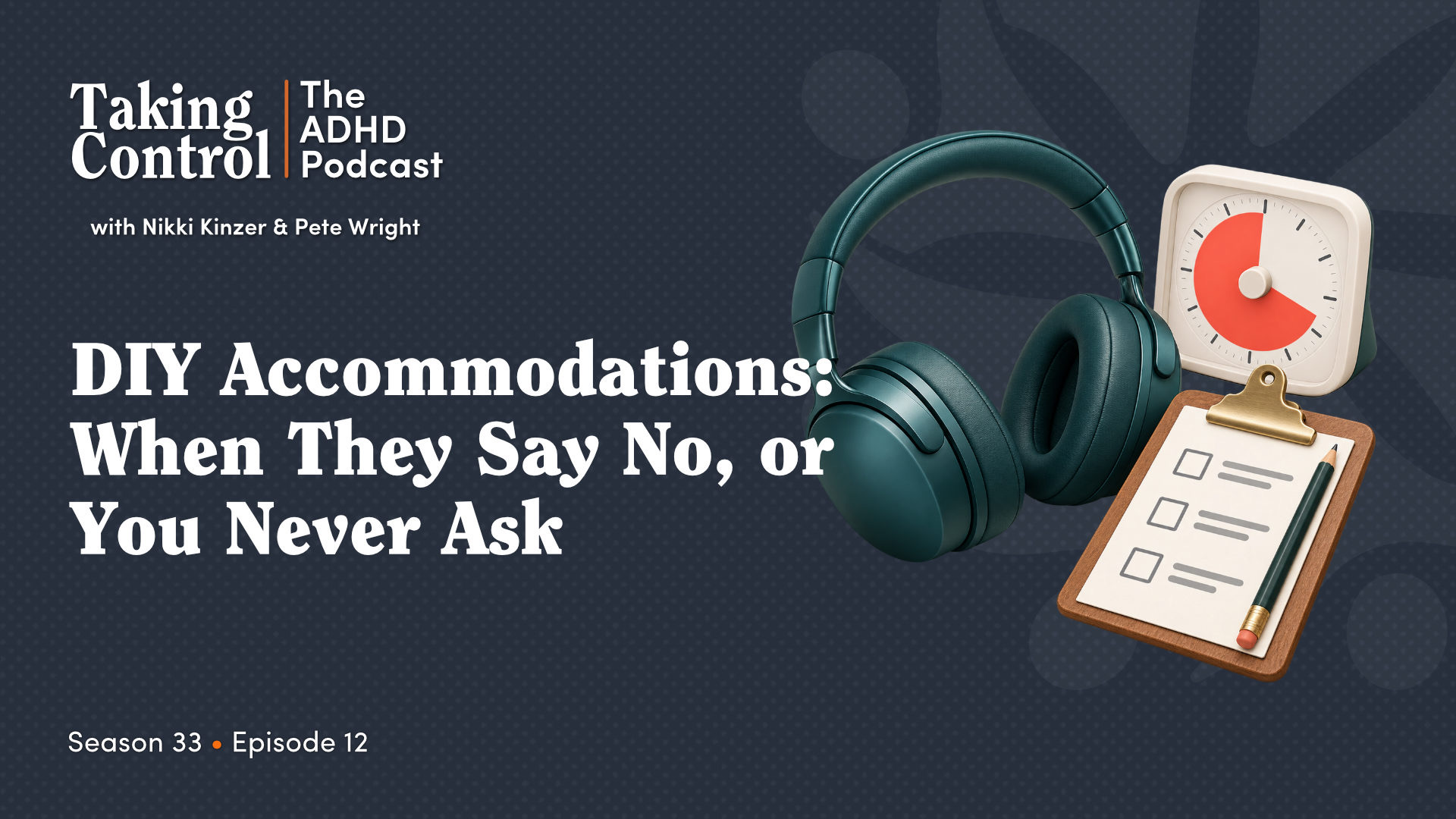
I’m your accommodations master. I am the gatekeeper to all the good that you have possible to do in your life. I get to decide if you can or you cannot do it.
Nikki Kinzer:
Okay, this could go a lot of different ways.
Pete Wright:
Yeah. Diabolical. This is a tough topic for a lot of people. I know we’re talking about accommodations and taking agency in your own accommodations universe.
Nikki Kinzer:
Yes, I think that’s a little bit…
Pete Wright:
Before we get into today’s show, and we’re going to hustle into today’s show, just a reminder about our wonderful Patreon community. Members of our Patreon community at patreon.com/theadhdpodcast get early, ad-free access to every episode. They get access to the member-only channels in our Discord community server and a seat in the live stream recording of this show, where you can ask questions to us and talk about the shows and books you’re reading and the movies you’re watching. We do a lot of stuff on these live streams, and it’s a lot of hijinks and maybe a few odd shenanigans. But the thing we hear people talk about most isn’t any of that. It’s all about the community of incredible people who have joined this server and have joined this community. They are all living authentically with their ADHD, learning how to show up for each other in a way that’s pretty special, and it’s hard to find anywhere else on the internet. So if you’ve ever considered being more than just a listener and want to become a part of our community, visit patreon.com/theadhdpodcast to learn more and join us. And if you’re not ready for that, that’s fine too. Find us at takecontroladhd.com, connect with us on the socials, join the Discord, or sign up for the weekly email newsletter. We’d love to have you wherever you may land.
All right, Nikki, accommodations.
Nikki Kinzer:
Yes, yes.
Pete Wright:
Oof, the gate comes down. What’s going on? Tell me about how this came up.
Nikki Kinzer:
Well, this came up because, as people probably have not noticed, but you and I have noticed when we’ve been doing these outlines, our shows the second half of the year have been sort of a part two of extended conversations, right? Of what we’ve talked about. And it was interesting because when this came up with DIY accommodations, the original title was about if they just said no. But then I added, what if they said no, but you never asked?
Pete Wright:
Mm-hmm.
Nikki Kinzer:
Because I think there’s two kind of things going on.
Pete Wright:
Yeah. You never gave them the opportunity to say no.
Nikki Kinzer:
Right, right. And so there’s two kind of things that we’re going to talk about, two different sides of the story. But what was so interesting is when I was reading our notes before, this had come up because somebody was told that they couldn’t use Todoist at work. Well, since we did that show, I have been working with someone who had an even bigger no. And I was like, I need to talk to this person before we do this show because this was directly, I mean, so much of what she experienced. So she was asking for accommodations for a professional exam. And they said, no, you can’t have these accommodations. She appealed. So she had to make the choice then whether or not she was going to appeal or if she was just going to let it be. And she appealed.
And she got a psychological evaluation. She listed all the accommodations that she was asking for, why each one of them mattered. And they came back and they still said no. And this is in 2026.
Pete Wright:
I wanna know so much that you obviously can’t reveal.
Nikki Kinzer:
This is…
Pete Wright:
I want to know what the association is. What business do they have denying these kinds of things? Who on their board looks at a psychological evaluation and a confirmed diagnosis of ADHD, I’m assuming it’s a confirmed diagnosis of ADHD, and says, no, you can’t have this accommodation this year?
Nikki Kinzer:
Of course. Nope.
Pete Wright:
I want to know so much. I want to know their home address. I want to write a strongly worded letter.
Nikki Kinzer:
I know.
Pete Wright:
This is insanity.
Nikki Kinzer:
It is unfair. It is completely unfair and mind blowing.
Pete Wright:
Mm-hmm.
Nikki Kinzer:
But this is the thing. When I asked her about it and I said, here you got this information. What do you do? And one of the things that she said, which I just think is really important, is that she let herself grieve for a little bit. She let herself feel like this is unfair and this is gonna make things so much harder for me. But she had to make a choice. Do I ignore or not ignore? Do I then just give up and not take the test?
Pete Wright:
Yeah, because it’s a professional certification, my assumption is they have to take the test.
Nikki Kinzer:
Right. And so do you just decide this is not the profession I’m gonna do anymore because I can’t get accommodations?
Pete Wright:
That’s what I would do.
Nikki Kinzer:
Right.
Pete Wright:
I would burn it to the ground. I’d be like, that’s all right, I’m done. I’m gonna go fish.
Nikki Kinzer:
You would feel that way. And you probably do feel that way in that immediate reaction, right?
Pete Wright:
Yeah.
Nikki Kinzer:
What is really interesting, and what I give this person a lot of credit for, is that she let herself be in that moment for a few days and feel bad and all of that. But then at the end of the day, she’s like, I have a choice. I can either let it go or I have to figure out how to make this work, because my end goal is still to take this exam and it doesn’t change.
Pete Wright:
Right.
Nikki Kinzer:
And so what do I have to do differently to make this now work? And that takes a lot of courage. First of all, it takes a lot of courage to ask for accommodation in the first place, because you’re saying out loud, I need help with this. And you are trusting that the organization is going to agree. When the answer is no, then it’s also feeling like, you’re right.
Pete Wright:
Right.
Nikki Kinzer:
I shouldn’t need this. They’re telling me I shouldn’t need it. And for whatever reason, you’re gonna internalize that as they’re right, I’m wrong. But that’s not true, because anybody that’s listening to this understands this is completely unfair, right?
Pete Wright:
Yeah, and it’s also a crisis of faith, right?
Nikki Kinzer:
This is…
Pete Wright:
A crisis of, why don’t these people want me to succeed in my field?
Nikki Kinzer:
Right. Right. Right. On a test. I’m so heated about this because it just makes me so mad.
Pete Wright:
Yeah. Me too.
Nikki Kinzer:
It is an exam. You’re being tested on how you take a test. That is so ridiculous.
Pete Wright:
How to take the test, right?
Nikki Kinzer:
It has nothing to do with the knowledge and the experience and everything that she had going into this in the first place.
Pete Wright:
Right.
Nikki Kinzer:
Right. And so just the whole thing makes me mad.
Pete Wright:
Yeah.
Nikki Kinzer:
Now there’s this other group of people who won’t even ask. Right. And they’re not wrong, because they read the room. They know it’s not a safe place to speak up. Now, this isn’t necessarily around taking an exam, but it could be in your own work environment.
Pete Wright:
Anything, yeah.
Nikki Kinzer:
Yeah. It is not safe because my boss has already said some things that make me feel unsafe. So I need to protect myself and I’m not going to ask for accommodations.
So what we’re going to kind of unravel today is both of these scenarios and kind of go through that. So let’s kind of picture the two people that are listening right now. So the first one who works up the courage. You ask, you gather the paperwork. You get the letter from your doctor. You wrote out the need and the why and all of this stuff. And they come back and they say, nope, we really can’t do that. It’s not fair. I would have to do this for everybody else. Whatever the reason is. So we know it’s dumb.
Pete Wright:
Which is dumb. It’s already dumb.
Nikki Kinzer:
It’s already done. So this hits much harder, right? Because of how much it took for you to ask in the first place. Then we get the second person who’s never asked. And it’s not because you don’t need support, but it’s because of your workplace, the supervisor, the colleagues, the competitiveness, whatever you’re in. So maybe you’ve seen how people get talked about after they share something. We know that happens. Gossip. And maybe it’s not about you, but you hear them talking about somebody else and you have the same issue, and so now you’re gonna be quiet.
Pete Wright:
Yep. Why would you want to be lumped in with any group that people deride in public?
Nikki Kinzer:
Yep, exactly. Absolutely. What they both feel is let down, angry, alone, tired of being your own safety net. And underneath it is this whole old story that we’ve talked about. I’m too much. I’m asking for special treatment. I shouldn’t need it. All of these things. Both of these are self-advocacy. One of you spoke up, one of you protected yourself. Neither is the wrong choice.
Pete Wright:
Yeah.
Nikki Kinzer:
So I want to be clear. What we know is you’re not alone. And there is more you can do. And that’s what we want to talk about. The mindset that my client had about, okay, how do I pivot, is just such a beautiful example. So I’m kind of excited about getting into what you can do. But Pete, I have a question for you.
Pete Wright:
Yeah.
Nikki Kinzer:
I know you worked on your own. You’ve been your own person for a long time.
Pete Wright:
I’ve been my own person as long as I can remember.
Nikki Kinzer:
But prior to that, well, yeah. You’ve always been Pete Wright. But I know you’ve also worked for corporate and organizations before.
Pete Wright:
Right. Yeah.
Nikki Kinzer:
Have you ever asked for an accommodation formally?
Pete Wright:
No. I’m a little bit embarrassed in this context because I should have, by all rights. But my work history is one of great privilege when it comes to my brain and how I work, because the accommodations that I would ask for, I’ve always been in a position to just do myself, because I’ve had a position of that kind of agency. If I needed a technological thing, I was the tech buyer for our company. If I wanted something at my desk, I just got it. Right.
Nikki Kinzer:
Yeah, no.
Pete Wright:
So I’ve been able to kind of manifest my own situation. Even when I was working for a big corporation, I only worked in the local office for a few years. And then I started working for the regional office out of an office in that local office. So I had nobody watching me. If I needed something, I just went and got it and had the headphones, had the, you know, I just had it. So I come to this conversation…
Nikki Kinzer:
Yeah.
Pete Wright:
With great privilege. And I wasn’t diagnosed until I was an adult. So even when I needed the accommodations, I just struggled, right?
Nikki Kinzer:
Right. Yeah, yeah.
Pete Wright:
I didn’t know I needed an accommodation when I was in high school and college. I didn’t know what was going on.
Nikki Kinzer:
Because you didn’t know what was going on, yeah.
Pete Wright:
So I just did crappy in classes and I was late and I forgot stuff. And that was just my life. I should have been in context to have an accommodation and nobody ever told me that was an option, because I’m a kid of the 80s.
Nikki Kinzer:
You didn’t know.
Pete Wright:
We just didn’t have it.
Nikki Kinzer:
Right. Right.
Pete Wright:
So yeah.
Nikki Kinzer:
Right. So one of my favorite parts of working with clients, especially students, but also adults, is when they advocate for themselves. I love it when I hear them advocating for themselves, because it’s so important.
Pete Wright:
Yeah.
Nikki Kinzer:
And my daughter, I’m gonna bring her up. She worked at a pool in the summer and she was a waitress. And they had said at the beginning of the season that you couldn’t have a stool, because they didn’t want the waitresses and waiters to not look like they were working, because it’s kind of slow and it’s not always busy.
Pete Wright:
Mm-hmm.
Nikki Kinzer:
And they were like, when you’re sitting on a stool on your phone, it doesn’t look good. So we’re not gonna have stools out. So she does her first day and she’s like, I’m miserable. I can barely walk. I’m in so much pain, because she has an autoimmune disease.
Pete Wright:
Yeah.
Nikki Kinzer:
And I’m like, okay. You need a stool. So you need to go tell them as an accommodation that you need a stool, because that is part of an accommodation that is reasonable, and all of the stuff. So she does. She goes in and sure enough, she gets a stool. And what I love about that interaction is, yes, I needed to kind of… she didn’t really think about it on her own. She just assumed that she couldn’t have a stool because they told them that they couldn’t. But I’m teaching her, too, to advocate. No, you need this to do your job. And so I love that she was able to do that. I love when I see clients in the workplace ask for things like Todoist, and they’re not always gonna say yes, but sometimes they do.
Pete Wright:
Yeah.
Nikki Kinzer:
And so then you get to see that you advocated and you got what you needed. So that’s one of my favorite parts, when people do ask and they do get. But it’s not always what’s happening.
I, Pete Wright, followed your suit, and I got some statistics.
Pete Wright:
I love it. Okay.
Nikki Kinzer:
Did a little research.
Pete Wright:
I’m contagious.
Nikki Kinzer:
You’re contagious. And I thought, you know what? He’s not the only one that can pull out things…
Pete Wright:
Yeah.
Nikki Kinzer:
From nowhere. So all of this information is going to be in the show notes, because it really doesn’t pull out from nowhere. It comes from somewhere.
Pete Wright:
I just need to correct it before my brain lights on fire.
Nikki Kinzer:
So what…
Pete Wright:
I’m technically a contagion. I’m not contagious. I’m the contagion.
Nikki Kinzer:
Right.
Pete Wright:
All right, you win.
Nikki Kinzer:
Yes.
Pete Wright:
Go ahead.
Nikki Kinzer:
Yes. Okay. So let’s talk about what a formal accommodation is. Under the ADA, ADHD can qualify as a disability, and employers may need to provide reasonable accommodations unless it causes undue hardship. That’s from CHADD. Now, we’ve talked about this before. In school it’s a lot easier to get accommodations.
At work, it’s a lot harder, because “reasonable accommodations unless it causes undue hardship” is a matter of opinion in a lot of situations, right? So the ADA applies to employers with 15 or more employees. So smaller workplaces and workplaces outside of the US play by different rules. So if you’re a listener who works somewhere that is smaller, that has less than 15 employees, federal law may not require their employer to accommodate them at all.
Pete Wright:
If you work for an employer that has fourteen employees, hire someone.
Nikki Kinzer:
So that’s important to know. Right. Right. But that’s important to know.
Pete Wright:
It’s really important.
Nikki Kinzer:
And some states do…
Pete Wright:
Makes a huge difference.
Nikki Kinzer:
Yes, and some states do cover smaller employers, so you have to kind of look at what your state does. But some listeners at small companies have no formal route to ask. They probably don’t have an HR department, right? So the do-it-yourself may be the only option. And that’s why we want to talk about what we’re gonna do today.
Employers can ask for documentation from a provider. Of course. That can completely make sense. I worked in HR. You need to be legit, right? I think that that’s fair and reasonable. But many people don’t know that going in. So where it’s hard, especially with students who are young and don’t know how to do this, there’s a lot of paperwork you have to gather.
Well, is that something that ADHDers like to do?
Pete Wright:
And just have at the ready, right?
Nikki Kinzer:
No. No.
Pete Wright:
Not at all.
Nikki Kinzer:
So to get accommodations, it’s really hard because you have all of these boxes you have to check.
Pete Wright:
Yeah.
Nikki Kinzer:
So if you can find somebody to help you…
Pete Wright:
Yeah.
Nikki Kinzer:
Please do, because that’s going to help make the process go a little bit smoother. It’s going to help check the boxes, because they’re going to ask for it. So just so y’all know, we are not legal people. We’re not gonna pretend like we are.
Pete Wright:
We’re legal people.
Nikki Kinzer:
We’re legal, but we’re not attorneys.
Pete Wright:
We’re legal people. We’re not attorneys. This is not legal advice.
Nikki Kinzer:
No, and there is a website you can go to and look at. It’s called the Job Accommodation Network. It’s Ask JAN. Isn’t that nice?
Pete Wright:
I love it so much.
Nikki Kinzer:
askjan.org, and it’s a free place to ask specific questions.
Pete Wright:
Yeah.
Nikki Kinzer:
So gotta throw that in there. All right. So why the answer comes back no. Let’s try to dissect this, because you even said at the beginning, I want to know who these people are that made that decision.
Pete Wright:
Yeah. Yeah.
Nikki Kinzer:
I don’t know what the answer is. I do not know why they did that. I’m sure that we can probably come up with more answers to this question. But this is what I found in my research. And it’s also what I found when I talk to people. If we do it for you, we have to do it for everyone. Right. So there’s this fairness thing.
Pete Wright:
Yeah.
Nikki Kinzer:
Now, right, because why not do it for everyone, especially if it’s not of any…
Pete Wright:
So do it for everyone.
Nikki Kinzer:
Hardship, right?
Pete Wright:
Yeah, yeah.
Nikki Kinzer:
What does hardship mean to a company?
Pete Wright:
Well, and this is, I mean, there are two things going on. One, for a company, there can be situations like, if you work in a job where part of the job requirement is to be able to carry things that are heavier than 30 pounds.
Nikki Kinzer:
Mm-hmm.
Pete Wright:
Right? There are jobs like that. And you can’t carry 30 pounds because of an injury or because of a repetitive stress situation. They need to find you something that you can do to contribute as part of ADA.
Nikki Kinzer:
Right.
Pete Wright:
They can’t fire you, but the job is not for you.
Nikki Kinzer:
Right.
Pete Wright:
And that’s okay. But where you started this conversation was in the context of a testing situation, right?
Nikki Kinzer:
Yes.
Pete Wright:
Which is the thing that’s making my brain explode.
Nikki Kinzer:
Yes.
Pete Wright:
How do they get… does the ADA not apply to a testing center?
Nikki Kinzer:
I agree.
Pete Wright:
It sounds like it does, because they took the appeal. Right? That indicates that somebody was aware of process, not just a blanket no.
Nikki Kinzer:
Right. Oh, I know. It’s crazy. It fires me up for sure.
Pete Wright:
Yeah. And I will also say, I do know some organized testing centers do offer things like extra time, proctored exams…
Nikki Kinzer:
Uh-huh.
Pete Wright:
For people who need to be in an isolated space. Some testing centers do, and that is inconsistent across national testing centers.
Nikki Kinzer:
Right. Yeah, yeah, and that’s right.
Pete Wright:
So all that said. Yeah.
Nikki Kinzer:
Exactly. Sometimes the no never made it to HR. So what this means is that you’ve asked your manager for something.
Pete Wright:
Yeah.
Nikki Kinzer:
And the manager maybe isn’t as informed about ADHD, or maybe they just play a role of, this is what the rules are. No, you can’t do this. You can’t have a flexible schedule because when you were hired, it was 8 a.m. to 5 p.m. Right? That’s just the rule. So this is something to think about if you work in a larger company that does have an HR department. If the manager says no, it may be worth going and talking to the HR manager or whoever is in HR, just to make sure that that’s true. I’m not saying you kind of… well, I am kind of saying, like, hey, I have this thing.
Pete Wright:
I have a diagnosis. If you’re willing to disclose that this is where you are, yeah.
Nikki Kinzer:
So if you’re willing to disclose, yeah. Can we talk about this? Because maybe my solution wasn’t one we can do, but is there another one that we could do?
Pete Wright:
Yeah, right.
Nikki Kinzer:
Can we think outside the box a little bit? So that’s something to think about. But sometimes it’s how the ask lands, right? So this is, I think, really true when people get nervous, but I see it a lot with ADHDers. They tend to apologize a lot. I’m really sorry that I need this. I’m so sorry I’m asking you this. I know that this is gonna be a big ask. So we want to kind of come in a little bit more confident and be clear. You don’t need to apologize for something you need.
Pete Wright:
Mm-hmm. It’s just a situation.
Nikki Kinzer:
You’re just asking.
Pete Wright:
These are the conditions of life right now. Yeah.
Nikki Kinzer:
Right, right. And sometimes it’s the paperwork. And again, oh, it’s so frustrating, especially for students, because I see these young adults who really have had their parents or some adult in their life be able to help them. And then now with the university, they will not talk to you. They will only talk to the student. It’s all on the student. So again, it’s trying to make sure you’ve got the proper documentation and all of that.
Pete Wright:
Yeah.
Nikki Kinzer:
But there’s all kinds of reasons why people say no. I mean, I think that a lot of times what I see in coaching is it’s a security thing where, yep, you can’t use this app. We only use this. Nope, you can’t bring this in because of privacy or whatever.
Pete Wright:
Yeah. Right.
Nikki Kinzer:
So okay. So I have more statistics.
Pete Wright:
Okay, bring it. Bring the rain.
Nikki Kinzer:
All right, so why so many people never ask. If you’ve never asked for accommodations, you’re in really good company, because one survey from understood.org found about 59% of neurodivergent workers worry that disclosing will hurt them at work. About a third said a request has been denied, and almost a quarter said they lost a job or were demoted after asking.
Pete Wright:
Okay. I have questions about the survey and the data. None of that seems good, but…
Nikki Kinzer:
No.
Pete Wright:
A quarter saying they lost a job or were demoted after asking, I have a hard time believing there’s clear objective data that says, yes, we fired that person for asking about an accommodation. That seems like the emotional response.
Nikki Kinzer:
It probably isn’t.
Pete Wright:
Like, I’m sure I was let go because I asked, but…
Nikki Kinzer:
Yes, I agree.
Pete Wright:
Really?
Nikki Kinzer:
Yeah.
Pete Wright:
Yeah.
Nikki Kinzer:
Yeah, that I agree.
Pete Wright:
And also, something to question, but that third in the middle is the thing that I think is the most illuminating to me.
Nikki Kinzer:
And something to question for sure.
Pete Wright:
Which is, a third said a request had been denied.
Nikki Kinzer:
Yes.
Pete Wright:
Once a request has been denied, you’re deflated.
Nikki Kinzer:
Yes.
Pete Wright:
Why would you ever ask again?
Nikki Kinzer:
Right. Oh, for sure.
Pete Wright:
Right?
Nikki Kinzer:
Yeah. Yeah, for sure.
Pete Wright:
Yeah.
Nikki Kinzer:
About 60% didn’t know what they were entitled to, and about half didn’t know who to even talk to. So this also goes back to the process isn’t clear, right? Whatever your organization is, how it’s set up is not…
Pete Wright:
Yeah. Right, because what do they do? What do they give you to teach you about the process? They give you a handbook, a website. You’re just meant to say, I’ve read everything. And what do we do? It’s a terms and conditions document. You press, I agree, I read this. You didn’t read it, because we have ADHD.
Nikki Kinzer:
Well, and they’re not gonna point it out, too, that if you need a special accommodation… I mean, maybe. I haven’t looked at a document, so I shouldn’t say that, but…
Pete Wright:
Nobody’s reading it. Right. Yeah.
Nikki Kinzer:
I guess that’s what we need to look for. If you need an accommodation, are they telling you where to go? I don’t know.
Pete Wright:
Well, as it happens, I will bring in from the extended Pete Wright podcast universe. On Human Solutions, the HR podcast, I interviewed someone who is in HR and a specialist in documentation. And her entire motivation was for HR managers: figure out how to get people to understand your policies. Because this statistic, most people don’t know what their own policies are, because HR is bad at it.
Nikki Kinzer:
Yeah. Yeah, yeah.
Pete Wright:
HR is not marketing. HR does not communicate well.
Nikki Kinzer:
They’re not talking about it.
Pete Wright:
And that is supported from the people in HR.
Nikki Kinzer:
No.
Pete Wright:
We don’t know how to do this very well. We just know we have to get you to agree because of legislation and regulation.
Nikki Kinzer:
Yeah.
Pete Wright:
That’s it.
Nikki Kinzer:
Yes.
Pete Wright:
So I’m fired up about that too.
Nikki Kinzer:
Yes. No, I know. I know. This whole thing is firing us up.
Pete Wright:
Yeah.
Nikki Kinzer:
So then we gotta talk about the emotional layer. Because this is huge, right?
Pete Wright:
Yeah.
Nikki Kinzer:
We know. And this is what I see with clients. When it comes back no, it almost never feels like the company declined my request. It feels like the company is declining me.
Nikki Kinzer:
Like they’re rejecting me as a person for who I am. Even if I’m a great employee and I do my job really well, I’m feeling like they’re against me now.
Pete Wright:
Yeah, that’s it.
Nikki Kinzer:
And it’s all confirmed. Everything that you were afraid of is confirmed.
Pete Wright:
No, no, it’s better than that.
Nikki Kinzer:
So when you live with RSD, right? Rejection sensitive dysphoria. One decision from one person can start to feel like a verdict on who you are as a person. And that is a lot of weight.
Pete Wright:
Absolutely.
Nikki Kinzer:
To carry. And it carries from one job to another, because I can’t tell you how many times I’ve heard this trauma response from, this happened at my last job. I can’t have it happen in this job.
Pete Wright:
Yeah.
Nikki Kinzer:
How do I avoid that at all costs? Because there’s so much negativity that’s coming from their last experience. So this is huge. I’m just so glad we’re talking about this, because it’s happening in 2026, which is just so annoying.
Pete Wright:
Yeah. Crazy, yes.
Nikki Kinzer:
How can we think about this stuff a little differently? So an accommodation changes how the work gets done. It doesn’t change who you are or whether you can do the job. A lot of supports do not require you to name ADHD at all. And I know we’ve talked about that, and we’ll talk about it more.
Pete Wright:
Yeah.
Nikki Kinzer:
You can ask for things and not name your ADHD. And most accommodations don’t cost anything. So let’s see what we can do for yourself. But I do want to be really clear that choosing not to tell is a valid choice. I don’t want anyone to feel bad about not saying anything. And you’re still advocating for yourself, right?
Pete Wright:
Right.
Nikki Kinzer:
You’re protecting yourself.
Pete Wright:
Right.
Nikki Kinzer:
All right, so let’s get to some hope. You ready?
Pete Wright:
I dare you. Yes, please.
Nikki Kinzer:
Okay. All right. What’s already in your own hands that you don’t need somebody to sign off on? So let’s start with what it looks like for you. So think about a workday. What is it like? Where do you struggle?
When it’s hard to get started. We know that task initiation is one of the hardest things for ADHDers. And this is a challenge. So how do you accommodate yourself when you have a hard time getting started? If you have any control over your calendar at all, protect it. Be really intentional around how you plan your day. This is your own accommodation. Block your focus time for hard work. Block buffer time so that if you’re in between meetings, you’re not going from one to two to three. You’re going from one to two-fifteen, or you’re giving yourself some time. Put the hardest tasks where your energy is, not just where there’s an open slot. Be more intentional. Really think about how you schedule your time. That is an accommodation, and we don’t often think of it that way.
Pete Wright:
For sure.
Nikki Kinzer:
Right.
Pete Wright:
Yeah.
Nikki Kinzer:
When meetings take over your day. I hear a lot of people thinking, I can’t even block my time when I work my best, because I’m in a meeting all day long.
Pete Wright:
Yeah.
Nikki Kinzer:
Right. So what’s an accommodation if you’re in meetings all day? Ask for the agenda ahead of time so you’re not processing everything live. So if you are going into a team meeting, you don’t have to say why you’re asking. Just say, hey, can I get an outline? Just a general outline, not a formal agenda, but can you just tell me what we’re going to talk about this week so that you can start thinking about it ahead of time?
Pete Wright:
All right.
Nikki Kinzer:
Add buffer time before and after that meeting. It’s giving you a little bit of time to kind of prep yourself, transition into the meeting. And then you’re giving yourself a little bit of time to process what happened in that meeting. And if there’s any to-dos or anything that you need to do, you can bring that out. This is something that a client did, which I think is great. After a meeting, they wrote an email and said, here’s what I heard. Let me know if I missed anything.
Pete Wright:
Excellent.
Nikki Kinzer:
To their supervisor.
Pete Wright:
Yeah.
Nikki Kinzer:
So what you’ve done is you’ve just given yourself written instructions without asking anyone to record that conversation or anything. You’re saying, this is what I heard. What am I missing? They come up with, nope, you’ve got it all, or you’ve missed this or that.
Pete Wright:
Yeah.
Nikki Kinzer:
That’s an accommodation. When messages pile up. Oh my gosh. Email, email. Oh, email.
Pete Wright:
Yeah, it’s rough.
Nikki Kinzer:
It’s rough. It’s getting better, because we have a lot of systems and things that can help, but it’s rough. So what do I do with all of these messages? The accommodation is setting up a workflow around your email, how you process your email. Instead of having it on all the time and having your notifications come on, because what does that do? That drags our attention straight to wanting to open it up. You check the email at certain times of the day. You turn off those notifications.
You’ve heard all of this before, but you probably have never thought of it as an accommodation. And that’s the shift. No, I am accommodating myself by doing this. I think asking, if you need it in writing, asking somebody, can you email that to me instead of verbal instructions, so that then you can process it.
Pete Wright:
Yeah.
Nikki Kinzer:
Now, when information doesn’t stick. So I think if you can get the accommodation of recording, I think it’s a good idea. Speech to text for getting things done, you can probably talk about that.
Pete Wright:
I’ve got one to pitch.
Nikki Kinzer:
Or yeah, getting things down. I’m sorry, not done, but getting things down. Having articles or documents read out loud, recording your own voice notes, things like that.
Pete Wright:
Mm-hmm.
Nikki Kinzer:
So yeah, tell me. If you are in a meeting, what are some of your accommodations that you can do to process that meeting?
Pete Wright:
Well, first is an emotional shift on meetings. Most of the meetings I attend are online. And there isn’t really anything that I attend anymore where someone doesn’t have a note taker running.
Nikki Kinzer:
Yeah.
Pete Wright:
Right. And it’s not always me, but if it’s not me, I ask, can I run a transcription on this meeting just so I can capture it, make sure I don’t miss anything? And so that is huge. I use Wispr transcription. Wispr, W-I-S-P-R, is a fantastic tool, but most of what I use Wispr for is for speech to text, because I find that saves me a lot of time in responding. If I just hold down a button on my keyboard and just start talking, it cleans up things very quickly.
But a new one that I love, which we got for my son for schoolwork, is called Speechify. Speechify is crazy, and I’ve seen ads for it all over the place for what seems like years. Finally signed up. You can just turn everything that you have to read into the Speechify app and have it read to you by any number of voices. The ones that they’re marketing right now are Snoop Dogg. So you could have Snoop Dogg read your email to you, or, what’s her name?
Nikki Kinzer:
That kind of makes it fun and engaging, doesn’t it?
Pete Wright:
It is fun. And the other one is, what’s her name? Goop founder.
Nikki Kinzer:
Oh, Gwyneth Paltrow.
Pete Wright:
Gwyneth Paltrow will read it, or John Rhys-Davies. They’re all people who have allowed Speechify to AI-generate their voice.
Nikki Kinzer:
Mm-hmm.
Pete Wright:
And they were paid for their model. And so you can have Gwyneth Paltrow just read your email for you. I have found that incredible for me, because you can change the speed just like an audiobook. You can say, read this to me at double speed. And suddenly I don’t have to worry about my eyes wandering. It’s just going. And I found that really useful. So that’s just a little sidebar recommendation, two products that have really helped me.
Nikki Kinzer:
Love it.
Pete Wright:
Yeah.
Nikki Kinzer:
I love it. Remember that show that we did, Plant Yourself in the Right Garden?
Pete Wright:
I remember. It was not long ago.
Nikki Kinzer:
Yeah, I love that show.
Pete Wright:
Yeah.
Nikki Kinzer:
It really resonated with me and a lot of our listeners too.
Pete Wright:
Yeah.
Nikki Kinzer:
When your surroundings drain you. So this again, I think, is something that you don’t necessarily have to talk about your ADHD, but it is one of those things that you could certainly tell somebody, I work better if I can have headphones on and if I can listen to white noise.
Pete Wright:
Yeah.
Nikki Kinzer:
I work better if I can actually move around and not just stay at my desk. Could I go into the lobby? Could I go into the lunchroom and work? Can I switch it up a little bit? Booking a meeting room or whatever. Even having your own chair. If you don’t like the chair that you’re sitting in, ask if you can bring in one of your own chair. Those are the things that absolutely cost a company nothing. Even if they said, well, if we let you do it, we have to let everybody else. Then let everybody else have their own chair.
Pete Wright:
Yeah, right, who cares?
Nikki Kinzer:
Who cares? Yeah, maybe that’ll make it a little bit more interesting to go into a…
Pete Wright:
Yeah.
Nikki Kinzer:
A room of cubicles, right? Who knows? But I think it’s trying to make your garden what you need. And this also goes into, if you’re feeling overwhelmed or overstimulated. Children or students, one of the accommodations I had for my daughter when she was in high school is if she started feeling anxiety, she could leave the room, and there were places she could go on campus where she could calm down her nervous system. That was an accommodation in high school.
So if you’re feeling that way in the work environment, without having to ask, interrupt your nervous system. Stand up, go outside, find something to fidget with, breathe. A Stanford study. Look at me.
Pete Wright:
Studies. My jam.
Nikki Kinzer:
A Stanford study found that just five minutes a day of cyclic sighing, which basically is breathing, it’s taking two inhales through the nose and then a long slow exhale, because it’s the exhale that really helps, lifted mood and lowered breathing rate more than mindfulness meditation did. So if you need to stop, get outside and do that. Two inhales through the nose and one long exhale. Ugh, breathing.
Pete Wright:
Yeah.
Nikki Kinzer:
It’s amazing how much that can do.
Pete Wright:
Yeah.
Nikki Kinzer:
And then, when a tool makes a difference. Pete Wright, you are all about tools. You said something a long time ago that’s always stuck with me. If a tool helps you do your job, paying for it yourself can be an investment in you. It’s not a defeat.
Pete Wright:
Yes.
Nikki Kinzer:
Pay for the upgrades.
Pete Wright:
Pay for the upgrades.
Nikki Kinzer:
Do what you need to do.
Pete Wright:
Yeah. Yeah. And I mean, that doesn’t mean pay for all upgrades for everything you try.
Nikki Kinzer:
Right.
Pete Wright:
You don’t have to pay for everything. But if there’s a core tool, like we talk about Todoist all the time, we talk about Speechify and Wispr, if those things change the way you do your work, the free plan will be nothing but pain.
Nikki Kinzer:
Absolutely, absolutely.
Pete Wright:
Yeah. Okay.
Nikki Kinzer:
Okay, so we talked about the client that had the no to the exam, which was really annoying, but I want to talk about something else that happened recently with another client, who had heard our Plant Yourself in the Right Garden episode.
Pete Wright:
Stop.
Nikki Kinzer:
And she said, I have an idea for a part two of that episode.
Pete Wright:
Okay.
Nikki Kinzer:
And I’m like, ooh, tell me what your idea is. And she’s like, what if you’ve had your garden for years, and those carrots and lettuce and everything you’ve planted has been growing beautifully. You are happy with that garden. You eat out of that garden, you give it to people. You’re really proud of it. And then someone comes along and says, I want you to plant new things in your garden. I want you to plant radishes. And she’s like, I don’t like radishes.
Pete Wright:
I don’t like radishes. And I don’t want them contaminating my garden.
Nikki Kinzer:
I don’t know how to grow radishes. This sounds like a horrible idea. But for her to stay in that garden, she has to now grow radishes. That’s part of the garden now.
Pete Wright:
Yeah, part of the garden she’s got.
Nikki Kinzer:
So, what does this all mean? This all comes down to her job.
Pete Wright:
Yeah, right.
Nikki Kinzer:
She’s been doing her job for years, everything’s been going great, and now someone is asking her to do something that she’s never had to do, doesn’t know how to do it, doesn’t see the point in it, but now she has to do it.
Pete Wright:
Yeah.
Nikki Kinzer:
And what do you do with that? What do you do when somebody is trying to plant radishes in your garden and you don’t like radishes? And it is such an interesting thought and a really hard place to be.
Pete Wright:
Yeah.
Nikki Kinzer:
Because what are your choices? Your choices are you stay with that garden. But if you stay with that garden, you have to learn how to do radishes. And even if you don’t like to eat them, you’re gonna have to figure out where they’re gonna go, right?
Pete Wright:
Yeah.
Nikki Kinzer:
Maybe I give them to people who do like radishes.
Pete Wright:
Right.
Nikki Kinzer:
Or do I find a new garden?
Pete Wright:
We’re talking about jobs right now.
Nikki Kinzer:
Yeah.
Pete Wright:
Right.
Nikki Kinzer:
But I really like the garden idea.
Pete Wright:
Okay. I do too. It makes it softer. It makes it more gentle.
Nikki Kinzer:
Yes, because we know that finding a new garden is hard.
Pete Wright:
Yeah. Yeah.
Nikki Kinzer:
There’s a lot of factors.
Pete Wright:
Well, this goes back to my favorite Dr. Dodson saying, right? It’s not your fault that you’ve inherited radishes. It’s not your fate. You can control whether or not you accept radishes, but it is yours. You get to make the decisions about how you move forward.
Nikki Kinzer:
Yeah.
Pete Wright:
And some of those decisions are in response to what has been handed to you. Somebody says you’re growing radishes.
Nikki Kinzer:
Right.
Pete Wright:
You get to say, no, I’m not. But the consequence of that no, of that agency, of exerting that part of your own personal authority, might be you’re in a new garden, and it’s not with our bigger garden. It’s in a different garden.
Nikki Kinzer:
Now…
Pete Wright:
Good luck gardening elsewhere.
Nikki Kinzer:
Right, right.
Pete Wright:
And there you go.
Nikki Kinzer:
With no choice of it, right? And so that’s the piece that’s really hard. Because you can also stay stuck, especially as an ADHDer, I think with RSD especially. You can stay stuck in how unfair it is.
Pete Wright:
Mm-hmm. Absolutely.
Nikki Kinzer:
And you can stay stuck with, this really sucks. I don’t like it. But at some point, like you said, yes…
Pete Wright:
It’s yours to deal with.
Nikki Kinzer:
It’s yours. It’s yours to deal with. And you have to, at some point, make that choice. And neither choice is wrong, because someone might say, okay, I think it’s better for me to stay in this garden and figure this out, because in the short term it’s going to hurt right now. It’s going to be hard. But I know that this is maybe, and I’m gonna just say it, safer, because I don’t want to do something brand new.
Pete Wright:
Yeah.
Nikki Kinzer:
Is it something I can tolerate? Is it something that I can learn and put part of my workflow into it and just make it work? If not, if the pain is worse than staying, because it is really blowing up your day, then you have to think, okay, what does finding a new garden look like? And how am I going to make that happen? And what are the steps? And start really getting into action mode, because the more you stay stuck in the decision, the ickier that’s gonna feel. And probably, like you just said, you may be pushed out of the garden if you’re not doing what they’re asking you to do.
Pete Wright:
Yeah.
Nikki Kinzer:
To do. So I just think that this is really an interesting thing to think about.
Pete Wright:
Right.
Nikki Kinzer:
I don’t have answers for this person. This is going to be a decision they have to make.
Pete Wright:
Yeah, deeply personal.
Nikki Kinzer:
Yeah, people that are relating to this, this is something you’ve got to kind of figure out. But I think that it’s worth talking about, right? It’s worth saying, yeah, sometimes we get asked to do things that we don’t agree with, and what do we do with that?
Pete Wright:
Yeah. Well, and it is the most challenging thing that I think we can run into, when we are forced to change something that we have finally figured out.
Nikki Kinzer:
Yeah, yeah.
Pete Wright:
Right? There’s just about nothing worse that I can imagine.
Nikki Kinzer:
No, absolutely.
Pete Wright:
Than facing that question. I finally feel like I figured this out and you’re throwing me radishes. It’s, how dare you.
Nikki Kinzer:
Yeah. Yeah, it’s yeah.
Pete Wright:
How dare you? Yeah.
Nikki Kinzer:
Again, unfair.
Pete Wright:
And the initial response for me, at least, is to ostrich, right?
Nikki Kinzer:
To that person. Mm-hmm.
Pete Wright:
It’s like, okay, I’m just gonna pretend, until somebody specifically asks for radishes, I’m gonna pretend they don’t exist.
Nikki Kinzer:
Mm-hmm. Right.
Pete Wright:
Right.
Nikki Kinzer:
Right.
Pete Wright:
And that’s just stubborn and not productive and eventually gets you in trouble.
Nikki Kinzer:
And gets you in trouble, because sometimes they’re gonna notice it and now you’re dealing with all of that.
Pete Wright:
Yeah, yeah. And the reality is, radishes are here, and they’re something that everybody else is adapting to.
Nikki Kinzer:
Yeah, for sure. Right.
Pete Wright:
And why not you? What is in the way for you?
Nikki Kinzer:
Yeah.
Pete Wright:
What is stopping you?
Nikki Kinzer:
Yeah.
Pete Wright:
So we say it’s a deeply personal conversation. It is yours, implies that, wow, you have to take some action on this one way or another.
Nikki Kinzer:
Mm-hmm, mm-hmm.
Pete Wright:
It’s not an acknowledgement that this is anything other than very challenging.
Nikki Kinzer:
Absolutely. Yeah, yeah. All right. So takeaways from today. What I hope for all of our listeners is that a no is an answer about a request. It’s not an answer about who you are, your worth, and your right to work in a way that fits your brain. You can do those things. Not telling is privacy. It’s not hiding. You’re not doing anything wrong if you want to keep it to yourself. And there are supports out there.
So please, look into that site that I had talked about, Ask JAN. Talk to other people about what they do in their work. Be in community so that you can find these things that will help you. And you certainly don’t have to figure it out alone. So my question for the people that are listening and resonating with this is, what’s one support you’ve been waiting for permission to give yourself, and how can you do that this week? How can you give yourself permission to…
Pete Wright:
Yeah.
Nikki Kinzer:
Leave some buffer time, or get outside even when you are so busy you feel like you can’t take a five-minute break. What if you did?
Pete Wright:
Yeah. What have you done?
Nikki Kinzer:
What does that look like? And guess what? We have a download.
Pete Wright:
No, we don’t. You stop.
Nikki Kinzer:
We do. My Accommodation Map.
Pete Wright:
Okay, what is it? Oh, that’s cute.
Nikki Kinzer:
Isn’t that nice?
Pete Wright:
That’s actually cute. Yeah, it’s like my first Walkman. My Accommodation Map.
Nikki Kinzer:
I know, I like that.
Pete Wright:
Anything with “my” just feels very approachable to me.
Nikki Kinzer:
Yeah. It’s just nice, right?
Pete Wright:
Yeah.
Nikki Kinzer:
So it’s a reflection to name where you feel your work is the hardest. Because I think that’s sometimes the hardest thing: I don’t know what I need, but I need something.
Pete Wright:
Yeah.
Nikki Kinzer:
So this is going to help you figure out, where are you challenged? What support would help? And what might that look like? Whether you’re figuring it out by yourself or you’re asking for a formal request.
Pete Wright:
Yeah.
Nikki Kinzer:
But it just gives you some questions to think about, like where do you need the help? And some of these strategies that we talk about all the time can be your accommodation. And I think that’s a great way to look at it.
Pete Wright:
For sure.
Nikki Kinzer:
So anyway, thank you for letting me ramble.
Pete Wright:
I love it.
Nikki Kinzer:
This was obviously something I’m very passionate about and really love.
Pete Wright:
Not at all. It’s perfect. It’s perfect. This is great. This is great. Thank you, everybody, for joining us for this. Thank you for downloading and listening to the show. We sure appreciate your time and your attention. Make sure you check the show notes for the link to that download and for the other resources that we’re dropping in there that Nikki mentioned throughout the course of this conversation.
If you have something to contribute to the conversation, you want to share your accommodations war stories, we’d love to hear them. We’re heading over to the Show Talk channel in our Discord server. You can join us right there by becoming a supporting member at the deluxe level or better at patreon.com/theadhdpodcast. On behalf of Nikki Kinzer, I’m Pete Wright, and we’ll be right back here next week on Taking Control, The ADHD Podcast.