Marcie Maxwell:
Hello, hello. Welcome back to the P2P Soapbox. I’m your host and P2P BFF, Marcie Maxwell. On today’s episode, we’re talking about forecasting. And no, I don’t mean the weather. For many of us, forecasting is one of those skills we were never formally taught. We know how to recruit participants, build relationships, and inspire people to fundraise. But when it comes to understanding our data, projecting revenue, and translating big organizational goals into what we should actually be doing each week, things can get a little overwhelming. But here’s the thing: data should be a tool that empowers our teams, not another source of pressure.
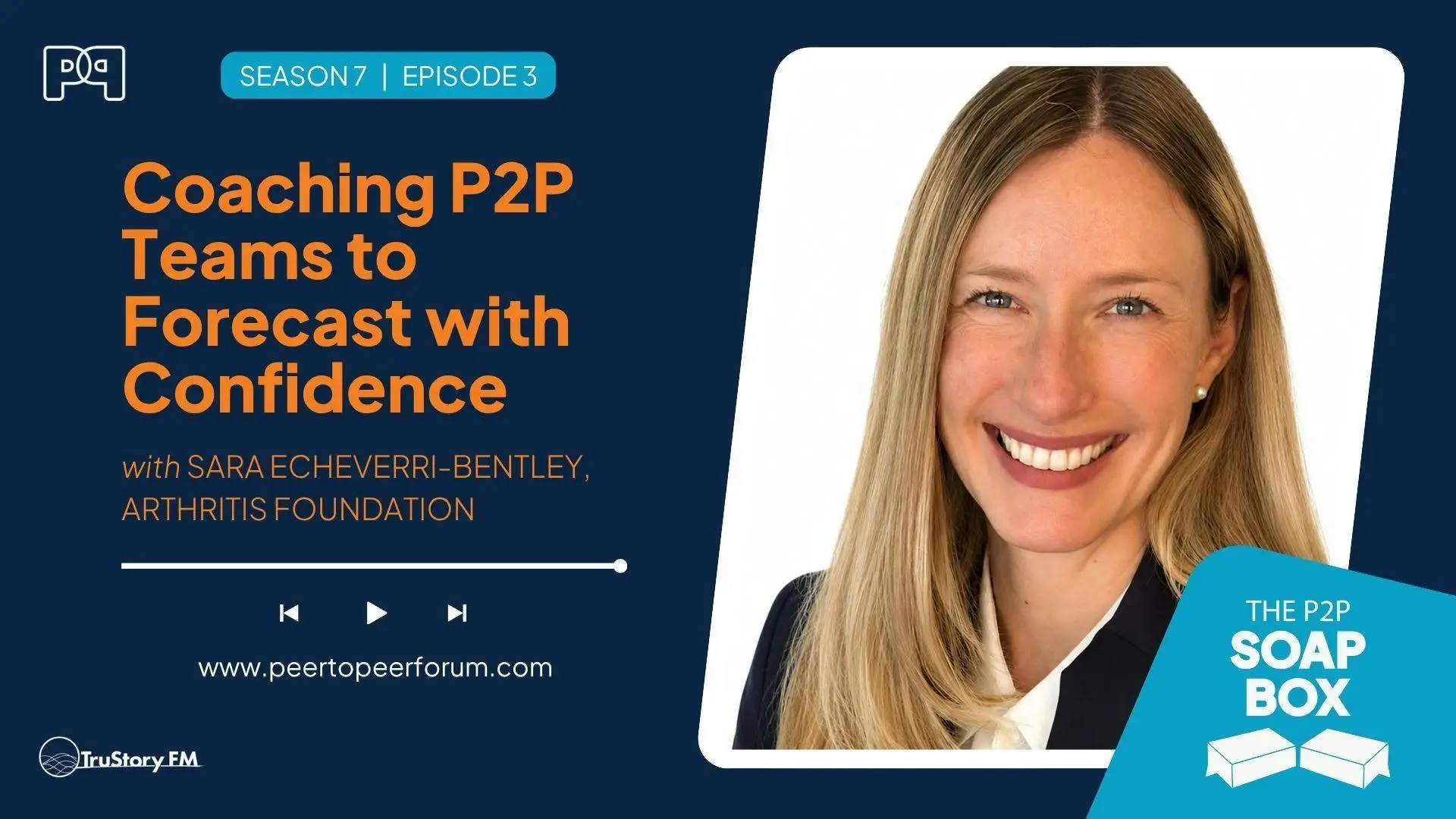
When staff understand not just what their goals are, but why those numbers matter and how they can influence them, that’s when we start to see real progress. Today I’m joined by Sara Echeverri-Bentley, National Director of Special Events at the Arthritis Foundation. The foundation is dedicated to pursuing a cure and conquering arthritis through life-changing science, resources, advocacy, and community connections. With more than 100 walks and runs across the country, Sara and her team are tackling this challenge head-on, finding ways to turn ambitious fundraising targets into manageable goals that local staff can truly own. From monthly micro goals to helping staff understand the story behind their numbers, Sara shares practical approaches to creating focus, building confidence, and keeping teams moving forward. We’ll also explore how connecting staff across markets creates opportunities to learn from one another and share what’s working. Because at the end of the day, it’s not about turning every fundraiser into a data analyst. It’s about giving every fundraiser the confidence and tools to make smarter decisions and drive stronger results. So let’s jump right into my conversation with the Arthritis Foundation’s Sara Echeverri-Bentley.
Sara, welcome to the P2P Soapbox.
Sara Echeverri-Bentley:
This is so exciting to be here, Marcie. Thank you so much.
Marcie Maxwell:
We’re so excited. So I always like to start these conversations with hearing a little bit more about your personal journey, your professional journey that led you to your role at the Arthritis Foundation.
Sara Echeverri-Bentley:
I love that. Yes, I’m happy to share. I started off actually as a participant in an event. That’s Bike MS. At the time I was working with an advertising company. They were the title sponsor of the bike ride at the time. So we were all wrangled in to be a participant of this event, but actually around the same time I was also pursuing my master’s in nonprofit. And so one thing led to another and I landed my first job in the nonprofit space. And I gotta say, I got hooked right away. I’ll share that my background is in the performing arts area.
So I think really what I found was I really love the aspect of teamwork in this space. And so that just drove me even further. Life then moved us to the DC area, where I had found my next role after a few years with the MS Society. I was continuing there in the health nonprofit sector. This is where I really continued in the space with another autoimmune disease, lupus, and I grew a deeper connection to the work, the volunteers, and gained experience at the national level there. And then I was looking to realign. I got the opportunity with the Arthritis Foundation, and I also have a personal connection to the mission. And I’m really, really enjoying it. Some folks fall into this space.
Yeah, there are always so many different stories. I love hearing how people find themselves in the nonprofit world.
Marcie Maxwell:
I agree, because I don’t think people grow up thinking, I want to manage a charity walk when I grow up. They have no idea this job exists. I actually was in advertising before I fell into this work too. And so, great minds. So let’s talk a little bit about your work at the Arthritis Foundation. So the organization is managing more than a hundred walks and runs across the foundation. So how do you take big organizational goals and break them into actionable plans for your local staff?
Sara Echeverri-Bentley:
Yep, so my role is focused on our Walk to Cure Arthritis signature event. In my role, I’m guiding campaign strategy, field support, and training, along with cross-functional projects. I’ll backtrack a little bit and share that this year was unique to us in that it was our 25th anniversary year for the program. So at the same time, while we’re really leaning into the 25th anniversary, we rolled out a program refresh. So new branding, additional signage, we’ve integrated mission throughout the event experience. Like other charity walks, we added a symbol of your connection to the cause. Ours is a pinwheel for movement. The color of each pinwheel represents a connection to that cause and why someone might be walking. So this was really a way to re-energize the program, re-energize our audience, participants, and our staff as well.
Also, this energized our goal setting a little bit too. So we did put a large goal for 2026 for this milestone year. And I think also still in the back of our minds, like many organizations, you have your pre-COVID numbers and your post-COVID numbers trying to get caught up. So we really wanted significant growth this year. We also have a number in our mind for the next three years, where we want to land by 2030 as well. So we took that number and we just started breaking it apart, breaking it down. What does that look like for us?
We looked at, for instance, team average. So if we want team revenue growth, what does that look like? An example for us was we needed 10 new teams per event. So we built that into our plan, and with each number we had to ask ourselves, is that digestible? Is it digestible for the field? How do they feel about that? And then to support that even further, what are the best practices to support this number as well? So we took that model and looked at it in each area that we wanted to prioritize.
Marcie Maxwell:
Well, I think that’s so important because so often I feel like nonprofits will say, all of these events need to grow by 3%, 5%, 7%, whatever that looks like. And when it feels arbitrary, it’s hard to get motivated by that goal. And so I think when you’re able to break it down and say, okay, 3% growth is this much in revenue, and that’s this many teams, it then suddenly feels like you’ve broken it down to the piece of the puzzle that is the most manageable for staff. And it feels less intimidating than just, okay, just add 3% or add 5% on the top. Which I think is often the case with a lot of leadership teams, that the leaders aren’t getting into the granular level work. But the granular work needs to happen when you’re rolling it out to the local staff. So I always think breaking it down to teams and participants, but teams, is so critical.
So I think about the skill of forecasting. This is something you and I have talked about a lot. It is not really taught in the peer-to-peer space. Forecasting is critical in direct response. That is something that is tried and true. How much money is going to come in on what day? What week? But in the field it’s a lot different.
I remember when I first learned about forecasting, I literally had someone, a VP from the direct response team, pull a piece of paper off the printer and map out a chart for me and go, okay, I want you to plot this on this axis and this on this axis, and then come tell me what it shows you. And it was game-changing for me early in my career to truly be able to understand forecasting. So how are you helping your staff get more comfortable with understanding their data, what the numbers are telling them, and then how they can use that forecast to make better decisions?
Sara Echeverri-Bentley:
Yeah, I agree. It’s definitely an art and a science, because when you’re working with numbers, these numbers are results of relationships and connections in our work. It’s twofold in a way. So a lot of it is about training, at the very core of it all. We have a process in place. It’s not perfect. We’re constantly working at it and striving for excellence in this area. But I think it’s definitely great to see that we have this practice there.
And with that, we are looking at about a weekly cadence in our organization. So being practiced in this is really helping the field be comfortable too. That’s really the only way we can find comfort, is constantly being in practice and being in it. So we support them. We have projection guidelines. We set weekly deadlines so everyone’s on the same track. Planning tools to support our projections.
So if you’re working in your planning tool, it gives you a better sense of where you are. After a conversation with a team captain, are they talking about reaching the goal that they have set? Yes or no? And in terms of their planning and their outreach, are they expecting that same large gift that they got last year? And then we have all this data roll up into dashboards that help us keep track across the organization. And it does help us in our decision making and our strategy. We have our do’s and our don’ts of projecting. You definitely have to put that in there. That helps guide them and makes them feel comfortable as well in how they’re projecting. And I think the main point here that we drive home is that hope is not a strategy.
So you really need to lean into this. And this also supports transparency. Transparency is something that we use as a guiding principle across the organization and all of our work. So if we have transparency into what we’re projecting and how things are actually playing out, then we can shift, we can pivot, we can roll up our sleeves and work together and figure out if we need to shift our focus. We have the numbers and the data and the space to do that.
Marcie Maxwell:
I love that. Are you looking at just revenue forecasting? Are you forecasting participation as well? What metrics are you having them look at on a weekly basis?
Sara Echeverri-Bentley:
Yeah, good question. Revenue and participation. So registration numbers and revenue. Yep.
Marcie Maxwell:
I think that’s great. And I totally agree with the hope is not a strategy. I can think of times where I would talk with people that say, you need 10 teams to sign up this week. And the last thing you want is for them to wake up on Monday morning and look around and be like, okay, I need ten people, I hope they all sign up, when they haven’t done the actual legwork in the weeks leading up to it. There’s often a lot of work that has to happen before somebody actually shows up in your registration count. There’s a different commitment of saying I’m going to do this as opposed to I have taken the action and I am showing up on your participant report. That is not always as immediate as we want it to be. We hope people are gonna immediately take action, and we know that is not always the case.
So I couldn’t agree more about hope not being a strategy when it comes to this. In order to drive this, the team introduced this past year some micro goals, monthly micro goals, that had everyone focusing on one specific priority at a time. So let’s talk a little bit about how that worked in practice and what was the impact you saw, both on participation and numbers, but even just on morale and how people were working together.
Sara Echeverri-Bentley:
Let’s say, for example, the ten new teams. So okay, well, let’s take this whole month and let’s just focus on that. We wanted to move together across all events in one direction. And this plan helped achieve that. So we worked in these monthly goals, each month with a specific task, and each task was tied to a specific KPI. And this was great because it challenged us. We kind of took it on like, this is going to be a challenge. Let’s see what we could do.
So examples, just one month focus, like we said, get your top ten teams back. I will preface with, at the time we were probably a little late in our timeline. We were really excited to shift that up earlier this coming year. And then at the end of the month, it gave us the opportunity to review these outcomes. And then with that, we could celebrate or learn from it. We had some markets that reached these goals, some markets that didn’t, so it also opened up an opportunity to share so then they can continue with those strategies. So it was more real-time. Another example would be a month where we worked on just a certain revenue amount in new sponsorship or sponsorship upgrades. We saw some great success here.
I think those focuses really kept us all on the same page in terms of our dialogue as well, across the country. Team revenue was another monthly focus, just driving activation of our teams. Again, what strategies, what support, what tools can we lean into that month. I think maybe that aligned with us leading up to Arthritis Awareness Month as well. So that also helped us in driving some strategy. And in the takeaway also, I have to make a plug here about the Peer-to-Peer Conference this past year. We really guided a lot of our strategies around core messages of don’t motivate but coach. I don’t know if you remember that, but we’ll use that as a guiding principle.
Marcie Maxwell:
Yeah, I love that.
Sara Echeverri-Bentley:
Yeah, and the impact…
Marcie Maxwell:
Shameless plug.
Sara Echeverri-Bentley:
Exactly. And the impact, it was really exciting to have everyone again working towards the same goal. And we were able to share these wins each week. We highlighted the markets that were hitting these marks. And the impact was really great. We hit many of these goals. And then we also saw that we could do it. And when we could do it, we could celebrate and we kept the ball rolling.
Marcie Maxwell:
I love that. I had to kind of chuckle to myself when you said maybe you were pushing some of your metrics up earlier. You were hoping to do that this year. I remember, before I truly understood forecasting, a year when I was like, I’m gonna move our participation cycle forward, and we’re gonna get revenue in so much earlier, that I shifted all the goals ahead by a few weeks. And then everybody was behind for the entire year. They were ahead of last year, but they were nowhere near where Marcie was telling them they needed to be. And so it was a big lesson for me as the person leading the initiative to be like, okay, you gotta maybe be one to two percent ahead. Don’t expect them to be 10% ahead year over year. It’s not realistic.
And so I think when you don’t know your data and you don’t know how to look at it this way, you then… I did the opposite of what you did, of creating this situation where people were stressed about not hitting their goals because they weren’t reachable, instead of really digging in and creating a plan of what can be done. So I say that to… we all have our failings, right? If any of my old colleagues are listening.
Sara Echeverri-Bentley:
Learnings.
Marcie Maxwell:
My old colleagues might be like, oh yeah. So I think sometimes we focus on hitting a number and we talk to our staff and really hit ten teams or this much in new sponsorship, but we kind of forget why it matters. So how are you helping staff connect these metrics that you’re really tying to these strategies that drive their fundraising growth? How are you helping them understand the why behind that number?
Sara Echeverri-Bentley:
Yeah, we looked at this and we also leaned into shifting the frame of mind a little bit. So we talk a lot about peer-to-peer being transactional. So we focused on the transformational part of it. So tying the language of the action that we’re coaching our teams to take into something that ties back to the mission. And so an example would be, if you’re updating your fundraising milestone, you are storytelling the impact tied to each level of this organization and the cause. Or if you kickstart your fundraising and make a personal donation, well, another way to frame that is you’re demonstrating personal belief in the mission.
And we also provided them with a language bank of mission-related activities that support and tie back to each action. And I think that helps in the thinking and then the process as well to tie it all together and make it a little lighter and, again, digestible and easier to process.
Marcie Maxwell:
I’m glad you brought up transactional and transformational, because I know that’s always such a debate, and I kind of take a slightly different view on it. I think there are some organizations that are scared to put a price on something and say your gift of fifty dollars could help XYZ happen, because they don’t want it to feel like a transaction. Yet I think that could be transformative for the donor to feel like I’m helping this one person, these 10 people, these 100 people get what they need through my gift. And so I do think there’s such value in showing that immediate impact of what a gift can be. You’ve helped raise $10,000 more dollars. Here’s what this is gonna do. And so I think that’s another part of tying it back, even for our staff, is continuously showing them: this is how much more you’re raising.
This is what this is funding. So that they stay not just driven by their goal for their review, their event goal, but they can truly feel like I’m really making a difference. And so I just think that’s always so important. So I love that y’all are continuing to remind them about that. So I know you have staff across a lot of markets, and managing a lot of events across a lot of markets. How are you creating opportunities for them to share what’s working, how they can learn from one another, and build ownership as a group and individually around their goals?
Sara Echeverri-Bentley:
Yeah, so we have built-in monthly trainings, and these trainings are also divided up by our market tiers. So they’re sharing across their relative events. We drive motivation through our Wednesday Wins chats as well. Again, when we have these monthly goals, they also naturally lean into the weekly moves. So we like to share those in our chats. And that’s across all events, all special events. So we get to hear about what’s going on in Marquee and in Run and in Walk and other events all at the same time, because we all know at the core of peer-to-peer, it’s a lot of the same strategies. We also have task forces, so each campaign will have a task force. So we are hearing from the field if anything bubbles up or trickles down, cascade messaging through this task force. And we are divided up into regions, so we have one per region so that we can keep our ear to the ground of anything that needs to be addressed or supported as well.
We’re highlighting in our weekly updates. So every week they’re getting updates. And in these we’re also highlighting wins from these monthly challenges, or what’s driving our growth, or are we flat or falling behind. And then I think also in terms of building ownership, we did find at first, when we were putting together these micro focuses, we were just getting a number. We were looking at just the number of events and dividing these goals out. Then we realized, well, every market has a different share of that revenue, a different percentage of it. So we started looking a little bit further as to, okay, each region or market’s going to have a certain percentage of ownership on that goal that we have set for these micro focuses to make it more attainable.
And then that also created an opportunity for everyone to get recognized and have wins too.
Marcie Maxwell:
Well, and I also think it just helps everybody feel this buy-in to the collective as well as to their individual goals. If we need a thousand more teams across all events, how am I putting my 10, 15, 20 new teams contributing toward that goal? I think it can be really powerful to help make people feel connected to their colleagues, feel like they’re part of something bigger than what they’re doing. And so I think that’s really exciting. So I think one of the underlying pieces of this is that we know that data can be a powerful motivator. But it can also be really overwhelming. And so what have you learned about how you use data to build staff confidence instead of just creating more pressure to hit these goals?
Sara Echeverri-Bentley:
I think it goes back to that collective ownership too, when we’re all working towards the same goal each month. That also gives a powerful motivator. They’re all in it together. I think the only way to be confident is to know the data in itself, having a handle on it. And then it kind of drives more thought around how far we can continue to break it down. So breaking it down, appreciating those little wins, continuing to appreciate those little wins, because we all have so much. And it is big picture when we’re looking at our organizational goals. So how can we take our little baby steps and make progress in one direction? Again, I’ll go back to transparency.
When you’re in the know, you can feel more comfortable in that in itself. So I think just the more you talk about data, the more comfortable you get with it. So we were always bringing that into the conversation, always trying to tie it back to a goal. And I think that’s where we found success too. And even after the fact, continuing to look at it. So it’s a year-round process.
Marcie Maxwell:
Yeah. I can remember times using data to kind of help people plot out recruitment specifically, and looking at prior year data. And sometimes you would see there’d be weeks where there would have been no teams that signed up. And then there’d be weeks with 25 teams signed up. And I would actually encourage the staff to go back to their calendar. And I would say, I want you to figure out, what did you do in those weeks? Because then they would look at it and they’d say, oh, okay, well, the weeks where nobody signed up, one of those was when I was on vacation. And one of those weeks was when we had our huge gala and it was all hands on deck. So I just really couldn’t focus on Walk.
And then the weeks when we saw 25 teams signed up, we had three corporate kickoffs that week. And it was matching the results to the activity. And then you could also look at it when you would look at the coming year. I would say, okay, you’ve got a vacation planned? Great. If you were supposed to get ten teams that week, how do you get those ten teams ahead of time? How do you add two or three more on each week? So you get ready so that you can have, heaven forbid, some work-life balance. How do you start to spread that?
You kind of own your schedule and then you build your activity plan off of that. And I feel like that can give people, again, that confidence of I’m attaching activity to results, and I can be in control of something that sometimes feels like, again, you’re just waiting for somebody to sign up. And there’s always an aspect of that. You’re waiting for that donation to hit the inbox. But it can feel a little bit more in control, which I think then leads to confidence as well.
Sara Echeverri-Bentley:
And familiarity, I agree, yeah. So if you’re aware of that, you can sit at it and say, okay, this feels familiar. I recognize this from last year and now I kind of know what to do.
Marcie Maxwell:
Yeah.
Sara Echeverri-Bentley:
Yeah.
Marcie Maxwell:
And you know what works and what doesn’t work equally as much, because there’s also the times you’re like, oh, I did all of this and nobody signed up that week. Okay, well, maybe I won’t do that again. Well, Sara, this has been great. I know there’s probably people listening that might want to learn more about the great work that you’re doing with the Arthritis Foundation. I know you said you just launched your websites for the spring walk season. So if there are people listening that want to get more involved, where can we send them? We’ll put some things in our show notes.
Sara Echeverri-Bentley:
Yeah, I would highly suggest looking for a local event to attend. We’re in our fall walk season. Like you said, our 2027 Walk to Cure Arthritis registration is open. And we opened off of World Arthritis Day, which was just this past Monday. We’re getting into the holiday season. We have the Jingle Bell Run, which is a unique 5K experience for families and friends, and I definitely recommend signing up for that event. You can volunteer. We get involved by volunteering, and most importantly, get informed at arthritis.org.
Marcie Maxwell:
Awesome. Well, Sara, thank you so much for joining us and sharing all your insights on forecasting and data and how we can help our staff with that. And for everyone else, we’ll talk to you on the next episode.
Sara Echeverri-Bentley:
Thank you so much.
Announcer:
The P2P Soapbox is produced in partnership with TruStory FM, engineering by Pete Wright. Music this week is “My Super Neato.” If your podcast app allows ratings and reviews, we hope you’ll consider doing just that for our show. But the best thing you can do to support the P2P Soapbox is simply to share the show with a friend or colleague. Thank you for listening.