Marcie Maxwell:
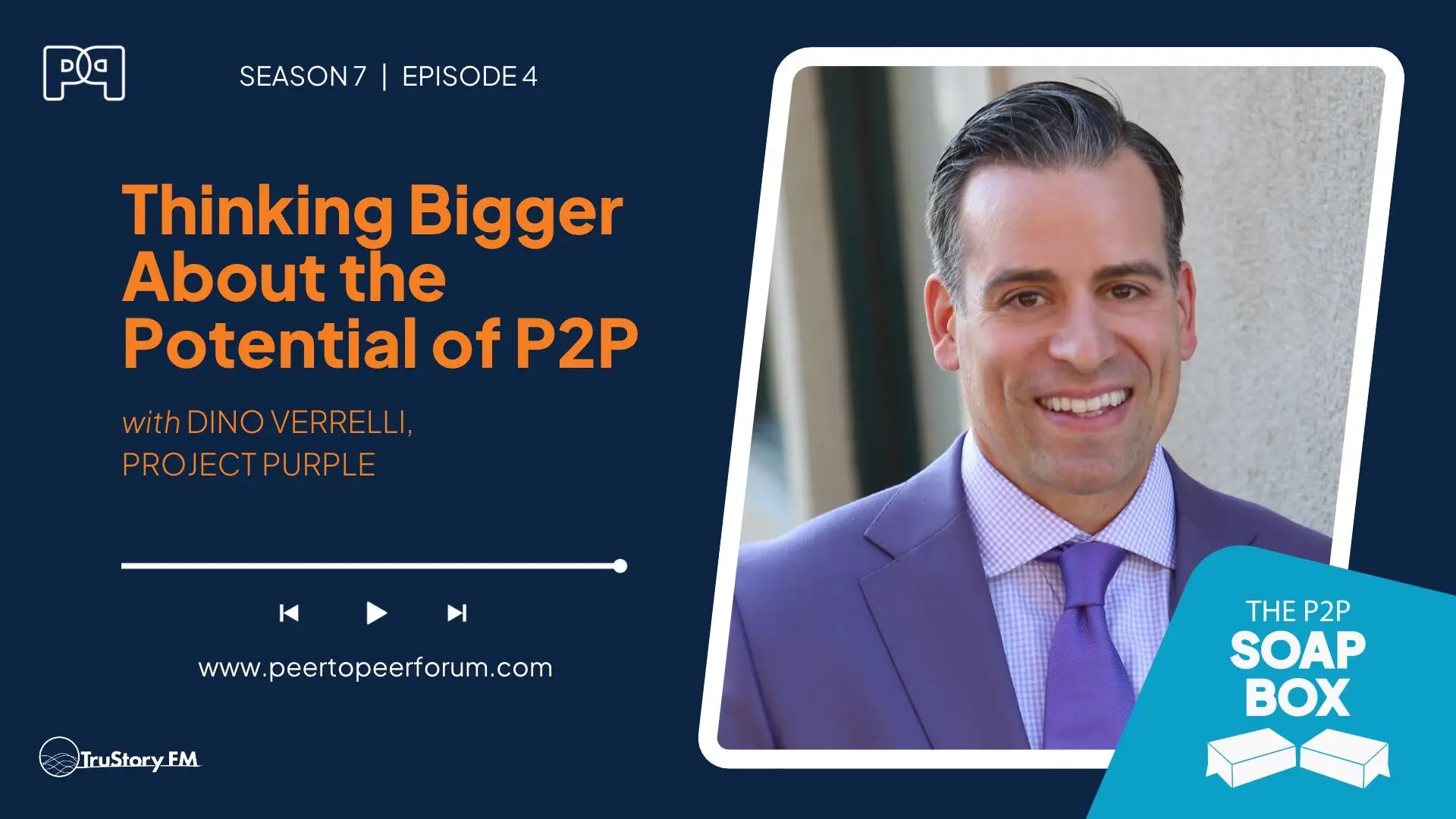
Hello, hello. Welcome back to the P2P Soapbox. I’m your host and P2P BFF, Marcie Maxwell. I think sometimes those of us in the nonprofit world have a tendency to underestimate ourselves. We underestimate what our supporters are willing to do, what our programs are worth, and what we could accomplish if we were willing to think a little bigger. And today’s guest has some pretty strong opinions about that. Dino Verrelli is the founder and CEO of Project Purple, an organization dedicated to finding a cure for pancreatic cancer and improving the lives of patients through support, hope, and compassion. Over the past 16 years, Project Purple has grown into an organization raising millions of dollars annually with endurance fundraising at the heart of its success. But as the organization continues to grow, Dino and his team are also exploring new ways to engage supporters and diversify their fundraising efforts.
What I especially love about this conversation is Dino’s perspective as both an entrepreneur and a nonprofit CEO. We talk about making strategic decisions about where to invest limited resources, setting ambitious expectations for fundraisers, and why nonprofits sometimes get in their own way by undervaluing what they have to offer. And Dino has some great advice for peer-to-peer professionals who see untapped potential in their programs but need to make a stronger case for leadership support. So let’s jump right into my conversation with Project Purple’s Dino Verrelli.
Dino, welcome to the P2P Soapbox.
Dino Verrelli:
Thank you for having me, Marcie. This is such an honor.
Marcie Maxwell:
Oh, I’m excited to talk with you. As I introduced you, you are the founder and CEO of Project Purple. So I feel like this is a little bit of a unique story when I ask the question of, tell us your personal and professional journey. Can you tell us a little bit about what led you to your role in founding Project Purple?
Dino Verrelli:
I don’t know if we’ll have enough time for the full story, so I’ll do my best to keep it perfect for the audience watching and listening. Project Purple is very personal to me. I founded it in honor of my dad. My dad was diagnosed with pancreatic cancer in December of 2008. Through his journey with pancreatic cancer, I was just inspired by the fight of my dad. I was wanting to help my dad, and he will be and always will be the main reason for Project Purple starting. But there were so many inspirational points along the way.
Even before that, I considered myself a serial entrepreneur. At the time when my dad was diagnosed with pancreatic cancer, I was the CEO of my own financial services company and insurance brokerage. I had a staff of five. I was selling life insurance annuities to brokers as an intermediary for about 30 different insurance companies. And then we also had a financial services arm where we were dealing with individual clients and helping them with their retirement and all sorts of financial instruments.
So it was always about awareness. I was like, hey man, we’ve got to raise a ton of awareness. You need fundraising to do things, to put programs in place and support whatever you’re going to support. But I’ve always said in 16 years, if you build the right awareness and you raise enough awareness in the right way, the fundraising will come. To some aspect. And we can talk about that a little bit more in depth later. But to me it was all about awareness at the start, to bring this disease to the forefront of people’s minds, just like breast cancer. And I hate using that example. But in my world, with my mom and my aunt being survivors, that was what we knew.
And there were a couple other little things along the way, Marcie. I remember Meb Keflezighi winning the New York City Marathon in 2009. My dad was an immigrant. I was first generation. Meb’s parents were immigrants. I had started to run. I’ve told Meb this story a couple times. I was like, wow, that’s so awesome. When you become a new runner, when you haven’t run, and you realize there are these professional athletes and you hear these backstories, it’s just really cool.
And then there was an incident. I said not an incident, but I had a meeting with one of the local cancer centers where my dad was being treated. I met with the development officer. And this is funny because now, if we take a step forward and look at how we’re set up. But I wanted to donate money, and I wanted the money to go to the nurses or the doctor. So basically a restricted gift.
Marcie Maxwell:
Oh yeah.
Dino Verrelli:
Which we know in this world now, to open a restricted gift, there’s a lot of administration involved in that. There’s compliance that’s involved in that. At the time, I didn’t know that. So I remember sitting down and having coffee with the development officer at this hospital. And I was like, yeah, I do okay. I think I have maybe $5,000 to donate, but I want it to go to Dr. X and maybe the nurses. But I want it specifically for them. And they said, hey, Dino, we really appreciate the support, but that’s not doable. And I was like, what do you mean? And they’re like, well, in order for it to be restricted, it needs to be $75,000.
Now that was one of the pieces in deciding to start Project Purple. And it might have been the tipping point. There were a couple other little things that had happened. But I think that as I look back retrospectively, that was the tipping point to say, all right, enough’s enough. The stars are aligning. I started to run, Meb, some other little things that happened, the cracks in the system that I saw, realizing that pink red of cancer. But that conversation with that development officer, which anybody listening or watching in development knows, that’s pretty standard. And guess what? Our restricted gift minimum is $100,000 here at Project Purple now. But not knowing at that time that there’s administration, there’s accounting. I mean, $5,000 is a lot of money, but to restrict those funds, you have to set that minimum.
But that was the straw that broke the camel’s back to say, let’s do Project Purple. Let’s do this. We’re going to start a foundation. And I rallied some friends, some strangers, some family members at the time. And we launched Project Purple in 2010. And the primary focus when we launched, because running was doing what it was doing for me, was to center it around running.
Marcie Maxwell:
I want to talk a little bit more about the endurance piece because I think that is what Project Purple is so well known for. You’ve built this really significant presence at some of the largest marathons in the world. So beyond it just being therapeutic for you, what made endurance that strong foundation for the organization, and how is your approach evolving as you’ve gotten bigger through the years?
Dino Verrelli:
That’s a great question. I think for us, endurance… we have so many sayings here at Project Purple, and everybody knows “nobody cares, work harder.” Well, we have one that says “it’s not chemo.” Work harder. And so I think endurance really aligns itself with the cancer space. Because what we ask of our runners, whether it’s running a 5K… we had a walk yesterday, and these walkers walked a mile. And for some people that’s a lot. Getting out, if you’re not physically active, going out and walking a mile is a lot to ask. But whether it’s a mile, a 5K, 10K, half marathon, marathon, ultra, triathlon, bike event, CrossFit, fitness, whatever we do in that endurance space, and it’s all-encompassing, it is nothing like someone who’s going through cancer and taking chemotherapy. We know that.
So to me, that’s where I feel like what we do in the endurance space… it’s been a piece of our DNA since day one because it was so good to me. But it is such a symbol for us when we have runners running whatever event or participating in an endurance event. They’re sweating, they’re getting active. It even could be golf, because people burn a lot of calories. They’re walking. It’s exercise. But that is nothing compared to what our patients and the people that we support, and the people that come to us that are supporting a loved one going through that journey, are going through. That’s number one.
And number two, this cancer is so negative, Marcie. And I saw that. That first run, that was that light bulb moment. I was in such a negative, deep, dark place. But that physical activity, and there’s so much data, there’s scientific data about this. If you are in a deep, dark place, the best thing that research says to do is to move your body. So by having people run for Project Purple in honor of that loved one that may have passed or is going through the fight, they’re in a deep, dark place. I always said, man, that’s such a gift to give back to so many people. Clearly there’s a market that we have really embraced in the World Majors and some of these really big marathons. But to give people that opportunity to run a New York Marathon or Chicago Marathon, Boston Marathon, is really, really special.
But I think just the fact of “it’s not chemo,” which is one of our sayings, and also that it just is so positive for people to be active in their lives, given the negative that this cancer is bringing in, it is just a gift. So I think for us, that’s really why endurance is such a strong foundational piece. It’s been with us since day one. It’s something that we embrace.
And if there are people watching or listening that have been impacted by pancreatic cancer, we’ve had people that have never done a 5K before. This is not like we need college athletes that ran cross-country or that were Division I athletes with an athletic background. We want everybody. It’s all-encompassing. I always say it’s never about finishing time. It’s about finishing. Time is irrelevant. Who cares what your time is? Nobody’s keeping track. I mean, I know people have personal goals and stuff, and that’s great. But we just care about people finishing, crossing that finish line, and just having such a positive mental and physical experience.
Marcie Maxwell:
No, absolutely. And when you talk about it being a gift, I often think about when you have a loved one who is battling cancer or going through some kind of terrible or traumatic illness or injury, it can feel really helpless as a friend or a loved one. And I think we don’t give peer-to-peer enough credit for being the way that people can channel that desire to help when really there isn’t that much that can actually be done to help in the moment. And so I think we don’t give it enough credit for that role that it can play in even your support system, your community, who is like, this is my way of helping this person that I love and giving back. So when you talk about it being a gift, I just agree with that so much.
So you mentioned you just had a walk this past weekend. While endurance is still a huge part, you are expanding into other channels, community events, other opportunities. So taking off the founder hat and putting on the CEO hat, how are you thinking about building a more diverse peer-to-peer portfolio? Where are those greatest opportunities for growth outside the endurance space?
Dino Verrelli:
That’s a great question, Marcie. I’m a firm believer that you go where your followers are. So clearly we have been very strategic, and I think this is part of the success of why we’ve gotten to where we’ve gone. And I say we, as a staff. We look at opportunities where we have constituency or we have partnerships, not just because we’re going to go to LA because it’s the second biggest market. Or we’re going to go down to Dallas because it’s an up-and-coming market and we know people are moving to Texas. We’ve been very, very strategic in terms of where we go and what we do based on the staffing that we have and the resources that we have, and also where people are and where we have assets and partnerships. And I think that’s been the key to our success as we’ve grown this thing over 16 years, to just follow those rules. And a lot of times you have to say no, because we’re just a small charity and we don’t have unlimited resources and unlimited staff to be everywhere all the time.
Marcie Maxwell:
So let’s talk a little bit about your staff, because I got to meet a handful of them recently. How are you balancing the pressure to manage overhead, which you and I have talked about, hate that phrase…
Dino Verrelli:
Yeah.
Marcie Maxwell:
…with the need to invest in the people and the relationships that are actually driving your revenue?
Dino Verrelli:
So we’re located in Seymour, Connecticut. I said before there are a lot of terms. There’s another one that I use: we worry about what we can control and the impact we can have. So things that we can control. Rent. We’re not in a major metropolitan area. My home is 10 minutes from the office, which is by design, I believe, because I’m here a lot. A lot of late nights, a lot of weekends. But if we were to move closer to New York City… we’re kind of centrally located in Connecticut. We can get up to Boston, we can get to New York in drivable time. I think New York is an hour and thirty minutes, Boston’s two hours, without traffic. So we’re outside the limits of cities, so it makes it reasonable in terms of rent and the space we have.
I think also, from a staffing perspective, we have gotten away with… and I’ve done some analysis. Our staff of 11, we’re closing in on $5 million. There are a lot of $5 million orgs that have 15-plus staff. Now, I’m not here to say that’s wrong. That’s not the discussion here. But if you want to compare apples to apples to other groups, for-profit and nonprofit, usually if you’re running at about $5 million, you’re usually right around 15 to maybe 25 in that range.
And also, some groups, if they have a big program where they need a lot of staff, but they’re having impact, then they’re going to have more staffers. If you have a program where you actually need more staff to support that program, well then you’re going to have more employees. Our programs are clinical research and then patient aid. We’re able to get away with low administrative staff because our patient aid program is like one and a half people. But now we’re getting to the point where we might need to expand. We might need to put two to three people in that program just because of the demand for that program. And it’s not fair to have just one staffer, not only from the staff perspective, but also from the patient population, so we can support them better. So I think that’s the other piece, Marcie, is just watching our overhead.
And then also, I said this earlier in a conversation: the difference here, when I was running a for-profit, you could write off stuff. You can have a loss. Here, our events have to win. You can’t lose money on events. And I can say in 16 years, have there been events where we’ve broken even? Yes. Have there been repeat events that we’ve lost money? No. If we’re doing them over and over again… not to say that we tried something and maybe we lost a thousand dollars. We’ve never lost big money.
So I think that’s another piece to us. We are open to doing other things, but they have to work. For example, we went down the road of pickleball five years ago, and pickleball’s been a little bit slower, but we started to see last year the pickleball events start to be supercharged and start to make us money. We have a youth program with high schools throughout the country that do awareness games for us. That was slow to get off the ground. We didn’t put a lot of resources into it. We weren’t spending a lot of money, but now we’re starting to see real results from that, from an awareness point and then also from a fundraising point. So those are two examples where I think we took the approach of slow and steady, but we also were conscious about not trying to spend money to lose money, but spend money to make money in those events so that we were profitable.
Marcie Maxwell:
Yeah, absolutely. And I think sometimes people get so locked into just a year view and they’re not looking at… I had an old colleague that used to call it Year Zero whenever they were testing something new. Year zero may not be a big profit, but as long as year one and year two we’re moving in the right direction, then we’re doing something in the right way. And unfortunately, I think sometimes people let that scare them away from being innovative and trying new things.
So I also want to dig in a little bit more on the marathon piece, because again, I know that’s something you and I talked about. And you have some examples of nonprofit supporters who sometimes underestimate what they’re capable of. Organizations do that too. That’s just, I guess, a human thing. So how do you determine what you ask of your participants? And why do you think we sometimes undervalue our own programs?
Dino Verrelli:
A lot of people in the nonprofit space think everything has to be free because we’re nonprofit. And here’s where I’m going to go with this. I think subconsciously we sabotage ourselves. Because nonprofits have this subconscious mindset that we’re nonprofit, everything can be free, and we have to get everything for free. And our worth is that. And when things are free, they’re probably not the best. So subconsciously, I think we sabotage ourselves already with that thought process.
Marcie Maxwell:
I call it the nonprofit inferiority complex. I think a lot of us struggle with “we’re never going to have that,” or “well, we’re just a nonprofit,” instead of having…
Dino Verrelli:
Yeah. No, our time is valuable, just like your doctor’s. People complain all the time. We’re in the healthcare space. “Oh, the doctor made me wait 10 minutes, an hour.” And the doctor’s time is so valuable. Well, our time is valuable. And so I think that’s just a mindset shift. Understanding that your time is valuable, your effort is valuable, what you’re doing is valuable, and it’s having amazing impact for your organization. I think if the space took a shift and everybody thought that way, then you could charge, or you could ask, I should say, for as much money as possible.
We go into every single runner, if the minimum is $6,000 for New York or $3,000 for Chicago or $25,000 for Boston, we go into every single runner with the mindset that this person, with success, if they follow our program and what we are asking of them, should be able to 4x that goal. And people might say you’re crazy. On $25,000, they’re not going to raise $100,000. But I’ll tell you this, we’ve had runners in Boston raise $100,000 because they buy into the process. They buy into what we ask them. Not to say that we’re doing anything different than 99.9% of the charities are doing out there, asking runners, supplying them with support.
But I think there’s that little bit of a mindset that, again, because it’s nonprofit doesn’t mean that everything is free. And I think everyone’s valuable, and everybody’s doing great things. We just have to remind our participants, whether they’re coming to a walk, or they’re fundraising for a run or a walk, remind them of that. But also remind them of all the great things you are doing to overcome the problem that your nonprofit was set up for. I think a lot of nonprofits, Marcie, forget that. Define impact for your nonprofit. Maybe that’s introspective for those nonprofits watching or listening. Think about it. Do you define impact hard enough for your constituents, for your donors, for your participants? Are you reminding them that that is what you’re able to do because of their support? And continue to do that.
Marcie Maxwell:
I think everybody does it. I think everybody knows the power of impact, but how do you keep it top of mind? How do you keep it something that you’re consistently going back to so that they can understand why you’re making this ask and why you need them to continue asking?
So, Dino, you have a unique perspective, both as founder and CEO of an org, but an org really built on peer-to-peer fundraising. And that is unique compared to a lot of other nonprofit executives that maybe come up more through the major gift route or the individual giving route. What do you wish your peers, more nonprofit executives, understood about how peer-to-peer works and what it takes to create success and build a successful program?
Dino Verrelli:
A lot of hard work.
Marcie Maxwell:
Yeah.
Dino Verrelli:
I’ve sat in meetings, I read a lot, and you always hear about these major gifts. They don’t happen overnight either. But here’s a sports analogy. LeBron James, because I follow basketball. He scored more points than anybody in the history of the NBA. And for the record, I am not a LeBron James fan. I’m a Michael Jordan fan. Michael Jordan will always be the GOAT of basketball. But I respect LeBron and what he’s done. He’s put in a hell of a career. He’s played now 20-plus years, and it’s just consistency. He’s been in a lot of games. And I think when you look at the success of consistency and time, it’s about getting baskets. Getting singles, if we go back to baseball. It’s not about hitting home runs.
So I think you can build a very sticky, annuitized business with peer-to-peer. That’s why I love it. When I was in the financial services business, it was all about renewals and building that renewal base. So when you turn on the lights, you know what? You’ve got $100,000 of recurring revenue coming in. And I know the space in philanthropy talks about recurring gifts, but in my mind, P2P, peer-to-peer, is like a recurring gift. If you do it right, it’s a lot of work, but think about it. Every year you’re just recurring those.
Marcie Maxwell:
Yeah.
Dino Verrelli:
You’re recycling and you’re growing and getting better. That’s how I look at it. And maybe it’s just because my mindset, coming again from that financial services business… there’s a term in the insurance and investment business of annuitizing your book, and that’s basically what you’re doing. I was trying to get to a point where I turned on the lights on January 1st and I knew I had a million dollars of revenue coming in, regardless of whether I worked a day or worked every day. So I think that’s P2P. If you can build that where you have these races…
Marcie Maxwell:
Yeah.
Dino Verrelli:
Now I get it. Not all these races are signing. And this is part of the frustration, maybe, on some of the CEO standpoint. Take any World Major. No one’s got a long-term deal that you’re in their charity program for the next five years. And I know that’s come up in discussion in some of the meetings with the World Majors. And I can see why, because whether it’s turnover or things change, clearly in the nonprofit space there’s a lot of great happening, but there’s also sometimes some bad. So from a legal perspective, it probably would not be good for some of these races to lock in with charities over the long term.
Marcie Maxwell:
Sure.
Dino Verrelli:
God forbid if something were to go awry, and we’ve seen misuse of funds through various charities throughout the years, at least since I’ve been in the space 16 years. But to go back, I think P2P really allows you to do that. So if there’s a CEO watching or listening that’s not involved, I would use that example, Marcie, of being able to annuitize your book of business. You’re going to work for it. You’re going to work really, really, really hard for it. But it’s hitting a lot of singles and just consistency, and that long-term growth potentially could be there over the long haul.
Marcie Maxwell:
I love that. So let’s flip the perspective. I would say our audience is more like your staff. They’re your peer-to-peer professionals who know the programs have more potential, or maybe not like your staff, but they’re struggling to get their leadership support. They’re having a hard time getting that buy-in. What advice would you give some of our younger or newer staff? How can they make a stronger case for more resources or new opportunities or a different approach? Maybe talking to our younger selves.
Dino Verrelli:
It’s another great question, and one that I have been asked often. Here’s how I want to answer it, Marcie. Everybody thinks getting into a World Major can make a big difference. And don’t get me wrong, in this endurance peer-to-peer space, it can. But I’ve said, you know what? Find a second-tier, a third-tier event and own it. Make it yours and knock that thing out of the park. Go to a smaller event than a New York Marathon. And I know we’re bringing up New York a lot, but I guess because it’s happening in a week.
Go to a small event if you’re going to start a marathon program, and bring 50 runners, raise fifty thousand dollars, and dominate that thing from a fundraising standpoint. And show your higher-ups, hey, 50 runners, $50,000, that’s a lot of money at a third or even a fourth-tier event, or maybe a second-tier event. And when I say tiers, find an event that has no charity program and approach them. Help them create that, but bring that excitement that you would to a World Major to that event. Or go to a program that doesn’t have a lot of charity partners and really focus and build that. You present that to your CEO, having success there, I’m sure you’ll get attention and assets and resources to go bigger. But prove it at a smaller event that it can be done.
And then hopefully the CEO will look at that and say, wow, maybe we’ve got something here. Because they get it. At a bigger event, it’s just going to grow. It’ll amplify itself because the event is so big. And I think that’s being lost right now. And I get it. The easy money grab is get into a World Major, get guaranteed entry. You’re going to have supply and demand, and you’re going to be able to fill five spots with 30 people that want to just write a check because everybody wants to do this. But I think there’s some excellent opportunity in that third, fourth-tier race. Races that don’t necessarily sell out, or maybe races that are regional to where you’re located or where your home office is located that maybe have a charity program, and they have two charity partners or five. Or a race that doesn’t have any charity partners. Approach them and be like, hey, we want to partner with you. We want to bring a hundred people. Or maybe you bring 50 runners and you go do an aid station. That’s huge. That’s going to be monumental for that event. And that’s a great way to get started and to build excitement and to get your CEO to notice, like, hey, this is something here.
Marcie Maxwell:
No, and I think that’s so true, because the reality is that’s how all these programs started. I’ve been in this space over twenty years, and yes, some of the big races started then, but that’s how a lot of these large endurance programs grew. Somebody local got into one race, and they started really working, and then it grew from there. And so I think that’s a little bit of old-school legwork that sometimes it’s easy to overlook and to just try and say, let’s get five bibs in this huge race, instead of seeing what we can do with more in a different market. So that’s great advice.
Dino Verrelli:
And it’s all work.
Marcie Maxwell:
Yeah.
Dino Verrelli:
Marcie, you’ve got to put the work in.
Marcie Maxwell:
Oh yeah.
Dino Verrelli:
You’ve got to be willing to work. But if you’re willing to work, you’re going to have success. And that would be, to your point, a great way to get started and to really get a lot of energy and excitement going.
Marcie Maxwell:
Yeah. And you’re going to learn so much. You’ll probably be better set up when you get into that large, massive market on how to respond and how to support those runners and fundraisers because you started small. So I think that’s another takeaway.
So I imagine, Dino, if people have been listening and they want to learn more about all the great work you do at Project Purple, where can we send people? We’ll put something in our show notes.
Dino Verrelli:
The best place is our website, projectpurple.org. Follow us on… I don’t handle the social media, the marketing, so follow us wherever you are on social.
Marcie Maxwell:
Spoken like a true CEO.
Dino Verrelli:
I know we’re all over the place.
Marcie Maxwell:
“I don’t handle the social media.”
Dino Verrelli:
I don’t know the handles. I know one’s Run for Purple, one’s Project Purple, and every handle is different. This is the million-dollar idea. Come up with a way to align everybody’s social media handle. Imagine if it was that easy.
Marcie Maxwell:
Imagine.
Dino Verrelli:
Brands would pay hundreds of thousands of dollars to have that.
Marcie Maxwell:
It’d be amazing.
Dino Verrelli:
I mean, they are in some aspects, buying URLs and stuff. But if there was an easier way, it’d be awesome.
Marcie Maxwell:
I know. Add it to the list. Well, Dino, thank you so much for joining us today. And for those of you listening, we’ll see you on our next episode.
Dino Verrelli:
Thank you, Marcie.
Marcie Maxwell:
Thank you.