Marcie Maxwell:
Hello, hello. Welcome back to the P2P Soapbox. I’m your host and P2P BFF, Marcie Maxwell. There’s been a lot of noise in our space lately about email being dead. Open rates are down. Inboxes are crowded, and attention spans feel shorter than ever. It’s really easy to start questioning whether email still deserves a seat at the table in our peer-to-peer marketing strategy. But here’s the real question. What if email isn’t the problem? What if it’s the way we’re using it that needs to change?
Too often we’re sending emails based on habit instead of purpose. We’re building calendars instead of conversations. And in doing so, we’re missing the opportunity to show up in a way that actually feels relevant, timely, and human for the people we’re trying to reach.
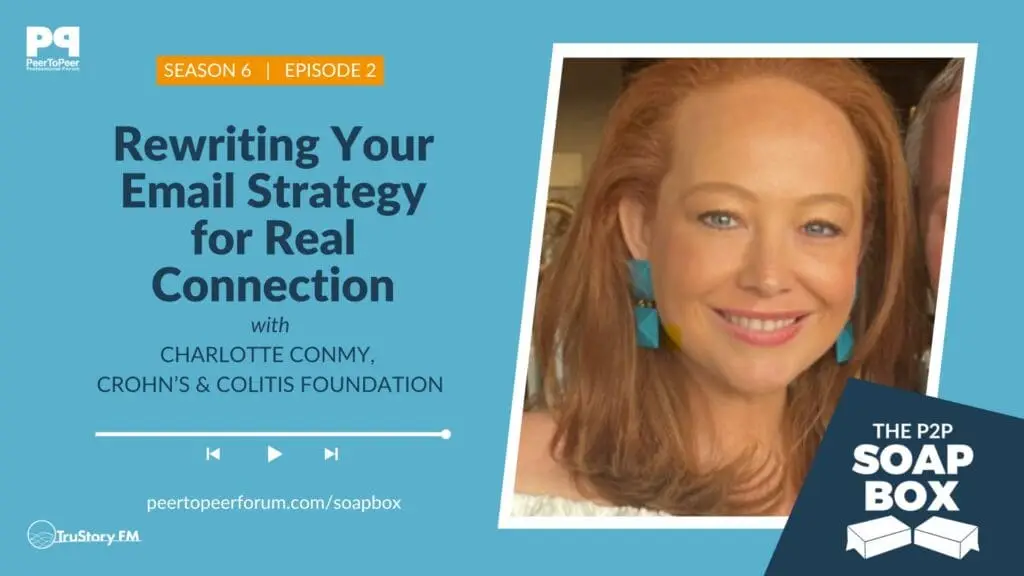
Today I’m joined by Charlotte Conmy, Associate Director of National Marketing at the Crohn’s and Colitis Foundation. The Crohn’s and Colitis Foundation is a nonprofit, volunteer-fueled organization dedicated to finding cures for Crohn’s disease and ulcerative colitis and improving the quality of life for children and adults affected by these diseases.
Charlotte brings a powerful perspective shaped by years of experience across both program and marketing roles in peer-to-peer fundraising. Her team is seeing strong engagement results, not because they’re sending more emails, but because they’re sending better ones. From rethinking cadence and leaning into segmentation and data, to balancing storytelling with clear calls to action, Charlotte shares what it really takes to stay welcome in someone’s inbox. We also talk about how email fits into a broader engagement strategy alongside texting and local outreach, and where she’s most excited to keep testing and evolving.
So let’s jump right into my conversation with the Crohn’s and Colitis Foundation’s Charlotte Conmy. Charlotte, welcome to the P2P Soapbox.
Charlotte Conmy:
Hi, Marcie. Thanks so much for having me.
Marcie Maxwell:
Well, let’s jump right in. I always like to start with just hearing a little bit about your personal and professional journey that led you to your current role at the Crohn’s and Colitis Foundation.
Charlotte Conmy:
Absolutely. Well, believe it or not, Marcie, this is my very first role on the marketing side in the peer-to-peer world. I’m not sure if you know that about me. My background was actually on the peer-to-peer side — the program side, fundraising, development, all that kind of stuff.
Marcie Maxwell:
Welcome.
Charlotte Conmy:
So I did begin my career — oh gosh, probably 15 years ago, not to date myself — just working with some local nonprofits in the Philadelphia suburbs, which is where I live. Some local charities, just kind of getting my feet wet in the industry, helping plan and fundraise for all kinds of different events and fundraisers. And I feel like I’ve really just dabbled in it all. Events anywhere from galas that I’ve helped plan, golf outings, fashion shows, local walks, things like that. And then I also worked on capital campaigns. I helped raise funds for the Children’s Hospital of Philadelphia when they were building their new Buerger Center, which is a large outpatient center for the children that get treated there. So really just boots on the ground for them at the time, out in the community, meeting with constituents, asking for money, and just trying to get as much money in the door to help build this amazing building. So that was really fun.
But then from there, once that was over, I made the leap over to a national nonprofit. I did work for the Lung Cancer Research Foundation for a while, where I worked on the program and peer-to-peer side, helping plan and fundraise for their national walk program called Free to Breathe. Not sure if you’ve heard of that. But then from there, I was actually recruited — the person shall not be named — to come on over to the Crohn’s and Colitis Foundation and work on their marketing team, which was really interesting to me. And so now that’s what I do.
I’m on the marketing team at the Crohn’s and Colitis Foundation, and my team and I — we are small but mighty — are solely dedicated to the marketing for our national peer-to-peer programs. We do have two of them at the foundation. The first is called Take Steps, and that’s our national walk program. We have 58 walks this year across the country and we’re in every major market. And then the other is called Team Challenge, and that is our national endurance program — well, it’s actually international. We have entries into races across the country and then a lot of international races as well. So it’s really fun and I really enjoy it. And I think my peer-to-peer background has really helped me get my feet wet there, and I certainly bring a lot of expertise from both sides of the coin.
But yeah, so that’s my story. I’ve worn a lot of hats over the years in this industry, but there’s one common thread, and that is that I’ve just been in nonprofit my entire career. I’ve never worked for a for-profit. And I just really love mission-based fundraising. I love the marketing for it. I feel really passionate about it and just advancing the causes and fueling real change and positive outcomes for the people and the populations that we serve at these organizations. So yeah, I’m happy to be here and let’s talk email.
Marcie Maxwell:
Yes. Let’s talk email. You know, just speaking to your background — I do think so many of the best peer-to-peer fundraisers are jacks and jills of all trades, right? I’ve always said doing peer-to-peer fundraising is the best training ground for almost any career you want to take in nonprofit, because whether you learn how to market, you learn how to recruit, you learn how to plan an event, you learn how to sell sponsorships or manage a committee — all the skills that you can then take for a lifelong career in fundraising. I think it’s some of the best training ground there is.
Charlotte Conmy:
Yeah. And working your way up from the bottom to the top in the nonprofit world — there’s no better way to get your feet wet and really learn the industry from the ground up. So I agree with you.
Marcie Maxwell:
Exactly. But let’s talk about the current role, and specifically I want to talk about email. Because there has been a lot of noise, right?
Charlotte Conmy:
Yeah.
Marcie Maxwell:
We hear it all the time about email being dead. Nobody reads their email anymore. Yet your team is seeing stronger open and click-through rates — specifically for the Take Steps walk — that’s the kind of data that I’ve seen. What do you feel like is driving that success right now? And how are you thinking about segmentation, data, and AI to make your messages more relevant?
Charlotte Conmy:
Yeah, it’s a really great question. There’s definitely been chatter in recent years, with all of our advanced technology and everything moving towards a more mobile-first mentality in this really social world that we live in, where everyone has really short attention spans. And I can see why people might think email might be, quote unquote, dead. But I don’t think that’s true, because I think if your email is really good and if it’s relevant to the audience that you’re sending it to, then it can be really effective still. It’s still very much a part of our marketing plan for both of our peer-to-peer programs — Take Steps and Team Challenge.
We have watched our engagement metrics and our conversion metrics slowly rise over the years. So clearly email is still resonating with this population and for these programs. And again, it’s still a key part of our marketing strategy.
But as far as what’s driving success right now, a big driver for us has been shifting away from that traditional campaign calendar mindset — right, sending emails just because it’s a certain day of the week.
Marcie Maxwell:
Walk Wednesday.
Charlotte Conmy:
Exactly. Walk Wednesday. Send an email. We don’t do that. I mean, I think there used to be value in that because it was like, oh, we know what to expect — every Wednesday we get an email. And maybe for a more newsletter-style email, that might make sense. But for recruitment and fundraising purposes, you really want to focus on sending emails when it actually matters to the participant, right?
So for example, right after someone registers, they need to get our welcome series. They need to begin receiving coaching emails. Or if someone hasn’t raised anything yet at all — that dreaded zero-dollar fundraiser that we all know and love — how do we speak to them differently? How do we motivate them and get them off zero? Or if someone hits a key milestone in the campaign — these are all moments when people are more likely to engage with you and actually read your emails. Because when you show up at the right time in somebody’s inbox, it just feels more relevant to that person. And relevance really does drive results.
Segmentation is something we talk about all the time, and it’s so key to your email campaign, because you need to be speaking to people differently based on who they are and what their past history is with you and with the organization. And I think that’s especially true for acquisition emails — getting people in the door, getting people registered. Connecting with different buckets of people: maybe someone who’s participated in the past, is this person a team captain? We have something we call our warm leads list, which just consists of people in our database that we feel are more likely to get involved with Take Steps or Team Challenge based on whether they’ve participated with the foundation in the past with an education program or a gala. Are they a healthcare provider? What is it that has brought them in the door, and how can we differentiate our messaging in a really thoughtful way based on who we’re talking to?
Another key piece of this is the data. Data is really, really key in your email campaign. We don’t wait until the end of the campaign to look at the data and say, oh, this worked, this didn’t work. We’re constantly checking throughout the entire life cycle of the campaign. And if something’s not working, or if we’re watching our unsubscribe rate climb or our open rate has dropped — if a particular metric’s just looking really sad — we can change it. We can adjust things along the way. And I think that’s really important.
And then just to circle back on your question, there are a few new tactics that we are using this year from Salesforce Marketing Cloud, which is what we use to send our emails, that I think — we’re testing them — I think we’ll be able to help move the needle a little bit and boost our engagement.
The first is dynamic content, which is used to personalize our emails on a deeper level. For anyone listening who doesn’t know, dynamic content is just a variable in your email that changes based on a certain data point. So for example, you can pull in what someone raised last year, or maybe what their team raised last year, and just reference that in your email, kind of thank them and reference their past participation, which is just a nice way to personalize.
And then the other tactic is an AI tactic. And I know we cannot get away from AI — it’s here to stay.
Marcie Maxwell:
Hey, there are efficient ways to use it. And I love this. I want you to tell everybody about this because I thought it was super interesting.
Charlotte Conmy:
Yes. This is something brand new that we are testing at the foundation this year — not just for our peer-to-peer emails but across the board. We’re deciding which emails make sense for it. But it is called STO, or Send Time Optimization. The system will gather the last 90 days of data to determine the best time to send an email, and it’ll be different for everybody. So maybe I am really active in my email inbox around 9 a.m., so the system will say, hey, Charlotte should get her email at 9 a.m. But Marcie, maybe you’re in there a lot at 6 p.m., so you’ll get your email at 6 p.m. It’s just an added layer of personalization with the intention of getting more eyes on our emails and boosting engagement.
But yeah, to circle back on your original question — when you put all of the things that I mentioned together, what it’s doing is making email feel less outdated. It’s more timely. We’re sending emails when people actually want to see them. We’re personalizing them more and we’re providing more value to the reader. It’s more helpful to them as well. And I do think that’s part of the reason why we’ve seen our email metrics steadily climb over the past few years.
Marcie Maxwell:
Fundraising emails really have to do a lot at one time. They have to balance the mission storytelling, the clear calls to action for fundraising, and all the logistical details that people need. How are you balancing that? And how do you decide whose story or what story to center in your communication?
Charlotte Conmy:
Yeah, this is honestly one of the hardest parts of all of this, because you’re right — these emails are trying to do a lot all at once. And I really think when you try to do everything and say everything in an email, that’s when your message starts to fall flat.
So the way that we think of it is: one email, one primary job. Before we build anything, we think, what’s the one thing that we really want someone to do from that email? What’s the one action we really want them to take? And that’s your anchor. The call to action needs to be really clear and easy to find. And then everything else in your email needs to support that call to action and not compete with it or pull attention away.
Storytelling is really important, and something that we try to do often — we want to amplify the voices of real participants, real patients, real caregivers, real people in our communities that are participating in our walks. And I do think that’s one of the really beautiful things about email, because it allows you to take your participants on a journey. You can tell stories in a really meaningful way. What we want is for the reader to connect emotionally with our email and naturally lead that reader towards the call to action that we want them to take.
So what we do is give tangible examples of dollars at work. Where are your dollars going? What are we putting it towards? What is the real impact of your fundraising? And sharing that with our participants — real life people who are out in the communities fundraising — they can serve as inspiration for our readers. Like, oh, I see this person is just like me. They’re a patient too. And they can do this. They raised a lot of money. They rallied a big team in their community. I can do that too, right? So your email needs to be connecting that emotional aspect — the why are we doing this — to the how, and taking people on that journey and enticing them to click and get involved.
We do have lots of participants from all over the country, from lots of different backgrounds. So when we’re trying to choose our stories, we want to make sure that we’re taking certain things into consideration. We want to make sure we’re representing different parts of the IBD community — someone newly diagnosed or a longtime patient. Are they a caregiver, a supporter, or even a healthcare provider? We amplify those voices as well because they’re very much a part of this community and moving us toward our mission. So it’s really important for us to show that representation and the different connections to the cause in our email.
And every email that we send, every message that we send, plays a role. Some are more emotional. Some are more action-driven. And then some are just more informational. We do like to provide resources and support program information for our patients and for our participants during our cultivation series, which runs after our campaign’s over. We have a spring campaign, and then after that’s over we have about six months of cultivation time. We send about one touch point a month via email. It really just serves to provide additional information about the foundation and what we’re doing, what we’re up to — research updates, educational programs you can get involved in, wonderful blog articles, patient stories, things like that. Just to keep in touch with our participants throughout the off season, so that when we do launch the next campaign, they haven’t gone six months without hearing from us. We want to make sure we’re keeping in touch and not just constantly making asks, but really providing value in our emails as well.
Marcie Maxwell:
You know, I kind of had an aha moment as you were talking, because I think — you mentioned zero-dollar fundraisers earlier and how we’re always trying to come up with a way to get that hook. But I think a lot of people have shifted to: we need to focus on the people that are fundraising and not worry so much about the people that aren’t. And I think the same can be said for email. I think so often we’re designing our emails thinking, I hope people don’t unsubscribe, or I hope people will actually open it, instead of thinking about what is the content that we need to deliver to the people who are so invested in our cause and so invested in our event that they are going to open this email.
That shows a sign of engagement. Just like when we say somebody takes their first fundraising step, they’re showing a sign that they’re engaged. What are we delivering for them, instead of being so worried about are they going to click through? Are they going to unsubscribe? I think sometimes we worry about the negative metrics instead of the positive metrics. That was just a little bit of an aha as we were talking about how you design that message. And I imagine if you think about it that way, then you’re only going to make more compelling content.
Charlotte Conmy:
Yeah, I completely agree. Relevance drives results. The more relevant your content, the more people who are actually going to read it, actually engage with it, and actually take the intended action. So you’re absolutely right.
Marcie Maxwell:
Well, one thing that I always think about with national campaigns is navigating that tension between standardization — what works, and what the email experts at the national office know works — and that local voice or the localization of details. What does that collaboration with your local teams look like to make sure the messaging is resonating in their specific community?
Charlotte Conmy:
Yeah, this is a good one. And I’m not going to lie, it is really something that we’ve struggled with over the years, and I don’t think that’s unique to us or to our foundation. I think a lot of nonprofits that are chapter-based deal with this. But we’re constantly tweaking and gathering feedback from the field — from who’s actually out in the communities using these resources — and we’re always trying to improve.
I do think we’ve made really great strides towards that cohesiveness in recent years. Because we’re a chapter-based organization, as I mentioned, we have lots of Take Steps walks across the country. So we’re always trying to find ways to balance our national voice while keeping things flexible and local. That’s always top of mind for us, but it’s delicate, because you need to keep things consistent so that the campaign feels cohesive, but then you also need to find that local community voice that actually resonates with the community that people are actually receiving these resources in.
And I think it’s important to note that from the lens of a walk participant, they’re not showing up for a national walk or a national event. They’re showing up for their walk in their community. And so we do try to keep that in mind when we’re building our resources.
The way we like to approach it is thinking: what needs to stay consistent across the board, and what could or should be flexible? Your consistent pieces are going to be things like your core message, your mission, your branding — that has to stay the same — your overall campaign theme, your tone, and your key calls to action. And then things that can be a little bit more flexible are things like local honoree stories, local event details, and local community partnerships. So if someone has a local sponsorship, we want to leave space on our collateral to celebrate those local partnerships. And even small tone shifts can be differentiated. We like to give approved messaging options that can make things resonate a little bit more from a local lens and feel a bit more in-market.
In recent years, we have made a really concerted effort — and it really pains me to say this — in relinquishing some of that control from the national level and making our resources a little bit more flexible for our field staff. So instead of always saying, use exactly this the way that we’ve done it, we do try to provide options. We provide plug-and-play copy, messaging options, templates for email that have customizable fields and are preloaded for them, flexible social media templates, flexible text message templates, and graphics and collateral — we always try to keep as much of our collateral flexible as possible so that they can customize to their liking. And then we also provide clear guidance and training on what can be customized and how to customize it.
We’ve also implemented marketing office hours this year where the field staff can just pop in, ask questions, and we can demo something if they need to see a particular piece be customized. So we do find ways to connect with the field staff and make sure they’re feeling supported throughout this process, because the goal of the entire campaign is that it feels unified from the top down, but also personalized and relevant at that community level as well. So it’s been a balance, but we’ve definitely made some really great strides and are moving in a positive direction there.
Marcie Maxwell:
I love that. One of the things that I remember doing back in the day when it came to localization and personalization — sometimes you put something in an email and you don’t realize the impact. When I was at one organization, we had it set up with variable content, dynamic content, where the email was signed by whoever the local field staff person was. And it said, you know, “Charlotte Conmy, your personal fundraising coach,” for every single email — or only to team captains. And the amount of field staff who came to me and said that people were seeking them out at the event, going, oh my gosh, you’re Charlotte — you’re my person. And it was this immediate personal connection. It was a variable piece of content that they didn’t have to touch, but it put their name in the person’s inbox to make them feel like, I’ve got my own person. Like I’ve got a specific person that’s going to help me with this. And so I love when you get to see the result of something like that. Take that and run with it if you want to try it.
Charlotte Conmy:
I’m taking notes. That’s a really great idea. It’s almost like their own little local celebrity. Like, I know you! I saw you in the email. It’s a great idea.
Marcie Maxwell:
Exactly. And I will say at the conference — because my name is in our peer-to-peer community’s inbox so much — there are a lot of people who are like, oh, it’s Marcie. And I’m like, I am not special. I am not. But my name is in your inbox a lot, so you feel a connection to me.
Charlotte Conmy:
A lot leading up to that conference.
Marcie Maxwell:
Exactly. Well, so as you talked about, email is just one piece of the engagement puzzle, right? How do you see it working alongside texting and even personal outreach to recruit participants and to activate them as fundraisers?
Charlotte Conmy:
Yeah, of course. And what a puzzle it is, always trying to put those pieces into place. Email’s really just one piece of it. There are so many other channels that are so important in this ever-changing digital world that we live in. And it’s really important to leverage them all in a really thoughtful way. Each channel has its own specific role, but it’s really the combination of them all that drives action and drives participation in your programs.
I like to think of email as the backbone of your communication campaign. It’s usually someone’s first — or one of the first — communications from us. When we launch our campaign, email is probably one of the first things that you’re seeing. It’s also where we’re telling our story and taking participants on a journey. But then other communication tactics are really important as well — social media, digital ads, and texting, which is a really key component of our campaign too.
Texting is a really great partner to email in that it can help drive that quick call to action and really just serve as a reminder to take the action that the email initially asked them to take. Everyone’s looking at their texts, right? And they’re looking at them pretty quickly after they’re sent. So it can be a really great way to nudge somebody in the right direction towards that intended action.
For example, maybe on a Monday we sent an email asking people to register, and then two days later, instead of just sending another email and overloading people’s inboxes, we might suggest that our field staff send a text message to their local participants, reminding them, hey, this email went out — please take this action and register. The two should really feel connected and cohesive, and they should have the same call to action. The text should really just be a natural continuation of the email, never a completely separate ask.
We do send national texts — blast national texts from the national perspective — and that really helps complement our communication strategy. But a lot of the time, what we’re doing is suggesting the field staff send local texts and providing templates for them, plug-and-play messaging, graphics, things like that to really help them and alleviate any pain points they might have. And we do make suggestions about segmentation for their text messages as well. Did we just send an email to past participants from the past three years? You might consider — at the local level — pulling your past participants from the last three years and sending them a text with that same message. And that’s also just a really great personalized touch point for field staff to connect quickly and easily with their local participants and start those conversations at the local level, in tandem with what we’re sending at national, keeping everything cohesive.
Marcie Maxwell:
I think that’s great. And I also feel like, back to what we were talking about with localization — I know it can feel like it’s letting go of control, and I have felt that as well. But there’s also the feeling of shared ownership: we both have a stake — both the local and the national office — in marketing this event and communicating to our participants, as opposed to the potential for blaming or finger-pointing if something didn’t go right. I actually think the more I think about it, that shared accountability and shared ownership is probably really valuable — maybe more valuable than just control and consistency.
Looking ahead, Charlotte, where are you most excited to keep testing and evolving as you approach your email for 2026 and beyond? Are there new channels, new personalization, new ways of connecting? What are you looking at next?
Charlotte Conmy:
The future’s certainly bright, and I don’t think there’s any shortage of new tactics and new channels to continue testing and trying. So it’s really just about choosing the right ones that will actually move the needle for us.
But one thing I am really excited about is continuing to lean into short-form and mobile-first content for all of our channels across the board. Because I think for so long we’ve been designing for desktop experiences and then adapting to mobile. But now what we’re seeing is a shift towards designing everything for mobile first and desktop secondary. People are living inside of their phones and mobile devices and iPads. So we need to meet people where they are and make sure everything that we’re creating takes a mobile-first approach.
In fact, one of our goals over the next year or so is really driving mobile app adoption and beefing up the fundraising resources and tools that we have available to our participants in the mobile app. We really want them sending their own emails, sending their own text messages, posting to their social media pages, and just continuing to make those resources better and get people actually using them. And there’s a stat that I’m thinking of — I think it’s something like people who actually adopt the app and use the resources in it raise something like three times more than those that don’t. So something that’ll be interesting to test is really shifting our messaging over the next year or so towards driving the adoption of the app, getting more people to download it and getting more people to actually use those resources.
Because the ultimate goal — and something we’re striving towards — is creating that cohesive experience that is a mobile-first approach for all of our participants. Everything fits into that bucket, all of our communications channels. Our goal is to make fundraising easier, make it more rewarding for our participants, and just remove those barriers and pain points that prevent someone from fundraising with us. So I’m really excited about what the future holds for those options.
Marcie Maxwell:
That’s awesome. Well, I can’t wait to watch. So if there are people listening who want to learn more about the Crohn’s and Colitis Foundation, or your Take Steps or Team Challenge programs, where can we send people?
Charlotte Conmy:
Absolutely. If any interested listeners want to learn more about the foundation and the amazing work that we do for Crohn’s and colitis patients and their loved ones, you can visit us on our website at crohnscolitisfoundation.org, or on any of our many social channels. You can find us on Facebook, Instagram, X, LinkedIn, YouTube, TikTok, and Bluesky. And then if anyone’s interested in learning more about Take Steps — we have walks across the country and there’s probably one in your backyard — you can go to takesteps.crohnscolitisfoundation.org. And then if you’re interested in learning more about Team Challenge, which is our foundation’s endurance program, you can go to teamchallenge.crohnscolitisfoundation.org. And you can also find Take Steps and Team Challenge on Facebook and Instagram as well.
Marcie Maxwell:
Awesome. Charlotte, we will drop those links in our show notes as well as your contact information and LinkedIn, in case people are looking to reach out to you. But thank you so much for joining us and sharing all about how you all are combating email fatigue and asserting that email is not dead.
Charlotte Conmy:
Thank you so much, Marcie. This was so fun. I appreciate you having me.
Marcie Maxwell:
All right, we’ll see you next episode.
Announcer:
The P2P Soapbox is produced in partnership with TruStory FM. Engineering by Pete Wright. Music this week is by Super Neto. If your podcast app allows ratings and reviews, we hope you’ll consider doing just that for our show. But the best thing you can do to support the P2P Soapbox is simply to share the show with a friend or colleague. Thank you for listening.