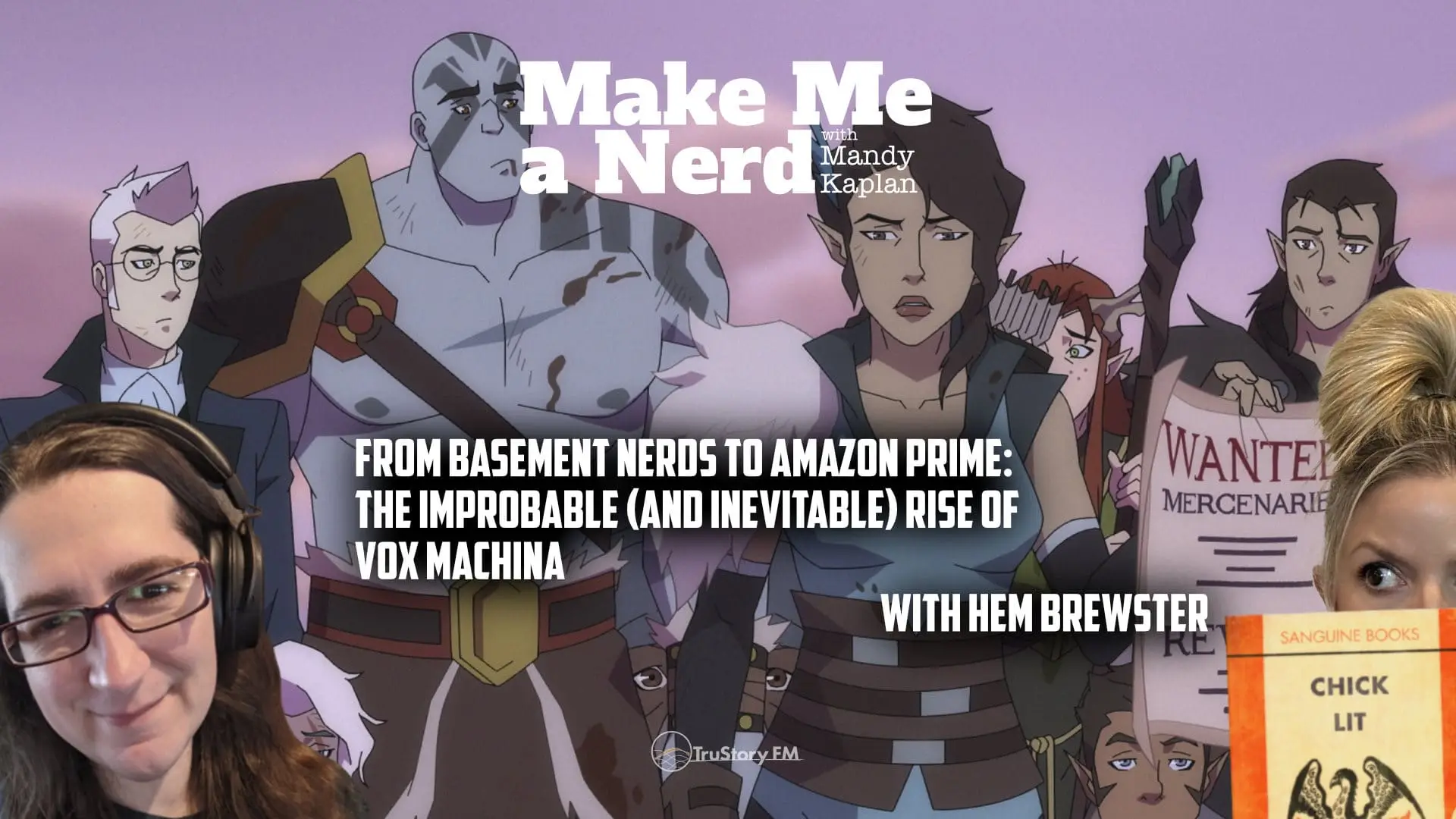
Mandy Kaplan: Hello, everybody, and welcome to Make Me a Nerd. I’m Mandy Kaplan, a mainstream mom whose mission it is to explore the world of nerd culture that I’ve been afraid of my whole life. If you’re new to the podcast, here’s how this goes: I am a total noob. Somebody who loves a movie, a podcast, a TV show, a book brings it to me with all of their passion and energy, and they try to get me to see why they are so nerdy about this thing. And what we are doing today is The Legend of Vox Machina. I’m very excited to have my guest on. Hem Brewster is the lead producer at Blighthouse Studio, creating escapist podcasts for folks to immerse themselves into. Hem has been playing role-playing games in some form or another since they were fourteen. The love of role-playing and performing led to not only the creation of the D&D actual play The Lucky Die, where she is the game master, but also to voice acting in The White Vault, forming Blighthouse Studio with her friends, and ultimately to moving to Iceland to be with the love they met along the way. Everybody, welcome Hem Brewster to Make Me a Nerd.
Hem Brewster: Hi! Yes.
Mandy Kaplan: Hi, all the way from Iceland.
Hem Brewster: Yes — although you can probably tell by my accent, not originally. But yes, all the way from Iceland.
Mandy Kaplan: Well, full disclosure, I couldn’t tell. I was like, are you Icelandic? That’s how I talk when I’m not recording.
Hem Brewster: Yeah, everyone needs to know this is exactly the voice that was used when we did the pre-talk.
Mandy Kaplan: How dare you contradict me right off the bat! So — D&D. That’s your jam. Other role-playing games too?
Hem Brewster: Yeah. When you’re trying to explain to someone what a tabletop role-playing game is, you always start with D&D — Dungeons & Dragons — because that’s the one that’s really most popular, that most people will know. Stranger Things has helped bring it to the forefront. Things like Dimension 20 and Critical Role have brought it really up and front. There were some terrible movies that have come out. But when you say “tabletop role-playing games,” you just see eyes glaze over. If you say D&D, people have a reference and an idea of what’s going on.
Mandy Kaplan: Absolutely.
Hem Brewster: For me, it really is tabletop role-playing games as a whole hobby. D&D is incredibly good at fantasy role-playing, but I like all kinds of role-playing. I like some things set in the modern world without all the magic and fantasy — vampire stuff, things set in the future, in a post-apocalypse, set in space. There are different systems that do different genres and different playstyles. I’ve just come to love a lot of different systems. It’s the role-playing part — hanging out with my friends, telling really silly stories or really serious stories. That’s the jam. That’s the thing that really gets my blood going.
Mandy Kaplan: Yeah, of course. And I attempted my first role-playing game — one of my nerdy guests recommended it. I can’t remember the name of it now. It takes place in a coastal New England town, and these four little old ladies are trying to solve murders. We become the ladies. So I finally got a taste of it — I would roll the dice and it would be like, “Nope, the door’s locked. You can’t open that door.” And I was like, no, but I want to open the door and see the evidence and find the killer. So I am inching my way towards actual D&D. I haven’t done it yet.
Hem Brewster: It’s definitely the go-to system if you’re into fantasy, mostly because there are a lot of resources available. But if there’s a particular genre you like — let’s say you’re into Renaissance stuff, or Pride and Prejudice — there’s a bunch of stuff out there that’s really good for those.
Mandy Kaplan: Yeah, sure. I mean, at its heart it’s improv — imagination and a choose-your-own-adventure. Remember those books? I think you’re right that D&D became the jumping-off point: elves and gnomes and fairies and dragons. But now it’s limitless, which is great.
Hem Brewster: Pretty much. I remember reading in one rule book: “Psst — don’t tell anyone, but you don’t actually need the rule book. You’re hanging out with your friends; make up the rules and the world as you go.” That has always stuck with me.
Mandy Kaplan: Great. Rule books — I don’t know. Who needs them? I always argue with my husband when we get a new game and he opens up the manual for a full reading of the rules. And I’m like, who cares? Let’s just put our pieces out and start rolling dice and see what happens.
Hem Brewster: Sometimes it’s a lot easier to learn the rules by actually doing it and messing it up, right?
Mandy Kaplan: I think so. But my husband does not.
Hem Brewster: Yeah, I have one of those too.
Mandy Kaplan: A rule follower? Okay.
Hem Brewster: Absolutely — which makes us playing games together sometimes very interesting when I’m in charge and I’m like, “Nah, I don’t care about that rule.”
Mandy Kaplan: You know, forget Vox Machina — let’s talk divorce. What are the divorce laws like over there in Iceland? No, I’m just kidding.
Hem Brewster: Oh, well, let me find out.
Mandy Kaplan: I love you, dear. I am totally kidding. Okay. So you mentioned Critical Role, and I could have Googled what all of this means, but I wanted you to give me a primer. What is Critical Role?
Hem Brewster: So imagine Critical Role is like a club — like a book club or a role-playing club. That’s just the name of the club. It’s the name of the seven or eight friends — fourteen, I think, at this point. They are a group of friends who are all voice actors when they start, and probably still are. They decided to take their home game — the one they just played privately, for nobody else — and put it out on Twitch. Every week they’d play between three and eight hours. Those old days.
Mandy Kaplan: Is it the same campaign, or would it be like “today we’re doing something totally different, and next week something different”?
Hem Brewster: They do long campaigns. So The Legend of Vox Machina is the name of the group of characters they played. The voice actors — Critical Role — would play this group, and the group was called Vox Machina.
Mandy Kaplan: So Vox Machina was one of their campaigns that they turned into a TV show.
Hem Brewster: Yeah, that’s right. That was their first campaign — a hundred-plus episodes. They’ve subsequently done a second campaign with, again, hundreds of episodes at hours and hours apiece. They’ve moved on to their third, completed that as well, and are now on their fourth campaign. They’ve been going for eight, nine, ten years at this point.
Mandy Kaplan: Wow.
Hem Brewster: Yeah. One of the biggest lies you ever see from Critical Role is that you have a group of eight adults who can all show up every week. That doesn’t happen in the real world.
Mandy Kaplan: Right. Of course not. And I wonder — as they’re playing, they start to think this might make a really good scripted thing. Do they have someone taking notes on all the adventures, twists, turns? If a character comes up with a hilarious line or a trait, they want to put that in the script?
Hem Brewster: If I remember the rough timeline correctly, they were partway through their second campaign when they launched a Kickstarter for the first campaign — Vox Machina. They launched a really successful Kickstarter. They needed a couple hundred thousand to make a pilot episode, and they did millions — in days and weeks. It was ridiculous how fast they got funding and went well above and beyond.
Mandy Kaplan: So cool.
Hem Brewster: It was genuinely wild to see. It’s like, yes, we need to see this — to bring what used to be a very “living in the basement with mum,” nerdy, don’t-really-talk-about-it thing out into the open, so more people will come play with us.
Mandy Kaplan: Right. Drag it into the light. Let it be seen.
Hem Brewster: Yes. Let other people see how incredible this is, because there is really no other storytelling experience quite like role-playing games. It was really good to see how supported they were.
Mandy Kaplan: And I’ve talked about this on my podcast before — the reason this podcast occurred to me is that nerd culture is now very mainstream. Star Wars, Star Trek conventions — if you love a show, you travel all around and cosplay. It’s everywhere and accepted. Which is why I thought, I really have to learn about this stuff, because I don’t know anything.
Hem Brewster: Yes.
Mandy Kaplan: And I credit — I don’t know if you’ve seen The Big Bang Theory.
Hem Brewster: Yeah.
Mandy Kaplan: I think that really cracked it open for everybody. A network show about this stuff.
Hem Brewster: On the nerd side of it, there are definitely things that aren’t accurate, and it doesn’t always portray old-school nerds in the best way. But it’s about making it accessible — making it funny. And as soon as you make something funny and keep portraying it, people begin to love it and it becomes less stigmatized. It’s much better for us, even if the show isn’t perfect.
Mandy Kaplan: Yeah. And I happen to love it. I did an episode of Make Me a Nerd about it with a wonderful comedian named Lisa Arch.
Hem Brewster: Were you the nerd in that one?
Mandy Kaplan: No — she really wanted to dive into the heart of the show and why she loves it so much. But Penny’s journey has inspired my podcast. Penny would look at them like, “What are you doing?” Why are you refreshing, refresh, refresh, refresh? You know? And she was watching them, like, “What is Comic-Con?” But she never made fun of it. She was freaked out by it at times, but she never mocked it. And then famously she got addicted to Halo and became a nerd in many, many ways.
Hem Brewster: She became her own form of nerd. And I really like the fact that — when I was younger, when I was first getting into role-playing games and other nerdy stuff, it was something you kept very quiet. There was only a particular kind of nerd. I like the fact that now there are so many weird little niches out there that you can be a nerd about, and you can just say, “Hey, I’m a nerd about this,” without worrying about getting picked on in the schoolyard.
Mandy Kaplan: Yes, right.
Hem Brewster: I’m a little too old to be picked on. But the point still stands.
Mandy Kaplan: It’s a lifelong fear. I still, when I see a group of teenagers, I’m like, “Oh god, they’re going to beat me up.”
Hem Brewster: They’re going to tell me I’m a nerd and I’ll back away.
Mandy Kaplan: Yeah. Well, I think it’s also — new theory alert, everyone, Pete play a sting — I think it’s the blending, like fusion cuisine. You can have Japanese-Mexican cuisine. They’re now blending nerd culture with very mainstream things like romantasy books. And this makes it like, well, I like romance. Oh, maybe I’ll like a romance about dragons. Right? And if you don’t know what I’m talking about, there’s an episode on Fourth Wing in my library. A Court of Thorns and Roses — I read these books for this podcast. I never would have known about them, and they became wildly mainstream popular successes, because it’s like a gateway.
Hem Brewster: That’s very much how I’ve come to consider Dungeons & Dragons in the role-playing world — it’s a gateway into finding the weird little niche of storytelling that you and your friends like. If you’re into sci-fi, there are much better systems than D&D, but this is a good way to get into it because it’s become very accessible. And then someone says, “Hey, if you want to play Starfinder,” and you’re just like, “Okay, sure, that sounds like me.” Or — there are two-person romance role-playing games out there. It’s totally out there for people to find. It’s really good to have that variety. You’re no longer just an elf, a dwarf, or a human.
Mandy Kaplan: And I remembered the name of the game I played — Chrissy Lenz, one of my most frequent nerd guests, recommended Brindlewood Bay. That’s the name of the game.
Hem Brewster: Cool.
Mandy Kaplan: And when I got it, it was just a book. And I was like, this isn’t a game, this is a book. That’s how ignorant I was. But you also have to have a GM who is so good at thinking outside the box and creating fun things. We got lucky.
Hem Brewster: Yeah. There’s a little bit of a misconception that your GM has to be the absolute best. One of the downsides of having things like Critical Role out there is that you always get compared to the GMs people know. “Why aren’t you doing character voices? Why isn’t your thing X, Y, or Z?” I very much always say: you need to be the best GM for your table. Because some people don’t want to do the in-depth emotional scenes — we call them campfire talks — and other people at the table are like, “Can you get on with this? I want to go kill a monster.”
Mandy Kaplan: Yeah.
Hem Brewster: You have to have a good GM for your particular table who knows the way your group runs. And another misconception is that the GM has to know every rule in the book. They don’t. You just need to know enough to make a ruling, because undoubtedly there is a bigger nerd at your table who knows all the rules. Use them — ask them what the rule is, then make a decision after that.
Mandy Kaplan: Sure.
Hem Brewster: The GM — the game master or keeper, depending on the system — will quite often homebrew, which means they make everything up: the world, the characters, the stories. But there’s also something called modules, which are pre-prepared stories. They have the characters you’d meet, the storylines, all the quests. I used to be an absolute snob about it — “I would never play one of those, I’m too good for that.” And now I’m like, most people don’t have time to do what I do. Having everything prepped and ready to go is great, especially for a first-time GM. Modules are there for you, and there are so many different stories out there — using systems you know, systems you don’t. Some are like one evening to play. Some are much, much longer. I’ve played in a Call of Cthulhu campaign called Masks of Nyarlathotep, and it took us two or three years to complete.
Mandy Kaplan: Wow. I know my sister’s in a long one. I don’t know how long, but.
Hem Brewster: There’s always something special when you play a long game with the same character. You get much more attached to them.
Mandy Kaplan: Of course. As an actor, I know this.
Hem Brewster: Yeah.
Mandy Kaplan: All right. Are we ready to dive into the television show, The Legend of Vox Machina?
Hem Brewster: Let’s go.
Mandy Kaplan: This thing is rated 100% and 94% on Rotten Tomatoes. That is extremely rare. People love this show. And I instantly think I know why.
Hem Brewster: What’s your theory? Can we do another theory stinger?
Mandy Kaplan: I’m going to make this up on the spot, like I’m role-playing. Let me roll some dice. I think it is designed for everyone — for real insiders and total noobs like me. My general note was: this first episode is the holy grail of nerdery. It combines fantasy, RPG, Monty Python humor, animation, and musical numbers. Who are we leaving out? That’s for everybody.
Hem Brewster: It almost feels like a shotgun approach to getting people to like your show. Even right at the beginning, when Matt is narrating the opening — there’s the Lord of the Rings reference right there. You have an elf, you have a human, you have what is clearly Gandalf in there. And instantly: boom. It’s so good.
Mandy Kaplan: I love the fake-out opening. And the right amount of humor to get someone like me to jump right in. If it took itself extremely seriously — which I’ve watched entities that do that — it’s a little harder for me, because I’m like, “Oh gosh, I’m supposed to follow all of this lore and all of these characters and the history.” I get overwhelmed. But if you give me a good fart joke, that buys a lot of goodwill. And I’m like, “Okay. I’m with this.”
Hem Brewster: And that really is a big reflection of how they play. I was there for the second, third, and fourth streams. And watching them — those very first streams are pretty much how I’ve experienced home games that aren’t published. There are lots of dick jokes, lots of fart gags, fun times, but also really serious moments — minutia control of this and that, lots of fun and laughter at the table, even if the story is really serious. And I like seeing the transition from what was their old-school home game to having it on screen as an animated cartoon. It’s kept so much of the original humor, even though they’ve had to condense what is probably hundreds of hours into ten or twelve thirty-minute episodes. They did an incredible job of crushing it all in, keeping the funny bits, keeping the serious bits, and making things flow slightly better narratively. Because when you’re improvising and mucking around at home, you can flub the lines and make terrible decisions. But when you’re scripting it, you can make things appear better than they were.
Mandy Kaplan: Yes. And they do a great job of storytelling and inviting us into this world. The characters are all different and varied. And it is immediately so R-rated.
Hem Brewster: Mm-hmm.
Mandy Kaplan: Scanlan in particular is a very sexual character.
Hem Brewster: He is very in touch with some of his emotions, yes.
Mandy Kaplan: It’s giving Spaceballs vibes.
Hem Brewster: Yeah. They have a very vivid sense of humor, and it really comes across in all of their episodes — especially the older ones, where they’re still just mucking around and having pizza ordered while they’re on stream. It’s a really good reflection of how everything was when they first started playing. And I’m really glad they leaned into that humor, because they definitely could have cut a lot of it and made a really serious, narrative-heavy, character-heavy thing — but that also wouldn’t be true to who they are. And it wouldn’t really be true to people who are looking to see a cartoon version of the story of Vox Machina. It would be kind of a disservice. I’m glad they kept what they have, because it allows people who don’t have the patience to listen through hundreds of hours to still have access to an incredible story. Because at the heart of it, once you strip away the dice rolls and the character sheets, you’re telling an incredibly amazing story. It should be accessible. It shouldn’t rely on, “Here’s a spell — if you know what this spell is, I’ll just say its name and move on.” They don’t do that. They constantly have Scanlan’s hand appear on screen, so you know what it is when he casts it. It’s really good.
Mandy Kaplan: Yes. And they use music a lot. They even did a musical number to introduce the characters, which I thoroughly appreciated.
Hem Brewster: It was so good.
Mandy Kaplan: Those who already know get new appreciation, and those who don’t get their first glimpse.
Hem Brewster: It’s a great way to introduce the basics of what each character is. In a very short amount of time, they’ve made something that could be really dull — “They are twins, they are half-elves, she is a thief and he is a ranger with a bear” — into a Scanlan song. That’s a great way of demonstrating who they are.
Mandy Kaplan: And yet, even though it’s very funny, I sometimes just write down a funny line that made me LOL. Grog — how would you describe Grog?
Hem Brewster: He’s a Goliath.
Mandy Kaplan: I don’t want to insult him.
Hem Brewster: Massively tall, very broad, greyish skin.
Mandy Kaplan: Goliath. We’re both doing the same thing with our arms right now — big “rarr” arms.
Hem Brewster: Yeah.
Mandy Kaplan: He gets hurt and he says, “Oh, it’s just a flesh wound.” And then he removes his hand and the blood — like a geyser — sprays out from his wound. I thought that was — I think he’s my favorite.
Hem Brewster: Grog! Here it is.
Mandy Kaplan: Is that okay to say?
Hem Brewster: Grog is a beautiful being. Very straightforward, with a ginormous heart hidden behind rage. Grog is Travis Willingham. Travis Willingham has done a lot of voices for games and anime dubs. But he is also actually the CEO of Critical Role — the man in charge. And sometimes you’ll see clips of “this is the CEO of Critical Role” and he’s just doing something really goofy, because he just is.
Mandy Kaplan: I love that he’s the brains behind the operation, because Grog is certainly not within Vox Machina.
Hem Brewster: Within Vox Machina, yeah, yeah.
Mandy Kaplan: And Vox Machina, for my listeners who don’t know — first of all, it’s on Amazon and everybody should watch it. It’s a band of merry mercenaries who are given the task of heading out into the world. I don’t even know what the mission is. Is that terrible?
Hem Brewster: Not at all. If you play D&D a lot, you notice the trope immediately: group of mercenaries in a bar, they get drunk, have a bar brawl, have no money, have to find a job, go to the local notice board, see a mission from the king that will pay, take it, and go try to do the job. Very typical trope, but a good one.
Mandy Kaplan: Is it the same mission all season, or —?
Hem Brewster: Usually it takes a while to get your players invested in the bigger story. So you start really small. You give them a little mission: “Hey, go over here and just kill this thing — we don’t know what it is, but it’s causing trouble. Go deal with that.” Then they go there, find a little storyline, bond with some villagers — and then, like any good story, you kill all the villagers so they feel invested. They come back, complete the mission, and then a new mission, tangentially related to that, pulls them into the bigger story.
Mandy Kaplan: Gotcha. Well, I thoroughly enjoyed the pilot. And full disclosure for the world — I tangentially know Sam Riegel, one of the original Critical Role creators and actors. He plays Scanlan — the musical elf? Gnome?
Hem Brewster: He is a gnome.
Mandy Kaplan: He’s a gnome. But he’s also hot — he’s built, with a nice chest, and it’s a confusing time.
Hem Brewster: He’s got chest hair, he shows it, and he knows it.
Mandy Kaplan: Yeah. So I reached out and said, “If you wanted to ask Sam anything, what would you ask?” And Sam recorded his answer, and I’m going to play it for us.
Sam Riegel: The question is: what change from the streamed game to the TV show am I most proud of? There are so many things I’m proud of with the shows we make. I think the thing I’m most proud of — and I also serve as the casting director — is that we’ve taken these NPCs, the world of Exandria, and fleshed them out with incredible actors from around the world, and populated our show with the best actors in voiceover and film and TV. It makes our show better, it makes the world more real, and we get to work with some incredible talent. I’m also really proud of the way we were able to translate the magic — the magic systems and rules of a TTRPG — into a narrative that made sense. You don’t need to know anything about the rules of games to enjoy the show. And it turned out beyond our wildest expectations.
Mandy Kaplan: Pete, I’ll send you that so you can play good audio for everybody. And people might be going, “Who is this Pete?” Does she have an imaginary friend? I do, but it’s not Pete. Pete is the engineer and producer of Make Me a Nerd by TruStory FM. My theme song is “Wonder Struck” by Jane and the Boy. Please, please, please go to Apple Podcasts, leave a five-star review, and if you write me a message — you can make a suggestion for something you want me to get nerdy about, ask a question, or just tell me my hair looks good — whatever it is, I’ll give you a shout-out on the air. And if you’re feeling extra supportive, please go to makemeanerd.com/join. Hitting that button gets you your episodes ad-free and early, and all of my gratitude. Episode seven: Scanbo.
Hem Brewster: Yes.
Mandy Kaplan: Sam co-wrote this one. And it starts with teens in a private school getting yelled at. I said, “Who the hell are these people?” like all of a sudden there’s a whole new — and then are we following these people this week? Were they in episodes I missed?
Hem Brewster: What happens at the beginning of episode seven is that we get a flashback to Percy’s backstory. Percy is one of the characters, portrayed by Taliesin Jaffe. His backstory is that he once belonged to an incredibly powerful and wealthy family from Whitestone. He is a de Rolo, and he has a twin — Cassandra.
Mandy Kaplan: Yes.
Hem Brewster: We flash back to them being teenagers and meet this horrible professor who’s a bit of a douche. And then it flashes forward. What we learn in this episode — and throughout the rest of the season — is Percy’s toxic obsession with his gun. That’s not a euphemism; it’s an actual gun. But it’s really a metaphor for his overinvestment in revenge and hatred.
Mandy Kaplan: Revenge. The gun displays the names of the people on his hit list.
Hem Brewster: Mm-hmm. At this point he’s knocked a couple of them off in the prior episodes. He becomes very possessed when using the gun. When we get to the finale, we can definitely discuss what that looks like. But yeah — it begins to tell the horrible story of how he got to where he is, how his parents and family were absolutely destroyed, and he’s just found that his sister is still alive. They’re hiding out, waiting for the opportune moment to break back into the castle to rescue her from the Lord and Lady Briarwood. They confront him about some very dodgy decisions he’s made and get him to tell the truth about what’s happening in his life.
Mandy Kaplan: And this episode felt much more like an RPG game and less like a TV show. There were a lot of — “I’m going to go this way, oh, that just blew up in flames, I have to go this way” — things I think are ripped from that feeling.
Hem Brewster: Yeah, pretty much. This episode is very much in two halves. You have the heavy emotional roleplay — Percy’s backstory and his interactions with the other characters. And then you have Scanlan’s side of the story. I watched this episode live when they were playing; it was a couple of hours long, not just thirty minutes. And Scanlan decides to make a distraction — that’s his job, he’s a bard, he’s very flashy. It was nothing but chaos watching the original stream of Sam, who plays Scanlan, breaking into this guy’s house, trying to set it on fire, and eventually turning into a triceratops. It was far more chaotic live, and I’m impressed how well they made it flow narratively.
Mandy Kaplan: Sure.
Hem Brewster: You lose some of the humor that came from the live reactions — “Oh god, the door’s closed” — and the chaos of “I have an idea: Polymorph, triceratops.” You lose some of that. But you see the steps in the episode itself, where he’s bouncing between one thing and another and — “Oops, this is closed, oops, I’ve ended up right next to the boss.” It’s chaos, and it’s why I wanted you to see that episode.
Mandy Kaplan: I appreciate that. The way I met Sam was through a friend — they were writing and singing comedy songs together. And Sam is, I know him to be, a musical performer. Scanlan sings almost everything. He’s just always singing. And I actually asked Sam about that.
Sam Riegel: For the other question — how did singing become part of my character in the show? Scanlan is a character I created many, many years ago, and singing has been a part of my life since I was a very small child. I performed in dinner theater and Broadway shows and a cappella groups and doo-wop groups and bands. When I first made that character all those years ago, I based him on myself. I was a guy who sang. The character is a bard, who casts magic with music, and it made sense for me to sing my magic. I’m so happy I got to do that on the show. I co-write all the songs that I sing on the show. And it’s my favorite part of any character I’ve ever played.
Mandy Kaplan: I thought that was so interesting, because I would take that route too. I’m a musical theater performer — that’s my background. And I like that he says “I based Scanlan on me.” Because Scanlan’s also a horn dog, not the most responsible — but I’m sure those aspects are fictional. It’s just his musical abilities that are Sam.
Hem Brewster: Yeah. One of the reasons he was playing a gnome bard — other than it obviously suiting him very well — is that back in the day, he and Liam, who’s another one of the guys on the show, started doing a podcast called All Work No Play. And they were talking about D&D and role-playing games. Sam asked, “What is the worst combination?” And Liam’s like, “It’s a gnome bard.” So that’s why he played a gnome bard. But interestingly enough, saying that you’re a performer, you’d probably do the same.
Mandy Kaplan: Perfect.
Hem Brewster: My favorite class in D&D is a bard. It is one of the most out-of-place classes, in my opinion — because it just makes no sense. You’re in the middle of a fight and you bring out a lute? That thing’s getting broken the instant it appears. Go, go — magic something! However, I love them. They are so ridiculous. I used to play a game where I could never cast a spell unless it had a rhyme, so I had to say something. And then it evolved into: I can never cast a spell unless I say a limerick. So they got longer and longer, much to the chagrin of everyone else at the table. But I’m so glad I did it, because it’s such a laugh.
Mandy Kaplan: Music makes everything better. So I love that Scanlan sings and that the show incorporates music a lot. And then you just mentioned Liam, who plays — please say the name so I don’t butcher it.
Hem Brewster: Vax’ildan. Vax is absolutely fine.
Mandy Kaplan: Okay. He plays Vax, and if you close your eyes, he sounds exactly like Pierce Brosnan. Exactly like Pierce Brosnan — so much so that I had to remind myself a couple of times it wasn’t.
Hem Brewster: I can very much hear that, yes.
Mandy Kaplan: The LOL of the episode for me is Grog saying, “Not everything is a trap. Ugh, it’s a trap.”
Hem Brewster: And that is also one of the big tropes of role-playing games — going to a door and checking it for traps. It doesn’t seem normal; if you’re telling a normal story, you’d never do that. But it’s very typical in D&D to have trapped doors, locked doors, a magical code where you have to solve riddles. Or — you can psych out your players and don’t do anything to the door whatsoever, including not locking it. Hours of fun. And it’s so good to see that.
Mandy Kaplan: Because no one thinks to just open the door.
Hem Brewster: Exactly. Because you know — “How am I going to get in? It’s going to be trapped, right?” And they’re a big mage and they’ve just left it open. It was so good to see — and then to have Grog walk in like, “You guys are being ridiculous,” and boom, there’s a bunch of archers aiming at him.
Mandy Kaplan: Very funny. And you remember these details of the streams. Do you re-watch them as you’re watching the TV show?
Hem Brewster: No. Some of the big moments really stick in your mind, and the ones where you laugh the hardest are absolutely the ones that stay. The ones that make you cry the most are the ones that stick in the back of the brain too. There are a couple of those from Vox Machina — some in this season, some that haven’t even happened yet because the show hasn’t finished. I did watch all of the Vox Machina story, because I really enjoyed it. They were doing their thing about a year or so before I got into being part of actual play myself, so it was good to watch and then understand how and where they got to where they are by basically doing something similar.
Mandy Kaplan: I’ve certainly been privileged to see friends workshop something or create something, and watched it go from the stage to the screen. Not role-playing, but other entities. It’s thrilling to see each variation and how it grows and changes.
Hem Brewster: Especially if you see it from the very beginning — workshop level.
Mandy Kaplan: Yep.
Hem Brewster: That’s how I feel about folks who have been following Critical Role fanatically since the beginning. And the easiest example — just go to YouTube — is their intro sequences. It was just stock images and Matt doing the intro for all the characters. Because with Vox Machina, we as an audience don’t join the story until about a third of the way through — they did a home game for years before they started Critical Role, before they went on to Geek and Sundry.
Mandy Kaplan: That makes sense.
Hem Brewster: And they were actually not playing D&D — they were playing Pathfinder. Completely different system. They switched to D&D because it was the biggest system, more people knew it, more portal. So they made the tactical decision to change for Geek and Sundry. And yeah, the original intro sequence was just Matt reading character information and world information. Then it became them doing frankly really bad cosplay in front of a grey screen. Then much better costumes out in the forest with theme music. Then animated stuff coming in. Then really in-depth stuff that doesn’t feel like cosplay — it feels like an intro sequence for an actual TV show. They’ve just grown over the years. And then to see the intro for The Legend of Vox Machina on Prime — it’s such an interesting thing to watch the progression over ten years: from really homegrown, really bad cosplay to professional-standard Saturday morning cartoon.
Mandy Kaplan: I’m so glad you adopted it so early and stuck with it and could see this progression and evolution. It’s exciting.
Hem Brewster: Yeah, it is. It’s awesome.
Mandy Kaplan: Episode twelve — dun dun dun — “The Darkness Within.”
Hem Brewster: Yes, the finale.
Mandy Kaplan: Why did you choose this one?
Hem Brewster: Because it’s the finale of one of the bigger arcs — specifically the culmination of Percy’s story. And I love Percy. He is my little emo heart-boy. Everything about him is super dark and super twisted, and he’s had a very dark and twisted upbringing. It’s an episode that not only finishes an arc — where you get to see that big battle happening within him and his friends’ support in that — but it’s also the season finale. So it’s meant to set up the next season. I wanted to be able to contrast how I remember the stream going versus watching the finished episode, since it obviously wasn’t “here’s the end of the season, wait six months” — you just waited seven more days and the next part came up. It’s such a heavy episode, and it has a lot of what I think are the best aspects of role-playing games demonstrated on screen. That’s why I wanted you to see it.
Mandy Kaplan: Well, I missed the humor. I was feeling — it was such a heavy cold open. It felt like it gave up on trying to be funny. Does the series come back to humor? Did this just happen to be a very emotionally deep episode?
Hem Brewster: Essentially, with Percy’s story, what’s happening here is that the Briarwoods — the ones who destroyed his family and took his sister hostage — one of them is a vampire and one is a necromancer. They’ve had a massive fight with them in the previous episode. They kill off Sylas Briarwood, Lord Briarwood, and it’s just Lady Briarwood left. And Keyleth, portrayed by Marisha Ray, is basically unconscious — they can’t wake her up, they can’t heal her. They’re in an antimagic area, which is a very typical D&D thing: you just can’t cast spells, you can’t do any of this.
Mandy Kaplan: It’s like a cell phone nowadays.
Hem Brewster: Yeah, basically — no coverage from magic, divine or otherwise. So when there are serious moments, there isn’t what I call the peanut gallery effect — people cracking jokes just to break the tension. They like to let that heaviness that has been earned sit.
Mandy Kaplan: Mm-hmm.
Hem Brewster: And they do something very similar here. This is the end of a very dark arc, especially for Percy, so they let that heaviness sit. But it doesn’t last very long. Beginning of season two, it’s all back to the same kind of shenanigans you’d expect — just with slightly higher stakes.
Mandy Kaplan: Okay, good. Phew. And I’m also continually shocked at how bloody the show is.
Hem Brewster: Oh yeah. The descriptions that Matt comes up with, and that the players themselves give — they are pretty heavy, pretty gory. It’s fantasy violence. You have a Goliath who is eight feet tall with massive muscles. If he punches you, you’re not getting a bruise. You’re getting a far more violent reaction.
Mandy Kaplan: Yeah. They did a junk punch in episode seven and even I winced. I’m like, “What? I’m not a dude. And it’s a cartoon.” But you felt the impact. The violence has real weight behind it.
Hem Brewster: Yeah. That is very true to the game that it’s based on. And I know they made a conscious decision not to roll back too hard on their rating. Hence the cartoon nudity in places, hence the extreme gore — and that does happen when you play. If your GM is the kind of person who asks, “Hey, what do you want to happen now that you’ve won? This is your moment — what do you want to do?” When you are in it and this character has been the bane of your character’s existence for months of real-time playing, and you finally lay that smack down — you get carried away. You get vicious.
Mandy Kaplan: Yes, it gets vicious. And lastly — I can’t believe I’m saying lastly, this flew by.
Hem Brewster: It did, yeah.
Mandy Kaplan: You are so easy to talk to. But before I ask my big question — tell everybody where they can hear your stuff.
Hem Brewster: I’m the lead producer for Blighthouse Studio, and you can find us by searching Blighthouse Studio. There you’ll find a link to everything we create as a group. There are about six of us, from various different countries and parts of the US. We have two actual plays: one is D&D, called The Lucky Die, and we have a Call of Cthulhu game — much more eldritch horror and less fantasy — called The Sprouting. We also have a couple of other fantasy shows and talk shows. Everything we do is on there, and everything our group does that isn’t under the Blighthouse umbrella is linked there too, because I love my friends and I love the stuff they do even if it’s not officially under the umbrella.
Mandy Kaplan: Lift everybody up. That’s great. So — I love the animation style of the show. And I might be talking out of my ass — it is 2D, like classic animation. Is that accurate?
Hem Brewster: Yeah, very much so. If you’re thinking —
Mandy Kaplan: It reminds me of my childhood. I would watch He-Man and those shows.
Hem Brewster: Yes, it’s that kind of style, but slightly smoother.
Mandy Kaplan: Slightly smoother, but not more realistic or CGI or 3D.
Hem Brewster: No, you don’t want that at all.
Mandy Kaplan: And I really like that. It puts the character and the story above the style and the animation.
Hem Brewster: They did an incredibly good job of taking out the story from all of the meta stuff — you don’t need to know what spell or what class a character is. We know Scanlan is a bard, but we don’t really know what class Percy is, for example.
Mandy Kaplan: I don’t even know what a class is. What do you mean, class?
Hem Brewster: He’s a gunslinger, exactly. So a class is a group of abilities or themes for your character. If you wanted to play someone who’s really in touch with nature, has an animal companion, likes to track things and uses a bow — you’d probably suit the ranger class. Not a lot of magic, more about nature. However, if you want to be someone who has a book in their hand, reads spells aloud, and makes magic happen — that’s a wizard.
Mandy Kaplan: You have really nerdified me. As you were describing all of the stuff you’re doing on Blighthouse, I didn’t understand half the words you said. So I’ve got a lot of catching up to do.
Hem Brewster: All right, I’ll explain the bigger one — actual play. That is us playing D&D, or Call of Cthulhu, or whatever system we’re playing.
Mandy Kaplan: Call of Cthulhu. I still don’t know what it is, but I just wanted to understand what you were saying.
Hem Brewster: Do you know who Lovecraft is?
Mandy Kaplan: I’ve heard the word, but I don’t know what it is.
Hem Brewster: Let me take you somewhere. Imagine there is a horror beyond comprehension. Even thinking about it will drive you mad. That is Cthulhu. So Cthulhu is — people who purposely seek out things that will drive you mad, to bring into our world, because they think the world should end, or because they love Cthulhu because they’ve already been driven mad by Cthulhu. It’s called eldritch horror, and it’s a huge genre.
Mandy Kaplan: No, I mean — I got it. I just wanted to see if you knew.
Hem Brewster: See? Thank you for testing me.
Mandy Kaplan: Thank you for passing. Hem, this was so wonderful. Thank you for coming on. Maybe there’s something in that realm — if you want to come back, we could.
Hem Brewster: If you want your mind wrecked by Cthulhu, I’m there.
Mandy Kaplan: Okay, I’m a little scared. Which is probably good. It means I should do it.
Hem Brewster: Uh-huh.
Mandy Kaplan: Well, thank you, Hem Brewster, and thank you everybody for listening. Until next time.