Pete Wright:
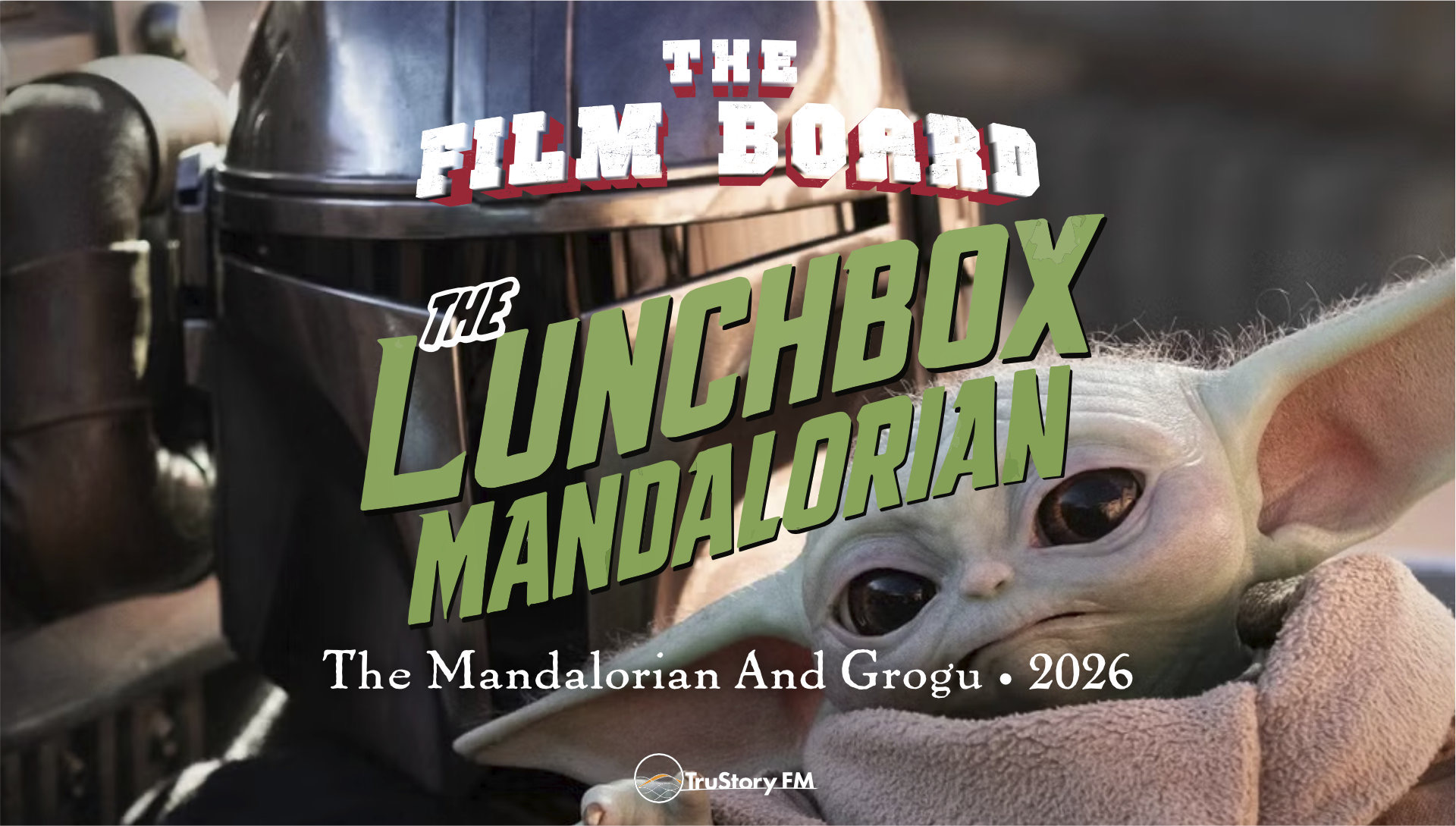
A long time ago, in a multiplex not all that far away, Star Wars got off the couch. Seven years since the saga last darkened a theater, and it saunters back, not with a Skywalker, not with a Sith, but with a tin-canned dad and his green goblin son, going to Space Mexico to rescue a swole teenage Hutt who would really rather you didn’t. This, apparently, is the way. I’m Pete Wright, and the New Republic has posted a bounty on this movie. Riding with me to collect it: Justin Jaeger, Matthew Fox, and Ocean Murff. Four hunters, one fighting pit, and a puppet that cost more than the Razor Crest. Let’s find out if the Mandalorian and Grogu brings the galaxy home, or if it’s just a very expensive nap with an A-minus CinemaScore. Welcome to The Film Board. Hello, everybody.
Justin Jaeger:
Hi.
Ocean Murff:
Hello.
Pete Wright:
I want to start. I’ve got a couple of things I want to start with. Number one, Ocean and I happened to go to lunch a little while ago, and I said that I was excited about this, and Ocean said he was very, very nervous. And I feel like this is going to be a grand reckoning about Ocean’s anxieties. Ocean, are you still feeling the way you felt over Mr. Bentoberger?
Ocean Murff:
Yes, I am.
Pete Wright:
Okay, all right.
Ocean Murff:
I think that I can go into that a little bit deeper, in that after having seen the movie, what I thought about it was: the Mandalorian is a good TV show. So this movie, it’s very good. It’s a good movie, it’s entertaining. The action sequences are great. And I am 100% here for the adventures of Grogu. It was great in 3D.
The primary issue I had, of course, is the plot. The plot was thin, and it felt like it should have been the first three episodes of season four, and then we just move on from there. And so that was, you know, I have spoken.
Pete Wright:
Okay. All right. JJ, your opening thoughts.
Justin Jaeger:
Yeah, I’m really glad you ask, because I am in a weird place with this movie. If you’ve heard me over the years on The Film Board, you would hear me being angry about movies of this type. Pete, I think you’ve had the nickname before, Popcorn Pete, right?
Pete Wright:
I earned that.
Justin Jaeger:
That’s been levied at you in the past.
Pete Wright:
Yeah, yeah.
Justin Jaeger:
Well, this movie felt a lot like cotton candy to me. It was very sweet and digestible, and leaves you with a little bit of a queasy stomach at the end of it. But I will say that for me, a cotton candy movie in the Star Wars universe is much better than cotton candy in other universes. So I ended up liking it and enjoying it quite a bit, even though usually I’m not a big fan of this type of thing. I’ve got a lot to say on it, both positive and negative, but overall it was a fun action movie that I didn’t expect.
Pete Wright:
Okay. I like that. Now Matthew, you come to us as host and proprietor of the Star Wars Generations podcast. And I know that you have just released an episode, a primer, before going into the Mandalorian and Grogu, knowing, I assume, precious little about it. I would love it if you would share your opening thoughts as an esteemed host in the media ecosystem.
Matthew Fox:
Well, I’m going to climb down a little bit from the pedestal you’re putting me on, but I will say that my thoughts are kind of a mix of both JJ and Ocean, in that this was an interesting week for TV at the cinema.
Pete Wright:
Of Star Wars. I dare you, I dare you.
Matthew Fox:
And apparently you could have paid a lot of money to see the final episode of The Boys on the big screen, or, as all of us did, we could have paid a lot of money to see the first episodes of season four of this show on the big screen.
Justin Jaeger:
Interesting.
Matthew Fox:
And like others have said, I think this would have been perfectly serviceable as the first episodes of The Mandalorian. Knowing that, I’m going to have a lot of fun watching it again. There were a couple things that really didn’t fit my understanding of what Star Wars should be, and Emo Hutt is top of that list. And the fight scenes, I thought, were a little long, but were definitely a lot of fun. All of the Grogu learning to become more independent and take care of his dad. As we’re a generation that’s all starting to probably have parents in nursing homes and stuff like that.
Pete Wright:
I think that’s a good thing.
Matthew Fox:
So that hit pretty well. I’m very much the kid who grew up with the original trilogy, so that felt well timed. It’s just, for me, when you take a TV show and bring it to a movie, especially one in the Star Wars universe, it feels like it’s going to be bigger. And for me, there’s one specific moment in the movie where I was like, oh, okay, this is just TV episodes.
For the entire show, Mando has been off on his own, doing his own thing, sometimes crossing paths with New Republic folks and sometimes helping them. But for the most part, just doing his own thing. And so we get to the point halfway through the movie where they’ve brought in Admiral Coin. They didn’t do it the way the Hutts wanted to, but that’s actually probably better. More on that in Mando’s character in a bit. But he’s given Sigourney Weaver what she wants. Now she can do the thing that the New Republic needs to do with this guy’s information. And I was like, cool, this is when we’re going to get the movie about the New Republic. This is when we’re going to get a movie that really dives into what’s the New Republic up to and how is Mando going to fit into it.
And then he kind of went off to Nevarro, and no one in the theater had any idea what the plot was going to be next, because everything was wrapped up. And then it just becomes another episode about the Hutts wanting revenge on him. So for me, I was really disappointed at that point in the theater. There were other things like that, but I think that was kind of my overall thought. I would have loved this to be a grand idea of a movie that took Mando and expanded the scope. It didn’t do that, and I’m disappointed. But that being said, I’m going to be perfectly happy throwing this on Disney Plus sometime when I want some good Mando-Grogu feelings, because it gave us a lot of those.
Pete Wright:
It’s interesting, because I think I line up with the vibe of all three of you. And we’ll have some specific areas that we may disagree on. But the pieces that I struggled with: it felt exactly like what happened, that they had written about eight episodes of the show, and then were told, here’s a little more money, make it a movie. And they just stapled it all together. It felt so deeply episodic to me, and not like one coherent piece, when you get these episodes like the little mechanic creatures and their teeny tiny spaceship, which was really fun, and a funny gag to jam Grogu inside that little spaceship. I really enjoyed that, but it felt so small-screen aspirational to me. The fights felt flat. Everything felt a little bit flat. Maybe had I been watching it on a smaller screen, I would have had even a better experience with the kind of two-dimensionality. I also saw it in 3D. But it just felt energetically flat.
The places where I was lost, unfortunately, were central to the film. I just could not abide Swole Hutt. Hutts are hard. They’re hard creatures. We’ve seen them tried again and again, and they’re hard creatures. Walking through Nal Hutta, where you have them kind of slimy, all over each other in their various dens, was cool. That was cool.
Jeremy Allen White. Let me just read a little bit of where I have it. Rotta, the whole character. I have Favreau saying that he recognizes it sounds like a Mad Lib, right? Jeremy Allen White is going to voice a swole Hutt. It sounds like nonsense. So either this is the dumbest thing that Star Wars has done in a while, of a catalog of dumb things that we could litigate in another show, or it’s the biggest heroic swing they’ve ever made. And it seems like audiences are deeply divided on that, which I have to admit, I’m a little bit stymied by.
Ocean Murff:
I liked the swole.
Pete Wright:
So?
Ocean Murff:
I like the swole Hutt. It made more sense. I have always been confused by why is Jabba the Hutt a big deal, because he’s this fat dude that can’t move, and everything he speaks in gibberish. So why don’t they just overthrow him? All the Hutts, you know, they’re silly. Maybe they have some money or something like that, but it didn’t make any sense where their power would come from. But then if a Hutt could be, when they’re younger, like this, now I’m like, okay, I see. They could have enforcer Hutts. There could be a whole mob hierarchy of Hutts. You have the enforcers, you’ve got the moneymen, you’ve got the bosses at the top.
Pete Wright:
Yeah.
Ocean Murff:
It looks like a much more well-rounded society. I will own that it felt weird to me that he was speaking English, but outside of that.
Justin Jaeger:
That’s the part that was really difficult for me.
Matthew Fox:
That’s where I wanted to go.
Pete Wright:
Yes.
Justin Jaeger:
And it felt like, in particular, one line really hit me hard in that way.
Matthew Fox:
Yeah.
Justin Jaeger:
And that’s when he said, I want to be my own man.
Matthew Fox:
Be my own man.
Ocean Murff:
Being a man, yes.
Pete Wright:
Oh God, stop. Yes.
Justin Jaeger:
In terms of writing, if you’re going to give him English, I guess, or even just something conversational for the universe.
Ocean Murff:
Yeah.
Justin Jaeger:
You don’t even have to say English.
Matthew Fox:
Yeah.
Justin Jaeger:
If you’re going to give him a common language, he still wouldn’t identify himself as a man, would he? That just hit me like a ton of bricks in the theater.
Pete Wright:
Yeah.
Matthew Fox:
Yeah.
Justin Jaeger:
It was tough enough to catch the accent as a Hutt, and then to do that, I was like, what are you guys writing here? It really confused me.
Matthew Fox:
Yeah, I’m with you. I don’t think that you need a Hutt to be a big, physically strong person to have power, because that’s always been one of the points of the universe. But I definitely don’t mind swole Hutt. For me, it’s the English and it’s the emo. It’s certainly these lines like “I’m be my own man” and complaining about his dad and all this. One of the things that I loved about the original movie, A New Hope, and this carries through most of the way through the original trilogy, and Lucas talked about this as something he wanted to have, is this.
Pete Wright:
I think it’s a good thing.
Matthew Fox:
Look, aliens have different vocal cords and different lungs. The idea that, as we’re learning to communicate with animals, we can’t make the sounds a dog makes, and a dog is probably not going to be able to speak English because we have different vocal systems. One of the conceits of that original universe is that all of them, Jabba, Chewbacca, Greedo, none of them speak English, because they’re not human. But Galactic Basic is a language they’re all speaking, and our human characters can understand them. They can’t speak their language either, and it works. I know they’ve gone away from subtitles, especially with some of the movies that were more for kids. But yeah, even if it was, if Jeremy Allen White’s character could speak Basic English, I would have at least wished that the two older Hutts, the twins, only spoke Huttese. Because they also were speaking a little bit of Basic, and at least they seemed like they were struggling to speak it.
Justin Jaeger:
Yeah, have him pick one or the other, I agree.
Matthew Fox:
And I feel like, if you wanted to have the character of the Hutt who doesn’t want to be a Hutt be someone who has a voice and has an emo character, there’s just so many other races you could have gone with that aren’t so classically not human. You could have even had it, if you want him to be from the Hutt clans, be a Twi’lek dancer. Which would have, I mean, you could have Twi’lek dancers of every gender, but if you make it a woman, congratulations.
Pete Wright:
Sure.
Matthew Fox:
You’ve now increased the number of women in this movie a hundred percent. Well, the sister is also a woman, but she barely has any character outside of her twin brother.
Pete Wright:
Yeah.
Matthew Fox:
So yeah, the swole part was a little weird. It’s just the emo-ness. It just didn’t make any sense to me.
Pete Wright:
I think some of the choices are what really gets me. I agree with the emo. The trick is, this is a movie where the filmmakers worked really hard to make this a practical film, to make so many of the central character choices practical choices. And Grogu, of course, is not the least of them. Then we have this central character in Jeremy Allen White that they chose to make a Hutt. And that’s the thing that’s crazy to me, because we know how hard Hutts are to make universally believable on screen. They’re really hard to do. Jabba was the last time, and it was a puppet. And they did not go in that direction. This is an own goal for me, that they chose to write a character that was a Hutt. It felt like they wanted to make this swing.
But the bigger problem that I have with this movie is not one that this movie can fix. It’s that the powers that be at Lucas went to the Star Wars stable and said, okay, let’s just say we’re going to adapt one of our TV shows for the big screen. We have Mandalorian, that was produced at a certain time. We have Andor, that was produced at a certain time. And I think, oh, let’s make the Mandalorian and the puppet movie because it sells lunchboxes. That’s my headcanon. And what I wanted was a season-one Mandalorian, and I got the lunchbox Mandalorian, post-Book of Boba Fett. I feel like it just wasn’t necessarily made for me, for where I want my Star Wars.
Justin Jaeger:
And…
Pete Wright:
I’ve got to go back and watch Andor again for that. That was my Star Wars right now. And I’m really grateful that it exists. This one was action without a lot of pulse.
Ocean Murff:
But I think that may have been the point. I agree with you, they’re just trying to sell lunchboxes. If they wanted to make a real Star Wars movie and go in a different direction, they could have grabbed The Acolyte. Because while that was not necessarily the most successful television show, it gave you a lot of difference.
Pete Wright:
Yeah.
Ocean Murff:
You could have an adventure story. You can go a lot of different directions with it and make it cinematic, without some of the attachments of things, and also have it where you have more people. I was struggling with you saying the word practical, because there was nothing practical in this movie. It was all the, you know, I thought of Tommy way more than I should have, because it was all these fake things dealing with fake things.
Justin Jaeger:
Yes, yes, there were.
Ocean Murff:
And even to the point of the acting, or voice acting, like when the Mandalorian and Colonel Ward, Sigourney Weaver’s character, are together talking, the dialogue feels so stilted and disjointed that I was sitting there questioning. I don’t think they were in the same room. Now, according to them online, they were, but I was like, well, maybe you guys should have done something a little bit better, because it just didn’t work at all. And that was the only time that the Mandalorian interfaced with an actual real person, was when he was with Colonel Ward.
Pete Wright:
Yeah, you’re right.
Ocean Murff:
And other than that, it was all CGI.
Pete Wright:
He’s on the ship with Zeb. It’s all CGI replacement.
Ocean Murff:
Well, correct.
Pete Wright:
Yeah.
Ocean Murff:
It’s all CGI and voice acting. So I think that there’s a lot of problems with that in terms of the structure and in terms of what they decided to do with it. But I will concede, I did enjoy it. There are a lot of positives in this. The action sequences were bigger than the show.
Pete Wright:
Exactly.
Ocean Murff:
The fight sequences were bigger than the show. It did provide those things. And it tried to add a little bit to his character. But it did make that wrong turn of having him go back and fight the Hutts, as opposed to continuing on to something that was a larger adventure. When he goes back and fights the Hutts, while that’s great, and that’s the adventures of Grogu, which, quite honestly, also great. I feel that it was just another point of evidence of how Star Wars is just better as a TV show. They should just really stop making movies altogether and just make TV shows.
Justin Jaeger:
Mm-hmm.
Ocean Murff:
They could have run the Mandalorian TV show for a decade, easily, because, as you know, he’s voice acting, it’s stuntmen, and he’s got puppets and CGI everywhere. So you’re not even going to be dealing with actors that became big deals and now are going to be much more expensive. So this really tells me television is where Star Wars should focus, because the television shows are much better than the movies. The movies, arguably, I think we’ve peaked at Rogue One, and then now we’re done. But that would be my stance. And I think everyone has that stance. Nobody has a stance of, oh, all of these Star Wars movies were great. There’s some point where there are diminishing returns, but the television shows are great.
Matthew Fox:
I do want to push back a bit, just because I am looking forward to seeing more movies. And yes, take a bunch of adults and ask them about the sequel trilogy, and you will have one hell of a debate. You’ll have some people who really only liked one or two of them. You’ll have some people who hate all of them. You’ll get all the idiots who want to say that all Disney Star Wars is bad and it’s woke and all that kind of nonsense. But what that reminds me of, and probably most of us are all going to remember this, that’s how we all talked about the prequels for a long time.
Pete Wright:
Oh, for sure.
Matthew Fox:
If you weren’t of the age that grew up with the prequels. And then all the kids who grew up with the prequels came out and they loved them, and they taught us to love them. And The Clone Wars taught us to love them. So I think, especially that generation that grew up with the sequels, they’re becoming young adults now. I think that’s what’s going to carry a lot of the next stage in the movies, because I do think there is that cohort that really does have a very strong positive feeling about the sequels.
And here’s what I think the strategy of this movie may be. I think it’s trying to capture lightning in a bottle twice, but I understand where it’s coming from. When people look at The Force Awakens today, which is not the best Star Wars movie, it has some really great parts, raised a great character, and yes, it’s very similar to A New Hope. I think what they forget is, Star Wars needed a palate cleanser, because there was so much prequel hate out there and prequel laughter, and people had written off Star Wars. This is a different situation, but the fan discussions around Star Wars right now are so toxic. I would have loved an Acolyte movie.
Justin Jaeger:
Mm.
Matthew Fox:
And would have probably had to not go on Twitter for three weeks because of it. Any podcast I did about it, I would just shut down my mail, because…
Pete Wright:
Yeah.
Ocean Murff:
Yes.
Justin Jaeger:
Right.
Matthew Fox:
You’d have Elon Musk saying, oh my gosh, this is terrible, and trying to shut it down, the way he and Trump literally shut down a season of Star Trek because it was too woke. So I just feel like this was such a basic, simple movie, and we all wanted more from it. But if it opens the door back to Star Wars movies, I’m okay. I don’t think it did as good a job as Force Awakens, and I’m nervous about it, but I at least think that may have been their strategy. And I think they could have done it a lot better and shouldn’t have just taken three episodes. But I think they had so many other film projects that they canceled, that this was kind of their, we just need to do something.
Pete Wright:
Yeah, and I’m with you, actually. I’m on board for Star Wars on the big screen, and I’m very much looking forward to Starfighter. I think that has potential to be something that feels like it was more made for my inner nerd. And still, this one had some things.
You talk about some of the action beats. Let’s just walk through some of them. First of all, the movie opens with the scene that we saw in the trailer, if you watch the trailer. They’re on the snowy planet, and he’s off to start collecting. He’s collecting the Imperial warlords by cards, where we’re using the cards straight out of Desert Storm, right?
Ocean Murff:
Yeah, of course. A great throwback to the Iraq war. Yeah.
Pete Wright:
Yeah.
Justin Jaeger:
Yeah.
Pete Wright:
Nice little throwback. And so we get the cards. That opening sequence, I think the trailer turned a lot of people off. I actually had fun with the opening sequence.
Justin Jaeger:
Mm-hmm.
Ocean Murff:
Oh no, it was great.
Pete Wright:
I thought it was great. Okay, we liked it.
Ocean Murff:
Yeah, that was great.
Pete Wright:
Generally liked it. It was a good way to open the movie.
Ocean Murff:
Yes, 100%. And it also demonstrated, yet again, walkers are not good machines.
Pete Wright:
Why do we still have walkers?
Ocean Murff:
Why would you have a walker on the side of a mountain?
Pete Wright:
They’re terrible. Why would they do that?
Ocean Murff:
It doesn’t make any sense.
Justin Jaeger:
What a terrible choice.
Matthew Fox:
I am a little curious that a small, tiny little handheld grenade has more power than the blasters on those rebel scout ships, but we can move on.
Pete Wright:
Yes.
Ocean Murff:
Yeah.
Pete Wright:
It’s okay. Yep, the things happen. I just liked the turn. I like the fact that it sets up the sort of Lone Wolf and Cub kind of cleverness between these two. I think it had a really nice opening action arc.
We then meet Sigourney Weaver. Let us talk about Sigourney Weaver in this movie. Nobody was surprised that Sigourney was in the movie, presumably. How did it hit you, Sigourney’s role as the rebel mentor and sometime star pilot?
Justin Jaeger:
We toss this word around a lot on our shows, but it really felt like stunt casting to me, in the way that it wasn’t a character other than the fact that it was Sigourney Weaver. Every time she’s on screen, I’m just like, oh, Sigourney Weaver’s talking to the Mandalorian. That’s how I felt about it the whole time. And I don’t need that for that character. So in that way, I found myself thinking about that the whole time. So I don’t like the casting in that regard. And I don’t think there’s anything she could have done to take me out of that mindset. I just need a different type of actor in that character to give the character what the character needs.
Matthew Fox:
Yeah, because it wasn’t a character.
Justin Jaeger:
Right.
Matthew Fox:
It was an NPC that gives him his next mission.
Justin Jaeger:
Right.
Matthew Fox:
And that, to me, was part of why I thought we were going to get a movie about Mando and the New Republic in the second half, because it’s Sigourney Weaver. Now, granted, having seen how much the Marvel MCU wasted her in The Defenders, I probably should have been. But even there, she got to have some plot. She was this historic, older person, had all the relationship with Elektra and stuff like that. And here, I don’t know, if you think about what are the things that make a character, her arc, how is she different from any other generic New Republic officer?
Justin Jaeger:
Yeah, she’s not.
Matthew Fox:
No idea. And if you’re already going to hire Paul Sun-Hyung Lee, I think his name is, the guy from Kim’s Convenience who plays Carson, the New Republic person already, he was in this. Why don’t you have him do it? He already has a fun dynamic with Mando.
Pete Wright:
Yeah, right. Barely in this.
Ocean Murff:
Yeah, well, he’s just sitting in an X-Wing and then cheers. So that’s about all he does. But yeah, I agree. They should have thrown a character in that you had some type of history with, because you want to then try to believe the hardness of Sigourney Weaver when she’s like, well, if you don’t like it, then I’d have nothing for you, move on. Otherwise, here’s a cool ship. That doesn’t hit. The acting doesn’t hit at all with it. It just seems to be there as a plot device to get him to the next place, and that’s it. So if you wanted it to be something, give a character you’ve already seen. If it is just going to be stunt casting, why not name her Colonel McGuffin? That would have been cool.
Justin Jaeger:
Colonel McGuffin, I love that.
Matthew Fox:
Well, wait, though, because we want to be positive about some parts of the movie.
Ocean Murff:
Yeah, Colonel McGuffin’s going to get us to the next place.
Justin Jaeger:
That would have been great.
Ocean Murff:
Perfect. All right.
Pete Wright:
Yep.
Matthew Fox:
Can we talk about the stunt casting that really worked? The greatest example of, if you can’t beat them, join them. Marty Scorsese, eating crow while serving up food and secrets. I was so angry when he said all that awful stuff about Star Wars isn’t real cinema, so it made me so happy to see him being like, fine, fine, these are good movies, I’ll be in them. Although this wasn’t. But also, I thought he was a fun character.
Justin Jaeger:
I did too.
Matthew Fox:
He portrays how scary these people are because of how much he doesn’t want to talk, but he also is happy to. That was a character. He gave me a well-developed, I knew what this guy was, I knew what his motivations were, I knew why he didn’t want to help the Mandalorian, I knew why he did help the Mandalorian. And I’m not saying he did better than Sigourney Weaver, I’m saying he just had a character written for him, the way Sigourney didn’t.
Ocean Murff:
Oh no, it was better than Sigourney Weaver. He was very entertaining and great. I love the end, too. He’s trying to not take the credits because he doesn’t want to have something happen, and then he realizes he’s asked for a famous Hutt, and he’s like, oh yeah, he’s right over there, and then takes all the money. It was great. I really did enjoy his character. I was a little bit, I don’t know if surprise is the right word, maybe disappointed, that they didn’t come back later, that there wasn’t some other reason for him to come back later. I did really enjoy that interaction and thought maybe it could be useful if they go a different direction. But once they leave the world, of course it doesn’t make any sense that he would come back. But that was some great stunt casting. Martin Scorsese, he’s done voice work and other things. I know him best from, what is it, Shark Tale, when he’s the blowfish.
Pete Wright:
Yes, yeah.
Ocean Murff:
It took me a minute to realize, okay, the blowfish is not talking, it’s a different character, because I’ve seen that movie way too many times. My children were at the right age for me to see that a lot.
Pete Wright:
Mm-hmm.
Ocean Murff:
So I really enjoyed that interaction. I thought that was really well written, and a great way to get us to the next point in the movie, and a very enjoyable thing. So this movie, and I understand that we’re going to focus some on the problems, but there are a lot of good beats in this thing.
Justin Jaeger:
My hot take on that character is that, if we get the movie of Marty Scorsese’s life, I think we should actually use that character and give it the Robbie Williams Better Man treatment, because that character actually embodies all of the amazing things about Marty Scorsese. He’s got all these hands, he’s really effective at doing the things that he does. He’s very aggressive, very smart, very clever, has the fear. I think it’d be amazing. I think we just discovered Martin Scorsese’s avatar in this movie.
Pete Wright:
Yes.
Justin Jaeger:
And it’s otherworldly. It’s totally appropriate.
Pete Wright:
That takes us to the planet slash moon Shakari, where we have this saloon walk-in, right? This fight sequence on the planet that wants for salt, I really enjoyed. If anything, it happened too fast. This is Mando looking for one of the cards.
Justin Jaeger:
Yeah.
Pete Wright:
He doesn’t know the name or the face. And…
Matthew Fox:
Yes, that’s…
Pete Wright:
The first place he goes is the place where he finds the guy. Okay, it’s fine. Plot armor. But we do actually get a great saloon brawl. And Mando gets beaten on, and beats up and throws people around, and uses the fire in his gauntlets, and it’s just all good. That’s the kind of brawler I was looking for. Is that, I assume, a high point for us?
Matthew Fox:
Yeah. Dropping the salt crystal in the guy’s drink when they’ve established that it’s super valuable.
Pete Wright:
Power move.
Matthew Fox:
That was just beautiful.
Ocean Murff:
Yeah, that was great.
Pete Wright:
Yeah.
Ocean Murff:
I don’t know why the guy didn’t immediately, but other than that, I was…
Pete Wright:
I know. It’s just…
Ocean Murff:
But yes, you’re absolutely correct. That was a high point. I really enjoyed all of it. I even liked the conversation to get to the next point, to get to Rotta the Hutt, with, oh goodness, what was it, the Corsu, the big mob boss, because he was the one. Yes, thank you, Janu Coin. So I did appreciate that, not only for the action sequences it had, but it still had a meaning, in that…
Justin Jaeger:
Janu Coin.
Pete Wright:
Coin.
Ocean Murff:
It did bring us to the next place. And it didn’t feel ham-fisted in for no purpose. It felt really of a piece. And I think it was part of, again, in an effort to make sure I say enough positive things about this movie, because I like a lot more of this movie than I don’t. It was something where it still felt cohesive and good. And then it felt big. Those fight sequences were big. And then it felt like, okay, well, now we’re going to move on to a greater adventure in the gladiator arena.
Pete Wright:
And then the gladiator arena happened.
Justin Jaeger:
I really liked the gladiator arena.
Ocean Murff:
Yeah.
Pete Wright:
Did you really? Oh man, once again, I am an island.
Justin Jaeger:
Yeah.
Ocean Murff:
Yeah.
Matthew Fox:
No, you’re not. I was so sick of monsters by then.
Justin Jaeger:
It wasn’t that I was sick of monsters. It wasn’t the monsters that I liked, let me just say that. The thing that I liked is that, in terms of the story, the fact that there was a belief that they could hold the monsters in, and then you see all these ridiculous monsters, that exactly what I wanted to happen happened. Where they get out and they attack the people who thought they could control the monsters. So I was very happy with that. It actually was the sort of comeuppance that I wanted for that whole environment.
Pete Wright:
Yeah, that is a sort of satisfying “down with the organized crime, state-sponsored crime” angle, but…
Matthew Fox:
Except then they go on and just attack all the people of the city.
Ocean Murff:
Yeah.
Ocean Murff:
But when they left, it felt weird to me when they left.
Pete Wright:
I know.
Matthew Fox:
Okay, this is one of my biggest complaints of this. It felt to me like we went backwards with Mando’s character. And it’s weird, because you said you wanted the vibes of season one. I felt like we got the character of season one, because in season one, he is still very much devil-may-care, I’m just out for myself. And I believe that season-one Mando would take a guy who he thought he was rescuing, but now says he doesn’t want to be rescued, Mando would say, I don’t care, I’m taking you in hot, I’m taking you in cold, I’m taking you back to your aunt and uncle.
Pete Wright:
Yeah.
Matthew Fox:
I do not believe that the character who ended season three would do that. And he does. And even when Rotta appeals to him and says, hey, please don’t do this, it’s only when Rotta says, I have a better way to do your eventual goal, that he changes. And similarly, this Mandalorian, to me, would be like, oh my God, okay, let’s see if we can round up these monsters and stop all these people on this planet getting killed. Instead, they’re just like, all right, we’re out.
Justin Jaeger:
Okay.
Matthew Fox:
Peace.
Ocean Murff:
All right, him trying to kidnap Rotta at the end there, though, I think was once he learned he was going to die. They talked one time, and he was fine letting him go, let him do his thing, because he had one more fight. But then when he goes and talks to General Coin, or Admiral Coin…
Matthew Fox:
Yeah.
Ocean Murff:
And then finds out he’s going to die, now he’s like, I’m going to kidnap you hot or cold. Which, at the same time, I think in that place he’s kidnapping him because he realizes, well, if he dies here, I don’t get my bounty.
Matthew Fox:
Oh sure, but he could let him go, instead of bringing him back to his aunt and uncle who are going to kill him themselves.
Ocean Murff:
So, yeah.
Matthew Fox:
That’s the part that was like, this does not feel right for this character.
Ocean Murff:
Okay, yes, yeah.
Justin Jaeger:
Right.
Pete Wright:
It led to, I’m already not quite in the bag for the sick monsters of the cage fight. It looked strange and flat to me energetically. I get it, it’s a brawler. But then it led to what has now become the tropiest of Star Wars tropes, the highway action sequence. This was some of the longest minutes of the film, getting to the other side of this. And I recognize the movie was not made for me, but this was rough. It’s fine. But the movie gets its legs again when it slows down, right?
I’ll skip a major sequence, because I want to make sure we don’t miss the episode of this movie that is Grogu the Caretaker. This movie slows way down, and we’re in a swamp, and Grogu’s natural instinct, I guess, is to build a hovel out of mud. And those beats of Grogu taking care of the now-poisoned Mando are some of the best in the movie for me. I thought the movie was going to end. I thought it was over. And then it went into this sequence of, I don’t know, 20 minutes of wandering around the forest. And I was in it.
Ocean Murff:
Exactly.
Pete Wright:
For the first time, I forgot that it was a puppet.
Ocean Murff:
Yeah, no.
Matthew Fox:
I could have done without the fish man from Deliverance, but other than him, if you’re going to have that character, give him a banjo, go all the way.
Ocean Murff:
Yeah.
Matthew Fox:
But other than him, I thought that was brilliant. I teared up at some parts. It was just that perfect mix of deeply emotional, and then he’s taking Mando into the hut to keep him safe, and he banks his head on the wall, and he does it.
Pete Wright:
Again and again and again.
Matthew Fox:
And that gives Mando its best, that mix of emotion and humor.
Justin Jaeger:
Yeah, I liked these sections too, and this kind of goes back to my original comment of the cotton candy aspects of this. I liked them because of where they show up. I even liked those tropes, Pete, of the transport. I actually thought, visually speaking, the transport sessions, whether it’s the highway chase or traveling through space, were kind of fun to reclaim in this.
But if we take a step and start thinking about the story in any of these cases, especially this 20-minute segment that you’re talking about here, it is riddled with deus ex machina. The character doesn’t show up. Why would the character help Grogu, the fish Deliverance man? Why does the hunter actually tell the fisherman all the details that he needs to know to be able to help Grogu help Mando? Story-wise, it does not work. But I agree with you, it was a sweet segment that I think worked really well. So this is the piece that’s reinforcing my initial comment on the film, that yes, the tropes are here, these things are here, but I like the universe so much that it didn’t bother me in most cases.
Ocean Murff:
I’m not sure if I agree or disagree with you. I think maybe I do both at the same time. There’s a part of that where, for me, it also reinforced why I think it should be a television show. Every part of the movie up to here, they’ve gone a bit bigger, you have good action sequences, that’s all fine, and that’s good movie time. But the part of the movie that I cared about is this part, when they really started delving into the relationship of the characters, how Din Djarin and Grogu, what their interactions are, how they’re doing it. In a sense, you have this moment of a role reversal where Grogu is taking care of him. And also being able to communicate all this non-verbally. Since he doesn’t speak, there’s a part where I’m realizing that my favorite ten minutes of this movie, there’s no real dialogue. It really is going into the relationships of it, which you can do in a television show. You can let a TV show breathe. You can let things be episodic. You can do more things that way. Whereas in a movie, it’s like, okay, well, we’ve been here for about seven minutes, so we need to wrap this up.
I love the Deliverance character. We can get the Deliverance guy in here to explain things, because they did have to figure out some way to get the antidote into him, because Grogu wouldn’t have known he was poisoned. So I think they put him in there for that, and also the cool fish scene.
Justin Jaeger:
Yeah.
Ocean Murff:
So they had to try to get it some kind of way. And that’s part of where I’m agreeing with you. There is some stuff like the plot demands that we need to get moving forward here. I even appreciated how, when Grogu was taking care of him, he was still respecting the Mandalorian, Din Djarin’s tradition, and just lifted his helmet up enough to shove the water in there, where it would have been much easier to pop that thing off. He still respected what his beliefs are, and still tried to take care of him in that way. So for me, this was the best part of the movie. It really kind of clumped together into what I really cared about, but it made me want the television show more, because I wanted more of that, and I don’t need as much action.
Justin Jaeger:
It would have been the best episode of this season of The Mandalorian.
Ocean Murff:
Yeah.
Pete Wright:
Yes.
Ocean Murff:
Yeah.
Justin Jaeger:
Yeah.
Matthew Fox:
Well, and especially because, if it was a TV show, it wouldn’t have what was, for me, the most clearly tacked-on thing. Which was, it feels like someone handed in the script, and then some higher-level producer said, this is a Star Wars movie, we have to have an X-Wing battle. And they said, okay, and literally just waited till the movie was over and then put in an X-Wing battle. Because the Hutts die. We have that scene of them opening the door. Am I the only one who was convinced it was going to be the Anzellans? Because the movie’s over, right? The Hutts are done. And instead, it’s more droids who are fighting. I don’t know why, because their masters are dead. And then we have an X-Wing battle.
It literally felt like someone just felt like, oh, we have to check the box, and the writers didn’t want to do that, so they said, fine, we won’t integrate it into the movie at all. I love this, because it’s five years old, I love the X-Wings and the TIE Fighters, I want to see that again, especially if you’re not giving me lightsabers. And I’m fine not having lightsabers. But I think in many ways the moment that I first realized this was not going to be the movie I wanted it to be was when one of the best shots of the trailers, the X-Wings against the sunset or sunrise, whatever it was…
Justin Jaeger:
Mm.
Matthew Fox:
We noticed that’s just a moment in the credits, when I was like, oh, that’s not part of, oh, okay.
Pete Wright:
Yeah.
Justin Jaeger:
Uh…
Matthew Fox:
That was just to have it in the trailer.
Pete Wright:
And did the credits feel weirdly, this is a brief sidebar, did the credits feel weirdly cheap to you? The opening credits felt like, I think I’m watching Knight Rider right now.
Ocean Murff:
Yeah.
Justin Jaeger:
Yeah, right.
Ocean Murff:
Yeah.
Pete Wright:
I think these are Knight Rider credits.
Ocean Murff:
Yeah.
Justin Jaeger:
The A-Team, yeah.
Ocean Murff:
Well, I was thinking the beginning of Top Gun.
Pete Wright:
Yeah, A-Team. Yeah, okay.
Ocean Murff:
It felt like that. It felt like the beginning of Top Gun, because there’s like little spaceships or whatever doing…
Justin Jaeger:
Yeah.
Pete Wright:
Yeah.
Ocean Murff:
Yeah, I was surprised I was reading all this, but…
Matthew Fox:
I think it’s the first Star Wars movie that had credits at the front, right? Didn’t George Lucas get sued, and that’s why he started doing them himself, because he wouldn’t put credits at the start of Empire, and then he started, he did Jedi on his own, something like that.
Pete Wright:
Yes.
Justin Jaeger:
Maybe.
Matthew Fox:
I can’t remember a movie having credits in the beginning.
Pete Wright:
I don’t know the whole backstory.
Ocean Murff:
I don’t know about that.
Pete Wright:
I know there was controversy. I think those Grogu minutes, I feel like it’s important to note that the movie has something thematic to say, right? This entire Mando and Grogu relationship is about fathers and sons. It’s about parents and children, and chosen identity versus inherited legacy, and in this case, mercy as a moral pivot, in this post-Empire galaxy. And I think those are such fascinating things to have a movie like this even attempt to address. And the fact that we get just a little of it in this part of the movie, I think, is really quite touching.
Also, the bounty hunter looking for the bounty hunter. What is his name? Embo? Enzo?
Matthew Fox:
Embo. E-M-B-O.
Pete Wright:
Embo. I don’t know much of Embo. I need a brief tutorial, Matthew. Can you tell me why I know Embo? And his wicked, scary dog.
Matthew Fox:
There’s not much known about him, except he’s super badass, and in this movie he did a good job of being super badass. He is very much a hunter, more than just like a “go find him.” Boba Fett is the like, I’m going to fight my way to you and maybe have some smarts about what you’re doing with your ship. This guy, especially with his wolfhound, that has some specific name that I don’t remember, his ship is called the Guillotine, which…
Ocean Murff:
That’s a great ship name.
Pete Wright:
Nice.
Matthew Fox:
Give yourself some badass points. He comes from the Clone Wars.
Pete Wright:
Yeah.
Ocean Murff:
That’s awesome.
Matthew Fox:
That’s where we really get to know him. He’s a person who’s been part of this world for a while. He very rarely speaks. But he’s super badass and super scary, and his helmet thing is blaster-proof, as was shown, and he’s just a cool fighter.
Justin Jaeger:
This is very much like Darth Maul in The Phantom Menace, where the coolest villain, well, he’s not necessarily the big bad, but the coolest villain has far more charisma than the star, unfortunately, in this movie. I’m way more interested in everything you just said, Matthew, than everything I learned about The Mandalorian in that movie. And he showed up really cool.
One of the complaints that I have about The Mandalorian, we know that if Pedro’s not visible, it’s always a stunt person, is that right?
Ocean Murff:
Yes.
Justin Jaeger:
Is that accurate?
Ocean Murff:
Yes, pretty much. That’s pretty accurate.
Justin Jaeger:
So something about the suit, and something about the way the suit shows up on the actor, whether it’s that stunt person or not, makes them walk in a way that’s not very awesome. I don’t know how else to say it. The stunt person is not standing in a way that is even like Pedro Pascal in Gladiator 2. Not a great character, but stood in a way that demanded respect. This Mandalorian, whoever is walking in it, doesn’t know how to walk with the uniform. I miss Boba Fett and the way that Boba used to walk in the original movies. There’s something missing in terms of the charisma there.
Matthew Fox:
It’s a little bit of a waddle.
Justin Jaeger:
Yeah. And it’s like, oh, you’re supposed to be the coolest person everywhere you go.
Ocean Murff:
So the power walk didn’t work for you.
Justin Jaeger:
You know?
Matthew Fox:
Yeah.
Justin Jaeger:
That’s what I want from The Mandalorian.
Matthew Fox:
I also want to say, on the coolness of him and all, a tiny thing, it doesn’t matter, but this bothered me so much. Let’s say there’s one Russian kid who comes to your high school, and you’re good friends with him and you know him well, and so you call him Russky.
Justin Jaeger:
Yeah.
Matthew Fox:
But then that friend goes out into the rest of the world, especially with a lot of other Russian people now starting to come out into the world, and they all call you Russky.
Pete Wright:
Yes.
Matthew Fox:
Why are they calling him Mando?
Pete Wright:
Right.
Matthew Fox:
He is one of many Mandalorians now at this point of the universe.
Justin Jaeger:
Right.
Matthew Fox:
Why in the world would Sigourney Weaver call him Mando?
Justin Jaeger:
No, yeah, I agree.
Pete Wright:
Yes, that is a really good point. It is on par with the “what are they doing speaking so much English” kind of challenge that I have with this movie. It just takes me out of the universe.
And yet, Pascal in the fight against the dragon snake was one of my favorite sequences of the film. I thought it was actually, in terms of fake things and fake slithering things, I actually quite liked it. I like the interpretation of the other native soldier species that has their face in the water all the time. They’re weird.
Justin Jaeger:
Yes.
Pete Wright:
I like them very much, and I think they’re very threatening, and we’ve seen them in some of the animated stuff. And the dragon snake, it is on the nose, I guess. Every Hutt has a trapdoor right in front of their throne, and maybe these guys should know.
Ocean Murff:
Well, of course.
Pete Wright:
Um.
Justin Jaeger:
Go around the circle.
Pete Wright:
Right, right.
Ocean Murff:
Yeah.
Pete Wright:
Somebody mark this for the next guy. So that was a little bit on the nose, but I still had a good time with that fight.
Ocean Murff:
Yeah.
Justin Jaeger:
Okay.
Pete Wright:
And I thought that lair. Did anybody think, when the snake rises up, where was it underwater? When he falls underwater, where was the snake? I don’t care, it’s fine. I just wish somebody could answer where the snake was.
Matthew Fox:
The level of done-ness I had with monsters by that point in the movie. I watched it with a bunch of people, and I literally said “oh, come on” when he emerged, because I was like, we just fought another monster. We’ve had so many monsters.
Pete Wright:
So many monsters.
Matthew Fox:
Now we have the wet rancor. We just had the other rancors.
Pete Wright:
Yep.
Matthew Fox:
Can we just be done? And everyone in my row of the theater, I mean, it was a pretty empty theater, but they were still like, yeah, we’re, I hope it sells some toys, and I bet in the video game it’s going to be really fun to fight.
Pete Wright:
Yeah.
Ocean Murff:
Oh, totally.
Pete Wright:
Oh, totally.
Ocean Murff:
Yeah, I assume the water was deeper. But it’s a thing where part of what I think the issues are, even these issues that we’re seeing with it, is partly because of the pacing of the movie, that you notice these things in real time. Where I’m watching this action sequence, like what Matthew just referenced, the ham-fisted X-Wing battle at the end with all the droids, in real time, because of the pacing, I’m thinking, why are they fighting? I don’t know. So there are several beats like this, and it’s unfortunate. Hopefully, either in a faster-paced movie or in a different movie, you shouldn’t have even thought about where the snake resided. And I didn’t think about it either, because I now realize, when he was fighting the original ones, he was standing in the water. So where would a snake this size be in water that he could stand in?
So you have a lot of different things like this. And it does seem to be that there was some color-by-numbers, some “hey, let’s do this.” Like Return of the Jedi had that big monster in there, so they can use the big monster to fight, something like that.
Pete Wright:
Yeah.
Ocean Murff:
So I feel that there are just a lot of these little pieces of things that are maybe good ideas in a vacuum, but when you put them all together, they don’t quite work out the same way. I enjoy the pieces. I just don’t think it makes a good meal.
Justin Jaeger:
One of the things that I liked about those pieces, and the way it showed up for me, is, a lot of the way that when I first saw X-Men, or X-Men 2 in particular, on screen, it reminded me a lot of the comic book. What a lot of these individual pieces in The Mandalorian remind me of are the end sequence for the TV shows, where it shows you concept art for each of the pieces, right? They run through that.
Matthew Fox:
Yeah.
Justin Jaeger:
And in particular, the snake. They had that shot where Pedro’s way off to the left, and you’ve got the big snake showing up on the right. That reminded me of that, and I was like, oh, this is something that I loved, in homage to the TV show.
I felt the same way about the music, in a way. Like the whole first sequence, and getting back to the themes, I thought was great.
Pete Wright:
Oh, the…
Ocean Murff:
Oh yeah.
Justin Jaeger:
And then they even took some risks, right? They took us out of the practice of what Star Wars has done historically, to actually deliver us some new music. And I actually liked it. It didn’t bother me at all. I was very excited about the new music ideas and that stuff too. And that felt very much like taking a turn as well. So all of those little pieces that they brought from the TV show and put on display in a cinematic way got me excited about this movie.
Pete Wright:
I will add, Ludwig Göransson did the music for this, and the last film that Ludwig Göransson did was Sinners. I think it’s important to note, this composer is a composer.
Justin Jaeger:
Awesome.
Ocean Murff:
Oh, okay.
Pete Wright:
Of the ages, right?
Justin Jaeger:
Love it.
Pete Wright:
Oppenheimer, all of the Mandalorian. Ludwig did the show too. And so I found it…
Matthew Fox:
And you’re right, Ryan Coogler won’t do a movie without him.
Pete Wright:
Yes.
Matthew Fox:
He also did Creed, or at least he did Creed 2, he did Black Panther.
Justin Jaeger:
Nice.
Pete Wright:
Yep.
Justin Jaeger:
Okay, so that’s, I’m making that Marvel comparison. It felt a lot like Black Panther to me, but in a great way.
Pete Wright:
Yeah.
Justin Jaeger:
It’s like, let’s take this cool music and then evolve it to the next level.
Pete Wright:
Yeah.
Matthew Fox:
Yeah.
Justin Jaeger:
I thought it was great.
Pete Wright:
One of the really cool things you can get in Apple Music, I presume Spotify, on Göransson’s page. They released each of the episodes of Mandalorian as its own album. So you can get Chapter One of The Mandalorian, Chapter Two, and it’s all his original music.
Justin Jaeger:
Wow.
Pete Wright:
It is just stunning. Really, really good. So for me, that’s the home run of the movie, the composition was just gorgeous.
Ocean Murff:
Yeah, I was going to say, look, the music was good, but the home run of the movie is the adventures of Grogu. Because if you take that out, this is a series of fight scenes with no heart.
Pete Wright:
Yeah.
Ocean Murff:
And that section right there, to me…
Matthew Fox:
Yeah.
Ocean Murff:
Makes the entire movie. It’s like, okay, well, now we have something that I can really like and enjoy, but the rest of it are just interchangeable YouTube clips of good action sequences.
Matthew Fox:
Yeah.
Ocean Murff:
So for me, it is the growth of Grogu, even enhancing his powers. They just enhance it, because earlier on, even in the show, if he’d have lifted up a Hutt, he’d have passed out afterwards, right? And this time he didn’t. The ability to control, to put, even pushing Mando, banging his head against the wall, which was great. So they’re increasing him. And then anything that does the development of his plot and his journey, I think, was really a great part of this, and the main thing to hang on to, because it was the main thing that I attached to. It’s the reason I’ll watch it again. The rest of it is like, if the clips are on. But the reason I’m going to watch this again is for those scenes and those moments.
Pete Wright:
We’re all parents with children, and watching some of the relationship of Mandalorian and Grogu in the movie just had me reflecting on how awesome it would have been had my kids had the Force. That would have been dope. So it’s a fantasy piece for me, still.
Ocean Murff:
Yeah, yeah.
Pete Wright:
Maybe the movie was made for me.
Matthew Fox:
I mean, it’s also magic markers floating around the room, writing on walls without them having to control them. So, you know.
Ocean Murff:
Yeah.
Pete Wright:
Fair, fair. Well, we’ve got to get to our final verdict here. Over at letterboxd.com/thenextreel, that’s where you can find the reviews and ratings for all the films that we cover on the Next Reel family of film shows. We use stars and hearts to make our mark. And this is the way. Out of five stars, Ocean, where do you sit?
Ocean Murff:
I’m pretty in the middle, so I’m going to go three stars and a Grogu, because Grogu is the heart of this movie.
Pete Wright:
Okay.
Ocean Murff:
So we’ll go three stars and a Grogu. Again, I like more of it than I don’t like, but I feel that it robbed me of a television show. That’s really what I want. I want seasons four, five, six, and seven of this show. I really hope that they take away from this, hey, let’s stop making the movie and just bring this show back. That’s where I think it would really thrive. The stories could be great, and it’s really the format where I’d want to enjoy it.
Pete Wright:
JJ.
Justin Jaeger:
I am three stars and a heart as well. The reason I prefaced it the way I did is because it sounds like a contradiction to my character, or the way I feel about these movies. We reviewed the most recent Jurassic Park movie last. I refuse to see all the new Avatar movies, because it is this kind of thing, right? We are getting into the things about these universes that we like so much. And I just like the Star Wars universe more than those universes. So it’s three stars and a like for me. And I will go see it again. I have all these quibbles, but it’s enjoyable. So I’m going for it.
Pete Wright:
Okay. Matthew.
Matthew Fox:
I think I’m probably two and a half to three stars. I’m not quite as up there. And I think it’s mostly because, and I’ve talked about this on the podcast a bunch, when I judge a Star Wars movie, I have to think about two things. One is just, how do I feel watching it, but also, how does it contribute to my overall thoughts about the universe of Star Wars? I think there’s only two bad movies in Star Wars, and that’s Attack of the Clones and The Rise of Skywalker, for very different reasons. But if I want to re-watch Star Wars, I’m going to watch those movies, because to me they’re essential parts of the story. I’m probably not going to re-watch Solo, because to me it doesn’t feel essential. I like Solo a lot more than this. But I’m not going to re-watch it as a “I need to immerse myself in everything Star Wars.”
This is going to be that. This is probably going to be, if I’m doing a re-watch of Mandalorian, I’ll end it with this. And not having the expectations I have of it, I’ll probably watch it again. I don’t think I’ll pay for it, but I’ll wait till it comes on Disney Plus. And I’ll probably enjoy it a lot more than I did. So I would say, as a movie, it’s three stars. As a Star Wars movie, it’s two and a half stars.
Pete Wright:
That’s absolutely fair. And I think we’re all right around the same middle. I’m going to go ahead and give it the Grogu boost, three stars and a heart. I think you guys have softened me a little bit on it, because I came in harder. I came in more disappointed in Swole Hutt. You guys, that’s so dumb, I can’t, I just can’t with the axes.
Matthew Fox:
I can’t believe you. To me, I don’t care about the muscles. It’s the “oh, my dad.” That’s not what a Hutt does.
Pete Wright:
It’s Bor Dawson, I know. That is such a ding against this movie, that entire character. And Jeremy Allen White is just cashing some sort of check to do this. I look forward to other really great things from Jeremy Allen White, besides The Bear, than this.
Matthew Fox:
I wonder if Jeremy Allen White is about to be in a Scorsese movie. Because that would explain his casting in this, if he’s got that.
Pete Wright:
They come as a duo.
Ocean Murff:
That’s a duo, yeah.
Pete Wright:
Do we have any guidance on what is going to happen with Mandalorian as a property, or does it all hinge on this movie? Is there any news about coming back for a season five after this?
Matthew Fox:
I can speak to that a little bit. They’ve obviously been doing a number of things in this time period that are, among other things, trying to fill in the gaps to the sequels the way that Clone Wars did for the prequels. For example, a lot of Mandalorian has been him chasing after these Imperials who are trying to do cloning, which is obviously setting up what becomes Snoke and becomes the Emperor and all of that.
And I will say one thing that I liked about this movie, because I was nervous about it. If you remember, in the MCU, there were a number of those phase-two movies leading up to Age of Ultron that just had these scenes stuck in for no reason, except they set up Age of Ultron. Sometime later this year or early next, we’re going to get Ahsoka season two. And at that point, Thrawn is back, and that’s the show where we’re really going to get some kind of a big fight between the New Republic and the Imperial remnants under Thrawn. I would have liked this movie to have a little bit to help set that up. I was worried it would have a lot that didn’t seem like it should. So I was glad that it didn’t go that route like the MCU did. But that’s our next big project set in this time period.
And I think Zeb is absolutely going to be a big part of that, and that’s why he was introduced in this movie. He was on screen for like five seconds in an Ahsoka episode, but this is the first time he really had some character. And by the way, he’s one of my favorite Rebels characters. I loved him, wanted more of him. I also really thought Hondo was going to come out of that gunrunner ship, but that’s another story.
But I think that’s going to be the next time we get something in this time period. And particularly as Ahsoka has been a show very much about the Force, and very much about different people’s attitudes to the Force. And we know that Ahsoka and Grogu have a connection. I think it is very possible that there’s some kind of an overlap there. We know that Grogu has rejected being a Jedi, he wants to be a Mandalorian instead. But I could see, depending on how many episodes of Ahsoka we get, some sort of big battle, or it leads into the Starfighter movie, which I think is also going to be set in this time period, in which Mando and Grogu, we get kind of like the Avengers. So to me, Mando and Grogu are the Guardians of the Galaxy to the Avengers. They’re off on the edge, but they’re probably going to come in for the big fight.
Justin Jaeger:
Ah, I like that.
Pete Wright:
Oh, I like that too. We’ve just made a movie I’m really excited to watch.
Justin Jaeger:
Yep.
Pete Wright:
Oh, Ocean.
Ocean Murff:
Yeah, yeah.
Pete Wright:
Look at Ocean twisting his face all up.
Ocean Murff:
Yeah, that’s way more thought than I’ve seen of anything of Star Wars. I honestly, at this point, I’m thinking, Matthew, you should be in charge. You run it, because they’re not smart enough to do all that. I would be shocked if you saw anything that had that type of cohesion. It’d be amazing. Honestly, you have my vote, Matthew. I want you running the Star Wars universe, because I want to see what you just said.
Matthew Fox:
I mean, I would love it, but the first thing I do…
Justin Jaeger:
I’m in. I’ll vote for that.
Matthew Fox:
The first thing I do is hand the keys to Rian Johnson. And for some reason I don’t understand, some people don’t think he’s good for Star Wars. So, there we go.
Pete Wright:
I’m in that camp too.
Matthew Fox:
To me, I wanted The Last Jedi and The Acolyte all the way down.
Pete Wright:
Yeah. Yes.
Matthew Fox:
Give me those two and Andor.
Pete Wright:
A hundred percent.
Matthew Fox:
Can I, I know we need to wrap up.
Pete Wright:
Yes.
Matthew Fox:
Can I close with just my one sad little thing? Anytime there’s something like this, I know that there’s always the balance of, how do you do it in a way that makes the people who love the show happy, without making the people feel like they have to do homework to watch the movie? And I get that most of the stuff from the show wasn’t going to carry over. We didn’t get anything about the other Mandalorians, and Satine Kryze and all that, and I was fine with that. Sabine Wren and all that.
But the one thing I thought would have been nice, both because of the show itself and the meta around it, is, one of Mando’s best friends was Greef Karga, who eventually became high magistrate. Not just high magistrate, High Magistrate Karga. And he, of course, was played by Carl Weathers, who passed away. So obviously the character wasn’t going to be in here, but we went to Nevarro, the planet that he was the high magistrate of. We didn’t stay there very long, but that’s the planet where they go and camp out, and then Embo finds him. He didn’t have to do much, but just like, when he’s walking through town, since we already know they put up statues to people, they did it of the IG droid in the show. I would have loved to see a statue that, in the movie, is honoring Greef Karga, but to us is also honoring Carl Weathers, who I think was a huge part of the Rocky movies that I loved as a kid, and to me are of the same time period. And it was part of what got me into Mando season one, was seeing him in it. So I just think it would have been nice. We don’t have to do a big deal, because people who haven’t seen the show don’t know it, and it’s from earlier seasons, but I was sad that there was no mention of Carl Weathers and Greef Karga.
Pete Wright:
It’s weird. You’re absolutely right. It is just exactly the kind of fan service that I would have been down for. That’s perfect.
Ocean Murff:
And Matthew just gave us another point of why he should be running the Star Wars universe, because that, again, is better than what’s in there. So, all right.
Pete Wright:
Yep, there you go.
Matthew Fox:
Disney, if you’re listening.
Ocean Murff:
Cool. All right. We’ll start the letter-writing campaign after this.
Justin Jaeger:
There you go.
Matthew Fox:
I mean, I’m making good money playing poker right now, but I think Disney could maybe make me a better offer.
Pete Wright:
Well, go check out the show, Star Wars Generations podcast. There is a lot of in-depth stuff over there if you want to get more of exactly this kind of material and learn more about the lore behind the lore of Star Wars. Star Wars Generations. You can find it wherever you find your podcasts, or at TruStory FM. And that’s where all of our podcasts are. The rest of us are all on some assembly of podcasts at TruStory FM and the Next Reel family of film shows.
We appreciate your visit there. And if you want to support the show, you can get access to all of the member-only extended versions of every episode we do with the Next Reel family of film shows. With one subscription, you’ll get your own premium podcast feed. Subscribe at trustory.fm/join. And you will get access to The Next Reel, Sitting in the Dark, The Film Board, CinemaScope, and I think there’s one more in there that I have officially forgotten. But it’s also there. And oh, Movies We Like. Movies We Like, which is going gangbusters, frankly, right now.
Justin Jaeger:
Oh gee.
Pete Wright:
It is an OG show, and we would love you to check out all those shows. Thank you, everybody. Thank you, Ocean and JJ and Matthew, for hanging out with me, for seeing this movie in the theater. And on behalf of all of us, I’m Pete Wright, and we’ll see you next month right here on The Film Board.
Matthew Fox:
We have spoken.