Megan Hunter
Welcome to It’s All Your Fault on TruStory FM, the one and only podcast dedicated to helping you with the most challenging human interactions. Those involving someone with a high conflict personality. I’m Megan Hunter, and I’m here with my co-host, Bill Eddy.
Bill Eddy
Hi, everybody.
Megan Hunter
We are the co-founders of the High Conflict Institute and ConflictInfluencer.com, where we focus on training, consulting, coaching, methods, and programs all to do with high conflict and how to do it better.
So welcome, listeners, welcome back, and thank you for joining us in your car today. Today we’re exploring whether applying all the right communication and setting limits tools with a high conflict partner, or any kind of high conflict situation, can ever lead to a truly meaningful, mutual, healthy relationship, or whether the best achievable outcome is simply reduced harm and managed stability. Or are other decisions necessary in some relationships?
Lately I’ve had a rash of clients who are faced with these very difficult decisions about their most intimate relationships, whether they be marital, family, friendships, and some even with neighbors. Even though that’s not intimate romantically, it’s still intimate because it’s, you know, kind of with you every day. They’ve BIFFed to perfection. They’ve used EAR Statements with success and have set limits, some.
And yet they are in tears. They’re in fear, clinging to hope that these skills that we talk about on our podcast and everything that we do and teach in our trainings and stuff will make the ultimate difference. The marriage will be saved. The neighbors will quit harassing me. The family members will quit causing continuous disruptions.
So a listener wrote to us a very kind and thoughtful message that was inquiring about this very issue. While using these skills that we teach helps to calm the conflict and manage the relationship a whole lot better, it remains mostly a one-way relationship, with one person doing most of the work. It’s exhausting. That’s the number one word we hear. I’m exhausted. I dread all those. Although most report that it becomes less exhausting the more the skills are used, digging deeper, what’s the reality?
And I’m going to quote here from the listener’s question. And this is what this person said. In other words, success in a high conflict relationship often looks like fewer blow-ups, less chaos, better containment, but not the emergence of a genuinely attuned, accountable, or mutually caring partner. That distinction feels important, especially for people still deciding how much to invest, what to hope for, or whether to stay. Yet it’s rarely stated explicitly. Why is that limitation more front and center in the conversation, meaning you and I, Bill, in our podcast? And how do you think about helping people understand what they’re realistically working toward, as opposed to what they may still be hoping for?
So, Bill, let’s discuss this. This question just smacked me right in the forehead, and it’s stayed with me. It’s such a dilemma for people who are really clinging to hope. You and I, we know these answers, and they’re different for everyone, really. These are personal decisions.
But, you know, when one partner does consistently apply these techniques, they stay regulated, they set limits, they use EAR to de-escalate, the hope is that it will lead to this mutual, emotionally attuned relationship. However, the only one doing the work, true work that needs to be done to make this a two-way relationship, is you. Right?
So it’s almost like you’re the one doing all this relationship work using the skills and probably feeling like you have to sacrifice your own self-fulfillment or relationship fulfillment while the other person’s kind of down here. So how do we get folks here? Is it possible to get folks here? How come this person doesn’t have to have skin in the game? Right? So let’s start there. Bill, is there potential of a two-way caring relationship?
Bill Eddy
Well, let me start with the word, it depends. The thing to think about here is high conflict people who tend to be preoccupied with blaming others, have a lot of all-or-nothing thinking, often have unmanaged emotions, and may do things, engage in extreme behaviors, that 90% of people would never do.
This pattern seems to overlap a lot with personality disorders. Maybe half of people with high conflict personalities have personality disorders, maybe they still may have some traits. So this is where the most difficult-to-accept part comes in.
If somebody has a personality disorder, the definition starts with an enduring pattern of behavior. Get that: enduring pattern of behavior. And then goes on to say characteristics. And that’s the problem. So I’m saying, if they have a personality disorder, they have an enduring pattern of behavior. It’s going to be very hard to change that behavior because it’s enduring.
However, not necessarily impossible. And this is an area where there’s been some good success for people, say, with borderline personality disorder. And that disorder includes a lot of blaming and all-or-nothing thinking, emotion dysregulation, and sometimes domestic violence or other extreme behaviors.
Well, there’s been therapy that’s probably, of the ten personality disorders, the most hopeful. Because there is some therapy like dialectical behavior therapy, nicknamed DBT, for its initials, that has helped a lot of people. And I think a recent podcast talked about that. It helped a lot of people improve their behavior, which helped improve their relationships.
However, most people with that diagnosis don’t even know they have it and aren’t seeking treatment. So there’s like an outside chance. And the way to get there is to try to get that other person to get engaged in some kind of counseling that’s good for people with high conflict personalities, like DBT.
So it’s possible, but that’d be the first thing I’d want to say. Then I want to say, if they don’t go to counseling, because if they do and there’s a chance and you have a counselor that understands this stuff, then you can maybe make some small progress, some small changes. But let’s say they won’t go to counseling. Then, hmm, what are your choices? You may be the only one working on change, working on relationship.
And here’s where I think lower expectations is realistic, because when you go for those high expectations, you often blow things up and you get an angry person back, which high conflict people are really good at.
Megan Hunter
Yeah, so let’s talk about counseling, right? I think this is the big challenge. When you approach someone with a high conflict personality with the notion that they need to go to counseling, some are automatically going to feel like they’re the bad person, and they don’t want to be the bad person. They don’t want to be the black sheep, and they become resistant. There’s, nothing wrong with me.
I think some feel that they do present some problematic behaviors, but they don’t know their way out of them. Others, it’s just a blanket, no way, I’m not going. I don’t need it. Right? Or some will go just to make themselves look good and they don’t really listen. And I’m hearing reports of a lot of folks who will finally go but don’t stick with it, right?
So is there an approach that works to suggest that someone go to counseling on their own?
Bill Eddy
Well, there’s two. One is that that person should get some counseling. The other is let’s go to counseling. Let’s go to couples counseling. And in the process, hopefully the other person will learn some skills.
But getting the individual into counseling often comes down to saying, look, I’ve had it. You need to change. And if you don’t, I may end up leaving the relationship. So it’s like doing your own intervention and saying, you need to do this, and I love you and I want things to work with us, but as long as you are yelling and screaming and throwing things on a regular basis, that’s just not gonna work for me. So you need to work on that. And if you don’t, I may be out of here.
Now, if the person’s violent, you may not want to say that by sitting next to them. You may want to say that from another building, over the phone, or with someone else present. Or with somebody else sitting there as well, maybe in a counselor’s office or something.
Megan Hunter
I think the first approach that people attempt is to say, oh honey, I think you need to go to counseling, and that’s met with resistance. So approach two is, what is the motivating factor that can get this person into some kind of counseling, and the right kind of counseling?
So your suggestion about let’s go together, I think, is very valuable, right? We need to go and get some help. Now, a lot of folks will go to couples counseling at this point and report back that it’s not really effective. And when I inquire why, they say, well, because past hurts are brought up so much, and issues and interests, and how I felt about this, instead of really working on skills. So can it be helpful going to couples therapy?
Bill Eddy
Again, it depends. And there’s a lot of unhelpful couples therapy that people in these situations have been to when the therapist has said everything’s equal, when in fact the other person may be really acting inappropriately, and, oh well, everything’s equal here.
Or the therapist comes down on the reasonable person and says, you have to try harder. Look how he’s suffering. You know, you have to try harder.
Or they come down on the person, the high conflict person, and say, hey, you, sir, you’ve got to change. You know, she’s being reasonable and you’re being unreasonable. There’s that.
Also, if it’s a domestic violence situation, couples counseling can often make things worse and maybe even dangerous. So it’s a dilemma, and you need to often consult with a therapist before you go to couples counseling to find out, will this help us, given this pattern of behavior I’m dealing with.
Megan Hunter
To that therapist or to a different therapist?
Bill Eddy
Often a different individual therapist. In other words, sometimes people have an individual therapist, maybe they’ve been going for a while, and they say, what do you think about couples therapy? You’ve heard a lot about my partner. Do you think we would benefit from that?
The therapist might say, yeah, I think that’s a great idea if you think he or she is ready to go. Or, I don’t think that’s a good idea. Might be dangerous, etc.
So yes, that’s what I mean. Talk to someone independent of the couples therapist. Also, you want a couples therapist that understands personality disorders and high conflict behavior so that they don’t set you up to be in a dangerous situation or reinforce that behavior, because they’re seeing everything as equal and it’s not really equal.
So counseling has a lot of caveats with it, but that’s one way you might be able to make some things better. And of course you can get them to go to individual counseling and they’re motivated. They may really make a lot of big changes.
And there’s relationships with people who are recovering from borderline personality disorder that seem to be going okay, but frankly, as long as someone has a personality disorder, there’s a problem. There’s a problem in how they relate. And personality disorders are interpersonal disorders. And so if they have a disorder, they have a problem. And if you’re in a relationship with them, then you have a problem to deal with.
Megan Hunter
I think a lot of people think, if I just do it right, and you mentioned, Bill, if I just try harder, and to me, try harder is a red flag. Right? Now, we can all do better, and that may mean trying harder, but I find frequently when I hear someone saying, I’ve tried, I’ve tried so hard, I keep trying harder, and I keep failing, I keep thinking I’m doing it wrong, that’s usually a sign that maybe things are not going to be reciprocal and caring, right?
Because you have only one of the two parties that’s moving, right? One of you is adapting, one has had to walk on eggshells, one has had to contain the relationship, learn the skills. And in their words, a lot of times, I’m the one that’s had to sacrifice. And then get blamed for everything, and then I’m doing it wrong.
And then if I leave this relationship and get divorced, well, now I’m going to be divorcing someone who still has these same issues, and it can be probably a whole lot worse.
Bill Eddy
Potentially, yeah. It’s really hard to say, but people with personality disorders have a disorder and the nature of it is interpersonal. And it tends to include a lot of blame, a lot of all-or-nothing thinking, a lot of unmanaged emotions that are an enduring pattern of behavior. So part of it is figuring out realistic expectations.
Now, let me just say a little bit about personality disorders. Cluster B personality disorders includes narcissistic; borderline, which is wide mood swings, sudden intense anger; antisocial, which is very aggressive, lies all the time, may fabricate stories that are totally made up, may take risks.
Megan Hunter
They confuse you.
Bill Eddy
And they certainly confuse you. They con you, confuse you, all of that. And then histrionic personality disorder, which is generally a very emotional kind of always bouncing from crisis to crisis and, oh my goodness, everything’s terrible.
So these four personalities are called Cluster B personality disorders. And some people have traits but not full disorder, which means they may be more able to change. So there’s a continuum of hope, I’ll say.
But research tells us the characteristics of people with Cluster B are that they’re erratic, so they’re kind of constantly in chaos; that they’re dramatic; and that they’re emotional. So their emotions are heightened, and that can be pretty intense to be around.
But research, meta-studies, meta-studies means they take studies and look at a bunch to see what the themes are. And there’s a meta-analysis of, I think, 126 studies that came out with three words that are kind of strong relationship with Cluster B, and that’s domineeringness, vindictiveness, and intrusiveness.
So if you have a partner who’s domineering, vindictive, and intrusive, that’s pretty uncomfortable to be around. Now, maybe they don’t have it as severe as some other people, and maybe you can cope with the level that they have. But it’s not going to be happy. That’s not happy behavior. And so you have to decide, where do I get my happiness from?
Maybe there’s a reason to keep this relationship, maybe to stay married, stay in the same house. Maybe you’ve got kids who are fifteen, and in three years they’ll be eighteen. So you want to try to stay together for them. And many people do.
I’ve consulted with a lot of people who are thinking about divorce but decide to stay together for three more years for the stability of the kids. I only recommend that if they think they can make it work by balancing that with other people in their outside life that can give them attention, that can give them empathy, give them respect, so that staying with this partner, even though it’s uncomfortable, is still manageable.
And so that’s one solution, is build a life, have a support system that includes people who can give empathy, attention, and respect, who can enjoy what you do and other things like that.
Megan Hunter
Otherwise you do run out of gas. And many people who come to us, as we both know, are just running on fumes. And they’re like, you know, this just doesn’t seem to be possible or worth it anymore. I don’t have anything left to give.
So I think that’s really important, to surround yourself with others if you are going to try to make it for the long haul.
Bill Eddy
Yeah. And it’s not comfortable. And this is so hard to say, because this means ten percent of people who the research says have a personality disorder aren’t desirable as relationship partners. The reality is that’s true.
And so they’ve got some options. They can try to change. And if they want close relationships and work at change, they may succeed. There’s a lot of people with borderline personality disorder who’ve gone into recovery from that because they’ve learned a lot of relationship skills and they are happier now, but they often have outgrown the diagnosis. They’re no longer in an enduring pattern of negative behavior.
So it’s sad, but it’s part of reality, is to know that this is an enduring pattern. And part of this is people really put a load on themselves: it’s all up to me. Like you said, Megan, it’s like they’re working so hard. But, you know, it may be a fantasy that I can make this a happy, intimate, close relationship that meets my needs. It may be out of reach.
Megan Hunter
Yeah, you know, I had this thought about physical bodies. Bear with me here. So you have someone who’s able-bodied who is in a relationship, like a marriage, with someone who is quadriplegic. Well, there are some differences there, right? One is able to move and walk and do all of those physical things, where the other partner is not.
It probably feels somewhat, I’m assuming, I haven’t spoken to anyone in this situation, but that one partner probably is having to sacrifice quite a bit. But because they love that person, that person is unable to get up and walk and take care of their needs. And so in that type of situation, you know, you make choices.
And so if we now take this over into the high conflict world, you have someone who is “able-personality.” That’s a Meganism, I would say. Able personality, it’s not in the dictionary. They can have interpersonal relationships, and we’re all a little funky and we don’t get it all right, but most people do and can.
And then if they’re paired or partnered with someone who is not able-personality, there is going to be sacrifice there. And one of you is capable of making these important decisions, yet it’s the other person that seems to be dictating everything and making those decisions. And this person, the able-personality person, is afraid to make that decision or to leave that person.
And if we go back to the listener’s original question, is it ever going to get to a place where it’s mutual? And I think in some, like you said at the beginning, Bill, it depends. There are some who do get into dialectical behavior therapy, maybe schema therapy, maybe some other kind of counseling that’s working.
Absent that, then you are making a choice. You are faced with the choice of staying with someone who’s able to change or not. And if they’re not willing to go to counseling, now you have a decision to make.
And I think that’s probably something you and I need to focus on when we do talk about this on our podcasts and our books and everything we do, is the skills are really the right skills to manage the relationship and to prevent it from becoming, you know, like on fire and the heads exploding and all of that, which helps you with your own stress, and probably helps your children if you have children, and other family members, to contain the conflict. But it’s not the magic wand. It’s not that final piece because there are other variables here. In that relationship, this other person is a variable, and it’s up to them whether they want this or not.
And so now we’ve got this able-personality person. I don’t know.
Bill Eddy
I like it if we explain a little bit more. I’ll let you finish, then I want to comment.
Megan Hunter
I can always tell by your face if you’re like, I need a little more here.
So I think there’s a piece in this about setting limits, right? And so the things you were talking about, Bill, where someone says, here’s what I’m going to need to do if you don’t go to counseling. Not in a threat way, but setting the limits. And I think that is the hardest thing for people to do.
While the high conflict individual’s whole world is about setting limits. Their whole world is about being the rule-maker, because that’s what they do. They’re very good at it. It fits with their operating system. And so those around them need to be setting limits on them, but they’re afraid to.
So one way then, a path for how to proceed in this relationship yourself, is to go ahead and set that limit, right?
Bill Eddy
Yeah. And plan what consequence you’re going to impose if they don’t accept the limit. And then follow through. And follow through.
And that’s the whole thing, the SLIC solutions idea: setting limits and imposing consequences. Because if you’re not ready to do that, high conflict people tend to ignore limit setting. And they go, oh, okay, I shouldn’t do this thing that you don’t like. Well, I’m just gonna keep doing it.
And you’re like, oh my goodness, well I told them to stop. I told them to stop. I don’t know. What else can I do? Well, have a consequence if they don’t stop.
And sometimes that’s leaving the relationship. Sometimes that’s not doing favors. Sometimes that’s not keeping secrets. Things like that.
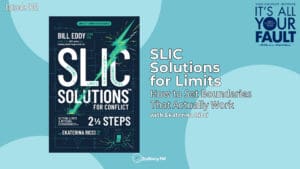
So people have to decide, am I willing to set limits and impose consequences? Of course, there’s a little book I would recommend for that: SLIC solutions for conflict, setting limits, and imposing consequences in two and a half steps, published by Unhooked Books and Megan Hunter.
Megan Hunter
And written by Bill Eddy and Ikaterina Ritchie. It’s a great book.
And I’m getting feedback from people who are reading it that it’s opening their eyes, because so many get really attached to our techniques of EAR and BIFF. They’re sticky, they’re memorable, and something I can instantly use. But I think we forget, our brain almost wants to conveniently forget, about setting limits and imposing consequences because it’s hard.
We think it’s hard. But when we teach someone how to do it, I like to think of it as standing up gently. Right? You don’t have to be harsh or mean. Setting limits isn’t mean. Setting limits is a gift.
And you can do it with empathy, attention, and respect. Use an EAR Statement, but it’s really about saying, here’s what I’m going to do. Here’s what I’ve done. Or this isn’t going to work for me. Those are some really simple phrases, especially this isn’t going to work for me, and here’s what I’m going to do.
So you’re not telling someone else, don’t do this, don’t do that. You’re just saying, here’s what I’m going to do.
Bill Eddy
Because you can’t control the other person, but you can control your response to that person.
Megan Hunter
And I see people sit up taller once they realize, oh, I can just say, here’s what I’m going to do, or that doesn’t work for me.
Bill Eddy
Yeah, it doesn’t have to be a major confrontation. Just, you know, when you do that, that doesn’t work for me. And if you keep doing that, this is what I’m gonna have to do.
And maybe we’ll spend less time together, but we’ll still spend time together. Or maybe this is a deal breaker. Like I said earlier, if that’s the case and it may not be safe to say I’m out of here, then be in a safe place when you say that. Don’t just tell someone that maybe is used to hitting you that now you’re gonna leave. That’s when you’re at the most risk.
But I wanted to just enhance what you’re saying about your statements. We say about half the time. That’s the half step. Because the other half the time you’re gonna have someone that’s gonna manipulate you if you give them too much empathy, attention, and respect. And you must stay focused on the consequence, because they’ll say, you don’t have empathy for me, you don’t care. In fact, you’re not a very nice person. I’m gonna tell the world, you know, all because you said I’m gonna set one limit.
And keep in mind, high conflict people like to tell the world how rotten you are when in fact they’re the one that’s misbehaving, because they can’t see it in themselves.
So it’s all tricky stuff, and there’s a full range of possibilities. But I would say the hope in relationships with high conflict people, if you do everything right, still is up to their personality, what they’re willing to do. And if they’re unlikely to work on themselves, then you’re unlikely to see change.
The people that do, maybe you’re a small percent, maybe less than 10% of the 10% with these high conflict personalities. So you have to make your own choices.
And let me mention also a book here. Randy Krager and I wrote a book together called Splitting: If People Get Divorced. But more recently, we put out a book together called Stop Walking on Eggshells for Partners. And she expanded from her book Stop Walking on Eggshells. And the idea is this helps people think through, should I stay or should I go? If I stay, how can I make it work?
So there are resources, but there’s no easy answers in this area. These are people often with an enduring pattern of behavior.
Megan Hunter
Yeah, it’s like they kind of come right up to that line into interpersonal un-effectiveness. And then they cross into it. And it’s just a different operating system and it just doesn’t work the same. And it’s very, very hard to change and to tell that person that they need to change.
Some do come to it slowly on their own. A lot of people with borderline personality will come across things online, on TikTok, and, oh, that sounds familiar. Oh, I’m experiencing that. And kind of get some clarity, where a lot of others really never do.
And so it’s just difficult to have relationships with them. And so if you choose to stay, then, you know, that’s your choice, and you use the skills and you rely on them. And some relationships end up working. They’re not maybe what you expected.
And there are some relationships I’ve seen that, you know, you have one high conflict person and the other person is not, and they somehow figure out how to just live with it. I don’t know. It’s not ideal, but that works for them. Every relationship is different.
But if we go back to the original question, these relationships are hard and they don’t all work. And I like what you said, Bill, that maybe ten percent of the population, they’re somewhere on that high conflict personality range, and only ten percent of them are going to, what did you say?
Bill Eddy
Get better, or we’ll change and improve, yeah. And really outgrow the negativity that makes it hard to be close.
And so, but keep in mind, ten percent of the ten percent, it’s not a huge number. And think about there’s another 90% that you don’t have these problems with. And you may decide, why make my life so difficult every day? Maybe life would be much easier and happier with someone from that 90% of more reasonable people. So that’s a tough choice, but know that that exists.
Megan Hunter
Yeah, and it’s okay to reach out for help about these things. It’s okay to talk, to get perspective from others. Many people who come to us have felt very alone and that no one understands.
So I want to kind of announce a new resource that we’re offering at conflictinfluencer.com. We have a couple of resources already, but they’re going to be kind of bundled together.
And one is New Ways for Couples, and it comes with coaching. And that’s just to learn the four big skills: how to manage your emotions, both people; how to have moderate behaviors; how to have flexible thinking; and how to check yourself. The four opposites of the recurring pattern of high conflict personalities.
So we have that, and then we are starting a whole new thing called Should I Stay or Should I Go? Or something like that. The title remains to be nailed down, but that’s the question we get so often: should I stay in this relationship?
So we’re going to have all the resources under there and support that you could ever need. We’ll put that link in the show notes and we’ll be talking about it in future episodes as well.
So thank you, listeners, today for listening. And thank you to the one who sent in that most excellent question. It’s actually helped many people who have had consultations with us since you sent that in. And through this podcast and other things we do, we’ll help many more. So thank you.
And you’ll find all those links in the show notes. If you are looking for training, either as an organization, as a company, or even for yourself as an individual, visit us at highconflictinstitute.com for the professional side and conflictinfluencer.com for the personal side. Keep learning and practicing skills. Be kind to yourself and to others while we all try to keep the conflict small and find the missing peace.
It’s All Your Fault is a production of TruStory FM. Engineering by Andy Nelson, music by Wolf Samuels, John Coggins, and Ziv Moran. Find the show, show notes, and transcripts at truestory.fm or highconflictinstitute.com/podcast. If your podcast app allows ratings and reviews, please consider doing that for our show.