*This transcript is produced using transcription software and reviewed for quality. Despite our best efforts, some passages may be incomplete or contain errors due to audio quality or software limitations.*
Megan Hunter
Welcome to It’s All Your Fault on TruStory FM, the one and only podcast dedicated to helping you with the most challenging human interactions, those involving people with high conflict personalities. I’m Megan Hunter and I’m here with my co-host, Bill Eddy.
Bill Eddy
Hi, everybody.
Megan Hunter
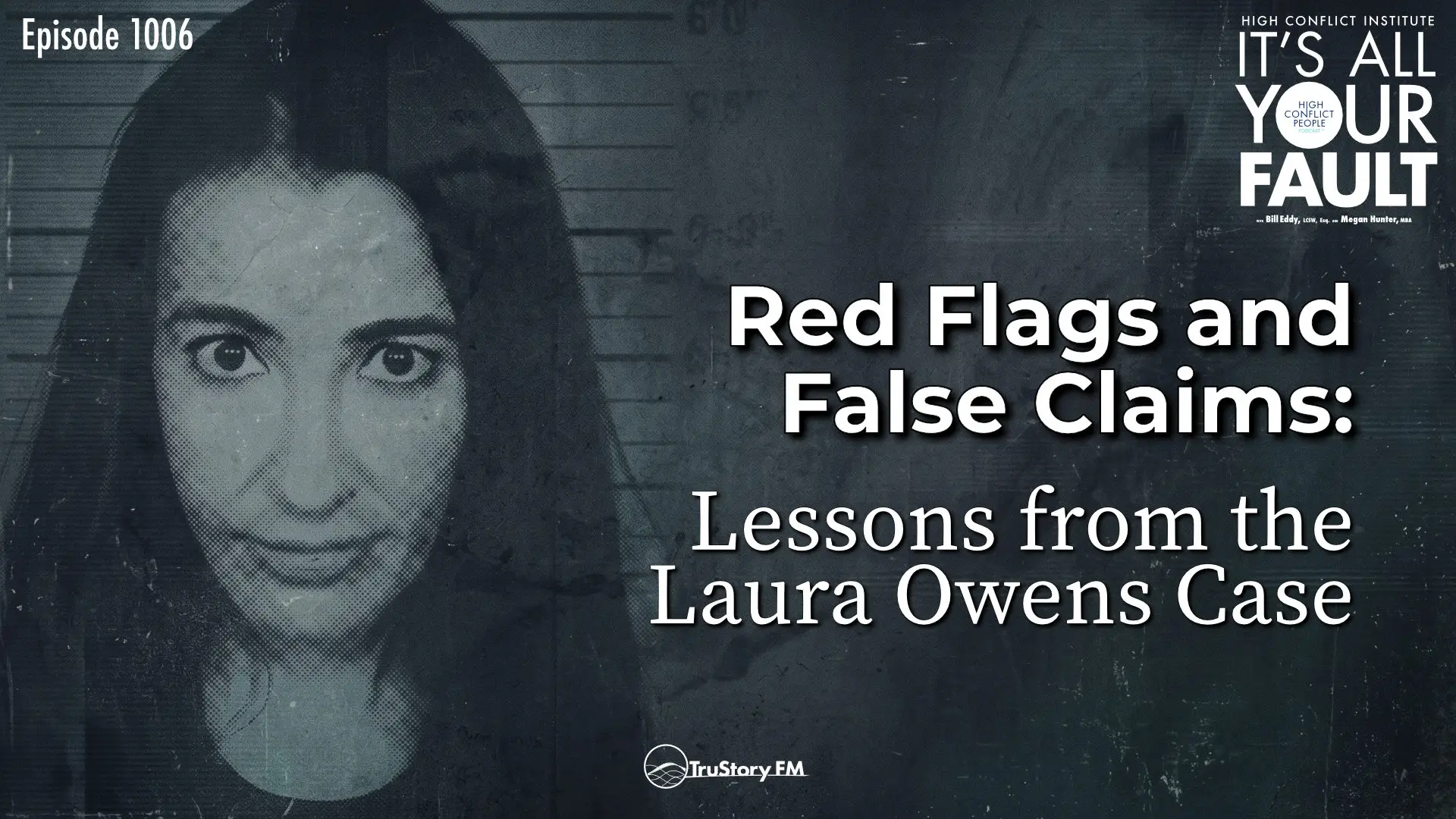
We are the co-founders of the High Conflict Institute and ConflictInfluencer.com, where we focus on training, consulting, coaching, classes, and educational programs and methods all to do with high conflict. Today we’re talking about a case that sounds almost unbelievable. It involves alleged pregnancies, romantic relationships that ended badly, hundreds of messages, legal threats, fabricated medical evidence, and several men who found themselves drawn into lengthy and costly legal battles. At the center of it all is Laura Owens, an Arizona woman whose allegations against former Bachelor star Clayton Echard, I think that’s how you say his last name, attracted national attention. But the Clayton Echard case wasn’t the beginning of the story.
Years earlier, other men had experienced conflicts with Owens that featured some striking similarities. We’re going to walk through the timeline beginning in 2016, examine some of the text messages and emails, and discuss the behaviors that turned brief relationships into major legal disputes. This isn’t just about a sensational story. It’s about what happens when someone won’t accept the end of a relationship, when threats and allegations become tools of pressure, and when the legal system itself becomes part of the conflict. We’ll also discuss how someone can respond without making the situation worse and why the advice to communicate, compromise, or explain yourself may fail in certain high conflict situations, and ultimately how to recover from being a Target of Blame. Welcome, listeners. Thank you for joining us as you soak in your jacuzzi.
All right, Bill, let’s dive in. One important clarification first is we’re discussing, you know, documented court findings, criminal convictions, and allegations that are all contained in court records. We’re not sensationalizing anything. We’re not diagnosing Laura Owens or anyone else with a personality disorder. So we’ll start from there. So in 2016 till about 2018, Laura Owens and a man in California, Marraccini, began dating in San Francisco, about in 2016. According to Marr, I think it’s Marraccini, and witness declarations filed in later litigation, Laura Owens claimed to be pregnant during the relationship. The purported father, Marraccini, alleged that she subsequently admitted fabricating a pregnancy claim because she did not want to lose him.
Owens has disputed aspects of this account. Their romantic relationship ended in 2017. And then we move to 2021, Greg Gillespie. Owens and Gillespie met in Arizona and went on several dates. Gillespie decided not to continue dating. Owens then told him she was pregnant and later claimed she was carrying twins. On August 6th, Gillespie received an ultrasound image. According to documents compiled from the litigation, a reverse image search linked it to an existing online image. On August 11th, Owens sued Gillespie, alleging abortion coercion, domestic violence, and intentional infliction of emotional distress. Protective order proceedings followed.
Then in 2022, Owens appeared in a TEDx talk describing an abusive relationship. Litigation and protective order disputes involving Gillespie continued. The separate court proceedings did not establish that every allegation made by either party was true. In May 2023, Clayton Echard enters the story. May 17th, Owens contacted Echard, who was working as an Arizona real estate agent. May 20th, they had a sexual encounter, which Echard said did not involve intercourse. May 21 through 25, Echard declined to pursue a relationship and eventually asked Owens to stop contacting him. June 1st, Owens notified him of a positive pregnancy test, 12 calendar days after their encounter. Prosecutors later presented evidence about her use of hCG injections and the falsification of pregnancy evidence.
Between June and December 2023, Owens sent Echard numerous emails connecting pregnancy decisions with whether he would pursue a relationship. Reports describe a proposed dating agreement, changing messages about abortion, and the claim that she was carrying twins. In August, Owens filed a paternity action. In September, the controversy became public. In November, protective order hearings took place. By late December, Owens reported that she was no longer pregnant and sought to dismiss the paternity case. Now we go to June 2024. Following a June 10th evidentiary hearing, Judge Mata issued a ruling on June 18th. The court could not establish that Owens had been pregnant with Echard’s children, found that her paternity proceedings had been brought in bad faith, and determined that she had provided false testimony. The court awarded Echard attorney’s fees and referred the case to prosecutors for possible criminal investigation.
Now we go to 2025. May 6th, the Maricopa County Attorney in Arizona announced felony charges involving the Echard case. By November 6th of that year, prosecutors announced additional felony charges arising from Owens’ 2021 interactions with a second man, whom public case records identify as Gillespie. Separately, Marraccini’s restraining order trial proceedings in California ended in 2025 when a renewal request was dismissed after Owens did not appear. So now we finally get to 2026. On August 28th, Owens pleaded guilty to four felony counts in a negotiated resolution of the two criminal cases. 10 other charges were to be dismissed. On October 23rd, which is just last Friday, she was sentenced to 30 days in jail and seven years of probation. The sentencing judge considered the harm to the men involved while determining that a prison sentence was not appropriate given her criminal history and the nature of the offenses. So, Bill, there’s, you know, a lot of email communications I have here, but in the interest of time, I think we probably don’t need to read all those because I think there’s enough information here for us to have a pretty good idea of possibly what’s happening and what these patterns might be.
So first thoughts, let’s talk about, you know, what’s going on with this pattern.
Bill Eddy
I think you said it right, possibly, what’s going on. So we can talk about possibilities, especially ones that ring true with other cases that I’m familiar with. Some people have a pattern, well, I’ll just call it the borderline personality pattern, which is preoccupied with fears of abandonment. And so I remember reading about a case years ago where a guy was ready to break up with a woman and he’s about to tell her and she says, oh wait, I’m pregnant. And so he decides, oh, okay, I guess the honorable thing to do is to marry her. So he marries her. Nine months later, there’s no child. And it seems to go, because I’ve heard this story several times, that it’s that wanting to cling, wanting to not be abandoned may be what’s driving this case. And of course, borderline personality is wide mood swings, very charming sometimes, very angry sometimes, sudden intense anger, unstable sense of self, unstable relationships and manipulation. All of those seem present here, but I can’t say. So these are just possibilities.
Megan Hunter
And on that point, Bill, some of the emails or messages that were sent from Owens to Clayton Echard were a June 28th email that included this phrase, “Having the baby if I don’t hear back from you tonight.” Another one, she presented a decision about continuing the pregnancy that depended on whether he would give the relationship a chance. So it seemed that there was, you know, she described these pregnancy decisions in ways that appeared to depend on his willingness to date her or to spend time together, which seems to fit sort of that “I need to feel connected” pattern.
Bill Eddy
Exactly. But I want to add the willingness to lie, to fabricate all of that also is often associated with another personality known as antisocial personality or sociopathic personality. Again, these are possibilities that could be looked into, but people with that pattern engage in a lot of lying, conning, fabricate entire events, often are involved with the criminal justice system. Maybe 40 to 50 percent of people in prison have antisocial personality disorder because it’s a narrow pattern they repeat and repeat and repeat. And so that’s something else that could be looked into or may have been looked into. But a prediction with both these patterns is if they’re at the level of a personality disorder, they’re fairly unlikely to change, especially antisocial.
Borderline, there’s some good treatment if people get into it, DBT, dialectical behavior therapy, et cetera. Although I’ve seen people in legal cases not really respond well even to that therapy. They’re so locked in, and it may be because they also have antisocial traits. But the thing is, if that’s a personality pattern, this is gonna happen again and again and again, and her relatively light sentence may be missing an opportunity to drive home a lesson that, you know, this is going to not work well for you if you keep it up. It may send a message, “Well, hey, you only got 30 days in county jail. You didn’t even go to prison. You know, maybe next time won’t be so bad either.” And we know people that repeat these patterns of behavior unless they’re really shocked into having to stop and restrain themselves. So I’ll be curious to know. I wouldn’t be surprised if we hear more about her in the future.
Megan Hunter
Well, let me add just one little piece of information here, that when in her statement to the court at sentencing and her parents’ statement to the court at sentencing, all three said that she had been basically persecuted online and demonized online, you know, death threats, I think, to the family and to her. And so she’s dealt with a lot. So those are also natural consequences. Do you think that, I mean, in their words, and not to quote exactly but paraphrasing, you know, she’s been punished. She’s suffered punishment.
Bill Eddy
Well, I think it’s a setback for her, and nobody likes to be attacked online, and there’s a lot of piling on all online, probably majority of it against people unfairly. So it may have an impact on her. And all of this, everything I’m saying are possibilities, because of what we know about the case, which is a medium amount, but I’ve never interviewed her. I can’t diagnose her. But I would think people should consider these, especially people in relationships where someone may be lying to them, understanding this does happen and that, you know, the diagnostic manual says about 4.5 percent of adults have a cluster B personality disorder, which includes borderline, antisocial, histrionic, and narcissistic, and many people have some of all of those traits. And so that’s, you know, 4.5 percent of what, 350 million people.
Megan Hunter
That’s a few.
Bill Eddy
That’s a fair amount of people.
So I think hopefully the lesson people will learn is we’re not saying what her diagnosis is because we don’t know, but we’re saying possibilities and patterns of behavior to consider when similar things happen to you.
Megan Hunter
Yeah, and we’ll talk about that next. But first I wanted to also say that if you watch the sentencing or saw any pictures in the media of Laura, it’s really kind of tragic seeming, as she stated in court that she now weighs 85 pounds. And you look at pictures of her from a few years ago, this beautiful, kind of thriving young woman, to now someone who looks very tragically ill. You know, there’s a lot going on there and I think we can have compassion for people that are tragically ill, physically or mentally. And at the same time, the courts and the justice system are there to, you know, mete out justice and the laws must be followed. So kind of following up on our conversation in a previous episode on mental health and criminality and what are the courts to do. That one was in relation to the Lindsay Clancy case. You know, I think the courts are probably dealing with a lot of this, and it has to be really, really challenging. So, you know, we wish for everyone in the case the best because look, the men went through a lot, and there was a lot of social shaming and pressure and targeting and just, you know, it’s consumed a large portion of their lives. So it’s kind of a big deal. So let’s move on to, you know, spotting this. And I did bring our book that we wrote together, Dating Radar, right?
Bill Eddy
Yep, yep.
Megan Hunter
And it’s not meant to say that Laura Owens is a bad person. It’s not that at all. It’s just there are some people who aren’t, you know, you should get to know people before you get into, you know, a relationship that’s going to tie you together by a baby or, you know, any other entanglement for the rest of your life, or even for five years or a year, because it can be hell. And that’s the subtitle of our book, “Why Your Brain Says Yes to the One Who Will Make Your Life Hell.” So I think if you ask these men, did this make your life hell, they’d probably say yes. I’m quite confident, after hearing them speak at the sentencing hearing. So Bill, what did we say in this book about spotting this kind of in advance or along the way?
Bill Eddy
Well, the first thing is we said wait a year before making a major commitment, like getting married, having a baby, buying a house, starting a company, that kind of stuff. Because these personality traits usually come out within a year, but often can be covered up for a few months. And so people should get to know the full person, not just the wonderful person on the surface. And this isn’t to say that wonderful, charming people always have a high conflict personality under the surface. There are people who really are charming, sweet, innocent people, but you need to do some research from your own experience and, if you can, talking to people that know this person. There’s something to be said for the cultures that had arranged marriages where two families investigated each other and then they said, “This is a good match.” We don’t do as much investigation. We kind of shut down parts of our brain when we fall in love and the chemicals are going and sex is great and it’s so exciting.
And then you find out that this is who you’re attached to. So we talk about some of the predictive patterns of behavior like borderline, like clinging, and especially watch out for the person, your dating partner’s way of interacting with other people. In other words, if they treat the waitstaff at a restaurant really terribly, someday they’re going to treat you that way. So things like that.
Megan Hunter
In this case, I would kind of reckon that she might be one to treat waitstaff in a restaurant with charm somewhat. I think there was probably a lot of charm in the beginning of these relationships. And, you know, I think about this, the pattern that seems to be present here with, you know, three successive relationships that resulted in seeming pregnancies, with one of them not even having had sexual intercourse. You know, there were some other hanky panky things going on, but not the actual thing that makes a baby. And that’s why these cases are kind of crazymaking, or these relationships are crazymaking, because I mean, I would think this man would know, well, we didn’t have intercourse, so how could she be pregnant? But somehow, right? And this is, so you really have to think, like, if this feels off, there’s a reason it feels off.
Bill Eddy
Yeah, look into that.
Megan Hunter
Look into it. Keep your head on a swivel. You cannot just be manipulated by sex, right? Or words.
Bill Eddy
Well, that’s interesting because that’s part of what we found out in our book, is that a lot of, I’d say majority of people, we had 300 some survey responses, and people repeatedly talked about this spark, that there was this spark of connection, just like that. And that’s in many ways a cover-up for what’s going to be coming, because they intensely want to connect with you. And I want to make sure, I want to reinforce what you’ve been saying, Megan. These aren’t, in my mind, bad people. These are people who often become this way through life experience, genetic tendencies, the environment, the larger culture they grow up in.
And by the time you’re 20, which we don’t really diagnose personality disorders before that, because personality patterns aren’t really locked in until about 20, even 25. But people don’t have a choice over their genetic tendencies, their early childhood, and the culture they grow up in. So I have a lot of compassion for them. But society needs to be protected. And that’s, and we kind of touched on this last time, my focus is protection of society, not punishment, because you punish someone with criminal behavior, they get out of their punishment. Let’s say they’re sentenced to prison for five years. They get out and then they repeat the behavior.
So punishment to me isn’t really the answer. It may be part of the answer, but protection. And protection in my mind is making people aware of these patterns. But in our book also we talked about self-deception and that basically patterns of beliefs, beliefs about relationships and love, can deceive us. You know, time will fix all problems. Time wouldn’t have fixed this problem.
Megan Hunter
Nope. There was plenty of time here, you know, 10-year span.
Bill Eddy
Yeah. And I can change the person. Maybe they’re 40 and no one else has changed them, but I can change them with time and love. That love will heal all wounds, will change all bad behavior into good. And that’s just not true. So it’s having your eyes open and knowing, you know, some people aren’t ready to get into a healthy relationship. And I hope for them that someday they learn the skills to be that way. But I hope for everybody else that they don’t fall for them.
Megan Hunter
Yeah, I mean, you maybe like to be a fixer, but you’re not gonna fix this. All right. I mean, it’s, and that’s not to be disparaging, it’s just, you know, you’re not qualified as a romantic partner. And that’s why we wrote this book. And those are the consultations we do every day, well, nearly every day, for people who are, you know, entangled either by marriage or financially or with children, with someone who is really dragging them through the mud. And I think in this case about the restraining orders that were filed against these men.
Bill Eddy
Oh, that she got filed.
Megan Hunter
Yeah, yeah.
So there was this repeated pattern and, you know, this was tough stuff on these guys. Restraining orders impact your everything, right? Your career, your livelihood.
Bill Eddy
Oh, especially your reputation.
Megan Hunter
Reputation, all of it.
Bill Eddy
Yeah, yeah.
Megan Hunter
So how do we respond to false allegations in court? So these men had some false allegations, let’s say even just the restraining orders. How do you defend yourself?
Bill Eddy
Well, my conclusion, and this comes out of mostly high conflict divorce cases, is that high conflict people communicate emotionally and with emotional intensity and emotional words, they can hook the emotional part of a judge’s brain and make the judge go, oh, well, this is horrible. I’ve got to do something. I’ve got to issue this restraining order. And let’s say a vast majority of restraining order requests are valid and should be fulfilled, but there are some that are false. So the way to match that really is to gather your evidence, but present it with simplicity. Because high conflict people communicate with simplicity, with repetition, and with emotion. And so you need to keep it simple. And I suggest maybe make two or three key points and repeat those over and over.
“And Your Honor, here’s another example of false statements by the defendant,” or whatever, so that it’s easy to absorb. Our brains like shortcuts, so you have to do the shortcut for them. Keep it simple, keep it repetitive, and mildly emotional, because you have to be somewhat emotional, but then you don’t want to look over-the-top emotional. So by saying “false statements,” false statement is a mildly emotional term. “Here’s another false statement.” But your evidence has to support your themes. So if you have two or three themes you repeat a lot, then get your evidence in that kind of puts it over the top, because high conflict people generally don’t have the evidence, they just have the emotion, simplicity, and repetition.
Megan Hunter
Yeah.
Bill Eddy
So I would suggest for anybody in a relationship, legal case, relationship related, is read chapter 14 of my book, Splitting: Protecting Yourself While Divorcing Someone with Borderline or Narcissistic Personality Disorder. So chapter 14, I talk about presenting your case in court, whether it’s with a lawyer or on your own.
Megan Hunter
So we’ll put that link in the show notes along with the Dating Radar link as well. So I want to circle back, Bill, to the sentencing. I listened to the judge’s remarks. I think they’re about 10 minutes long, and he was really torn between, you know, like this is another tragic, tragic situation and, you know, will prison do any good? So getting 30 days of county jail plus seven years of probation. And the request from her parents and from Laura herself was, “Look, my dad has Parkinson’s, he’s in a wheelchair, my mom can’t take care of him alone, she needs me to help, and the pets are at home and I need to take care of the pets, and, you know, I’ve been punished enough already.”
So, you know, what’s a judge to do? It’s a tough place to be, I’m sure.
Bill Eddy
I mean, was she in prison before the sentencing or she was out on bail, do you know?
Megan Hunter
I think she was out on bail, but I’m not absolutely positive.
Bill Eddy
Yeah. You know, my own thoughts are, like, she needs like three to six months separated from society to really have this sink in. “This is not comfortable and I never want to go through this again.” I’m not sure that 30 days will communicate that to her. It’s a very specialized question with each person, what will get through to them. And it won’t make her necessarily change her personality and her approach to life, but it may make her stop herself before engaging in things like this again. That’s why I said I feel like, you know, 30 days, there’s probably a good chance you’re going to see this behavior happening again. And the other thing is if she mostly, if she primarily has borderline personality disorder, I would hope that she’d be required to get into some treatment for that, and maybe learn some skills for managing fears of abandonment and learn some skills for managing relationships better. Because the treatment methods like dialectical behavior therapy teach self-managed emotions, teach relationship management and all of that. If she’s primarily antisocial, then it’s mostly giving her enough of a prison sentence that she doesn’t want to go back to prison, because they generally don’t change. And so it’s the threat of prison that often gets their behavior to at least be restrained.
Megan Hunter
Well, and I think that was included in the order, that there was a pretty, you know, strict probationary conditions, which could get her sent to jail if she violates. So hopefully that will, you know, give some pressure as well. I mean, I think she’s gone through a lot. The consequences have not been just on her and not just on the men, but also on her family who, you know, as it was reported, are about to lose their home because they’ve sunk the money into all these legal cases. There are a lot of consequences all the way around. So now let’s wrap this up with talking about the men, and they were, you know, what we call a Target of Blame or target of focus, right? So became a target, started as a target of focus and became a Target of Blame with the restraining orders and then, you know, all this litigation. So I think that in the end, in the sentencing hearing, Laura did take some, you know, responsibility.
The men were there in court and spoke as well, and, you know, of course their lives have been upended. So how do they recover from being a Target of Blame and going through all of this and just moving on with their lives?
Bill Eddy
First of all, just understand what happened and that there are people like this and that it’s not their fault. And that’s such an important thing. People feel like, what did I do to make this happen? Or do I attract people like this?
Megan Hunter
How could I have missed it? How come I was so stupid? Right?
Bill Eddy
Right, right, right. And so these patterns aren’t generally explained in society, certainly not growing up. And so unless they listen to our podcast, they may go through life never realizing that there’s everyday appearing people that have some real serious patterns of behavior problems. And that’s one of the big things about personality disorders is they look normal on the surface. There’s no, you know, horns coming out of their head or things like that. So people need to really learn. So I’d say one of the first things they should do is to read the book Dating Radar so that they don’t stumble into this again and they understand what happened to them. Because we have many examples in there of people who were taken advantage of and only realized it a year, sometimes even two years later. So I think gaining understanding of what happened, but I also think being in a good therapy relationship with a therapist to really work through the emotions, the loss of the fantasy that was created in their relationship with these people.
It wasn’t the real person, it was the fantasy, and they’re good at creating fantasies that people buy into. We all want unconditional love and, you know, have as much money as we could ever want and have the perfect home and the perfect partner and all that stuff. Well, that can be manipulated by this small group of people, but that’s in the millions, so it’s not too small. 5 percent of the population generally. And also having a good support system. People, friends you can talk to, people that like you for who you are, and doing activities. Don’t just spend time licking your wounds.
You want to be engaged in life. And that’ll help you grieve and heal the loss, and the loss of the fantasy of this relationship. Because my guess is in court, even standing there, they had twinges of positive feelings for her because they had had that during their relationships.
Megan Hunter
I don’t know. I don’t know about that one, Bill.
Bill Eddy
Maybe not by now, I don’t know.
Megan Hunter
Well, I think just because in this case they were very short relationships, very brief relationships.
Bill Eddy
Yeah.
Megan Hunter
From what I understand. So they might not have had a lot of positive feelings because, you know, the allegations happened very quickly about pregnancy. So I would agree with you that in most circumstances, a longer relationship, you would have some of those positive feelings because those are stored in your brain too. So it’s going to be natural to do that. Anything else on that, or can I go to a next question, or a little bit of comment about therapy?
Bill Eddy
Those are the main things: therapy, understanding, and support groups. So go ahead.
Megan Hunter
Okay. So this focuses on therapy. You know, if you’re a therapist and let’s say you have a Laura Owens come into you and there’s, you know, “I’ve been dumped by these men who aren’t standing up for me.” Now I’m just, like, I’m making this up for clarity, right? But, you know, this happens. It’s hard for mental health professionals often to kind of know what’s going on, what’s truth and not, when you’re only getting one side of the story. So it behooves all mental health professionals to really be trained on personality issues and patterns of behavior. And I am really happy to say that, something I mentioned last week in our last episode about our mental health certification course taught by you, Bill, that we received approval by the American Psychological Association just today, as we’re recording this, for continuing education credits.
So if you’re a mental health professional, we’ll put that link in the show notes. And there’s lots of discounts you can get on it too. So it will really educate you on what high conflict personalities kind of look like, and what this looks like in a family court case and many, many different realms of it. Eight hours’ worth. So I think you’ll love it. So thank you for recording that, Bill. I think it’s necessary.
Bill Eddy
Thank you for getting it through the paperwork. I know there was a lot of that. Let me back up and say one more thing to therapists about these cases. And that is you have to have a healthy skepticism and consider the possibility when your client tells you something awful is happening to them, consider it may be true. Consider it might not be true, especially with personality disorders, or consider that your client may be a victim and also a perpetrator. And this is true with men and women. The antisocial personality that fabricates the most, three-quarters male, but one-quarter are women. And the question is whether that was true in this case or not. But when therapists reinforce stories that are false, they often escalate cases into legal disputes that might not have gotten there without the therapist’s encouragement.
So I think the best thing for therapists is to say, “You need to understand that this isn’t always believed, and your case may be true, and you need to talk to a lawyer or a specialist of some sort to figure out what to do. What I can do as a therapist is help you look at possibilities, help you manage the emotions, help you look at alternative actions that you could take from here. But I can’t say I know what’s going on, because I’ll never know what’s going on for sure. But you have my empathy and support and I want to really help you.” That’s the kind of message therapists have to give.
Megan Hunter
That’s excellent. Absolutely. Well, thank you, Bill, and thank you to all of you listeners. If you have any questions, go to our website. There’s a link in the show notes where you can ask questions or give feedback. And if you’ve experienced a situation with someone who’s repeatedly refused to accept your limits, or you’ve been falsely accused, or something, remember that you don’t necessarily, you know, have to persuade that person to agree with your decisions. You have to look out for yourself, right? You can focus on your own behavior, boundaries, protecting yourself.
So get our book, Dating Radar. Get it for your teenagers, get it for your 20-somethings. And until next time, if you’re looking for training or consultation about a high conflict anything in your organization and want to be conflict ready, visit us at HighConflictInstitute.com. And if you have a high conflict situation in your personal life, visit ConflictInfluencer.com. Keep learning and practicing skills. Be kind to yourself and to others while we try to keep the conflict small and find the missing peace.
It’s All Your Fault is a production of TruStory FM. Engineering by Andy Nelson. Music by Wolf Samuels, John Coggins, and Ziv Moran. Find the show, show notes, and transcripts at trustory.fm or HighConflictInstitute.com/podcast. If your podcast app allows ratings and reviews, please consider doing that for our show.