*This transcript is produced using transcription software and reviewed for quality. Despite our best efforts, some passages may be incomplete or contain errors due to audio quality or software limitations.*
Megan Hunter
Welcome to It’s All Your Fault on TruStory FM, the one and only podcast dedicated to helping you with the most challenging human interactions, those involving high conflict situations. I’m Megan Hunter, co-founder of the High Conflict Institute and ConflictInfluencer.com, along with my co-host Bill Eddy.
Bill Eddy
Hi, everybody.
Megan Hunter
The other co-founder, where we focus on training, consulting, coaching, classes, and educational programs and methods, all to do with high conflict.
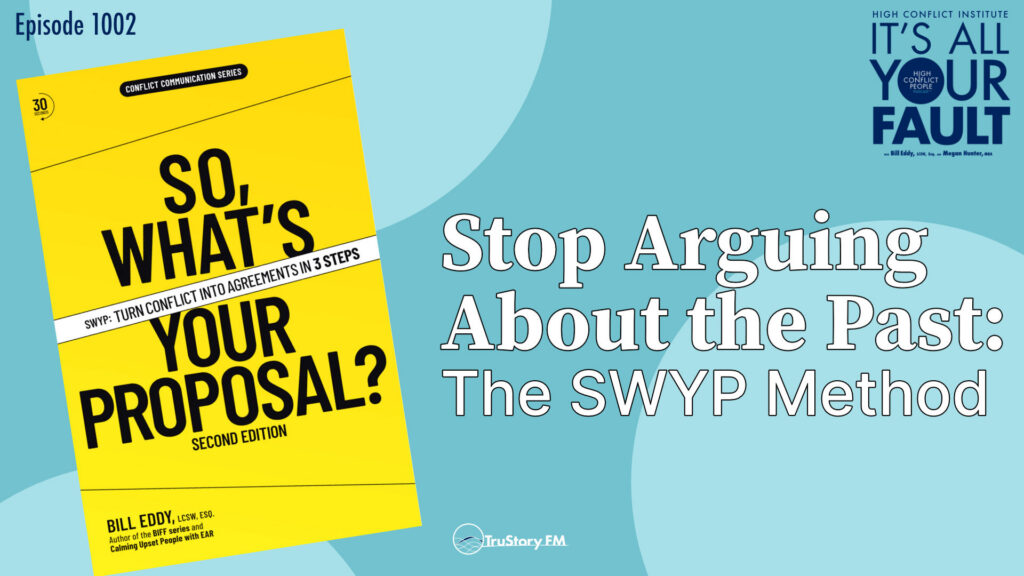
Today we are answering your questions, listeners. It’s been a long time since we’ve done this, so we thought we better get to it. So we have quite a few to get through today. And we’ll of course put a couple of mentions in about Bill’s new book coming out in November called SWYP. So, What’s Your Proposal? Turn conflicts into agreements in three steps. We’ll put that link in the show notes, but let’s get rolling here, Bill, on our first question. This one is school and education related. Dear Bill and Megan, I recently started listening to your podcast after finding myself in a complex situation at my daughter’s school, and I found your breakdowns of high conflict dynamics incredibly helpful. I’m writing to ask for advice on managing a highly reactive parent dynamic within the specific structural environment of a public parent participation co-op elementary school.
So the situation is earlier in the school year, a parent at our school consistently encouraged her daughter to seek out mine, explicitly telling me several times that she instructed her child to stick with mine. Over time the other child began displaying unpredictable behaviors toward my daughter, specifically physical contact without consent, insulting language, and attempting to prevent the other children from playing with her. To handle this constructively, we requested the classroom teacher’s assistance. The teacher stepped in and worked to establish a healthy physical and social separation between the two children in the classroom. Once this separation began, the other parent’s behavior changed significantly, and she began speaking negatively about our family to others in the community. This culminated when the kindergarten girls had a routine playground dispute over a game of chalk tic-tac-toe. The parent escalated the incident by sending an urgent email to the school administration copying multiple individuals, framing our family as a safety concern, and requesting a social separation. The current status. The school administration has been collaborative. The classroom teacher issued an email directing both parties to cease communication regarding this specific situation.
And the administration has finalized a plan to place the children in entirely different classrooms for the upcoming school year. However, because this is a co-op school where parents must frequently volunteer on campus, attend community meetings and share a mandatory WhatsApp channel for classroom logistics, complete separation is not structurally possible. My question for the show. Traditional parenting advice often suggests staying in these environments to help a child build resilience against difficult personalities. However, the ongoing stress of managing forced adult proximity is challenging. So how do you practically maintain boundaries when the other party uses physical proximity at required school events? Clearly glaring, whispering, pulling her child away and whispering to her, which results in more glaring, to try to prompt a reaction. This as well as making chats outside of school and asking community members if we’ve RSVP’d to events to make known that they will not be in the same space as us. At what point does a parent’s focus on building a child’s resilience shift to an executive decision to simply find a more peaceful school environment?
Thank you for your time and insights. All right, Bill. So that was a long one, but it’s thorough and complete and helpful for that information. So what do you think?
Bill Eddy
Well, several things. There’s really three layers to this. And first of all, I want to really empathize with the parent going through this because unfortunately, this isn’t the first case like this I’ve heard of. There’s a specific one that there ended up being a substantial article about in a major newspaper about five years ago. Since I can’t remember exactly where or what it was, I can’t refer the person to that, but it was very similar. So this pattern is not that unusual for a high conflict person. Remember high conflict people are preoccupied with blaming others, a lot of all or nothing thinking, unmanaged emotions, and often extreme behaviors, and we’re certainly getting extreme behaviors in this example.
So there’s three levels. How should, I think it’s a mother describing this, deal with the other parent? How should the mother deal with the organization and other parents, the school? And how should her child deal with the other child? First of all, I don’t think kids should be overloaded to learn resilience by overloading them, that high conflict situations often aren’t healthy for them and they shouldn’t have to be exposed to them. Low conflict is important to learn how to survive in life, get along, manage things, etc. But high conflict isn’t healthy for children’s brains, really. There’s a lot of parenting research with personality disorders and also in divorce about how children’s brains need to be protected from high conflict.
So if we start with the child, that’s a good move that the other child’s in a different class. I don’t know how soon that takes effect. In the meantime, if there is contact, it sounds like getting the teacher involved has been good and necessary. People should understand that the child really appears to express the same pattern of behavior that the other mother does. And the pattern in this case includes a lack of boundaries. And we see that with a lot of high conflict people. Physical boundaries, touching when they shouldn’t be touching, emotional boundaries, talking about things that are really inappropriate. As well as sharing anger with a child. So I’d be concerned about that child just absorbing that parent’s approach to life, which is a high conflict approach. But let me move on to responding to that parent and then talking about the organization.
Let’s say the questioning mother, the person who’s written to us, in dealing with the other mother, the best thing is setting limits on contact and not emotionally responding to her. So if she gets glared at or comments are even made and stuff, just really just try to avoid the situation, not engage. You’re not gonna change someone like that. You’re not gonna point at them and say, can’t you see what you’re doing? Because they can’t see what they’re doing. So mostly staying disengaged, and it sounds like she probably is. But at community events, just trying not to interact, et cetera.
The biggest concern I have here is the organization and the risk that other parents will absorb the complaints that the potentially high conflict parent’s doing. There’s two options here. And there have been other school issues where I’ve suggested this, that somehow there’s a statement from the school or from the questioning parent that says something about that there’s a concern of trying to think of words other than high conflict behavior.
Megan Hunter
Difficult.
Bill Eddy
Difficult. There you go. Thanks. It’s so good you do this training too, and so we help each other with our language. Yes.
So let’s say the organization makes a statement that sometimes there’s difficult interactions between parents in our school, and we understand that, and there’s always different points of view in any organization, and we would urge people to not make assumptions and to check out rumors and to as much as possible have positive interactions with each other, something like that, because in a small school people are going to get wind of this conflict. And a statement like that from above kind of helps keep it within bounds. The other thing is the parent could say to other parents, even email other parents, saying, you may have heard that there’s a difficulty between me and one of the other parents in the school. I want to encourage you to contact me if you have any questions about that and not to make assumptions and jump to conclusions. And something like that really helps because people go, oh, okay, so the other person isn’t agreeing with these nasty things that are being said. Because that’s how high conflict complaints get traction, is because there’s no response. And people go, oh, well, must be true.
You know, no one’s telling me it’s not true. And so I think that that’s a helpful thing to do.
Megan Hunter
And on that point, Bill, when do you know whether you’re just, you know, like fanning the flames by responding or, you know, what is that fine line? Do I respond or not?
Bill Eddy
And it’s really hard to say. I think when other people are starting to frown at you, or maybe they don’t talk to you now at a community meeting, then you need to do something. I believe, don’t be surprised, in the BIFF Response, rather than no response. One of the BIFF books, I give an example of a school where there was a teacher, this is years ago, and I won’t say where it was. But there was a teacher that somehow got into a conversation where she mentioned to the kids that Santa Claus isn’t real. And one of the kids told their mother that, and their mother was outraged, just like, I wanted to be the one to say that. You shouldn’t have said that. This is a third grade teacher, so 8-year-old kids. Many of whom have figured it out by then.
But anyway, so the parent, instead of really dealing directly with the teacher, went to a local radio station. And told the local radio station how inappropriate this teacher was and mentioned her name. And it was one of those, you know, jock radio things where there’s a lot of laughter and humor and all of this. And so the radio host started laughing about this person too and how, you know, inappropriate she was and this and that. And so the whole school was exposed to this controversy. So what they did is they decided to put a note in the school newsletter basically saying, you may have heard there’s a dispute. We believe in our school of protecting children from uncomfortable and inappropriate information.
A statement was made which is kind of on the border of whether that’s okay or not. We’ve addressed the situation, and if anyone has questions for us, please let us know. We want everyone in our school, the children and adults, to feel comfortable. So thank you for your support, stuff like that. So that’s essentially what it said. And that may be necessary in this case, either her personally or the school organizationally, to have some kind of a vague but boundary-setting statement. And sometimes occasionally high conflict parents are asked to leave the school. And that’s sad because the kids end up, you know, losing out on peers, etc. So that’s my off-the-cuff answer.
Megan Hunter
Okay. And if schools don’t kind of lean into this and, you know, sort of let their limit be known, it really does give high conflict people a lot of wind, right? They have to be informed what the limits are, and I can’t get away with this. They’re not thinking of it on their own. And I think that’s very important to remember.
Bill Eddy
Yeah. Also with that is they’re not self-aware. That’s one of the things of high conflict people. They think all of their behavior is justified because of what other people have done, and they don’t see that they set in motion what other people have done. So when people set limits on them, they’re outraged because they can’t connect the dots back to, well wait, I was the one that put this in motion and now I’m having limits set that I don’t like. That lack of self-awareness is so important because so many people point their finger and say, can’t you see your part in this problem or you’re causing this problem? And they can’t, and saying that makes them act worse, not better. So the better thing is set boundaries, back off, don’t engage. And as an organization, you may need to do some notice that sets limits, like I suggested.
Megan Hunter
Yeah, and it doesn’t need a lot of thought put into it really. I mean, as far as perseverating and spending hours and hours of, you know, committee meetings, board meetings, or even just an individual overthinking this. Just set the limit and move on. I think that’s really one of the key parts of high conflict management is just don’t waste a bunch of time. You don’t need to.
Bill Eddy
Right, right, right, disengage.
Megan Hunter
Disengage. All right. Here’s our second question. Hi, Bill and Megan. I’ve listened to probably 10 and a half hours of your podcast at this point, and it’s given me so much relief from feeling like I’m losing my mind regarding my relationship with my adult brother. He is around nine years older than me, divorced, and now has three children and in his third serious relationship within the past three years. We were never close, mostly due to our age gap, but I recently moved back closer to home to be near family along with my husband. To make an extremely long story short, after living close to family for four years, I became very involved in my niece and nephew’s lives. I have my own car seats for them, toys and kid bathroom necessities at our home.
You get the picture. My brother has been very reliant on our help, but I’d been happy to help because I’ve found so much joy in being an aunt. The kids absolutely adore and love being with us. We’re the cool and fun aunt and uncle who take them to the beach, playgrounds, read to them, cook with them. We love you aunties and uncles. All of us are. It has been a true blessing watching them grow and be such a huge role in their tiny lives. With all of this has come the chaos of my brother and his very unstable dating life, which has resulted in me calling the police to his home and urgently picking up the kids to avoid domestic violence situations with him and his then partner. Fast forward one to two years and things continued to escalate, but now with a new girlfriend. In October of last year, he got a DUI while with his girlfriend.
Myself and my family helped him with the kids, but were shocked, and I didn’t know what to say to him. He became irate when my parents refused to give him $12,000 for a lawyer, and said he couldn’t believe no one asked how he was doing. He ended up sending very dramatic, hurtful, and crazy texts to us saying that we cannot see the children for the foreseeable future and do not contact him. I have not seen the kids for over seven months now, despite me sending him a text every two months or so using your methods. I think she’s meaning me using the BIFF method. But he never responds. It has been so painful to be apart from the kids. My husband and I have both started individual therapy, which has been helpful, but I’m so desperate for help. I know I have no legal rights to the children, but I don’t know at what point I attempt a possible legal case. I’m a heartbroken aunt. My brother very clearly thinks his family were all in the wrong for not sympathizing with his situation of getting a DUI.
I am very suspicious that he is BPD. I know this is a case of isolation, and he is weaponizing his children against us. I’m so sad and concerned about what he could possibly be saying to them about us. They are 12, 6, and 3 years old. We were seeing them at minimum every two weeks, so I know they are aware of our absence. Any advice on how to handle this situation via the podcast would be so appreciated. Thank you so much for your podcast and any feedback I receive. So thank you for sending that question in. I’m sure it’s happened a few months ago, so we’re a little slow on this, but hopefully there’ll be something here that will be helpful for you at this point.
Bill Eddy
What’s sad about this is the situation itself, and it’s also not that uncommon. More often with grandparents who get cut off from the kids, but also aunts and uncles. First, let me just say some of the legal perspective. In general, and this isn’t legal advice, I’m a California lawyer and I can’t advise anybody else, but just generally stating, there was a big decision in the United States Supreme Court many years ago that still basically stands that non-parents don’t really have legal rights to the kids, like they’re saying. And so grandparents and aunts and uncles, if the parents themselves want to cut off those people or minimize their contact, they’re within their rights to do that. Given that, I believe it takes a village to raise a child, and grandparents and aunts and uncles are essential. But the law is more designed on property rights and sees, in a sense, in my mind, sees children as another form of property.
So that’s why the village gets cut out if the two parents want to cut the village out. With that said, there’s some common strategies for dealing with alienation. This is similar to where a parent alienates the kids against the other parent, often unconsciously, by things they say and do. So one of the pieces of advice in those types of cases that I would suggest here is when there’s kind of normal times for sending notes and cards like birthdays and holidays. We’ve got holidays coming up.
Megan Hunter
Graduation.
Bill Eddy
Yeah, to send a note that’s short, just a sentence or two, congratulations on graduating. I love you and wish you all the success in the world. Happy holidays, this and that. Don’t say, you know, I miss you or my brother’s a jerk.
But just a nice, a nice note. But also make a photocopy of it, take a picture of it, because the child may never get that, but someday there’s a real good chance you’re going to end up connecting back with them. Hopefully not waiting until they’re 18 and older. And keep in mind if someone has BPD, borderline personality disorder, they do things like this. There’s a lot of all or nothing thinking. And that includes wide mood swings, which often include coming back around.
Megan Hunter
Oh, that’s interesting.
Bill Eddy
Yeah. I think of cases I’ve been involved in just the last couple of years where there was an effort to really exclude a parent. And then suddenly it’s like, hey, can you take the child for the next two weeks?
And next thing you know, it’s not only working well, but now the parent has a child living with them.
Megan Hunter
The mood swings are coming from when someone’s in that React brain, they’re going all or nothing. And then when they calm down, maybe over a day, maybe longer, it suddenly I think is almost forgotten in a way. Like, what are you talking about? I never said that.
Bill Eddy
Right. Well, one researcher, I think it was out of Harvard, he had talked about the right and left hemispheres of the brain, and that people with borderline personality often have a smaller corpus callosum and it’s almost like they jump back and forth from left brain thinking and right brain thinking. And right brain seems to be where the defensive emotions, more all or nothing, jumping to conclusions, all that stuff goes on. Left brain’s the more logical, problem solving, use of words and language happens. And it really is as if each of them, when you’re in one, you don’t remember the other. And I think you’re right that that switch back and forth has to do with the brain. So when they’re calmed down, they may go, oh, you want to see your, oh sure, let’s call her up. And as if everything before then never happened.
And that’s often what people describe. Like in the workplace they’ll say, you know, someone was outraged, they were throwing papers and yelling, storming out of the room yesterday. And today they’re like friendly, how you doing? And people feel like saying, well, what was happening yesterday? Let me suggest you don’t ask that question.
Megan Hunter
Yeah, don’t go back.
Bill Eddy
Because you
Megan Hunter
Let’s not open that door.
Bill Eddy
Don’t go backwards.
Megan Hunter
Right.
Bill Eddy
Right. So I think that’s mostly just sending notes when it would be normal. And eventually there’s a good chance that things will loosen up.
Megan Hunter
In this particular listener’s question, it seems like there’s not the, you know, switching back and forth between yes, you can see the kids, no, you can’t. It’s just a all or n— Done. Eliminate you, aunt and uncle, from the children’s lives. So you’re saying kind of continue to send those notes at the appropriate, like kind of more expected times and without expectation, because sometimes those notes are delivered and sometimes they’re not. Right. So there’s some things you do have to, you just keep putting one foot in front of the other and doing the right things that you can, knowing that you can’t control some of this. But what things can be done to kind of reduce the resistance, or should there be an attempt made to talk to the brother, because obviously, as we know, the issue’s not the issue.
And in this case, the brother seems to be more upset that he wasn’t supported during his legal case surrounding the DUI. It doesn’t have anything to do with the kids at all. So what would you suggest in that, if any, connection there?
Bill Eddy
Yeah, when there’s normal kind of family times, like the holidays, might be a chance to reach out and say, hey, you know, we’d like to invite you over, or be nice to get together. How about, and suggest some kind of get together. You never ever discuss the gap. Just try to connect, friendly, superficial level.
Megan Hunter
That’s a t-shirt, Bill. That’s such a t-shirt. Never discuss the gap.
Bill Eddy
Yes. Don’t mind the gap.
Megan Hunter
I like that. I’ve never heard you say that before.
Bill Eddy
Don’t mind the gap.
Megan Hunter
Never discuss the gap.
Bill Eddy
Yeah, because then that puts them back in that defensive mode. And yeah, I’ve done this. I remember I had three young women in their thirties who told their mother they learned about borderline personality and during a visit, they told their mother, we figured you out. Your problem is you have borderline personality disorder and there’s help for that. And the mother responded by saying, get out of my house. I never want to see you again.
And so about a week later, they contacted me and said, what should we do? And what I said is just at some point start superficial contact, never discuss, first of all, borderline personality disorder, never, and that should be a piece of advice people get out of this. Never tell someone that they have a borderline personality disorder or a personality disorder or that they’re high conflict. If you’re right, it’ll go badly. If you’re wrong, people will just be irritated. But if you’re right, it can trigger like months or years of difficulty. So the idea is to come back in superficially and friendly. And
I wouldn’t be surprised if, and I hate to say it, maybe sounds long, but within two years I think you’ll be connecting with those kids again. It may take a while, especially if it’s been seven months. But just gentle stuff, gentle stuff with them, gentle stuff with the kids. There’s a good chance you’ll reconnect.
Megan Hunter
Yeah, I think the most important things here are trying to reconnect with the brother because that’s what he’s craving is connection. And even though he said, get out of my life, underneath the surface is, I want to have a relationship with you. I just don’t know how to do it. And I’m probably too stubborn to come talk to you about it and make that invitation. So I think, super, like you said, doing something superficial and light and sweet and nice to make him feel included and welcome and supported in the family. I think there’s a distinction between using, you know, support and that, you know, validating bad behavior or something, right? It’s okay to support
Bill Eddy
Right, it’s like emotional support as a person.
Megan Hunter
Right.
Emotional support. We’re your family. Right. And hey, what can I do to help out here?
Bill Eddy
Yeah.
Megan Hunter
And look, he may say something really off the wall, like, you know, well pay my fine or pay my legal fees. And you don’t have to.
Bill Eddy
Right.
Megan Hunter
Being friendly and warm doesn’t mean paying someone’s legal fees or, you know, caving to someone’s demands. So then you get to say no, you get to set a limit and then move on to something else.
So at least you’ll have tried and I think, you know, that’s the main point here.
Bill Eddy
Let me fit in here because you’re getting me thinking. It’s important when they send, if they want to send a note to the kids saying, you know, I wish you well, congratulations, that they also send at the same time a card to the parents or the parent so that he doesn’t feel that you’re favoring the kids over him. Because borderlines very much see a sense of rivalry, like, oh no, someone’s getting more attention than me. So the holidays are great. Send him a holiday card, send the kids a holiday card. And that may get through.
Megan Hunter
Mm, yep, I love that. Okay, well, two questions took up our whole block of time, so we’re going to add another episode and answer more questions. Listeners, thank you for sending in those questions. And you can send us questions anytime. Go on our website, HighConflictInstitute.com, go to resources, and you’ll see the podcast there where there’s a link to submit those questions. Bill’s new book, So, What’s Your Proposal? The link for that will be in the show notes. We really encourage you to purchase it now before it publishes in mid-November because early pre-order sales really drive demand. And we’d love to hear your thoughts on it.
So write us and let us know. And if you have questions or thoughts about subjects we could talk about on the podcast, we’d love to hear from you. So just use that same link on our website.
If you’re looking for training for your organization or for yourself, visit us at HighConflictInstitute.com. If you need help in your personal life, visit us at ConflictInfluencer.com. Until next time. Keep learning and practicing skills. Be kind to yourself and to others while we try to keep the conflict small and find the missing peace.
It’s All Your Fault is a production of TruStory FM. Engineering by Andy Nelson. Music by Wolf Samuels, John Coggins, and Ziv Moran. Find the show, show notes, and transcripts at trustory.fm or HighConflictInstitute.com/podcast. If your podcast app allows ratings and reviews, please consider doing that for our show.