Mandy Kaplan:
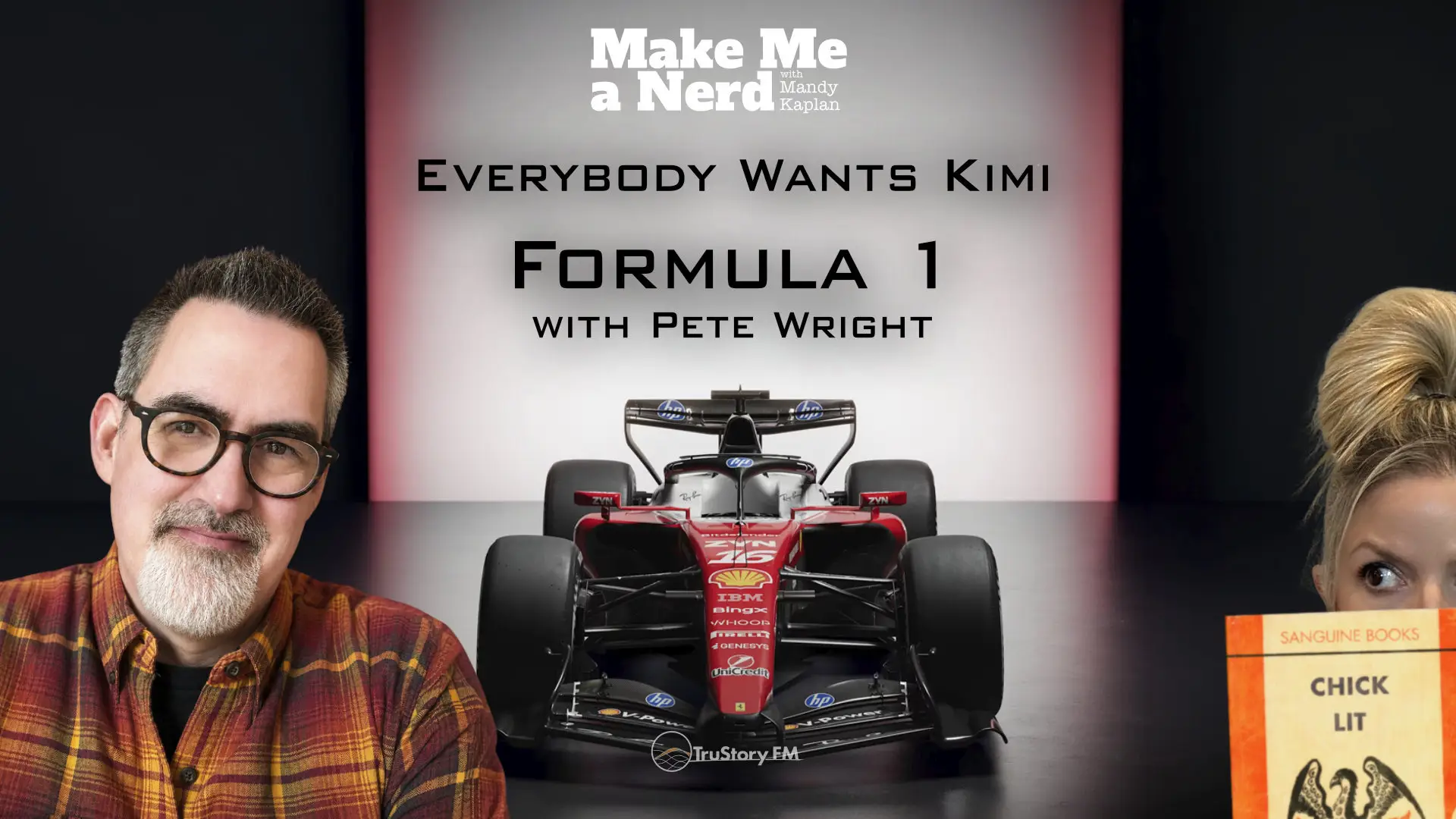
Hello everybody, and welcome to Make Me a Nerd. I’m Mandy Kaplan, a mainstream mom whose mission it is to explore the world of nerd culture that I’ve been missing out on — and afraid of, with good reason — my whole life. I’m very, very excited to welcome back everybody’s favorite, my overlord, Pete Wright.
Pete Wright:
Oh, please.
Mandy Kaplan:
Master of podcasts for TruStory FM. And it turns out, something I didn’t know about this super nerd: he’s super nerdy for Formula 1. Welcome back, Pete Wright!
Pete Wright:
Hi, hi. So great to be here. So excited not to talk about movies this time.
Mandy Kaplan:
I know you — and not in person. I think everybody knows I’ve never met you in person. I’m not sure if you’re real. You could just be a deepfake AI. And a good one.
Pete Wright:
They’re getting really good.
Mandy Kaplan:
But I know you to be a sci-fi nerd, and I found this to be a strange outlier. When this was your answer — I want to nerd out about racing — I was like, okay.
Pete Wright:
Okay, why do you think — well, let’s tell the people what you’ve done to prepare for this conversation.
Mandy Kaplan:
Don’t tell me what to do on my podcast, Pete. I have watched a series on Apple called Drive to Survive. I mean, it’s right in the title of the podcast. Don’t you get sassy with me. I know nothing about cars or racing, other than I could recite Talladega Nights: The Legend of Ricky Bobby.
Pete Wright:
Which is a totally different class of racing.
Mandy Kaplan:
That is my only knowledge. Only knowledge. So that’s where I’m coming from. And I watched three episodes and I got a good feel for it. What do you love about Formula 1? And do you love all racing, or just Formula 1? Is it because they’re all so good-looking?
Pete Wright:
Is that weird? That’s weird. I think it might be weird. And they are, they’re very handsome young boys.
I love cars. I do. I am a car head, and I do love other races. I love the 24-hour endurance races at Le Mans. I think those are fascinating. I don’t follow NASCAR. I don’t follow stock car. I guess I don’t really follow American racing, and so I don’t have a lot to say about it. I hear it’s very good.
Mandy Kaplan:
It’s a little hoity-toity, Pete.
Pete Wright:
I don’t follow IndyCar.
Mandy Kaplan:
I’m not going to lie. You sound a little like, “I’m a Francophile and I don’t like American racing.”
Pete Wright:
No, I did live for a time on the Riviera.
Mandy Kaplan:
Did you really?
Pete Wright:
Yeah, I did. And it’s legit. So I actually had the opportunity to walk a part of the track at Monaco. And the Monaco track for F1 is — I think it’s safe to say — the most well-known circuit on the F1 calendar, next to maybe Silverstone, which is in England, and that’s the original. But Monaco is legendary, and it was like going to church. It was an incredible experience.
And there are cars driving on that circuit when I’m there. I’m just playing Frogger with my life. But it was pretty special to be in that space where so much incredible racing has happened.
Mandy Kaplan:
Do you remember your first exposure to it? What got you hooked on this world?
Pete Wright:
I think I was a kid, and I just started collecting die-cast models of the cars. I’ve got all kinds of die-cast model cars growing up. They were the real metal cars, and I really loved having them on my shelf.
And so that was kind of the first time. It just felt like this is something that is so futuristic I can’t imagine it existing in real life, and then I could turn on the TV and watch it. And it just felt like they might as well be in space. They were just so cool.
Mandy Kaplan:
When we were kids, Formula 1 was a thing? I don’t even remember it.
Pete Wright:
It was pretty early. But remember, Formula 1 was not a big deal here. It took a while for it to become a thing in the United States. And we’re in a weird place with Formula 1 right now, and we’ll talk about that, I’m sure. Just in terms of where we are with the United States and Formula 1.
Mandy Kaplan:
Does it have to do with political reasons, or —
Pete Wright:
No, it has everything to do with the fact that there are no American drivers in the Formula 1 circuit, and we’ve got Miami, Austin, and Las Vegas. Of all the circuits in the 2026 season, we have three of them in the United States, and not a single American driver. It’s just strange.
Mandy Kaplan:
I didn’t know the difference between NASCAR and Formula 1. I thought it was all the same. But when I saw the cars, they don’t look like NASCAR cars. And they don’t look all that sturdy. They look like four giant wheels sticking out of a little compartment where the driver sits.
Pete Wright:
They look like spaceships.
Mandy Kaplan:
They look like little spaceships. Okay.
I watched the newest season, because I’m an idiot and I just pressed play on whatever popped up on my Apple screen. You’re welcome. And so it’s season eight, episode one, “New Kids on the Track.” Do you remember how that episode starts?
Pete Wright:
Sure. And I think — did you get to meet Kimi Antonelli and Liam Lawson and Isack Hadjar?
Mandy Kaplan:
This show literally starts with Kimi Antonelli’s mom dropping him off at school. And he’s like, “Bye Mom, I love you.” And he grabs his backpack and he goes into school. And then we find out he’s a Formula 1 racer.
Pete Wright:
Yeah, he was eighteen, nineteen when he started.
Mandy Kaplan:
He just got his actual license and he’s already a pro. And my thought was, well, of course teenagers are good at this. They’re fearless. They’re stupid. They feel invincible. So teenagers is where you should get your hooks into these drivers.
Pete Wright:
Well, and remember, all these guys are actually getting their hooks in when they’re very small children. They start with go-kart racing, and they’re very small cars going around very small tracks, and they just keep getting better and better and bigger and bigger. And eventually they get into Formula 2, which is kind of the feeder circuit into Formula 1 — the cars are a little bit smaller, the farm team — and eventually they get picked.
Mandy Kaplan:
Okay, the farm team.
Pete Wright:
And so this season you had a bunch of guys who were really young. There was Jack Doohan, who was driving for Alpine, and Gabriel Bortoleto. We’d known Oliver Bearman, Ollie Bearman. Hadjar for Racing Bulls, Liam Lawson for Red Bull. And then Kimi. And Kimi is the big story that you probably don’t know about, because you only watched those three episodes.
Mandy Kaplan:
Right. Well, I saw a different big story. But even the more experienced drivers, the ones who were like, “Oh, this rookie’s on my team” — they still could be my grandson. They’re like twenty-three instead of eighteen. Ugh.
Pete Wright:
Right. They’re still very young. They’re very interesting pieces of the car, the drivers. And I think that’s a really important way to look at F1: that F1 is an engineering race more than it is a driver’s race. The driver is just one piece.
And it is fun to see these kids get in here and be so good, but that doesn’t take away at all from the senior drivers, who are incredible. It just makes it more heartbreaking when they lose to —
Mandy Kaplan:
A whippersnapper.
Pete Wright:
So they’re going to come back — I don’t know where they are. Monza, I think, is the next race. Italy. Anyway, they’re coming back and they’re going to do the rest of the season, but everything has changed since the episodes you watched.
In fact, you watched episodes one through three. The major political story, and the reason I think Drive to Survive was kind of low-key perfect for you, is that there is a major shakeup at Red Bull that was reality TV drama.
Mandy Kaplan:
Well, the show itself is gorgeously shot, highly produced. They do tons of drone work, tons of beautiful B-roll of glamorous cities and gorgeous people. It’s a gorgeous show to watch. It’s really dressed up.
My thoughts about the show: I wanted more of the personal drama. They kept driving cars in circles, Pete. And I wanted backstories of these race drivers and where they came from. That was my yearning when I was watching the show.
Pete Wright:
You got a little bit of the shaft of not having been a part of the show since the beginning, because we all know the drivers pretty well. This was season eight of Drive to Survive. If you started with season one, you got a lot of that. And every season when they introduced new drivers, you would get a lot of that. You would learn where they’re from, you’d see them more at home.
And I think over the course of the season you do see more of the performance of these kids. So by the end of the season of Drive to Survive, you know more about Hadjar and Lawson and Antonelli. They just drip it out.
Mandy Kaplan:
That makes sense, because they did start with Kimi and then they lost that thread a bit, which bummed me out, because I immediately wanted to breastfeed him.
Pete Wright:
Yeah. Everybody wants Kimi.
Mandy Kaplan:
I just wanted to take care of him. He’s such a puppy. They’re all such puppies. But that disappeared. It makes sense though. It’s like, yeah, here’s the new kid for the season, you know the rest of them, you’ve already met their parents.
Pete Wright:
Well, and Antonelli — the emotional spine of that season is really the fact that Antonelli, who was 18, replaced the multi-multi-world champ Lewis Hamilton for Mercedes, because Lewis, who had been with Mercedes for twelve years —
Mandy Kaplan:
The best guy ever, that I have heard of.
Pete Wright:
— decided he was going to execute a lifelong dream when he had the opportunity to drive for Ferrari. And that is a huge deal. Getting in the seat for Ferrari. And now that makes the drama between Antonelli and Lewis Hamilton and George Russell, who is the other driver for Mercedes, a really interesting little triangle.
Mandy Kaplan:
I don’t think I got a lot about Lewis Hamilton. I realized he was leaving, but I didn’t really see much more about him.
Pete Wright:
One of the things Drive to Survive does is really focus on the new stories, the unknown, and the middle-of-the-pack stories. Because in many ways, if you watch a race weekend, the guys who win, they’re not the most interesting part of the race. The real racing happens in the first few laps. A lot of it is the first corner after the lights go dark. And then the middle of the pack — that’s where interesting stuff happens. And the winners often are less interesting, certainly less dramatic for the show.
Mandy Kaplan:
And how do they determine where you get to be in the pack? That’s by pre-qualifying races?
Pete Wright:
That is such a great question. You’re talking about how they’re placed on the grid.
Mandy Kaplan:
Yes. There’s somebody twelve cars in front of the person behind — oh, look at my wingspan, Pete.
Pete Wright:
That’s a really wide angle that we’ve got on here.
Mandy Kaplan:
But I was curious: how do you get to be in front? And is that always an advantage? Or is it sometimes an advantage to be in back where you can see everybody and make your maneuvers?
Pete Wright:
No, it’s almost always an advantage to be in the front. And so everybody is shooting for pole. I don’t think anybody’s like, “God, please, please put me last.”
Mandy Kaplan:
I’m such an underdog person. But the way you just answered — like, “no, you fucking idiot.” Hey, you asked me to be on your podcast, so I’ll be polite. That’s what that was, everybody.
Pete Wright:
I’ll address this first, because it is a good question. There are advantages to being kind of in the middle of the pack, when you have a good car, a reliable car that harvests power well. You can have an advantage, because sometimes you get somebody who’s able to linger behind. And pit stops are everything. If some team misjudges their pit stops who had pole position, and they aren’t able to maintain that lead, or their pit falls short, or it takes too long, then you can use that as an advantage to secure the front of the pack in the middle of the race and just ride it all the way out. So sometimes you see that happen.
A lot of times, specifically on really tight courses — again, Monaco. Monaco is like a goat path through the hills of that city. It’s crazy. There is practically no passing, because the roads are just too narrow. And so when they secure a place on that track, it’s both some of the most interesting racing and some of the most boring, because nobody’s passing each other. The only way you’re going to get by somebody who’s in front of you is if they crash.
Mandy Kaplan:
This brings up so many more dumb questions that I have for you. Wait, I do want to take a pause though. Can we take a commercial break?
Pete Wright:
I want to take a pause. I think we should take a break and toss to an ad, and then we’ll come back. I want to tell you about qualifying. Can we do that?
Mandy Kaplan:
Yes.
Mandy Kaplan:
Welcome back to Make Me a Nerd. I’m here with Pete Wright, who happens to also be the producer and editor of Make Me a Nerd for TruStory FM.
Pete Wright:
Oh, dishwasher.
Mandy Kaplan:
He is the engineer. And I jokingly called him my overlord, but I do believe it’s true sometimes.
My theme song is “Wonderstruck” by Jane and the Boy. You can get me on Instagram at Mandy underscore Kaplan underscore Klavens — both with K’s — or on TikTok, I almost said YouTube, TikTok at Mandy Miscast. Please, please, if you’re on Apple Podcasts, leave a five-star review. Write something in the review. I’ll give you a shout-out on the air. It helps more people find the podcast.
And guys, we have a membership. If you’re feeling extra supportive and you like what you hear, go to makemeanerd.com/join. Hitting that button will get you your episodes ad-free and early, and my eternal gratitude, truly.
Pete Wright, tell me about qualifying races.
Pete Wright:
Okay, this is really good. And if you’re becoming a nerd for this stuff, the qualifying races are actually really fun.
The first qualifying round is 18 minutes long, and they put all 22 cars out on the track and you just race. And at the end of that 18-minute qualifying round, the slowest six cars are out.
Mandy Kaplan:
Done.
Pete Wright:
They get positions seventeen through twenty-two on the grid.
Mandy Kaplan:
They’re like the first dancers cut in A Chorus Line.
Pete Wright:
That’s exactly right. And in that respect, the last ninety seconds of that first eighteen-minute qualifying round is some of the most exciting, reliably tense racing in the sport, because everybody is shooting for that pole position. The track is getting more and more grippy, the tires are all warmed up, and everybody’s super excited to see if they can get into those top six spots. And so it is really good. Ninety seconds of really good, high-adrenaline racing.
First, the slowest six are out. The second round of qualifying is only 15 minutes. There are 16 cars. Six more cars are out — they take positions 11 through 16. The last ten cars are racing in the third qualifying round, and that’s a 13-minute, essentially, sprint. And it’s just a shootout for pole position and slots two through ten after that, pole position being the first slot.
Mandy Kaplan:
Number one. I remember that game from when we were kids.
Pete Wright:
Right. Pole Position.
Mandy Kaplan:
The driving game.
Pete Wright:
Absolutely. The driving game.
So that’s how qualifying is done. And it ends up being a really fun way to get into the race. Qualifying takes place over — so there’s practice Thursday, Friday, qualifying Saturday, and Sunday is the actual Grand Prix. And every race weekend in every city is called a Grand Prix.
Mandy Kaplan:
Okay. What I hear as a very overly concerned Jewish mother is: these kids put their lives at risk for 18 minutes, 15 minutes, and 13 minutes, to put their lives at risk in a Grand Prix.
Pete Wright:
For three hundred kilometers. Two hours of racing at two hundred miles an hour.
Mandy Kaplan:
The whole thing gives me the shpilkes. I can’t. It makes me so nervous. Are there fatalities in F1 history? There have to be.
Pete Wright:
Oh yeah. There are some gruesome ones. I mean, they’ve gotten a lot better. And I think we haven’t seen a fatality in many years. I don’t remember the last one, which says a lot. Well, I do — I remember them.
What has changed over the years is the safety of the car. One of the things that was introduced in fairly recent history is the halo. It’s the piece that comes over their head with a spoke down the middle. It’s just open air. It’s like a roll bar, but it’s right in front of their face. So they’re driving with that thing right in front of their face. And that is for safety, and that has allowed more drivers to just walk away from incredibly destructive wrecks that they would never have survived.
Mandy Kaplan:
Do you think this is part of the appeal for the audience? It’s like, oh my God, these people could die.
Pete Wright:
Oh yeah.
Mandy Kaplan:
Okay, that’s a gene I just don’t have.
Pete Wright:
I think there are people who are like — these are people who are willing to put their lives at risk for sport. And that is fascinating. However you want to — maybe it’s Schadenfreude, I don’t know what you want to call it, but there is a fascinating gene. It’s the same thing that puts people in the cockpit of a fighter plane, or at the tip of a rocket that’s shooting into space. They’re all taking their lives and putting them at risk for this thing that they believe in. And it’s kind of incredible.
Mandy Kaplan:
Do you know if drivers have ever been on the track, witnessed a fatality, and then walked away from the sport?
Pete Wright:
I don’t know.
Mandy Kaplan:
Or do they talk about PTSD, or any sort of “I can’t do this”? Now that I have a child, you know, to live for — I’ve got to walk away. Do you know why people retire? Do they retire young in this sport?
Pete Wright:
Well, mostly they retire when they’re no longer winning. And there is so much money in the sport that teams are able to make pretty incisive choices about who’s driving. Because remember, there are eleven teams and twenty-two drivers, and that’s it. It’s not like you have a sports team like football or hockey where you have bench people.
Mandy Kaplan:
Fifty-one-man roster, yeah.
Pete Wright:
Right. You just have the two people who are driving these cars for you. And if something happens to one of them, you have to farm somebody else up and take a flyer.
Mandy Kaplan:
No understudies.
Pete Wright:
Right. I mean, you can make an argument that all of F2 are understudies. They’re all out driving their circuit.
But the real story is that you’re putting a lot of money behind these two guys and two cars. And, of course, they have backup cars and parts and things. But there is a cost cap on each car each season. So they can’t spend more than X number of dollars, and it’s an extraordinary number of dollars, but these races are incredibly expensive, and engineering costs are incredibly high. And so having somebody who is not cutting it can often be cut with great haste.
Mandy Kaplan:
Sure. I want to talk about the owners for a minute, because this was reminiscent — I did an episode on Hangman Adam Page and the WWE. And please, everybody, go back and listen to how I navigated that. That was difficult for me, because it’s also violent. And this was difficult because of the danger. I watched it through closed fingers.
But a guy named Christian Horner, one of the owners, walks onto a stage — massive crowd, thousands and thousands and thousands of people — and he got booed like a wrestling match. Why? What did he do? Who is he? What happened?
Pete Wright:
Oh my God, this is so deliciously interesting to me. This is the drama.
So Christian Horner has been both the CEO and team principal of Red Bull Racing for a number of years. He’s very successful. And he has actually said that every great story needs a villain. He kind of sees himself as the Darth Vader of the role. And I think Red Bull, in many respects, is kind of the Darth Vader team. They’re very successful and have been very successful for years.
Okay, this is where the timeline of Christian Horner’s story is kind of damning, even though it’s very complicated and nobody on the team has ever come out with details about why all of this is happening. So here’s what happened. He was investigated in February 2024 after a complaint from a female employee. He was cleared by an independent King’s Counsel on the eve of the season opener for that season. He was totally cleared.
Mandy Kaplan:
How convenient.
Pete Wright:
But wait, there’s more. The next day, an anonymous Google Drive of alleged messages went out to journalists, the F1 CEO, the FIA president, and rival team bosses. Somebody sent this Google Drive share to everybody who would care about it.
The complainant was suspended, appealed, and a second King’s Counsel dismissed that too. Horner denied everything the whole time. He was never found publicly to have done anything. And eighteen months later, two days after a big Silverstone race, Red Bull fired him anyway and never said why. And that all came out in episode four, that you missed.
Mandy Kaplan:
Oh my gosh. Okay, my bad.
Pete Wright:
That was the next episode of Drive to Survive. So the real tension is that we don’t actually know, and yet the show kind of paints him as the villain of the sport.
Mandy Kaplan:
One of them.
Pete Wright:
One of them. He’s also, as team principal and president, over Max Verstappen, who is a complicated guy. He was the world champion the year before. He is arguably — maybe inarguably — the best driver on the field, who is really suffering this year from a crappy car.
And so there is so much complexity and drama in the administrative offices of Red Bull that has leaked out into the actual sport. It makes it both kind of fun and not a little bit distracting.
Mandy Kaplan:
Wow. Okay. So that explains — I did not get any of that from Christian Horner. I just got ego.
Pete Wright:
Right. Huge ego.
Mandy Kaplan:
And all of these owners — we’re going to get to another one in a minute — but they all clearly treat the drivers as product. There’s no humanity for these kids.
Pete Wright:
Well, and remember, there are two actual championships in F1 in every season. There’s the drivers’ championship, which is what you would expect. It’s who drives the fastest. And that’s all 22 drivers against each other.
The second one is the constructors’ championship. And that’s the team championship. So while the drivers are driving against one another, they’re also driving with one another for the team. Because the constructors’ championship defines who has the best overall engineering, who puts out the best total product.
So when you say these drivers are products, that’s what I mean. They’re just one component of an incredibly complex ecosystem. There are a thousand people on these teams that are making the cars, manufacturing, creating, testing, doing all the stuff. Many of them don’t travel with the teams, but a lot of them do, like you see in Drive to Survive.
Mandy Kaplan:
How many of them get those sexy jumpsuits?
Pete Wright:
Everybody needs a sexy jumpsuit.
Mandy Kaplan:
Those coveralls, right? Oh, I love that. Even the owners, everybody’s in those.
Now, when they’re talking, the drivers can communicate to the pit, to the crew or the booth, right? And is that how their coach or whomever is saying, “Okay, this guy’s coming up on your left”? They’re getting some feedback?
Pete Wright:
Yes. There are a couple of things going on. Every driver has their own engineer. The drivers don’t talk to each other, and they don’t talk to each other’s engineers. So the engineers are talking to everybody else in the pit, and they have all the data that’s running on the car and on the track and on weather and everything that’s going on.
I don’t hear a lot of “they’re coming up on your left” kind of thing. What you will get is, “You are within a certain number of seconds to the next guy in front of you,” because that stuff is really important. If you are within one second of the car in front of you, the car can functionally change. The fins on the tail and the nose can change to reduce —
Mandy Kaplan:
Like a Transformer.
Pete Wright:
Like a Transformer. These fins — I’m way oversimplifying this, so just bear with me. The fins on the nose and the tail are all about drag. Because when there is air pushing on the fins, when there’s more facing the wind, that creates downforce that sticks the car to the road, to the tarmac. When the fins pivot and they become flat with the air, air goes through them, and it reduces drag and downforce. So you’re not sticking to the road as tightly. It’s riskier in certain circumstances. But my God, you can go fast.
So that means if you get within a certain distance of the car in front of you, then depending on the segment of the track you’re on — it’s very complicated — you can go into this passing mode and you can just thrust past the car in front of you. And that makes for some very dramatic racing. And that’s what racing is: trying to figure out how do you get close enough to the car in front of you that when you really push down on the throttle, you have enough power to get around. And that’s what makes it fun.
Mandy Kaplan:
I love how lit up you’re getting when you’re talking about it. Look, we all know I love football. I love fantasy football. But I don’t think I light up about the sport. Every once in a while there’s a catch that gets me sexual. But I love how nerdy you are, making something that doesn’t seem nerdy to me. And I love that.
Pete Wright:
There was a race not long ago. I sat on my back porch with my Vision Pro headset on and I watched the whole race on my seventy-foot virtual screen, and the end was so exciting I cried. I was crying in the headset because of that particular — it was a historic win by my man Lewis Hamilton, who is my man. He’s my driver.
Mandy Kaplan:
The GOAT.
Pete Wright:
And Ferrari is my team. I’m a big fan of Ferrari and I love the red. And so it’s very exciting to watch. And he’s also 41 years old, and he’s a guy who’s been doing this for a long time. So the story of this guy who is a multi-world-champion winning driver, has had kind of a rough stint figuring things out, and now being one of the oldest guys in a car to actually start winning Grands Prix again — it’s fantastic for a guy like me.
Mandy Kaplan:
I have 10 million more questions.
Pete Wright:
Go. What do you got?
Mandy Kaplan:
I know, well, we’re going to take a break and we’re going to pivot.
Pete Wright:
Should we take a break? Let’s toss to an ad. This’ll be how you pay for the show. Okay. You do you.
Mandy Kaplan:
Thank you, Pete.
Pete Wright:
You’re welcome.
Mandy Kaplan:
Well, I’m going to pivot for a moment, because you’re in the zone of your passion and your nerdery. And I know you are passionate about writing. And I want to hear about your latest book, if you will tell me about it — that I have not read yet. And I apologize for that.
Pete Wright:
Oh, you mean Onset?
Mandy Kaplan:
Onset, by Pete Wright.
Pete Wright:
Manifest Book One, by Pete Wright.
Mandy Kaplan:
What do you mean, Book One? Is it going to be a series?
Pete Wright:
It’s going to be a trilogy. I’ve got a whole trilogy planned out. I’m very excited about it.
So this is my first full-length novel. I wrote a kind of “test the waters, do I know how to do this” book that came out earlier in the year called Lattice, which was a novella. And I’ve had this kind of waiting in the wings. Can I do it on a slightly larger scale?
And it’s a story that started — you know what it started? It started when my kids were nine and thirteen and we were sitting at the dinner table. And we had that dinner table conversation: would you rather be invisible, or would you rather be able to fly?
Mandy Kaplan:
Yes. Many talks about that in my house.
Pete Wright:
And I wrote a book about it. So it’s my take on kids with abilities. And, you know, puberty told through superpowers. And I had a blast writing it.
And I will tell you, I’ve had some pretty good feedback. So I’m enjoying people finally getting it and reading it and getting through it. It’s a lot of fun. It is definitely a YA kind of crossover thriller, some dark concepts, but it’s been a blast to start seeing people reading it.
Mandy Kaplan:
Well, you are such a wonderful writer. I always delight in your show notes for my show and your shows. And when we do The Film Board, another podcast that we appear on together periodically, you make these unbelievably hilarious, observant speeches in the beginning. I think you’re a great writer.
Pete Wright:
Well, thank you, Mandy.
Mandy Kaplan:
So I’m excited to read it. Everyone should get it on Amazon. Onset.
Pete Wright:
Yeah, and it’s on Amazon. It’s at Barnes and Noble too. And at Barnes and Noble — this is the first time it’s being released as a hardcover, and it actually has a nice slipcover jacket and everything. But they don’t have the slipcover at Amazon. So if you want a hardcover, go to Barnes and Noble.
Mandy Kaplan:
Well, big huge congratulations. You amaze me, as always.
Pete Wright:
Thank you. That’s very sweet.
Mandy Kaplan:
Now I want to talk about the real supervillain of F1, who seems to be in episode two. Flavio, the owner, who comes across as like a James Bond villain, puttering around his house in his sunglasses in his weird, out-of-date castle mansion.
Pete Wright:
He’s Blofeld. That’s what — you don’t even know who that is, because you haven’t —
Mandy Kaplan:
I don’t know that reference. No, I did one episode of James Bond back in the beginning with Matt DeGroat, and that was my only exposure. I don’t even remember the movie I watched. What did I watch?
Pete Wright:
I don’t remember.
Mandy Kaplan:
We all need to go back and listen to that episode.
Pete Wright:
Okay, so what do you want to know? We’re talking about Flavio Briatore, and I think you’ve described him accurately.
Mandy Kaplan:
Thank you. Everyone seems to be afraid of him, to hate him, but yet to need him. He seems to be the guy who determines what goes. Not just for his team — he seems to have some sway over F1.
Pete Wright:
I think you’re talking about the episode where he fires Doohan. And when we’re talking about how quickly somebody’s career can be made or broken, that’s the example that we’re setting. This is a guy who’s like, “You are another part in the machine and you’re not performing, so I’m going to get a new part.” And that’s the end of the story.
He is incredibly cold, but he’s also one of the most successful team bosses ever, like twice over. He ran the team when very famous Michael Schumacher won his first two titles in the nineties. He’s the one who signed Michael Schumacher. There’s a name that means maybe very little to you, but he is one of the most famous names in racing history.
And then Briatore came back with Renault, and now he’s with Alpine. They’ve rebranded — it’s the same team, same building. And so you can giggle all you want.
Mandy Kaplan:
Is it terrible that I want to giggle when you say Alpine? Thanks.
Pete Wright:
It’s kind of a legendary motorhouse, Alpine. We don’t have Alpine cars here. They don’t sell them here, but all over Europe, Alpine Renault.
Mandy Kaplan:
He seems like a normal dude who does here taxes. Flavio seems like he might have an eye with a camera in it.
Pete Wright:
Do you know, there’s kind of a cool — it’s not cool, but — did you watch the movie F1?
Mandy Kaplan:
No.
Pete Wright:
Okay. So Brad Pitt is in a movie about F1.
Mandy Kaplan:
Yeah, I was going to ask about this. They go to the premiere on Drive to Survive.
Pete Wright:
They do. That’s exactly right. That was the big thing. Because with F1, the movie, they got some incredible access to F1. So when you watch the movie, especially now that you’ve watched Drive to Survive, all of these faces will be familiar, because they’re all in the movie.
It’s Brad Pitt and his other driver in a fake team, and they’re in the lineups. They’re racing against these drivers. Because during the breaks in the real races, they allowed Brad Pitt to get in his car and drive around the circuit with these guys. It’s crazy, the access they got. It’s just lunacy.
Anyway, there are things that happen in F1 that don’t really happen anymore. But in the 2000s, there was a thing called Crashgate.
Mandy Kaplan:
Crashgate.
Pete Wright:
So at the 2008 Singapore Grand Prix, there was a Renault driver, Nelson Piquet, and he crashed deliberately to trigger a safety car at exactly the moment that it effectively handed the race to Fernando Alonso, who had started fifteenth on the grid, and he ended up winning. And doing that is wildly against the rules.
Mandy Kaplan:
Was that his teammate?
Pete Wright:
Yeah, they’re teammates together. It’s race fixing. You’re not allowed to do that.
Mandy Kaplan:
John C. Reilly sacrificed himself in a slingshot move so that Ricky Bobby could win.
Pete Wright:
It was a slingshot move. That’s exactly right. That’s called race fixing. And the FIA charged Renault with race fixing, and Briatore, who was the managing director at the time, was banned from Formula 1 for life in 2009.
Mandy Kaplan:
Flavio!
Pete Wright:
And he is back anyway, because a French court ended up striking down the ban in 2010 on some administrative grounds. So he’s back anyway, but it was a massive deal that this happened.
And in the movie F1, Brad Pitt is doing this kind of crap all over the place. Like, people say, “Oh, that’s not real.” It is real. It is legitimately real and it has been litigated. And it’s fantasy if you just came to F1, because they’ve really gotten better about doing that kind of stuff. But it pulls from history, where drivers are absolutely tanking in order for their teams to win the constructors’ championship and get into the points. Because the points matter, huge.
Let me just take a sidebar. May I take a sidebar on points?
Mandy Kaplan:
I’ll allow it.
Pete Wright:
Points are very important. There are constructor points and driver points. They all add up. And you don’t get points at all if you fall below 10th place in any race. Places eleven through twenty-two get nothing.
And points mean money. The points determine your share of the pot that you get for the sport. That determines how successful you’re going to be next year. How much you get is everything. So everybody’s out for points. And they do these kinds of shenanigans in order to stay in the points, as they say.
Mandy Kaplan:
So what does it cost when one of these cars crashes and gets totaled? How much are these cars worth? I mean, they crash all the time. It’s like a video game. They just go up against the wall, or they bump into each other, or they go into the grass. It’s not uncommon, right?
Pete Wright:
Not uncommon. And one of the things you’ll find is they have all kinds of parts for each car, because cars are constantly bumping into one another. They’re all carbon fiber, so they’re very fragile, but very strong, very light. If another car runs into it, it breaks the front wing, it breaks the back wing, it breaks something on the car.
They often can replace a lot of the parts in the pit stop. The pit stops are everything. And so if they can replace pieces of the car, it’s like the Ship of Theseus. The car is not the same car that started.
Mandy Kaplan:
Yeah, of course. I was going to say that. The Ship of Theseus. Who do you think you’re talking to?
Pete Wright:
All right, enough. You know what the Ship of — okay.
Mandy Kaplan:
I don’t.
Pete Wright:
Well, I’m using it as a thought experiment. There’s a ship that goes out to sea, and over the course of their journey they replace every single part, but it’s exactly the same shape, and none of the original parts are left. Is it still the Ship of Theseus?
Mandy Kaplan:
Sounds like a Real Housewife getting all new faces and boobs.
Pete Wright:
It’s a Real Housewife. They get a lot of work done. A lot of work. Yep. It’s the Ship of Theseus. The Real Housewives of Theseus.
So it’s about 22 million to build a 2026 spec car. That is up from twelve to sixteen million before the regulations changed. That’s why I wanted to look it up, because it’s much more expensive this year. They have to constantly manufacture. Eventually, you can destroy enough cars that you don’t have any left. I mean, the steering wheel alone is 60 grand.
Mandy Kaplan:
Have you ever been in one in person?
Pete Wright:
I’ve seen one in person.
Mandy Kaplan:
Like, seen one. Okay.
Pete Wright:
I’ve never been in one. No. The drivers kind of have their own — they take some of the equipment with them, like the helmet and the shoulder piece that they’re strapped into. Their heads are strapped into the thing so they don’t get their necks broken.
The steering wheel is something that comes in and out. They take it with them. It has their name on it. They get used to their steering wheel and their configuration.
So the power unit itself in the car is the most expensive thing. And this was a huge year for power units. It’s a big year for power units, Mandy. I mean, big.
Mandy Kaplan:
I sensed it, yeah.
Pete Wright:
Because this year is the first year that — first of all, they’re all renewable fuels. That’s mandated by the FIA. And half of the power has to be electric. So these are all hybrid cars.
And that means — have you driven a hybrid or an electric car?
Mandy Kaplan:
Yes, we have an electric car.
Pete Wright:
Okay. So you know that if you drive it hard and you floor it all the time, you use more power. Imagine if you took your car around a track and every time you came around the track, all the electric power was gone. They burn through it so fast, because the torque is so high. And every time they accelerate to pass, they burn through. Which means regen is something they’re talking about all the time, and the drivers hate it. They just want to go fast.
But in this case, they actually have to brake in order to regenerate enough power to be able to make it around the circuit again, because they don’t get enough from the half that is fuel-powered, the combustion engine. And they hate it, because sometimes you get passed because you didn’t manage your regeneration enough and people pass you, and it’s humiliating and terrible. And they hate it.
Mandy Kaplan:
So I was really under the impression that all racing was just around in a circle, and it’s not. This track is miles long, right?
Pete Wright:
They’re all different. Some of them are circuits, some of them are streets, some of them are hybrid.
Mandy Kaplan:
So my question is: if you go to an event to watch a race, you’re not really seeing much, right? You see them take off, and then you see them come back in. But have you been to an F1 race?
Pete Wright:
No, I don’t care for it.
Mandy Kaplan:
Are there screens that show you —
Pete Wright:
There are. There are screens. And the starting line, the grid, is coveted. You want seats in the grid if you’re going to get anywhere, because it’s right over the pit.
But they’re different everywhere. Like, I think it was Hungary — maybe Spielberg, one of them, the Red Bull Ring in Spielberg, Austria. I think they had 560,000 people coming to that race. Like, a half a million people show up to a race.
Mandy Kaplan:
Wow.
Pete Wright:
It’s massive.
Mandy Kaplan:
Is it like a marathon, where they’re all along the track?
Pete Wright:
There are stadiums. There are stadiums around each place. And if you go to some of them where there is a race in a city where a driver happens to be from — like Charles Leclerc drives for Ferrari and he’s from Monaco. He’s a Monégasque. And so there is a whole stadium that shows up that’s just covered in his face, and everybody wears red, and you just want to get in that, because that’s your fandom. And so it can be really fun.
But there is nothing interesting to me about going to a race.
Mandy Kaplan:
Really?
Pete Wright:
I like the data. I like having the screens. I like being able to, in the app when you’re watching a race, change the audio track. You can hear different commentators, and you can switch to the audio in the cars so you can hear your favorite driver talking to his engineer. That’s what I want. Why would I want to sit in the car and wait in line and sit in the heat? There is zero interest in going.
However, I will say that there are some tracks that are really interesting to me. One is Singapore. It’s Marina Bay, and Singapore is an incredible city, and it is a city circuit. It’s incredible. That is one that I would just like to see. I think I might stop there. I think that’s the only one that is really interesting. Besides Monaco. Monaco should be the de facto standard. I just like being in Monaco. It’s a great town.
Mandy Kaplan:
Well, you mentioned when the drivers talk to their engineers, and I noticed how calm they are. They’re driving — what top speeds are we talking? 200 miles an hour?
Pete Wright:
Over two hundred miles an hour. Just over.
Mandy Kaplan:
I’m going to barf just thinking about it. And they are like, “Oh, what’s going on? Oh, okay, yeah. Oh, thanks. What’s the weather doing?” Like they’re just chit-chatting like you and I are right now. Going too — how do they wear diapers, Pete? Like, how?
Pete Wright:
Well, they lose a significant portion of body weight on every race. I mean, the temperature in their suits —
Mandy Kaplan:
Oh, so maybe I will try it.
Pete Wright:
The temperature in their suits, in the cockpit, is over a hundred degrees Fahrenheit. They are legit dehydrated. So they come in dehydrated. They don’t want to go to the bathroom while they’re there, because there’s no stops. But the races are about two hours. You can do it. You can sit still for two hours.
But it is hard on the body, pulling the g’s. There’s no functional power assist on the steering. You don’t get power-assisted steering. So they’re working really hard. It is a physically demanding experience.
Mandy Kaplan:
And yet they’re so calm.
Pete Wright:
They’re so calm.
Mandy Kaplan:
I bet they could all pass polygraphs.
Pete Wright:
I’m sure. It is a very particular personality.
The other thing that gets me — and this is a part of the sport that isn’t the sport, it’s the sportsmanship. At the end of these, these guys are fighting each other on these tracks. This is a war zone. They are really, really trying to beat one another. And at the end, the top three guys are always shuffled off into this room. The cameras are on. It’s very reality show. They’re just filmed talking to each other. They always hug. They always sit down and talk about the race as if they were spectators at it. And they are so kind and so collegial. Maybe that’s just a thing on camera, but they just seem like —
Mandy Kaplan:
Maybe it’s because they’re not American.
Pete Wright:
Maybe it’s because — okay, you said it, not me. I just think it’s part of the personality of being a competitor at this level, that there is a certain kindness across the board.
Mandy Kaplan:
It’s genteel. There’s a respect.
Pete Wright:
They present as good, respectful people, even though they are all ego. It’s one of the things I get the most joy out of, after the race, watching them interact with each other. Sometimes they’re mad because their own race was bad. Sometimes they get knocked and they’re pissed off about it, but they recover quickly and they’re like, “That’s racing. That’s racing.”
Mandy Kaplan:
I wish we saw more of their training. Mental training. There’s one in the third episode I watched — somebody needs to go do some training. Ask and I shall receive. It was cool to see Lando in training. I wanted more of that.
These are rare athletes, or skilled whatever they are. And how did they get that way? Do you watch a show called Quarterback on Netflix?
Pete Wright:
No.
Mandy Kaplan:
Oh, it’s so good. They bring you into the gym and into physical therapy, and let you watch the quarterbacks watch tape, so that we’re seeing the game as they’re seeing the game, and they’re breaking it down for us. And if you’re a football fan, it’s pretty porny. And I wanted more of that from this.
But I mean, this show is gripping. It really is made for fans. It’s not made for newbies, because they don’t even leave it at the end of an episode. They tell you, “This guy won. Coming up next week.” If it were made for newbies, they would leave it as which guy ends up winning, find out next episode. But they don’t even cliffhanger.
Pete Wright:
Because that ends up not being the story.
Mandy Kaplan:
Right, right. For fans.
Pete Wright:
So I’m so glad you watched it. And I don’t know if I have done anything to help make you a nerd, but I do think it’s fun to watch the races. And if you have Apple TV, it’s free. You just get it. You get all the audio tracks, you get all the stuff, you get all the qualifying rounds. You can just watch every other weekend. You just watch.
What is interesting — I just want to do a quick note about where things stood on the season you watched and where things stand now.
Mandy Kaplan:
Please.
Pete Wright:
The 2025 driver season, that you are watching Drive to Survive of — what ended up happening was Lando Norris ended up winning, and Max Verstappen for Red Bull ended up coming in second by two points. 423 points to 421 in the drivers’ championship. Oscar Piastri for McLaren took third, so McLaren is one and three. 410 points.
Mandy Kaplan:
And Lando and Oscar are teammates. And Lando crashed into Oscar and then ended up winning.
Pete Wright:
They’re teammates. Right. And then ended up winning.
Then George Russell for Mercedes, then Ferrari — Charles Leclerc, Lewis Hamilton. Kimi Antonelli finished seventh in that season.
Jump to now. As of the midseason break, Kimi Antonelli is all but unbeatable. He’s got 219 points right now, accumulated driving for Mercedes. Lewis Hamilton, who came in seventh last year, is second for Ferrari at his 169.
Mandy Kaplan:
Wow. So like a nineteen-year-old against a forty-three-year-old.
Pete Wright:
And a forty-one-year-old, right?
Mandy Kaplan:
Love it.
Pete Wright:
This nineteen-year-old. This is one of those stories. What was the one — the World Cup story, where there was the guy who was bathing the young child, or the baby, in a photo, and they were playing opposite each other? I don’t know if it’s football, soccer, I don’t know, but there was a picture.
Mandy Kaplan:
I don’t know what you’re talking about.
Pete Wright:
It was a very famous picture. Anyway, this is that story, because Kimi Antonelli was watching Lewis Hamilton come up in racing and be a world champion. And now they are neck and neck, and Kimi is winning. It is crazy.
George Russell is Kimi Antonelli’s teammate. And George Russell was dominating. He was doing great. And now this 19-year-old kid is kicking his ass and it’s humiliating, and it is the story of F1. They have the same cars and the same engines. What’s the difference? Well, it’s that. That shows you the value of that part in the cockpit.
Charles Leclerc is fourth. Everybody loves Charles Leclerc. He’s adorable. He’s driving for Ferrari. So now it’s Mercedes, Ferrari, Mercedes, Ferrari, and then the world champions — Lando Norris, Max Verstappen, Oscar Piastri. The McLaren, Red Bull.
This season is currently a story of four teams. Two at the top and two next, and that’s it. It is a crazy story right now. It has gotten so pinpoint exciting, point by point. And in terms of the constructors’ championship, Mercedes is first — they were second last year. Ferrari is second — they were fourth last year. And who else? Who cares about anybody else?
Mandy Kaplan:
And are they filming for Drive to Survive?
Pete Wright:
Oh yeah. Oh yeah.
Mandy Kaplan:
Oh God, you must be so excited for another season to come out, to see all the behind the scenes.
Pete Wright:
It’s very exciting. I love the behind the scenes, and I love it even more after I’ve watched every race, because then it’s fun to see what was going on in the pit at the same time.
Drive to Survive is notoriously a Netflix property. This was a special deal that they put it on Apple, because Apple was the production partner with F1 for the movie F1 and invented all kinds of new cameras.
Mandy Kaplan:
Oh, I see.
Pete Wright:
And so Apple said, “Look, we want Drive to Survive for this season. Make us a deal.” Wrote a big check. And we’re also carrying the season. So who knows what’s going to happen next season, but it’s been really fun.
Mandy Kaplan:
It is weird when it starts and it’s like, “Netflix presents.” And I was like, whoops, I clicked on the wrong streamer.
Pete Wright:
It is weird, right?
Mandy Kaplan:
Oh, Pete, thank you for sharing your nerdy love with me.
Pete Wright:
God, Mandy, I feel like I was all over the place. I hope some of this made sense, but I just love it.
Mandy Kaplan:
I’ll ask my editor to make it make sense.
Pete Wright:
Oh crap.
Mandy Kaplan:
Oh wait, that’s you.
Everybody go get Onset on Amazon or Barnes and Noble. And everybody, thank you so much for listening. Thank you, Pete.
Pete Wright:
Thanks, Mandy.
Mandy Kaplan:
Until next time.