Mandy Kaplan:
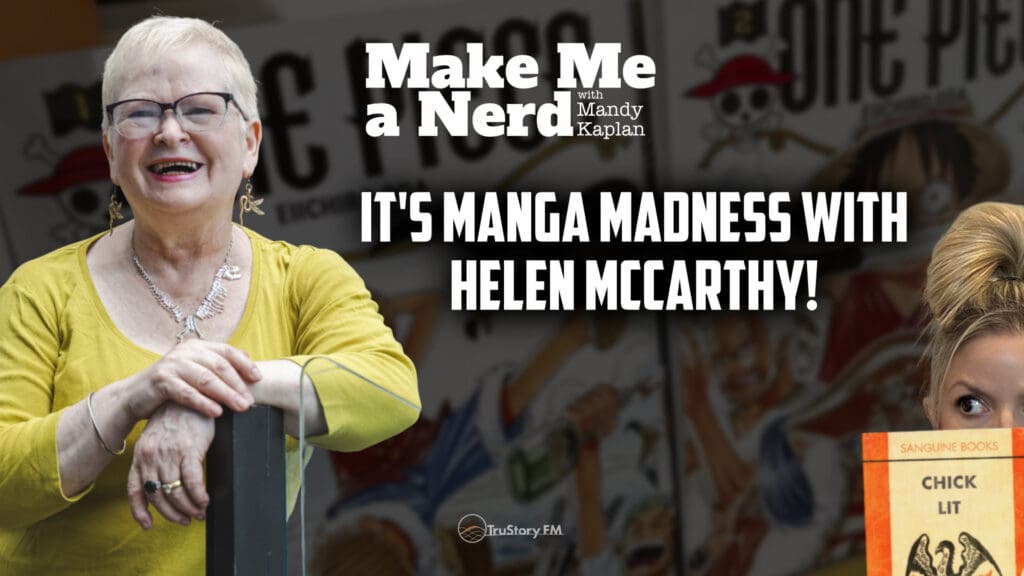
Hello, everybody, and welcome to Make Me a Nerd. I’m Mandy Kaplan, a mainstream mom whose mission it is to explore the world of nerd culture that I’ve been missing out on, and slightly afraid of, my whole life. If you’re new to the show, this is a good one to get started on because I am brand new to manga, and I’m here to represent all of those who don’t understand or have not experienced manga. And I have a world-renowned expert to explain it to us. Welcome to the podcast, Helen McCarthy.
Helen McCarthy:
Well, thank you, Mandy. It’s great to be here, particularly since I have a new book just about to come out, which I hope everybody who hears this podcast is going to rush out and buy. That’s The Manga Bible, and it will be out on the 24th of March in the USA from Prestel. The other thing is, I absolutely love manga. I get so much out of it. And I think ever since I first encountered manga, I firmly believe that there’s something there for everybody and there’s nothing there that anybody needs to be afraid of, so we should have fun.
Mandy Kaplan:
I can’t wait to dive in and learn a lot because this is all brand new to me. But first, my listeners might be saying, world-renowned expert on manga? Come on, Mandy. Exaggerate much? No, no, no. Helen has always been a nerd. She’s the author of the first book on Japanese animation in English. The first book on — please forgive me — Hayao Miyazaki in English, and the UK’s first pro anime and manga magazine. Her professional nerd profile in anime and manga just sort of grew organically. Her main nerd hobby is historical dress and costume — different episode. She delivers ecstatic or derogatory but usually annoying commentaries on costume while watching anything set before the 1950s. Please go to her website, which is what?
Helen McCarthy:
HelenMcCarthy.net, nice and simple.
Mandy Kaplan:
Where you can read about her 13 published books and The Manga Bible coming out in the United States on March 24th. Okay, so she is actually a world-renowned expert, everybody. I’m not just exaggerating.
Helen McCarthy:
Yes, universities have told me so, so I’m happy with that.
Mandy Kaplan:
Oh, have you taught manga at university?
Helen McCarthy:
No, no. When I started out there were no university courses in manga anywhere. And so I have no qualification in the thing that I’m a world-renowned expert on, but I now frequently get asked to look at people’s doctoral theses or master’s theses, and I’ve spoken at universities from the Akita International University in the north of Japan all the way across to the University of Maryland. So it’s been fun.
Mandy Kaplan:
Well, I teach singing and dancing to little kids when they let me. I’m an expert too. I got nothing, Helen.
Helen McCarthy:
That’s harder, trust me. An audience of three to five year olds is the hardest audience in the world.
Mandy Kaplan:
True. So how did you come to manga? Do you remember the first one and who gave it to you and how they got you hooked?
Helen McCarthy:
Absolutely, I would never be forgiven if I forgot it because I met a guy.
Mandy Kaplan:
Oh, hot.
Helen McCarthy:
I met a guy, and he was — and he still is, because we’re still together after 45 years.
Mandy Kaplan:
Let’s go.
Helen McCarthy:
I met a guy and he had just come back with a group of friends on the graduation trip. I think they probably do this in America too. You know, groups of chums, boys or girls or mixed, go away when they graduate and go to somewhere nobody knows them and disgrace themselves utterly.
Mandy Kaplan:
Sure.
Helen McCarthy:
Yeah. And in Britain, in the 1980s, the place for that was the Spanish island of Mallorca.
Mandy Kaplan:
Sure.
Helen McCarthy:
Sun, sea, sex.
Mandy Kaplan:
Okay.
Helen McCarthy:
Unfortunately, this group of five fine art and illustration grads were nerds. And they wanted to go and find out about local life and local culture. There may have been a bit of sun, sea, and sex as well, but they got deeply into chatting to people in local stores and in the restaurants. And they started to watch local TV in their hotels at night. And one night they found a giant robot cartoon marathon. And it fried their brains, completely fried their brains, because they were all — remember, they were used to communicating in line, in imagery, visually. And they were seeing a new way of doing that that was nothing like anything they’d just spent five years studying in college. So they came out the next day and they ransacked the small town they were in for all the comic books and all the toys and all the memorabilia they could see in this style.
And so fast forward a couple of months, they got back to the UK and I had met Steve for a project we were both working on, and he said to me, come and meet my mum, you know how it goes.
Mandy Kaplan:
Yeah.
Helen McCarthy:
Come and meet my mum and dad, you know, come and have dinner, and you’re terrified but you try and be casual. Well, his mum and dad turned out to be great. His father, a Welsh former miner who had got away to fight Germans and then settled in London and married his mother, who was a goddess of a woman, utterly gorgeous, and remained far from his Welsh roots here in London, painting walls because he was a painter and decorator by trade. All three of his sons were either fine artists or designers, so work the genetics of that one out.
Anyway, Steve took me up to his room and showed me all this stuff he’d found in Mallorca and said, I know it’s in Spanish, but it isn’t Spanish. It’s from Japan. Because see, if you find this tiny little note here on the back, you can see it’s a Japanese company, Japanese names. And I thought, wow. And I thought, who cares? Because I didn’t speak any Spanish at the time and definitely no Japanese. And I looked at it and I thought, I can read this narrative just from the images. Not the fine detail, not the nuance, but I can get the thrust of the story.
Mandy Kaplan:
Sure.
Helen McCarthy:
And for me, I grew up with story. I’m Irish, my family tells stories. I was told stories from before I could articulate or remember or listen. I love narrative, and to find a new way of making narrative that was completely foreign to me — that was great.
Mandy Kaplan:
Yeah.
Helen McCarthy:
So I thought, right, wonderful. You’re obviously a really great guy, and he was, and he was hot — and he still is hot — but we’ve got to find out more about this. This is going to be our project. And it’s been that ever since, because we started to look around for material and I happened to have worked for a while for the National Library of the United Kingdom, the British Library. So I had a lot of library contacts. I knew people in book-lined places, and none of them could help me find a single book about Japanese comics or Japanese cartoons in English. So I said, there’s got to be a book. There has to be — people like me will see this thing and want it, and there must be a book. I’ll write a book. Oh, naive and sweet child that I was. I thought, I’ll write a book, it will be simple. And it kind of was, but it took me twelve years.
Mandy Kaplan:
Well, might I just ask — you just said Japanese comics. Why is manga not just called a comic book? Or is it?
Helen McCarthy:
It is called a comic book in Japan because they consider manga to represent any comic. I mean, Spider-Man is a manga in Japan, although that’s blurring the lines a bit, because there is both a Japanese version and an American version of Spider-Man. But they use the terms — since they were occupied after the war and got brought into Western culture fairly quickly — they’ve used the terms “comics” and “manga” kind of interchangeably. But outside Japan itself, most scholars and a lot of fans tend to use the term manga to let us know we’re talking about Japanese comics. If we’re talking about American comics, British comics, it’s comics. For French it’s bande dessinee, Italian is fumetti. It’s just a label that helps us know that we’re particularly zeroing in here on Japanese comics. And there will be Spider-Man, there will be Batman, because he crops up in manga too, but this is Japan.
Mandy Kaplan:
Okay, so that clears it up for me that it’s not a separate thing. It is all of one ilk.
Helen McCarthy:
Yes. Every single thing that a Japanese person picks up and looks at that is graphic communication and storytelling is a comic. They might call it manga or they might say, oh, this is from America, Batman comics, but it’s all a comic.
Mandy Kaplan:
And do you read other stuff or are you all in all the time on manga?
Helen McCarthy:
I do read other stuff, but the other stuff I read is historical romance fiction.
Mandy Kaplan:
Oh, okay.
Helen McCarthy:
And lots of other stuff as well.
Mandy Kaplan:
Sure.
Helen McCarthy:
But I got really interested in history as a child. And I read loads of trashy historical novels all the way through growing up. And now I am a Bridgerton addict. And in fact, my very favourite girl’s manga is kind of related to Bridgerton, but I’m sure we’ll get on to that later.
But one of the problems, as well as the joys of getting really into a topic — of nerding out on it — is that you tend not to have an awful lot of time to read anything else. So I read around my other interests, but as far as comics go, I focus on Japan. Steve, my partner, he is a huge Marvel/DC fan. And so he’s constantly sitting next to me reading his latest Batman or his latest Thor or whatever. And I pick up a lot that way. And I do confess to a sneaking addiction for the Submariner, who’s one of America’s early and great comic characters. But mostly when it’s time to get my head down and read through something, it’s manga.
Mandy Kaplan:
I’ve never even heard of the Submariner.
Helen McCarthy:
Oh, he was so cool.
Mandy Kaplan:
Well, when we were introduced by Andy at TruStory FM, I said, okay, pick a couple titles for me. And God love you, Helen. You sent, I don’t know, 14 titles, because it’s clear you have a lot of favorites, a lot of things that you are passionate about. And we winnowed it down to three titles that felt stylistically different, thematically different, and that felt like a way for me to jump into different things.
And the first one of those is One Piece. And I did a whole episode on One Piece with Zach Logan, who hosts the official One Piece podcast. So everybody can go listen to that. I surprised myself and flipped for One Piece. I really enjoyed the anime, the live action I loved, loved, loved, loved. So this is a great gateway. One Piece feels like I can keep up with it. It’s gonna grab me. It’s got humor, it’s got action, it’s got a story I can follow. This is the smart way to get somebody hooked.
Helen McCarthy:
I couldn’t agree more, because if you look at the structure of One Piece — the manga and the TV — it’s episodic. The story runs in what the Japanese call arcs, and essentially you start when the team lands on one island, because it’s a pirate manga of course. And you end when the team leaves that island and goes off across the sea. So it’s really easy to do bite-sized chunks of One Piece. You don’t have to dig in for a long haul. You can pick it up and put it down.
But the thing that gets me about One Piece is it’s so sweet. It’s got great sweetness and tenderness and innocence, and it’s part of a long line of manga like that that are done for the boys’ market. But the boys’ market is very flexible, and it’s probably the same in American comics. Girls come in and often read their brothers’ comics and pick things up there. But there’s a tradition of stories about protagonists who are both very sweet and innocent in nature, and also not always the person you’d expect to be the hero.
I mean, you look at Thor — and please let me look at Thor, because I’m a huge Chris Hemsworth fan — but you look at Thor and you think, yeah, muscles, superpowers, god, big hammer. That guy’s a hero. But you look at Luffy from One Piece — it’s different, isn’t it? He’s this little skinny creature with these shabby clothes and —
Mandy Kaplan:
Yep. He ate some gum-gum fruit and he got these superpowers and —
Helen McCarthy:
Yeah, and the superpowers are mainly stretchiness when you first encounter them, and then you see how they go. But he’s just the sweetest little guy, but you would never think that he would be a major hero.
Mandy Kaplan:
Now you say sweet little guy, and I agree he is, although he is also a rage-a-holic. And there is an underlying violence, albeit cartoony. We’re not seeing anybody actually get decapitated or anything in One Piece.
Helen McCarthy:
Yes, not yet.
Mandy Kaplan:
It’s cartoony, okay. But one aspect of manga and superheroes and all of these things that I’ve always battled with is I don’t like violence. I don’t like the threat of underlying violence. People will roll their eyes at me because I can’t watch The Sopranos because it feels like that could happen in real life. If I rear-ended Tony Soprano, he gets out of his car and beats me to a bloody pulp. That could happen.
So One Piece, more than the other ones that I read, there’s always this, oh God — they’re just sitting around talking, and then guys walk in the saloon. Oh shit, is this gonna turn into a violent explosion? And the answer is most of the time, yes.
Helen McCarthy:
Yes. Yeah. Most of the time, yes. But most of the time our heroes walk away without too much damage. And if you notice, while it’s the kind of explosive damage that you see, many other people walk away without too much damage too, because what we’re looking at is the inside of a small boy’s head. What we’re looking at is how little kids — like ten, eleven — who are the little kids, nobody has any time for them.
Mandy Kaplan:
Right.
Helen McCarthy:
It’s easy to lean on them, it’s easy to pick on them. What goes on inside their brains — with all the normal things that children and small animals have — I think all children were cats in an earlier life. Because they’ve got the same thing that cats have. They’ve got: go for it, I want it, get it, I’m hungry, I’m tired, I’m sleepy, I’m angry. Oh, fine. Kids are like that, they change second to second.
Mandy Kaplan:
Yeah.
Helen McCarthy:
And what you find in a lot of the type of manga that One Piece is — manga for boys from, say, elementary, junior high — is it reflects how they see the world, how challenging, how confrontational, how terrifying the world is for them. And it says, yeah, here’s a guy who’s just like you. All right, he’s got a few extra powers. He ate the right thing. Nutrition is important, children. He ate the right thing. But he’s basically kind of like you and he’s in the same situation you are, even though it’s more exotic, in that everything could go wrong any second, and then he’s just gonna get out of that the best way he can.
So what’s this guy done to cope? He’s surrounded himself with really good friends who really trust him and he really trusts them. And he approaches things so openly and so ready to make up and be friends when the explosion’s over. Maybe you could cope that way too.
And I really do think that manga both provides a really vital safety valve, especially for people in positions of powerlessness like young children, and also provides them with a framework for walking back from the violence. It says you’ve got to build your structures. You’ve got to have your friends, your family — maybe in some manga it’s mom or dad or big brother or big sister. You’ve got to build those structures. But also you’ve got to be willing to shake hands at the end of a fight and say, okay, we’ve just fought ourselves crazy. Look at this place, it’s a mess. Now let’s move forward. And I really do think that they are a very valuable, a very sneaky tool of social conditioning.
Mandy Kaplan:
That just blew me away. I love the depth that you cull from this. I, of course, am an extremely shallow person and I didn’t go that deep, but I really love that.
After this break, I’m gonna ask you some more questions about One Piece. There is no sense of time and place. This could happen anywhere — it’s just the ocean and on land and a village. Is that intentional to give it global appeal? We can all see it happening in our neighborhoods. Or is there a time and place and I just missed it? That’s also a possibility.
Helen McCarthy:
Well, there is a time and place. It fits into its own structural universe. But as you say, once you get onto the sea, onto the ship, and the friends are all sailing together, that’s irrelevant. And it is again — I wish I could say that this was a really clever political setup, but it’s kind of the way that these manga are usually structured. There may be a specific time and a specific place, but the world beyond that fairly tight friends and rivals group very rarely gets intruded on. Kind of like high school, junior high or senior high.
Mandy Kaplan:
Mm, mm.
Helen McCarthy:
The most important thing are the people in your school. Every now and then you run across a football team or a hockey team from another school, and then there are rivalries and there are friendships, but the world is tight because that’s the only world you can handle at this stage in your life.
But I think the other thing that it does very well is it enables you to write it onto anything you want to, while allowing people to say, this is just a kid’s story. This is just pirates. This isn’t political. It’s political as hell, but it’s just pirates, and so you can take it at the level that you want it.
The guy who wrote it, Eiichiro Oda, he loved another comic called Dragon Ball when he was a kid, and lots of other comics, but Dragon Ball was a favorite of his. And Dragon Ball was one of the most famous manga in the world. And he wanted to write a manga like that, that gave him the same sort of feeling that Dragon Ball gave him. And the two are, in many ways, similar. And they have that same very tight little structure that wherever you are in the world, you take your world with you. And the real world, the world that impinges on you, is actually the world of your friends and your family and your relationships, regardless of what goes on politically.
And of course that means you can drop it in almost anywhere. An Indonesian protest — I’m trying to remember which one it was, but my head is empty because various things happened last week — an Indonesian protest, just as we were wrapping up the book, used the pirate flag of One Piece as one of the protesters’ banners. And my publisher rang me and said, this is so cool. We’re going to try and get it into the book somewhere.
Mandy Kaplan:
Yes.
Helen McCarthy:
And you know, because people pick up on it and they say, these guys are fighting my fight, they’re fighting my struggle. I’m young, I’m powerless, but I’ve got friends and we can do something.
Mandy Kaplan:
Well, I love that something creative and artistic can have such resonance for real life, real struggle, and blur the lines. That’s fantastic.
Now just a practical question. This is the copy I got. It seems to be quite new. And there is some behind-the-scenes stuff in here where Oda explains how he created and named Captain Morgan. Is that only because I got a new edition, or when he wrote the original, did he include some of those insights and BTS stuff that I love so much?
Helen McCarthy:
Yes, well, there we are — don’t we all? We’re betraying all our nerdiness here. If you start writing manga as he did — as a virtual rookie, he’d done a couple of things before but he wasn’t a big name — you generally get published in a book that’s about that size, but it’s got maybe a hundred stories in there in little episodic chunks.
Mandy Kaplan:
Oh, this is three.
Helen McCarthy:
You start out publishing week by week in a big fat manga anthology, and it’s merciless, it’s cutthroat. They have cards in the back that the reader is urged to tear out and fill in and send back, and they have a prize draw, which is how they encourage readers. And anything that doesn’t score well on those cards is out after three or four weeks. So many manga die that way.
But Oda kept building his audience, and gradually he got more and more popular, and then all those stories were collected together in what they call a tankobon, a collected volume. Because the weeklies are on really, like, newsprint — they’re really rubbish paper. And when people decide, I like this comic enough to commit to it and want to collect it, they come out in tankobon volumes, in bound volumes that cover, say, one whole story arc or one whole year, and that’s where you get the chance to put those extras in.
Mandy Kaplan:
Do you know how many original weekly episodes are in this thing with three volumes? I mean, this is a thick one.
Helen McCarthy:
It’s probably going to be maybe thirty, thirty-five. I’m guessing there.
Mandy Kaplan:
There were definite moments where I felt like, oh, we just totally switched. We were with this one group and now we’ve totally switched. So that makes sense — that was an episode that had ended and a new one started and I was just not picking up on that.
Are the originals worth something? Of course I’m just so shallow.
Helen McCarthy:
Right now, this is the best-selling manga.
Mandy Kaplan:
Right. So if I had my originals from when they came out — not in book form — are they worth something? Do people trade them?
Helen McCarthy:
Not really. They will be over time, because few people have the patience to keep a stack of telephone book-sized magazines in the corner of their room — or in the cupboard — until they become worth something. They will be worth something over time.
And number one — actually, the pro tip, if you’re a collector of manga or comics or any graphic item — number one is always worth having. Number one is the one that you seal into bags and put in a safe, temperature-controlled place. Did you see that story a little while back about some guys whose mother told them, as she was dying, that she’d left something in the attic of the house for them? And they went up and found a series of bagged comics, including a number one Superman in perfect mint condition.
Mandy Kaplan:
Hello.
Helen McCarthy:
Yeah. They’re now very, very wealthy men.
Mandy Kaplan:
God, another reason to resent my mom. Thank you, Helen, for feeding that flame.
Helen McCarthy:
My mother made me get rid of all my comics because she said, you know, you’re going to university. We can’t keep all this stuff in the house. I don’t know why you’ve had it for so long. For heaven’s sake, give it to a charity or the orphanage or whatever.
Mandy Kaplan:
All right.
Helen McCarthy:
None of mine would have been worth anything, but had I had a number one Superman, I would never forgive her.
Mandy Kaplan:
I mean, people are just so passionate. The hunger for these things — and I loved the TV show Big Bang Theory, and the way they would treat something: don’t touch it, don’t look at it, it’s valuable. But they actually wouldn’t sell it. They wanted to have it and possess it. It’s very touching that it means so much.
Helen McCarthy:
To be able to say I own a number one of Superman, One Piece, whatever, and it is in perfect condition. It’s as if I just walked into the store and bought it. That stirs something in a nerd.
Although there are the other things. There’s a British TV presenter called Jonathan Ross, whom I’ve known for a while, and he’s a sweet guy. And he’s a huge comics nerd. And his catnip is Spider-Man. And when he first started making big money on TV, he went out and bought his best friend a copy of Spider-Man number one in mint condition. And he said, giving that to him and seeing him riffle through the pages was just the purest pleasure he’d ever had. Of course he wasn’t married at that stage, so he hadn’t experienced, you know, having a child or anything, but —
Mandy Kaplan:
Right. Sure. I mean, I would sell my family if they were in mint condition and could get me a good price. I don’t have this connection to belongings.
Helen McCarthy:
Wouldn’t we all? Yeah.
Mandy Kaplan:
You know, I love movies, I love music, I love these things, but I don’t have that — like, if I could just touch it, if I could just put my hands on this thing, that would mean so much to me. I don’t really have that for anything.
Helen McCarthy:
I have that for old buildings, because I think buildings record their history. I think stone remembers and wood remembers. But with books, with possessions and so on, when people love it, they really love it.
Mandy Kaplan:
Yeah, as they should.
One thing that I really like about One Piece is the humor. And I did write down a couple of LOLs as we say. Koby introduces himself and says, “I’m Koby the cabin boy.” And then there’s a little sign that says, “I’m Koby the cabin boy.” It’s like Koby the cabin boy. You know, it’s just very light. And you have explained to me that there is manga of every genre, but I’d be curious if you want to recommend a comedic one. I’m based in comedy. Everything is comedy to me. And I wanted more laughs.
Helen McCarthy:
Actually, I think one of the things that we’ve got to acknowledge at this point is the only reason that sounds funny to us, native English speakers reading in native English, is that some God-given genius of a translator — who is underappreciated and definitely underpaid — has sat down and read what the joke was in Japanese and thought how best to put it into English so we laugh. Because as a comedian, just translating a joke doesn’t work. The words of the joke are not the joke. The joke is what comes over when it’s conveyed properly and with the nuance of the timing. So thank you, translator of One Piece, and thank you all comic manga translators.
There’s a whole range of wonderful comic manga, the best of which we will never get to see, because there’s a Japanese comic tradition called manzai, which is very regional. It comes out of Osaka. And it’s slapstick, fast interchange between a pair of partners, Osaka-ben — Osaka dialect — virtually untranslatable. Even people who are taken to comedy clubs to hear it and don’t speak Osaka-ben don’t get it. And I’ve talked to friends who look at this and say, God, it’s hilarious, but I couldn’t explain it to you because you kind of have to do it.
So there’s a whole range of that in manga and in Japanese comedy. But there are a lot of funny moments rather than outright comic manga. And I’m just searching my head to see if there’s a comedy special and I can’t actually think of one, although there are a lot of manga where the humor varies enormously in tone, from very dark to very slapstick to very bawdy and very rude. Go and explore, you’ll find them.
Actually, my friend Zack Davisson could probably help you because Zack is a brilliant translator and adores his manga, and he’s somebody I’ll hook you up with later — he could probably tell you all kinds of things.
Mandy Kaplan:
Cool. Thank you. Crazily enough, I think we can move on from One Piece to another one, unless I’m missing something deep and important about One Piece.
Helen McCarthy:
I never try and tell people things that are deep and important. When somebody asks me to recommend a manga, as you said, I over-recommend. But I also like to ask them, what kind of movies do you like? What’s your favorite book? What’s your favorite non-Japanese comic? Because then I know the kind of thing they’re looking for. This is such a big field. So you can’t miss anything in One Piece. You will get everything that One Piece can give you at the time you read it. Whether you go back to it later and get something different, that’s something else again.
Mandy Kaplan:
Right. It’s a real crowd pleaser. It has a little bit of everything and heart. And we love Luffy. We just love him, we root for him, and we root for his ragtag friends. So let’s talk about Nana.
Helen McCarthy:
Nana is something I love.
Mandy Kaplan:
Very different than One Piece.
Helen McCarthy:
Very different indeed. And girls’ comics — shoujo manga, as they’re called in Japanese — are so specific to their audience. But of course, because like little boys, girls are girls all over the world. We all have broadly similar experiences. Shoujo manga are really easy to translate out, and there are a lot of really dynamic, really marvelous girls’ comics.
The reason that I recommended Nana is it’s so accessible. Ai Yazawa, who wrote it, is sadly plagued with terrible health and frequently has to put things on hiatus for long periods of time. But she really ties into the girl experience. I mean, you sit on a train and you just start chatting to this person and suddenly you’ve got the same name. Most of us have been there. You know, you’re standing in a restroom at a club gig doing your face and somebody’s offered you mascara when you ran out. Those little intimate connections that start off just so casually — I think they really give everybody an in because we’ve all been there.
Mandy Kaplan:
Well, this had a total Sex and the City vibe to me, which I was shocked by. It is two distinctly different stories and the protagonist just happens to be named Nana in each story. But it is two books in one. They don’t really connect.
But the first Nana — I question why she’s so childlike. She’s supposed to be maybe eighteen, nineteen, leaving high school and going to what would be university age or starting your life age. Am I reading into it? She was wildly naive and childlike. She’s a Carrie Bradshaw and just keeps falling in love helplessly and then getting hurt and moving on to the next one. But within that, she just seems to not be a functioning adult.
Helen McCarthy:
It’s very much one of the tropes of girls’ manga, but it’s also one of the tropes of Japanese life experience — that there are a great many young girls just at the stage of leaving high school who have had very, very sheltered lives. They’ve stayed in the same small town or the same small village. Their parents have perhaps only the one child, or perhaps they have one sibling. Their parents have looked after them with great care, and they themselves have not explored much. They’ve been encouraged to be quiet and passive and naive.
Now that obviously doesn’t apply to all Japanese young women. But it applies to enough of them that this type keeps cropping up in girls’ manga. And usually the transformational thing for this type is meeting someone who shows her what the world can be.
Mandy Kaplan:
Is that Junko for this? Because I would hate to think it’s a man. The feminist in me doesn’t want to believe that.
Helen McCarthy:
It can be Junko. And very often, because the girls who read girls’ manga — like the boys who read boys’ manga — very often read up. Nobody really wants to be the nine-year-old kid in a story. Everybody really wants to be the hero or the heroine who’s cool and sophisticated. So a lot of manga about girls just leaving high school are read by girls who are still three or four years away from reaching high school, maybe even in junior high, and are just starting to imagine themselves as they go into that world. What would it be like?
Now of course, by the time they actually get to be 18, they have hopefully acquired a few more smarts. But looking at it from the point of view of 14, it still looks like a lot to offer. So it’s a rite of passage manga, but it softens the rite of passage considerably.
The other Nana is, in some ways, everything Nana wishes she could be. She’s hip, she’s clever, she’s sophisticated. In other ways, maybe not so much.
Mandy Kaplan:
Well, Helen, I feel like I did a disservice to the listeners. Let me read the back of the book so they know what we’re talking about. Because most of my listeners are probably not familiar.
Nana Komatsu is a young woman who’s endured an unending string of boyfriend problems. Moving to Tokyo, she’s hoping to take control of her life and put all those messy adventures behind her. She’s looking for love and she’s hoping to find it in the big city. Nana Osaki, on the other hand, is cool, confident, and focused. She swaggers into town and proceeds to kick down the doors to Tokyo’s underground punk scene. She’s got a dream and won’t give up until she becomes Japan’s number one rock and roll superstar. This is the story of two twenty-year-old women who share the same name. Even though they come from completely different backgrounds, they somehow meet and become best friends. The world of Nana is a world exploding with sex, music, fashion, gossip, and all-night parties.
I’m gonna admit to you right now, I didn’t pick up on the fact that they met and became best friends. I thought I was reading two completely separate stories.
Helen McCarthy:
Yeah, fair enough, because you do get slowly into that whole business. But it quite often happens in life, doesn’t it? That if you only meet one person, you don’t realize how important the other person is to them. And I think Nana is very good in that it’s very well timed — it lets you stay with whichever Nana you prefer until you realize how they overlap. And to me that comes in later in the arc when they both start going out with guys from the same band.
Mandy Kaplan:
I just didn’t pick up on the fact that it was Nana. I just thought, oh, this character looks like the first Nana. I blame myself entirely.
Helen McCarthy:
No, don’t blame yourself, because for one thing, not every manga is for everybody, and for another thing —
Mandy Kaplan:
Right. Yeah.
Helen McCarthy:
You’re reading three manga, three big manga, very quickly in a short period of time, which is nerd overload.
Mandy Kaplan:
Yes. I was reading this when I was at the Department of Motor Vehicles. My son was getting his learner’s permit.
Helen McCarthy:
Oh my god.
Mandy Kaplan:
So I was just reading and taking notes. And this young girl came up to me.
Helen McCarthy:
You can’t possibly have a son old enough to get a learner’s permit.
Mandy Kaplan:
Oh, Helen. Helen for the win.
Helen McCarthy:
No way.
Mandy Kaplan:
But this young girl came up to me. She must have been nine or ten and said, what are you reading? Is that manga? And I said, it is. It’s called Nana. And I had just started it. And she said, is it good? I love manga, but I don’t know that one. And I was so impressed by the global phenomenon that is manga.
Helen McCarthy:
Oh, yeah.
Mandy Kaplan:
And it was very cool. And I wish I had been further along so I could bond with her over manga, but —
Helen McCarthy:
Yes. Although since she hadn’t read Nana, you couldn’t really bond with her over that, but you could probably have turned her onto One Piece.
Mandy Kaplan:
Totally. I could have. I didn’t. Because my son got his learner’s permit and that took over.
Helen McCarthy:
Wonderful. So now you have all the fear, dread, and triumph of seeing him finally learn to drive without smashing the car.
Mandy Kaplan:
Yes, well, let’s hope that last part is true.
I was very frustrated with you saying Nana and me saying Nana. I don’t know who’s right. You must be right.
Helen McCarthy:
Either are fine.
Mandy Kaplan:
Okay.
Helen McCarthy:
The one rule with Japanese is that every letter is pronounced in exactly the same way every time you use it, except when it isn’t.
Mandy Kaplan:
Okay.
Helen McCarthy:
So it’s very like English in that regard.
Mandy Kaplan:
Yes, yes. Okay. But I, as a feminist, I found it frustrating — the choices they were making, both Nanas. But everything was around a guy or seeming cool. At one point in the first story, Nana and her roommate Junko let these guys sleep over after they’ve all been drinking. Total strangers. And they’re like, yeah, you just stay here. And the mom in me was like, no, you don’t let them sleep. This feels like a throwback to the fifties, when it was like, go to college to earn your MRS — the old joke. They’re just all about boys.
Helen McCarthy:
In a way it isn’t of our time, although for Japan the fifties went on a lot longer than they did for America and Britain. It first appeared in 1999. And I think Steve and I first went to Japan in 1997. And one of the things — it’s really weird, this is a psychic connection — one of the things we said to each other as we stepped off the plane is, oh my God, it’s the nineteen sixties come back.
Mandy Kaplan:
Oh.
Helen McCarthy:
Obviously Japan’s moved on quite quickly since then, but at that time the social structures, the level of public courtesy, and to some extent the level of public naivety were very much reflected in all their popular culture.
And I think that you’re picking up on that reminds me of another thing about manga, which is right now — because manga’s having this big moment — people are going out and licensing manga for release in the West. And they’re licensing manga that’s come out any time over the past thirty-five to forty years. So many of the stories we’re getting, particularly the ones that look contemporary and look cool because we still reference the iconography of punk rock and so on, are actually stories from my girlhood, my mother’s young motherhood.
Mandy Kaplan:
Sure.
Helen McCarthy:
So we’re picking up things there. And the genius of the translator is how far they let us see that. Obviously the licensor doesn’t want the translator to make this look like a story about 30 years ago because they want it to sell to young kids now. It’s a difficult line to walk.
Mandy Kaplan:
Interesting. I wouldn’t know that this was — I mean, I think I saw when it was released, but that does make total sense. And here I am saying the fifties, but then I’m also referencing Sex and the City, which was nineties and two thousands.
Helen McCarthy:
Yeah. Nineties and two thousands, yeah.
Mandy Kaplan:
But I think that came around to the conclusion that it was really a love story between four women and their friendship rather than about their romantic success, which is why I love it.
In the second Nana story, there was a moment where Nana insulted manga and says, you should try reading a book instead of just manga. Not that there’s anything wrong with manga. And is that common? Like, why would they insult their own genre in the genre?
Helen McCarthy:
Oh come on, there are loads of American parents who say to their kids, put that Superman rubbish away and read a good book. And it’s a kind of parental thing that we pass on to our more straight-laced, more pleasing children. But it’s cultivated and intelligent to read books, and it’s not cultivated and it’s not intelligent to read comic books or play video games. It’s one of those things about culture that passes on through society and is embedded in lots and lots of Japanese popular culture. And you still get it occasionally in parental attitudes in schools.
People have now started to accept that the main thing about getting kids reading is to get them reading. It doesn’t matter if they’re reading a comic book or if they’re reading the text of a game, just as long as they’re processing text through their brains, they’re fine.
Mandy Kaplan:
Yeah, I do think it’s changing, particularly in terms of graphic novels.
Helen McCarthy:
But it used to be that parents would say to kids at ten or twelve, why are you still reading books with pictures?
Mandy Kaplan:
Yeah.
Helen McCarthy:
Why haven’t you moved on to grown-up books? And that attitude is still there. I still sometimes meet people who say, oh, well, of course Japanese literature is fine, but why do people do this Japanese comic stuff? It’s all Japanese literature. And honestly, if you can get your head around reading Japanese, as far as I’m concerned, you have respect as a reader, because that is a tough language.
Mandy Kaplan:
Yeah. Yes, I imagine. I’m saying yes like I know — I don’t know, but yes.
Helen McCarthy:
I’m sure you do. It’s the idea that there are three separate writing systems — three separate script systems, all of which interlace and interlock, and there are rules about when you use them. And then just the whole challenge of interpreting Chinese kanji into Japanese. It’s mind-bending.
Mandy Kaplan:
It is well beyond me.
We are gonna move on to Nausicaa of the Valley of the Wind. But before we do that, I want to tell everybody that Make Me a Nerd is a production of TruStory FM, engineering by Pete Wright, the peerless Pete Wright. And my theme song is Wonder Struck by Jane and the Boy. If you are enjoying what you’re listening to, leave a five-star review on Apple Podcasts. Ask questions, make comments. I will shout you out on a future episode. And if you’re feeling extra enthusiastic and supportive, please go to makemenerd.com/join. Hitting that button will get you your episodes ad-free and early. Thank you all for listening.
Now, Nausicaa of the Valley of the Wind.
Helen McCarthy:
It’s a stone-cold classic for a very good reason. It’s one of those manga that I recommend to everybody, regardless of what they like or not. Usually with something else alongside in case they can’t stand Nausicaa. But as you say, very different from both One Piece and Nana, and almost unique in the architecture of manga.
The only thing I can think of that is anything like it — which is a very different theme — is Naoki Urasawa’s fantastic trilogy, 20th Century Boys. And it’s not got anything to do with Nausicaa in terms of theme or style, but it’s got a similar monumentality about the story. You read it and you feel you’re reading an ancient legend.
Mandy Kaplan:
Yes, it feels biblical, it feels epic, it is post-apocalyptic. Let me catch everybody up.
Academy Award winner Hayao Miyazaki has created an epic environmental cautionary tale. This masterpiece is now available in a new edition. In a long-ago war, humankind set off a devastating ecological disaster. Thriving industrial societies disappeared. The earth is slowly submerging beneath the expanding Sea of Corruption, an enormous toxic forest that creates mutant insects and releases a miasma of poisonous spores into the air. At the periphery of the sea, tiny kingdoms are scattered on tiny parcels of land. Here lies the Valley of the Wind, a kingdom of barely five hundred citizens, a nation given fragile protection from the decaying sea’s poisons by the ocean breezes, and home to Nausicaa. Nausicaa, a young princess, has an empathic bond with the giant Ohmu insects and animals of every kind. She fights to create tolerance, understanding, and patience among empires that are fighting over the world’s remaining precious natural resources.
So anyone who knows me, Helen — this was tough for me. I don’t deal well with post-apocalyptic. First of all, I loved that there was a young woman as the protagonist. That felt ahead of its time. When was this written?
Helen McCarthy:
Miyazaki had been thinking about it for many, many years, as very often happens with monumental manga passion projects. It started appearing in 1982 in a magazine called Animage. And the movie came out in 1984, but the manga itself didn’t finish for almost eleven years.
Mandy Kaplan:
Oh, the movie came before the manga?
Helen McCarthy:
The movie came while the manga was still running — it’s an interesting story. 1982 the manga starts, it’s a huge success. And immediately there’s pressure to make a film. And Miyazaki says, no, I don’t want to do a film that will tie me into something that may not take the story where I want it to go. And I don’t want to let the readers down by doing a lightweight trivial sort of film and then take the story in different directions. That’s a big challenge for anyone writing manga. You get pressure to go on TV or on film and you have to take decisions that may affect what you will write in the future.
So he found a way through it and found a story that he could use and did a brilliant, brilliant movie, which is credited with being the start of the steampunk boom in many, many places.
Mandy Kaplan:
Oh.
Helen McCarthy:
But then he had to go back and finish the manga, and it took him another ten years.
Mandy Kaplan:
Wow, that’s dedication. And this — each panel, the detail — this was so richly drawn and the world was so — it enveloped me in a way that I found disconcerting because of all of the themes. But this was not for me. I tried so hard to go on the journey and enjoy it, but it was just upsetting. I mean, it’s pretty obvious — all the themes I just stated. It’s not a laugh riot. Is this one of your favorites?
Helen McCarthy:
It’s one of the ones I admire. I wouldn’t necessarily say it’s a favourite, but that’s tied up with my own feelings about Miyazaki and the rest of his work.
When I first encountered his work, like many people who hadn’t really gone deeply into it at the time, I believed he was profoundly feminist. Although it’s true that he does give young women a far better profile than most film industries around the world give them, his feminism is fairly restricted and situational. I’m not saying anything bad about him. He’s not an awful guy or anything. He’s just a traditional Japanese socialist patriarch, and that means that he deals with feminism more easily in a story than in real life.
Mandy Kaplan:
Interesting.
Helen McCarthy:
But having said that, it is a profoundly feminist text because it shows a lot of different ways of being a woman in that situation. And that situation — for us today, looking at the possibility that we’re about to bring an ecological or apocalyptic disaster on our own world — it’s really tough to look at things like this and see what we might be calling down.
But it is such a work of art. And it draws so much on science fiction from all over the world, comics from all over the world, all sorts of references to artists he loves and to comic books he’s admired from all around. And at the heart of it you’ve got this young woman who is really quite difficult to deal with. She’s very compassionate and she’s very outgoing and she’s very empathetic, but she’s flinty when it comes to what she believes. She is determined that people are going to cooperate, whatever they’re trying to do. So in a way she’s a true heroine because she finds a way through every situation that presents itself. But in another way, her empathy and her ability to persuade people to cooperate depends on an absolute charisma that drives them to support her, and I’m not sure how realistic that is.
Mandy Kaplan:
Mm-hmm. Yeah.
Helen McCarthy:
But on every level it’s a huge achievement in world comics — artistically, in story terms, in terms of its reach and in terms of its daring. It’s quite amazing.
Mandy Kaplan:
I like that you said you admire it, because I can go there, but I couldn’t say I liked it. It’s a great story, but I definitely admired the artistry of it and the importance of it. It’s epic. It’s just too bleak for my fragile little heart.
Helen McCarthy:
I think actually you might find that you would prefer the movie. The movie was finished long before he got to the darker pieces at the end, and it has a happy ending which does not exist in the manga. So you might find that the movie was a better way for you to approach that story.
Mandy Kaplan:
Is Teto in the movie? Because that was my favorite part.
Helen McCarthy:
Oh, Teto is in the movie. Of course Teto is in the movie.
Mandy Kaplan:
Teto is a little fox-squirrel, very cute and seemingly friendly, but then will bite your finger off if you approach. And we have a cat like that, so I was very much — yes, the Teto struggle is real.
Helen McCarthy:
Yes. You relate. Teto for the movie was a huge merchandising plus. You can imagine how many plushies of him sold all over Japan.
Mandy Kaplan:
Yes, makes total sense.
Helen, we are at the end of our time together. Can you believe that?
Helen McCarthy:
Oh, I can’t. It’s been so much fun.
Mandy Kaplan:
I learned so much from you and I tried things that are way outside my comfort zone. And I cannot thank you enough for curating those choices for me and making them resonate on a personal level and a global level — not just for entertainment’s sake, but you made them all click in other ways for me. So thank you, thank you. You have made me nerdier.
Helen McCarthy:
Maybe we haven’t made you into a complete manga nerd, but we’ve opened the door for you and the other manga-curious people out there, and that’s great.
Mandy Kaplan:
Yeah, that’s what I would say. And if anyone listening is curious about more manga or comics, I have done Watchmen on my podcast previously, and Superman Smashes the Klan, with Adam Rose and Jimmy Aquino, respectively. Go back and listen to those episodes. I wrapped my brain around those a little easier, but this is all still — it’s an art form that I admire and I’m fascinated by, but I get intimidated by it.
Helen McCarthy:
Yeah. It’s a juggernaut. It’s a huge rolling thing that looks as though it could easily crush you.
Mandy Kaplan:
That is true. You, however, could not crush me. You are delightful. Tell everybody one last time — the new book is called?
Helen McCarthy:
The new book is called The Manga Bible, and it is an easy, accessible entry point that actually doesn’t do what we’ve been doing. It focuses more on the stories of the people who make it. And that to me is always thrilling. The Manga Bible, 24th of March, from Prestel.
Mandy Kaplan:
Excellent. Thank you so much for doing this, Helen. It’s wonderful to get to know you.
Helen McCarthy:
I have had great fun, thank you. And I really enjoyed hearing you and Zach Logan talk about One Piece.
Mandy Kaplan:
Oh good! Excellent. Everybody listen to that one too. Okay, thanks for listening, everybody, until next time.
Helen McCarthy:
Yep, definitely.