Carrie Fox
Hi there, and thanks for joining today’s episode of the Mission Forward Podcast. For context, we are recording this episode in late August 2026, as students are just heading back to school. And as student journalists are starting back in on a most critical job: reporting on the news and information that their communities will need this year. Investigating dots no one else is connecting. Holding power to account. But what happens when a student newsroom suddenly comes under threat? When the story that a student wants to tell is the very story someone in power would rather they didn’t? That question is not hypothetical. Last year alone, student journalists reached out to the Student Press Law Center nearly a thousand times, from 46 states, for help standing up to censorship and retaliation.
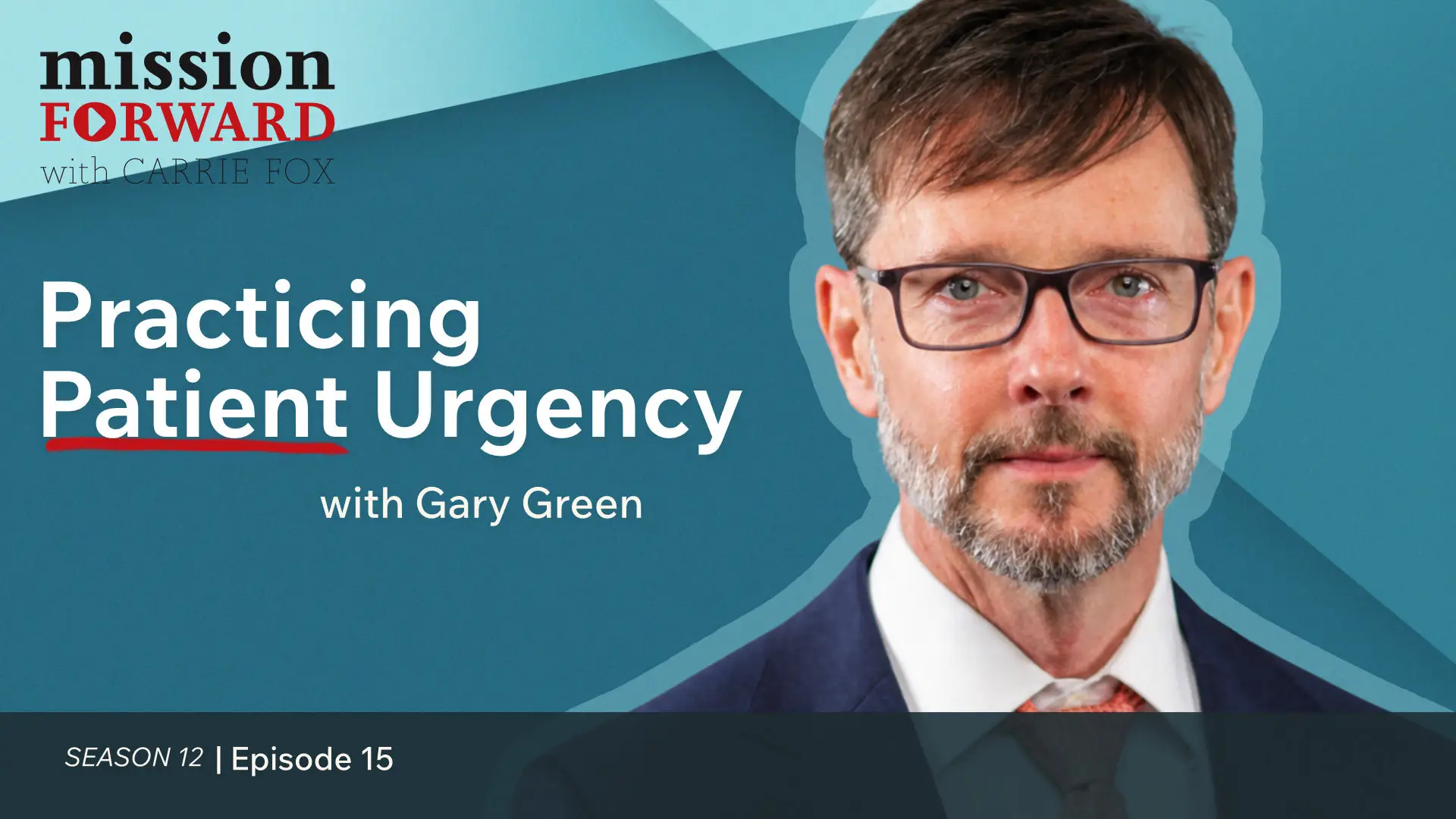
And those calls keep coming. Hi, I’m Carrie Fox, your host and founder of Mission Partners, a social impact communications agency that works with organizations through critical moments of change. And all year on this show, we have been exploring how mission-driven leaders are navigating this moment right now. Which brings me to today’s guest. When a student newsroom comes under threat, the Student Press Law Center is who they call, and Gary Green leads it, at a time when the need to defend student press freedom has never been greater. Here is one of the many reasons I wanted to talk with Gary this season. Because in a moment of extraordinary pressure, right, with demand for their services climbing by the day, Gary and his team did something almost counterintuitive. They slowed down just enough so they could intentionally choose where to focus. The results of that process are now detailed in Student Press Law Center’s new publicly available strategic plan, which we will hear more about today.
Gary, welcome to the show, and congratulations on the new strategy.
Gary Green
Thanks so much, Carrie. It’s a pleasure to be here. I look forward to the conversation.
Carrie Fox
So do I. So Gary, I gave folks just a little bit of grounding at the top, right? But I have heard you say, and I’ve read in your words, that the need to defend and advance student press freedom has never been greater than today. So I want you to help our listeners feel that a little bit, right? What does that mean right now? What are you seeing in your work?
Gary Green
I think the numbers is part of the story. You know, clearly you can look at our hotline numbers and see that a thousand calls this year, twelve hundred calls the year before, a rise of over 42% over the last couple of years. Uh, there’s something going on in the student journalism ecosystem. But I also think there’s a larger story to tell. Student journalists have been contributing really important work to their, for their communities for 51-plus years, longer, you know, since we were founded in 1974. What’s changed is the journalism landscape itself. Student journalists are now playing a much, much larger role in our local news and information systems. In many communities across this country, student journalists might be the only journalists left reporting at the county commission meeting, at the city council meeting, at the school district meeting. And so those stories are now in many cases the primary source for news in communities and news deserts all across the country.
They’re just simply more valuable. They’re getting more eyes. They have a broader audience. They have more people paying attention than ever before. And then at the same time, we have seen escalating threats across the professional sector to the First Amendment, to the Fourth Estate. And that trickles down into students. It impacts every level of journalism when threats from the highest level of government to the highest practitioners of journalism are coming at us on a daily basis. That really disrupts the system throughout.
Carrie Fox
It’s so interesting how you talk about how the threats are increasing and the role that student journalists are playing. And I imagine a lot of folks listening hadn’t connected those dots, that students are filling gaps or voids in community news, right? Off campus, in community news, in ways that maybe they weren’t even a few years ago. Is that what you’re seeing too?
Gary Green
Absolutely. And I just want to share a couple of numbers just for the sheer magnitude of this. One of our partners with the Student Press Report reported last year over 250,000 student bylines in traditional college media in the academic year. Another one of our uh key partners, the Center for Community News, had conducted a study of news-academic partnerships, which is an emerging model. And they have shown that there have been over 44,000 stories with nearly 9,300 students and over 3,000 partners in local communities last year distributing local news. Those two combined show that there is just a massive impact of student journalism around the country. And the other part of this too is I think for a long time, those of us in journalism took for granted that student journalists would always be around, that there would always be a healthy pipeline of young people entering into this field. The fact is that this is a really challenging time to enter into journalism. And I think we can confidently say that a healthy democracy needs a robust and healthy Fourth Estate.
And so more people are paying attention to student journalism than ever before. And that’s a good thing. We actually are bringing more people into the movement and the mission. But it’s not enough. It’s escalating rapidly, and we want to give students the support that they need. And without a doubt, this upcoming academic year will have more than one really big flashpoint. We don’t know what they’re going to be yet, but the trend has shown that every academic year, there’s a giant flashpoint that impacts student media, and we have to prepare for that moment.
Carrie Fox
You know, in my opening I talked about that flashpoint type moment, right? The reaction, the threat, the crisis. And what I want to reset for folks actually is that’s not the only work you do, that there is this incredible reactionary crisis body of work that you play, and role that you play, that no one else plays. But, you know, we just had a fellow this summer who was the editor of her student newspaper. And when she came on and joined us, she said, oh my gosh, Student Press Law Center. We had them come in and train us, right, in a proactive way before anything ever happened. And in her case, nothing ever happened, but she knew you were there. So it might actually help for you to give a little more of that kind of spectrum of services, because it’s not just the reactive. It’s also this really important, how do you plan ahead for something that might happen too?
Gary Green
Yeah, I’m really glad you asked that, Carrie, because the headline of “we did some training” isn’t nearly as um emergent, if you will, as a crisis, uh, hotline crisis response. But the fact is that a huge part of our work is the education and training before the legal crisis evolves. What we really are trying to do is educate all the advisers, all the faculty, and every single student journalist who needs some, you know, clearer understanding about media law, about where the law is. What are the guardrails? What can they do? What can’t they do? What should be allowed in the shape of censorship? I would argue no censorship should be allowed. Um, but this fall is a great example.
We have students all across the country that are gonna go out and cover a historic midterm election. Many of those programs are reaching out to us, many of those student newspapers are reaching out to us to say, what are the rules for covering an election? How do I cover a protest? Do I have rights when I’m at a protest? Or last year, uh, a big um surge in calls was, you know, how do I cover ICE and immigration before they show up on campus? We’re trying to give them the education and the training to say, if this, this is how you approach this scenario. So most of our work really, you know, is the proactive, the training,
the education, the SPLC in the Classroom program, the going to the conferences and leading sessions about media law, with the understanding and sharing that if we provide that base, we provide that very clear understanding of where the law is, when things go wrong or you have questions, we’re there to help on the reactive side.
Carrie Fox
All right. So someone’s listening right now and they’re like, well, Gary’s got it all figured out. Like, it clearly sounds like you know your strategy, you know what you’re doing, you know where you put your time. But a few months ago you went through a pretty major strategic planning process. So why, right? Maybe that’s why you sound so crisp and clear right now, Gary. But why did it feel like now, coming out about a year ago, was the right time for you all to do this pause and think about where your next five years of impact will be?
Gary Green
It absolutely was necessary among the chaos, and I’ve been asked that question a lot right now. How can you go about strategy and doing a strategic plan when the work is so intense, and you know, the world’s just moving at such a fast pace, and it’s coming at you in ways that you can’t really take time to slow down? That’s exactly the reason you have to take time to slow down, is to calm the chaos, create a plan, create a path forward, and give everybody on the team a very clear-eyed way forward. Um, I would also say that, you know, we went through a leadership transition with the organization about three and a half, four years ago. That was board, that was team, that was executive leadership. And really the last strategic plan was written in about 2021. It was a very different world in 2021. Um, I just think that the journalism landscape is changing so rapidly in front of us. The rise of censorship is just coming at us faster than we can process. And it was time for us to take a moment and say, okay, here’s the landscape, here’s our opportunities, here’s what really needs to be addressed.
And here’s how we as a small organization that’s been around for 51 years are going to address these needs. And what I will say is every one of our team members has expressed to me that it’s very clear how we accomplish our outcome goals now. It’s very clear what our outcome goals are. Everybody knows what success looks like. And we calmed the noise. We were able to take a step back and go into this academic year, just I would say, again, clear-eyed, refreshed, and knowing we are prepared for what comes next, whatever that might be.
Carrie Fox
You know, I heard from someone the other day that I haven’t worked with in many, many years. And she reached out because she said they had worked internally on a strategic plan and they published it, and then they got pretty significant pushback from their community because the plan was out of sync with what their community needed. And I’m thinking about the process you all went through. And I should say, in transparency, I had a very close eye on it. I was watching you all. I was with you along this process. But you took so seriously the fact that this wasn’t a plan just for an organization that was going to be created in a corner, but it had staff and board and students and advisers and educators and partners and funders, right? Everybody was at that table
to inform where you went. And I would love you to talk about the importance of that community-informed process.
Gary Green
Absolutely. Our mission, our mission is so much larger than our organization. There are so many key stakeholders and people who are impacted by our work. Everybody that you just named. There’s just no way to put together a plan without listening. I think you have to listen to your constituents. You have to listen to your donors, your funders. To really get a pulse of, what do they need from our organization to address what’s going on in the field, and what are they looking to SPLC to lead, and how can we best help them, how can we best help them to accomplish their goals? And really their goals are to inform their communities.
We think we have a pretty good understanding of what their friction points might be, but that is not up to us to decide. I think you really have to listen to them. And it helped guide everything uh that we brought together in that strategic plan. And then the other important thing I think, um, that I want to mention here, Carrie, is that we specifically went out to create a three-year strategic plan, because none of our stakeholders, nor our team, nor our board felt like any of us have an idea of what the world will look like in five years. That just seems like an eternity from now. So we decided to create a three-year plan, but also build in just great flexibility.
It was really important to be nimble, to be flexible, and to be able to pivot within our key kind of programming and priorities as the field gives us feedback and responds to what we’re doing. If we need to say, we need to put more resources here, we’re going to be able to do that. We’re not going to just set this in stone and say, we created a plan, here it is, and we’re never going to deviate from it. That’s just not wise in this space.
Carrie Fox
Right, right. So we started a little bit by talking about where you’ve been, this incredible history of the organization. We’ve talked a little bit about where you are, how you are very actively filling a need that, in your own words, right, is going to rise up as a new school year starts again, whatever that flashpoint becomes. So as much as you can or want to, tell us a little bit about where Student Press Law Center is going.
Gary Green
So a big part of what we were hoping to accomplish with this plan is we want to scale our resources and our capacity, but we also want to scale our audience and our constituency. What we know is for the better part of 50 years, those who know the Student Press Law Center, they love us, they call us, we come into their classrooms and their newsrooms, we provide training, we see them at the conferences, and they are the most loyal supporters of our mission that you could ever imagine. But there’s a whole broad swath of the student media ecosystem that have never called on us, that have never really even understood why they would need us. And so we know that we’ve got to do a better job of getting to those schools, getting to those newsrooms, getting to those communities that could really benefit from our resources, but didn’t even know we existed. That is a very intentional effort to get out to communities and spaces that we haven’t been going to.
Carrie Fox
Yeah, yeah.
Gary Green
The other thing I think that’s really important is, to meet this rising demand, we could easily hire 10 people on the team and we would still be redlining. We would still not have enough people to do what you need to do.
So capacity is always the conversation. Oh, do we have the capacity to do this? Do we have the capacity to do that? Well, we understand capacity comes with finite resources, and so we really are trying to leverage different partnerships and relationships to come into our mission. And I’ll look at our legal uh team specifically. We are really excited to announce that we’re hiring a legal director this fall, right as we kick off the new academic year. This is a brand new position for the Student Press Law Center, and it’s just, it’s really going to amplify our team’s impact from a human resources standpoint. But we also know that our partnerships with outside law firms, our uh partnerships with other nonprofit legal support organizations, our partnerships with First Amendment clinics around the country,
and our attorney referral network, as well as technology, all of those are going to be key elements to really increase our capacity to meet this demand. And I look at it as, you might diversify your financial portfolio by investing in different lanes and making sure all your revenue doesn’t come in one place. Well, we know that we can’t meet the rising demand on our legal team by just hiring out of it. We have to bring the whole community in together. And part of that is just sharing with them just how important student journalism is, and how they can help our organization meet that need.
Carrie Fox
Yeah, you’re making me think of that great um, that great quote: if you want to go fast, go alone; if you want to go far, go together. And you all have a really interesting way of thinking about those partnerships, particularly because, as I’ve heard you talk about this, the world of um student press media or media law is very, very specific. So there are certain people who are deep, deep in that work, right? But you’ve got to wrap around it all of the other experts to um support issues as they arise. Maybe talk a little more about that, is how you think about the depth of expertise you have with the range of experts that you work with.
Gary Green
Yeah, and you’re right. Traditional student media is very niche, and there are a couple of, you know, court cases that really are the guidelines for much of what we do in what I’ve called the legacy student media space, which has been our predominant constituency for five decades. Without a doubt, Mike Hiestand, our senior legal counsel, is the foremost expert across the country for student media. He’s been with our organization for 35 years. He’s answered over 20,000 hotline calls himself. He has a deep, deep, deep knowledge. And sharing that with our partners is part of that, is getting them up to speed on that niche lane of student media. The other part of that equation is that as these news-academic partnerships, or these student reporting programs that are non-traditional programs, they have different needs.
They’re looking at media liability. They’re looking more at libel and defamation. They’re looking more at MOUs for publishing partnerships. They’re looking at how do they work within a university system and a general counsel and potential insurance policies to make sure that they have the protections they need to produce accountability journalism in their communities that, you know, could cause some friction points with certain stakeholders. And then there’s um one more emerging space that we’re really trying to be prepared for, is you’re looking at the podcast space, the independent journalism or journalist space. You have the uh content creators and news influencers. There are, you know, big journalism institutions such as Arizona State and Syracuse and Kent State that are all developing programs to work with student journalists that want to develop their own platforms and be in what I would say a very non-traditional space.
We need to help educate them and provide that wraparound legal infrastructure, because many of those students aren’t going to have media liability insurance and they’re just not going to understand what some of the risks are. So, but broadly, we want to be able to work with our partners to provide whatever legal support any student journalist in this country needs. Regardless of platform, regardless of model, we’re there to help them when they need it.
Carrie Fox
That’s pretty incredible. Um, last year, if I have this number right, you delivered over 4,000 hours of pro bono legal support, which was about $3 million in value. And I think that’s just a really important piece to reinforce here, right? We’re talking about a Student Press Law Center that students or their educators or administrators can call with no bill attached. That’s pretty impressive to be able to deliver that year after year.
Gary Green
It is, Carrie. And the other thing I really want to stress here is something we take great pride in. We turn away no one. As long as it is a student journalist, educator, adviser, administrator, as long as it’s within the stud— Now, we have gotten some calls. Can you help me with my divorce settlement? And obviously we’re like, no, that’s not really what we do. But my point is, we take every student journalist call. They’re not just the ones that make good headlines, not just ones that might make for, you know, good impact litigation. Not ones that, oh, it might be a little too messy.
We take every call. And that should provide just great confidence and courage to those out there producing this really important work, that you know what, I know somebody’s standing in the corner waiting to help me. And I know they’re proactively going to come in and give me the training, so I’m prepared to do this work.
Carrie Fox
Um, someone I worked with so many years ago introduced me to this phrase, patient urgency. Must operate with patient urgency. And I think about you all when I think about that phrase, right? Because you are um managing the urgency, as you just said, of daily crises that are coming to your hotline. You need to navigate them in real time, with the patience of a movement that requires years to play out, right? Of training, of supporting this. Um, the news-academic partnerships you talked about is really, really interesting, and how that will unfold over years to come as we think about how we um close news deserts and news gaps. So this patient urgency is so interesting. And I’m curious if there’s anything that came out of the strategic planning process, or maybe this is just um a natural tendency that you bring to the organization, but why is that kind of patient urgency important to SPLC?
Gary Green
Well, I think that patient urgency, Carrie, if I can really tie it to a specific movement, is our New Voices movement. Um, this is a movement that’s been around for over 10 years now, and it is a movement that we lead to pass student press freedom laws in all 50 states. Uh, there’s 18 states that have those laws on the books in some variety uh at this point. Um, and what it really does is it enshrines First Amendment protections for student journalists operating, you know, from their school or in their community. Um, as you’ve seen, censorship is the number one reason people have called us over the last 51 years, and continues to be the number one uh escalation on our hotline. And when there’s a student press freedom law on the books, it really gives those students a mechanism to fight back against censorship. But as anybody involved in policy work knows, policy work is slow and grinding, and sometimes you get a quick win in one state. And then you have another state like New York that we’ve been working so hard for nine years to get a student press freedom uh bill passed and a New Voices bill on the books.
And so that movement, those New Voices laws, they are the floor for everything we do. Everything gets protected at, you know, and everything gets easier, I want to say, when you have those laws on the books. Although I will make a point to say that oftentimes calls to our hotline go up from those states that have a New Voices law, because now there’s an enforcement mechanism. But it really balances out our work, where you’re doing the education, you’re doing the training, you’re doing the hotline and the crisis response work. And at all times in the background, you are working to pass these student press freedom laws in all 50 states. And it might be another 50 years before we get there. But that is so core to the mission that we will never stop. And thankfully we have team members who are dedicated, that some are more, had the rapid response sort of metabolism, and others are like, you know what?
I’m going to just plug away at this New Voices movement, and we’re going to get it done, every day a little bit further.
Carrie Fox
All right, let’s hang on that long game for a second more, because I’m thinking about the number of organizations we work with who are in the hunger and homelessness space, who say, you know, the ideal end state is that we don’t exist anymore. We’re not needed anymore, because we have closed the gaps of hunger or homelessness in our community. In a lot of ways, you all have reason to exist forever. But what does the end state look like for you all? What does that long-term vision look like?
Gary Green
That’s a great question, Carrie. Frequently when I’m out on the road talking to different people. We, when we were founded in 1974, it was in response to a landscape analysis that reported that censorship across the scholastic journalism landscape was rampant, and minority representation in student newsrooms was just largely lacking. 51 years later, can we say that that has changed? And I would say no. I would say that, you know, at this moment in time, minority representation in student journalism is not where it needs to be. And censorship continues to be the number one, uh, number one reason people call us. That being said, it’s a real privilege to do this work, because I absolutely believe that we are contributing to a healthier democracy, and I think that we have helped thousands upon thousands of young people get vital experience in journalism, whether it’s in high school or college.
Some of them maybe did not go into journalism as a career. Maybe they went on to business, uh, became business leaders, politicians, diplomats. Um, you know, they became stewards of their community in some capacity, with a better, clearer understanding of the role journalism plays in society and a healthy respect for it. And really the other part of this is they’re news consumers because they went through this experience. So I look at this as, yes, it would be great if there was no censorship. It would be great if we never had to come in and defend somebody because another party was breaking the law. But what I will say is, our end game is, yes, a healthy democracy. Our end game is training young people to lean into their voice, to know that their voice is respected, to stand up to those who are trying to silence them, to give them the tools and the experience through journalism to get active in their communities and in their government, and carry those lessons on into their adult lives to make just a healthier, well-informed citizenry.
And I think journalism’s a great space to do that.
Carrie Fox
Yeah. You know, we’re wrapping up and I’ve got one more question for you, but first I’m gonna just share. I have had the opportunity to meet a few incredible young people who uh have either been on the board or have been connected with me through my work at um Student Press Law Center. And listening to them talk about uh, one, how empowered and in control they were because of the skills and the resources that you all provided them with, right? That that was a transformational moment in each of the students’ lives that I spoke to. Um, how that will stay with them for the rest of their lives, their ability to navigate through a crisis in a way that they could be in control of, um, because they knew they had you, you know, right behind them. It’s pretty remarkable what you all do.
And um, and it’s so, so essential, particularly right now. So you’ve already started to touch on this, but my last question for you is, as the school year starts, right? You’ve just talked about you’ve got a wonderful new hire starting at Student Press Law Center. You’ve got a new strategic plan in place. What gives you the most hope right now?
Gary Green
Without a doubt, that’s the easiest question you’ve asked me all day long. It’s young people, it’s youth, it’s the people who are getting involved in this work. When I go to conferences around the country and I see not tens, not hundreds, but thousands of young people who are inspired to do this work, that want to be part of the energy to create the change in the world that they hope to see. And they’re doing that through journalism. They’re learning how the world works through journalism. And they just crave information. Help me do this work. Help me be better at this. I want to understand the tools that are going to help me make a difference in my community.
And that gives me hope. They do not think about what the journalism industry used to be. They’re not thinking about the disruption that we all know so well. All they see is opportunity in front of them. All they see is an avenue for them to report stories that matter to them, matter to their friends, matter to their families, and matter to the communities that they want to live in. That gives me hope every day. And if you’ve ever been to a journalism conference where you left feeling kind of dark and like, oh my gosh, this feels so heavy. Student journalism conferences in college and high school are the most uplifting, just warm, inspiring events you could ever attend. And if you’ve never been to one, please go, because young people are our future and it’s a real privilege to be able to support them.
Carrie Fox
So, um, folks who are listening, you now know exactly why I wanted to talk with Gary and why I love talking with Gary. Every time I do, I kind of feel the energy and the passion kind of um come right off the screen as I look at him right now, and through his voice. You know, if you care about democracy, if you care about students, if you care about journalism, if you care about our future, there’s a little bit of something in Student Press Law Center for you. And so I would— Gary, have you close by telling folks where to go learn more and how they can support your work?
Gary Green
Thank you, Carrie. The easiest place to go learn more about our work is splc.org. It’s our website that has all of our resources there. You can learn about our teaching resources. You can learn about our free legal hotline. You can learn about our New Voices work and the impact across the country there. And then of course you can learn how you can donate to our organization. Um, I like to always say that there is no mission without the money, and we are really, really grateful. We have a long list of supporters and foundations that believe in this mission that help us carry it forward, but every year it gets harder and every year the demands increase.
Um, there’s ways that people can donate. Every little dollar helps. No, no dollar is too small, and certainly, you know, the large gifts are transformational. But most of all, we want to just bring more people into the mission. If they can be out in their communities communicating to their friends, their families, their businesses, that you know what, student journalism is journalism. It’s not a separate section of journalism. It’s just students, or journalists that happen to be a little bit younger. We need to understand their value. We need to support them. We need to protect them.
And we need to encourage them to go into this, because we’re all going to benefit from it. And if you go to our website and you have questions, I would just encourage, reach out to me. Come find me and let’s have a conversation. I would be more than happy to meet anybody and just share more with them about our work and how they might be able to make a difference through volunteering or partnering with us or donating to the organization.
Carrie Fox
Well, Gary, thank you for a great conversation today, for guiding us and informing us about student press and all the work you’re doing at Student Press Law Center. Appreciate you so much. And um, uh, folks who are listening, make sure you go check out splc.org. We’ll have some resources in the show notes too. And Gary, thanks so much. We’ll be watching you real close in the year ahead.
Gary Green
Thank you so much, Carrie.