Andy Nelson
Welcome to Movies We Like, part of The Next Reel family of shows on TruStory FM. I’m Andy Nelson, and that over there is Pete Wright.
Pete Wright
It is, lurking, Pete Wright.
Andy Nelson
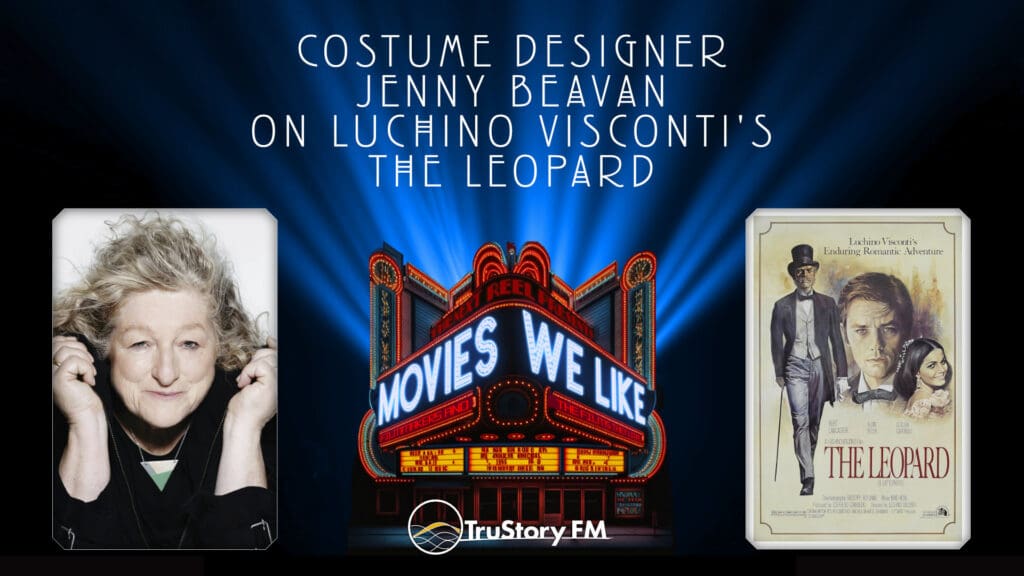
On today’s episode, we have invited costume designer Jenny Beavan to talk about Luchino Visconti’s The Leopard, a movie she likes. Jenny is a three-time Oscar winner known for period work like A Room with a View and Gosford Park and bold swings like Mad Max: Fury Road and Cruella. Jenny, welcome to Movies We Like. We’re thrilled to have you.
Jenny Beavan
Thank you very much. I’m very honored to be here.
Pete Wright
Oh my god, A Room with a View. I just — I had such a crush on that movie when I was young. I mean, a huge crush on that movie. It is luscious. I loved it. I love you. Thank you for being here.
Jenny Beavan
Stop now. No pressure, you know, come on.
Andy Nelson
I still just love saying Mr. Beebe. It’s still one of my absolute favorite things.
Pete Wright
Oh, Mr. Beebe!
Jenny Beavan
Oh, Mr. Beebe. Oh my god. Yes, it was very special. It was very special. And it was the first one I think John and I did together as an actual partnership. I mean, I’d thought on The Bostonians he did more than was humanly possible, so we became co-designers on that. But A Room with a View is the first one, at the beginning of a huge partnership. And it was just one of those extraordinary films. And I think at the time we didn’t think it would — it never occurred to us it would be that successful. But I think like a lot of things, it just needed a movie like that at that time. I don’t know what else was around, but obviously they weren’t hitting the mark or whatever, and you just needed some really good story with a really interesting love, whatever going on. And it was amazing. I mean, I’m terribly proud of it still. And people do say — there’s a wonderful woman in Tokyo who said, well, I feel a bit depressed. I put on A Room with a View and I’m thinking, well, you know, if you make people happy, that’s a brilliant thing to do in your career.
Andy Nelson
Yeah, very true, very true.
Pete Wright
Oh my goodness, for sure.
Andy Nelson
I want to talk a little bit about you getting started, and especially because Merchant Ivory ties into that so much. And you mentioned John — John Bright — your kind of mentor, who you ended up working with.
Jenny Beavan
Yep. John Bright.
Andy Nelson
Talk about how all of that started, and especially I’m curious, as you talk about that, how early period kind of taught you about costume design and how to, like, work on a set and everything.
Jenny Beavan
Well, in truth, I really wanted to be a theatre set designer. I had no ambition to be a film costume designer. And I went to the Central School of Art and Design, as it was called then. Studied with an amazing head of department, Ralph Koltai, who was top of his game in set design and very sculptural, very avant garde. We’re talking about the late sixties. But then by chance, I’d grown up with a boy called Nick Young, and he by chance got to know Merchant Ivory. And he ended up on a wonderful arts programme called The South Bank Show. And he rang me and said they commissioned a film from Merchant Ivory, who he got to know through a friend — I think he was a study mate at Westminster School. It involved — this was a film they were going to make in India, and it involved Dame Peggy Ashcroft, who was a phenomenal theatre actor, mainly in those days. And she was seventy. But she was — in the film, her character was an eccentric English art dealer travelling overland to India to try and buy or find a legendary collection of miniature paintings owned by a Maharaja in Rajasthan. Unbeknown to her, two other art dealers were after this, an American and an Indian, and they basically were all out to steal these paintings. So would I go to Dame Peggy Ashcroft and just help her put some clothes together? No money was mentioned, you know, it was just her wardrobe and mine. Anyway, second visit to her, she said she was a little concerned about going to India on her own at seventy. She’d been given a first class ticket. If she changed it for two economies, would I go with her? So I pitch up in Jodhpur, Rajasthan. They were mildly surprised to see me. Those were days before — I mean, telephone communication was ghastly with India. You could hardly hear anything. There wasn’t even telex, you know, we were way before that. Anyway, they realised I could be quite useful. So I not only looked after Dame Peggy, her costumes and anyone else’s costumes — I looked after her wig, I looked after her. I did crowd collecting, I did props, I did anything they needed. And acted in the film because the actress who was supposed to come up from Bombay, as it was then called, couldn’t make it. So I just became part of the Merchant Ivory family and they thought I was a costume designer and promptly gave me work. And without any anything on my part, I moved sideways from set design in theatre, opera and ballet, which was my, you know, my world, into costume design in film.
Andy Nelson
Yeah.
Jenny Beavan
And to be honest, I would still love to do theatre. And I’ve done a bit of theatre costumes, you know, with various people over the years, but not not a huge amount. But I have stayed within the theatre bounds. But I’m a storyteller. So, you know, I don’t mind where I tell the stories. It’s almost a medium I understand — I understand clothes and I understand sets and, you know, I just storytell. So that’s how it happened. Certainly nothing I planned.
Andy Nelson
Yeah. That’s amazing.
Pete Wright
It’s a delightful fake it till you make it story, and it sounds like you didn’t even really have to fake it that much. Just show up and be artful.
Jenny Beavan
Well, just be helpful. I think the thing that people don’t really understand in costume and in the film industry now — they all do these courses at very, very good film schools, but they all come out thinking they are a costume designer, a set production designer, whatever. Basically, I think you have to learn every skill as you work your way up. So you should do dressing, you should do aging and dyeing, you should do pattern cutting, you should do making of all sorts, because you never know. It might be buying — very important area. You might within that be happier, because what I do is a massive amount of negotiation with producers and directors, as well as my creative job. And also you have to be really good at — it’s almost like you’re conducting the orchestra. So I have a lot of ideas, along with my assistants, but I have all these sections, like the first violins, the cutters, the chief cutter, the, you know, the second violins, whoever. And I’m just basically holding it, putting out the ideas and then conducting. And if I don’t like the way they’re playing, you know, I have to adjust it. But it’s about people skills. So the grander you are, you know, and the sort of more snobby, the worse it’ll be. The best thing is to just go in learning everything and then work your way up. And you may find you’re brilliant at it, no question. But equally you may find on the way you don’t really want to be head banana. You actually are very happy, you know —
Andy Nelson
True. Yeah, right.
Jenny Beavan
— doing something incredibly creative within the department. Because everybody who works for me brings extraordinary things and helps make me who I am.
Andy Nelson
Yeah, a lot of skill, talent, a lot of, you know, just know-how in all of those different roles.
Jenny Beavan
Absolutely. I mean, I can do most things, but nothing like as well as — of course, but if you understand how it’s done, then you won’t ask for something ridiculous. You know, you won’t ask someone to tailor a suit in a slurpy silky velvet. You know, it will be difficult and it probably won’t look that great and it’ll fall out of shape. I mean, just simple things like that.
Andy Nelson
Well, I’m curious — moving back from like working with your team to more like when coming into a project — when you first come into a project, you’ve had such a variety from like the period pieces to like the fantastical projects that you’ve worked on. Do you find that there’s still a through line as to how you approach each job, whether it’s period or fantasy or just present day?
Jenny Beavan
It’s always the same. Read the script, do the breakdown, which is what teaches you. I go through the script, put endless post-it notes and write notes, which means I learn it. I also normally see it in my mind. I mean, some scripts are much harder to see than others, but I normally get a pretty instinctive reaction to a script.
Andy Nelson
Yeah.
Jenny Beavan
And then, I guess, it’s sort of — I mean, the post-apocalypse. The thing about Fury Road was George Miller is an auteur. He sees it, he conceives it, he writes it, he probably does drawings through it.
Pete Wright
Yes.
Jenny Beavan
I mean, we’re working to George’s ideas. And yes, we put a lot of ourselves into it, a bit like I’m saying with my crew. But he’s got an incredibly clear idea of where he’s going with it. So it’s not as difficult as you would think. And also he has a wonderful set of rules about the wasteland and what you can find in the wasteland and how you repurpose. And you know, they’re all desperate for water and food, and there’s that sort of famine mentality. And they become almost savage in their need for stuff, which you can see happening all the time in our current world, I fear, you know.
Andy Nelson
Sure, yeah.
Jenny Beavan
So that’s actually incredibly easy, in a weird way, to get into his mind and understand how it works in the wasteland. And then Furiosa was obviously a little bit earlier. So we had a little bit more freedom with what they might have and what would still — but things like leather, it lasts. You know, you’ve got certain things that will not disintegrate. Even though it’s presumably been blasted by a nuclear bomb. We never know. We presume.
Andy Nelson
Right, right. Yeah.
Pete Wright
It’s such an interesting breadth of work. I’m perseverating on one comment that you just made — that you can see the work. And then I look at your filmography, which is, in a word, extraordinary. Just cherry picking: The King’s Speech, Child 44, Life, We’re Going to Space, obviously the Mad Max films, Cruella. These are some extraordinary bits of fruit I’m pulling off the tree, and I just need to know how your brain works to be able to see those and be able to visualize the universe with such apparent affinity. And yet I look at those films, I would never in a million years be able to imagine that the same person had costumed them.
Jenny Beavan
Ha. That’s a real compliment, because I do not want to put myself into my work. I want it to be correct and appropriate to each project. But I think I’m incredibly instinctive. I’m not very clever. I’m not academic. I read things, and I sort of see the world for some reason. And I don’t know why that happens. I mean, I think I’m just lucky. I can’t do many things. I’m not a hopeless cook, and I play the cello unbelievably badly. But I mean, I’m a storyteller, so I think that’s what guides me. I’m not interested in clothes as such until I tell stories with them. Then I’ll happily go any direction with clothes, including fashion, which is one of my least favourite things, you know, in terms of what I do in my normal life. I absolutely love ceramics and early painting and, curiously, religious icons — although you’ve never met anyone less religious than me.
Pete Wright
So funny. Have you ever — let me ask it this way — have you ever met a project that you said no to because you couldn’t see it?
Jenny Beavan
Very rarely. I can’t think of one offhand. I’ve certainly said no to things I thought were stupidly violent or, you know, just not appealing. But in the early days I had to take every job. I’m a single parent. I was living in Southeast London, and my daughter had to go to a private school. There were some — nowadays they’re terrific state schools, but I had to earn a reasonable amount of money. I had to pay for childcare because of the hours I do. So I took a lot of jobs I probably wouldn’t have normally wanted to. And then ended up really enjoying them because they weren’t quite what I’d anticipated. But I don’t think there’s anything I’ve — I mean, I’ve had to work to find it. Sometimes it’s like climbing Everest, you know, and you see it, but then it’s not easy. And often, although I sort of see it, I then think, oh my god, I’ve no idea what I’m doing here. Help. And then halfway through the film you think, why did I ever think that? You know.
Pete Wright
Yeah.
Jenny Beavan
Actually, I do know what I’m doing. But I think if you don’t think like that, it wouldn’t be as good.
Andy Nelson
Right.
Jenny Beavan
I think self-doubt is very important. And what you do wrong, you learn far more from. You know, when you’re doing a fitting and you put the wrong thing on someone, you learn far more from it than when it’s right. You just have to be calm about it and just keep going and work a bit harder. Sometimes I just find I sit there and I make more notes, and that helps, you know. Clear your brain.
Andy Nelson
Well, and I think what I have latched onto is that costume design, just like every other part of filmmaking really, is fundamentally about telling a story. Like, that’s your job, just like everyone else.
Jenny Beavan
Absolutely. Yeah. We’re all — and hopefully we’re all telling the same story.
Andy Nelson
Yeah, right.
Jenny Beavan
And that’s when it works so brilliantly, particularly with things like Merchant Ivory. Because Jim just brought us all together. We’d never had any doubt about where we were going with a project. I mean, I still — for me, he’s one of the greatest filmmakers. And they’ve been remastering quite a lot of the films. And sometimes John and I have done Q and A’s, so we’ve seen the film on a huge screen, you know, looking — and you just think —
Andy Nelson
So many amazing films. Yeah.
Jenny Beavan
How did we do that? Because we used to do it with minimal crews. I mean, I remember dressing Vanessa Redgrave in the ladies’ lavatories at the Wigmore Hall, you know. I never had facilities or anything. I was once — I designed it, I was part of the dressing team.
Andy Nelson
Yeah, right, right.
Jenny Beavan
Undressed and dressed all the extras on A Room with a View in Florence with one assistant, Elena Politti, who didn’t speak English, you know.
Andy Nelson
Oh wow. Geez.
Jenny Beavan
And my Italian was terrible. So —
Andy Nelson
Well, looking back — since you’re kind of talking about all these different films — I am curious, especially since you just received the Costume Designers Guild Career Achievement Award, which is fantastic. Congratulations.
Pete Wright
Yes.
Andy Nelson
But with the career that you have had, when you think back across your whole body of work, what does that arc feel like from the inside when you’re looking at all of that that you’ve accomplished?
Pete Wright
Are you one to be racked with nostalgia?
Jenny Beavan
Yeah, I love a bit of nostalgia, don’t you worry. I’m not going to lie. I feel incredibly lucky. I mean, what did I do right in a former life? Because I had amazing parents. We didn’t have a lot of money. Both my parents were classical musicians working in orchestras. I was brought up with music, a very alternative outlook on life. We went to very alternative schools and had, you know, a lot of real creative stuff going on at home. No television. So we made things all the time. And you know, so that was a blessing. And then meeting Nick Young, who got me into the Merchant Ivory scene. I mean, how lucky was that? Both our parents — mine and his — sent us to this very esoteric music and movement class, not normal ballet for us.
Andy Nelson
Yeah.
Jenny Beavan
And Nick and I became good friends, and his sister Sarah and my sister Sara Hill. And you know, that was just an incredible thing, that he then met Richard MacRory, who knew Merchant Ivory. How did that happen? And then by my other route, I got into the Central School of Art and Design and worked with Ralph Koltai, had an extraordinary time doing ballet and opera and all sorts of wonderful theatre. And then the choice of the movies I’ve worked on, the directors I’ve worked with — how did that happen? You know, I mean, the luck. And I’ve done Disney projects, but I’ve never had to do a real — you know, what they call them, a real life thing from an animation. I’ve always done origin stories with Disney. And they’ve always been interesting. And I mean, apart from a slight glitch on Cruella, they were, you know, they’ve been great. And I don’t know. And now working with Alex Garland, I’m just blessed. And the last thing I did was with Nicholas Hytner. My god. I mean, the luck is just ludicrous.
Andy Nelson
We should talk about The Choral a bit, since that’s the project you just worked on most recently.
Jenny Beavan
Oh, The Choral.
Andy Nelson
This is a project, a film that’s set in 1916, and in a kind of a small mill town in England, as World War One is going on and people are coming and going from the war. And I’m curious, because it is such a different feel from aristocracy, like in something like A Room with a View or any of these other kind of Merchant Ivory films. This is very ordinary townspeople. Do you find you approach things differently when you jump into period research when it’s like mill workers versus, like, the aristocrats?
Jenny Beavan
Yeah. I mean, you just research that area of life. And it’s an amazing script by Alan Bennett, who’s one of our national treasures and one of the greatest writers on earth. But he comes from that area. His father was a butcher in Yorkshire. He knows those people. And he wrote this beautiful script, which is anti-war, anti-discrimination, and so powerful, without being over the top. It’s very laid back and has the most wonderful music in it, which is very dear to my heart. Anything with music and I’m there. But I mean, it’s very easy to research because in 1916 there were quite a lot of photographs, and there was even cine footage of mill workers coming out of the mill from even earlier. So that wasn’t a problem. And the other wonderful thing was we had an incredibly small budget. I mean, we made that film on eight million pounds.
Andy Nelson
Whoo, my goodness.
Jenny Beavan
Which is, you know, probably less than the catering budget on Furiosa.
Pete Wright
What?
Jenny Beavan
But in 1916 in a mill town in Yorkshire, nobody had many clothes. So legitimately, I could give it truth. But actually, everyone only had two outfits.
Andy Nelson
Yeah, that helps. Yeah.
Jenny Beavan
And it helps in every way. And I did say to Alan Bennett — I met him when he came up to watch some filming. I said, you know, it’s so brilliant that you wrote it then. He said, oh, yes. My father was a butcher and he had two suits. One was my suit and the other was my other suit. And I just thought, it’s the most beautiful story ever. And so it was completely right to do it like that. And of course, I worked out of Cosprop, John’s company in North London.
Andy Nelson
Yeah.
Jenny Beavan
And of course they had the perfect — and we had to make a little bit, because we used a real amateur choral society in Yorkshire to fill in our actors. And people are bigger now and we just ran out of stock. So we made some very simple dresses which we accessorised. But that was it. Other than that, it was just Cosprop, Cosprop. And all the men’s suits — they’re all just stock suits, but their stock is so wonderful you can find gems in it. And of course it’s not new, it doesn’t look brand new, and, you know, it’s worn and it’s got a life. And it’s perfect for that. So I was fantastically proud of it. But I also think it’s a beautiful film.
Pete Wright
It feels like the perfect prequel for Swing Kids, right? Like —
Jenny Beavan
Swing Kids, yeah, yeah.
Pete Wright
You know, another movie with young people in nice suits and a lot of music, and it’s just a little bit later in history.
Jenny Beavan
Yes, just a little bit later. Thirty-seven, thirty-eight?
Pete Wright
Yeah.
Jenny Beavan
It was just pre-thirty-nine, I think.
Pete Wright
Yeah.
Jenny Beavan
Yeah. In Prague. My first film in Prague. Oh god, I love Prague. It’s a wonderful city. Wonderful to work in.
Pete Wright
Oh my goodness.
Andy Nelson
Well, I imagine that’s a part of any of these projects — where you’re traveling and filming in different parts of the world and finding things that fit that. And even, I imagine, for a story that takes place in this mill town, just finding things that feel like they fit, that feel like they’re of this world. I was really taken by Ralph Fiennes’s suit because it just felt like it was part of him. It seemed so right for him, you know?
Jenny Beavan
I know. Again, I think somebody looks after me above. I’m not religious, as I said, but somebody — because that suit was there, and every time I looked at it I thought, mm. And Ross, who does the men’s stuff there, said, you know, I think it’ll fit Rafe. And of course it did. It also had a — although it’s an English suit — I think it’s a real one, but it could have been made in Germany. It just could have been. So he’s come from Germany, you assume he’s probably bought some clothes there because he was successful there. And then again the hat — although it’s not anything stupid with, you know, feathers in it and all that, like a Tyrolean — it still could have been made in Germany. And Rafe — oh no, he wears things very well too. He just adopts them.
Pete Wright
Yes.
Jenny Beavan
I mean, wonderful. He is wonderful.
Pete Wright
Do you know, it makes me think of other movies where he dresses suits well. And I immediately think, how is it that you have escaped being roped into doing a Bond film with your career? The only thing on your IMDb that is Bond-related is a Nokia commercial. How is that?
Jenny Beavan
Oh yes, oh yes. I was certainly asked to do that, with that lovely actress whose name completely escapes me. Anyway, yes, I’ve absolutely no idea why I was suddenly asked to do that, but I was. And I don’t know if it ever came out —
Pete Wright
Lashana Lynch — is that who you’re talking about?
Jenny Beavan
Yes, that’s right. Yeah, absolutely. I’ve no idea if the thing ever came out, but it was quite fun to do.
Pete Wright
So funny to me.
Jenny Beavan
I mean, I’ve done all sorts. You know, I did the British Airways safety video. If you’ve travelled on British Airways, you’ll see, you know, people putting on safety harnesses and all that, wearing full period costume.
Andy Nelson
Really.
Pete Wright
Yes.
Jenny Beavan
And it’s hilarious. One of the most fun jobs ever, with Sharon Maguire.
Andy Nelson
Oh yeah, that is fantastic.
Jenny Beavan
It was hilarious. No, honestly. As I said, I’ve been incredibly lucky. I’ve twice met Sam Mendes for Bond, and he’s twice decided I’m not the right person. I’m actually quite grateful. But he’s always sent me the most lovely hundred-pound note. And I just thought, oh well, you know. I think Bond — there’s the problem with films like that, and Star Wars and things like that. There’s such so much producer interest. I won’t say interference, but interest in them. And I don’t think it’s very easy. And you have a huge amount of product placement in a Bond, you know. And actually I enjoy watching a Bond, but I don’t think I enjoy doing it. I hope I do a good job, but I’m not sure.
Andy Nelson
Different, yeah.
Jenny Beavan
And so I’m very happy with certain films that haven’t happened in my world, because I seem to have done and still be doing really, really interesting work. Smaller scale, but I mean, the one I’m doing at the moment’s huge, but —
Pete Wright
For sure.
Andy Nelson
Well, let’s shift gears and talk a little bit about The Leopard.
Jenny Beavan
Oh, yeah.
Andy Nelson
This is Visconti’s film. And I mean, it’s a very fascinating film that is about the period in Italy when things are shifting — the Risorgimento, or I’m trying to think of the Italian word.
Jenny Beavan
Yes, yeah, yes.
Andy Nelson
Yeah. And as everything is changing — and I think it’s just a lush, lush film, beautiful performances, and the way it captures. I’m curious, for you, where did this film enter your life? And like, what made it something that really meant something to you?
Jenny Beavan
My feeling is — and it’s a long time ago, so I’m not a hundred percent certain on dates and things — is that it was about, so it was made in 1962 and was being talked about. And I went to college in the late sixties, and my memory is that actually a group of us from college went together to see it in a screening cinema in Soho because it was on. And it was one of the things we all went to see — all those weird, wonderful Czech and Polish films, because it was sort of — but I think we all went to see The Leopard at that point. And it was just astonishingly beautiful as a film and fascinating with the politics, which I didn’t really understand to this day. You know, I still have to sort of look up what was going on. It’s not a period of history any of us know. We don’t study it. So it was very different to anything else I’d ever seen. But also I think I then probably saw it again later on. And John Bright, my mentor and dear friend, was always talking about it — the fact that Piero Tosi, who did the costumes, was only thirty-six. And in the sixties, it was often when you saw period things, particularly if they were made in England, they looked very nineteen-sixties. The fabrics were nylon. There weren’t wonderful true fabrics around. There weren’t silks and all the interesting things we actually have now — far, far more. And so if you look at particularly English BBC television, The Forsyte Saga or something in there — I think that was black and white — it’s still got a very modern look. They have very modern makeup and hard hair and, you know, it was great. And then you saw something like this. And yes, there was a little bit too much eye makeup, probably, for 1860, but it’s still astonishing in its truth, and the beauty of the fabrics he used, and the absolutely accurate period cut. I mean, he was obsessive, Piero Tosi. I don’t think he was happy because it was never perfect enough. But he was one of the most incredible costume designers ever. And his range is pretty enormous. I don’t think he did post-apocalypse, but you know, he’d certainly covered a massive range from very, very poor Italy to Medea, and just, you know, great range and loads of body operas. And I think if you ask most costume designers who their sort of hero is, it will be Piero Tosi.
Andy Nelson
Hmm, interesting.
Jenny Beavan
So that was a huge thing for me in the film.
Pete Wright
There is no shortage of sweat, I did notice.
Jenny Beavan
Well, I think it was probably pretty hot when they were shooting, you know.
Andy Nelson
Yeah, yeah.
Pete Wright
Yeah. It’s so hot. They clearly worked it into the story. It was hot where they were, and it was fundamentally challenging. It is such an interesting thing, because you’re right — it is a movie of extraordinary beauty, and the costumes, the number of costumes —
Jenny Beavan
Amazing number. And they would have all been real. They wouldn’t have CGI’d — they wouldn’t have done crowd enhancement then. They really dressed all those people and they really had them out on the set.
Andy Nelson
Yeah.
Pete Wright
Yeah, extraordinary. And the period of existing sort of between — it feels like — I don’t know, like they’re calling on this sort of Victorian, like, European style. And yet we’re at the end of that period, right? We’re about to not be wearing those kinds of dresses so much anymore.
Jenny Beavan
No, we are. I mean, the eighteen-sixties was the huge crinoline, and then it collapses down into the seventies, and then up at the back in the eighties, and then down again in the nineties. I mean, there’s always a flow in fashion, but it was still very excessive clothing. But the eighteen-sixties is this huge crinoline, because you’ve come out from the fifties, obviously. You’ve come up from the very regency and then into the sort of Jane Austen narrow, and then it starts to go out and out, and then the shoulders go out, and then it goes — you know, I mean, it’s always a great flow if you look at it.
Andy Nelson
Yeah.
Pete Wright
Well, it is so much easier to see and hear when you talk about it in terms of women. But what about the men? There were some very interesting things going on with the clothes of the men. Some of them are just — you look at, oh, there’s a dude in a suit. But there’s such a wide swath of what we see in terms of regalia, because there’s a lot of dudes in military suits.
Jenny Beavan
Oh yes, you’ve got all the red jackets of Garibaldi, you know. Yeah, yeah. Well, that’s just what they wore. I mean, that’s not terribly difficult to research. What was amazing was the amount. Did they make them? I don’t know. I mean, they’re probably still in Peruzzi or Rancati — or no, not Rancati. They’ve probably been in Peruzzi if anyone’s got them.
Pete Wright
Yeah.
Jenny Beavan
Possibly — oh, Tirelli. Tirelli may have them.
Pete Wright
You think these suits are still hanging around somewhere?
Jenny Beavan
Well, it’s only the sixties. I mean, we’re only — maybe sixty years ago. They’ll still be somewhere. And they do look after them in Italy. They’re probably in Tirelli, because Piero Tosi was part of Tirelli, and I think Tirelli made most of it.
Pete Wright
Fascinating.
Jenny Beavan
And that’s how we do it. For me, Cornejo and Paris have bought all the medieval films that were made in Spain, because they have much cheaper warehousing outside of Madrid. So you go about forty miles or so outside of Madrid to these incredibly dull industrial estates. And within these huge warehouses are masses of costumes. We can’t do that in England. We don’t have the space, we couldn’t afford it. And they’re like four euros a square meter and we’re like forty euros a square meter. I mean, it’s massively different. And it’s expensive enough, period costume, anyhow, because you have to maintain it, you have to look after it. And also they found more costume houses in Italy, and they’re just about still keeping going because all the theatres and opera houses didn’t have their own wardrobes. They rented or got stuff from the various costume houses rather than make it in house. So there are big stocks abroad more than we have here in England. Cosprop’s the place for things like The Choral or Merchant Ivory. Brilliant, from about — let’s say 1750 to about 1950. That’s there, really strong.
Andy Nelson
That’s their range, yeah.
Jenny Beavan
So masses of these period films we all love come from there, even if they’re made in America.
Andy Nelson
Interesting.
Jenny Beavan
You all come to us, which is wonderful. But I think with The Leopard, you know, he would have just looked into the peasant characters and the — you know, it’s like storytelling. I mean, he was a consummate storyteller. So the mayor and everyone, slightly pompous, you know. He’d have just found the right look for them. And there may be sort of things you can see in paintings that spark your imagination.
Andy Nelson
Well, I definitely feel that with Claudia Cardinale. Like, when we first meet her, right? She comes in and she’s in that white lace ball gown when we first meet her, which — you know, I guess now you have me on this thing about how it’s all about storytelling. Because I think that’s an outfit that is doing some psychological work, as far as it’s her mark into this aristocratic society. But also she’s kind of this interloper coming into it. And I think that’s an interesting element that we’re getting, because that ties so much into what you’re just talking about, about how it’s all about the storytelling.
Jenny Beavan
Well, that’s when it works. And there are certain films like Cruella — it’d be a shame if people didn’t notice the costumes. It’s about costumes and fashion.
Andy Nelson
That’s her job, right. Exactly.
Pete Wright
Yes.
Jenny Beavan
But a lot of films — like The Leopard, although it’s an incredibly beautiful period, so you’re going to make people look incredibly beautiful in those clothes — but what’s so clever with what he did was they’re phenomenal costumes, but you still look at the actor. Whereas when, for me, it doesn’t work is when you can see a consciousness in the design and somehow the designer’s in there going, look at what I can do. This is my mark. And you think — do you know what I mean? It’s — I mean, but some things need it. Priscilla Queen of the Desert would be very disappointing if it didn’t look amazing. Do you know what I mean?
Andy Nelson
Yeah, great point.
Pete Wright
For sure.
Jenny Beavan
And actually Paul Tazewell’s work on Wicked — I mean, it’s so extraordinary, so detailed. Makes me almost exhausted. But he’s such a dear. And there’s stunning ideas and stuff in there. It’s so — and very appropriate, because it’s a musical, basically. I don’t know if I’d be able to do that as well — I certainly wouldn’t do it as well as Paul does it. I mean, he’s just incredible. And then Kate Hawley, who just won the BAFTA. Brilliant work on Frankenstein. Again, it’s not period accurate, but it’s period sensitive. And I just think she did beautiful stuff. I was absolutely, you know, really, really impressed with her. Very interesting, very different. And I’m thinking, I’m not sure I’d be able to do that, you know. But I probably would, because you’d be given the right instruction by the director.
Andy Nelson
Well, sure.
Jenny Beavan
But, you know, even so, it’s like — whoa, that’s amazing.
Andy Nelson
That’s an interesting thing that I don’t think I’ve actually heard anyone say. It’s not necessarily period accurate, but it’s period sensitive.
Jenny Beavan
Yeah.
Pete Wright
I was just keen on that.
Andy Nelson
And I think that’s a great way of describing all of these different projects, because I think that you’re obviously tapping into that too, even in something like Cruella, which is a period film, right?
Jenny Beavan
Yeah, definitely. Definitely.
Andy Nelson
And so you’re reaching back to a period of time, but you’re also expanding and playing.
Jenny Beavan
Yeah, exactly. Because that’s the character of Cruella and that’s the nature of the story. And you know, you’re working her towards Glenn Close at some moment, you know.
Pete Wright
Yeah.
Jenny Beavan
But that’s where she’s gonna be. You know, you just do what’s appropriate for the film. And yes, it wasn’t — I remember the seventies pretty well, actually, I’m terrified to say. It was a fascinating period, very interesting clothes. I was quite interested in clothes in those days, and you used to go to Biba, and I could never quite afford it, but I used to look longingly at stuff. And it was a very innovative period in some ways. But it just felt right for the film, you know, the way we did it. And she’s a wannabe fashion designer. She does her own clothes. She’s jolly good at making and designing, and a little bit punky, a little bit, you know, edgy. And that’s how she developed. And then the Baroness was a hoot, because you just knew she was slightly outdated and slightly past her sell-by date. But it was Emma Thompson. And we found this sort of asymmetric thing, and that just became her style. And it was sort of almost luck — threw something at the stand and it landed asymmetrically. And then off we went, you know. That was Emma.
Andy Nelson
That’s amazing, like finding a little clue like that.
Jenny Beavan
Yeah, you find clues and you have to be open to everything.
Andy Nelson
Yeah.
Pete Wright
It’s a funny little observation that, you know, in a movie like Cruella, you’re looking at performances, costuming that has to live up to the scale of the performance, right? And those performances are very big. And I look at The Leopard, and I look at Lancaster — he could have been one of those as the prince, right? He could have been one of those over-the-top. And yet I think he plays it as reserved as he is outfitted to be. At no point does it feel like he’s a pretender.
Jenny Beavan
No, it’s very true, isn’t it? And there’s a kindness, because it’s such an interesting role. And the fact that he sees what’s happening, but he can’t quite give in to it because he’s so tied into his world and his aristocracy and what he feels is right. I mean, I think it’s amazing. I truly haven’t seen it for so long, and it’s really making me want to — I just haven’t had time to re-look at it. So I’m not really as —
Andy Nelson
Sure, yeah.
Jenny Beavan
I don’t know why. It was just one of the films I chose, and you lot chose that one as the one I talk about, and it’s like, ooh. Because yes, the costumes — no question — but in general, I can’t even be specific about them, were just extraordinary and true and much more real than anything I’d seen in the cinema or on television in that period. And the idea that it was made in 1962 and then shown in ’63 is so bizarre when you look at the beauty of the production design. Because in England it was still all painted sets and, you know, it hadn’t got that amazing reality.
Andy Nelson
Well, and the scope. Oh, the scope too — because, like, that entire last, I don’t know, hour almost of the movie —
Jenny Beavan
Oh, the forty-five minutes in the ballroom. Yeah, yeah, yeah.
Andy Nelson
Yeah. The ballroom. I mean, you’ve got four hundred costumes in there with all these extras, so many people. And it’s all as authentic as you could get, because that was what Visconti wanted. So you just feel like you’re living in that space, you know? And I think that’s the key — whether it’s Cruella or The Leopard — is finding the pieces that make it feel authentic to the story that we’re telling. Because I bought this entire world. It’s just everything is so real.
Pete Wright
Even the sweat. Especially the sweat.
Jenny Beavan
Oh, the sweat, yeah.
Pete Wright
Good god.
Jenny Beavan
Probably shouldn’t talk about the sweat too much. Perspire.
Pete Wright
I’m sorry. I’m inelegant.
Jenny Beavan
The perspiration. Glowing, I believe, is what women do.
Pete Wright
I will say that last — in terms of a film, at just over three hours, that last bit is an untidy segment in terms of pacing. I found it a little breathless in its overall pacing. Beautiful, fascinating period of history. And my god, it is very long for the story it wants to tell.
Jenny Beavan
Oh, it is very long. No, I know. I mean, that’s my problem with films at the moment. I love The Choral because it’s much shorter. But you know, when you’re working in the industry we do very long days, and I just can’t watch film at the moment. I watch crap television. Celebrity Antiques Road Trip is a particular favourite, you know. Because I don’t have to think.
Andy Nelson
Yeah, right.
Jenny Beavan
And I do sudokus. And I go to the theatre if I can, or concerts. But —
Pete Wright
Yeah, you get to turn it off.
Jenny Beavan
I just can’t be doing with these three-hour — two-hour films, two-and-a-half-hour films. Which are all fine. And I’m sure they’re very good, a lot of them. But at the moment, I’ve just — I’ll catch up, yeah. They can —
Pete Wright
There will be a time for cinematic reflection.
Jenny Beavan
Oh yeah, at some point. Yeah, yeah, yeah, absolutely. I’ll catch up, but at the moment it’s all a bit much.
Pete Wright
Yeah.
Andy Nelson
Well, I mean, it’s been wonderful chatting with you about you, your career, The Choral, The Leopard, all of these different things. Thank you so much for joining us.
Jenny Beavan
Yes, The Choral is very dear to my heart, and I tried to promote it to my best ability. Because in truth, Sony didn’t do a lot. Didn’t send out screeners to the people who — and you couldn’t get it in India or in Australia, you know. So it’s really weird. They just didn’t bother with us. And yet, to me, Ralph Fiennes is better than I’ve ever seen him. You know, I just think he’s wonderful.
Pete Wright
It is so bizarre that it took us scheduling you for this show for me to realize that movie existed.
Jenny Beavan
Existed. I mean, you know, we had no money. And they obviously didn’t have money to distribute it. And I think maybe Sony had other films they thought it might interfere with, like — oh, the thing with Ethan Hawke — sounds rather good — Blue Moon. You know? So yes, of course. But it is a beautiful film, and it’s not perfect. But I mean, the amount of people I know have seen it more than once because they really loved it. But again, in England it was around more. It was in cinemas, and some cinemas it’s still showing.
Andy Nelson
Well, I’ll say, like, I hadn’t heard that piece by Elgar before, but it like pulled me right in.
Jenny Beavan
Oh, right.
Andy Nelson
Like, that music was just so beautiful. And like, when you have the nurse and the soldier singing —
Jenny Beavan
It’s phenomenal. Oh, yes, yes, yes.
Andy Nelson
It just really, really gets you.
Jenny Beavan
No, I think Nicholas just felt, if we just did it, it would be — he wanted a little bit extra. But what’s extraordinary is when I first knew it was The Dream of Gerontius, I tried to listen to it and I thought it was the most boring thing I’d ever heard. Because it goes on and on before you get to that bit.
Andy Nelson
Yeah, yeah.
Jenny Beavan
And then more recently, I was sort of fiddling around on YouTube, one of my faves, and I found a recording made in 1968 in Coventry Cathedral with Sir Adrian Boult conducting. Peter Pears, who was an amazing tenor, Benjamin Britten’s partner — Janet Baker and John Shirley-Quirk, all of whom I heard when my father was a cellist in the Philharmonia. And they all sang in things like the St. Matthew Passion, you know. So I knew all of them. And I thought, well, I’ll just give it a go. Oh my god, it’s brilliant. And Peter Pears with a quite a reedy tone of voice is so perfect as Gerontius. I’ve become completely obsessed. So it’s my sort of go-to on YouTube.
Andy Nelson
Well, I’ll have to look for that version and include it in the show notes so that people can check it out.
Jenny Beavan
Yeah.
Andy Nelson
Because yeah.
Jenny Beavan
Yeah. 1968, Adrian Boult, Coventry Cathedral, and Peter Pears as Gerontius. It’s — for me, it’s perfect. So now I’m absolutely addicted. But yes, do promote it, because it’d be lovely if — you know, anti — I mean, everything that’s going on at the moment. It’s all in there. And awful discrimination. And of course it was all totally under par. But the very subtle way Alan Bennett writes — and it’s not in your face.
Andy Nelson
Yeah, right.
Jenny Beavan
It’s not flung at you. It’s not — it’s just this is how it is.
Andy Nelson
Yeah, right, right. Well, we appreciate you coming here and chatting about all of this stuff. Do you have — you’re on Instagram, right? Is that a place people can go find you and check out what you’re up to?
Jenny Beavan
@JennyBeavanDesigns.
Andy Nelson
Okay. Is that a place people can go find you and check out what you’re up to?
Jenny Beavan
I do it, but my sister actually posts it because she’s a graphic designer. She sort of says, I think we should do them in this order and let’s do this. And variously puts on slogans or whatever, or this works as a montage, you know. So she does it, but I write it. And at the moment I haven’t had anything recently other than The Choral. And then odd things like this actually would be quite fun to pop up on Instagram if you want to send me — I mean, I could take a photo of myself. It’s quite hilarious.
Andy Nelson
Oh, perfect.
Jenny Beavan
Oh look! Oh, that’s lovely. Oh look. Here we are. Hi. Hi, guys.
Pete Wright
Love it.
Andy Nelson
Fantastic.
Jenny Beavan
And sometimes I’ve got, you know, other obsessions like gardening and the foxes in my garden and my daft cat and, you know, but I don’t really do —
Andy Nelson
They pop in there from time to time, yeah.
Jenny Beavan
Things I eat — I always find that a bit odd when people put on a nice cup of coffee and think, eh, whatever. But yeah. Particularly in the garden, but at the moment it’s so wet here. Oh, are you — no, you’re in LA, aren’t you?
Pete Wright
No.
Andy Nelson
I’m in Arizona and Pete’s in Oregon.
Jenny Beavan
Okay. Oh, Oregon. Right. I was just thinking, because New York’s really getting it at the moment, isn’t it?
Andy Nelson
Oh.
Pete Wright
Yes, getting blasted.
Andy Nelson
Oh my goodness, yes.
Jenny Beavan
I’ve got a friend here who’s supposed to go back on Wednesday. I don’t think he probably will. Hopefully.
Andy Nelson
Yeah, good luck.
Jenny Beavan
I mean, I wouldn’t want to fly in in that kind of snow.
Andy Nelson
My goodness. Oh no, that’s daunting.
Jenny Beavan
They’ve stopped cars, haven’t they? So they’re keeping the roads clear for, um, yeah.
Andy Nelson
Yeah, yeah, right. Oh my goodness.
Jenny Beavan
Quite something, isn’t it?
Pete Wright
Well, this has been an absolute delight, Jenny. Seriously. Our great honor.
Jenny Beavan
I’ve really loved it. It is an amazing film and should be seen.
Andy Nelson
If you loved hearing Jenny talk about The Leopard — and what it means when costumes disappear into a world so completely that you forget someone designed them — here are four great next clicks.
First, Jenny won her second Oscar for Mad Max: Fury Road and returned to that world with Furiosa: A Mad Max Saga — two films that couldn’t be further from 1860s Sicily, and yet the same storytelling instincts are all over both. Over on The Next Reel, we covered the entire Mad Max series, and The Film Board reviewed Furiosa when it came out. Links to both in the show notes.
Second, right here on Movies We Like, our conversation with Academy Award-winning costume designer Deborah L. Scott on The Mission — another period film where the costumes had to carry enormous historical and moral weight, and where the craft is every bit as invisible and essential as what Piero Tosi achieved.
And finally, also here on Movies We Like, costume designer Alana Morshead on Never Let Me Go — a quieter film where what characters wear says everything about who they are and what they’ve lost, right in the spirit of what Jenny was describing.
We’ll drop links to all of those in the show notes. Thanks again to Jenny for joining us today. For everyone out there, we hope you enjoyed the show, and certainly hope you like the movie like we do here on Movies We Like.
Movies We Like is part of the TruStory FM network and part of The Next Reel family of film shows. Our theme is Chonklap! by Out of Flux. Find us at trustory.fm and follow @thenextreel on Bluesky, Instagram, and Letterboxd. If you’d like to learn about becoming a member to The Next Reel family of film shows, visit trustory.fm/join. If you’re enjoying the show, we’d love your rating and review wherever you listen. See you next time.