Andy Nelson
Welcome to Movies We Like, part of the Next Reel family of shows on TruStory FM. I’m Andy Nelson, and that over there is Pete Wright.
Pete Wright
It is Pete Wright.
Andy Nelson
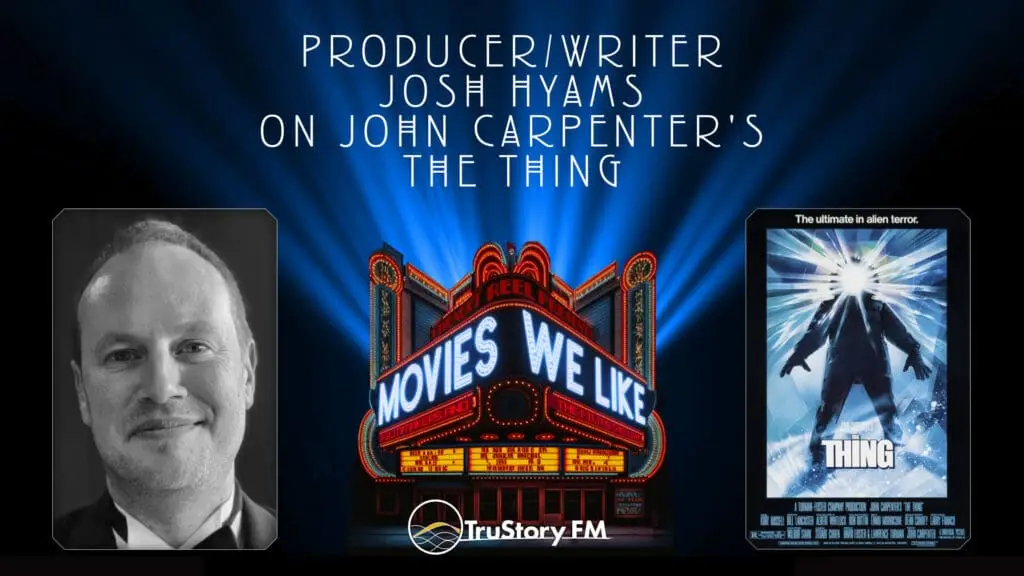
On today’s episode, we have invited producer-writer Josh Hyams to talk about John Carpenter’s The Thing, a movie he likes. Josh is a BAFTA and Emmy-winning producer and writer whose most recent film, Mr. Burton, received a BAFTA nomination for Outstanding British Film and is now available in the U. S. Josh, welcome to the show.
Josh Hyams
Thank you for having me.
Pete Wright
A delightful hyphenate you are, Josh. writer, producer, and yet you’re coming to us from what is quite obviously your music studio. What what’s going on with your life
Josh Hyams
I know I’m it’s I’m a frustrated musician, awfully frustrated, and I still there’s something in me that still thinks maybe one day it will happen and I kind of have to accept that the bee the well I yeah, I sort of fell into doing films. I loved doing films But I always feel like I am a m m a musi musician in disguise. Uh sometimes people might say very heavily in disguise. But no, I love I love making music. And actually it plays into the thing which we’ll talk about later because you know, John Carpenter who has become a big Pete Wright
For sure
Josh Hyams
You know, people really love his love his soundtracks now. Maybe they didn’t exactly the time, but there is an overlap.
Andy Nelson
Well, and he’s performing on the road too, so yeah.
Pete Wright
I know, a touring musician, John Carpenter, also fell into filmmaking.
Josh Hyams
Yeah. Exactly. Probably because as he would say, the thing was a complete failure and I’m look, I’m sure it’s done okay, but But I’m but you know, getting money on the road as a music musician is the way to do it now because can’t sell any records. And the thing was a dud, so maybe it’s still making up for not making money on the thing.
Andy Nelson
Right, exactly. Still trying. Still trying.
Josh Hyams
Yeah
Andy Nelson
Well, let’s talk about you and your career. How you got started I mean as a somebody who was a frustrated musician who kind of fell into film. What was that fall like? How did you kind of land in this industry?
Josh Hyams
Well, I have always loved film, but it kind of A bit like with Mr. Burton, which we might go and yeah, hopefully talk about a bit. I wasn’t exactly a kid from nowhere. I mean it happens more in America perhaps than it does in England, but you know, people do come from all over the America, which is a very big country. And but I didn’t know anyone that did film as much as I loved it, really loved it, because I was a kind of a VHS horror film kid, you know, the 80s and really just started to really love film through you know, films like the one we’ll talk about later and others. and horror and special effects and then got into more serious film and it was a you know pretty good time for film, but I didn’t really see it as a potential career path because I didn’t know anyone that did it or how to do it or what anyone did on it. I mean I’m still trying to work out what a producer does, but you know, I definitely definitely didn’t know any. Uh and Yeah, I did an English degree. Uh I you know, was always doing music. I still do music and, you know, kind of had the dream about being in the band you know, being this sort of rock singer. Again, partly probably why I like the thing is a few years after watching the thing I started getting into the music of the doors and Like Kerr Russell does like, you know, how has that sort of poet’s beard era Jim Morrison thing going on? It kind of what it ties in. But yeah, I got a work experience job. Uh a f a friend had done a work experience placement and I managed to get a work experience placement at Working Title. which is one of the you know, obviously one of the big big production companies and And it was a good yeah, we’re a good place to be and actually it just so happened.
Pete Wright
Yeah, not a bad gig.
Josh Hyams
the Nikki who works on the desk at Working Title and people would phone, have you had any runners come through recently that are okay? And Revolution Films happened to phone after I’d done a few weeks there and Nikki recommended me. And I got the job at Revolution on with Michael Winterbottom and Andrew Eaton and Melissa Parmenter. And really it kind of took off from there. And I, in a way, maybe it not being my complete and total dream. helped in the way to m how build a career around something that I just kind of didn’t there wasn’t as much pressure or I probably should have felt pressure at the time, but I probably didn’t feel the pressure. I just enjoyed doing it and Yeah, enjoyed the collaborativeness of it. A little bit. It is a bit like putting a band together, you know, working on a film and you know, just really seeing how films worked and Really, I’m still working with Revolution. Um, we just made another series of the trip and Michael. And so I’ve really yeah, been there from boy to man and they can’t shake me off And it’s great working with people you know and like. You know, there’s you know it’s important to you know, the more you make things, the more you think, well it’s yeah, you try and assemble the band out of people that you like the way they play music Or you know what I mean, there is an equivalence there, but if you’re thinking, okay, I need to put a group of people together You know, you don’t necessarily choose the the person who’s the absolute best at their job, the best in the field, which is probably how I’ve managed to stumble into working because I you know, I enjoyed working with people, I enjoyed being there. They obviously detected that I you know, I was pleased to be there. And I’m still pleased to be there. And I’ve been lucky on the things I’ve worked on. I think that’s the other important thing. I mean it’s funny working, you know, I did love films like the one we talked about, you know, kind of big, bold, effects-y things. But m the Michael Winterbottom, who I’ve worked with a lot, He made films in a completely different way, in a kind of verite way. And he was really exploring that kind of digital cinema thing and, you know, making it real, making it feel real, both in terms of the film and also the way you make the film. Um and that kind of brought out a whole side of of filmmaking and types of filmmaking that, you know, I the sort of yeah that I’m really into. Uh and unfortunately the audiences are still undecided sometimes but anyway you can never be never be sure
Pete Wright
Hey man, I gotta I mean I feel like that is classically British diminishing of your accomplishments. I mean looking just we have this rule around here around the our our particular house that You know, if it’s over six stars on IMDb, it is imminently watchable. Like it’s it’s just there there’s a window under six stars and over two stars that’s largely unwatchable.
Josh Hyams
Yeah, cool
Pete Wright
And th y I mean, there’s nothing you’ve done that people don’t like above and beyond that m marker. And that is a that is a crazy accomplishment in this industry. Right? You have a string of very delightful projects.
Josh Hyams
Thank you very much. And that is important. You want audiences to like it. You know, there I’ve probably not worked on the sort of, you know, smash hit. that obviously you kind of want to work on, you know, that just kind of catches the wave that somehow really is Zeitgeist, you know, Z a words on great films, you know, which will love and have won awards and you know, all kinds of things. But it you know, I still hanker after that one that just catches fire and really, you know, just but I you know, it’s you can’t really plan for that, can you? If you could, everyone would do it. It’s It’s that’s a magic. There is a magic thing that you search for the where the stars align. But thank you for to no for noting the IMDb scores. But I did work on one of the first things I worked on, and you won’t know this from you won’t have heard of it, is called Sex Lives of the Potato Men. and I was a runner, I run a driver, I run a driver on that. And it must have been a slow newsweek, but this film which starred a Mackenzie Crook actually who is now making his own TP was in the became was in the office and things like that. He he was and a and a British comedian called Johnny Vegas. And it was it was quite funny, but it had got money from the National Lottery Fund, the BFI as it is now. And I think someone just noticed that it the lottery had given, you know, the British people had essentially subsidised this film and it became a news story about it being the worst film of all time. Is this what we put our money to? So I have actually worked on something that ran slightly unkindly, I think, was completely vilified as as one of the worst films ever made.
Pete Wright
You know what? I’ll I’ll I’ll give you absolute credit for that. Sex Lives of the Potato Man is in IMDb and I just hadn’t had that window expanded
Josh Hyams
Yeah. Yeah. Yes.
Pete Wright
And it in fact is the lone four point seven in the no man’s land.
Josh Hyams
Yeah, we’ve still got 4. 7. That’s impressive though.
Andy Nelson
Yeah, but yeah, right, right.
Josh Hyams
That’s a good solid form.
Pete Wright
Yeah.
Josh Hyams
We’ll take that 4. 7. I think I speak for everyone that works on the film, but
Andy Nelson
There you go, there you go
Josh Hyams
Because yeah, the critics were definitely I think people may have watched it out of interest and been like, that wasn’t so bad. You know what I mean?
Pete Wright
Yeah, yeah.
Josh Hyams
It can it can have the opposite effect. You kind of want to watch the terrible movies because you know, you were kind of interested in them, would you like the room or something like that, you know, there. But I think actually it is a it is a yeah, I would say we’d take that IMDb rating. Uh yeah. But but I wasn’t responsible for it, but I did have a, you know, had a I put in the work. I suppose that’s one thing I should say that I didn’t know what I was doing. I didn’t expect to be a producer. I kind of wanted to learn how to how to do it. And You know, and I did start well I suppose a lot of people do, but I did I didn’t have any leg up I started as a runner and you know just kind of kept kept going. You know, with the literary back they sort of like books and literature and things like that. So that’s the kind of writery part. So you know the more that side of producing.
Andy Nelson
Yeah. Well when you’re when you’re working on the variety of projects that you have, like the you know, things like the trip with Michael Winterbottom versus some of the more narrative types of projects. Like are you finding, you know, as somebody who’s produced, who writes, who’s helped develop projects, are you able to kind of pull things from one type of project to use in the other. Is that is that something that you’re you’re finding a skill in?
Josh Hyams
On set, I would say yes, because Michael, again, not talk about him too much over the course of this thing, but inevitably I worked with him a lot. He does show that there’s a way, there’s no right way of making a film when you’re on set. And sometimes the right way is kind of mm-hmm more impersonal, like if the crew is too big. if every actor goes back to their trailer and just, you know, waits around. If the you know, you spend hours lighting a shot you know, the momentum of a project, it can just be really sapping and exhausting, especially actually now. I’ve worked on a lot of inevitably been working on a lot of TV series as well of late, even though I love film and they can get stretch on for months. And if you’re making it in that way, it you know, it’s a bit of a painstaking, boring process and The way Michael shoots is the camera is turning, you know, a lot of the eight hours continuous day that he likes to work. You know, you don’t have a trailers for actors, you don’t shout action or cart, we don’t have slates. you know, clapperboards. And you do you do just put people and you know, even if a big star walks into that, they kind of get that. you know, they kind of get that enjoy and you have a very small crew. You have as few people as you can possibly get away with having. And kind of i I just think people can enjoy that experience more. where you just strip away some of the stuff and some of the people and some of the some of the slack times in a day. And you can make films more affordably, number one. but you can also make them more enjoyable, which I do like to try and do. You know, it’s easy important to try and have some amount of fun some amount of fun, you know, along the way. And and I think, you know, that helps the vibe of of of the production. So yeah, it definitely from that point of view, in terms of the actual onset, you’re always thinking, having worked in that way, if you turn up to a set with too many you know, too many cars, too many trailers, you know, too many generators humming away. You know, it just feels so artificial and just slow. That’s not to say you y you know, some films completely require that. Oh yeah, and available light is the other thing Michael likes to do. You know, it’s not Dogme-esque aesthetic. So, you know, trying not to Trying you know, trying not to waste too much time perfectly lighting shots. But it look, it just depends on the depends on the material, doesn’t it? And it and the budget and everything else. But yeah, it’s worth knowing. that there are ways of making a film n you know, the that don’t require the big you know, the the sorts of circus around
Andy Nelson
How do your editors enjoy the no slates?
Pete Wright
Oh my god, Andy, I was just gonna say that.
Josh Hyams
Well yeah.
Pete Wright
I it’s been I’m my mind is ringing right now
Josh Hyams
Yeah, no continuity person either. Um and sometimes two camera two cameras
Andy Nelson
Wow.
Josh Hyams
But the answer to that actually is kind of an interesting one. Like first of all it’s digital, you know, so you’re not you know, when I started, and actually you I c you can see it in the thing, it’s just the The film stock is perfectly chosen for the material. You know, they’ve really thought about the stock and the reels. And you know, and then obviously these days you don’t need to worry about the actual the actual fit sheeting on film, you know, if you’re di if you’re digital. But the answer actually is Michael also edits in the office in the Revolution Films and just takes a bit longer over it, so there’s not that pressure of like hiring a cutting room. And and actually yeah, the editors Again, a little bit like other people, you know, and it’s kind of an open plan off open plan office. I remember one editor arriving in the first few days, she’s like, I don’t know how I’m gonna work like this, you know, with with these this amount of material and also the way like people are just making coffees and chatting over there. How can I and then in the in the end in the end she was like I You know, I think this has been my favorite job to cut because you feel like you’re part of it.
Andy Nelson
Wow.
Josh Hyams
And actually as you know, when I was there working as a you know, like in the office, you feel part of making the film in that so Yeah, but but it takes a bit more time, it is true. But the you know, mm that’s and Michael i he started in editing, so he’s he kind of you know takes a lot of that. But I don’t think it’s Kind of you know, and you just want people to obviously watch it and they have to watch all the material and mark it and you’ll have to ask the editors how they feel about it, but they seem ha they seem they seem happy enough.
Andy Nelson
They seem okay, yeah, right.
Pete Wright
That’s it. They’re telling you, the producer, that everything’s okay.
Josh Hyams
Yeah, yeah.
Andy Nelson
It totally are
Pete Wright
Okay, we’ll take that.
Josh Hyams
Everything’s fun.
Pete Wright
Yeah.
Josh Hyams
No, again, we work with the same we work with the same people, the same victims.
Pete Wright
Good everything’s great.
Josh Hyams
I mean the same brilliant editors.
Pete Wright
Yeah.
Josh Hyams
No, I And we actually we we made this film called Tristram Shandy, which was well A Cock and Bull Story is what it finally was called, but it’s based on a book called Tristram Shandy, and the joke of that book Is this man trying to write his autobiography? It’s a, you know, it’s an 18th-century book. It’s supposed to be an unfilmable book. Because he the joke, the mate, basically the central joke is he’s trying to write the story of his life But it takes him a year to write a day or a week of his life. So he’s you like at that rate he will never finish. And you know, it’s it’s kind of impossible. He’s like he’s still playing around with his his early childhood, you know, when it when it’s four or five hundred pages in. And that he’s kind of played for laughs or eighteenth eighteenth century laughs. Um and actually when we were making the film we were shooting so much, it felt like the editors just would never it would never be possible for the editors to like actually sit through all the material. Like it sort of reflected the way the book the book was. Um But yeah, look, there’s a way of doing it and there is a naturalism to it and you know people respond to you know not being told not worrying about continuity. You know, it you know not not not worrying about the clapperboard, you know, the and now let’s act. You know, it’s like it’s not and there’s no action. It’s just returning, you know, sound speed, you do all that. And and yeah, it’s more I suppose it is more documentary like But that’s not to say Michael doesn’t do fine filmmaking, like The Killer Inside Me is which I didn’t particularly work on much actually is on one of the films I was doing something else. But that is a really beautifully made you know period piece, very stylized, you know, it it’s you can still produce you know, films, you know, that are have have style and look beautiful and it’s about finding the people that can do it in that environment, I suppose.
Pete Wright
I want to dive in a little bit to what feeds you about being a producer. And I specifically want to talk about this in contrast to or or maybe context of Mr. Burton which we will transition to. You are a y a self admitted VHS kid. growing up watching movies, what is it that had you land in a position of producer and not a more, let’s say, hands on crafty role, and not behind camera and not You know what I mean?
Josh Hyams
Yeah. I think it was just the words thing, that’s just seemed to be what I was better at. You know, photography, I still struggle a little bit with you know, I’ve got quite a n a nice Sony camera now and I’m still struggling with you know, frame rates and ISO and all the you know, it’s not naturally what I kind of know about special effects.
Pete Wright
Oh, there are definitely people who intuit that kind of language, yeah.
Josh Hyams
I look Yeah, exactly. Technically into it. And and special effects I really wanted to do up till a certain age. I was kind of obsessed with like Tom Savini and all you know, the thing obviously is comes out of that.
Pete Wright
Of course
Josh Hyams
But I think at a certain point I realized that well, you kind of do need to be a good artist to do that or sculptor. particularly if you’re working in 3D or makeup is obviously a kind of form of painting and, you know, shadows and light. And although I w I’m not awful, I c you know, I just it wasn’t really my natural I just kind of realized that possibly I would never be able to sculpt this amazing monster mask, you know, that I kind of dreamt about. It just wasn’t the way I really thought. And Yeah, going through kind of English degree and but yeah, I suppose it was through development, through thinking. I do quite like the script. I like researching, you know, I like researching periods and looking into you know, the backstories of things and whether it’s a real you know, I’ve obviously done quite a lot of real stories where you’ve got people to talk to and books to read and reading reading around stuff I just naturally did and enjoyed doing and it just I suppose producing is the job you do when you’re not talented enough to do any of the crafting. Is that is that my thing I’m finally saying? I don’t know, maybe Yeah
Pete Wright
Well, and I also don’t think that’s fair. I’m I’m actually curious what it is about producing what is the natural skill that you feel like has you’ve nurtured over the last twenty plus years in doing this role because we know Production is incredibly important, right? We know this role is incredibly important. What is it that sort of feeds your soul? What makes you get up in the morning?
Josh Hyams
I think I do like working with people. I like, you know, it is a wonderful I suppose I the part of the VHS kid in me is like when you work and I think people when you’re out of you know, a dinner party and you say what you do. People are just you know, interested in what we do as filmmakers because you can sort of point to that thing on the shelf, although there aren’t any shelves anymore and there’s nothing. Uh but it you know, you can say, I made this, you know, I made this and it has some tangible form. And I suppose there is a real sense of achievement with of being involved with something, you know, at the beginning, just in a small way and now you know, a little bit m a little bit more and actually getting some way owned ideas over the line. I suppose and then people. I do like working with people again, a bit like being in a band or something. I just I do like, you know, bringing people together on set and solving problems and, you know, some problems require you know, we we’re all wondering about where how where we are on the spectrum these days in terms of ADHD and things like that. And and producing is a kind of interesting mix of things because some things you have to think quite long and deeply about. But then a lot of things on filmmaking is just kind of little problems that just crop up that you have to, you know, kind of whack-a-mole style problems that you just have to think about and solve. And I suppose it suits my Uh yeah, I can’t tell if it’s I I’ve got a mixture of good focus and then, you know, kind of quite like loads of different things to worry about rather than just one thing. But you know, like I the producing there’s different s forms of producing and fundamentally, I suppose, the older I get, you know, it you know, and cause I’ve come out of it as more of a hands-on on the ground producer in the trenches, which I love doing, but you know, there’s there’s a dimension in producing that I’m still trying to understand, which is how to get the money. Where some would say, is the hardest and the main the main thing
Pete Wright
That was my next question, yeah. Like, how do you feel about shilling for dollars?
Josh Hyams
Yeah, it’s it’s different it that is a side of it. You know, to be fair, I you know, I often work with people that you know, have have solved some of those problems before I step on, or I’m working with people that can solve those problems and we work and you know, some producers don’t like being on set as much and you know, I’ve had producer partnerships which I quite enjoyed where you know, I you know, I want to become the complete producer. But I think in a way it’s about, you know, getting the money. It’s always helpful if the last thing you did has done okay, really. That’s it. And can you can you can you get the actor, you know, that might make the difference and you know, more than and is the budget is it you know, can you do it the right budget? It’s all all of those things is the unfortunately there’s no science or magic to it. It’s and it and there’s no You know, I wish there was hard to always get a money from the same source. Uh like Mr. Burton, for example, you know, a lot of that money was because of the Welsh setting. it which is you know it was a kind of region and they you know a lot of bit there was a lot of goodwill for that to happen if it had been if it had been an e in and you know you kind of just have to hope for the right collision of subject matter and talent and you know funding sources and aha cool
Pete Wright
Well, I just had a personal shout out. My dad’s a Cardiff grad and so yeah, so w it feels like It was just really nice to see Cardiff represented.
Josh Hyams
Yeah. It’s a proper Welsh movie and I’m proud of that.
Pete Wright
Yeah.
Josh Hyams
I mean I have no again, I me I have no I’m an a Jewish kid from Essex, I which is East London and I have no you know, I don’t I didn’t really understand Wales, but I knew I loved this story. And, you know, you find people that suit, you know, you just try and find collaborators along the way that will help, you know, increase your chances of getting it getting it made. And, you know, each each film’s like that has that has to have that journey.
Andy Nelson
Well let’s let’s talk more about Mr. Burton and dig into this a little bit. Uh this the story of Richard Jenkins before he became Richard Burton, the actor we all Love and Adore. Um and his relationship with school teacher Philip Burton, who became a mentor and legal guardian This a story that you conceived and then you co-wrote it and produced this. So how, I mean, as somebody who kind of like came up with this story, like what was your draw to Richard Burton in telling this particular story?
Josh Hyams
Funnily enough, it comes from the two two words the answer is actually Rob Brydon. And Rob is a is a is a comedian, a comic actor, and it’s him and Steve Coogan that are in the trip Rob, along with Michael Sheen, who I’ve been lucky enough to work with, and Anthony Hopkins, who I haven’t been lucky enough to work with, and Richard Burton all came from this particular part of Wales and it’s just up the coast from Cardiff and it’s kind of out on the coast and it’s kind of nowhere really.
Andy Nelson
Okay, okay.
Josh Hyams
It’s a mining Sort of inland there’s mining, coal mining, and then there’s a steel mill that we you see in the film the you know billow billowing smoke. Anyway, so Rob is also an impressionist in the ways the trip r relies quite a lot on on Steve and Rob doing these impressions. And one impression Rob would always do when the camera was turning, and a lot of the time when the camera wasn’t turning, was this voice this voice, you know, to he would often do to begin at the beginning, which is Richard Burton doing Dylan Thomas Under Milk Wood. And You know, he di after about three series or two or three series, I just you know, when you’re interested in something and I just started watching some Richard Burton And I look I love again, I mentioned Jim Morrison already once and Kurt Kurt Russell, who’s in the thing drinking whiskey. You know, they we and you know, with the sort of the mu the age I am in terms of being a musician. I do like Hellraisers, you know, and I was lucky enough to work with Peter O’Toole. It was a, you know, Hellraising actor. I felt like this breed of m of men. you know, in a way literature had it with Hemingway and anyway, the English actors, probably because it was seen as a slightly effeminate thing to do. made up for it by by drinking and womanizing and the you know, there’s legendary stories of that. So I had that idea of who Burton was in my mind and then the voice Rob doing the voice, which it is, you know, and then listening to Richard Burton, it is this most amazing instrument. It’s the most amazing voice. It’s rich, it’s it crackles, it’s it cuts through, it is a completely amazing instrument for delivering poetry particularly and lines and then you know the look of him and I then read a biography and again like musicians like you know many you can mention David Bowie and other people, you know, they weren’t born. with that name to find out that Richard Burton was born Richie Jenkins and it had this you know, any person that has a stage name, they’re they have this dual the duality to them. No, there there there was this split in their personality. And it felt and so that was interest. I mean it was immediately interested. I already didn’t realise his father was you know, he had his real father, this drunk womanizing minor and then he had this surrogate father figure Philip Burton who represented these different impulses. And I’m gonna talk about the doors again. Oh my god, how many times could I mention? But you like well I like I like movies that lead you on to other things. I suppose I like music that leads you on to other things and some music
Andy Nelson
Sure.
Josh Hyams
Like the doors led me on to like Nietzsche on and philosophy and Aldous Huxley and things like that. It kind of it’s a gateway to other stuff. And one thing in Nietzsche is this thing about the Dionysian and the Apollonian, you know, these and I maybe didn’t think of that straight away, but really you have the Dionysus part of you that wants to kind of get drunk and party, and then the Apollonian, which is about order and you know, like art and like you know, making things just so. And it felt like Richard Burton had these two father figures. that really just, you know, m they kind of made him great. They made him greater than he would have been otherwise. But it also kind of pulled him apart. It was the tectonic plates of like where he kind of fell apart a bit and, you know, alcoholism, or these things. And then the Welshness, but then giving up your his his voice then became this cre he was a like a Frankenstein’s monster slightly. You know, it’s a Pygmalion story because this voice was created by this this teacher and it became, you know, a bit like every expat or someone, you know, a Welsh person that lives elsewhere. Richard Burton was more Welsh than the Welsh in a way, because he it’s because he had left. But he had to give something away in order to leave and that was make his voice more English, make his name more English, you know, sort of appear to be pretty much English. And that probably tugged at him as well and he was aware that he’d had to give up something of himself and pretend to be something it wasn’t to get famous. So it just felt like it was all there. And then the actual thing that made me realize where this story could go to. Again, being someone who did A-level English and then beyond Shakespeare has this this character of Henry the of Hal, yeah, who who’s in Henry the Fourth, and then it and then becomes the king in Henry V. And he’s a good king because he has He’s been in the taverns with Falstaff, who’s this father of of the taverns really. You know, he’s like Hal messes around with his older big man who helps him drink and, you know, have fun. And but then he knows he has to become the king. He’s he’s the king, his father wants him to grow up and take responsibility. And it feels like he as a king, he’s seen as a good king because he was able to interact with people in taverns. He was able to interact with people with court. It’d seen both sides And because Richard Burton’s defining role, at least on stage, before, you know, his career really kicked in as an actor, he appeared as Hal in Henry the Fourth. And it felt like, okay, we could tell this story. you know, from you know, for this particular window of time that showed you, you know, him becoming famous and how he you know, how his rise from absolute it’s just so improbable his journey to stardom And, you know, but be beyond the where our film goes. I mean, he was one of the biggest stars of the last century and you know, people can’t quite remember that now, you know, if you’re below a certain age, but, you know, the level of fame he had with Elizabeth Taylor, you know, it was just it was like it was something that hadn’t been seen before. You know, he He dined with the Kennedy’s and Sinatra and you know, he just he really just his his style was it just he just flew, you know, up and into the orbit and So it’s kind of how does that person, how does this young kid go from that to that? And also I love English teachers. And so just and people that give back to work and also working class kids act giving them access, you know, the mentor figure you know, giving a working class kid sorry, I’m k I’m going on you started me off now, but it’s all all of those things.
Andy Nelson
No it’s
Josh Hyams
I kind of saw all of those things in that in that in that story, that bit of this person’s life. And it felt like it wasn’t just about Richard Burton, it was a more universal story. of, you know, a kid that the that shouldn’t be in the arts apart from he’s got this talent and this talent would go to waste unless this person saw, recognized this talent and helped nurture it. And those people are really important to celebrate, I think.
Pete Wright
Uh, I’ve got so much I want to ask about this movie because first of all, it’s a banger. Like I got so much joy
Josh Hyams
Oh, thank you.
Pete Wright
out of watching this movie. I can’t even tell you. I’m also a deep sucker for great teachers on film, and this one was outstanding. Toby Jones is fantastic. Harry Lawtey is a treasure. Uh it was just really, really wonderful. How’d you know you were the one to write it?
Josh Hyams
Well, the answer to that is I thought I might not be the one to write it alone. So that’s why I phoned I happen to have a friend of a friend was Tom Bullough who who who writes these amazing novels really steeped in Wales and Welsh history and had explored this sort of territory through novels and poetry and I just thought I needed someone to collaborate with that knew that part of it and I recognized that I didn’t. Uh and so I always remember calling Tom and saying, you know, explaining the story. And sometimes when you tell people an idea they like they go quiet and you kind of you’re not sure if the quietness means what why is he why is he what’s he talking about or or whether okay maybe this good you know like that
Pete Wright
Listen.
Andy Nelson
You’re like, oh yeah. Wait, wait.
Josh Hyams
And he had the quiet the went quiet in the way that okay, I really like the sound of that. But the thing we keep laughing about is that I then kind of, you know, when he said he would be interested, I was like, Anne, look you take years to write novels. This we could, you know, we can write a screenplay and, you know, we could be making the film next year or in two years. And cut to seven years later when we were still trying to make And he’s pr he’s published two more books and we still haven’t made the film, but
Andy Nelson
Euros
Pete Wright
Oh no, why did you open your mouth?
Josh Hyams
Exactly. But but yeah, no, Tom, Tom was really important to this and the and the way that the characters the you know the characters were he had a real sense of Philip Burton and who he was. And we just had fun, you know, looking up because it’s quite fun to follow in the footsteps of Richard. He’s just a it feels like just an interesting character to explore Richard Burton and it feels like one for the w you know, Tom you know, loves Wel Wales and the Welsh and it has turned out to be the case that, you know, more Tom than me, but people, you know, do really you know, he lives in Wales and a lot of Welsh people have now seen the film and I happy want to talk about it. So yeah, again, it’s like finding, I mentioned it a bit before, but finding the collaborators that help unlock it. And then Ed Ed Talfan, who I produced it a lot with he actually his dad actually worked at the BBC and knew Philip Burton. So when I told him the story, it was he’d heard of Philip and that seemed to be a happy coincidence and Ed, you know, was was in the as a Welsh producer, you know, kind of a big fish in the Welsh Pond he was able to pull together some Welsh funding. We all and then Marc Evans, the director, is someone I knew because he went to film school, funnily enough, with with Michael Winterbottom and Andrew Eaton. And so I knew him more socially. And it just Yeah, it seemed to yeah happen at the right time in the end because Harry would have made it we I always think that if we’d have made it when we first had the idea or first wrote the script, Harry would have been like nine years old and not capable of it.
Pete Wright
Yeah.
Josh Hyams
So so we it was worth waiting for Harry.
Pete Wright
Yeah, you had to give him time to ripen.
Josh Hyams
Yeah, exactly.
Andy Nelson
It was the right right.
Josh Hyams
It was worth waiting for Harry to ripe, ripen and so yeah, looking at all I’m very happy that it all came together and now There’s a lot of film and film ideas. You end up, you know, I buy books. You know, I’m sure you’re the same. You buy things, you’re researching things. And I’ve got them on, you know, some of the bookshelves around around this. And in the house. And every time you I think subliminally, even if you don’t notice them, if it’s something that you’d like to make and you haven’t made, you walk past them and you’re always thinking, ah bugger I still haven’t made that film. Uh but now I I’ve got this Richard Burton shelf of like all these biographies and different different bits and bobs that I c I’m at peace. with having actually made this film. And again, like, it’s on the shelf.
Andy Nelson
It’s there, yeah.
Josh Hyams
It’s, you know, all it’s not actually there is a I do have a DVD copy of it. Uh but but you know what I mean? It’s now, it’s it’s made, it’s it’s done. I can close that chapter to some extent.
Pete Wright
Okay, well that’s sort of the follow-on question, right? Aspirationally speaking. You’ve you’ve closed the book on that chapter. Have you also closed the book on a desire to write the things that you’re producing? Is that is that sort of was that an itch you needed to scratch?
Josh Hyams
I really want to open that book much more. I mean look, because I worked as like a development producer for a lot of time and it has to be said that a lot of the time you really fight to get money at the beginning of a project. You know, and producers just don’t get money and the production companies don’t really get much money. The person that gets the money is the writer. And you know, whether it’s made or not You know, you often really you often re this a terrible thing to say probably on camera, but you often like fighting to get the writer page, you know, which I’m always pleased about. I love writers, I love working with writers, and I’m not saying I would wanna write everything that I w you know, wanna do. But if there’s something you fancy and then someone else writes it and you’re not quite sure if it you know, when you when they’re finally because if they’re a good writer, they’re always busy And so you get them the money and then they eventually find the time and then you get a draft and you’re like, Yeah, I k that’s g it’s g you know, it’s good, but maybe I could have, you know, if I’d have spent a couple of weeks I could have got somewhere in the area of look, writers who are are who can really, really write, you know, that that’s a that’s a an amazing talent and with the right project, you know, the right writers amazing thing. I feel like I can I really have an eye for a story and the structure of it and I don’t feel like I could write everything and you know like I’m working with a g guy called Simon Woods and his gift for dialogue is kind of Tarantino-esque, I would say he’s just got in him to just mint and it just pours out of him snappy dialogue after snappy dialogue, just pages and pages of the stuff. you know, I would say I’m more of a I’m more of a shaper of stories, you know, more of a you know, of a you know, working out the sh you know, the tangent, which is important as well.
Andy Nelson
Wow, nice
Josh Hyams
You know, it’s things like just having that gift, that ear for dialogue is you know, it’s something I m may have a bit, but it’s you know, it’s it’s that’s a gift that you know, some writers really have and but yeah, so so to answer the question In a way, as a producer, it’s very difficult unless you’re all already independently wealthy, which probably is the best way to start as being a producer. Um is
Pete Wright
Note to self. Hang on, let me write this down.
Josh Hyams
I love writing. I would like to do more of it. I’m not going to do everything. But yeah, I’m and I’m working on a horror horror part of the reason why I wanted to talk about the thing is I am working on a horror film at the moment, which, you know, as is in the area of
Andy Nelson
Nice
Josh Hyams
I just rewatched the thing again recently and you know that It’s kind of in my been on my mind because because of that. So yeah, I hope hopefully it’s not the last thing I’ve write, the Mr. Burton. If it if it is, then then I’m happy because it was a good one. But if it’s but I’m hoping I’m hoping to do more. I’m hoping to do more
Andy Nelson
Well, I mean I was totally blown away by Harry Lawtey as Richard. Like he was channeling the guy. It was it was phenomenal. And I’m like this I could I could see him step out of like step off this and just go right into like look back in anger or something, right? Like there’s just he carries that energy that Richard Burton has so often. Uh as a kind of this this producer and writer, I mean, were you much involved in the casting process for this or did you guys kind of turn it all over to Marc Evans, your director?
Josh Hyams
Pretty much I’d like to say yes, because it was Harry was such you know, I was I mean there were times on set I just was so ple the whole film would not have worked. without the person in that role doing a good job and Harry did such an incredible job. So but actually Kelly Valentine, the casting director, aired Talfan and Marc Evans had a list of of people they wanted to see. You know, some a lot of Welsh people as you can imagine, and some other people of the right age and Harry you know, Harry did a video read, which I did see actually. I w I was sent the ball. But I think Mark, you know, Mark really felt Harry, you know, Mark then went and met Harry and just felt, you know, this this young man, this kid, you know, had what it took and I wasn’t sure until because He didn’t really do the voice, but then Harry and I connected, you know, and talking about the research and, you know, different aspects of the script and, you know, had lots of nice chats and then a and we were on WhatsApp together and he started sending me, okay, this I’m just working on the voice, but here’s a clip of me doing whichever, a bit of Shakespeare or something. And when I pushed play on that first clip and I was like, I think this film might work you know, he’s he th he had the voice com it was just amazing, really. I mean, I played it to Kate we know one of the beautiful things about the film was we got to know the family, Kate Burton and her daughter, Richard’s granddaughter.
Andy Nelson
I was yeah, I was gonna ask if they had seen it, yeah.
Josh Hyams
Yeah, and you know, I remember playing it to Kate too, as you know, as we were must have been getting ready to film or one day when Kate was kind enough to visit. And, you know, she had the same thing that that’s That’s that’s m that’s dad. You know, he she really you know, you keep it was in it was almost indistinguishable. And that’s quite interesting because Harry And and to give him even more credit, what was very impressive is because of the nature of our shooting schedule, there were some days where he would have to be the, you know, the kind of schoolboy in his shorts. And you know, Harry really does try and plot the trajectory of it. And and actually other friend I remember an actor friend that saw it said, when the film started, I just wasn’t sure if he was gonna get there. to get to the Burton thing and Harry really skillfully, you know, demarcates Richie Jenkins from then Richard Richard Burton and they’re completely different. feel like different characters, you know, this and time has elapsed. And some days Harry would have to have to start as one and move on to the other. And, you know, he just he really puts the put the work in and has the talent and the ear. you know, in a in a way it’s some a musical thing is to have be able to imitate like that and to but not only imitate to really, you know, believe make you believe this a three-dimensional person. So and then there were some times where you had to bring things forward. You know, like the scene with Shakespeare m it’s quite a moving scene where they’re in front of Shakespeare’s grave. We were supposed to film that in Stratford, kind of towards the back end of the movie, and it’s a really emotional thing where he comes in
Andy Nelson
Oh yeah
Josh Hyams
and yeah and Philip Burton is in the pew.
Andy Nelson
Mr. Burton’s sitting there, yeah.
Josh Hyams
Yeah, exactly.
Andy Nelson
Right.
Josh Hyams
That that scene we’ve we had to spring that on Harry. We were like, look, we don’t think we can afford to go to Stratford. We found a church in at the end of actually at the end of Cardiff High Street. The that funnily enough, j was just a really good match. Uh it was extraordinary really. But We had to bring it forward by about two, three weeks. You know, we’re gonna have to do it in a couple of days. I remember telling him, setting him down and telling him. And he was like, okay, right. Uh and I have to say But his work in that he you know, I think everyone was in tears watching him do that particular bit of it. And it was just an earlier in the day he had probably been in like a pair of rugby shorts and running around a pitch, you know, he He he just as a school kid, he just really na he really, really nailed her.
Andy Nelson
Oh my gosh
Pete Wright
You know, just a shout out to his his I was surprised that he wasn’t a local Swansea kid. Like w I e the that he’s an he’s an Oxford kid having to learn Wales is to be a presentable youth from this part of the country, even though they’re what, hours apart. He he represents a bit of local that I was very surprised to see.
Andy Nelson
Yeah, shout out to William William Conacher, his dialect coach, who we’ve had on the show before.
Pete Wright
Yeah. Yeah, we have.
Josh Hyams
Yes, I saw that actually. And funny enough, I need to call I actually got it on my list to call them about something another film we’re working on with. I’ve got some things to do with but but yeah they they did an amazing job but Harry had the has the capacity to he’s got a great ear. I think his dad was in the It was in the an RAF engineer or something. Anyway, they moved around a bit. And I think Harry just was it kind of had — I think I’m not mistaken thinking Harry as a kid moved around country a bit and You know what it’s like in I mean it’s the same in America, but in England it’s particularly like you only need to travel an hour and it’s a completely different dialect or different
Andy Nelson
Yeah.
Josh Hyams
And he was just all he just is one of those people that was good at th thankfully for us that just has that ear of of you know and that sensitivity to
Pete Wright
Yeah.
Josh Hyams
Yeah, and the and the depth of the voice as well because it’s it’s a low voice perhaps. He’s kind of an interesting mixture actually, because it’s kind of a deep voice, but he’s got this crackle on the top. It it kind of is It’s you know, in he did like probably smoke thirty cigarettes a day, that feels like that’s in there and he seemed to just embody it all. And look, we some Welsh people were probably a bit put out that it wasn’t a Welsh kid playing Richie Jenkins and but but you’d either have to go for a Welsh person that went Richard the English Richard Burton Or like we did, Harry we knew could do the English Shakespearean side, you know, and work back to the Welsh thing, but it was a lot of work for him. And yeah, all kudos to him.
Andy Nelson
No kidding, no kidding. Well, it is streaming now, so everybody you should check it out. It is well worth it Let’s take this opportunity though to switch and start talking about John Carpenter and his 1982 flop the thing.
Pete Wright
I actually love that you pick this movie because I sort of feel like it is the horror Mr. Burton. Like in the spirit of like we can’t trust what’s left of Richie Jenkins in Richard Burton. It’s like We can’t trust because it’s the aliens are taking over his body. It’s the same movie, really.
Josh Hyams
Yeah, that’s true. There is I mean it’s it’s interesting. It can’t be seen. It’s one of those films that can be seen as a kind of paranoid you know, thing where you people stop trusting each other. I think John Carpenter because obviously thinking about doing this podcast, I I’ve I’ve listened to a few things about about the thing and John Carpenter’s You know, he mentioned it a few years ago that, you know, the we’re becoming more divided. You know, quite a long time ago, it was probably twenty years ago, we’re becoming very divided as people, you’re not sure who you can trust even within families and countries and you know, this these group of people start to have to mistrust each other. And it does feel like unfortunately things haven’t got better since John Carpenter said that twenty years ago. It feels like it’s right but but really the thing
Andy Nelson
Cheers.
Pete Wright
Yeah
Josh Hyams
I wanna describe where I first watched this film and maybe you’ll understand why I’m why I’m I suggested it to you guys. I was, I think, seven or eight years old. We were away as a family in Europe somewhere, I think Greece. And you know what it’s like when you’re in a kind of resort, hotel, there’s entertainment of various kinds, and I suppose I can’t remember too much about the holida holiday But what I do remember is one night, you know, one hot Greek night, we there was an outdoor cinema of some kind. It felt big to me, like a kind of amphitheatre-y Like not huge, but I yeah, it was a kind of outdoor setting. A cool place to watch a film actually at night time. And it must have been I mean, I was born in seventy-seven. So you know, w you know what it’s like in those sorts of things. They don’t show the film that has just come out. They’ll show something that probably had been out for a couple of years and you know they were able to show it or had a printer or whatever. Um so I was seven or eight years old. They played the thing, and I suppose my parents didn’t really you know, it just was something that was going on at night and Yes, it was summer, I didn’t have to get up in the morning and I was just kicking around. I sort of remember being low down in the seats, kind of looking through, you know, kind of people’s legs almost at the screen. And I don’t remember too much about the whole film, but what I do remember is the sequence of the defibrillator sequence.
Andy Nelson
Oh yes.
Josh Hyams
Uh and then when the head comes off and then it comes on the thing and then grows eight eight spot legs and eyes.
Andy Nelson
Oh yes.
Josh Hyams
and scuttles off under the table. And I think as a kid that had a kind of pretty profound effect on me. It kind of blew my mind. And and it remains remained blown. And really I suppose I you know, if any moment made me love cinema, maybe it was kind of that one because I just then got really into har probably because it scared me. I mean actually th I don’t know if you’ve seen the Fabelmans, the Andy Nelson
Yeah, the Spielbergs film
Josh Hyams
The Spielberg film and there is that lovely sequence where he’s trying to understand his fear, isn’t he? I think a lot of filmmakers maybe have that. It’s like, okay, this a trick, this a magic trick, this an illusion. How does it work? Why has this scared me so much? Why did it have this effect on me? you know, in order to conquer their fear. So in the Fabelmans you have not to compare myself with Spielberg. By the way, I should say, I’m not feeling compared. But I, you know, I understood where that was from. Like he had just seen the big train crash on the cinema and he had his train set and he had his camera and he tried to pick it apart. And And maybe not. I mean, I between the ages of like ten, th to thirteen, I’d I’d watch more horror films and then I just wanted to get into special effects. And and part of understanding how a special effect works, it teaches you the grammar of of filmmaking, doesn’t it? It teaches you that there is a camera, number one, and that you can cut and move the camera around and there are things the camera can’t see that you know, people with syringes full of blood like pumping it away or you know, like just how how to sell a ma essentially a magic trick, you know, and make it feel real and certain the way you light it and And I suppose and Tom Savini, who I think I mentioned a bit before, had this book of Grand Illusions that really showed his effects and there are other movies you know, like the thing that I love, like mentioned like An An American Werewolf in London in London, you know, that transformation scene. Um, Day of the Dead, I particularly like Day of the Dead. and Dawn of the Dead and all of those things and Evil Dead 2, you know, a clutch of just amazing I would just say they’re amazing films, you know, with they’re just films, they’re not horror films. They’re just brilliant movies and that helped me, even though I didn’t know anyone in film and no way of really learning. And and also there’s no there wasn’t YouTube, obviously. These days you can see so much behind the scenes stuff and there wasn’t even particularly behind the scenes, you know, DVDs and come out. So you would just have to glean these these ideas of how you might make a film. And so the thing, I still think it is the gold standard of practical effects. you know, it just coincidentally it’s still I don’t think it’s been topped, you know, and it and then as an you know, the best films you’re they’re rewatchable, aren’t they? Uh you know, and we you know, have I have watched that film a number of times with a number of different people. Most recently a few weeks ago with someone that hadn’t seen it and you just enjoy different things in it and can appreciate it. I, you know, as an adult, you know, th I appreciate what we were talking about before the distrust of this group of people, this ensemble actors working together. feeling like real people and the the way that the situation unfolds that they’re in. But as a kid, burns on my retina were those amazing effects by Rob Bottin.
Andy Nelson
For me, that was exactly the same how I fell in love with this movie is like I was on a trip with my dad and yeah, we were in a hotel room and There was the a and my d my dad thought I was asleep. It was late at night and he was just up and he was watching TV, watching like HBO at the hotel. and it happened to be on and I happened to actually be awake and I was just kind of watching it, you know, across my pillow so my dad couldn’t see me. And I mean it terrified me. And that scene of the of the defibrillator with Richard Dysart getting his hands bit off, like has just it’s been burned into my brain since then. And it’s just like it I immediately fell in love with this and has it’s always been one of my favorites. So fantastic effects the way that Rob Bottin pulls all of this stuff off.
Pete Wright
I think Rob I think Rob’s the work is exemplary, of course, but I think one of the things that makes the thing work, and I think when you talk about it as an example of just a great film. is that the setup for this thing is already terrifying, right? Like we’re already, they put us in a location that is terrifying. They put us in a location where the elements alone can kill us. And then they tell you that the central horror is that the monster looks exactly like you. Right. It’s it it’s identical to everyone around you. So you almost don’t need the glorious effects to create an atmosphere of absolute terror. And I think that’s that’s one of the things that the movie really the story I I’ll say too because I think the you know the original novella I think really captures that spirit. What they bring to screen is captures anxiety in a way that is really special.
Andy Nelson
Well, and what’s funny about that is like being being based on not only who goes there, the short story, but also the thing from another world in the fifties. Like this one almost carries more of that fifties like fear of communism, fear of the other than than even that one does, which I find fascinating.
Josh Hyams
Yeah, completely. And I actually I hadn’t read the short story. I thought and I just happened again the just in the last few days. I just thought, oh yeah, I’m gonna read the story. And a lot of it is in there, even down to the blood testing scene. But you’re you’re you’re right, it is just about the pace of the film I absolutely adore. It draws you in. It doesn’t patronize you. That is really important. It just never patronizes the audience It is a grown up cerebral, you know, well told horror film that takes its time and when the effects come, you know, it is just it kind of you know, they’re explosive, but they don’t feel it ever feel gratuitous. You know, they feel like you know, it it’s Probably the only gratuitous thing in the movie is the commando role that Kurt Russell does at one point towards the end. I don’t know if you remember that A really kind of B movie Chuck Nor like the sub Chuck Norris.
Andy Nelson
Yeah. Yeah.
Josh Hyams
Like I can’t really do my roles here. My head over here, my little head overheels. But no, I the pace of the movie, it’s all about the pace of the movie. And obviously as a seven-year-old, but maybe I did appreciate it. Maybe this was like I can’t remember that aspect of it. But I know also it just takes you somewhat, isn’t it? It’s completely transporting. And the, you know, the ice, the snowy tundra, and then the flamethrowers, you know, the cl these different textures they have and just the vibe of the people. I mean look, I as a musician, I absolutely now love Stevie Wonder. I’d never noticed really until I watched it quite recently that superstition is on, you know, when rotor skating around the I love that, but I remember the first time I heard I felt like I heard that m that song. You know, it had the same effect on me of the Clav playing. Anyway, it is it it just is the most wonderfully rendered film. And look, that’s probably why as a mass market film. I mean the Alien has it Alien the Original has it too, you know, has this slowness to it and then these watercooler moments that I’m, you know, the people just can’t believe, you know, still talking about those effects. An An American Werewolf in London in London, of course, has it with the transformation scene. You know, it these you know, and I think you’re right, effects. need to be embedded in good filmmaking, you know, and to and they were just yeah, extraordinary. So it wasn’t just the Although as a child it was somewhat to do with the effects. I appreciated that it was a film by a proper filmmaker, you know, you know, a powerful filmmaker and with a great cast that just you know, it’s just a great based film by a real filmmaker that’s taking his time that really probably had to fight for a lot of things in this movie to be a certain way. You know, and the ending too and you know again my research about about thinking about this film for for this podcast. Not to jump too much to the end, but just to say that he they obviously tested it, it didn’t test well. But it is the right ending for the film. And it and you know they’re obviously f fights would have had to be had to make this a proper filmmaker’s film. It’s not a horror film. It’s a gr a grown-up f you know, cinema lovers film.
Andy Nelson
Well, and it’s I mean, look at the cast and the way it’s not just the cast, it’s the way that they wrote those characters. Like you believe all of them. They feel like actual people working down here on this this base down in Antarctica doing research. And it all like they all play it well and you can see all of diff all their different roles and just how they all fit together and then the way that the dynamic is as they start interacting and start I’m not trusting you now because you’re acting a little suspicious. You know, let’s lock let’s lock Wilford Brimley up out in the storage shed. Like there’s a lot of that sort of the way that they are reacting. And I think that’s an important element that not only the screenwriter’s capture, but also I think John Carpenter knew how to how to actually direct that and shoot it in ways where he’s he’s, you know, putting certain characters together in frame or isolating someone in a frame by themselves. And I think That’s just you know, you really have to know the story and how it’s gonna come together and unfold in order for that to work well, especially when you know it needs to be something that’s going to scare an audience.
Josh Hyams
Yeah, and in all you need to you need to care about the characters in order to so when the when they are, you know, when they or do variously die, you kind of feel something. They’re not just throwaway characters, they feel dimensional. And and it does sound like they had that time. We we had a just go back to Mr. Burton, we had a few days to really talk about the script with it was Mark and Tom and I and then Harry and Toby Jones and you know we really talked about every aspect of the you know, talk through each scene and the dynamics and had a bit of time just a week or so before filming to just refine it. And it feels like they did have that work you know, workshop that thing and develop these relationships with each other. you know, the ac the actors really bring something to it and they really had a sense of of who their characters were. Funnily enough, like I say, I’ve just watched the I just read the novella and, you know, a lot of those characters are to some extent in there. There’s a sense of them in there and their names are in there. And you know, it was kind of quite I haven’t watched the fifties one recently and I’d be interested to actually go back and rewatch it. And presumably the nineteen fifties one had the effect on John Carpenter or Rob Bottin or whatever that this The Thing had on me as a kid, you know, it must have stuck in their minds. But yeah, a lot of it is about this camaraderie of the characters. It reminded me, I don’t know if you’ve done aliens on this show I was I mentioned alien, but apparently with aliens, you know, when they’re all getting ready to go down to the plan go down to the planet and they, you know, they’re all the sort of military team are all kind of together and they under there’s a dynamic between them and apparently he shot that right at the end. He shot that at the end of of them having been together shooting everything else because he knew the best way to show this the camaraderie between these people that knew each other would be if they did genuinely know each other and had kind of inhabited their roles. And it feels like although they might not you know, that you get so much of that in the thing and it feels like this it has stemmed from the characters, you know, the actors really helping feed into, you know, like just a proper collaboration, which is what you want in a in a film.
Andy Nelson
Yeah, absolutely.
Pete Wright
That’s fascinating. I actually that is one bit of trivia I did not know and I think it’s fascinating you can totally see it in that film. This one, you know, I It’s got me thinking about the mist, which I think the remake of the mist, especially the black and white, is just extraordinary. And I think what’s what I celebrate with that film is the same thing I celebrate with this film, that y you know, even though the mist, the monster is not inside you It is watching the destabilization of human relationships. And I think that’s what we we get here. And I think we get that from the 50s version too, right? We get this feeling that i look at how fragile humanity is. If we’re gonna lock up a national treasure like Wilford Brimley then we have we have fallen too far. We are irredeemable. And that’s that is, I think, the biggest and most horrific lesson is that we are deeply, deeply fragile human species and it’s one of the things that this movie is a horror movie does so so well. I am curious your take on Carpenter writ large. Did you find that you started celebrating more broadly his catalogue and the works of of the great John.
Josh Hyams
Definitely. I look, I always loved him as a filmmaker and as a musician. And you know, he just feels like he’s a He’s a great intelligent American filmmaker and I haven’t gone back for the I for this I probably should have done a John Carpenter season and really, you know, sort of tracked it. But he He’s, you know, he has made quite a lot of varied interesting films, you know, and even in the run-up to this, you know, obviously he made Halloween and then but then obviously did the Elvis film. That’s kind of a you know that’s where he first did the Kirk the got the Kurt Russell, you know, was in that, you know, it’s kind of interesting how he You know, didn’t necessarily do the obvious things and then Assault on Precinct I’d watched. I didn’t love it as much as the thing. You know, again, it’s quite fun ca you know, but but artist you know actor director collaboration I remember Big Trouble in Little China I remember came out when I was a teenager so that was probably the First one I watched actually in the cinema and you know it’s kind of I quite like to watch it again now. It’s quite a fun patchy film.
Andy Nelson
Oh, it’s yeah.
Josh Hyams
Probably they spent too much money on it. Uh and they live obviously has you know has you know it’s kind of blue pill, red pill stuff, isn’t it? That that is
Andy Nelson
Oh yeah, yeah
Josh Hyams
It feels like a film that is being re and you know probably there’s a few dodgy commando roles in that film as well. Uh but yeah, I mean look he’s a great filmmaker and has worked on different budgets. you know, and just he’s rightly celebrated. I mean, look, I think probably I get the impression that people like us talking about the thing you know, 40 years later might slightly annoy him because it wasn’t here at the time. Like, where were you at the time? It didn’t doesn’t help me.
Andy Nelson
Yeah, all right.
Josh Hyams
I d I think it, you know, he probably does have that. you know, im you know, put thing of like, okay, so it’s great in posterity, but it’s like it’s celebrating, you know, yeah, someone that is, you know, Van Gogh, but it didn’t really help Van Gogh much.
Andy Nelson
Yeah, right.
Josh Hyams
Like he’s not around to appreciate the
Pete Wright
Mm look, John, I was ten years old. I was doing my part, man. This what we get.
Andy Nelson
That’s right.
Josh Hyams
Yeah.
Andy Nelson
Well look, he made he made all of his money on this movie when he had the rights to the prequel made, right?
Josh Hyams
Yeah.
Andy Nelson
Like that’s where he pulled all that extra money from.
Pete Wright
Yeah.
Josh Hyams
Yeah.
Pete Wright
Right, he did fine.
Josh Hyams
Yeah, that’s true. Yeah, which I didn’t go back and wat I didn’t go back and watch.
Andy Nelson
Yeah.
Josh Hyams
I should watch. I mean funnily enough I
Andy Nelson
I’m curious to revisit it. It’s yeah.
Josh Hyams
Yeah, I just spent a lot of time in Norway.
Andy Nelson
I don’t remember it being great, but yeah.
Josh Hyams
I used to spend a lot of time in Norway, so I watched it when I watched the thing again recently.
Andy Nelson
Oh.
Josh Hyams
Oh right, actually I know Norwegians and th you know kind of
Andy Nelson
Yeah, yeah, right.
Josh Hyams
I kind of like the Norwegian aspect of it, which is something they I can’t again, I can’t remember if it’s in the fifties one. That’s not in the Joseph Campbell stuff.
Andy Nelson
No, no. Fifties is just very American.
Josh Hyams
But I Yeah. And the Norwegians, the idea that this has just happened to someone else and it’s about to happen to you, you know, but you don’t know it yet. And through this dog and why are they trying to shoot the dog is just In the film just leaves you wondering what is gonna ha happen at every turn and it takes and that dog is a brilliant you know, a brilliant part of the movie.
Pete Wright
Yeah.
Andy Nelson
Great dog performance, yeah.
Josh Hyams
Yeah, great dog performance and it and then like you were saying about isolating them in the frame. You know, that feels like there’s those lovely shots of the dog. You know, little do they know what this dog is carrying and then the dog, you know, the dog, the dog-loving character, the dog handler. And and what was great is that I tried to watch it on DVD with one of my kids and I don’t know whether it was something interaction between the DVD and my TV just didn’t look that great. When I watched Def Hughes, it looked like an old film. But we stream streamed it the other day with a friend, you know, from you know, one of the streaming platforms which I won’t mention here. But anyway, it was just so looked so good. It looked so sharp, so crisp, like it was made yesterday, you know, but a period piece. It really you know, apart from the commando role. Um, but it yeah, and it looked like it could have been made yesterday. It just and it just so beautifully filmed. And, you know, a lot of the you know, there’s this story of Rob Bottin wanting his the effects to be not too you know, keeping them in the dark, keeping them, you know, with with sorts of lighting that didn’t just reveal too much. all those choices they made in the with the lighting were just perfect ones in the film stock and it just you know I just don’t think I don’t I do think it’s one of the great, you know, like I say, one of the great films, definitely one of the greatest genre films. And you know, not for everyone because it’s slow, it’s it doesn’t ha you know, it’s it asks questions, it doesn’t answer them all, you know, but it is A wonderful piece.
Andy Nelson
Well, I I’m very much looking forward to you figuring out how to integrate a commando role into your horror film that you’re currently working on.
Pete Wright
Yeah, that’s canon now, right?
Andy Nelson
I need to be you need to be like, how can that work?
Josh Hyams
Yeah.
Pete Wright
You have to do that.
Andy Nelson
There’s gotta be a way.
Pete Wright
Yeah, it’s it’s Josh Hyams himself. This signature producer role is to make sure commando role is somewhere in everything you do from here on.
Josh Hyams
Yeah
Andy Nelson
Somewhere in the project, yeah.
Josh Hyams
I feel like I’m I’m getting to that age where like it feels like everyone could do a commando role, but actually I’m thinking could I now just go on and do a commander? I’d be slightly worried. I’d do something do something.
Andy Nelson
Yeah, right, right.
Josh Hyams
I’d feel it the next I’d feel it the next day. I think I’d feel it the next day
Andy Nelson
Yeah, it No kidding, no kidding. Uh I want to wrap wrap this up, but before I do, I just considering your your love of music and everything, and we’ve talked a lot about John Carpenter. We Uh we’d be remiss if we didn’t mention any of the fact that he did the score for this and captured like perfectly a John Carpenter Essence score. Uh I’m just curious how how the score works for you. Uh ‘Cause it feels very different from so many I mean, so many of his scores feel different, but this one in particular.
Josh Hyams
Yeah, for Morricone I mean it’s interesting it’s Morricone ’cause it could be John Carpenter. So it feels like it must have been some like, you know, meeting where John Carpenter was like, How about you if you do what you do, but you do it with, you know, this instrument? You know, because you know I
Pete Wright
Oh, we’re all we’re all aware that John Carpenter had his fingers wrapped around Morricone’s neck during composition, right?
Josh Hyams
Yeah. Yeah. But i I just think it does work. You know, so apparently there’s a lot of music that wasn’t used. And and you know, in this repetitive, drony, you know, kind of someone described it as it’s a kind of isolated pulse, you know, that it reflects the isolation of the characters because it’s quite bare. It is one note and it is just feels like it is alone this and it and it just does drive through the film and it is incredibly atmospheric and I do think I think Tarantino used some of the music I was just reading also this on the Hateful Eight. reused some of the music that wasn’t used, you know, the unused music and obviously Kurt Russell. I think, you know, I hadn’t realized Tarantino liked this film. I suppose I imagine he might do because it’s that age and again a video shop
Andy Nelson
Sure, yeah yeah.
Josh Hyams
junkie. But you know, he recognized in this film something that he re reused with with yeah, but The Hateful Eight definitely in terms of the music, but also in terms of this group of men having some issue, you know, Reservoir dogs being one, The Hateful Eight being another.
Andy Nelson
Exactly.
Josh Hyams
But the music the music is a key part of it. It places it in time, but you know, like I think post Stranger Things and Marty Supreme recently, I think that kind of synth led soundtracks are kind of back in mode. Uh, you know, and a lot of it is you can see I’ve got a bunch of synth here that would be, you know, unaffordable you know, when this film was made. You know, some but they’re kind of replicas of of the technology and you can get it on plugins now the these amazing synth sounds which are very much of their age still haven’t quite been surpassed in the way that they they can just work. They’re synthetic. Yeah, but yeah. So I love the music as well.
Andy Nelson
Yeah, it’s it’s fantastic. It’s a great film. I’m so glad that you recommended it and gave us a chance to chat about it here on the show. Mr. Burton, out right now. Everybody should check that out. And their streaming services. What else do you have in the works that people should know about right now, Josh?
Josh Hyams
Well look, I b on Mr. Burton, thank you for mentioning that. We I would absolutely love people to work. Mr. Burton and I guarantee you’ll get something out of watching that film and it will make you feel something about you know, how there might be some talent out there that could do with your help if you work in the industry or or just m recognize something, you know, that you like in it. I hope everyone does get a chance to watch it if you can. Uh because it’s hard to get films out on the cinema. So I’m really, you know, appreciating these coming out in the States and You know, it’s a it’s tough to get films out these days and, you know, I think people will you know, people that like cinema will like Mr. Burton and I have But yeah, we’ve got a common and more another series of the trip we shot last year in Norway, Scandinavia.
Andy Nelson
No, this was the Norway trip.
Josh Hyams
It’s called
Pete Wright
Yeah.
Josh Hyams
Yeah, the Norway trip, the trip to the Northern Lights, we call it, and it’s Steve and Rob, slightly older. So so the trip comes out as a film in America that will be coming out probably towards the end of the year. Um and it comes out as a series. Actually, it’s cut into a six-episode series and a film. But the series comes out in the UK in October. And then I’m working on a film called The Worst with the writer I was talking about, Simon Woods. And quiet starry cast, Keira Knightley, Alicia Vikander, Jamie Dornan, Anna Maxwell Martin, hopefully Tom Holland, people like that. I probably shouldn’t mention too many names in case they so we’re Erin Kellyman, who who was Andy Nelson
Wow.
Josh Hyams
He w he was in Scarlett Johansson’s film recently, her first film. So we’ve got this the old one.
Pete Wright
Josh, every one of those names transcends the title of that project.
Josh Hyams
Yeah. Yeah.
Pete Wright
Every one of them.
Josh Hyams
Yeah, because it’s called the worst. And so at the moment it’s called the worst unless some marketing people tell me it’s a bad idea for a film, it’s called it the worst. And actually someone already
Pete Wright
Oh, marketing people.
Josh Hyams
Some someone that works with like a casting person passed me on to an agent and said this Josh Hyams, he’s the worst producer Which I loved. I because the film is called The Worst and I and we know what the t-shirt would be, the worst crew, the worst car, you know what the yeah, and like so so but at this point I’m taking up by the name The West.
Andy Nelson
Yeah, yeah, right, right.
Josh Hyams
But it’s essentially it’s about the worst people having the worst weekend, you know, they’re they’re away in France for the weekend and it all goes horribly wrong, these old friends. So so hopefully we’ll be shooting that in June in sunny France.
Andy Nelson
Lovely.
Josh Hyams
Not Norway, quite different to Antarctic.
Andy Nelson
Wow. No, yeah, right, right. Time for time for some sun.
Pete Wright
Outstanding
Andy Nelson
That’s great.
Josh Hyams
But thank you so much for having me and really appreciate the invite. Andy, I worked with in Phoenix, and we really enjoyed working together, so lovely to see him Thank you, Pete.
Andy Nelson
If you want to keep watching and listening, here are a few other episodes from the Next Reel family worth checking out. Pete and I talked about the thing as part of our horror series over on The Next Reel. And on Cinema Scope, I covered 1950s science fiction, including the thing from another world, the film Carpenter Was Reworking, with guest Robert Horton. Then if you want more Richard Burton, Pete and I covered one of our favorite Richard Burton films, The Spy Who Came In From the Cold, on the Next Reel as part of our John le Carré series. And on Cinema Scope, there’s an episode on the British New Wave with David Forrest that touches on Burton’s early film Look Back in Anger. Links to all four in the show notes. Thanks again to Josh Hyams for joining us today. For everyone out there, we hope you enjoyed the show and certainly hope you like the movie like we do here on Movies We Like. Movies We Like is part of the TruStory FM Network and part of the Next Reel family of film shows. Our theme is Chonklap! by Out of Flux. Find us at trustory.fm and follow at The Next Reel on BlueSky, Instagram, and Letterboxd. You can also watch full episodes on The Next Reel YouTube channel. If you’d like to learn about becoming a member of The Next Reel family of film shows, visit trustory.fm slash join. That’s T-R-U-S-T-O-R-Y. fm slash join. If you’re enjoying the show, we’d love your rating and review wherever you listen. See you next time.