Pete Wright
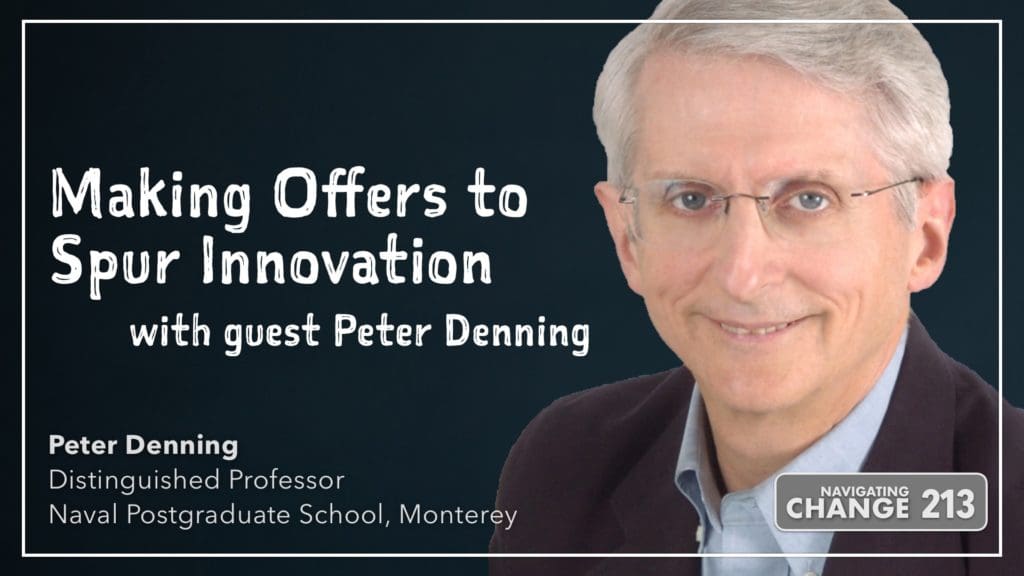
The last time Peter Denning was here, he introduced us to a simple and transformational piece of writing: the Beginner’s Creed. And just as that text served to transform the experience of learning for so many of us — and for his computer science graduate students at the Naval Postgraduate School in Monterey, California — so does his message today have the ability to transform the way we work together to create. Peter sits down with Howard Teibel to talk about innovation. But this isn’t about the tools or technology behind today’s latest and greatest inventions. That would almost be too easy. Instead, Peter and Howard break down the nature of the promises we make to one another, our offers to others, and our ability to deliver on them. In this light, innovation is a distinctly human skill of leadership, attention, and communication that can be sharpened. And now, Howard Teibel with Distinguished Professor of Computer Science at the Naval Postgraduate School in Monterey, Peter Denning.
Howard Teibel
Welcome back, Peter, to Navigating Change. It’s great to have you again.
Peter Denning
Well, thank you.
Howard Teibel
When we finished last time, you and I talked about taking the next step and having a further conversation to build on what you invented — which I have shared with many of my clients — the Beginner’s Creed, the gift that keeps on giving. And if you haven’t read the Beginner’s Creed, I invite you to get a copy from our website, where we’ll share that. You teach at the Naval Postgraduate School in Monterey, California, in the Computer Science Department, and you have graduate students who’ve moved beyond the undergraduate experience and are now paying attention in a different way. They’re in their mid-30s or so. And I wanted to have a conversation with you that is broader than what’s happening in your classroom. I think what you’re teaching and engaging people in around innovation has great relevance not just for students who are going to go out in the world and make an impact, but for teachers and administrators — around how we bring innovation to our work.
Peter Denning
You know, Howard, I spend a lot of my time talking with my students about computer science topics, notably operating systems and artificial intelligence. But I also spend a lot of time talking with them about their own leadership. They’re military officers who aspire to be leaders in the Navy or the Marine Corps. They live in a world where they’re under a lot of pressure from Navy leadership to be innovative — to accelerate the pace of adoption of new, useful technologies — and they feel that’s part of their mission. And I’m trying to help them do that.
Howard Teibel
When you and I were having our pre-conversation for this podcast, we spoke to this question of what innovation actually is. You framed innovation as the emergence of new practices in a community.
Peter Denning
First, I would say that one of the reasons my colleagues and I formulated that alternative definition was that the common understanding just wasn’t working. People want innovation. They think innovation is all about inventing ideas. That’s what they do. They invent ideas and then they watch as very few of them get adopted. They wind up feeling frustrated, feeling ineffective, like they’re not able to do their job or be a leader. This isn’t just our students who feel this way. A lot of people feel that way. I’ve been in many meetings where a common reaction was: my boss said, please put innovative ideas on the table, that’s your job. And that’s what I did. I spent a lot of time putting a really cool innovative idea out on the table. The group discussed it briefly, and then they didn’t select my idea — they selected the idea of that guy at the end of the table. It was the stupidest idea I’d ever heard, and his got selected over mine. And I don’t know what happened. Mine was the better idea. I could clearly demonstrate that. So I’m not able to do the job my boss wanted me to do. What is going on here?
Howard Teibel
So from that repeated experience, and from observing it, you arrived at a different way of thinking about innovation.
Peter Denning
The first thing I said was: what is the current way of thinking about innovation? And the current way is the invention of new ideas. So we call that the invention point of view. You listen to managers and corporate executives and they say, yeah, we’ve got loads of ideas that we could choose from, but we don’t have enough resources and people to explore every one of them. So we have to pick and choose. Just because you created an idea doesn’t mean it’s going to produce an innovation for us. This led me to ask: if creating ideas is not the end result we need, what is the end result? That led me to the notion that the end result is that people are actually using your idea in their daily work — in the way they go about doing things. I call that their practice. So they’re using it in their practice. And my job as an innovation leader is to get them to adopt the new practice. When you see that happen, when you see a community engaged in a new practice, you can say with certainty: this person accomplished an innovation. And that’s what we want as the outcome — not that someone had an idea, but that they got the community to do things differently.
Howard Teibel
Often when we see an innovation show up, we don’t know how it happened. We might know the forces that contributed to it — a good obvious one in our larger community is Uber. This question of making something possible is so relevant, Peter, to people who are trying not just to become more efficient in education on the administration side, but to provide better value to students and faculty. And value often shows up in a certain kind of innovation — but it doesn’t have to be sexy, it has to be relevant. Talk about what the adoption of new practices in a community actually means. How do you orient people to that as a way of creating something relevant?
Peter Denning
That’s a good question. The way I like to think about it is that for a new practice to be adopted — I use the term practice as a kind of technical word for the way I go about doing things. My normal, everyday set of habits and routines, not just mine personally, but shared with everybody in my community, the way we all go about doing things. I call them practices because I do them mostly without thinking about them. They’re not thoughts, they’re not ideas — they’re me doing things. I think you’ve used the word embodied for that. When I embody something, I do it without thinking about it. So when I say my community adopted a new practice, that’s what I mean: they changed the way they do things without even thinking about it. That’s what I’m after. That’s what we call the emergence — when people are doing things differently. Now we can say the innovation has occurred.
My concern is not just on the ideas, but on people using them, putting them to work. You also mentioned relevance, and I think this is extremely important. People will not adopt a new way of doing things unless it’s relevant to what they’re trying to do and actually takes care of concerns they have. They’re concerned about doing something, and I’ve given them a new way to do it, or I’ve shown them the possibility of a new way to do it. And unless there’s a concern I’m speaking to, I fall on deaf ears. I can say, here’s a great new practice for you — and if you’re not concerned about that, nothing is going to happen.
Howard Teibel
And you had a great example for me around strategic planning.
Peter Denning
Let’s just think about this for a second. We have this notion that we want our community to shift, to engage in a new practice. And they won’t do it unless my offer to them takes care of something they’re concerned about and seems highly relevant and valuable. So my job, if I’m trying to produce the emergence, if I’m trying to get people to do it, is to make them an offer they basically can’t refuse.
Howard Teibel
Right.
Peter Denning
The reason they can’t refuse it is because I’m offering to take care of something they actually care about. The example is a project we did here at the Postgraduate School starting about a year and a half ago to create a new strategic plan. Every university wants to have a strategic plan. I’ve been around others where they spent a lot of time and effort putting one together. When they finished, it was a great big thick, polished document — handed out to the whole community, to supporters of the university, to alumni — and all those copies went into the lower right drawer of a lot of people’s desks, never seen again. The reason is that nothing in the strategic plan seemed relevant to anybody. It was something the administration wanted to do, so they went along, but it was otherwise meaningless. And the only reason they went along was to make sure they had their oar in the water — they didn’t want to be left out, so they played along just enough.
Howard Teibel
So if someone says, what’s your strategic plan, you could at least say you have one.
Peter Denning
Right. And you knew what you wanted to do anyway, and you wanted to be left alone to do it.
Howard Teibel
Let’s get back to work.
Peter Denning
Here we started this project for a strategic plan, and it actually kind of began that way. I was on the committee. The committee said, well, here are some high-level themes — for example, artificial intelligence in weapon systems — and they had a list of about seven or eight of these kinds of themes. The provost held a couple of town hall meetings to present those themes to the faculty and get reactions. And what he got back was a large, very loud amount of yawning. Deafening yawns. He wanted a strategic plan the faculty would embrace, which everybody wants. So we got back in the meeting and I said, what’s missing here is we’re not making offers. And as the faculty community, you’re not asking us to make offers to the Navy.
So an offer would be something simple like: I’m an expert in artificial intelligence. I offer to start up a project to investigate uses of artificial intelligence in drones. What that means is, if you back me — you being the administration — I’m going to do that. You can count on it. I am making you a commitment right now to do that if you back me. You can back me in a number of ways. You could give me some money, you could introduce me to a federal agency that wants to sponsor my work, you could connect me to a foundation where some alumni might want to sponsor my work. There are a lot of ways you could help me, but I’m committed to do this if you back me. So I said to the committee: maybe that’s what we need. Can we get our strategic plan to read like a set of offers from the faculty — offers that speak to Navy concerns, that the Navy leadership would welcome?
Howard Teibel
The shift here is moving from “here’s what we want to do” to “what concern are we addressing — an existing concern already in the community we’re trying to serve.” That’s a big shift.
Peter Denning
Yes. So the provost liked this idea. We came up with topic areas where we know the Navy leadership is concerned. One of them is artificial intelligence. We went out and held town halls where we invited faculty to come and talk to us about what they could do in each of these areas. I think we landed on twelve different areas. And we had twelve town hall meetings, each attended by anywhere from twenty-five to sixty faculty. We have two hundred faculty here, so this was a pretty substantial turnout. They told us what they would like to do, and the ones that sounded like powerful offers made it into the plan.
When we distributed the plan, the Navy leadership reacted all the way to the top. The CNO — the Chief of Naval Operations — said this is the best strategic plan we’ve ever seen. And they said: how can we support you? What can we do to make it possible for your faculty to do all these things? This shift — moving away from the plan as a bunch of ideas that a committee cooked up with maybe some operational steps that might get us there — we shifted that to the plan as a set of offers from the faculty to do things that take care of Navy concerns. And when we did that, we got a plan that was exceptionally well received and came with counter-offers: how can we help you do this?
Howard Teibel
We talk a lot about buy-in — getting faculty buy-in or administrative buy-in. Buy-in is a pretty low bar compared to having people show up and in the end be in a position where they’ve made commitments. Buy-in as a way of reflecting back and saying, yeah, they’re in this, we’ve got them to buy in. What I see you doing in that example was the mechanism for being able to say that people have made commitments, and those commitments are an expression of buy-in.
Peter Denning
No, I wouldn’t say that at all. Buy-in to me is an intellectual exercise. The kind of commitment I’m talking about is in my heart, in my body. I want to do it. It’s going to get done. It may not even be totally intellectual, but you can count on me.
Howard Teibel
When we say we need to get buy-in — what are we really saying?
Peter Denning
We’re going to persuade them to go along with us and let us do our thing.
Howard Teibel
Thank you for pushing back. When we say we’ve got buy-in, we’re fundamentally saying we’ve convinced you to go along.
Peter Denning
Right. But you haven’t elicited a commitment from me. That’s not going to get you anywhere.
Howard Teibel
That’s good.
Peter Denning
I want you to —
Howard Teibel
I’m going to stop talking about buy-in. You’ve just taught me something. I hear people talk about buy-in and I think it’s a weak way of representing moving the needle forward.
Peter Denning
Because you don’t have any commitments behind it.
Howard Teibel
I started off by saying that what you’re doing in the classroom — what you’re teaching these graduate students, who will ultimately take it out into their military careers — is about how they can show up differently in these conversations, be able to make offers that address a concern in the community. What are some of the areas you explore with your students? Just give people a flavor of what these practices are that lead to being able to make these kinds of powerful offers.
Peter Denning
Well, first I’d say most offers are powerful — you just have to make them. The surprising thing is the large-scale amount of reluctance I see. People come into meetings and they are reluctant to make offers. I think they’re reluctant because they’re afraid there’s a commitment attached to making the offer. If somebody accepts their offer, they’re on the line — they’ve got to do something. And not sure they want to make that commitment, so they don’t make an offer. They’ll make bland statements like, it would be good if we recommended so-and-so, or it would be good if somebody did such-and-such. But they don’t say: I offer to put together a task force to explore how to do this, or I offer to organize a lunch where those of us who are interested in this topic can come together and come up with some things we can do.
Maybe we also have a misunderstanding of what an offer looks like — like we’re going to put some big thing on the table and you’re going to pay for it. But no, an offer can be a relatively small thing. Like: I’m offering to bring together a bunch of people to have a conversation around this issue we don’t know anything about and see if we can learn anything. I go to a lot of meetings and people are sitting around saying things like “it would be good if we recommended…” — nobody in the meeting will say I volunteer to do something, or I offer to do something. So the person who does that is going to have great power in the meeting, because nobody else is doing it.
Howard Teibel
The other barrier to making offers is that if I make an offer, I don’t necessarily know how I’m going to get it done, and I may lack a certain level of confidence that I’ll be able to navigate the uncertainty. And I think part of what people want is certainty that they can do something successfully. If I make an offer and I don’t have everything figured out, I’m at risk of failing. And that’s another contributor to why people are reluctant to put things out. If you said yes to my offer — I will do a program for you, Peter — and I don’t quite know what that program looks like yet, I have to trust myself enough that I’m going to be able to execute on that. Otherwise I look even more foolish.
Peter Denning
A perfectly good offer is to say: I’m going to convene a conversation to figure this out.
Howard Teibel
You know, it’s funny you say that. I’m with the deans at a major research university, and what I’m saying to the academic or the administrative leadership is: you don’t have to lead with your expertise. You don’t have to come in with the answers around what the model should look like or the business model. Can you be the leaders of convening the conversation and making an offer or an invitation for a conversation? And I’m seeing how people are sitting on their hands because they’re afraid they don’t have it figured out before they make that offer. They feel they have to know more.
Peter Denning
Howard, this goes back to the Beginner’s Creed. We could say: this thing we need to deal with is new. We don’t know much about it. Nobody here has enough expertise to answer the question. We’re all beginners. So let’s get together as beginners and have a conversation. See if we can figure this out.
Howard Teibel
Yeah, but on the academic and administrative side — to be able to tell somebody, look them straight in the eye, and say, can we acknowledge that in this area we’re beginners? That is a hard thing unless you have deep trust. People don’t want to admit that in a public way.
Peter Denning
Mm-hmm.
Howard Teibel
It takes the lid off this pretense that our expertise is everything. And I’ve struggled with how to have that kind of conversation — with a set of deans or a group of faculty. Can we take off our expertise hats for a minute and recognize we’re beginners in how we’re going to navigate this problem? People often don’t want to step into that conversation. I’m curious how you get people to open up around that.
Peter Denning
The simplest thing I can think of is to say: I want to learn about this. I’m going to bring some people who are knowledgeable about it. We’re going to have a conversation together, and the purpose is for me to learn something. I’m not declaring myself the expert who wants to teach you something.
Howard Teibel
Yeah, maybe —
Peter Denning
I’m not declaring myself the expert who wants to inform you about something. I’m saying I want you to help me understand something — you know more about it than I do. People like that. They’re willing to have that conversation because I’m not threatening them, not trying to upstage them, not trying to claim my expertise is better than theirs. I’m simply saying: I want to figure something out. I need your help. You know a lot about this. I think if we put our heads together, we can come up with something good.
Howard Teibel
A colleague of ours, Lampros Fatsis, once said to me in a meeting with a group we were working with: can we have a conversation about something where it’s okay that nothing comes out of it? Because in the background, people are evaluating whether they’re going to participate based on whether they can see the outcome. I’m only going to participate in something if I can see where it leads. But maybe we have to give ourselves permission to be in conversations where it is really okay that in the end nothing came out of it, except we learned. This is where it took us — or it didn’t take us anywhere. And I think that’s interesting, because it’s about giving ourselves permission to be in conversations that could end up being irrelevant. What are the eight practices you teach in your program?
Peter Denning
Going back to the beginning — what does it mean to have the emergence of new practice in a community? That’s our definition. We’ve written about this in my book with Bob Denham, The Innovator’s Way, where we talk about eight essential practices that innovation leaders engage in in order to bring about adoption. And I could just rattle off their names: sensing —
Howard Teibel
Rattle off.
Peter Denning
— envisioning, offering, adapting, sustaining, executing, leading, and embodying.
Howard Teibel
You know, normally when I listen to a list like that, I’m listening for the arc. And it seems to me these are not linear. They’re related, they’re interdependent, but it’s not like you start with sensing and end with embodying. They’re relevant to each other in different ways. These practices — it’s almost like a toolbox. And in a given situation, you may have to step in and make an offer. Are these ways for people to develop a different level of awareness around how they move something forward?
Peter Denning
Yes. I call them navigational skills. With these skills, we have a general idea where we want to get to, and we can actually get there. Take the first one: sensing. This is all about being able to listen to your community and find a way to address a concern they have. It’s a listening skill, and it turns out a lot of people don’t know how to do it. We think we know what a concern is, but we often don’t know what the actual concern is. If you ask somebody what they’re concerned about, they might tell you something — but then again, they might not even know exactly how to say what they’re concerned about. All they know is something bothers them or concerns them, but they can’t put it into words. So your job is to find out what they can’t put into words and put it into words for them. And then you can tell if you’re successful, because they’ll say: that’s it. If you could do something about that, I’m in.
Howard Teibel
You know, versus just listening with your ears — what I’m discovering more and more, Peter, is that in the listening, if I make a request of you, it’s not just that you heard it. It’s: how are you paying attention to my concerns? Can you articulate back to me the concerns that I may not have even spoken? As opposed to what we typically do — and we’ve been trained this way from a very young age — you’ll say something to me and I’ll nod my head, and I’ll walk away saying, I have no idea what he just asked me. Or I think I know, but I never really got in there and listened for the concern. I think it’s a great example of a skill set that can be practiced. And once you have that, the person goes: oh, that’s it. Exactly right.
Peter Denning
Let me just add a personal footnote on that. There’s this technique called active listening, where somebody says something and you try to repeat it back to them. To me, that’s a very mechanical technique.
Howard Teibel
Oh my gosh.
Peter Denning
I could do it with a tape recorder. And I don’t want to be a tape recorder. I want to be a committed, involved person who actually cares about their concern. That’s how I want to show up — not as an automaton repeating back what they just said. I want to show up as someone who actually cares about them and how their work is, and who is genuinely trying to offer them something helpful.
Howard Teibel
I love that distinction, because active listening is not just mechanical — in many cases it can completely avoid what the concern actually is. That’s a really good insight for our listeners: recognize the difference between listening for concerns and simply being able to repeat back what someone said, which is how we’ve typically been trained to be better listeners.
Peter Denning
Right.
Howard Teibel
All right, more on this. This is great, Peter. You’re on a roll right now.
Peter Denning
What I like to think about is possibilities. A possibility is a sense that something is possible. I think we’ve all had our own experience of what it means when a possibility shows up — this feeling in our body that something has become possible. What do we do with it? Often we get drawn to it, especially if it has something to do with something we’re concerned about, something we care about. We get drawn to the possibility. We want to move into it. And that’s the kind of sensation I look for when I’m talking to people, trying to understand their concerns. When we talk and possibilities start showing up in the conversation — which ones are they drawn to? Those are the possibilities I want to work with. I don’t want to work with possibilities that don’t draw anybody to them.
The conversation may expose possibilities I didn’t even suspect. I try to let myself be completely open to that — oh, there’s something these people want to have happen, and I think I can help them do that. And it takes care of my interest in helping them do it, but it’s not exactly the same thing I thought of originally. Developing this art of being able to listen for when possibilities show up, and when are they attracting you to move into them — and more importantly, when are they attracting your community members to move into them? And do you have a mutual attraction? Does this possibility bring all of us toward it? When that happens, we’re onto something. There’s something we can work with. So let’s try and work with that.
Howard Teibel
Yeah, I’m struck by the role of the leader in this. Because very often I see that if you train people to have good conversations in a group and train them to listen for concerns — telling them we’re not going to solve today, we’re really going to navigate a conversation and see what value can emerge — that often doesn’t lead to action. And what I see often stopping it is that we have leaders in the room who don’t know when to say: all right, now we’re ready to move forward. This has been a great conversation. Are we ready to take action? And when that person exercises that move, it allows us to recognize we’ve got something and now we’re ready to act. In much of my work with leaders and their teams, there’s a strong focus on trying to get as many voices on the table and looking for what will likely have the greatest amount of agreement. And we often don’t even get to that move where a leader is willing to make a declaration: I’ve heard everything, it’s been a fantastic conversation, let’s move this forward. What’s your sense of the leader’s role in moving from sensing all the way to adoption?
Peter Denning
I have an answer that depends on my having been in a lot of faculty meetings. Faculty meetings are always rather difficult. But what I find is exploring in the meeting where the possibilities are that people want to gather around. The only way I can bring that out, often, is to literally go around the table and point to each person and say: what do you think? A lot of them will speak up, and some can be very eloquent, but they don’t speak up on their own unless you create the opening for them to speak up.
Howard Teibel
That’s not just faculty meetings.
Peter Denning
No. And now that everybody’s had a chance to speak, you actually get a really good sense of where the possibilities are.
Howard Teibel
You need to sometimes explicitly go around the table, look each person in the eye, and say: what do you think? And once you’ve done that, there’s still a move that needs to be made — now what?
Peter Denning
Once I’m pretty sure, I’ll say something like: looks like here’s a possibility we can work on. And people nod their heads — yeah. Okay. So let’s work on this one. I might, depending on who’s going to take responsibility, say: I’m going to take responsibility to convene a subgroup of this faculty to look into this issue and report back to us. Or I might go a little further and ask: does anybody volunteer to lead that subgroup? Somebody might raise their hand. Fine — you are the chair of the subcommittee. So what I’m now trying to do is produce actions. I can make a declaration about what direction we might head. I can make a request: would you be the chair of the subgroup to look into this for us? Or I can make an offer myself: I’ll convene the subgroup to look into this. A lot of moves I can make, but every one of them carries a commitment by somebody. It’s either me making a commitment or somebody in the group making a commitment. And that’s where the action comes from — they make the commitment, they say I will do it, and it comes to happen.
Howard Teibel
What you just described brings us back to offers. In the end, one of the key takeaways I walk away with is a greater awareness of: am I making offers in a space where I want to make something happen, rather than waiting for some circumstance to change? And you’re right — we all could be making more offers, if we’re paying attention. My sense is the more we do this, the more we realize this is how we move things forward. People can always decline. But this is a missing skill in most workplaces — recognizing the power you have to make offers, even if it’s as small as: I will organize the lunch. You said to me the other day, it could start with organizing the lunch, and next thing you know you’re looking back and you’re the COO or second in command, because you kept demonstrating your capacity to make offers and executing on them.
Peter Denning
It’s a wonderful way to build power in a group — make offers. It could be really simple things: I’ll organize a lunch, I’ll bring some crackers and cookies, I’ll call up a certain person and ask if he’ll come and be a speaker at our seminar. These seemingly little things are easy to do, but you’re making an offer, and when you fulfill on it, you earn a few credibility points with your group or your boss. Before long you’ve accumulated some power. And you might wind up, as you just pointed out, being the deputy of the group, or second in command, and you look back and say: how did I get there?
Howard Teibel
Yeah.
Peter Denning
Well, I just kept making offers, kept accepting them, and the next thing I knew, here I am. The management consultant looking in from the outside might say, this person built social power by making and fulfilling offers. But that’s a detached, intellectual description. I’m talking about the person who feels involved and keeps willingly raising their hand to offer to do things — and because nobody else is raising their hand, they wind up being taken as the person who gets something done. And that’s what a leader is: a person who gets something done.
Howard Teibel
We started talking about innovation. I think we have different views about what it is. We often look at innovation as things that show up in the world like Uber or Airbnb or Amazon. But what you’ve done is framed innovation as something that an individual or a group can engage in to move things forward. It doesn’t live in the object — it lives in the development and adoption of these new ways of showing up, new practices. And the innovation is what it is — it could be small, it could be large. This is more about the habits we’re developing, not the objects we’re creating.
Peter Denning
In my way of looking at it, objects are tools that support practices. When something presents you with a new tool, it may open up a possibility that wasn’t there before, and you might start using it because you’re interested in that possibility. So you change your practice in order to reach the possibility, and the tool is helping you get there.
Howard Teibel
That’s fascinating. If you think about Airbnb — Airbnb is the object, but the practice is how we take vacations, right?
Peter Denning
Okay.
Howard Teibel
And Airbnb is an example of a tool we use as part of that practice of mobility and taking vacations.
Peter Denning
So the platform is a tool. The practice is the making of and engaging in these exchange transactions — the back-and-forth offers between somebody who wants to rent and somebody who has a place to rent. I call that an exchange transaction because they’ve made an offer to rent their place, and I show up and say I’ll accept your offer. They might vet me to see if I fit their basic requirements, whether I can pay, all those kinds of things. And when we reach an agreement, the offer is fulfilled. I get to rent, the owner gets the money. And Airbnb as a company gets a little share of the money that changed hands. But the real thing happening there is I’m engaging in a practice — back and forth with another person, facilitated by the tool — to rent their house.
Howard Teibel
What I’m taking away from this, Peter, is a deeper appreciation of the importance of making offers. They have multiple positive benefits: one, to be able to move something forward; two, to exercise and develop a certain power in a community; and three, to remind myself that it should be focused — maybe always — on offers that are addressing not just a concern I have in my head, but a concern that exists in a community. And what you have done for me in this conversation is something I knew of, but you have a way of expressing it simply — and it’s something that I think we can all take into our worlds and explore with others. That’s a key thing that’s top of mind for me.
Peter Denning
Mm.
Howard Teibel
And also the distinction between innovation as objects versus innovation as the inventing of new practices that lead to something showing up differently in the world — things like Uber and so on. Those were my takeaways. Anything for you, just in hearing yourself or in this conversation?
Peter Denning
Just this for our listeners: go practice making offers. You can do it in simple steps. Next time you go to a meeting, just sit there and listen and watch if anybody makes an offer. I think you’ll be surprised — in most meetings, very few offers are being made. And people get bored with those meetings, including you. And you can also try this: when somebody in the meeting has brought up a possibility that you feel strongly about and you’re drawn to it, raise your hand, make an offer. Do something. Even something simple like organize the conversation, organize a lunch to have people talk about that thing. And observe — sit in the meeting, see where you’re making offers, where other people are making offers. You will be surprised at how few people are actually making offers, and what kind of power you have when you make them.
Howard Teibel
That’s a perfect way to end this. Thank you again, Peter. We’ll post on the podcast page the links you want to share with folks. And thank you so much for doing this again and for being the thought leader that you are.
Peter Denning
Well, thank you, Howard.