Carol Cone:
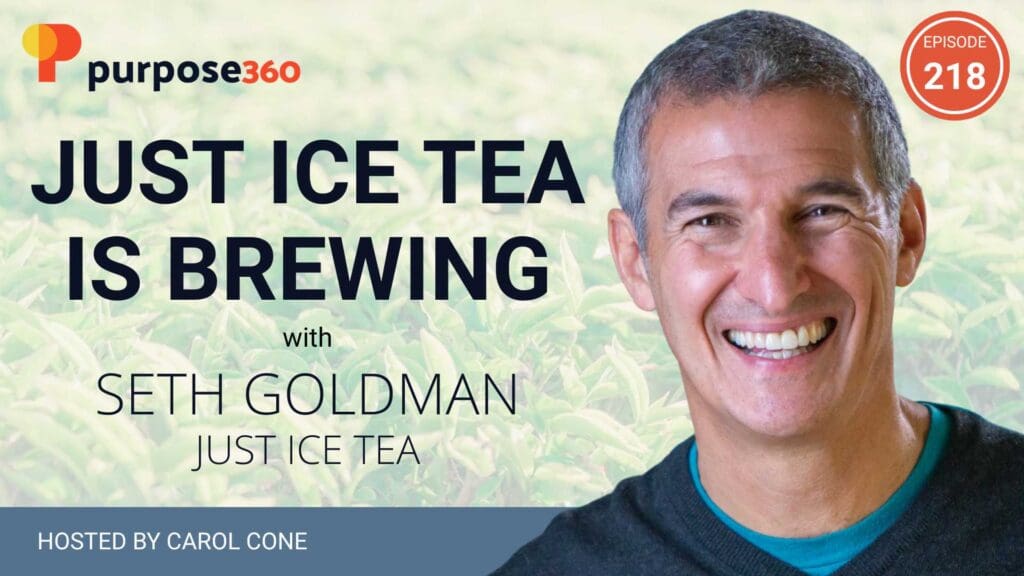
I’m Carol Cone and welcome to Purpose 360, the podcast that unlocks the power of purpose to ignite business and social impact. I’m so excited about today’s conversation. It’s with the visionary social entrepreneur, Seth Goldman.
He’s best known for co-founding Honest Tea in 1998 that he sold to Coca-Cola, and we’ll talk a little bit about that. Plant Burger in 2020 and Just Ice Tea two years later that took off like a sky rocket because it built on so much of the learnings that he had with Honest Tea. Seth has built every enterprise on a foundation of ethical sourcing, equitable partnerships, and environmental stewardship. Throughout his remarkable career, he has modeled a new, more humankind of capitalism, one rooted in transparency, authenticity, and his unwavering optimism so important for an entrepreneur. So, join me for a powerful conversation that will inspire you to lead with conviction and compassion and to believe as Seth does, that business can be both profitable and great for the world. Let’s begin.
Welcome to the show, Seth Goldman. I guess today your title is co-founder and CEO of Just Ice Tea. But let’s just get a little bit about your background and why are you so committed to socially responsible business, stakeholder-based capitalism and just doing the right thing?
Seth Goldman:
Well, it is so nice to be with you and to reconnect on all these topics we’ve been discussing over the years and hopefully to update a bit as well. I grew up in Wellesley and my father was a professor at Wellesley College and my mother was a professor at Boston University. One was a historian, one was an economist, so the dinner table discussion was not about the Red Sox or the weather much as I would’ve wished it to be. And so, we were talking about big ideas in the world and there was always an expectation that you would be, us as children there were four of us, we’re expected to play a role in addressing issues you care about. So, for me, it was just a question of which arena I would choose. And I actually grew up in my early sort of leanings, were more political.
I did a bunch of internships with Mike Dukakis and worked in sort of summertime in some roles in the Massachusetts State government. I thought again that was where I was going to go, but I started to see that while there’s real impact you can have in politics, it can also be undone and it can also require a lot of posturing, I thought or it can be a little distant from the people you actually impact.
And so, I realized it was worth trying to pursue opportunities where I could feel like my impact was more direct. And that eventually led me to the Yale School of Management and I got involved in the founding of what has become Net Impact.
Seth Goldman:
Eventually got a job with Calvert and moved down here and Calvert was the leader, really the first to do socially responsible investing for mutual funds. And again, interesting work, but it did feel a little removed from the people we were impacting because we were investing in the companies and I thought I’d really like to build one of those companies. I just needed to find the right idea. And then it was a run in Central Park. I had gone to New York to give a presentation to a bunch of institutional investors, and after the presentation, I went for the run. After the run, I was thirsty and I went to a beverage cooler and I said, “There’s a big hole here.”
And so, I was passionate about building a beverage brand, but it was my co-founder who had been my professor, Barry Nalebuff, who came up with the name Honest Tea. And for me that name unlocked this opportunity to go pursue, create a business that had impact embedded into it. And even though this is back in 1998, so we didn’t know exactly how the impact would be embedded, but first it was just a less sweet drink, which was better nutritionally for the consumer. But then we went to make the world’s first organic bottled tea and then the world’s first fair trade bottled tea, and then eventually did those together and that was the path. That’s how I got here.
Carol Cone:
Yeah. And Honest Tea, I was very well aware of it and certainly aware of your background and we will talk a little bit about its trajectory, especially selling to Coke and then what happened with Coke. But you have built multiple purpose brands besides Honest Tea, and then you have Just Ice Tea and then you also have Beyond Meat, and you’ve been part of the movement per se before it was labeled ESG, before it was even before B Corps were around. And so just from where you sit, what’s changed most about this movement? That’s the first question.
Seth Goldman:
Well, I think one thing that’s changed is the transparency that consumers can have. So, 20, 25 years ago, it was easier for a company to say, “Oh, we’re doing, we’re ‘socially responsible’ or we’re all natural or we’re earth-friendly.” And those are kind of broad labels that can really be open to interpretation. Today, a company that makes those claims better be able to back it up because the consumer has access to information in a way they didn’t. So, that’s a good thing. It means there should be more rigor.
But what I love about a business like Just Ice Tea or Beyond Meat is that the product itself when sold as designed, makes an impact. So, with Just Ice Tea, it’s organic, it’s fair trade, we’re investing back into these communities whether the consumer wants to or not. Whenever they buy a bottle of tea, a portion of our purchase goes back to these communities and the consumer doesn’t have to. They can get involved and cheer us on and other ways to support us, but they don’t have to. They can also just enjoy a refreshing drink of tea.
And then with Beyond Meat, obviously if we’re able to provide a nutritious protein product to a consumer with 90% less water, 90% less land, and 100% less misery for the animal, then that can be a really, and of course a product that’s if we can say nutritionally better for the consumer, then that again, the impact is embedded in the business.
Carol Cone:
Absolutely. And so, the consumer doesn’t have to do anything, but they can be aware of it and they’re going to save a lot of energy. So, that’s great. What frustrates you about this world today?
Seth Goldman:
Going to the plant-based side, you were seeing people recognize that they could enjoy diets that were healthier for them, better for the planet. And what I’ve seen in the past five to 10 years is that that progress isn’t linear the way it is. I still believe in the long arc, some history, but it’s a longer arc that I think many of us anticipated.
And so, things that seem obvious may not be taken as obvious that just because there’s science behind it doesn’t necessarily mean people accept it. And so, as someone who does a lot of marketing, that’s a challenge. But it’s a challenge. That’s why we’re here, right? If everything were easy, we’d just sit back and enjoy the day.
Carol Cone:
Yeah, absolutely. So, I would love for you to share with our listeners, what’s your framework for embedding purpose into a business model?
Seth Goldman:
You have to look at it holistically. It really comes from all aspects. So, the first thing we have to do is, “Okay, what is the core product we’re offering? Is it beneficial to the consumer?” There are products that could be great to sell, but ultimately really are harmful to the consumer. So, that’s already out, but to say I’m not involved if that’s the case, then how do we make sure what we’re doing environmentally can have the kind of impact I’d like to see it happen. So, for me, organic is kind of table stakes. You have to start with organic could be because it’s an approach that has less chemicals, less synthetic chemicals going into the ecosystem and going into the bodies of the consumer. And with tea, especially, less chemicals being exposure for the people picking the tea leaves because our tea pluckers are interacting with these bushes directly with their hands and breathing in whatever’s there. So, those are kind of minimum requirements.
And then you have to look from the environmental side, what’s the packaging? So, we’ve evolved now with Just Ice Tea, we don’t sell in plastic at all. And so for us, how do we continue to think about lightweighting our footprint environmentally and of course, so the package design is one thing. Where we produce is another. Can we produce on both coasts? Can we cut down on our freight? Those are, I’d say have to be embedded. And then looking at the supply chain, what can we be doing in the communities we source from? As I mentioned, tea is our main ingredient. So fair trade is again, table stakes. We have to be able to make sure there’s no child labor, no slave labor, prison labor, that the wage that people are paid in the country they’re in meets the National Labor Organization standards. And on top of that, can we invest back in these communities?
And then you have to think about how you lead and run the company. So, for us, for me is that can we really empower our team? So, there’s really three key things. Do they have the information they need to make decisions? Are they empowered to make decisions, right? And are they accountable for the decisions? Meaning if they make good decisions and execute well, do they get to experience the upside? Or conversely, are they held accountable for when they don’t deliver?
And then the key piece for me, all of that makes sense if they also have a stake in the company. So, do they have ownership in the business that enables them to benefit from the upside that we can create, the value we can create together? So for me, those are, I would say the core pillars.
Carol Cone:
Thank you. You’ve said in a previous interview, “There’s no downside to acting on your values.” What does that mean?
Seth Goldman:
So, for me, I want to make sure wherever possible I am doing things that align with the values I hold. And so, look, I think we all, if we’re learning people, our values evolve over time. When I was leading Honest Tea, our lead package was a plastic bottle, and I’ve evolved away from that.
Carol Cone:
You have tremendous resilience and I would love you to share some of the insights you gained during the time Honest Tea was part of the Coke system because I think that for those of us in the purpose world, when we heard you were selling to Coke, I mean, especially me personally, I went, “Wow, Seth’s doing that.” But I’m curious, what did you learn about that? And then for our listeners, the relationship didn’t last forever. So, what happened in 2022?
Seth Goldman:
So, I think it’s important to start with a postscript on it, which as we know, we do know Honest Tea got discontinued, but Honest Kids, which we created and sold as part of the transaction is thriving inside of Coca-Cola. And I’m not evading your question, I’ll get to it, but it’s important because our goal in the transaction was to democratize organics, to make organic and healthier products more widely available. And by that token or by that standard, I would say it’s been a resounding success. So, Honest Kids is the most democratized organic product, I think probably in the world. It’s available in McDonald’s, Subway, Wendy’s, Chick-fil-A, just in McDonald’s alone, where they sell over 200 million units a year, they’ve helped eliminate over a billion calories from the American diet just by having Honest Kids at McDonald’s. So, that for me is a great example of when you take a mission-driven product and can scale it inside a big company, the impact can be tremendous.
Yeah. So, what did I learn? I think that Honest Tea was probably too small to really be integrated into the Coca-Cola system, so the kids’ product was already close to gaining scale, and then it was very easy for them to just cut and paste once it got into their warehouse network, it worked.
One of the things that’s nice is that there’s always an effort to try to take shortcuts, but with Honest Tea, there wasn’t any compromises to the brand. So, they kept it fair trade, they kept it organic, they moved to a lighter weight package, which hey, that’s all good and on the plastic bottle. We were able to save a lot of money, which meant more margin, because Coca-Cola buys so many bottles. So, that was a good step because actually that was what helped fund our move to fair trade sugar. And so coming out of the pandemic, they moved to a fewer bigger brand strategy and Honest Tea was a victim of that. So, it was a sad decision probably I wasn’t that surprised when I got the news, but I was surprised that they were just willing to walk away from the brand entirely. And that’s when it kind of hit me. Well, this is too obvious an opportunity for me to just sort of let go by.
Carol Cone:
So, in your previous conversations and such, you talk about a couple of weeks of grieving.
Seth Goldman:
Yeah. Yeah.
Carol Cone:
And so, I’d love for you just to share, I mean, that was your baby.
Seth Goldman:
It was. I was really sad as were, by the way, hundreds or even thousands of people who had built the brand and or really enjoyed the brand. And so, it was very needed just to sort of be sad, not do anything, not think, just let us sort of feel sad. But what happened was within a week of that sadness hitting, I started getting messaging, messages from people who wanted, they said, “Well, look, just because Honest Tea is going away doesn’t mean that what you were doing should go away, that the impact should go away.” And for some people, this taste and this taste profile, this product should go away. It really was a part of many people’s lives.
And then the thing that really got me was one of our suppliers, one of our tea suppliers reached out to me. This is somebody who I had worked with his father at sourcing organic tea, and he said, “Of course, we’re saddened by this news economically, it is a real impact, but we’re all equally sad by the consideration that maybe this means organic and fair trade was a failed experiment.”
Carol Cone:
Oh, no.
Seth Goldman:
And I said, “Not while I’m…”
Carol Cone:
And you couldn’t do that. That’s why I said you’re resilient.
Seth Goldman:
No, not while I’m still breathing. So, then I said, “We’re going to do this.” We got together, my co-founder, Barry, who had already been still in close touch, my co-founder, Spike, over a weekend, we brainstormed names and we came up with… Barry came back with Just Ice Tea, which has the word justice in it, of course-
Carol Cone:
Right. Loves that. Yep.
Seth Goldman:
That was the second time the clouds parted. The first time with Honest Tea was like, “Okay, that’s it.” But Just Ice Tea, maybe even more so, gives you this license to build a business, a purpose-driven business. And then it really was gratifying about all parts of the supply chain. So, the tea growers, the glass suppliers, the manufacturing facilities, the distributors, the retailers and the consumers all said, “We want this. Let’s go.” And the retailer said, “We’ll get Whole Foods and Sprouts. We’ll give you expedited shelf space as soon as you can deliver it. We’ll put it on the shelf.” The tea supplier says, “We’ll rush you the tea shipments.” The glass manufacturer said, “We’ll get you whatever you need.” The co-packer said, “We’ll cut into our production schedule. Just tell us when you’re ready to go.” And that enabled us to go from basically nothing to being on the market within 90 days. And today, we’ve just marked our three-year anniversary on the market, and we’re now larger than Honest Tea was in its 10th year.
Carol Cone:
Amazing.
Seth Goldman:
Yeah. And the fastest growing tea in the country. So, it’s a really exciting place to be. And for all the reasons we’ve been talking about, Carol, and you know me, I’m not too new agey, but there’s a karma here. This idea that what comes around goes around and all those relationships, I didn’t have to go introduce myself to anybody or ask if they want to. And actually the karma I’d say I’m most proud of are the employees. So, the core part of our team are former Honest Tea employees, and they came back wanting to do this again. And that for me has certainly been the most joyous and gratifying part of that.
Carol Cone:
And again, listeners, it’s about investing in relationships. Can you talk about how that really you view the impacts because it’s multiple, multiple stakeholders?
Seth Goldman:
It really is multiple forms. So, obviously the first is that justice for the tea pluckers that there’s a disproportionate share of wealth that leaves. They’re the ones doing valuable work and so much of it, they kind of are the lowest part of the supply chain. So, how do we make sure we’re investing back into them? And as I said, it’s not just that we’re paying them, which of course is important, but we can invest in these community priorities. And there’s a whole layer of ripples that come from fair trade because number one, you’re putting the money back not to the owners of the farm, but to the workers and then how the workers make their decisions. And that means the workers’ council that makes those decisions is representative the workforce, which means women have an outsized voice in the allocation of these resources, which is especially important in communities where women might not have the same economic voice.
So, there’s a whole layer of impact there, but that’s certainly the first one. Then there’s a layer of justice for the environment. If we can nourish and using regenerative organic practices, actually nourish the land as opposed to just extract from it, then the justice for the consumer that they’re getting something that is what it says it is. It is real brewed tea and ideally can help them on a path to being healthier. But there’s another layer of justice which is interesting, which is justice for the consumer in terms of choice.
And so, when a company, a big company decides to discontinue a product like Honest Tea, it could mean that consumers are deprived of being able to buy something that they wanted to buy. And so, there’s a justice in that no that they shouldn’t be able to dictate everything we eat and drink. And this is the role of an upstart company like ours is we reject that notion and we believe there is a role for a company like ours.
Carol Cone:
Absolutely, and I love the fact as you said that you have reached, what, $24 million in revenue in two years faster than Honest Tea did in 10?
Seth Goldman:
Yeah. We’ll be around $30 million this year. So, yeah, growing.
Carol Cone:
That’s great. Okay. Now, there are very few companies, thank you, that have created a bestselling comic book that you co-authored Mission in a Bottle. So, just why did that happen and why that format and what’s in it?
Seth Goldman:
This was so fun. So, this was in, we sold to Coca-Cola in 2011, and even though I was still running the business, it did free me up a little bit because I didn’t have the same pressure to go raise money the same way. And I also started to reflect on going, “I think there’s a story here I’d like to share,” but I was reading a lot of different business books, including some purpose-oriented books, and I was feeling very uninspired. I said, “Boy, this isn’t going to attract people to what we’re doing.” And it turns out that was also the year my oldest son was graduating from high school. And so, he had gotten in early to college and was, I would say, going into cruise mode. I’m like, “I got to find a way to keep him at least doing his homework.” And so, I go up and sit with him while he was supposed to be doing his homework, but he was reading comic books and he got me interested in the comic books.
And it kind of like, “Wait a minute. If I could combine a purpose-driven business book with a comic book, that would be interesting.” And one of the really nice outcomes of what we’ve done is that there are so many people who read this book who wouldn’t normally pick up a business book because of the format and also the fact that there is so many visual elements to what we’re building, whether it’s the labels or the tea gardens or the bottling line, all these different ways to show people what we’re doing that really can engage the reader. And so, I think that’s one reason the book has been such a success.
Carol Cone:
Okay. I love that. Now, if you had to write the next chapter of Mission in a Bottle, what might it be about? And is there a message for emerging entrepreneurs in there about building purpose-driven brands today and tomorrow?
Seth Goldman:
Yeah, well, I certainly do hope to write another book. I think it will be certainly a large part about what’s happening with Just Ice Tea. Reason I’m not writing it yet is because I don’t know the ending. I think there’s been so many lessons really around this idea, the karma, that the doing things the right way has just incredible benefits. But also I think there’s a mindset that’s really important, and it is part of that yes-and mindset. It’s the thinking about the possibilities. To think about how do I turn this into opportunity? How do I make something out of this? And ultimately, that’s the entrepreneur’s job, right? We have to create ideas and create hope where it’s not obvious.
Carol Cone:
I love it. To create hope when it’s not obvious, that’s wonderful. Boards of directors of emerging companies and established companies, there’s still learning about purpose and then you have the backlash that’s happening through our political environment. Do you have any special recommendations or working relationship or messages for boards?
Seth Goldman:
Well, one of the Purpose Pledge commitments is that as a whole, a board is aligned around this. A company cannot sign up for the Purpose Pledge if there’s not a majority of the board supportive of this. So, it is important to have that clarity around what is our purpose and are we aligned to that? It sounds so obvious, but you’d be surprised how often it is ignored. So, for my businesses, that starts with making sure the investors I bring on understand.
And look, I’m very proud of the fact that both for Honest Tea and Just Ice Tea, I’ve had a great diversity of investors. There’s by no means, these are not, I’ll call it non-profit investors. These are investors who expect to get a good financial return, and I’m happy that I’ve been able to provide that for that, but I also make it clear what the business will do, what the brand stands for, and how we plan to create that kind of shareholder value. And so, you’d want to make sure there’s that alignment.
Carol Cone:
So, are there very specific things you do to get that clarity and create the alignment?
Seth Goldman:
Just being transparent about the business, right? No one who’s on our cap table is surprised that we’re fair trade certified or surprised that we’re going to be building this health clinic in Mozambique, and by the way, all the funds for that health clinic are not coming out of the company. That’s a fundraising effort that we’ve raised with Rotary International.
Carol Cone:
Fascinating. I promised that we would talk a little bit about the Purpose Pledge because I believe a lot of our listeners understand B Corps and that as a construct and the very tough certifications. Purpose Pledge is different.
Seth Goldman:
Yeah, I would say it’s an attempt to elevate the standards that shareholder capitalism is certainly a great 1.0, it’s demonstrated its effectiveness. The Purpose Pledge is a broader approach to stakeholder capitalism. Shareholders are critical that they are… That’s an audience that we need to certainly pay attention to and to make sure we uphold our commitments to them. And as I said, proud of the fact that Honest Tea delivered a 23-fold return to our [inaudible 00:48:24] investors.
I know the Purpose Pledge community believes that we can meet our obligations to our shareholders and at the same time take into mind the broader set of stakeholders who we also could serve, whether that’s the employees, the environment, the communities we operate in. And so, all those things can be done, but it does take a broader mindset to be able to do it.
Carol Cone:
Excellent. And can you name some of the companies? Because I know Dr. Bronner is in there.
Seth Goldman:
Sure. Bronner is in there, Lundberg Family Farms, Guayakí or now Yerba Madre is in there. Yeah, a lot of wonderful brands. Mostly food and consumer product brands, CPG brands.
Carol Cone:
I want to do some rapid fire questions if I can.
Seth Goldman:
Sure.
Carol Cone:
Okay. What’s one word that defines purpose for you today?
Seth Goldman:
Well, I think about impact. So, what is the impact of what we’re doing? And thinking everything has an impact, and so being mindful about the choices we make.
Carol Cone:
Okay. I like impact. What’s the hardest compromise you’ve had to make from Honest Tea?
Seth Goldman:
So, I guess you could say stepping away from Honest Tea was probably a hard decision because I knew if I could stay there, I could keep growing, but I also had been building it for 21 years and felt like it needed to sort of grow on its own.
Carol Cone:
Okay. One thing you would redesign about capitalism?
Seth Goldman:
Well, there’s a really interesting dialogue going on right now about whether quarterly earnings should be changed to maybe half-yearly earnings. And there’s something to be said about trying to create a longer-term mindset. I understand all the reasons there is more all this pressure to keep that transparency because you do want transparency, but that’s the trade-off. If you had less transparency, but you could encourage longer-term thinking, might that be a good thing? It might be.
Carol Cone:
Okay. What do you think will be the next frontier of Just Ice Tea?
Seth Goldman:
Well, for us, we’ve just sort of captured the natural channel. So, the next frontier is getting into mainstream channels, and we’ll see that over the coming year. We’re hearing from a lot of national retailers that are looking to take us chain-wide, which is exciting. think there’ll be other categories that we’ll be able to expand into, and we’re getting some really interesting ideas and concepts developed.
Carol Cone:
Great. Well, this has been a phenomenal conversation.
Seth Goldman:
It’s been really fun, Carol.
Carol Cone:
Oh, it’s been so great. I always love to give the last words to my guests. So, what else haven’t I asked or do you want to emphasize?
Seth Goldman:
Well, I like this idea. We discussed this idea that the entrepreneurs find hope where it isn’t obvious. I think that’s a neat way to think about both business, but the world too, right? That there’s a lot of reasons to be depressed and concerned about what’s going on in the world, but part of our job is to find reasons to hope. And so, our world needs more of that.
Carol Cone:
Oh, fantastic. That is so great. So, Seth, it’s great to be reconnected. And you reminded us in this conversation that just isn’t a word. It’s a standard. It’s a standard that you believe in your heart, and you’ve brought this to bear across Honest Tea and Beyond Meat and Just Ice Tea, and it shows that purpose can scale because I love it. You’re always about scale, adapt, and stay true even in turbulent times. I am remiss of not having you in the first year or two of this, but you will be, I trust returning guest because your wisdom is extraordinary.
Seth Goldman:
Thank you, Carol. Great to be with you.
Carol Cone:
This podcast was brought to you by some amazing people and I’d love to thank them. Anne Hundertmark and Kristin Kenny at Carol Cone ON PURPOSE. Pete Wright and Andy Nelson, our crack production team at TruStory FM and you, our listener, please rate and rank us because we really want to be as high as possible as one of the top business podcasts available so that we can continue exploring together the importance and the activation of authentic purpose. Thanks so much for listening.