Kynan Dias:
Hi kids! It’s me, your favorite legally distinct, silly, goofy, dog-like character. If you’re tuning in today for a brightly colored, wacky, off-the-wall barrel of chuckles, you’ve come to the wrong place. Garsh. That’s my nervous laughter trying to escape the dreaded knowledge that we’re about to go down a rabbit hole into the dark and twisted heart of terror, of worlds and characters who could only be imagined and realized by the sickest, freakiest creators of animated — or should I say, anime-dead — horror films. Thanks for that button, Tommy. Well, better get going before Pete gets sued by the Mouse Lawyers, the most evil monsters of all.
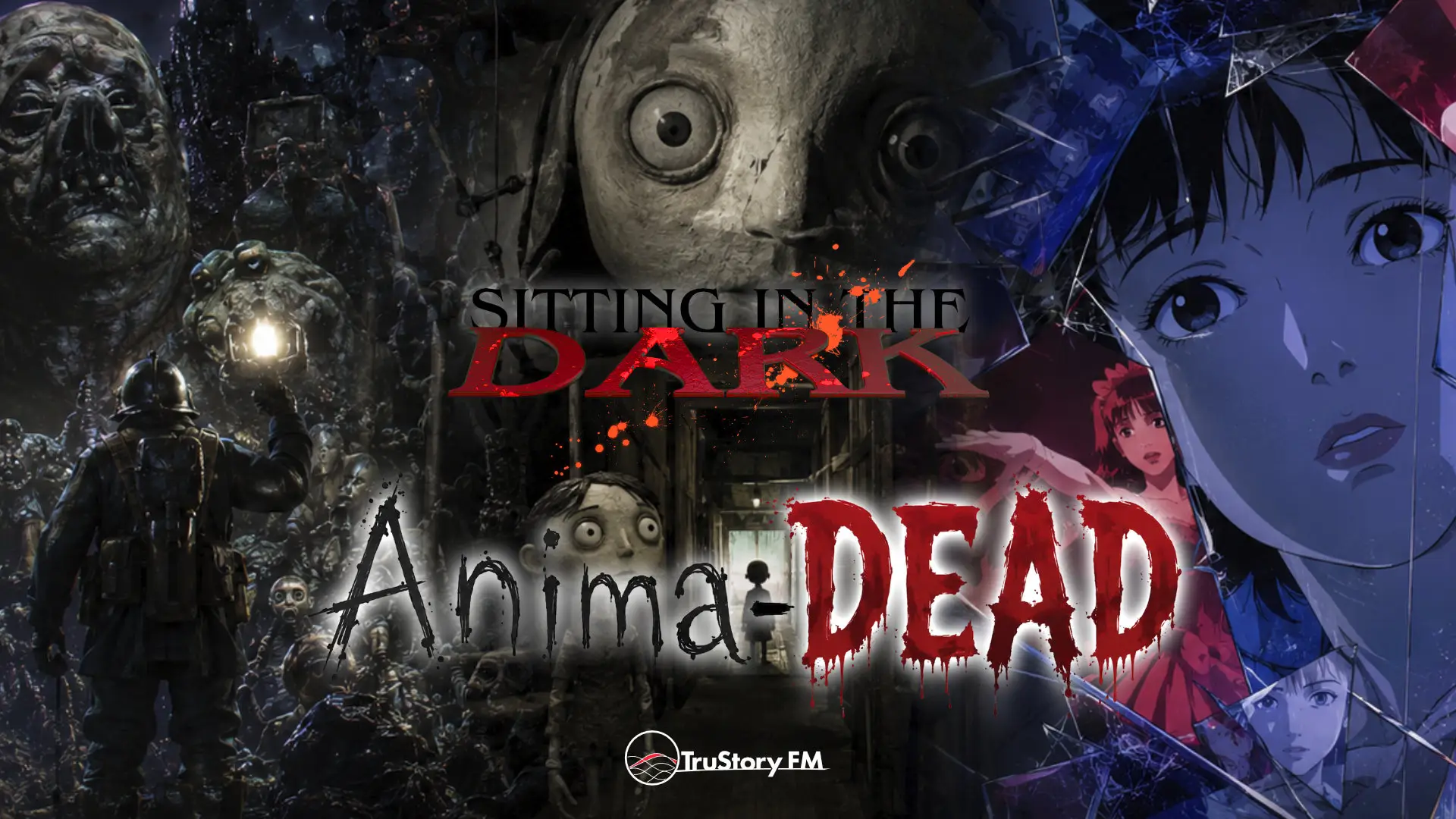
From TruStory FM, this is Sitting in the Dark. Each month we take a look at a subgenre or a topic within horror films, and this month we are looking at animated horror. That’s right, we’re looking at animation — the filmmaking that is done frame by killer frame. And as some definitions go, as we see in stop motion, one of our three films, animation is described as the art of bringing to life still images. But what happens when we bring them to death?
So this week we have with me, as always, a coyote walking straight off a cliff but not falling until she looks down on the canyon floor far below: Chelsea Stardust. Hi, Chelsea.
Chelsea Stardust:
Hello.
Kynan Dias:
A cat sticking a full fish into his mouth and in one stroke pulling it out to reveal an entirely clean skeleton — that’s Mr. Pete Wright. Hi, Pete.
Pete Wright:
I hear the xylophone of my ribs going, going, going, going, going, going.
Kynan Dias:
Oh, and then they hit two and make two distinct tones sitting in the same rib. I hope somebody got fired for that blend. And last but not least, the same living-room couch and lamp set that the rest of us walk by in the background over and over again so the animators’ hands don’t cramp up — that’s Tommy Metz III. Hi, Tommy.
Tommy Metz III:
Yep, hi. Thank you for having me.
Kynan Dias:
So this week we’re looking at some pretty out-there stuff. We have, from Japan, Satoshi Kon’s 1997 Perfect Blue. We have, thirty years in the making, animation master Phil Tippett’s Mad God from 2021. And making his live-action debut, Robert Morgan, the stop-motion animator, with the film called Stopmotion from 2023.
I’m so glad you’re here doing this all together. Any thoughts at first? What’s your relationship to animation in general, and to the medium? Are you all cartoon fans? That hasn’t come up yet on the show.
Tommy Metz III:
I am not, and am, in that I never choose to watch animation. I always feel like I should be watching something adult or real-life. And then when I see animation, I love it. But I refuse to learn the lesson. So I just keep not — there’s a vast amount of, like, Disney films I haven’t seen. I wasn’t really shown them growing up, and so I just never really got on that train. So I was a little bit wrongly nervous when you announced this, because I didn’t think it would be up my alley, and again I was proved wrong, and I look forward to next time.
Kynan Dias:
Wonderful.
Chelsea Stardust:
I love animation. I like weird animation. I like Ralph Bakshi, I like Fritz the Cat. I love Heavy Metal, the dirtier the better. And sometimes when I do my monthly watch — like, every day of the week, what are we going to watch? — I’ll do an animation day and catch up on the things I haven’t seen, or the ones I missed. So I was very excited about this category as someone who loves it. I love stop motion in general, but I love all animation, and I love the hybrid of live-action animation, like Cool World, Mary Poppins, Roger Rabbit.
Kynan Dias:
Magical, yeah.
Chelsea Stardust:
Yeah.
Kynan Dias:
And Pete?
Pete Wright:
I had watched a lot of cartoons as a kid, but I don’t think I was fully transformed until I saw Bakshi’s Lord of the Rings. That was awesome. I did not know they could do that with animation. So yeah, I’m in the same boat. I probably split the difference between Chelsea and Tommy. It’s one of those things that I love when I’m watching. I’m not an overt antagonist to it, I don’t watch enough of it, and I’m always overjoyed when I see something great.
Kynan Dias:
Yeah, I’m a big animation fan. There’s a lot out there that I kind of have to know I’m getting into something worth my while, because there’s a lot of really poorly made crap for children, and sometimes it’s hard to tell just from the poster what’s what. But I’m a really big fan. They’re at the top of my list every year. And even though it’s technically a live-action movie, the movie I was looking forward to most this year was The Sheep Detectives.
Chelsea Stardust:
All right, sir.
Kynan Dias:
So that’s my deal. But yeah, like Chelsea, I follow some of the weird stuff. I love discovering new animators, and oftentimes you can discover them — like Robert Morgan, whose work I’d never seen until we started covering Stopmotion. Oh, they have this whole back catalog of really cool, interesting things. So I’m glad that we got to take a look at these together.
One of the things, as we go through these three films — when I was in grad school at UCLA taking some animation classes, I wasn’t an animator there, but whenever we would pitch a story we were told to freely ask each other, why does this have to be animated? Why not just go out with a camera? That’d be so much easier. Part of that sounds really rough, but part of it was the animation teaching trying to save you all this time — thirty-one years of time — of trying to make a film. So I think these three pass that test of why couldn’t we just do this in live action. That’s what I’d like to look at on each one specifically.
So I think if we go chronologically through these, we’ll also get a nice ramp-up into 2D animation, stop-motion animation, and then the making of animation. So why don’t we start with Perfect Blue, which is one of Satoshi Kon, the great Japanese animator’s, masterpieces. This is about a young girl-group starlet who is trying to become a serious actor, but someone or something is trying to keep her from that transition, and starts to sabotage the sets that she’s on, as well as sending her some horrors from the real villain of the film, the early internet, where somebody is writing a blog and apparently can see her every movement in her room. Is she losing her mind, or are there deeper forces at work? This is Perfect Blue. Was this new to anybody?
Pete Wright:
Not me.
Kynan Dias:
No, we’d all seen it. Okay.
Tommy Metz III:
This is the one I’d seen.
Kynan Dias:
With Perfect Blue, do we have any axes to grind?
Pete Wright:
Go ahead. Go ahead, do it. You know you want it.
Tommy Metz III:
My general axe to grind about anime is anime. I just have to really change my brain, because — like you sort of talked about in the opening — the repetitiveness, the lack of drawing all the faces in a crowd, the repeated motion. It’s a completely different type of thing that I’m just not used to, and so it always takes me a good half of a film to get into that groove, unfortunately.
Kynan Dias:
Yeah, and they’re so brief, so that’s a big chunk.
Tommy Metz III:
Right.
Pete Wright:
I think mine is a narrative axe. The first time I saw this, it was a Fathom event, so I saw it on a very big screen at one of our better theaters.
Chelsea Stardust:
Oh my gosh.
Pete Wright:
It was delightful. It’s really, really fun to see it on the big screen. So I watched it again and I had the same feeling. I hate the last line of this movie. It makes me so effing crazy. When she looks around and says, “I’m the real—” whatever it is.
Tommy Metz III:
“The real me.”
Pete Wright:
I’m like, oh god, you just blew it. You popped the whole balloon. There was a whole balloon and you went and popped it. I get so frustrated every time I see it. That’s my only axe.
Kynan Dias:
Yeah, I’ve tried to retroactively fix that line, to figure out something else that’s going on there, but no. It basically says, after all of the mind-effs over and over and over again, there’s one last one — but we’re not going to tell you what it is. Something else is going on here. It’s very strange.
Chelsea Stardust:
I don’t know if I have — I really love this movie. As someone who’s a big Miyazaki fan too, I can see some of that in here. Also, the team behind Cam definitely watched this movie.
Pete Wright:
Oh, I’m so glad you said that. There are definitely echoes in Cam, for sure.
Chelsea Stardust:
If you’re an Instagram user, there are a lot of accounts that show stills from this movie used in movies later on, used in live-action movies, which I find very fascinating. But if I have to really find something — there’s a weird, maybe because it’s animated, I don’t know why — there’s a weird levity to this very heavy subject matter that sometimes feels a little off and makes you a little uncomfortable. Because I’m like, this is some really serious stuff we’re trying to just shrug off, and it feels weird about it. I don’t know where that stems from, but for me personally it’s like, ooh, I’m really uncomfortable with the way this is being handled. But overall I love this movie. I think it’s a very fundamental movie in the animation world. But if I had to pick something, that would have to be it for me.
Kynan Dias:
Yeah, well, I’m with you. That’s essentially my axe. I’ve watched the film twice now, and it has such sympathy for its female characters and the place of female stardom — and then it is also easily read as misogynist. That’s sort of my question: is this movie misogynistic with its use of sexual assault and rape, and how much you see of these women’s bodies, not necessarily for any reason except that they can? But it’s also about those things. So I’m always like, oh gosh, what am I supposed to do with this? I think ultimately the movie is pro-feminist, but it also has some imagery in it that you could see going right into a misogynist’s spank bank, these terrible uses of this film. So I’m always of two minds when we get into that center section.
Pete Wright:
It’s really interesting to say that, because there’s another dimension in the filmmaking beyond character performance, voice performance. There’s also: why is this rape scene drawn with such glee? You kind of feel the hand that is actually creating these images, in a way that you don’t always feel the filmmaker. So I think there’s sort of an intimacy to it that is really fascinating. And you’re right — I hadn’t given it a whole lot of consideration until this viewing for the show. Why is it that I feel like every version of Mima is somebody’s fantastical sex unicorn? And there are multiple target audiences for that.
Kynan Dias:
Yeah, and there’s this really interesting stuff about her filming a rape scene, what it’s like from her perspective, and the actor on top of her who’s playing her rapist is like, “Hey, are you okay?” and checking in. That’s very interesting stuff. But then you get a shot that’s like, whoa, whoa, whoa — that’s not interesting, that’s exploitative. So it’s a very strange movie in a lot of ways. But let’s get into this.
A lot of the horror is coming from her being an image, as you say — to counter some of the problems that Tommy has, her being this perfect image and not moving a lot. We’ll get to these shots where she’s in the center of really frenetic stuff, but there’s no animation in her whatsoever. That’s inherent to anime, but I think that’s part of what’s so creepy and weird about the movie: so much stuff is going on around her that she has no control of. So for me that’s one of the reasons why this should be animated. If you were to do a live-action version, you’d have to completely reconsider what it’s like for her to not have agency. You’d have to give her some other kind of effect. Any thoughts about that — why this should be animated and not, you know, Darren Aronofsky fully redoing it instead of just borrowing ideas for Black Swan?
Chelsea Stardust:
Kind of, yeah.
Tommy Metz III:
Yeah, I saw the tub scene from Requiem for a Dream is the one that stuck out for me.
Chelsea Stardust:
Mm-hmm.
Tommy Metz III:
That shot, he just sort of redid it. That’s an interesting choice, and an interesting topic to bring up, because — and maybe this is just because of my thoughts about anime; I’m going to say it like you did, because it sounded fancy — I would be interested in seeing a live-action version of this.
Kynan Dias:
Oh, really?
Tommy Metz III:
I’m fascinated by the constant rug-pulls of what is real and what is not. You think you know what the situation is, and then it pulls back, and that’s a part of the TV show that she’s in. I find all of that absolutely captivating. That is the coolest thing about the movie. So I’d like to see it. But I think that’s just me trying to make something that is a little more foreign to me — anime — into something more recognizable. I love that. That was my absolute favorite part: how the reality just constantly shifts, because you feel insane, like she does. Even before the psychosis sets in, it’s constantly shifting like that, which is great.
Kynan Dias:
Yeah, it gives you this sense that you’re not really in control of the narrative. Scenes end a lot sooner than you have the rhythm in you to feel like, hey, this should be wrapping — oh, gosh, it’s just gone from you. These really crazy transitions. Some of them are clever — at one point we have a police car investigating the murder, and then it turns into a kid riding a Fisher-Price version of a police car through the scene. And then some of them are just completely jarring, and eventually you’re not sure: am I seeing the same day over again, Groundhog Day, or any of that?
Pete Wright:
To that question of to what end this story is being animated — the fact that they tried to make it, or imagined it, as a live-action film and tore it apart is, I think, important. I wonder if today it’s easier for me to imagine this movie as live action, just because of the nature of the visual-effects process. This story being told thirty years ago, this stuff was effortless in animation. It was just everything you wanted to create. And I think for the last twenty-five years it may have been hard for me to imagine this movie breaking the sort of reality seal in the way that the animation does so easily. Maybe I can see it, but I almost don’t want to. There’s something about the model design, the J-pop stars, the way animation takes this culture and heightens it. And I don’t think it would be jarring at all when people get stabbed in a live-action version. In this, it’s jarring. It’s jarring when you see the naked bodies after a period of this being about a pop-star actress. That’s the stuff that’s impactful, because it’s using this language that is generally assumed to be for a younger audience.
Tommy Metz III:
That’s a good point.
Pete Wright:
That’s crazy.
Chelsea Stardust:
Yeah, and I don’t think KPop Demon Hunters exists without this movie. It feels very ahead of its time. Obviously that’s a different version of this, but that’s something I was thinking about when I was watching. I was like, oh, I’m sure this was an influence in some way, shape, or form. And — going off of Tommy — I guess I hadn’t really thought about it as a live-action version, but as long as Sam Levinson isn’t directing it, I think I’m on board.
Pete Wright:
Oh, Jesus.
Kynan Dias:
There’s this idea in animation theory that I was first introduced to by Matt Groening, who said that each of the characters should have their own really distinct silhouette, so you could tell Krusty from Homer without even hearing their voices. But here in anime, it doesn’t quite obey those Americanized rules. We have these three girls who were in this J-pop group together, who are pretty interchangeable. I don’t think it’s totally interchangeable—
Pete Wright:
Totally interchangeable.
Kynan Dias:
It’s really, really difficult to tell them apart. And then, hopefully you’ve all seen the movie if you’re listening — once we figure out that Mima is going to be stalked by her own self, that’s what we’re led to believe is happening, and you can’t quite even tell these people apart anyway, which one is the evil one, which is the good one. And then the reveal of the quote-unquote real solution, until the balloon-popping at the end, is that it is her assistant, Rumi — who the first time I saw it I wasn’t suspecting at all. The way that animation is able to meld those two people together in this really weird way, where it’s just a tiny little — Rumi looks so distinct before she becomes the killer, but then it’s a tiny ten-percent tweak and you’re like, oh god, they’re like twins. If someone could do that in live action well, I would probably have a heart attack in the theater and die.
Pete Wright:
There’s another class of movies that I think this movie is sort of seminal in the definition of, and that is the films that deal with the ownership of a manufactured person. We’ve talked about it in the case of Frankenstein and those kinds of films, but also like S1m0ne — why am I talking about S1m0ne? They manufacture an AI character who then becomes adopted by her audience and out-shines the creator. That’s echoes of this movie all up and down. And this movie was vastly better than S1m0ne, but the echoes are in there. The movie is sort of a dedication to the parasocial relationship twenty-five years before that word was a thing we were thinking about. I think that’s a really interesting place for this movie to live.
Kynan Dias:
Yeah, so the movie goes through a couple of different acts of who we think the bad guy is. At first we think it’s this guy in the audience who is darker and scarier than everybody else, and uglier, so we think the movie is about this fan who doesn’t want her to become something else than what she was. But that in itself is scary. And then it could be her having this split from herself, not wanting to become an adult, not wanting to become this image that she had wanted when she was younger and innocent, but now she doesn’t want. So it goes through a bunch of stages of what Pete’s talking about — this manufactured image, and who has the right to change that person, or to argue against that, or to destroy it. Can the creator, can Mima, who has created this new image of herself — is she even allowed to destroy her own image? It seems like she’s not allowed to.
Pete Wright:
Yeah.
Tommy Metz III:
It’s also a little alienating. I don’t quite understand the pop-idol business of Perfect Blue, in that she’s a huge star and yet she’s on the subway.
Chelsea Stardust:
Yeah.
Tommy Metz III:
She’s just walking around the street. And I didn’t understand: are people not recognizing her? Or is a pop idol something different? That didn’t hurt my enjoyment of it. It just made another level of, what are you in the people’s eyes?
Pete Wright:
Most of those people didn’t even have faces, Tommy, so you don’t really have to worry about it.
Tommy Metz III:
They really didn’t. They’re just stumbling around going, “Ahh.”
Pete Wright:
Yeah, right.
Kynan Dias:
We do get into some of the ideas of dissociative identity disorder, which is super interesting because her character on this Law and Order-type TV show is experiencing that, although it’s much more graphic. I don’t think Japanese TV has full-frontal nudity — there’s something off about that too, just as an aside. Is that really what this show is like, or is she completely imagining it? I feel like animation, especially the kind Satoshi Kon does, where the line between what’s memory and what is reality is so thin — if you go and see his film Paprika, which is crazy, or a really surprisingly nice movie he does called Millennium Actress, which is about forty years of an actor’s life, where we go into her movies and into her thoughts — this is a really interesting depiction of dissociative identity disorder. We often see that from the outside, see someone being treated by the doctors, or it’s revealed at the end. But here, about halfway through, we start saying, now let’s experience what it is to have dissociated, which might be because of its animated nature.
Chelsea Stardust:
Mm-hmm.
Pete Wright:
Yeah, it’s interesting to see how they end up using DID as a tool to describe the experience when you have this person who was packaged and sold as a product. When she tries to take her own authorship and agency back, every other party in the system fights to keep animating her — fans who need to keep the old image they have of her, the industry that has obviously been profiting from her, and then Rumi. The fact that it’s dissociative identity disorder that is the bubble in which all of those things live — that’s the tool we have to use to describe the enormous emotional toll of these parasocial relationships and industrial relationships that exist. That’s horrible, you guys. What are we doing to people? That’s kind of the weight of this argument.
And there is some horror in this movie. There’s stuff that’s animated gore, but mostly the horror isn’t a monster. It’s this gap between the image that they’ve created and a human, and the violence that erupts when you try to close that gap, when you try to regain humanity. That’s something that I don’t know is unique to the animation of this thing, but it is certainly unique to Kon’s vision and the ultimate identity of this film. It’s really torturous. And the fact that there’s this kind of “for kids” irony here — the bows and the bubblegum, all of that really manufactured naivete that she’s trying to get out from under, that it’s designed for a childlike audience and absolutely sold to adults. And maybe that’s the answer to the end of the equation: why is there misogynist imagery in here? Because that’s the mid-audience. It doesn’t matter what we’re talking about. And sorry, Chelsea.
Chelsea Stardust:
No, you just made — I’m going to go to a kind of dark place.
Pete Wright:
Yeah, right.
Chelsea Stardust:
But I think this movie does some very — talking about the doppelganger — does some very, especially with the last line of the movie that you mentioned, some weird, again tonally adding so much levity, it does this weird infantilization, keeping her seeming very young. She’s trying to do these adult roles, but we want to keep her young, and how the doppelganger reacts, and at the end it’s sort of like, oh, we want to keep her young, but then they’re fetishizing her on that TV show. Very disturbing, very creepy, and it upsets me every time I watch it, because — speaking of the misogyny — I’m like, this is not what we should be fetishizing. They’re trying to make you do that as the viewer, I feel like. I don’t like that. But I love the movie. It’s like, oh, this is some brave shit happening right now.
Kynan Dias:
Right. And that’s part of the question I have. It turns out that the villain, the shadow character — who often is the opposite of the hero, has the same problem as the hero but deals with it in a different way — Mima wants to grow up but is afraid of letting go of her youth, so she ends up doing all this adult stuff. Rumi is the same thing, but she becomes a serial killer. But the movie also seems to be saying that she’s not attractive enough to be allowed to do it, because she’s overweight, or ten years too old, so her putting on the little-girl bow and the mini-skirt is this monstrous, evil thing. And again, that’s interesting — I’m just not sure if the movie knows it’s saying that. At the end, when it’s the mirror of the two people and they look the same, but then you really see Rumi and she’s fifteen pounds heavier than she should be — that’s pretty dark stuff. I’d like to think the movie knows it’s doing that, but I don’t always know.
Pete Wright:
That’s a grim indictment, Kynan.
Kynan Dias:
It is.
Chelsea Stardust:
Yeah, yeah, yeah.
Pete Wright:
I think you’re probably right. That’s pretty grim.
Chelsea Stardust:
Yeah.
Kynan Dias:
Hachi-machi. All right. Well, any other thoughts about Perfect Blue?
Pete Wright:
Did we sufficiently address the Aronofsky stuff? Watching this again, thinking about it — Aronofsky has been on the record saying he’s just fully in homage territory.
Chelsea Stardust:
Yeah, yeah.
Kynan Dias:
Yeah.
Pete Wright:
And it’s some Black Swan too, right?
Tommy Metz III:
Black Swan especially.
Pete Wright:
Like Black Swan and Requiem. At some point, when is homage just a straight-up lift?
Chelsea Stardust:
Yeah.
Kynan Dias:
You know, I’m okay with it.
Pete Wright:
Okay.
Kynan Dias:
I’m okay — I think you’d have both of them.
Chelsea Stardust:
I don’t mind it.
Kynan Dias:
Yeah.
Chelsea Stardust:
I don’t mind it. And I also thought there is another horror movie that I think pays homage to this movie, but I don’t want to say what it is, in case people here haven’t seen it. You might know the movie I’m talking about, but in case people haven’t seen it, I don’t want to say the name, because there’s something about it that’s a big reveal, a huge reveal in it, but I don’t know if you guys have covered it, so I don’t want to bring it up.
Pete Wright:
Okay.
Kynan Dias:
No, no, no. Is it Psycho, Alfred Hitchcock’s Psycho?
Chelsea Stardust:
No, no, no.
Tommy Metz III:
Oh, I’ve heard of that.
Pete Wright:
Damn it, now I know.
Kynan Dias:
Okay, I think that’s a good one.
Tommy Metz III:
Yeah.
Chelsea Stardust:
It’s one that came — I believe it’s 2000, so it was closely after this one.
Kynan Dias:
All right.
Chelsea Stardust:
Upon this rewatch, I thought, oh my god, this director is definitely lifting some big things from this movie.
Kynan Dias:
Well, I’m excited for that. All right. Moving into the world of stop motion, we have Mad God by Phil Tippett. I feel like you have to hear the whole production saga of this before we get into it.
Phil Tippett is a master stop-motion and effects artist, and he was working on this as his side project, Mad God, while he was on Robocop. And then he was brought in by a director named Steven Spielberg to be the supervisor for the animation on Jurassic Park, and he said, “Oh my god, I’m now extinct,” which Spielberg then used in Jurassic Park. He got that line from Phil Tippett. So he put this on the back burner completely and said, well, I’m supervising the animation on Jurassic Park, but everything is changing — there is no world for grown-up stop motion anymore, even if there is any for kids. And so he picked this back up in the late 2010s and used a little thing called Kickstarter to get the rest of this done, and raised about $120,000. By that point, even though he was older and couldn’t have the same kind of stamina, he had an army of young volunteers who came and did the majority of the work for him. So the budget was about $124,000. It’s picked up by Shudder. People had been waiting for this like it was any number of partially completed animated films that took twenty or thirty years, like Richard Williams’s movies.
So the movie itself is about a little explorer guy. We don’t know a lot about him. He’s placed, Planet of the Apes-style, down into a hellscape that gets deeper and deeper. He sees some terrible, terrible monsters, and some faceless drones who are destroyed by their monstrous world. About halfway through he’s caught by the monsters. They open up his brain, read his memories on a scanner, and harvest some kind of larva thing out of him, which gets taken to some kind of wizard, who then destroys the larva thing and makes some kind of magic gold dust, and starts the entire process of the world’s hellscape over again. Does that sound about right?
Chelsea Stardust:
Very, very competent description of this.
Kynan Dias:
Okay, alrighty. Great. So any axes to grind with Mad God?
Pete Wright:
Oh, Kynan.
Tommy Metz III:
I was excited to see a movie that made H. R. Giger seem appetizing.
Chelsea Stardust:
Oh.
Tommy Metz III:
I started watching this movie eating lunch, and I immediately realized — the soup went back into the refrigerator.
Chelsea Stardust:
Oh no.
Pete Wright:
Oh, no.
Tommy Metz III:
My only axe to grind, because it’s visually stunning and it’s so gross, is at one point when we lose the main guy and it starts to become live action mixed with stop motion. Part of me just kind of wanted to keep seeing that one guy go through the entire movie. But I assume that some of the move to live action was: at some point we have to finish this movie, especially now knowing how long it took. At what point — and I think it’s probably on purpose — you’re just sort of hanging on, and I don’t understand what’s going on. I’m desperately trying to find meaning and understanding, other than just human toil and the crushings of society. But then when larva monsters start showing up, I don’t understand.
Kynan Dias:
Well, I share that axe with you about the live-action sequence. It’s well done, I guess, and it turns out the little man has been sent down there by Alex Cox, the director of Sid and Nancy. And — oh, shoot.
Tommy Metz III:
So—
Chelsea Stardust:
Repo Man.
Kynan Dias:
Repo Man, yeah. I was like, what’s his bigger movie? Alex Cox from Repo Man. That’s all interesting, but I wish there were no live action in here. I wish it were all stop motion. But yeah, that’d add seventeen years to the production, probably.
Chelsea Stardust:
Yeah.
Pete Wright:
Yeah.
Chelsea Stardust:
I’m going to piggyback off something Tommy said. I’ve just got to use my words wisely, because the hardcore horror bros — as a woman, if you dislike something they like, you’re a C-next-Tuesday, so I’ve got to be really careful about it.
Kynan Dias:
Uh-huh.
Pete Wright:
Yeah.
Chelsea Stardust:
It’s tricky, because these visuals are so — I could literally eat this movie up, with how graphic and incredible the creatures are designed. It’s such a feast for the eyes and the ears. The sound design in this is incredible. But what kills me is the loss or lack of narrative thread. It was so strong, and then it just drops off, and then it disappears. What happened to the assassin? Well, there are more assassins. And then, wait, whose POV are we in now?
Tommy Metz III:
Yeah.
Chelsea Stardust:
It almost becomes vignettes instead of — and listen, you don’t have to give me a traditional narrative, but I really crave a story to back these incredible visuals, because I want something to follow. But if you just want to do vignettes, that’s fine. It kills me that that happens. Even — I’ve seen this movie several times and I’m still looking for, okay, where — okay, we still don’t have it. I just don’t know what happened. It’s sort of like, where did it go? Because it’s there at the start. Why can’t we follow it through?
Tommy Metz III:
Yeah.
Kynan Dias:
I think that’s a big point. I don’t agree — I really do like the movie a lot — but I could see that, if the beginning weren’t so incredibly visually catching and you’re following this guy and they make you really care for this guy whose eyes you can’t even see. I could see how, for a lot of people, it’s like, whew, that just goes off a cliff. Whereas another movie could have cut between this guy and a bunch of vignettes, and used this guy as a little clothespin for these things.
Chelsea Stardust:
Yeah, I think that’s a good idea.
Kynan Dias:
But that’s not what they promise you at the beginning, I guess.
Chelsea Stardust:
Yeah, I don’t know. I think it’s sort of an excuse. It’s like, hey, we’re not going to give you a narrative — we didn’t figure out this narrative thread, so here’s the band-aid for it, so we can get away with not delivering that. But in the visuals, I tend to forgive it, because this movie’s incredible. It’s such a feat that I get it, I get it. But it’s the axe I’ve got to grind. I’m sorry for all the people who love this movie.
Tommy Metz III:
No, that’s a more eloquent way of what I was trying to say. I end up respecting the movie more than I end up enjoying the movie. The movie is a triumph, but is it something I want to sit and watch? I want to watch it up to the point where, I guess, he’s about to set the bomb with the briefcase.
Chelsea Stardust:
Mm-hmm.
Tommy Metz III:
And then everything goes off the rails, which is interesting. But I like the idea of more of a through-line. It seems to be going through a lot of the different parts of living in society, in this hellscape — going to work, the medical system, briefcases.
Kynan Dias:
Mm-hmm.
Tommy Metz III:
I don’t know, all sorts of these things. And then at some point there’s a child larva, Pete.
Chelsea Stardust:
Yeah.
Kynan Dias:
That’s reproduction, that’s fatherhood, Tommy.
Tommy Metz III:
It’s true.
Chelsea Stardust:
Uh-huh.
Tommy Metz III:
Yeah.
Pete Wright:
There’s so much of — what I’ve read said this was loosely based on Dante’s Inferno. Kynan, knowing your love of Dante’s Inferno, I was wondering how much of that you see in this movie.
Kynan Dias:
That had not occurred to me until you said it, but of course that makes sense. Because — I was thinking about them more like video-game levels, but of course that’s borrowed from Dante, I suppose. So I don’t know what I’m talking about. But yeah, the deeper you go, there are whole new themes to the world and different kinds of suffering. So of course, once you say that, you’re right. We just don’t know what their sins are. But they have little, tiny, ironic punishments — the Malebolge from Dante. We have these people who are shoveling feces.
Chelsea Stardust:
Oh, yeah.
Kynan Dias:
And they’re not allowed to play in the feces. They’re electrocuted whenever they have too much fun with the feces. That’s the ironic punishments of hell.
Pete Wright:
Oh my god. This is the movie where your best friend is really good at stop motion, and they start this movie in high school and force you to sit down and watch it. And it’s eighty-three minutes of never-ending relentlessness. You’re watching it, and you forget why you’re watching it. And then, right about minute twenty-eight, you’re like, is this friendship really valuable to me? But this friend has all the skills of Phil Tippett. So it’s like, oh, the craft is not poor, it’s excellent. It’s that I don’t know if I can do the friendship anymore. And that, I think, is the challenge I had with this movie. If I were to boil it down, that relentlessness is not a feature.
Chelsea Stardust:
Yeah, yeah.
Pete Wright:
It’s a crutch. And I too long for an anchor, something to hold on to that doesn’t require me to have done the psycho-social homework before watching this movie. So it’s one that I can appreciate. From a horror perspective, my god, man, it’s doing the work. It is doing the work. There is some truly unsettling stuff going on in here.
Chelsea Stardust:
Yeah.
Pete Wright:
As an indictment of industrial capitalism and creation as consumption, I get it. As an indictment of the systems that we have created that then take our livelihoods and our lives from us, I get it. And it was an eighty-three-minute movie that felt about seventy-six minutes too long for me. It was clearly not made for me. This was not made for me.
Kynan Dias:
That’s funny. I know we’re still in the axes portion—
Pete Wright:
That was it. I’m sorry.
Kynan Dias:
—and this is the horror of other movies we’ve seen on this show, but I really appreciated, as we were going, I’m like, give us some slapstick or something.
Pete Wright:
Thank you.
Kynan Dias:
Give us some Woody Bandersnatch or some romance.
Pete Wright:
Give me a sheep detective, for crying out loud.
Chelsea Stardust:
Yeah.
Kynan Dias:
Yeah, but for this one I was like, wow, I’m really glad that this little guy isn’t meeting some talking parrot down there who’s like, “Oh, I’m your buddy, let me take you through here.” I was so glad that they were like, this is hell. This is a really, really great vision of hell. There’s no end to it except to go to some other room, or some other circle. I feel stupid now noticing that, but there’s nothing else to do but to keep moving forward. There’s no lesson he learns here. He doesn’t save one of them who goes back to the surface. Instead he just looks through this room and sees two different types of creatures being tortured. One’s like a teddy bear and one’s a doll, and they’re both being tortured. And he’s like, well, that’s not on my map, so I’m just going to continue on. For me, I was like, whoa, yeah, that’s what this should be. No Hangzhou side characters or anything like that.
Pete Wright:
Oh my god. But imagine if there was.
Chelsea Stardust:
I do love the commitment to little-to-no dialogue.
Kynan Dias:
Yes.
Chelsea Stardust:
I kind of wish — because we get a little bit of it later on — I kind of wish we had none of it.
Kynan Dias:
I wish we had no dialogue, absolutely.
Pete Wright:
Yeah, I don’t know.
Kynan Dias:
It’s pretty close, right? So, in your axes section, you got to a lot of the stuff I wanted to talk about, because a lot of it was, well, this is so good, or that’s so good. But the character designs, I think, are unlike anything else. It doesn’t feel derivative. A lot of times you watch something with creature designs and you’re like, well, they’re doing Giger. And these feel completely unique — dozens and dozens of different types of creatures and monsters, who are all monsters in their own unique way. You can see how it could take a long time, not just because of budget, because these are well-thought-out designs that aren’t just, okay, on this level they’re going to wear a hat now, it’s the same guys from above but with purple jumpsuits. There are dozens, and I can imagine fans now that this movie is made going through and cataloging them all and giving them fan names. So can we talk about maybe some of your favorite little crappy guys?
Chelsea Stardust:
Yes. I mean, you can tell he loves Hieronymus Bosch, because it’s very that.
Kynan Dias:
That’s true.
Chelsea Stardust:
It’s very that, especially when you’re talking about Dante’s Inferno — that’s a big inspiration for Bosch too. Favorite, hands down: titty-butthole monster. That’s my guy, or gal, or non-binary. That’s my person.
Kynan Dias:
That is a crazy idea. Way late in the movie, you’re like, whoa, yeah.
Chelsea Stardust:
It’s so insane, so crazy. But, titty-butthole.
Kynan Dias:
And there are some kind of overlords. I wasn’t aware of how much Phil Tippett had done — and the Star Wars nerds might be mad at me, because I don’t know how to pronounce this — but he had the AT-AT walkers. I don’t know what you call them.
Pete Wright:
AT-AT, yeah.
Kynan Dias:
AT-AT, thank you.
Chelsea Stardust:
Yeah.
Pete Wright:
All Terrain Armored Transport, Kynan.
Kynan Dias:
Thank you, Pete, for saving me.
Pete Wright:
Of course. It’s an AT-AT, yeah.
Kynan Dias:
So imagine a version of that that’s a titty-butthole. That’s really interesting stuff. That’s horrifying.
Pete Wright:
And that definitely should have been in Grogu.
Kynan Dias:
Anybody else?
Chelsea Stardust:
That’s when Tommy was eating, was that guy.
Tommy Metz III:
I had just gotten the soup back out.
Pete Wright:
Wow.
Chelsea Stardust:
That’s when I got my lunch, for that portion.
Kynan Dias:
Yes.
Tommy Metz III:
Yeah.
Chelsea Stardust:
I was like, oh yeah.
Tommy Metz III:
I would have liked — because it starts to get, especially when the real guy shows up, it’s in a bunker and it’s having this real World War One, World War Two kind of imagery. I was kind of hoping that, like in Starship Troopers, there would be versions of monsters for each kind of different thing we were using in warfare. And maybe there were, and I missed it, but—
Kynan Dias:
Gotcha. Well, Phil Tippett did Starship Troopers, so there you go.
Chelsea Stardust:
Uh-huh.
Tommy Metz III:
Oh, wow. Okay.
Pete Wright:
Which famously also introduced a giant butthole monster.
Kynan Dias:
That’s right.
Tommy Metz III:
If it’s not broke. Is Phil Tippett English?
Chelsea Stardust:
That’s right.
Kynan Dias:
No, he’s American.
Tommy Metz III:
I was wondering, because there can be different definitions of the word “mad” in the title.
Kynan Dias:
Uh-huh.
Tommy Metz III:
Mad God — it’s a very angry god in the beginning, yelling at people in Leviticus, after, I assume, the Tower of Babel.
Chelsea Stardust:
Oh.
Kynan Dias:
Yeah, I think so.
Tommy Metz III:
In the very beginning he destroys it, and then he screams at us in Leviticus. But “mad” can be angry, but also mean insane. And I think both are true for whatever god would create this type of world, this type of imagery.
Kynan Dias:
Yeah, that’s a really good point that I hadn’t thought of. As I start to watch the movie I’m like, okay, which one — which one is the mad god? My favorite little guy is the guy on the poster, who has the real human teeth. He kind of looks like Slimer, but he’s brown, he’s got the legs and everything. You assume that he’s in charge, that this is the guy, and that lasts for quite some time. We’re like, okay, he’s going to go down and do this thing, and that’s not going to work, and he’s going to come back and have to beat that guy again. But that’s not the case at all. So, is there a mad god in the movie or not? I guess by the end of it, maybe we think it’s the Alex Cox character, because one of the cruelest things that happens is near the end. We see that he’s put the little guy down and he’s just waiting up there, like, oh, I wonder what this guy’s going through — after seventy-six-minutes-too-long of him going through absolute hell. Like, oh, I wonder if this one will be—
Chelsea Stardust:
That anchor didn’t quite fully deliver.
Kynan Dias:
Oh, I like that a lot. Did you have a favorite or least favorite creepy little piece of garbage?
Pete Wright:
I don’t know that I could pick just one, Kynan. Pre-brutal-vivisection, the assassin — the main little character was affectionately called, I think, the assassin.
Kynan Dias:
Yeah, in the credits.
Pete Wright:
Right. And then the little larva baby — I’m going to say the larva baby, they called that the homunculus.
Kynan Dias:
Okay.
Pete Wright:
And I thought that was interesting. And then they put the homunculus in a meat grinder. And by then, I guess I’m on board. So I thought that little newborn larva thing was a really interesting way for the snake to eat its proverbial tail, just to get us to the next level.
Kynan Dias:
Mm-hmm.
Chelsea Stardust:
Yeah.
Pete Wright:
So I guess I’ll land on that. Ugh.
Kynan Dias:
Not that I’m saying this movie’s on the same level, but do you have these types of issues with something like Eraserhead?
Pete Wright:
No. I’ll tell you one that I do, that I couldn’t stop thinking about.
Kynan Dias:
Yeah.
Pete Wright:
It’s Tetsuo: The Iron Man, which I found deeply disturbing.
Chelsea Stardust:
Oh no.
Kynan Dias:
Yeah.
Pete Wright:
And these movies — we talk about movies being in conversation with one another. They definitely are. Tetsuo is this intimate, cellular, one-man, one-apartment, one-psychosexual-transformation. This body becomes a new thing. And Mad God is the cosmic version of that inversion. I think they’re both fascinating. Like, look, we’re going to have a discussion about the engine of creation, and we’re going to do it in some of the most grotesque images you can imagine, and we’re not going to give you a narrative.
Kynan Dias:
Mm-hmm.
Pete Wright:
It’s just an exploration.
Kynan Dias:
Right.
Pete Wright:
And I didn’t care for that either, surprising no one. So, noble effort.
Kynan Dias:
Right. Well, it’s like Eraserhead, I say, trying to defend the movie one last time. But speaking of creation, what I think Mad God is ultimately trying to say is one of the reasons why it needs to be stop motion: because we can feel the creation of these little creature things somewhere, even if we never see the actual creator.
Chelsea Stardust:
Yeah.
Kynan Dias:
So to move on to a film where that’s made explicit — this is Robert Morgan’s 2023 film about a stop-motion animator’s assistant. This is Aisling Franciosi as Ella, who is assisting her mother, Suzanne, a legendary stop-motion filmmaker making what she knows is her last film. The mother has some kind of arthritis or neurological problem that’s not allowing her to use her hands in the same way. She has a stroke early on in the film, and Ella is trying to finish her mother’s film for her, before the demon of creativity leads her astray, or perhaps to her saving grace in making her own film — but with disastrous results, luckily for us.
Any axes to grind on Stopmotion, which is a live-action film, I should clarify for people who didn’t get to see it — a live-action film, but with a substantial amount of hybrid live-action animation mixture. Any axes to grind?
Pete Wright:
My first axe: I tried to explain to my son, who’s just home for the summer from film school — we were watching Mad God, which was stop motion, and then I said, then we’re watching Stopmotion. And he said, “But what’s it called?” It was a real “Who’s on First” kind of exchange. So the title is definitely an axe to grind.
Chelsea Stardust:
Oh, yes, yes.
Tommy Metz III:
Yeah, third base.
Pete Wright:
My only axe on this — and I have to say, after you tied the boat anchor to my ankle and threw me in the river with Mad God, you really cut the rope for this one. I feel like you are totally redeemed. I had an overwhelmingly good time with this movie, right up until the gold box at the end, where I was trying to figure out if I really understand what is happening here. So I look forward to being educated on the entire looping narrative of this thing. But overall, yeah, I thought — so we’ll talk about that.
Kynan Dias:
Another one of those.
Pete Wright:
I don’t want to screw up my axe and give it all away. But yeah, that would be it.
Kynan Dias:
Great.
Tommy Metz III:
I was wondering — there’s a lot of these movies, and Perfect Blue, the idea of an artist being so consumed by their art that they lose their grip on reality. When I realized that it was that kind of movie, I was a little bit like, okay, we’re going down this. But the stop motion of it all brings such a new, fresh idea to it that I was more than happy to watch this kind of psychosis again. So it’s a really good — I didn’t know that I had another one in me, and I did.
Kynan Dias:
Yeah.
Chelsea Stardust:
At first I was confused, because I was like, I don’t know if this movie meets the brief. But when you explained the process of it, then I thought, oh, okay, this does fit into that.
Kynan Dias:
Right.
Chelsea Stardust:
And, as I said earlier, I love a hybrid that involves animation. I’m a big fan of this movie, but I’m sort of in line with Pete, where I love what this story is doing, I love what it’s saying, I love the creative-constipation crisis this woman has. And the ending, I think, does not deliver for me, unfortunately. This is the second or third time I’ve seen it, and it just really doesn’t land for me. So that’s my sort of bummer.
Tommy Metz III:
Which part — the egg, or the box?
Kynan Dias:
Right.
Chelsea Stardust:
The box. Very, very, very end.
Kynan Dias:
Yeah, the very, very end.
Chelsea Stardust:
Yeah.
Kynan Dias:
Yeah, I’m with you. I don’t know, Pete, if I have quite an answer, except that we’ve seen the little box before, but from the point of view of the little tiny girl. I don’t know. It’s trying to get in the box, yeah. Some kind of coffin or something, I don’t know.
Pete Wright:
Mm-hmm.
Chelsea Stardust:
It’s like, girl, you’ve been trying to get out of the box.
Pete Wright:
Yeah.
Kynan Dias:
Yeah, something else, I don’t know.
Chelsea Stardust:
You’ve been trying to get out of the box, and then you push — what?
Pete Wright:
Put yourself back in the box.
Chelsea Stardust:
No! After this journey? Oh, killing me.
Kynan Dias:
Right. One of the things I think this movie does well: in a lot of films about tortured artists, they’re in a medium where we can’t really see what they do. We can’t really see what a writer does. We can only kind of see what a painter does. And frankly, movies tell you that they can teach you what actors do, but they can’t really. We kind of pretend that a movie can show you what an actor does, but not exactly. But this one really feels — for a medium that I’ve only done very briefly, any stop motion, I’ve only done like eight seconds of stop motion in my life — like we really get the feeling, especially with the early Act One stuff of the mother, trying to place these things and really being a perfectionist, and seeing how time-consuming it is. This one really puts me into what I think I could understand of these characters’ work. I could see how doing this work can make you go crazy and want to kill anybody, especially people who make money doing it. So I think that it does that really, really well. I’m glad it lined up, Chelsea. I was taking a bit of a risk putting it in here, knowing that it’s not fully stop motion.
What do we think about the stop-motion creatures, and the interactive, hybrid animation part? Can we see this in another medium? Could this be in CG? Why is it important that we have these, and how effective are these little creatures? I know they’re no Mad God, but—
Chelsea Stardust:
I love them. I love them. I think they’re kind of brilliant, and real fucked up, and made of meat, and like — what? Thank god they’re not CG, or AI or something. I thought they were great, personally.
Pete Wright:
Yeah, I think it would have been a betrayal to the story of her artist’s crisis to make them CG. We need her to be devastated under the weight of the toil that is stop motion. When her mother says at the beginning, “We have to do it again,” we’re only like four minutes into the movie and I am crushed on her behalf.
Kynan Dias:
Mm.
Pete Wright:
So I’m on Team Psychosis from the beginning. It’s inevitable that she’s going to lose it. And I think that’s the work. Part of what the movie is saying is, look, there are people for whom this work is perfect, and there are people for whom it is great grief. We get to see both of them in this movie. The creatures as a manifestation of that — she starts with the wax, then she moves to the steak as the flesh, then she moves to the fox carcass. That journey is deeply unsettling. What a gruesome idea. None of those creatures are attractive or cute or Studio Laika. They’re all horrible. And that, again, is part of the definition of her psychic decay. I think that just makes it work better, stronger, every route.
Kynan Dias:
Mm-hmm. Yeah, there’s something in the main little creation of the little girl who’s lost in the woods, where she is repulsive but has enough of the features you would want in an animated character that you sympathize with her. So it’s both, “I don’t like looking at you,” but, “I don’t want you to get eaten by the Ash Man.” They can have it both ways, because as the movie goes on, you start seeing the little girl more, and you see her being more quote-unquote realistic, as the little girl says, and then being made out of human flesh and all sorts of crazy things. So you’re not taking her from looking like Disney’s Cinderella to something horrible. She always looks horrible. But she’s our horrible, in this really weird way. And then to see her realized in real life, in and of itself, is monstrous — without, “What have you done to my little girl?” She’s always been like that, but now she’s real.
Another thing about the movie — I love the first act, how quickly it gets us in. The mother and daughter dressed like mad scientists as they’re doing this.
Chelsea Stardust:
Wow.
Kynan Dias:
They have these long gloves and these smocks. They look like Dr. Frankenstein, or Dr. Rotwang from Metropolis. So it’s getting right off the bat about creation and what it is to have that power. And to abuse that power. The mother is like, “I’m a creator here, and you’re not a creator, so I can abuse you.” She doesn’t say that explicitly, but in order to create, “I need to break a few eggs,” even if it’s my own dog. All this cool subtext that’s right off the bat just gets you right in there. And then by the end, up until the box, you’re like, wow, we’ve been laying this path since the beginning, really effectively. Any thoughts about creation, and about the horrors of creation, before we even get to the psychosis part?
Tommy Metz III:
It is interesting that one of her continued hallucinations, if you want to call them that, is that she is made of clay — or no, it’s the embalming, what is it?
Pete Wright:
Embalming wax.
Chelsea Stardust:
Wax, yeah.
Pete Wright:
Mortician’s wax, that’s right.
Tommy Metz III:
Mortician’s wax, yeah, that she’s made of that. And later on it’s, “All great artists have to put themselves in their work.” So the idea that she is sort of treated as an object — by her mother, by her friend. She thinks she’s going to be going to the studio to animate things, and instead she’s just making a zillion eyes. She’s just put through the wringer in all of these things, as if she’s not a real person. So in a way, she’s just sort of stumbling through the woods, like her character, the entire time.
Kynan Dias:
Right. Yeah.
Chelsea Stardust:
To me, it was an interesting commentary on when you are the child of a famous artist and you’re trying to make your way, but you’re also doing the same profession as them. I think so much about these prolific filmmakers who have children that are making movies, and really trying to make a name for yourself, and how difficult that is. When she goes to the studio — oh, they don’t care that you’re essentially a nepo baby, they’re going to make you start in this room, and they’re just going to steal your idea and then make you do this hard manual labor. But the pressure — I really understood that pressure she was under. “Oh, I’m trying to create something,” and you just took this idea. Like, her anger is justified, I feel like. I don’t know if killing them is justified, but her anger towards that is definitely justified — trying to get away, and they’re like, “Oh, mommy’s not here anymore to protect you,” essentially.
Pete Wright:
Yeah. That’s where I was going to go, and I think the movie sets up really effectively Ella as puppet from the beginning. Not just metaphorical puppet — she is the literal puppet for her mom’s hands at the jump. The film uses this medium, this control of a body that isn’t yours, from the beginning, so that by the time we realize the idea is inverting, it hits so much heavier, because she has been an instrument herself, an instrument empty of any ideas of its own. She’s practically just the armature with meat wrapped around it. That’s it. And the movie is absolutely playing the hits on the grief cycle. But where it’s playing the hits with an outstanding solo is that idea that it had seeded — this concept that she is an armature with meat on it. And I didn’t get it until the last armature with meat being put on it, when she was trying to carve out her own flesh, which was gruesome, in order to finish this work.
Kynan Dias:
Mm-hmm.
Pete Wright:
That was the only thing she had to contribute — her own flesh. And I thought that was outstanding. That was just outstanding horror.
Kynan Dias:
She’s pulling out her own flesh to put into it, as her boyfriend and her boyfriend’s sister, who are artists but in this way that Ella won’t accept — “You go to an office, so you’re not an artist” — as they’re breaking down her apartment door, going, “No, you don’t have to do that. You don’t have to pull your own flesh out and put it onto the armature in order to be an artist.” And she’s like, “No, you’re all crazy.”
Pete Wright:
Yeah.
Kynan Dias:
“You have to do this. You have to be this way.” I wonder if, on a second viewing, some of this stuff might play out more, because Ella has some flaws at the beginning as well that aren’t necessarily emphasized. To wake up her boyfriend the first time we see him, she covers his nose and mouth to wake him up, which is horrifying — it’s cute when nobody gets killed.
Pete Wright:
Yeah, right.
Kynan Dias:
Super cute.
Tommy Metz III:
I forgot about that, that’s right.
Kynan Dias:
But that becomes how she kills him at the end.
Chelsea Stardust:
Stuff like that.
Kynan Dias:
He wakes up and she’s like, “Oh, I’ve got to get home, I have to be back before my mother wakes up.” And he says, “I feel used.” Again, it’s funny for your boyfriend to say “I feel used” when nobody gets killed. But then by the end of it, Ella as puppet master is using everybody in her life for her own purposes. There’s something off about her.
Pete Wright:
Oh, totally off.
Chelsea Stardust:
Yeah.
Pete Wright:
And the fact that — can we go back? Morgan is a master animator working in a film about animation. Is there something to this statement that she’s just not very good at making appealing images in the quality of her work? Everything we get is very smooth and beautiful and looks like it has all the technical merit, I guess, but her sculpture is grotesque. I wonder what that’s saying. Especially when you compare it to these other two, who are artists in their own right and go to their office — it makes me think that they’re probably better at creating art than she is. And that may be part of the statement that I don’t know that I’ve reconciled with.
Kynan Dias:
Yeah, I love that we see the boyfriend’s sister’s work. She’s showing, “Hey, here’s our new ad campaign.”
Pete Wright:
Mm-hmm.
Kynan Dias:
And we see it from Ella’s point of view, and she just looks down at this, like, ugh. But what we can see is nothing awful. They’re not working for weapons manufacturers, selling them to kids. It’s just, oh, these are cute little things. But we see it from her point of view, like, ugh, I would never want to do that. I want to do stuff that kills people.
Chelsea Stardust:
I love the snobbery.
Kynan Dias:
Yeah. And you can imagine Robert Morgan, knowing what you know of his work — if you Google around a little and see what’s available online — that he might have that same kind of snobbery. But to put that into the character of someone who turns out to be the villain is very interesting.
Pete Wright:
It’s self-aware for sure.
Kynan Dias:
What does he think of—
Chelsea Stardust:
So real.
Kynan Dias:
Very self-aware, yeah.
Pete Wright:
Yeah.
Kynan Dias:
Maybe he does like Aardman, and chances are he does, but also, the movie starts with this really interesting thing. Maybe I was paying attention to a lot because we’re thinking about animation this week, but the opening is of Ella, after this egg imagery, at some kind of dance floor, and we have all these strobe lights on her. Strobe lights are really interesting, because — especially when they’re from different directions — you can basically animate a face. When it’s from one angle versus another angle, and they’re blurring. I don’t know if this is too nerdy about animation, but people compare the first cave drawings to animation. Have you seen this? The cave drawings that would have eight legs, and they’d go, why do these cave drawings from forty thousand years ago have eight legs? It’s because, if you have a torch next to them, they would animate.
Chelsea Stardust:
Oh.
Kynan Dias:
So her face is kind of like that, and then they start putting in little frames that are sinister.
Pete Wright:
Yeah.
Kynan Dias:
Just based on where you look at it, one frame at a time, she’s a perfectly fine person versus this evil person. It’s a super interesting way to start a shot off about your main character.
Chelsea Stardust:
Yeah, I love that. I love that nerdy shit. Give it to me. Keep it coming, Kynan.
Pete Wright:
It made me think of the — what was it, the zoetrope, right?
Chelsea Stardust:
Those little zoetropes too, yeah.
Kynan Dias:
Yeah. No joke. Yep.
Chelsea Stardust:
Yeah.
Pete Wright:
Yeah, very cool.
Kynan Dias:
Yeah, exactly. And then I also like this idea that she thinks she’ll be freed by taking LSD, which is a really big argument a lot of artists have, obviously. Disney animators used to get that question in the ’60s when people were going to school for animation. They’d say, “What were you on when you were doing Dumbo?” And they were like, “You dirty hippie, get away from me. I would never do anything like that.” I love that sequence, which is the start of when we begin to see her having this Perfect Blue, dissociative-identity sort of thing. There’s this crazy shot where she goes into this party, and someone has a stop motion of a ventriloquist dummy on the wall, and she’s standing in front of the projector light looking at it. But she doesn’t actually block any of the projector light, because if she was, we couldn’t see the dummy. So it’s this really cool, trippy stuff. And then it turns out, of course, that she hasn’t taken any LSD.
Pete Wright:
She’s just tripping on life, man.
Chelsea Stardust:
Yeah.
Kynan Dias:
That’s pure Ella.
Chelsea Stardust:
I love that.
Pete Wright:
Yep.
Kynan Dias:
Yeah, exactly.
Pete Wright:
When you put these together, did you have any intention to create a series about movies in which the body is itself all material?
Kynan Dias:
No, I hadn’t seen Mad God or Stopmotion, so I’m glad when these things line up.
Pete Wright:
Oh, that’s right. They totally did, right? Mima — her body is all commoditized. And Tippett’s entire hell is creatures for meat, and reviews. And Ella is augmenting puppets with pieces of herself. All of that, I think, is a really fascinating — what is that part of the genre that I’m just not aware of, that they all have something to do with using the flesh in art?
Chelsea Stardust:
Yeah.
Kynan Dias:
Yeah, that’s probably in Happy Feet as well.
Pete Wright:
Yeah.
Kynan Dias:
It’s probably there and we’re not thinking about it. But I think probably animators think about that more than the rest of us, right? About designing these things from scratch. Every single line — if you add a line to Mima’s face, you have to draw it twelve times a second, over and over and over again.
Pete Wright:
Six.
Kynan Dias:
So really, really well-considered designs and creation. I wouldn’t be surprised if they’re constantly thinking, we are all shapes, we are all mud.
Pete Wright:
Yeah, raw material for somebody else’s vision.
Kynan Dias:
Mm-hmm.
Pete Wright:
Gross.
Kynan Dias:
Yeah. Any other thoughts about this general idea between animation and horror? I know there’s more out there, but these are the first ones we’ve really done on the show, so hopefully we’ll bring some more in.
Chelsea Stardust:
I loved this.
Kynan Dias:
Mm.
Chelsea Stardust:
I thought it was great. And also, as someone who loves animation, Kynan — if you haven’t seen Attack of the Demons by Eric Power, I highly recommend it. It’s on Shudder, and it’s all done with cut paper.
Kynan Dias:
Oh, I love that.
Pete Wright:
Oh, wow.
Chelsea Stardust:
It’s really incredible. His work is so amazing. And it’s genre, too, so I highly recommend that.
Kynan Dias:
I love that stuff. I love it when you can see what the materials are they’re working with, and be like, god, how long did it take? I don’t have the patience for this.
Pete Wright:
Yeah.
Chelsea Stardust:
Yeah, he also just did a documentary that talks about how he does it, and how he did it, and all that stuff. So highly recommend. But watch that first, just to get his style.
Pete Wright:
Awesome.
Kynan Dias:
Great.
Pete Wright:
No, I loved it too. I thought this was outstanding, Kynan. I was actually texting folks last night, saying, “I can’t wait to talk about this. Kynan did the work this week. Oh my god, these movies are messed up.” Well done.
Kynan Dias:
Messed up.
Pete Wright:
Congratulations.
Kynan Dias:
Yeah, and I will say — well, thank you — I will say, I did tell our folks here that one of these months, when Pete sets me up with three of his movies that are just so awful and terrible and scary, I reserve the right to pull the card of, we’ll do some more animated, but they’ll be animated horror for children. Wuss horror, that I get to just enjoy.
Chelsea Stardust:
Yes.
Pete Wright:
I can’t wait.
Chelsea Stardust:
I co-sign this.
Kynan Dias:
What scares a five-year-old still scares me. But with that, next month our curriculum is being set by Chelsea Stardust. Chelsea, what have you got for us?
Chelsea Stardust:
I felt like these were three sort of heavy movies, so I’m changing it up a little — just with two of the three of these. Under the theme — because this is for July, and “The Rocket’s Red Glare” is the theme — obviously the basically only through-line of these three films is fireworks. Just saying. I really wanted to lean into the holiday. So we’re going to be all three different decades. The 1981 Brian De Palma gem, Blow Out.
Pete Wright:
Oh.
Tommy Metz III:
Nice.
Chelsea Stardust:
The 1997 Jim Gillespie I Know What You Did Last Summer. And, because we skipped it, the 2006 James Wong masterpiece, Final Destination 3.
Pete Wright:
Oh my god.
Tommy Metz III:
All right.
Pete Wright:
Oh my god.
Chelsea Stardust:
So, three basically summer films. To me, that’s what I wanted to throw out there. I’m sure there will be axes aplenty, but I love these three movies so much and have been trying to find a place to put them, and this came together very nicely for me.
Pete Wright:
Boy, I haven’t seen I Know What You Did Last Summer in a long time. That’ll be fun to revisit.
Chelsea Stardust:
It’s the only one that exists.
Pete Wright:
Is it, for sure?
Chelsea Stardust:
There are no others.
Pete Wright:
Yeah, that’s true. That’s true. I get that.
Kynan Dias:
I’m looking forward to seeing all those together. That’s crazy.
Pete Wright:
Yeah, me too. Well done, team. This was really fun. Thank you so much, Kynan, for a great week, a great episode.
Chelsea Stardust:
Yeah.
Pete Wright:
I’m looking forward to next month too. It’s summer — do we have any particular horror plans for the summer? Are we doing any horror-related adventures this summer?
Chelsea Stardust:
Well, if you’re in LA, Midsummer Scream is in August, that’ll be happening. And I’m doing a bunch of film fests.
Pete Wright:
Yeah, you are. You’re on the circuit. Where are you going next?
Chelsea Stardust:
Next weekend I go to Chattanooga Film Festival, for Grind.
Kynan Dias:
Oh yeah.
Pete Wright:
Chattanooga.
Chelsea Stardust:
Yeah, driving there from here.
Pete Wright:
What a hotbed of horror. That’s awesome.
Chelsea Stardust:
Apparently. And there are some great regional filmmakers from Tennessee.
Pete Wright:
All right.
Chelsea Stardust:
So I’m excited to go check out that fest. I hear great things.
Pete Wright:
Good fun. Good fun. All right. Well, then it’s time for us to just go on vacation. It’s summer. Take a vacation, everybody. Thank you for hanging out with us. SittingInTheDark.com, if you want to learn more about the show. We would love you to subscribe and share. And let’s all get scared together. On behalf of Tommy Metz III and Chelsea Stardust and Kynan Dias, I’m Pete Wright. We’ll see you next month, sitting in the dark.