Marcie Maxwell:
Hello, hello. Welcome back to the P2P Soapbox. I’m your host and P2P BFF, Marcie Maxwell. One thing we talk about a lot in this community is that peer-to-peer events aren’t just about fundraising. They’re often someone’s very first step into a community that truly sees them. For many families, that first walk or event comes right after a diagnosis in a moment that can feel overwhelming, uncertain, and deeply personal. So here’s the question I’ve been thinking about: How are we showing up in those early moments? Are we doing it in a way that connects people not just to resources, but to a sense of belonging from day one?
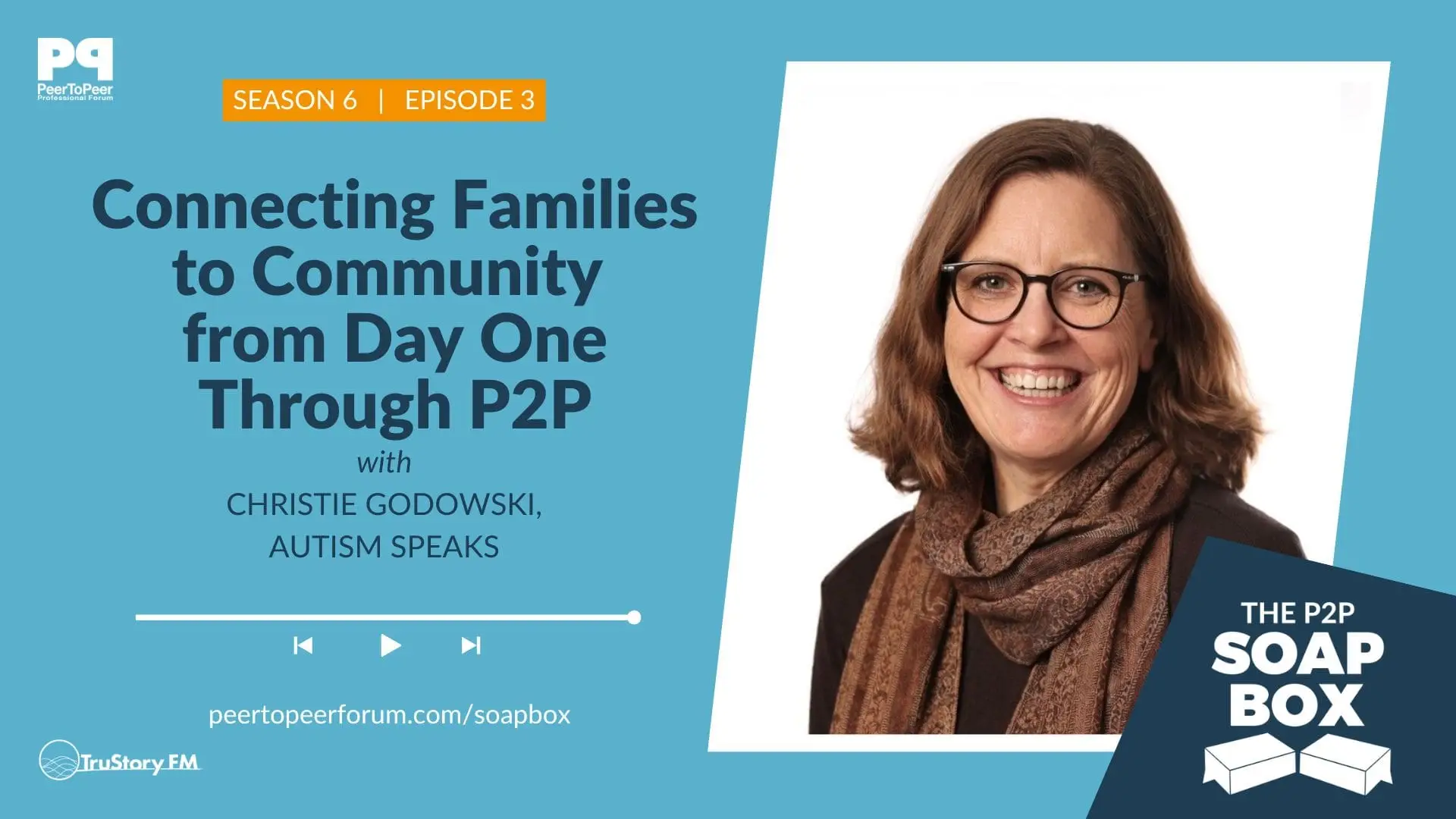
Today I’m joined by Christie Godowski, Vice President of Community Engagement at Autism Speaks. In partnership with autistic people, Autism Speaks works to create a more inclusive world and redefine what’s possible across the lifespan. As the largest autism organization in the US, they’ve spent more than two decades advancing research, expanding services, and shaping policy to improve quality of life.
Christie brings a powerful perspective on how peer-to-peer can serve as a bridge from diagnosis to community. We talk about what it takes to create a seamless experience across our internal program and fundraising teams, how to support fundraisers in navigating deeply personal conversations with care and confidence, and how approaches shift when engaging adults who are newly diagnosed. We also get into what happens when early outreach is done well, and how those first touchpoints can shape long-term connection, retention, and strengthen your community for years to come.
So let’s jump right into my conversation with Christie Godowski of Autism Speaks. Christie, welcome to the P2P Soapbox.
Christie Godowski:
Thanks, Marcie. Excited to be here with you today.
Marcie Maxwell:
Absolutely. Well, let’s just jump right in. Tell us a little bit about your personal journey, your professional journey that led you to your role at Autism Speaks.
Christie Godowski:
Yeah, like a lot of nonprofit professionals, going through college, nonprofit wasn’t where I anticipated being. But I got into nonprofit through the Muscular Dystrophy Association coming out of college and really jumped right in and found the passion within the nonprofit community. I spent about eight years with that organization just building my acumen in nonprofit, working as an executive director.
Autism Speaks was just coming onto the scene. It was founded in 2005, and my journey aligned with an opportunity as they were building out their community engagement model. I came over to the organization in 2007 and have been here — it’s hard to believe — going on 19 years. I’ve worked throughout many different positions and grown within the organization, but always on the peer-to-peer community engagement side. Now I’m really lucky and honored to work alongside our community engagement team leading up our efforts across the country. So it’s been a journey, but I’ve enjoyed every single minute of it.
Marcie Maxwell:
We often talk a lot on this podcast about how peer-to-peer events are not just fundraisers. They’re these really important entry points for the community, especially for people directly impacted by our missions. For many organizations, the first walk is where the journey starts for families. So how does Autism Speaks show up in those early moments after a diagnosis to connect people to support and invite them into the community?
Christie Godowski:
Yeah, it’s so true. We say it all the time — maybe a little cliche — but we say our walks are the front door to our organization. Oftentimes families stumble on our walks because they’re looking for resources or support through a website search, and they come across our walk pages. Then they attend our event and realize the community support that’s really around them.
We really see our walks as an opportunity to not only connect families and individuals to our own resources, but to connect them to the resources available to them throughout their local communities — from service providers, doctors, clinicians, gyms, healthcare, you name it. We really try to invite those community-centric partners to our walk to make sure that an individual and a family is really supported.
But I think even probably more important than the supports is just that they’re not alone. An autism diagnosis can be overwhelming for a family, particularly a new diagnosis of a young child. When they attend a walk, we often hear from newly diagnosed families shortly after to say, “I didn’t realize so many people were impacted by autism. I’ve met a mom or dad or a grandparent who’s going through the same journey that I’m on right now, and it’s just so valuable to me.”
In my 19 years with the organization, I’ve found people that I met early on in my career, who I met when their kids were just diagnosed, who are now young adults. Watching them go through the different life stages of an autism diagnosis and how we showed up for them along their journey — while it may start at a walk or a new diagnosis, organizationally we’re really focused on that entire lifelong journey. Autism is a lifelong diagnosis. So there are some really critical points throughout the lifespan where we check in on our families and make sure that they feel supported and have the resources that they need along the way.
Marcie Maxwell:
What I have observed is that many organizations struggle with a disconnect between the program services team and the fundraising teams — whether it’s territorial, whether it is a philosophy difference, if we don’t ask families to fundraise. What have you learned about breaking down those barriers so that families experience this seamless, supportive team, and we can also engage them in a variety of different ways?
Christie Godowski:
Yeah, I have to say we’re really lucky here. We have a really strong relationship between our supports and services team and our fundraising team. But I think it only works when we are transparent and communicating constantly with each other and really taking the time to understand our roles and understand how they work together.
We always make sure that we’re putting our family or the individual who’s facing a diagnosis first. When they come into the organization, they’re not defining a fundraiser versus a program person. They’re just looking for support and resources. So if you come in through our door — let’s say through our autism response team, you call our 1-800 number seeking out resources — our program PM is trained to help facilitate the request that that individual is asking for, but they also share information about ways to engage locally, whether that’s through a walk or through a town hall series, just getting involved.
And vice versa, if somebody comes to one of our events and it’s the first time they’re engaging with us, we make sure we’re connecting them to our autism response team. So it’s very transparent back and forth. Both sides of the house make sure that people understand overall what’s available to them from either a resource perspective or an engagement perspective.
I think sometimes that gets lost in the mix when we engage as peers within the organization. We can’t define ourselves as fundraisers or as program team members. We’re all staff to the organization, and our number one role is making sure we’re supporting those who are coming to us seeking support and resources. That is always top of mind for our teams, and I think it’s really helped us to ensure that we’re giving the best experience back to the families we serve.
Marcie Maxwell:
I know it’s going to sound cheesy, but I have definitely in my time said things like, “Ask not what you can do for walk, but what walk can do for you,” when you think about other teams. Because so often you might have your walk lead feel like they have their hand out to the other team saying, “Can you talk to families about fundraising? Can you talk to the doctors? Can you connect us here?” Instead of saying, “Here’s what walk can also do to help you achieve your goals and what you’re trying to accomplish.” I know it sounds cheesy, but I think when you see this truly as — the walk is not just a tool for the fundraising team to hit their goals, but it is a tool for the whole team, the whole office, the whole organization to achieve their larger community engagement goals — it can flip the script and create more of a teamwork environment.
Christie Godowski:
Yeah, Marcie, when you think about it, attending a walk, no matter what space you’re in, is really one of the only opportunities for an organization to display everything they do from a programmatic perspective, from a fundraising perspective, from an engagement perspective. That’s really powerful for the organization. You can go to a research summit, or you can go to a point-of-sale fundraiser, but you’re not going to see community there necessarily in the way that you would see at a walk.
Our program team understands that really well. It gives them a chance to connect face-to-face with our community. And the fundraisers see the value in bringing the program team to the table. I often say, particularly to newer fundraisers who are starting, relationship is the most important thing you start with. You do that right and the fundraising will follow. It is so important, especially in those early days of a diagnosis when people are really trying to figure out their journey and what their next steps are, to be there to help support them. They will remember that down the road. You’ll often see a tenfold return on the fundraising side just by taking that time to be really thoughtful about the space that they’re in at any given time.
Marcie Maxwell:
That brings up a great point when we talk about your frontline staff. A lot of times our frontline fundraisers are very early in their career. The conversations with a family that’s newly diagnosed can feel really intimidating, can feel really personal. How are you preparing your team and helping build those skills so they can navigate those conversations confidently and thoughtfully and with intention?
Christie Godowski:
Yeah, it’s a great question. I often say it’s time and practice. There are lots of different disease and disorder spaces out there, and every experience is different. Some of them are physical, some of them are emotional, some of them are mental. But really meeting individuals where they are — being thoughtful about the questions that you’re asking, about how much you’re pushing at any one particular time from an engagement perspective.
I always say don’t be afraid. I have heard numerous times in my career, “You can ask me questions, you can be curious. That only helps me down the road.” So I would say be curious, be sensitive to what’s going on, but don’t be afraid. We have a job to do within our organization, and that only comes by being curious, being sensitive, building relationships.
For me, it’s just sometimes it takes practice. Over and over again, the more you do it, the better you get at it, the more comfortable you get at it. And I always say, do that work early on. Build the foundation to your relationship, because then throughout that journey, sometimes things might get tough. If you have that relationship built already, it makes those conversations a lot easier, a lot more real and defined. Establishing that foundation of trust and relationship early on is one of the keys of building long-term relationships with our families.
Marcie Maxwell:
There are things you can teach. We would say this at some of my previous organizations — a person has a disease or has a diagnosis. They are not a cancer kid. A person has a disability, or a person has a diagnosis. Leading with the person — you can teach those language pieces. But it’s so much more than just that about how to have — yes, those are important to be thoughtful and careful of, but that’s not the only piece of the puzzle.
Christie Godowski:
No, they’re human beings. They’re our friends, they’re our family, they’re our community. They are people first, and relationship first, and that should always be top of mind. I agree, you can teach the best practice and the skill, but the relationship just takes time and practice to build upon.
Marcie Maxwell:
Absolutely. Now, it seems like we’re seeing more and more people being diagnosed with autism as adults. So how does your approach shift when you’re engaging a newly diagnosed adult as opposed to the parent of a newly diagnosed child? What nuances should fundraisers be thinking about?
Christie Godowski:
Yeah, it’s a great question. In our community, often an adult diagnosis is validating. They may have had struggles along the way. Maybe they are engaging differently or have different needs within their work environment or family members may say, “You’re kind of quirky,” or it could be any number of things. A diagnosis validates that — validates the things that they’ve been thinking. Often they need services, and in order to get those services, they have to have a diagnosis. So sometimes an adult diagnosis is more out of necessity. They may internally have that gut feeling, “Hey, I have autism, I have some clear markers for it,” but that diagnosis really validates that.
Whereas with an early diagnosis, often that comes through a screening or not hitting milestones. So they’re really different scenarios. But often in the adult space, when an adult receives a diagnosis, it can often be a relief for them. They have an understanding of what’s going on. They may be able to access resources that they didn’t have before.
What’s really interesting in our community is oftentimes those individuals have been engaging with us through a volunteer opportunity or as a donor or a supporter of a family member. They already know a great deal about autism. They know a lot about our organization. So often we already have relationships with those folks.
Autism in adults is becoming a pretty significant topic for us organizationally, particularly in that profound autism space. There’s an 80% unemployment rate for individuals on the spectrum, and we know that many of them actually can be employed. So it’s a big focus area of ours, particularly as that diagnosis rate in adults continues to increase and we see more adult diagnoses. Big area of focus for us, but often more validating than anything.
Marcie Maxwell:
Are you seeing them engage in your fundraising events or your walks in the same way?
Christie Godowski:
Yeah, a little different in the walk space. Our walks really are more focused on that younger family, younger diagnosis. But what we often see with our adult population is they engage on our committees, on our executive leadership councils. We see them running in our endurance events or engaging in our special events.
What we’re really trying to do organizationally is ensure we have space, no matter where you are on the spectrum and at what stage in your life you are on the spectrum — that we have opportunity for everybody. They’re still engaging on the walk side, and we do have teams with adults leading. But they often become our champions. They really help support behind the scenes, like I said, through leadership roles, and play a really integral part of how we move our organization forward.
Marcie Maxwell:
What impact have you seen when you feel like outreach is done really well? How does it shape that long-term involvement and the overall strength of your community?
Christie Godowski:
Like I said early on, relationships really are the foundation for success when it comes to fundraising. As with any peer-to-peer portfolio, it is really easy as a national staff person to see across the portfolio where relationship development is happening day in and day out. When you attend an event and your event lead is flocking around the site and everybody’s asking for them, you just see that connection, you see that bond, you can see the work that’s been done behind the scenes leading up to event day.
For me, it’s really making sure that the team is focused a little bit less on the logistics side of our events and really taking the time to build those relationships. I always say to the team, make those phone calls, send those emails, send those texts, and don’t worry if you don’t get a response back right away. People are listening on the other end. They see it. It’s important. They feel like they are an important part of the work we are doing. Even if they don’t establish that genuine connection early on, just continue to push. You’ll get there.
It may be repetitive, but the more we establish those relationships early on, the longer-term benefit we’re going to see there. I remember early on in my career at Autism Speaks, when I was working as a frontline fundraiser up in New York, some of those relationships in my early days — those folks are still very important parts of my life today. When I get out to events where they’re at, it’s like a bit of a family reunion for me. But it was because of the work that I did early on to really establish those relationships. Those folks know they can call me any day of the week, anytime, night or day, and I’ll be there to help them, and vice versa. Just establishing those relationships early on.
Marcie Maxwell:
I love what you said about you’re reaching out, and even if they don’t respond, they’re listening. It can be very easy to be caught up in your own head about why hasn’t somebody taken an action, why hasn’t somebody signed up when they said they were going to. But when it comes to working with people who are in the trenches of an early diagnosis or in the middle of a treatment, it can be hard to remember what they’re dealing with on the other side. It’s easy to only see your side of the equation and not think about, well, maybe the child’s getting chemo today, or maybe they just had a really bad week with doctor’s appointments and things are just hectic and busy. They’re not intentionally forgetting about you. They’re not intentionally not taking action. But they’re listening. How are they hearing from us? I love that. I do think it can be really easy to just be driven by your own numbers and be frustrated and not be thinking about what’s actually happening.
Christie Godowski:
Yeah, it’s what I actually love most about our event days — is that reminder of the human side of the work we do. I often reflect on bad days that I’ve had myself, and when somebody reaches out and says, “Hey, how are you doing?” or, “Hey, I get it, I understand, it’s going to be okay” — we have to keep that in the back of our heart. These people are facing enormous hills that they have to climb, and we can help support them through that and make their days better through our events, through conversation, through leaving a voicemail of, “Hey, I was just thinking about you. I hope you and your family are doing well.”
It is a big part of what we do. In a world where we have become so used to technology and AI and everything that’s happening, we have this really unique opportunity in the peer-to-peer space to keep relationships top of mind — to stand out among the monotony of technology in the day-to-day world. That really can be a benefit for us if we harness that power. I think we’re in a really exciting space, and one that people are seeking right now — that human connection.
Marcie Maxwell:
For someone who’s listening who’s thinking, “I want to do better in this space,” what’s one mindset shift or small action they can take to build that trust and create that meaningful connection with a newly diagnosed family?
Christie Godowski:
For me and my team, what I always like to do is model that for them. Get on the phone with your supervisor or a peer. Attend a meeting, watch somebody else who does it well, do it. Then bring them with you on a meeting. Take the lead, but you have that comfort of having somebody next to you who can help fill in if you fall short somewhere. Once you’re comfortable there, go out and do it yourself.
You’re going to get there. Like I said early on, it takes time, it takes practice, and it’s okay to screw up. I have screwed up conversations throughout my entire career. Being genuine in the conversation, genuine in the relationship, laughing when you can, just bringing comfort to the conversation and ease — they’re all great ways to build rapport, to build relationship.
And be genuine. More than anything, you’re there to help support and care for the people that have turned to your organization for help and resources. So be genuine to that. They’re in a vulnerable state often. Be mindful of that. But just be your genuine self, and practice at it. It takes practice.
Marcie Maxwell:
Absolutely. This has been a really — I’ve loved this conversation. It’s been really inspiring to think about and to reframe so often what we’re doing in this space. If people are looking to learn more about Autism Speaks — this podcast is going to be releasing during Autism Awareness Month — where can we send people in our show notes to learn more about getting involved with Autism Speaks?
Christie Godowski:
Yeah, you can visit autismspeaks.org. It’s where you can find all of our resources and support. You can also follow us on social. We’re on all the major social channels.
Marcie Maxwell:
Awesome. Well, Christie, thank you so much for joining us today.
Christie Godowski:
It was a pleasure.
Marcie Maxwell:
All right, we’ll see y’all next episode.
Announcer:
The P2P Soapbox is produced in partnership with TruStory FM. Engineering by Pete Wright. Music this week is by Super Neto. If your podcast app allows ratings and reviews, we hope you’ll consider doing just that for our show. But the best thing you can do to support the P2P Soapbox is simply to share the show with a friend or colleague. Thank you for listening.