Marcie Maxwell:
Hello, hello. Welcome back to the P2P Soapbox. I’m your host and P2P BFF, Marcie Maxwell. Now let me ask you something. What happens when you change everything about your signature event all at once? The name, the location, the timing — all of it. For a lot of organizations, that kind of shift feels really risky. You worry about losing momentum, confusing your community, or even putting revenue on the line. But what if that kind of change could actually bring your teams closer together and deepen your connection to your mission?
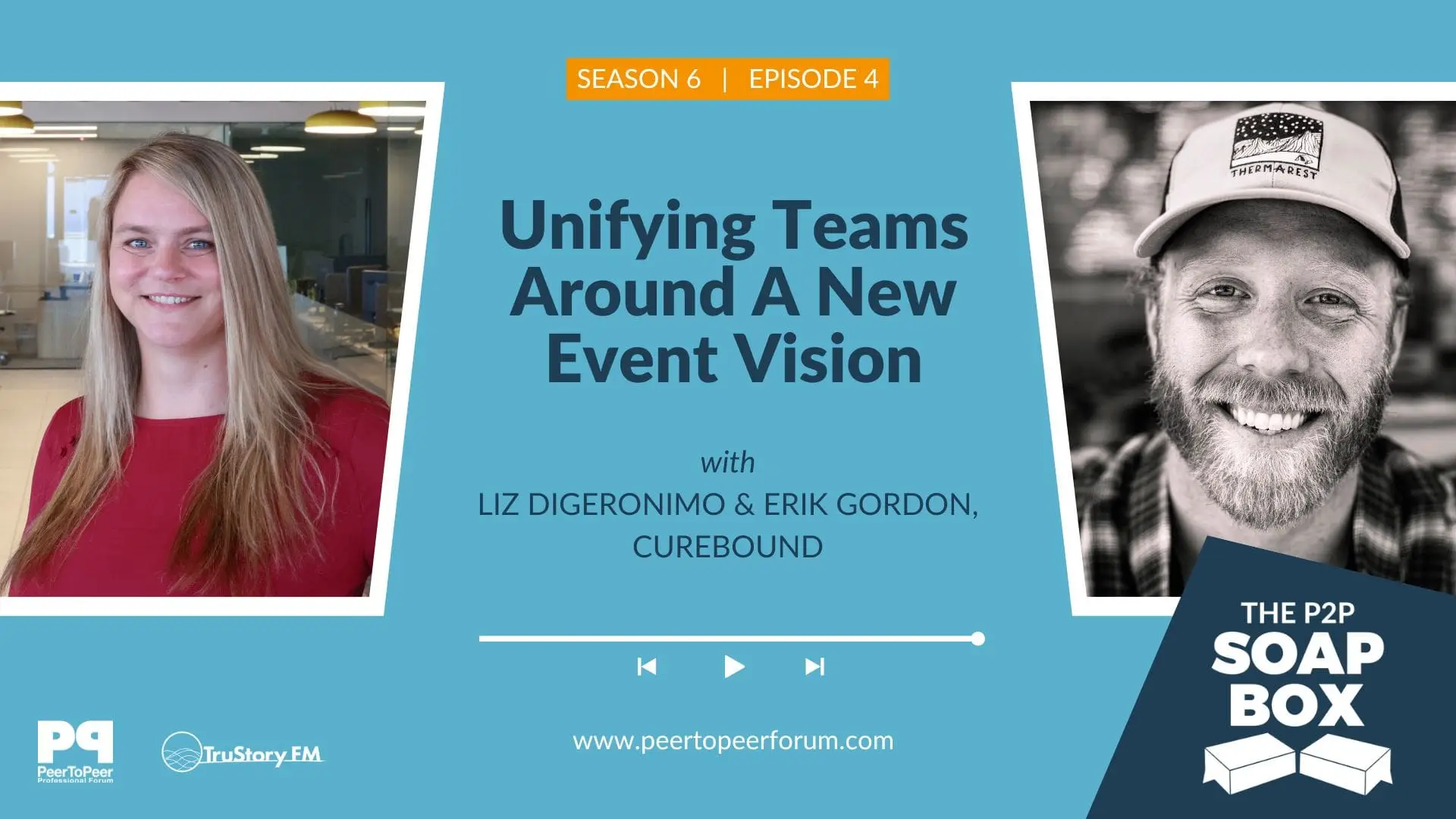
Today, I’m joined by Liz DiGeronimo, Director of Community Fundraising, and Erik Gordon, Director of Marketing at CureBound. CureBound is a San Diego-based nonprofit raising and investing strategic funding in translational cancer research to accelerate discoveries from the lab to real patients.
In this conversation, Liz and Erik take us inside their bold 2025 transformation, where they reimagined a long-standing event with deep community roots. They share what signaled it was time to evolve, how they invited their community into the process so no one felt left behind, and what they learned about what truly matters to their supporters. We’re also going to get into the real work behind the scenes — how marketing and fundraising came together around a shared story, why clarity mattered more than perfection, and how staying grounded in mission helped guide every decision.
If you’ve ever wondered how to lead your team and your community through big change with confidence, this is a good one for you. So let’s jump right into my conversation with Liz DiGeronimo and Erik Gordon from CureBound. Erik and Liz, welcome to the P2P Soapbox.
Liz DiGeronimo:
Hi, thank you for having us.
Erik Gordon:
Thank you so much.
Marcie Maxwell:
We’re excited to have y’all. Let’s jump right in. I always like to start — will y’all each tell us a little bit about your personal and professional journeys that led you to your current roles at CureBound. Liz, I’m going to start with you.
Liz DiGeronimo:
Yeah, so I actually deviated from what I went to school for. I was going to school for city planning, and then I found my first job at a nonprofit. While I was working there as a receptionist, there was a cycling event, a fundraising cycling event, and I was like, that is what I want to do.
From then on, I just kind of worked — I’ve had a lengthy career in endurance or cycling events and fundraising. I heard about CureBound at the PAC, or a different name a little while ago, and it just seemed so fun. I loved that everything was here in San Diego where I live. So I ended up here, and I’m very happy. It’s been great. I’ve been here for just under four years now.
Marcie Maxwell:
Awesome. Erik, what about you?
Erik Gordon:
For me, it was quite a windy road. Maybe similar to Liz — I actually went to college for oil painting, so I have a degree in fine art. After college, I started a coffee business in the outdoor industry out of an old VW, and I drove around the country for about half a decade. Opened a bunch of coffee shops as an entrepreneur in that way.
Then around COVID, did a bit of a career change into the marketing realm, more so actually in the outdoor industry. A little over a year ago, I joined CureBound and was just really looking to make a change and get a bit more into a more impactful space. It’s been really fantastic and a really great ride so far.
Marcie Maxwell:
Awesome. I know you mentioned that the CureBound organization and the event is primarily San Diego based. So if there are people who might not be familiar with the organization or the event, can you just give us a quick overview of the org and of your peer-to-peer portfolio?
Liz DiGeronimo:
Of course. CureBound is an organization where we raise funds to fund cancer research. One thing that I find really cool about CureBound is that we require collaboration for our research partners. So if you work at one institution, you’re required to work with somebody from a different institution, with the belief that more than one mind is better than just a single mind. We fund our institutions here in San Diego. Our event is based here. That’s all we do — is fund cancer research. We have our own scientific advisory board who approves our grants and funds our grants, and all of that stuff. So it’s kind of unique there.
With CureBound, we raise money through our peer-to-peer event, which is called the CureBound Cancer Challenge. We also have a Concert for Cures event as well. That’s how we fund the research. For the peer-to-peer event, for the CureBound Cancer Challenge, it’s a cycling, walk, run, spin. We have group classes, all sorts. I tell people if you want to participate, there’s a way for you to participate at this event. The event hosts around 3,000 people, and we raise about $4 million all in.
Marcie Maxwell:
You made a really big move in 2025 with this event, because not only did you change the branding, you changed the timing and you changed the location of this signature event that the organization has had for years, that has really deep roots in the community. Can you take us back, walk us through that change. What signaled to you that it was time to evolve, and what felt at stake with that decision?
Liz DiGeronimo:
Of course. So we are formerly called Padres Pedal the Cause, and our event was at Petco Park — that’s of course where the Padres play. We were there for over 10 years, and they were fantastic partners of CureBound. But what we were finding is that we were having an inconsistent date. That is one of the reasons why we had to change.
We would get our date six months before our event, usually. So in 2024, for the 2024 event, we didn’t know what date we were going to have until November of 2023, and our event was in March. They were like, “This is your date,” and then we just had to start and get going.
Marcie Maxwell:
That is stressful.
Liz DiGeronimo:
Yeah, it was really stressful. We were like, “Oh, okay, let’s go.” It had been like that for a couple of years. That is hard, as you know — most people who are in this industry, having this at a consistent date is really, really important.
And then our footprint at Petco was shrinking. Before, we used to finish on the field, and they were like, “Well, we can’t do that anymore. So we’re just like at their main event site.” Our footprint was shrinking significantly.
Then, of course, we were creating major brand confusion with it being Padres Pedal the Cause and then CureBound. Before, the whole entire organization was called Padres Pedal the Cause, and then we combined with another organization and formed CureBound. Padres Pedal the Cause became an event underneath the CureBound umbrella. I know that’s a little bit confusing, but people were like, “What’s CureBound? I didn’t donate to CureBound, I donated to Padres Pedal the Cause.” It was creating a lot of confusion in the community.
That was when our former CEO and our board of directors started thinking that maybe this isn’t the right place for us anymore, and that maybe we need to find a consistent date and do all of those things. Those were the reasons.
Then of course, leaving Petco Park, we lost a huge infrastructure there. We had their staff helping us at their event. They have a main stage. We didn’t have to really bring very much in — they had it all. We had major, major support there. So of course, leaving Petco Park — we ended up at the soccer field at UCSD — we had to bring everything in. Of course, there’s a cost associated with that. How are we going to do all that? That’s not usually what we have done in the past. A lot of that was, what are we going to do now? We worked through that, and that was actually probably the easiest thing, because we were able to find a company that could replicate that for us.
Marcie Maxwell:
That is quite the undertaking, and a whole new different kind of stress than only getting your date a few months out, to actually making all of those moves. When you think about when people really love something and it starts to change, there’s this mix of excitement about new potential, but also hesitation. So how did you bring your established community into this process, so they felt like they were a part of it, they weren’t surprised by it? And along that way, what did you learn about what really matters to your supporters?
Liz DiGeronimo:
Yeah, I think at first I was like, “We’re leaving Petco Park to go where? Oh my gosh, what are we going to do?” I was like, how can we make sure that all of our top fundraisers and our team captains and our community felt supported and that they felt heard?
We were like, let’s meet with every single person we possibly could. It didn’t matter if it was Zoom, we had them over for coffee, if it was wherever. We hosted probably well over 200 meetings, just letting people know and hearing their feedback, and getting to the reasons why, and the name change. We’d be like, “Drum roll — our name change is the CureBound Cancer Challenge now. What do you feel about that?” Just kind of really hearing people and bringing them with us.
Through these conversations — it was really shocking to me, it’s probably one of the most surprising things — people didn’t care about where we were. They cared about why they were participating in the Cancer Challenge, which is to fund cancer research. With more and more conversations, it started to get easier. We started to become really proud of this move and what it meant for our community. And our community members felt that way as well. They felt part of the decision and not just being told something. Because again, it had been a very long time at Petco Park.
Marcie Maxwell:
Beyond getting that buy-in from your participants, obviously big change like this, there’s a lot of internal alignment that is needed. I think there’s probably a lot of listeners here that that has been their make-or-break moment. So Erik, you’re on the marketing side. How did your marketing team and your fundraising teams really come together around the shared story and getting everybody moving in the same direction with this change with such confidence?
Erik Gordon:
Well, it was really actually a great moment and time for us to kind of prompt a refresh of how we talk about our event and our organization internally as well as externally. It really presented this awesome moment — and honestly it still does, as we’re kind of building into the brand a bit more with the name change.
It just allows us to have really open and honest conversations about potentially, oh, how did we used to talk about the event or the organization, and potentially the goals that we had previously? What got us there? Even the types of messaging that were really effective, the things that we’ve been noticing when we’re reaching out to our participants and our community, and communicating that change.
Sometimes we have these meetings here called Ask Me Anything, where we sit together as a group and everybody just kind of brings up some useful things that are happening in their world and in the organization. It felt like just an awesome moment like that was happening for us, where we were able to make any effective changes that we needed to break away from — as far as things we used to do that aren’t as effective going forward.
And then also when it comes to having that message land with our community — events like this are so emotional, and people get really attached to what they are used to. When we’re communicating this change, it allowed us to really hear from our community what was the most important thing to them, and in turn allowed us to market the event a little bit better, communicate it better, and find out the things that are the most meaningful — not only in the mission and the message, but also the experience. Just a fantastic learning experience all around and opportunity.
Liz DiGeronimo:
Being out in the community and trying to realign actually helped Erik and I realign what we were talking about. I would always be like, “Cancer Challenge, Cancer Challenge, Cancer Challenge,” and Erik’s like, “CureBound, CureBound, CureBound.” We had to really look at it and be like, how are we going to become full CureBound? What does that look like, even if we change the logo on our gear at Cancer Challenge and all that stuff? Sometimes that was hard. Not easy.
But going forward, we’re definitely in meetings together all the time, and we’re working together and trying to create the messaging — what we say out to the public, and what Erik’s putting out to the public, to be the same. Through those Ask Me Anything meetings, we were like, “Oh, we’re not that different.” We just try to work really hard, and we try to stay close and connected on what our messaging is, and what his goal is is the same thing as mine. It’s to raise as much money as we can for cancer research.
At the bottom line, that’s how we kind of started aligning our messages — was just, why are we here? This is why we’re here, and let’s make it happen. That’s kind of our evolution working together last year. I think we’re seeing a lot of success now that we’re kind of on the same page.
Marcie Maxwell:
I love seeing the magic when marketing and development teams do come together. Because unfortunately, that is where a lot of organizations struggle — whether it’s ego, whether it’s my expertise versus your expertise, or just an unwillingness to listen to the other person. So it’s always great to hear stories of where that works, and stories that bring that group together.
Erik, y’all joined us at our conference back in February, and you talked a little bit about how the real risk wasn’t just the change itself, but it was the story not being clear. How do you make sure you avoid that? How did this evolution of the event reshape your approach to storytelling and keeping that mission front and center, while you also have to make sure that they know about every other little detail that is shifting in the event?
Erik Gordon:
Yeah, one unique thing when it comes to storytelling for us is that now that the Cancer Challenge, formerly Padres Pedal, is now under the CureBound umbrella, it really allowed us to weave together — you know, we have another event that’s called CureBound Concert for Cures, which is a really big event here in San Diego as well.
When we’re approaching storytelling in that way about CureBound in general, it allows us to — the people that are experiencing the concert event, we actually don’t have a ton of crossover, surprisingly, because they’re just very, very different events and populations there. But when it comes to storytelling around CureBound, it allows us to really say, no matter where you’re coming from — whether this is kind of your wheelhouse coming to more of our concert, or participating in the Cancer Challenge, or any other event that we have — it allows us to center around the mission, of course, but then also make it really easy to communicate about the CureBound organization as a whole. Ideally, it allows us to bring up mission-based moments that carry over from the Challenge to the Concert, to all the other touch points within the organization, which just really bolsters the connection we have to all of our community and supporters.
Liz DiGeronimo:
Yeah, one of the things — I actually heard it at the peer-to-peer — was your mission is your North Star. If it’s just grounded in that, everything else is — I don’t want to say falls into place, but kind of it does. You just remember why you’re here. Your mission is the reason why you’re here.
If you’re at CureBound, we all live and breathe that mission, and that’s the most important thing — to always keep that in mind, keep that as your North Star, and just keep grinding towards that. Once we all discovered that, we all just kind of got on the same page and started making it happen.
We’ve got everything changing, but at the core of it all is this mission and this desire to fund really important research, especially in days like today. So yeah, that’s probably my biggest lesson from all of this change.
Marcie Maxwell:
You’re on the other side of the first year of the new branding and the new location and the new date. Tell us a little bit about the results — where you see that momentum, what your surprises were, and kind of what you’re looking forward to as this now evolves even more in 2026.
Liz DiGeronimo:
Oh yeah, I can talk about this all day. We are so excited, because we raised more money actually — which was one of the risks I should have said earlier, was of course having a revenue risk. And we didn’t. We actually raised more money in 2025, which was fantastic.
We saw a lot of momentum with our teams, in particular our friends and family teams. They seemed to really rally around it, and they drove competition. They’re like, “Who’s going to be the number one fundraiser this year?” and all that stuff. We rallied around that type of friendly competition, especially amongst some of our larger teams.
Also, a surprise is competition between friends and family teams and corporate teams. They’re like, “Oh, that team has a tent. I want a tent. How do I get that tent?” In the past, that necessarily wasn’t always true. But for 2025, for some reason, that was something that was just rocking and rolling the whole event.
This year we’re really excited to really take the lessons learned, because it was a new event, new site. We brought everything in. We learned some lessons, and we’re going to expand and create an even better event footprint.
Now we are clear on our messaging even more so, because we’re not doing it real time. So we’re really looking forward to getting out there and talking about CureBound and CureBound Cancer Challenge, and building on all that stuff that we learned from last year, around just how important it is to remind people what we’re doing here, and to fundraise unapologetically for it. That is kind of what we’re digging into for 2026. I’ll let you know how it goes, but so far so good.
Marcie Maxwell:
I just think it’s always so interesting, because there is this misguided belief — or just unclear belief — that you have to have your event at a sexy location. If your event’s at the zoo, or at the amazing stadium in town, that that is what is going to draw people. While there are certainly examples of that being true, I think sometimes it creates a different motivation for why people are showing up to your event, than the people who are going to come to the soccer fields and this experience that may not have the same immediate “it” factor of being at Petco Park — but they’re there for the mission.
I’ve had that debate so many times with people that wanted to have a walk at a zoo, and I’m like, “Okay, well, are people coming to the zoo, or are they coming for your event?” That’s a very important distinction when you want to motivate fundraising, and when you’re thinking about cost, and not just having people there for just that experiential cool factor.
Liz DiGeronimo:
For sure. That was probably one of the biggest lessons actually, if we’re talking about lessons — was just that we’re here for this very specific reason. That’s what we want people to come and join us for, and to feel that, and to feel the mission and to be part of the mission.
It was great — we love the Padres. We still love that we have our concert there. We’re still best friends with them. But for this particular event, when we started going through all these changes, that’s why I mentioned a couple times that we really brought the mission forward. That’s the center of our being now. Not necessarily that that wasn’t true in the past — I mean, it was, but not as much as it is now. That just kind of floated to the top as the most important thing, and it changed all of our messaging. That was a huge lesson that we learned from our past event to this current one.
Marcie Maxwell:
Erik, what about you? What were some of your big takeaways?
Erik Gordon:
Probably one of the biggest ones, other than the obvious name change and alignment there, was also the fact that we had a set date and a set location. That was so great for just the momentum and the messaging cycles that you go through within a year — of how to keep messaging fresh and engaging. Then for us also, finding the right times to highlight different events in our case, that can potentially bring people over into — kind of cross the event audience there. So that’s been really awesome, to be able to play in the full sandbox that is CureBound in that way. We love that. That’s been super beneficial for a lot of things.
And then also, especially when it comes to the change of venue — being in a space that is not the grandiose, per se, Petco Park, but in more of a space that we are creating in a lot of ways from the ground up — every place we put something has the ability to be a mission moment. A place that we can reflect what our priorities are, and push away any distractions. Everything there is very intentional. We can guide the experience really well as far as creating a new layout of how we want the event day to go and people to spend their time.
So much of these days is vying for people’s attention. On an event day, you’ve got six, eight hours to continuously keep people in and bring people into the mission. It’s just a really awesome time to be able to, with the name change as well, really rethink and embolden what that message is and should be on event day and beyond.
Marcie Maxwell:
That’s great. I always love thinking about how do you bring mission to life on site at an event. I remember earlier on in my career saying to someone, “How are we bringing the mission to life at our event?” And they’re like, “Well, our logo is everywhere.” I’m like, that is not the same thing. You’re right, it’s well-branded. But does it very well speak to our mission and what we’re actually trying to accomplish?
The open slate of a big park can be intimidating, but I think sometimes for a marketing person, it’s this blank slate — we can do whatever we want with it, which is really exciting.
If there are people that are interested in learning more about what you’re doing at CureBound, about this event — where can we send people? How can people get involved?
Erik Gordon:
Yeah, definitely head to curebound.org. That’s going to be our main place where you can check out all of our events, especially the Cancer Challenge. And then also on social media, usually it’s just going to be at CureBound Official, or just at CureBound, on different platforms. We have some really great videos that are up on YouTube actually, that we’ve gone and interviewed some pretty amazing researchers that we funded, where they talk about their mission and their impact. Lots of places to check us out, and we hope you do.
Marcie Maxwell:
Awesome. We will drop all of those links in our show notes. Liz and Erik, thank you so much for joining us and telling us a little bit more about how you navigated this brand refresh and what it meant for your event.
Liz DiGeronimo:
Thank you so much for having us on.
Erik Gordon:
Thanks, Marcie. Really appreciate it.
Announcer:
The P2P Soapbox is produced in partnership with TruStory FM. Engineering by Pete Wright. Music this week is by Super Neto. If your podcast app allows ratings and reviews, we hope you’ll consider doing just that for our show. But the best thing you can do to support the P2P Soapbox is simply to share the show with a friend or colleague. Thank you for listening.