Marcie Maxwell:
Hello, hello. Welcome back to the P2P Soapbox. I’m your host and P2P BFF, Marcie Maxwell. If you’ve been in this space for a while, you know that peer-to-peer fundraising has long held a meaningful place in our organizations. It’s built community, fueled growth, and connected people to causes in powerful ways. But as more revenue channels are entering the mix, P2P is facing new scrutiny, sometimes from leaders who haven’t lived and breathed this work. So here’s the question we’re exploring today: how do we clearly demonstrate the true value of peer-to-peer fundraising in a landscape that’s more complex and more competitive than ever?
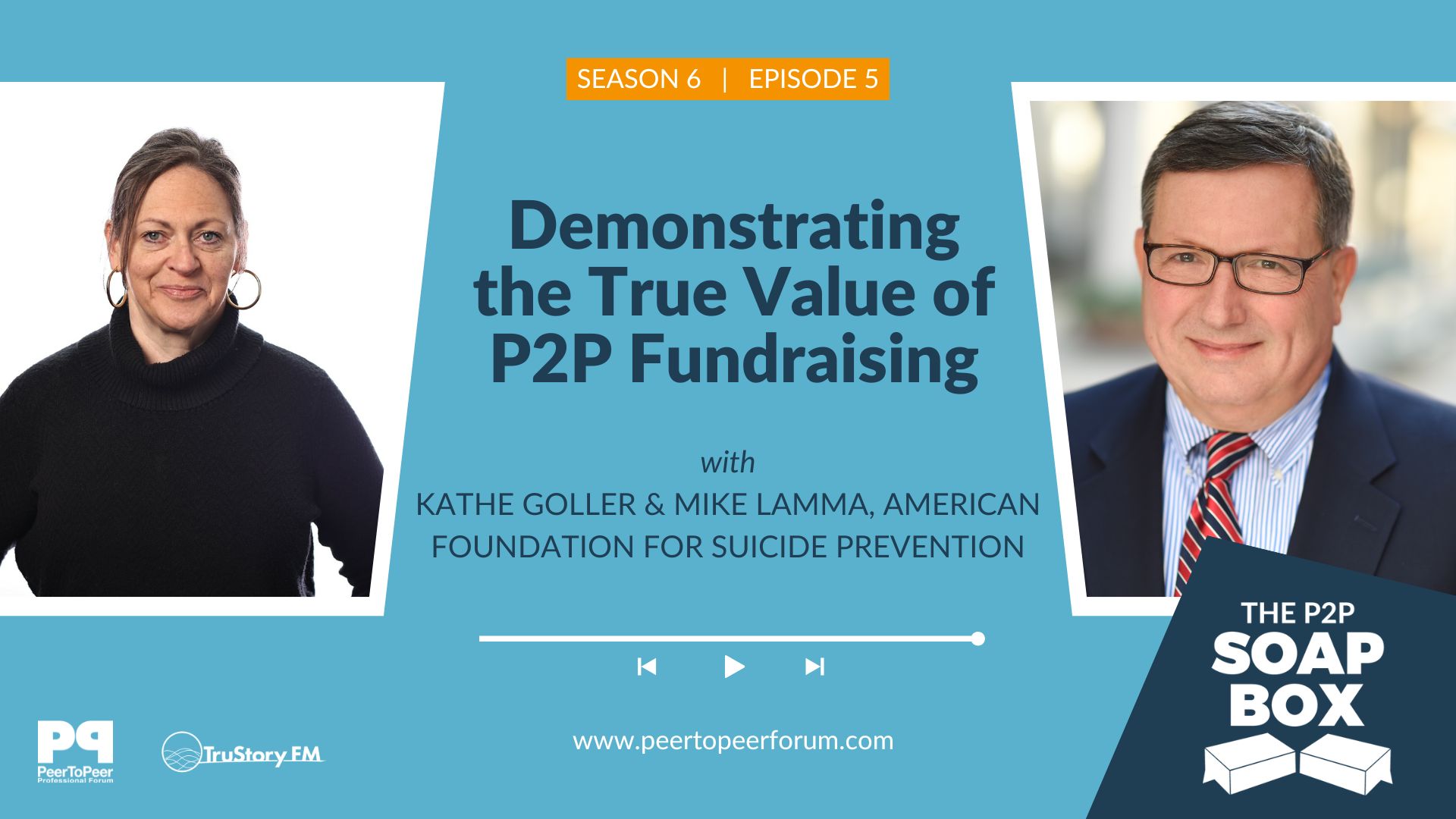
Today I’m joined by Kathe Goller, Senior Director of Community Fundraising, and Mike Lamma, Executive Vice President and Chief Operating Officer at the American Foundation for Suicide Prevention. AFSP is dedicated to saving lives and bringing hope to those affected by suicide through research, education, advocacy, and support for their communities. Kathe and Mike have helped grow one of the most recognized walk programs in the country, the Out of the Darkness Community Walks, which has been a mainstay in the U.S. peer-to-peer top 30 ranking and came in at number 17 in 2025.
They bring a grounded, honest perspective on what it takes for peer-to-peer to earn its place as a true driver of organizational success. From early skepticism to sustained impact, they’ve seen firsthand how this work can evolve and prove its worth. We get into how to communicate value beyond revenue, how to build confidence with leadership, and how peer-to-peer can stand alongside traditional development as a true partner in your strategy. So let’s jump right into my conversation with Kathe Goller and Mike Lamma from the American Foundation for Suicide Prevention.
Mike, Kathe, welcome to the P2P Soapbox.
Kathe Goller:
Thank you.
Mike Lamma:
Pleasure to be here. Thanks for having us.
Marcie Maxwell:
We are so happy to have you. Mike, you were one of the unlucky few that got stuck with the snow for our conference and were not able to join us as a presenter, but Kathe filled in your shoes, so we knew we had to have the two of you join us on the soapbox.
Mike Lamma:
Well, thank you. Yes, two feet of snow here in central New Jersey.
Marcie Maxwell:
It was a wild week for travel that week.
So let’s jump right in. We always like to start — I’d love to hear a little bit about each of your backgrounds, your personal journey, your professional journey that led you to your roles at the American Foundation for Suicide Prevention. Mike, will you start?
Mike Lamma:
Sure. So I’ve worked in nonprofit fundraising, mostly peer-to-peer, even though we didn’t call it that in those ancient times, since I got out of college. I always tell people I started at ground zero. I was a special events coordinator for the Cystic Fibrosis Foundation in Richmond, Virginia. In those days, our big event was the Bowl-a-thon event. So my claim to fame was I knew where every bowling alley in the state of Virginia was.
Over the years, I moved up and became a chapter executive director, worked regionally for a couple of organizations, and then nationally. Pertaining to this topic, I worked for the American Diabetes Association on their national staff when we launched our walk program in the early 1990s.
So anyway, later on, fast-forwarding through time, the American Foundation for Suicide Prevention was looking for someone to build a real chapter structure and to launch a signature fundraising event. I always joke because in the plan it said, “create a signature fundraising event, probably a walk.” And that’s what we had when I walked in the door. So that’s kind of how I got involved here at AFSP. And here I am 22 years later.
Marcie Maxwell:
That’s amazing. Kathe, what about you?
Kathe Goller:
I have also been in nonprofit for the bulk of my career. As a really young professional, I was working in the financial planning industry, and I was volunteering with a nonprofit — another health-related nonprofit — based on a diagnosis that someone very close to me had received. I had an opportunity to interview for a position with the organization that I was volunteering with and was fortunate enough to get that position, and just completely fell in love with nonprofit work. So I have been here ever since.
I actually came to AFSP about eight years ago. I had an opportunity to interview for a position here, and I am the parent of a person who struggles significantly with their mental health and with suicidal ideation. So when this opportunity came about, it was the perfect chance for me to really take something that was meaningful for me personally, that also used my work experience. I have been very happy working in this role at AFSP ever since, for the last eight years.
Marcie Maxwell:
I always love hearing different people’s origin stories of how — what brings them to this kind of work. So thank you all for sharing that.
So let’s start back, Mike, a little bit when you started. When AFSP first considered launching that walk program — you know, maybe there was some skepticism of “is it probably a walk, maybe” — what do you feel like people were getting wrong about peer-to-peer back then? And what has helped prove that misconception wrong?
Mike Lamma:
Right. Well, there was a lot of skepticism. As I always joked, one of the greatest attributes I brought to this position is I’m a stubborn SOB. Or the nice way of putting it is I’m very persistent.
There were a lot of people on our national board, there were people who said, “It’s too late to get into walks. There’s already too many walks. That fad has passed.” I remember I proudly sent out an email to all of our chapters and said, “We’re launching our Out of the Darkness Community Walks. We hope you’ll do a walk in your community.” And I got back emails from people that said, “We’re not going to do the walk because there’s already too many walks in our community.” And most appallingly, they said they didn’t think people would walk for this cause.
So yeah, there was a lot of skepticism. I remember we launched our walks in September of 2004, and I can remember during that summer I had one moment of doubt. I remember thinking, geez, I hope this is going to work. But I got past that moment of doubt, and our goal was to have 10 walks and raise $300,000, and we ended up having 24 walks and raised $850,000. So we knew we were on to something. And that has just grown progressively since then, up until COVID. And now we’re slowly getting back on an upward swing.
Marcie Maxwell:
Rebuilding. Well, I will say, I launched a walk program in the mid-2000s as well. So I remember having some of those exact same conversations of, are we too late to the ballgame for the walk? What is this actually going to do for us? What is it going to take? So I can empathize with that experience for sure.
Looking at the growth from those early goals to where the program is today, which has been consistently among the US top thirty — what do you feel like are those key moments or decisions that turned peer-to-peer into a real driver for growth? How did you get those chapters that initially said, “no, not for us” — how’d you get them to turn the page?
Mike Lamma:
Well, through a lot of persuasion and training. And look, it was a one-person show then. I always tell people, I was the walks department. There was no one else. And we did it almost all long distance by telephone. This is pre-Zoom, so we did it by telephone and email and those things.
Ironically, once we had about probably fifteen walks and when we launched officially, then I started getting contacted by people who weren’t involved in our chapters, but were almost angry: “Well, how come you’re not having a walk in my community?” And I said, “Well, if you’re willing to chair the walk, I’ll be happy to work with you and we can do it.” So we added another ten walks after that. Once we did it and were successful, then it became much easier to sell it to our chapters. We just built it from there.
I think one thing that clearly changed the game for peer-to-peer, and especially walks — when I was part of ADA when they launched their walks, the high-tech way you registered was to fax in your registration. There was no email, there was no internet, and you couldn’t fundraise online. But the changes in technology made it a whole lot easier to register and to raise money. People discovered that if they just simply shared their story with their friends, people would donate to them, and oftentimes say, “I’ve never said this before, but I lost my brother to suicide,” or “I lost my cousin to suicide,” or what have you.
And I think the one thing we’ve tried to keep in place over the years is for us not to become too prescriptive. I’m a huge numbers and data person. Kathe will tell you, we talk about the numbers all the time. But it’s really important that people understand that it’s not just numbers, it’s what we’re able to accomplish because of the money that we’ve raised. And making sure we don’t get too far removed from the mission — people understanding that this is all about accomplishing our mission. I think that’s been really important over the years as we’ve grown and gotten bigger.
The walks transformed the organization. We were a $2 million organization in 2004, and we’re a $45 million organization today. And the biggest part of that growth was from the walks. It also helped us grow our chapter structure. We had about eighteen chapters when I came here, and because of the walks, we were able to establish chapters in a lot of other places. Now we have 73 chapters. We’re in all 50 states plus DC and Puerto Rico.
Marcie Maxwell:
Mike sets the framework. Kathe, you came in eight years ago — I’d have to do the math, about 15, 16 years later from when Mike started. Since you joined, what are some of the key moments that you’ve seen in terms of driving growth, beyond the invention of the internet, as Mike so casually just drops in there about how that changes things?
Kathe Goller:
Sure. I mean, I think technology even in the last eight years has changed a lot. The way we’re fundraising — our participants are utilizing different tools that they may not have had six, seven, eight years ago. So that helps.
But I think, too, the pandemic has been a big driver for growth. And with our cause, one thing that’s unique about us is the pandemic, while it had a lot of impact and made things very difficult for us, it also really brought mental health to the forefront. It really launched our mission into the spotlight. So that has been a real key driving force for us as we’ve worked to rebuild our program following COVID — that that conversation is happening openly and much more often than it used to. So that really, for me, has probably been the most pivotal thing in the last eight years that has helped us to continue to grow the program.
Marcie Maxwell:
That’s very true. And we sit here in the middle of mental health awareness month.
Pre-COVID and post-COVID — we had people that had skepticism about the role of peer-to-peer back before things started, and now I feel like even more coming out of the pandemic, you still have organizations that are asking, is peer-to-peer worth it? Events are getting more expensive. What’s the value in this? Pressure is really high to rebound to those early days of peer-to-peer.
Mike, sitting in the executive level, and Kathe in this senior director level role — how do you help leadership understand the full value of peer-to-peer beyond just today’s revenue?
Mike Lamma:
Well, as I said, for us as an organization, it has totally transformed our organization. As I said, we were able to grow our chapter structure because of walks. Many places, people would do a walk and we didn’t have a chapter there, and so then I would say, well, why don’t we explore trying to form a chapter here? And anytime anybody approached us wanting to start a chapter, the first thing they had to do was do a walk.
So obviously, besides the revenue — which, I always remind people, first and foremost this is a fundraising event — there are lots of other what I refer to as pleasant side benefits, if you will. Raising awareness about our cause, reducing stigma, which is huge. Especially in the early days, people would come out and they’d see five hundred to a thousand people, which in those days was a big event for us, and they were like, “We had no idea this cause affected so many people. Our family felt so isolated.” So it helped with that. Raises awareness, educated people, brought people who’ve lost someone or have family members who struggled together, and built this connection. So it’s been this incredible driver for the organization.
I guess I cheated a little bit because I came from the peer-to-peer side, and then I ended up taking over the development department. So I oversee both peer-to-peer fundraising and the more traditional development areas. As I always say, as long as I’m here, peer-to-peer will be a huge part of what we do because we know it works and can really help. And the two can be complementary to each other. I’ve never seen it as either/or.
Marcie Maxwell:
Absolutely.
Mike Lamma:
I’ve seen it as peer-to-peer and traditional development. Because I oversee both, kind of like I said, I cheated a little bit on it. And because my boss has been here from the very beginning when we launched this — he’s seen the results, and I don’t have to convince him that, oh, we need to do this or what have you. He’s seen the results and has bought into it. So I’ve been lucky in that regard that we have that executive level of support.
But I could tell you, some of our own chapter staff and stuff will say things like, “Oh, peer-to-peer fundraising is dying off.”
Marcie Maxwell:
Drives you crazy. Drives me crazy.
Mike Lamma:
It doesn’t sit well with me.
Marcie Maxwell:
No, not at all.
Kathe Goller:
Not at all.
Mike Lamma:
And look, you show people the numbers and it’s not. Look at the peer-to-peer top thirty. Most of those organizations are all growing, and as a whole, it’s growing. And it’s like anything else — there are basic fundamental things that you do, but you also have to always be looking and seeing, what can we do? How can we refine our approach? What can we do a little bit differently? It used to be radio advertising drove walkers, and now that’s not so much the case anymore.
Marcie Maxwell:
No.
Mike Lamma:
So you always have to be aware of what’s going on and seeing what kind of changes you can make to make sure that we’re staying competitive. Like any other business, you have to look at your business model and make sure that you’re staying on top of the game.
Marcie Maxwell:
Exactly. Going back to what you said in the beginning, where you said whenever somebody wanted to start up a new chapter, a walk was a great first step. I’ve often said walks and peer-to-peer is the best training ground for anybody coming into fundraising as a staff person, because you learn event logistics and project management and sales and relationship building. You kind of have to learn everything.
And I think the same is true for volunteer leaders. I used to say that at a previous organization. They’re like, “Well, we might want to put this person on the local board.” And I’m like, well, have they ever fundraised before? Why don’t you start with having them champion a walk team or be a team captain to see how they’re doing? You don’t want to put an unproven fundraiser on your board. So a walk is a great opportunity to test the water, see how they’re doing, and build that. So I think in the same way that you test that out for potential markets for chapters, walk is a huge benefit that we see for sure.
Kathe, what about you?
Kathe Goller:
I’m really fortunate, as Mike said, he strongly believes in peer-to-peer. So I don’t have that battle of trying to convince our leadership that peer-to-peer is worth it. We know that it has driven the success of our organization.
But some of the things that I think could be helpful when you’re dealing with leadership maybe that don’t quite have that firsthand experience or don’t quite buy in to that same belief is — everything starts with our grassroots in the community. That’s where we’re delivering our mission. That’s where we’re raising the money to deliver our mission. So I think anytime that we can invite our leadership to come out and be a part of those events and see them firsthand and talk to the participants and see those things that peer-to-peer offers to the organization that maybe aren’t immediately measurable in the numbers or the data, but that really contribute to driving our growth and keeping people engaged and creating more awareness of our mission in the community — if they can see that firsthand, I think there’s a lot that can be understood that’s very difficult to relay when you’re trying to explain to somebody what that looks like.
So that would be my first thing — really try to get the leadership out there. Our leadership often goes out to events. Mike attends events all the time as our chief operating officer. Bob Gebbia participates in events as our CEO, our national development team. We go out and participate in these events because what’s happening there on the ground can be such a strong force for not just the fundraising but the mission delivery. And if the leadership can see that and they can see how it’s going to help us implement what we’re here to do, then I think it’s a lot easier to get that buy-in on things like the cost or what resources might be needed in order to produce the events, because they do so much more.
They are first and foremost the fundraiser, because it takes the money to pay to deliver the mission. But there are so many other things that those events accomplish, and it’s really great when they can see that firsthand.
Marcie Maxwell:
Absolutely. I think there’s also where a lot of orgs seem to be struggling is how to use their data to show the value beyond just that immediate revenue. Especially again, hard costs are getting a little more expensive. Everybody in peer-to-peer knows the cost of cotton is always increasing for your t-shirts. The cost of events is getting more expensive.
So if someone is looking into that data, or they want to use data to really make that case to their leadership team, where do you feel like they should start in building that understanding of history of their program and the data and how it’s driven their organization? Not everybody’s been there for 22 years to be able to articulate the picture.
Mike Lamma:
Well, I think the first thing is that you need to know the data inside and out so that people can’t cherry-pick things and make an argument against you or whatever. So you need to know the data inside and out.
And look, in many ways all of us are salespeople. You need to be — you can’t get complacent. You always need to be selling what we’re doing and keeping leadership abreast of what we’re doing.
Kathe’s point about having people go out and attend walks is a good one. From the very first year we did the walks, our CEO went out to a couple of walks every year so he could see them in action, see what was happening on the ground. And other of our executive leaders have too — our chief medical officer, she goes out to events. People always come back, and they’re always just blown away by the incredible energy and positivity, and what big productions these events are. And this is mostly volunteers doing all this. We only have like one or two staff people in our chapters, and they do multiple events. So we couldn’t do it without the volunteers.
That’s a really important point as well. I think some of the organizations who struggled over the years, they became too staff-driven.
Marcie Maxwell:
Pendulum swings.
Mike Lamma:
And look, the staff play an important role, but you have to have volunteers involved. They can help spread the word. They bring in creative ideas and things. We don’t pretend like we know everything. So I think those are all really important parts of this.
Marcie Maxwell:
I think back on — I know sometimes maybe budget constraints prevent people from traveling out to events, but I can think of during some early days of some walks that I’ve run, we gave a list of three or four fundraisers for each member of the executive team to call and to reach out. And then that support — to me as the lead of the program, where people are saying, “Oh my gosh, this walk team captain over here is amazing. Did you hear their story?” They got so invested in the fundraisers just by making a short call. That was obviously meaningful to the fundraiser themselves, getting a call from a CEO or CMO or an SVP. So if they can’t get out there physically, there’s still ways for them to connect and get to know those people as well.
Mike, you sit in a role both with your history as peer-to-peer and leading peer-to-peer and traditional development. There’s often this perceived tension, this battle for resources, battle for ROI — which one is better? You talked about being more of an “and” organization than an “or” organization. Can you talk a little bit about that philosophy? And Kathe, I’d love to hear what you’ve experienced working with Mike in that framework.
Mike Lamma:
Yeah, and to be clear, it’s not always kumbaya. We have moments where the two operations butt against each other sometimes. But it’s been interesting over the years, our peer-to-peer fundraising kept growing, our traditional development revenue was growing as well. In fact, as a percent of our revenue, the traditional development has actually grown pretty significantly, which is really kind of surprising. Everybody thinks, oh well, you can’t combine the two, it’s either/or. But we’ve grown both.
And obviously, you can do things like, let’s look at our list of walkers and see, are there potential major gift prospects there? Is there somebody who’s being a $5,000 sponsor of a local walk — is that a nationwide company that we could get them to be a major corporate supporter of ours? Those things.
I think the big thing — it’s really been helpful that the two have been housed under the same management, so that we can make sure there’s that communication and cooperation between the two. I think in some organizations where they’re completely separate, there’s more of that butting of heads and that kind of thing. But because they’re both under one umbrella here, it makes it a little easier.
Marcie Maxwell:
Absolutely. Kathe, what is it like working under that?
Kathe Goller:
It works really well, like Mike said, because we are under the same umbrella. So we are working with common goals and objectives.
The thing that is really helpful about it for me as a peer-to-peer fundraiser is, we need the expertise that the traditional development side of the house has to offer. They have a lot of experience with things that maybe we don’t, and vice versa. And we’re able to bring people into the organization maybe that they wouldn’t have had access to, that do go on to be very strong donors in terms of individual giving or legacy gifts and those types of things.
So I think the key for me is really just keeping that communication open so that we can collaborate on those things, so that we can identify where those joint opportunities are and make sure that we’re stewarding our relationships and our fundraising in the best way possible for the donor or for the fundraiser. With us being separate, but as two sides of the same house, we’re really able to do that in a seamless way that feels very natural for our fundraisers and for our donors. It’s helpful that we do have different skill sets and we do have different constituent bases, but we are working toward the same goal under the same management. So it’s a very coordinated effort, which I think makes all the difference in the world for us.
Marcie Maxwell:
Absolutely. Now, I imagine there might be some people listening who are thinking, this is great, I am trying to build this type of internal buy-in at my organization. What have you found that really resonates with executives and helps peer-to-peer to earn that real seat at the table, if that’s not where they’re currently sitting?
Mike Lamma:
Well, it’s rather simplistic, I guess, but first and foremost, producing results. When you can produce results and go to executive leadership and say, look, here’s how much money we’ve raised this year, here’s how many people we’ve engaged — going back to when I talked about people said they didn’t believe people would walk for this cause — well, now we have like a quarter of a million people every year walking in our walk events. So I always say, I wish I’d have kept some of those emails so I could have said to them, I think people will walk for this cause.
One of the things I would think — look, there’s certain things that the two can complement each other. Like, for example, stewardship is a big deal in traditional development. Well, we can use those same concepts for dealing with our big walk fundraisers, our big team captains. We can use those exact same strategies there. So when we can get the two to work together to help each other out, then you can see there’s mutual benefit and it’s not necessarily a competition. Although we’re all very competitive throughout the team. But we do work together on things, and likewise, we can find potential prospects for the traditional development side of the house. So figuring out ways that you can complement each other helps to diminish some of the mistrust and that kind of thing.
Marcie Maxwell:
I’ve often said, to terribly paraphrase John F. Kennedy, ask not what walk can do for you, but what you can do for walk, or vice versa. There is so much benefit, whether it’s using it as a training ground, using it as a stewardship opportunity, using it to move someone from this level of involvement to a different level. I think sometimes that gets lost when you don’t have the larger understanding of the power of peer-to-peer.
Kathe, what would you say for someone making a case to their leadership team?
Kathe Goller:
I would say the same thing Mike did. We need to see how our peer-to-peer fundraising directly drives the revenue. I mean, that’s why we’re here. But I think really showcasing how it also serves to recruit volunteer leadership and how it opens the doors where we can deliver the organization’s mission — really collecting those stories that showcase those things so that we can demonstrate why that seat at the table was important.
We talked a little bit about data, and it’s not just about numbers. I think sometimes we think data and we think, okay, let’s look at what are the numbers, what was the percentage increase. But when you’re talking about showing the value of peer-to-peer fundraising, I’m looking at data all the time — everything from surveys that people have filled out as to why it’s important that they participate.
Another really great place to look at data is your CRM system, because you’d be surprised how often, when you look at those relationships and what’s been documented in them, you can really show and make the case for the fact that many of those people that have gone on to be significant donors or really strong leaders within the organization — it’s in those constituent files that they started out as a peer-to-peer fundraiser or on a committee for a peer-to-peer event. So really thinking of data in terms of more than just the finances and using that to show how the peer-to-peer movement is driving the success of the organization.
Marcie Maxwell:
Yeah, absolutely. How do we get those attributions right so that you can truly see not just what an event raised today, but look five years from now — what is the total amount of contributions from the people who came through that first event? How are we able to do that? I think people are trying to get there. There’s a lot of people trying to figure out how to get there.
So I think this was great. Mike, I’m wishing I met you earlier in my career, because I feel like I needed your expertise. You too, Kathe. But Mike and I launched walks around the same time. I wish you’d been my peer buddy during that time.
If there’s people that are listening that are wanting to learn more about what you’re doing at AFSP, learn about the Out of the Darkness Community Walks — where can we send people to find out more?
Kathe Goller:
You can send them to afsp.org. There is information there on our resources, our programming, and — as most important to me — our peer-to-peer fundraising events. We have our Out of the Darkness Community Walks. We also have our Overnight Walk, which is getting ready to happen in June in Chicago. And we also have our new signature peer-to-peer fundraising hike for hope, Construction Hike for Hope. So information is available on that at afsp.org as well. And then on social, we can be found at AFSP National — that is our handle on our social platforms.
Marcie Maxwell:
Well, thank y’all so much for joining us and for sharing. And I would say, if anybody’s listening and trying to get internal buy-in, send this podcast episode to your executive team. Maybe they’ll listen.
Mike Lamma:
There you go.
Marcie Maxwell:
Well, thank y’all so much for joining us.
Kathe Goller:
Thank you, Marcie.
Mike Lamma:
Thank you. Thanks for having us.