Marcie Maxwell:
Hello, hello. Welcome back to the P2P Soapbox. I’m your host and P2P BFF, Marcie Maxwell. It is our season six finale, but don’t fret, we will be back in the fall with more great guests.
If you’ve worked in peer-to-peer fundraising long enough, you’ve probably felt the pressure to constantly come up with the next big campaign idea. It’s easy to look outside your organization for inspiration, whether that’s industry trends, competitor programs, or the latest fundraising success story making the rounds. But what if your next great campaign idea is already hiding inside your existing organization?
Today we’re talking about how organizations can uncover fresh fundraising concepts by paying closer attention to their supporters, their communities, and the ideas that are already gaining momentum. Sometimes innovation doesn’t start with a brainstorming session. Sometimes it starts by recognizing potential in something that’s already working.
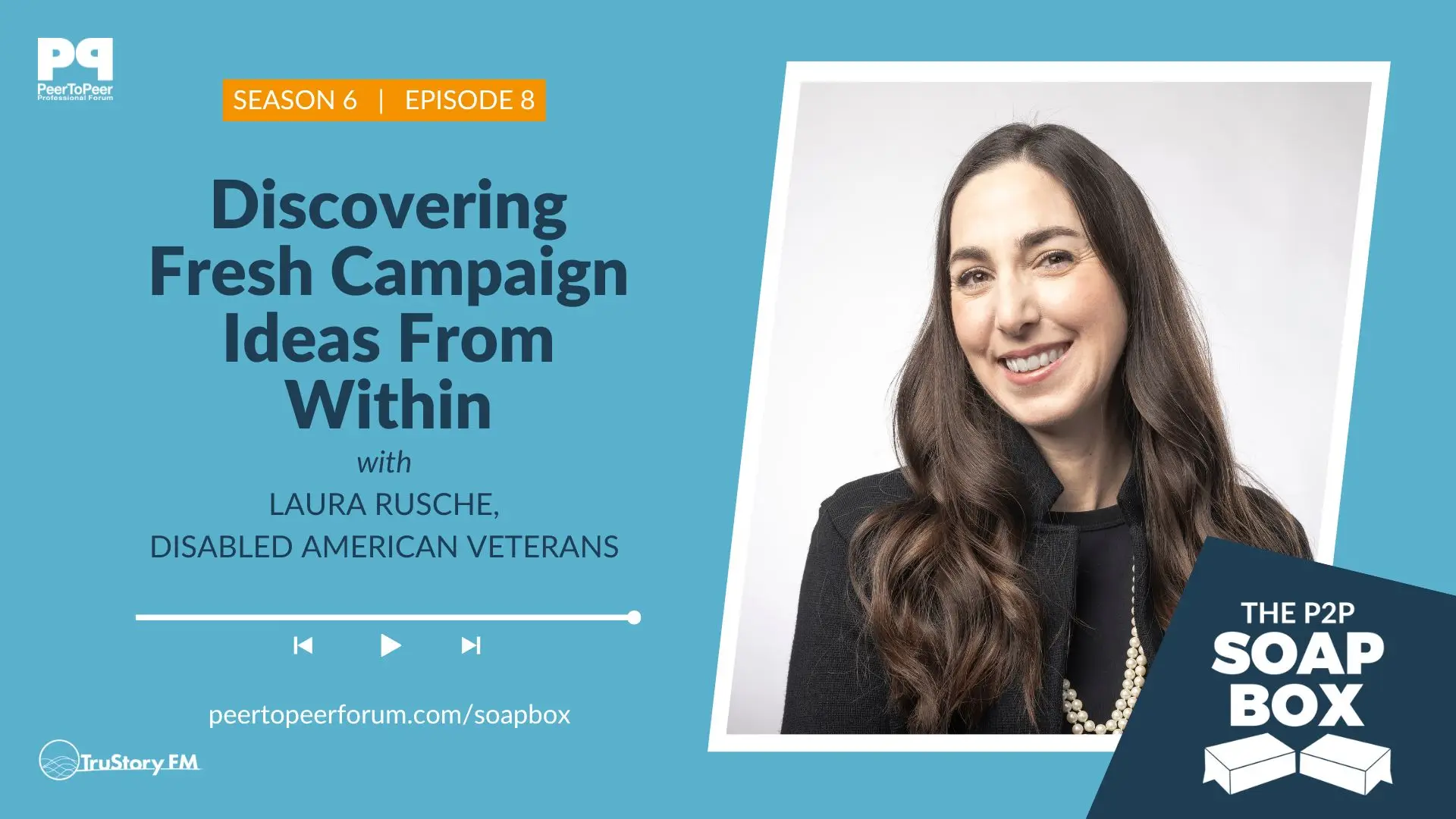
Today, I’m joined by Laura Rusch, Strategic Fundraising Priorities Manager at Disabled American Veterans, or DAV, an organization dedicated to a single purpose: empowering veterans to lead high-quality lives with respect and dignity. Laura shares the story behind their Field of Flags campaign, a grassroots initiative that didn’t begin as a peer-to-peer program, but evolved into a powerful DIY fundraising campaign. We’ll explore how DAV identified the opportunity, scaled the program across communities, built internal support, and is continuing to evolve the concept by staying connected to the people who made it successful in the first place.
If you’re looking for new campaign ideas, this conversation is a great reminder that sometimes the best place to start is by looking inward. So let’s jump right into my conversation with DAV’s Laura Rusch. Laura, welcome to the P2P Soapbox. So happy to have you.
Laura Rusch:
So excited to be here. Thank you, Marcie.
Marcie Maxwell:
I feel like we have been talking about this episode for a while now. So excited to have you on and to hear a little bit more about all the good work that you’re doing. So let’s just start by hearing a little bit about your personal journey, your professional journey that led you to your role at Disabled American Veterans.
Laura Rusch:
Yeah, thank you, Marcie. I’m excited to talk to you today. So for me, I began my career in banking, working in marketing and communications. And employee engagement was a focus of that job. Part of my role involved bringing different nonprofit partners to allow our employees to support local causes. And I was just inspired by the passion that they had for their work. I had never thought about aligning my career with a cause that I truly care about until I had these experiences with these awesome people. So I made the jump from banking to the nonprofit sector and cut my teeth, if you will, working at Susan G. Komen in the Race for the Cure before really beginning my nearly 17-year journey at DAV. In August, I’ll have reached my 17-year anniversary with the organization.
Marcie Maxwell:
Congrats.
Laura Rusch:
It’s awesome, right? During my time at DAV, I’ve worn lots of different hats, so I’ve got to do a lot of different things, from corporate development, to launching our very first peer-to-peer event, our DAV5K, to managing real estate, vehicle, and clothing donation programs, as well as developing some of our sustained monthly giving strategies. And it’s really been a privilege to work at DAV.
Just a little about the organization. DAV was founded in 1920 and chartered by Congress in 1932 to act as the voice for disabled veterans. More than 100 years later, DAV continues to help veterans of all generations obtain the benefits they’ve earned through their military service. And since DAV is not government funded, we rely entirely on the generosity of patriotic supporters. Today I’m joining you, Marcie, to discuss one of our new digital-turned-peer-to-peer initiatives where donors are putting that patriotism into action, which is our Field of Flags campaign.
Marcie Maxwell:
I want to dig in on Field of Flags and what exactly it is. But I also want to understand how it came to be. How would you describe the DIY fundraising landscape at DAV before Field of Flags came, and the challenges you were trying to solve within that program?
Laura Rusch:
Yeah. The start of peer-to-peer at DAV really started with what we call our DAV5K. That was born out of looking around at our fundraising portfolio and understanding that we didn’t have a peer-to-peer footprint, we didn’t have anything to offer. So it was a very grassroots idea. We were like, hey, maybe we could put this together and see what happens. So we pulled our resources. I asked for help from various people in various departments. And we did it. In our first year, we were just blown away by that feeling of the community coming out, people coming together, honoring their individual family member or their loved one, spouse, father, son, but being together inside of a community of a greater good.
That just kind of started to stumble into some of the other areas. Our 5K still remains probably our bread and butter of our peer-to-peer portfolio. We do have do-it-yourself fundraising, where there are lots of different things that everyone comes up with to fundraise. We have honor and memorial, that’s popular in our nonprofit, just for people to honor their loved ones who have passed away. And then we started gaming and live streaming really recently. I think within the last year, we have started to tiptoe our way into that.
We’ve tried a lot of different things. As the 5K continued to grow, we were looking around to say, what are other things that we could do? How do we expand and broaden? And where we were looking was kind of outside of ourselves. We were looking at what everybody else was doing. I know your mom is always like, don’t do what everyone else is doing, do what’s best for you. And that ended up ringing true for us. When we tried to do other things that other organizations were doing that were super successful, that had a lot of media attention, a lot of social media attention, it just didn’t work for us. We underperformed in the way that we would evaluate. By trying those different ideas, it reduces momentum and it deflates the goals and objectives that you’re trying to achieve when you’re expanding a program.
So what we ended up doing was looking within our own channels about what our audience wants. We serve veterans and their families all over the United States. For us, it was really looking inward to see what was working, and whether there was something where we could take an idea — maybe, for our case, a digital campaign — and then bring that to the homes and to the hands of people, to be able to take an idea and then make it their own.
Marcie Maxwell:
So Field of Flags didn’t start as peer-to-peer. Tell us a little bit more about what it is, but its origins and those early signals that made you realize this could be something bigger and morph into a peer-to-peer opportunity.
Laura Rusch:
Yeah. The origin of this was that it was actually a digital campaign that we launched in 2016, so almost 10 years ago. It’s a long time. It really was just what you expect in a digital campaign. It was to our audiences. We had email, light box, digital ads, tactics with premiums and matching gifts. And the ask was, if you make a donation, we’ll fly a flag for you in our national headquarters field.
This was really a concept board of my colleague Dan Clasgens. Our office at the time — we’ve since moved — had a huge green space. It was widely trafficked. People were driving by all the time. So it was like, oh, what if we built a field of flags in front of our headquarters and used it as a fundraising opportunity? So anyone, anywhere could have a flag flying in honor of their veteran and their loved one. And this was just beyond our expectations. It quickly exceeded KPIs and it became one of our tentpole digital campaigns. It was super popular. We actually outgrew our field because we had so many flags being planted.
I had shared this story with Danielle, just about the peer-to-peer idea of how we have a lot of sweat equity in what we do, and we’re doing a lot of things behind the scenes that are just wild and crazy tactics. One of the stories with this is that, in order to think about other ways to give — we’re always thinking how to iterate, how to optimize, how to add a gift — one of the add opportunities was, if you upgraded your gift, we would actually fly the flag on our DAV National Headquarters tentpole, raise it above DAV, and then pull it back down, package it up, and send it back to you, so that you could keep that flag or raise the flag in your home. That was one of the stories where it was a good idea, and then there was the practicality of how many people were really interested in doing it.
Marcie Maxwell:
Oh my gosh.
Laura Rusch:
So we had a little team going where we would raise the flag, lift it. I was the one who folded it appropriately back into the binder there, and then mailed it back to the donor. So, lots of different ways of incorporating that idea of making it a part of a community, but very individualized. So you could have a piece of that at your home, but that it was flown in concert with everyone else across America, which really resonated with our donors.
Marcie Maxwell:
So how did it go from there to something more?
Laura Rusch:
Yeah. For us it was just seeing the success, seeing the audience interest, seeing that our veterans and our supporters were interested, and then taking that idea. Going back to reframing peer-to-peer and DIY within our organization: we tried things that didn’t work for us, I would say. They weren’t meeting the needs of our audience, weren’t meeting the needs of our donor. So for us the priority was finding new audiences at a lower net cost with a low risk. That was our formula for how we were looking to identify a campaign that could scale and could take us to another level.
It’s really about those interconnected conversations that we’re having between our different departments and different marketing teams, to be able to say, oh, this is working or this isn’t working. This one just kind of was a highlight. Like I said, it became a tentpole campaign. Being able to have those interconnected conversations with our other channel teams allowed us to ideate on what that would look like. If, instead of — we outgrew our field — but what if we gave the opportunity to others to plant the fields wherever they are, however that would look?
So we did a pilot. We knew that we needed to focus on the low net cost, low risk. It was really entrepreneurial, where I identified in our headquarters area about 10 different companies, schools, and individuals, and asked if they would be interested in participating in our pilot. And luckily they said yes. We were given the clearance and the dedicated staffing to be able to really focus on this pilot and service these piloters who were growing their fields, to help them have success.
After that pilot, what we found was that not only was this important and had become meaningful, but it took on a whole life of its own in terms of that outward expression of patriotism, an outward expression of gratitude to veterans — and the people who just drive by and see it, not just the people who are fundraising and telling the story about why this is important to them. It’s the natural way of being able to have that outward expression to do something and be connected to your community. We found it was a success in that pilot, and so that gave us the ability to get the buy-in and the investment that we needed for the second year to start to roll it out in a bigger way.
Marcie Maxwell:
Just to make sure we all understand — so someone says, yes, I want to have a field at my company headquarters. And then, just like a walk team, they’re asking friends and family to support and make a donation in order to have a flag flown in the X company’s field. Is it — I don’t want to say simple, but is it as simple as that?
Laura Rusch:
Yeah. So the origin campaign was, if you donate, we will fly a flag at our national headquarters. The change here is that we’re offering the opportunity for people to register, which we allow them to do for free. And then they fundraise in order for us to send them flags and send them the materials. We call it a flag kit. It has a big vinyl banner, so that, again, if people were driving by — what we found is that strangers want to participate and get involved in the Field of Flags.
Marcie Maxwell:
Yeah.
Laura Rusch:
They fundraise in order to get these flag kits. And then we send them to the fundraiser’s home, or school, or office building, and then their action is to erect the Field of Flags in a green space that they choose. The more that they fundraise, the more flags they can add to their field. So it’s become more of that do-it-yourself, actionable campaign. And it’s been wonderful.
Marcie Maxwell:
That’s great. So once you saw the potential with those eight to ten local-ish companies that you personally asked to do this —
Laura Rusch:
Yeah.
Marcie Maxwell:
— how did you begin to grow beyond that and take this to more of a true national campaign in a way that’s sustainable, that’s scalable? You’ve mentioned schools, you’ve mentioned companies. How did you create that plan to grow?
Laura Rusch:
Yeah, and I think we’re still learning. I would still say that we’re in the early phases of the campaign. One of our goals last year was to have at least one field in every state across the United States. And we did achieve that last year, so we were really excited about that.
From that first start — I know it’s wild — but in the last four years, we’ve increased our registration by 473%. And our net revenue has grown by over 2,000%, which are wild statistics.
Marcie Maxwell:
Amazing.
Laura Rusch:
Again, we were starting at zero, so it’s a little easier to show those statistics when we have an early incubator program. But what that says is just that we have an audience who is interested. So our responsibility, in terms of how we grow something — again, we were focused on net profitability. In the past, or in other campaigns, we thought we could recoup maybe our initial upfront investment, and it didn’t always go that way in terms of what’s reasonable in the timeline of recouping that investment. So I think we’ve learned from past failures, if you will, of campaigns that didn’t work out for us, how to really focus on this net-profitability metric.
It really dictates how much we spend in marketing. It dictates how much we spend on fulfillment, because we really want to make sure that this is something that is beneficial long-term and growing at the pace of a long-term portfolio piece to the peer-to-peer portfolio. So we looked really at making sure we were strategically aligned with our internal partners and making sure that, from a fulfillment perspective — that was huge, because that’s really what our cost is. We’re not having a singular event like a 5K where —
Marcie Maxwell:
Yeah.
Laura Rusch:
— you’re organizing, everyone’s there, and then they leave. This is really outward; we’re shipping.
Marcie Maxwell:
Mm-hmm.
Laura Rusch:
There’s a mail cost and the postage and all that kind of stuff. And then one of the denominators too for us is the fundraising doesn’t really stop. We don’t want to turn off fundraising, we don’t want to stop people from fundraising, but they do have to set up their fields before a particular day, or on a particular day, based on the alignment of Veterans Day. So part of the strategy of Field of Flags, with the execution of launching and erecting your field, is really about the Veterans Day moment. What we’ve learned from our organization and our constituency is that that’s really one of the most important days of the year for our cause. It’s a universal day that everyone really understands, and you don’t have a lot of education to try to get people on board.
Marcie Maxwell:
Yeah.
Laura Rusch:
There are a lot of existing Veterans Day celebrations; they naturally happen in all of our communities. So this was a way to say, okay, here’s an opportunity to give back, to support a cause that’s so important to veterans and their families, and then do something and have a public display of patriotism. So that timing, that activation on Veterans Day, also was a really important part of the strategy of growth — just identifying who’s already doing things on this day, and how this can be another way of honoring veterans.
Marcie Maxwell:
Yeah. I love that. You talked about how so often we look at other organizations and we try to — as someone in our industry always says, RD means “rip off and duplicate,” which always makes me laugh.
Laura Rusch:
Yeah.
Marcie Maxwell:
So often we do try to just look to other organizations and say, what does that look like for us? And that’s not always going to be the right fit. So can you talk a little bit more about how you really understood your own supporters, and why Field of Flags felt like the right opportunity to take a digital campaign and turn it into something peer-to-peer?
Laura Rusch:
Yeah. That’s a good question, Marcie. Our organization has a lot of different channels of fundraising. One thing I think that makes us a little different than some of the other guests that you’ve had on your podcast is that peer-to-peer is not our primary channel of fundraising. For us, direct mail is really our primary channel of fundraising, which is very unusual in some of the peer-to-peer industry conferences and webinars that I’ve been to. So we are really focused on testing and modeling and data-driven decisions in terms of marketing and fundraising. A lot of those come from our roots in direct mail and direct mail fundraising.
So for us, it’s really about testing — like you’re saying, what RD is —
Marcie Maxwell:
R and D: rip off and duplicate.
Laura Rusch:
Yeah. Okay. So ours is really like test and iterate, where we’re focused on changing one thing, having a control, and iterating and validating before we make a big choice. And I think that peer-to-peer can seem challenging for us in a way, where it’s a different method, different methodologies of fundraising, on a scale that we just haven’t been able to execute on. So for us, it’s these smaller instances where we can find a niche, if you will — a niche audience to be able to really galvanize.
And then I’ve heard some of your other podcast interviews just talking about really right-sizing expectations and understanding, what is the KPI here? What are we hoping for, knowing that really peer-to-peer opens the door for lots of new types of donors, lots of new types of constituents, who can just funnel into the pipeline for all these other channels that we do have at DAV?
So really thinking about, for Field of Flags in particular, how does this expand our horizon when it comes to a new donor pipeline, and opening up doors with people — even our youth? When we think about the opportunity to talk to our youth about patriotism and veterans and the stories of veterans — there are so many schools that we’ve talked to across the United States that are already doing such great things, and they care really deeply about making sure that the veteran honor and respect and dignity that we have is not lost across generations. This campaign really activates and supports those sentiments. It gives children the chance to go out and talk about veterans, and then plant the flags and have a visceral experience, a physical experience, with a teaching that’s going on in the schools.
Marcie Maxwell:
I can envision the intergenerational opportunity that this presents — not only for fundraising, but also just for furthering the conversations of the importance of what veterans have done in service to the country. So I can see that as a selling point — not to turn it into just marketing language, but the value in that.
So obviously growth like this doesn’t happen in a silo. How did you get that internal alignment and bring those different teams together, especially knowing peer-to-peer wasn’t the biggest revenue stream for DAV? How did you bring in the rest of the team into this idea process?
Laura Rusch:
Yeah. Going back to your point about the multi-generational, some of the storytelling that we can offer, just from experience — my one of my favorite stories is Brad. He’s from Georgia. He is a middle school teacher. This is one of those things we all know in peer-to-peer as fundraisers: it’s different being a fundraiser than being a donor. The direct-response donor versus a fundraiser — the way that we treat them really has to be different. A lot of our fundraiser coaching is to try to encourage them to raise more money, which means more flags in their field for our campaign.
So Brad is a teacher in Georgia, and he was talking about how it’s a lot of work, right? You have to galvanize all the leadership and then get — for him, it was his students — involved. It’s not just a direct ask; there’s more to it than that. So he was setting up his flags in his field in front of his school. It was hot, the sun was out, the sweat was rolling off of his forehead. And he said that a gentleman drove by — and we later learned his name is Marvin — who was a Vietnam veteran. They didn’t know each other. Marvin just saw what Brad was doing, got out of his car, shook his hand, and just said, thank you for what you’re doing for veterans and to honor veterans. So they had a really wonderful exchange.
And then later Marvin got Brad’s information and texted Brad and said, you are teaching the next generation about patriotism and honor, and letting us know that we are not forgotten. He said, I wanted you to know that I’ve sent this to 200 of my veteran friends so that they could come by and see the field. That reminds us all how the work that we do — sometimes we’re into the tactics, we’re into the marketing, we’re into the KPIs, and everybody has these stories — but it’s a good reminder in the peer-to-peer universe about how important these moments are, and how effective they are into the heart of the people, into the mission that we’re trying to raise money for.
Marcie Maxwell:
That’s a great story. You’re a great storyteller too.
Laura Rusch:
Ah, thank you.
Marcie Maxwell:
So as you look ahead, what’s the long-term vision for Field of Flags, and how are you thinking about evolving it beyond how it exists today?
Laura Rusch:
Yeah, we’re still thinking. We’re still in the creative process. This came from the peer-to-peer forum — we were on a panel, and that was such a great conference in February. Marcie, you guys do such a good job with curating the right mix of topics and representatives from different organizations. That’s one of the things that has really affected us in terms of how we think about our portfolio: to learn from the best of the best, and then come back and really think about how that would work in our environment.
So we’re still thinking about it, but one of the things that somebody had asked a question about was, why did we choose Veterans Day? Was it an intentional choice? I answered it, and then I have been thinking about it even more, because we have an opportunity — versus, why isn’t it evergreen? I think that sometimes we use that word and it just means it’s always on. That’s my definition: it’s on, you can do it whenever you want, at any time that you want. And we don’t do that currently. That goes back to focusing on the net, and focusing on how our team and our staff can fulfill a campaign like this.
As we were talking about earlier with the fundraising, every dollar raised contributes into a number of flags that they will receive. So it gets tricky when it gets close to Veterans Day and they’re fundraising, and then we’ve got to get the flags to them to be able to set up. So we really put parameters around that, just for the sanity of our fulfillment team and our procurement partners, as well as to make sure that we’re delivering a really good experience for our fundraisers — because they really care. They really care about that one extra flag that they fundraised for. They want to make sure that everyone is counted, as do we. So we have kept it to Veterans Day.
I think that might be one of the areas for exploring in the future: how do we open this up to opportunities to host a field on other holidays, on other days outside of Veterans Day? So that is one idea that we’re exploring. The stimulation came from a question at the peer-to-peer forum, to think about why — the difference of being evergreen versus intentional about the days on the calendar that we expand. So that’s one area that we’re looking into.
And luckily, already this year, we’ve been working with our other channel partners. So we have a corporate partner for the first time, which is incredible for us. We’re super excited about it. And we’ve also found that our mid- to major donors are interested in fueling the program and the project. They even have ideas of where they’d like to see the fields. So now, by going back to taking it from a digital opportunity, where we’re hosting the field at our headquarters — even our mid- to major-level donors have ideas of where they would like to see a field planted. This DIY program allows us to put the tools in their hands. It’s a different kind of funding, where they could take it and bring it somewhere they would like to partner and host a Field of Flags. So we have, organically, these new channels opening into the ideas for exploring expansion and growth.
Marcie Maxwell:
I love hearing that. And I’ll slip in your tip for talking about the ideas you get at the conference. But I do think there’s so much value. What I like about this is it seems like the whole organization is embracing it and looking for ways to grow. The programs that grow the most at organizations are the ones where it does not just sit with the peer-to-peer team — you’ve got direct response going, okay, well, what if you tweak this, or what if you test this, or what if we push out something about it? You’ve got the major gifts and the individual giving team looking at it. You’ve got corporate looking at it.
When I think about early on in my career growing a walk program, those were the people that were at the table to have those conversations that opened up doors, that when you just hold it to yourself, it doesn’t happen. I’ve said this on the podcast before, and it’s very cheesy, but — to very terribly paraphrase JFK — ask not what you can do for peer-to-peer, but what peer-to-peer can do for you. Because when you explain, here’s how it’s delivering new donors to the file, here’s how it’s an engagement touch point for your major donors, here’s an inroad to a new corporate partner — then suddenly the eyes of your fellow colleagues open and they get excited about what this can do. Sometimes we have to force those conversations to happen, and find our champions in the other departments who can see the value in what we’re doing and help us make that case internally.
Laura Rusch:
Yeah, and sometimes it’s a timing thing. What I tell my team that I work with is, we have to love this more than anyone else. We have to love our program and our campaign more than anyone else, and just remember that our other channel partners have totally different KPIs and goals and objectives. They’re not always looking or focused on what we’re doing in our space and how it could help them. But it serves us and serves the organization to keep reminding, and to keep setting up the meetings, and to keep having the check-ins, and then learning from what’s working and what’s not.
So from a timing perspective, for us, we had to grow enough to be at a level and a scale where it would be interesting to be able to sell to a company or to a major donor. That was the first goal: to have the numbers, to have the 50 states participating, and to have that net revenue. And then you start to build, so that it makes more sense to be able to expand to those other channels. And then it’s exciting, because if they’re interested, it’s a new product to offer. I know that’s what my corporate friends are saying — like, well, this is great. It gets energy around having the conversation, because it’s a different way of supporting and giving, especially because it’s this outward expression.
I’ve said this a couple of times, but that, to me, is one of the lessons that I take in how special the peer-to-peer universe is. You allow someone to have that individual effort and component, and to wear that badge of honor — that brand and the cause is their own thing, and yet they’re a part of that bigger community. So there’s just so much joy in the execution across the spectrum of all kinds of people, that just makes peer-to-peer work so special.
Marcie Maxwell:
Well, so we are recording this — we’re coming right up on the Fourth of July, and all the 250 years of celebration, and obviously Veterans Day in the fall. If people are wanting to learn more about DAV, about Field of Flags, where can we send people? How can people get more involved?
Laura Rusch:
Yeah. Our website is dav.org, and from there we have our “ways to give” page, where there’s all of our different programs and ways to engage with DAV. And then for Field of Flags specifically, our website is dav.org/flags. So you could get right to the Field of Flags campaign from there.
Marcie Maxwell:
Awesome. Well, Laura, thank you so much. I love all of your insights and I’m excited. It’s always fun to watch a newish program grow and flourish, so we’ll be keeping an eye out on it.
Laura Rusch:
Thank you.
Announcer:
The P2P Soapbox is produced in partnership with TruStory FM. Engineering by Pete Wright. Music this week is by Super Neto. If your podcast app allows ratings and reviews, we hope you’ll consider doing just that for our show. But the best thing you can do to support the P2P Soapbox is simply to share the show with a friend or colleague. Thank you for listening.