Marcie Maxwell:
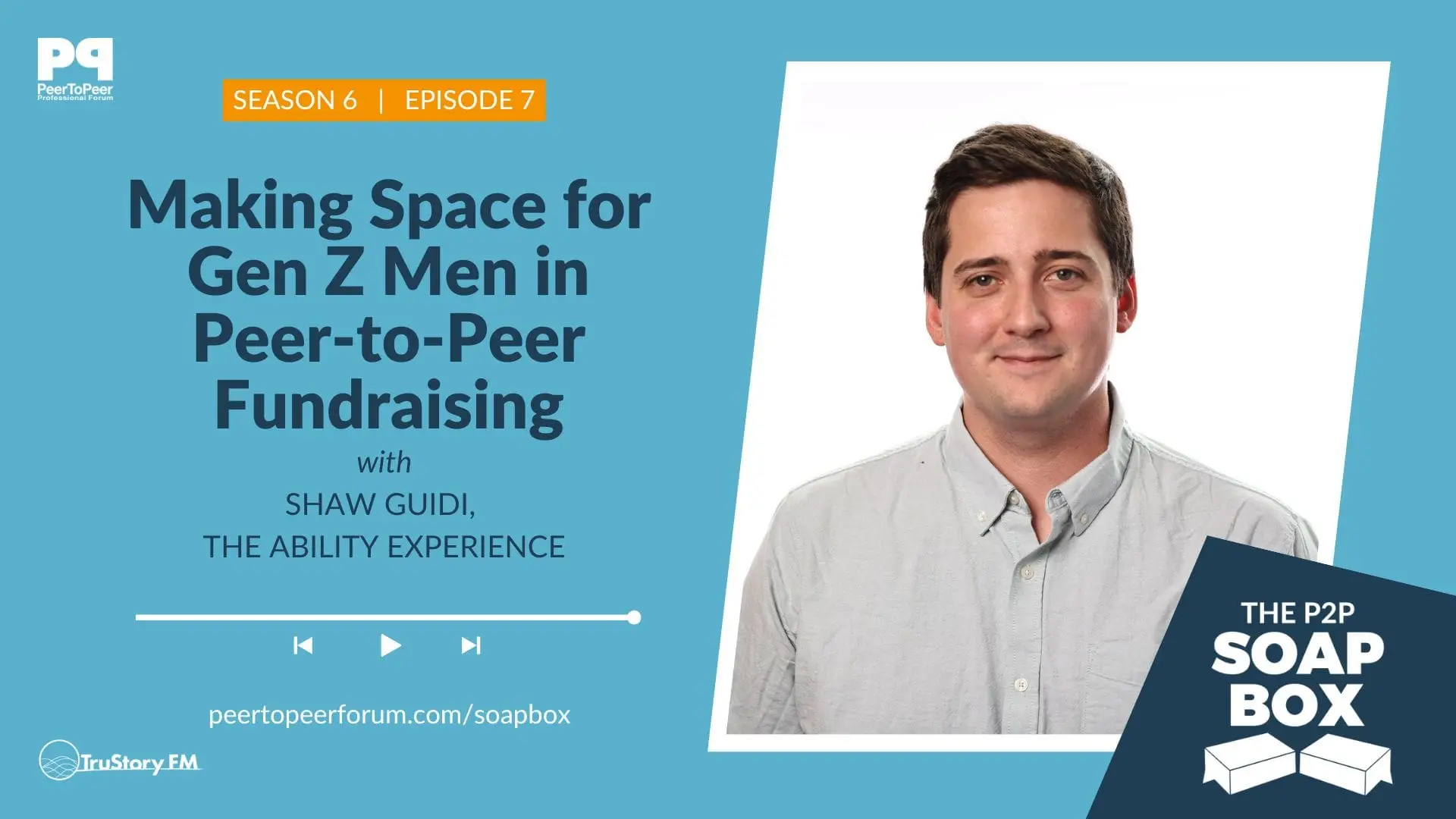
Hello, hello. Welcome back to the P2P Soapbox. I’m your host and P2P BFF, Marcie Maxwell. One question I hear again and again from our community is: how do we actually engage Gen Z in fundraising, and not just get them to show up, but inspire them to care, to connect, and to lead? And maybe even more specifically, how do we create space for Gen Z men in peer-to-peer fundraising?
Here’s the thing. This generation is deeply connected online, but at the same time, they’re craving something real. They want purpose. They want challenge. They want to feel like they belong to something bigger than themselves. And when we get that right, the impact can be incredible.
Today I’m joined by Shaw Guidi, Director of Chapter Engagement for The Ability Experience, the national philanthropy of Pi Kappa Phi fraternity, dedicated to serving people with disabilities through shared experiences, fundraising, and leadership development. Shaw works closely with college-age men across the country, supporting them as fundraisers, leaders, and community builders. And what he’s seeing is really powerful. From competition-driven campaigns to cross-country cycling events, Shaw has a front seat to what motivates Gen Z men and what helps them stay connected to a cause over time.
In this conversation, we talk about how challenge and mission serve as key entry points, how to guide fundraisers without limiting their creativity, and why showing up in person still matters more than ever. We’re also going to dig into how social platforms like TikTok and live streaming are evolving into real fundraising tools, not just marketing channels.
If you’ve been wondering how to better connect with the next generation of fundraisers, this episode is going to meet you right where you are. So let’s jump right into my conversation with Shaw Guidi from The Ability Experience. Shaw, welcome to the P2P Soapbox.
Shaw Guidi:
Thank you so much. I’m excited to be here.
Marcie Maxwell:
Absolutely. I’d love to hear a little bit about your personal and professional journey that led you to your role at The Ability Experience.
Shaw Guidi:
Yeah, what led me here actually starts two months before I was born. My family started a camp for people with disabilities after sadly my uncle passed away at the age of 12 due to complications with his disability. Growing up, I spent a lot of time at my family’s camp, where we built floating docks, and my dad always said it the best. It was just an opportunity for people with different abilities to get an opportunity they don’t normally have. Whether it was flying a kite or riding a boat, it was just our little slice of paradise that we loved to share.
So growing up, like I said, I would go out there and volunteer. When I went to college, my brother, being the very stubborn man that he is, told me about Pi Kappa Phi, because he had joined Pi Kapp because of The Ability Experience, and told me that I was going to join. After an argument, I ended up joining, because I fell in love with it after I heard more about The Ability Experience.
After being in the chapter for four years and then going and doing two of our now three summer events, going across the country as the project manager for the North Route team, it was amazing. So when I had an opportunity to come on staff and work with everybody, I didn’t hesitate and I jumped on.
Marcie Maxwell:
That is a great story, and I love hearing how people get into the world of peer-to-peer. Yours might be the first one I’ve ever heard where it started before you were born. So that’s too funny.
We have a lot of listeners who may not be as familiar with The Ability Experience and what the organization is. Can you tell us a quick overview of who you are and what your peer-to-peer portfolio actually looks like?
Shaw Guidi:
Yeah, The Ability Experience was founded back in 1988, when our fraternity CEO at the time came to the realization that we needed a philanthropy to be paired with. He worked with a close friend, and at the time they called it PUSH. From there, it just kind of turned into a wildfire.
Right now, we work with every single chapter of Pi Kappa Phi. It is the only people that we work with — college-age men — getting them to fundraise and do some of our events, which when you explain what the events are, they sound crazy. But we take them super seriously, and there’s a ton of safety procedures involved when it comes to cycling across the country. We currently have about 168 chapters, ranging anywhere from 13 men to over 200 men in a chapter.
Marcie Maxwell:
Tell us a little bit about the events that you have. The cross-country cycling, what does that look like?
Shaw Guidi:
The cross-country cycling trip takes anywhere from 63 to 67 days long, where guys get on an actual bicycle, not a motorcycle or anything, and they pedal from one side of the country — starting in either San Francisco or Seattle, Washington, and ending in Washington, DC.
We do have support roles too, of course. We take, like I said, safety extremely seriously. We have our fantastic crew which sets up every ten-ish miles so that guys can get snacks and water, and if they get a flat tire, we have a method so that they’re never not in between our cars. We’re able to roll up, help them fix things.
Along the way, we stop at local organizations that help people with disabilities, and we have friendship visits. It’s our cyclists’ opportunity to get to know these people across the country, experience different things. Some of my favorite memories from when I did this — my team, after I presented a grant check, I looked up and I was surrounded by seven guys with water guns and water balloons. And honestly, my only thought was, “Please let the sponsor walk away first,” which they did, thankfully, and then I got soaked.
Marcie Maxwell:
Oh my gosh, that’s so great. What about people who are not able to go all the way across the country?
Shaw Guidi:
We have, as I mentioned, the crew positions. It allows brothers who might not have the ability to cycle to still participate as part of the team by driving one of the support vehicles. How I like to describe it is, it’s really your opportunity to be there and be the biggest hype man in the world.
One of my favorite things to do when I had my crew stops is I would open my doors and play some music for the guys as they rolled up. Because something small like that — because they climb actual mountains — can really turn your day around and get you hyped up. It’s like, “We have another 70 miles to go, I’m ready to tackle it.”
Marcie Maxwell:
That’s so great. Shaw, The Ability Experience is working, I would say, with two highly coveted target audiences. People are always looking how to get the beloved Gen Z involved with nonprofit, but also men involved. So you’re working with Gen Z college-age men. What have you learned about what actually motivates them?
Shaw Guidi:
I feel like the best way to describe it is, with these men, it is competition, competition, competition. It has just been ingrained in them as they’ve grown up. So it’s something we lean into a little bit with them — having a friendly competition.
Currently, we’re doing a fundraising campaign that we call March Mayhem, where we pit the top 64 fundraising chapters head-to-head on who can fundraise the most per man. It allows our smaller chapters to participate, and our bigger chapters who have more of a network able to fight back. We have a good mix still in the competition currently. I have our Ole Miss chapter right now going against a chapter of 13 brothers at Wingate, and it is intense between the two of them, trying to figure out who’s going to win.
I see a massive donation come in from Ole Miss, but then I have to divide it by their nearly 200 men, versus a smaller donation for Wingate is exponentially more because of their smaller chapter size. So it allows them to really go head-to-head. On our Instagram, there’s playful banter going between the chapters where they’re like, “We’re going to beat you,” that sort of thing.
Marcie Maxwell:
When it comes to competition and fundraising, this might be someone’s first time doing peer-to-peer fundraising. How do you onboard them as a fundraiser? What guidance do you give them, without taking away that creativity?
Shaw Guidi:
We have what I like to call kind of our multi-step process. Every single year in January, we have in-person training with all of our students who are taking the executive role position. This year I was in Pittsburgh, but we also have Birmingham and Dallas. We have three chances to get in front of these guys and walk them through the nuts and bolts of, “Okay, cool, this is how we typically see chapters do it, but there’s this whole wide area that you can expand upon.” We give them the basics so they can run with it.
I love my students, and when they come to me and say, “I have an idea,” there are two sides of that coin. I’m very excited to hear it, but I’m also very nervous to hear it. Because as I’ve told some people before, I had a student say, “For $250, I want to be tased.” And I’m like, “Let’s talk about how we don’t do that.”
Usually how I try to frame it to them is, “I can’t say yes to how you have it built currently, but let’s talk about how we can get it to a spot that we both like, that’s both safe and smart when it comes to fundraising.” Because guys, I’ve heard it countless times too, will want to get tattoos. We don’t typically suggest or allow guys to get tattoos, because we’re part of a fraternity, and frat tats don’t always have a positive meaning behind them.
Marcie Maxwell:
You’ve got a whole set of challenges that maybe not everybody else deals with when it comes to fundraising with this target demographic. But I also think your approach of “how do we both get to a good spot” is really what matters. Because you never want to stifle someone’s excitement, but you want to point them in a direction that’s going to actually be successful. Otherwise, sometimes we’ve all seen those kind of wild and crazy fundraising ideas, and they seem fun, but they don’t actually result in any dollars. Then people are just frustrated, they’re disappointed in how it works. So I like your approach to that conversation, because you want them to be safe, yes, but just want them to be as successful as possible for their own excitement.
I can imagine — you kind of mentioned this — people come to this big cycling event with a lot of different reasons. They might be up for the challenge, they might be up for the mission. What tends to draw people to participate initially? And then how do you build that deep, long connection to the cause?
Shaw Guidi:
I would say what typically gets our first group of guys in are guys who have a massive connection to people with disabilities and want to support. That’s what I would say our first wave is.
Then afterwards, as guys go through new member education and they hear about, “Oh, this is a cycling trip 4,000 miles,” or “This is a cycling trip across Florida or New York,” that’s something I’m interested in. Because like I said, they climb actual mountains. Then when you get to the Midwest — I’m from the Midwest, and I know the people listening who are from the Midwest — you can practically stand on a bucket and see the back of your head with how flat it is. It gives them an opportunity to test themselves in multiple different environments and push themselves.
How we connect with those gentlemen who want that challenge is, as I mentioned earlier, those friendship visits. I’ve seen this firsthand. There was a gentleman on my team, I won’t say his name, who very clearly from the beginning said that he was doing this event because he wanted to go across the country on a bike. By the time we made it to Nebraska, this man was the biggest dance party monster on the dance floor. I know he’s still in contact with the people that we saw going across the country today. A couple months after, he reached out to me. He’s like, “Hey, I’m having trouble getting in contact with these people. Do you still have their contact information?” And I was like, “Absolutely, bud,” and I sent the information over to him.
It is just the natural progression for them being able to get the hands-on experience, the in-person experience, rather than just going out and doing a fundraiser at a restaurant. It is the actual chance to see the impact in person that changes their minds.
Marcie Maxwell:
I can imagine — are they staying involved once they graduate, as an alumni?
Shaw Guidi:
We have special ways to stay in contact with them. We call them Pi Alphas. They’re the top 1% of our organization, and we have a newsletter that we send out to them, and then we have special reports. We can have specialized communication just to them.
For example, when we have teams cross the country, we can keep them up to date with what’s going on, and they can know — for example, when gas prices shot up out of nowhere, I believe it was in 2021, they were facing it. We made a special appeal. We asked them — there was no way we could have predicted it leading up to the event, and we didn’t budget for gas. Money started flying in to support, because they remember their experience and they want to make sure that the guys after have that same experience.
A lot of times going across, we meet Pi Alphas on the route who now live in that area, and they will sponsor the team with a meal. We’ll sit down, and honestly, what they want is just to sit down and hear our stories and share their stories.
Marcie Maxwell:
Yeah, I love it. I think it’s so easy to focus on this year’s crop of fundraisers or this year’s crop of supporters, that sometimes you do forget that connection to people who’ve participated in the past, and their memory and their stories, and how it just grows the community even more. So I love that.
Now, I can imagine that social media plays a huge role in how your men are fundraising. What are you seeing that’s working really well right now? Do you think organizations need to rethink these social platforms as communication tools, as fundraising tools? What are you experiencing?
Shaw Guidi:
Yeah, I think there’s two major factors I want to touch on with this. I actually just got off a call with our Mizzou chapter, and he was telling me, “I want everything to be able to be accessed online, so we’re not just working with our local area.” And I’m like, “Tell me how you want to do that.” He’s like, “Absolutely.” And he started to talk a little bit about wanting to use TikTok.
We are very lucky to have our partner, New Clavis, who has TikTok capabilities. I was able to show him that he can use TikTok when guys get on their bike for their bike-a-thon — they can record that they’re on the stationary bike and post it, and we’ll have a link that will take them directly to their fundraising page. So it’s an extra touch point.
Then the live-streaming aspect that we’ve been coaching them on — getting it live-streamed and making sure they know not to play copyright music, because it will be taken down immediately. Aspects like that.
Then on a national level that we do, which I think is really cool, is we now have a leaderboard that we post once every two weeks. You can see who’s in first, second, third. We do the top 10 every month, and then around the 15th we do the top 20. So you can see, “Okay, cool, who’s moving up that we might not be expecting?” That chapter that did a call-a-thon on Monday went from not being in the top 20 — they just took first place, because they fundraised $27,000 on top of the $4,000 that they already had raised. And donations are still coming in.
Literally right before we started recording, I sent a photo to the student so he could see that they took first place, and they’re going to be on this month’s social media post saying they’re in first. That’s a really cool thing. When I saw the first post go up, the comments all over the place were guys being like, “Nick, dude, we need to get another fundraiser. We’re in second, we’ve got to take first.” Or, “So-and-so doesn’t know it yet, but we’re actually in first,” stuff like that. So it’s able to lean into, like I talked about earlier, the competitive nature that we see in our men, allowing them to be competitive in a healthy way.
Marcie Maxwell:
Oh, that’s great. So I know so much fundraising is happening online, but when you and I talked ahead of time, we talked about the importance of the in-person connection. Why do you think that still matters for this younger generation?
Shaw Guidi:
Being Gen Z myself, I think back to when I was growing up, and what could I not do online? Everything, especially as I get older. I can order food online. I don’t even have to go through a drive-through anymore. I could just stay inside and be a hermit all day.
A lot of guys, especially now with the loneliness pandemic that we’re talking about — I feel like this is the opportunity where a lot of guys, when they see somebody from an organization that they believe in take the time to go see them, even if it’s just for 45 minutes. And I say that as I’ve flown out to a chapter to spend one hour with them and stay in a place for less than 16 hours, and then fly three hours back right after, just so they could see us.
It built such a connection that I had, at the time, 17 guys say that they were willing to do one of these cross-country or Florida or New York events, because they appreciated it and I was able to explain it to them in person.
I feel like the in-person aspect — just being able to build that connection and see each other, rather than just hearing that it’s Shaw from The Ability Experience — it is “Shaw’s right here, and I can go up and I can talk to him.” It is not an email or a text message. It is, “He cares enough, he came to see us.”
Marcie Maxwell:
Yeah, I think that is such a great lesson and such a unique distinction. We feel like everything happens online, which makes what happens in person even more special and even more meaningful. I think as all these new technologies are making so many things easier, it’s not replacing that in-person experience.
You think about AI and all the AI-generated content versus human-generated content — we know what performs better. It doesn’t mean that the technology is not important and the social is not important, but if we just rely on that as a crutch and we just ignore the in-person human element, we’re missing a huge part of what can make peer-to-peer successful.
Shaw Guidi:
And I remember us talking about it in the prep call for this — you miss out on the super fans.
Marcie Maxwell:
Oh yeah.
Shaw Guidi:
I don’t know about you — being a super fan is my absolute favorite part about working for a company that helps people. I hoot and holler, I get excited. I haven’t gotten to the point yet where I cover myself in ABEX gear, at least not since I’ve been on staff. But it’s allowing them the opportunity to show how much they believe in it.
Our college-age men — we absolutely have them host these events in person, working with sororities with our War of the Roses. That is one of our biggest fundraisers, working with them in person, having all different kinds of fundraisers, but under the same umbrella of War of the Roses.
Marcie Maxwell:
I love it. I think the idea of being a super fan — it’s about the participants being a super fan for your mission, and it’s also about us as staff being super fans for them.
I can think of some of the most fun memories I’ve had at large peer-to-peer events is at the finish line of a marathon. You’ve got your cowbell, and you’re probably sunburnt, and just dancing it up as you’re welcoming the final finishers, and how meaningful that is. I think that’s getting lost some places. I think that is what is still resonating — not just with Gen Z, but with everybody — because it’s making them feel like the heroes in the situation, and that you’re there to support them as they are supporting the cause that they love.
Shaw Guidi:
And I am happy to say, at least with our Gen Z men, those super fans do still exist. They look a little different now.
How I love to describe it — and my girlfriend hates it — is I get calls 24/7 from students when they get excited about something big that’s happened, and they’re celebrating, hooting and hollering. The first time I can think about it is when a chapter of 10 guys fundraised $3,000 in a day. I was sitting at my girlfriend’s little sister’s musical when my phone started ringing. Of course, I didn’t pick up then.
But the amount of after-hours calls at 9, 10, 11 p.m. that I’ve gotten and picked up because they’re so excited — but they just work on a different schedule than what we typically see. The fact that they see that we’re picking up — I’m like, “Dude, tell me how that makes you feel.” And then they can just explode. I was at Walmart pushing a cart one time when that happened, and my girlfriend was so mad because I almost bumped into like seven different people. But I was like, “I’m not willing to get off the phone, because this student put so much work into this, and he just fundraised $7,000.”
Marcie Maxwell:
No, and I love that, because I also think that’s a sign of a great relationship that you’ve built. Who do you want to call when you’re excited about something? It’s somebody you’re close to, and you want to celebrate it with them. I think that’s just a testament to you, and how they feel comfortable with you and close to you, and want to impress you and be excited, and know you’re going to celebrate with them. So kudos to you for that.
I imagine there’s a lot of organizations, they’re always saying, “How do we get this next generation of fundraisers?” What’s it going to take? What’s one piece of advice or one shift that you think they need to make right now to start really engaging this next group of fundraisers?
Shaw Guidi:
This might seem a little bit like a cop-out answer — I want to preface it with that. But truly, what we’ve seen with a lot of our men and other organizations working to get them to fundraise, is we find that Gen Z mostly donates not to organizations that they necessarily believe in, but the one that’s directly in front of them.
So it’s just the ability of being able to put yourself out there, get them educated on what it is, and get them excited at the idea of working with you. And just giving them options. Like I said earlier, with the whole, “Let’s figure out a way to make it work.” The amount of guys that don’t want to do what everyone else is doing is alarmingly high. And I say alarmingly high because it makes me nervous sometimes when they’re like, “But everybody does that.” It’s like, “Well, it’s because it works.” So finding a balance of the two with them. But yeah, getting out in front of them is honestly the best thing that you can do. Make yourself seen.
Marcie Maxwell:
No, and that makes a lot of sense. I don’t think it’s a cop-out answer. We’ve always known in the world of peer-to-peer, there are going to be people who are going to come to your event because of the mission, and there are going to be people that come to it because it’s at a cool venue or it’s a cool activity, or because their friends are doing it. And that is okay. There is a place for everyone.
You want to turn those people into mission supporters, but how they enter does not necessarily matter — it’s getting them there. I know it does seem simple of just “be in front of them,” but it’s really true.
This has been great. I love your energy. This is really fun to talk about. If there are people that are listening that are thinking, “I’d love to know more or hear more about the great work y’all do at The Ability Experience,” where can we send people? We’ll drop some links in our show notes.
Shaw Guidi:
We have a couple different places you can find us. Of course, we have our Instagram, @AbilityExp. But I think by far, probably one of the coolest things that we offer is our website — The Ability Experience website — because we put a lot of work into it to make sure it’s actually ADA compliant, so that it’s accessible by all people, so you can find whatever you’re looking for.
There’s a ton of awesome resources you can find. You can learn about our Journey of Hope team, our Gear Up Florida team, Gear Up New York team. You can hear about some of the guys’ experiences doing the events. It is truly awesome.
And to throw it out there again, with the Instagram, we do live streams every morning when our guys are on the road, so you can hear what they’re doing that day. Both the friends, family, and loved ones can see it, but also our diehard supporters can tune in and watch.
Marcie Maxwell:
That’s awesome. Well, Shaw, thank you so much for joining us on the P2P Soapbox and for sharing all your great insights.
Shaw Guidi:
Perfect. Thank you so much for having me. This has been a ton of fun.
Marcie Maxwell:
Absolutely. See you next episode.
Announcer:
The P2P Soapbox is produced in partnership with TruStory FM. Engineering by Pete Wright. Music this week is by Super Neto. If your podcast app allows ratings and reviews, we hope you’ll consider doing just that for our show. But the best thing you can do to support the P2P Soapbox is simply to share the show with a friend or colleague. Thank you for listening.