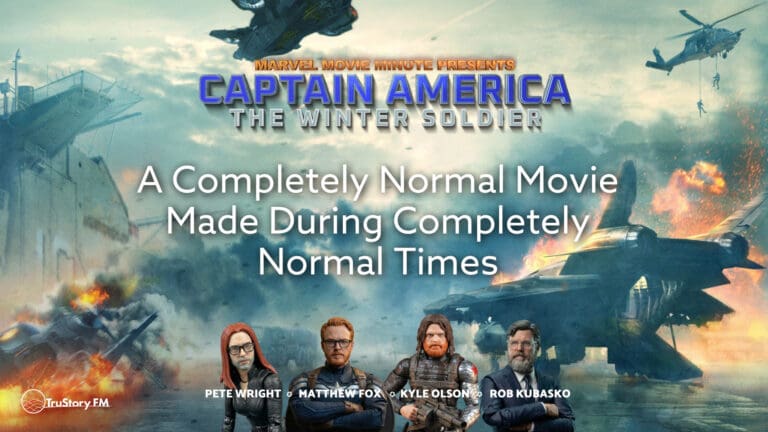
Pete Wright
Welcome back to the Marvel Movie Minute, a weekly podcast in which we assemble to explore the films of the Marvel Cinematic Universe five minutes at a time. In this, our ninth season, we’re looking at Captain America: The Winter Soldier. I’m Pete Wright.
Matthew Fox
And I’m Matthew Fox.
Kyle Olson
I am Kyle Olson.
Rob Kubasko
And hello, I’m Rob Kubasko.
Pete Wright
As we dust the cobwebs off the podcast, today we are going all in on The Winter Soldier. We need to get you caught up on where the MCU is, and then open up the hood to see what this movie borrowed from the comics — especially the Brubaker stuff — and what Marvel invented. Because the phrase “national security” sounds so much cooler when it’s attached to a flying aircraft carrier full of murder algorithms. Together we’re going to connect the dots between spy thriller paranoia, Hydra’s extremely aggressive workplace infiltration strategy, and the central question of this film: what if the real villain is bureaucracy? So welcome to the briefing, and to whatever this is that we’ve chosen for our lives. Let’s start with the comic origins. Where does the stuff we see on screen come from as we careen into Marvel’s spy thriller era? Who amongst us is the most equipped to talk about that?
Kyle Olson
I believe that would be me.
Pete Wright
Yes, it’s you. We’re waiting for that.
Kyle Olson
Okay. My current title is Resident Marvel Zombie. I was reading these live when they came in. So in the comic lore, there was something basically called the Bucky Rule — that said in comics there are three characters you are not allowed to resurrect: Bucky Barnes, Jason Todd, and dear departed Uncle Ben. They were sacrosanct. Those deaths were the pivot points — the things that are unchangeable. But Ed Brubaker had a different idea. He had always been a huge fan of Bucky. As a kid reading the comics, he loved seeing this guy right next to Cap running around doing all this stuff. Unfortunately, Stan Lee was not a big fan of Bucky. He thought the idea of having a teen sidekick in World War II was silly, so he retconned him out of existence. As the years went by, other people who also liked Bucky slowly started pulling him back in — he was there, but not as much — and then finally it became, yes, that was a thing that happened. So when Ed Brubaker got to write the book, he wanted to bring back Bucky, and had to pitch to all the Marvel people this idea of breaking one of their sacred rules. Apparently it was a hard sell, but he eventually pitched the whole thing out as: what if he’d been here the whole time? What if he’d been underground and we never knew about it? And then he tied it in with the Red Skull and the Cosmic Cube and all these other machinations. But it was really his longstanding love of Bucky Barnes that made this happen.
Pete Wright
I just want to say for the record — the original Bucky Barnes teen sidekick to Cap was legitimately ridiculous.
Kyle Olson
At the time though, it wasn’t, because everyone had a teen sidekick. I mean, we talk about Robin, but the original Human Torch — not the one from Fantastic Four — flew around with a teen who also set himself on fire named Toro. Every hero at that time had a teen sidekick. So it wasn’t weird. But then as comics got more serious, it became: hey, wait, why are we putting teens in war?
Matthew Fox
Right. So it finally got weird for everybody.
Kyle Olson
Yes, it finally got weird.
Matthew Fox
How did they explain why the army would allow Cap to have this teenager? There are generally rules about that.
Kyle Olson
So the way Ed Brubaker massaged the timeline was that what we saw in the promotion — the kid in tights standing next to Cap, like “gee whiz, let’s punch Hitler in the kisser” — that was PR. The actual real Bucky Barnes was 16 when he joined up, so still young, but he was also trained as a special operative. He was essentially the guy they would send in under the wire to handle the things that Cap wouldn’t do, or couldn’t be seen doing, because he was Captain America.
Matthew Fox
I was going even further back — in those original stories where Cap has this teen sidekick, how did they justify a 14-year-old being in the army?
Kyle Olson
Honestly, because war. It was World War II — everybody has to do their part, including kids.
Matthew Fox
Okay.
Pete Wright
And remember, at that point in the lore, Steve Rogers had been trying to sign up and keep getting rejected. Everybody wanted to do their part, everybody wanted to seem older than they were. And to my mind, that’s the easiest way to justify Bucky putting on boots.
Matthew Fox
Fair enough.
Kyle Olson
Yeah, and of course when they bring him into Captain America: The First Avenger, they age him up so that he’s the older brother — the one who’s already enlisted first. Which was not the case in the comics.
Pete Wright
That brings us to the actual arc of the Winter Soldier in the Brubaker books. We’ve retconned the fact that Bucky is dead — he comes back. How much of what we see on screen actually comes from that canon?
Kyle Olson
Not much. The reason Bucky has the metal arm in the comics is that he was holding on to a bomb that Baron Zemo was launching — a buzz bomb, I think they called it — and his arm got caught when it went off. He diffused it, but it still exploded, and that’s how he lost the arm. In the movies they just go, well, he fell. It’s that weird movie thing of: we want it to look like the comic, but we’re not going to use the same reason why. The age range is different, and the Russians are involved — it’s always been Russian. The Red Skull was a lot more heavily involved. The Cosmic Cube was heavily involved — which we know as the Tesseract, but in Marvel comics it’s actually a completely separate artifact. It’s basically a wishing stone; it can do pretty much whatever you want it to do. In the comics, Cap ends up using it to restore Bucky’s memories. So it’s not “to the end of the line” or punching him in the face — he literally uses the Cube to fix his memories. There’s a lot more psychic manipulation, timeline jumping, and body-swapping going on. Because comics.
Pete Wright
Do we still have Steve’s grief angle at the loss of Bucky?
Kyle Olson
Yeah, yeah.
Pete Wright
That’s one of the things that makes me think about this movie fondly in terms of its adaptation. I think of it as a vibes adaptation — knowing that literally the stuff we’re seeing on screen was not pulled from a panel. Sometimes the nerd in me is just exuberant for the panels recreated in the films. But I still love that I’m getting those emotional beats, that those emotional moments are resonant in the film even as adapted from the comic.
Kyle Olson
Yeah, this is one of the downsides of doing a movie and having to use so much shorthand. We’ve only seen Bucky for maybe ten or fifteen minutes on screen. And I thought Joe Johnston did a great job in The First Avenger of establishing the relationship and then Cap throwing everything away to go rescue his friend. But that doesn’t capture 20 years of adventures that comic readers had been following. Suddenly having Bucky come back as a villain was a huge deal in the comics. In the movie it’s more like, “oh yeah, I kind of remember that guy.” It doesn’t quite have the same impact. Compare that to if they did a heel turn now on someone we’ve known for ten years — like if Happy Hogan suddenly became a supervillain. That would land completely differently, because we’ve built a relationship with him over all this time.
Matthew Fox
That was very much my perspective as someone who didn’t know the comics at all. I saw the first movie, didn’t connect to Barnes in any particular way, saw him briefly in The Avengers, and then a couple years later when I heard there was a new Captain America movie coming out, I had no real memory of him. I’m curious — for those who did know the comics, when you saw The First Avenger and saw Barnes go down on that train, did part of you think, “oh, so we’re gonna get Winter Soldier at some point”?
Kyle Olson
Yeah, pretty much. My daughter makes this joke all the time when she watches things — she goes, “Man, my favorite characters are the Waynes. I hope nothing bad happens to them.” It’s the same thing. As soon as we’re introduced to Bucky it’s like, tick, tick, tick. Your time’s running out, buddy.
Matthew Fox
Yeah.
Pete Wright
It’s such an interesting observation though, because at that point there hadn’t been so much Marvel stuff introduced with threads dropped. To me it could very easily have just been an isolated Easter egg. And I wasn’t, I don’t think, paying close attention to actors’ contracts at that point. Sebastian Stan signing a nine-picture deal was not on my radar.
Matthew Fox
It’s funny, because it’s not that long ago — this movie is eleven or twelve years old — and yet I feel like the media ecosystem around these movies has changed entirely. Today, the lead-up to a movie like this would have some podcaster doing an “everything you need to remember from the first movie” primer. I’m sure some of that existed then for people deeply into the MCU, but it just wasn’t as ubiquitous. I saw it with a group of friends and most of us were like, “Oh, Bucky. I guess I remember him. Well, he’s a fun character now, so let’s go.”
Pete Wright
What about the extended characters besides Bucky? Obviously Cap we know. What about our dear friend and future Cap, Sam Wilson? What did we know about Sam Wilson from the books?
Kyle Olson
Falcon had been around for a long time — I think he came around in the 70s or so. He was a sidekick for a while, almost like a replacement Bucky. He sort of bounced around, had a period of popularity, and then became more of a background character. He was peripherally involved with different incarnations of the Avengers but never really had that pop. Honestly, I think a lot of his resurgence came down to this movie. I never really connected with the character before. He had a psychic link with a bird — I didn’t really understand what that was about.
Pete Wright
That’s the thing I remember most from the comics.
Kyle Olson
Right. But when they bring him into this film, as we’ll talk about over the course of the season, I think it redefined the character. He’s had a huge resurgence since, and eventually ended up in a very familiar suit.
Pete Wright
Sharon Carter.
Kyle Olson
She’s been around for a long, long time, and the relationship wasn’t as complicated in the comics as it gets on screen with the whole “still loving Peggy” thing. She was a long-term love interest of Cap’s, and it was fine. Nothing creepy about it. She’s had her own run — probably a miniseries at least — but once again, if you’re around Cap, something weird is going to happen to you. She’s been tossed through time, aged, de-aged, the whole deal.
Pete Wright
What’s so interesting about their relationship in this film is that we lose that romantic angle. She just becomes more of a values check on Cap, which I think is interesting, because he’s still holding onto Peggy.
Kyle Olson
Right. And she’s very much a peer in the comics — sort of Nick Fury’s right hand for a lot of it. She was doing the kind of things that Black Widow does in this film: running ops, gathering intel, working behind the scenes. So when they de-aged her and built in the Peggy connection, it made her feel more like the rookie, whereas in the comics Cap sees her as a peer.
Matthew Fox
I do think they’re setting up a romantic tension in this one already. Natasha is asking Cap about who he might want to date, him and the nurse are flirting a little. I agree it isn’t paid off until Civil War, but it’s definitely being established here.
Pete Wright
Yeah, there are hints because they need to plant seeds, but it never quite matures the way it did in the books.
Kyle Olson
I think it comes down to chemistry. There are a couple of relationships in this film that basically rewrote the continuity just because they were so strong. The connection between Cap and Peggy Carter was so powerful it redefined everything. And similarly I would say Cap and Sam Wilson — they’re electric together. Cap has had a lot of partners in the comics over the years, but when you put those two together it became clear: he’s the guy.
Pete Wright
He was the guy. For my money, he was the guy in the first scene of this movie. That charisma was so palpable.
Kyle Olson
Yeah.
Matthew Fox
Well, one thing that really strikes me in the movie — and I want to know if this is from the comics or invented for the film — is how Sam not only sparks that chemistry, but connects with Cap on a vulnerability we’ve never really seen before. Cap as just one more soldier struggling to come back from the war. Him and Sam bonding over that — we so often think of Cap as the superhero, the symbol, but here he’s the everyman. Just like any other soldier coming back from war, having trouble sleeping in a bed that feels like a marshmallow. Is that something strong in the comics, or was it really created for this?
Kyle Olson
It was much more created for this. In the comics, Sam was much more of a challenge to Cap — like, “you’re up there flying around on Quinjets, but I’m down here with the people trying to help them.” He was more of an antagonist in that way. The soldier-to-soldier bond is something they built specifically for this film to make that connection between them.
Pete Wright
And that’s one of the reasons I’ve been so excited to talk about this movie, because it is such a departure in tone from everything else. It introduces us through Marvel to one of my favorite genres: the spy thriller, the espionage film. So how much of Brubaker is buried in the DNA of this espionage thriller? How much of the super-weapon helicarriers with predictive targeting comes from the source material?
Kyle Olson
Of that specific stuff? None. But the tone — the spy thriller DNA — absolutely, one hundred percent. That’s where Brubaker lives. He does a lot of crime comics, a lot of dirty people doing dirty things. All that conspiracy and paranoia — who do you trust, who can you believe, who’s on your side, who’s betrayed you — that is definitely throughout his entire Captain America run, and even into his Daredevil work. That boots-on-the-ground feeling. Even when you have Cosmic Cubes and Red Skull jumping bodies, there’s still this real down-and-dirty element to it. That’s one of the best things about the spy thriller part — Cap on the run, having to hide out, before we get to the big action setpieces. Because the movie has lived in that reality long enough that we’re okay with the spectacle when it comes.
Matthew Fox
And similarly, one of the things that really gets introduced from the very first minutes of this film is the tension between Cap and Fury specifically. We saw some of that in The Avengers, but especially the idea that Fury’s vision for what S.H.I.E.L.D. should do is getting to some dark places. How much was that part of the Brubaker run?
Kyle Olson
Not as much, because the villain scheming was much more… schemier. It was a lot more the Russians, Red Skull, Crossbones, all of them pulling the strings. Nick Fury was hiding things and moving pieces around — as he often does — but he was less of the antagonist. It was more them on the back foot trying to stay ahead of whatever threat was coming. The idea that there’s something evil inside S.H.I.E.L.D. itself — that came more from the screenwriters pulling from different stories.
Pete Wright
Right. The idea that the institution itself is suspect is new for us in this era of the MCU. Even when you go back to The Incredible Hulk — the institution was suspect in the form of the military, but the military was never shy about what it was doing. This introduces us to a new era where S.H.I.E.L.D. can’t be trusted, where there’s a virus in the system. And that pays dividends many movies down the line. This is, for my money, an inflection point story.
Kyle Olson
I’m still amazed at how they found a way to bring in Arnim Zola and pull it off. He was one of those characters I thought, “They’re never going to be able to make this work.” And they absolutely did.
Pete Wright
Well, let’s talk about Zola, because there are three more characters I wanted to cover: Zola, Rumlow, and Alexander Pierce. Let’s start with Zola.
Kyle Olson
Zola is one of those silver age characters where things got psychedelic and weird. He started out as we saw him in The First Avenger — just a scientist. But eventually in the comics he becomes essentially a robot — his face lives in his stomach, displayed digitally, and then he’s got almost a disc on top of his body that shoots lasers. It’s wild.
Matthew Fox
Are you telling me he’s a Teletubby?
Kyle Olson
Except Teletubbies have heads. He doesn’t even have a head. He just has a plate. His head lives in his stomach.
Pete Wright
Outstanding.
Kyle Olson
He’s like the anthropophagi — those figures from mythology whose heads do lie beneath their shoulders. And he was the typical mad scientist, showing up to do the evil bidding of Hydra or Red Skull or whoever would give him the money. It’s amazing to me that they pulled off Zola in such a fantastic way in this film, and then dropped the ball completely with M.O.D.O.K. Both are wild characters — they found the way with one and fumbled the other.
Pete Wright
Yeah.
Kyle Olson
Rumlow is great. Crossbones is just the perennial soldier-for-hire. He’s the Punisher with no code. You give him money and tell him who you want shot — that’s it. He’s done work for so many supervillains because he just has no code, no creed. He even had a long-term relationship with the Red Skull’s daughter, a real Bonnie and Clyde situation for a while, and it does not go well for anyone.
Pete Wright
Was he ever a sympathetic character in the books?
Kyle Olson
Never.
Pete Wright
That ends up being an interesting part of the adaptation, because the film tries to make us like him — at least initially.
Kyle Olson
Yeah, exactly.
Pete Wright
And last — Alexander Pierce. This is a name that’s been part of the bureaucratic landscape in the books for years, but never quite relevant. I think it was the MCU that made him significant. Right?
Kyle Olson
Yeah, pretty much. I don’t remember him having a significant arc or being “the guy” in the comics. There are a lot of men in suits — that face of bureaucracy or government oversight — and from my experience he was just another one of those. I feel like Marvel has admitted they sometimes just go through a list of names and go, “yeah, he’ll do.” And then you drop a Redford into that role and see what happens.
Pete Wright
Okay. Anything else specific you want to nail on the comic origins? It sounds like we’re at a point where there’s not a single book to point to and say, “if you want to see this adaptation, read this.” Really it’s the Brubaker run if you want the vibes check.
Kyle Olson
Yeah. I mean, there are shots lifted straight from the comics — Winter Soldier catching the shield, for instance — but after that it kind of diverges when they bring in the helicarriers and all that. I was also really hoping they were going to do Nomad, which is the whole arc where Cap gives up the name and the shield and becomes Nomad. We see it kind of alluded to as we move past this into Infinity War and beyond, but they never fully go there. Also — that costume is ridiculous. Do yourself a favor and look it up.
Pete Wright
Wait — that’s not just the black suit?
Kyle Olson
No. It’s a deep V. A deep V with big gold discs. It’s so 70s. It’s so awful.
Rob Kubasko
Wait — is it Borat-level deep?
Kyle Olson
Oh yes. I’m talking sternum. It’s a deep V and a cape.
Pete Wright
Oh my God.
Kyle Olson
It’s wild. I kind of thought they were going to go that way — where Cap says, “I’m not Captain America anymore, now I’m this guy.” It kind of does happen, but they never fully commit to it. Obviously we know John Walker is coming, so there’ll be another Cap and then another Cap after that.
Matthew Fox
I’ve got one last comics question, and this is more about the results of this film. As Pete was saying, this is the inflection point for Cap that causes him to stop trusting anything but himself and the people he believes in — which is of course a huge part of his motivation in the movie version of Civil War. Is there a connection in the comics? Is that break in trust with S.H.I.E.L.D. consciously in his mind when we get to Civil War in the comics?
Kyle Olson
Yeah. I’m trying to remember the exact run, but basically around Watergate and Nixon there was a moment where Cap thought he was taking orders directly from the President. It turned out he wasn’t, and that broke his trust. He said, “I don’t work for the government — I work for the people.” There was a huge moment where he essentially told them: I’m proud of being Captain America and proud of being a soldier, but I don’t take orders I don’t believe in. There was even all this hype to build him up for a presidential run, and he said, no — that’s the line I won’t cross. They took a lot of that and put it into this film too. That “no, you move” moment — that was always baked into the character from way back then. I give Christopher Markus and Stephen McFeely enormous credit for taking the character we’ve come to know across multiple films and just putting him in these situations and having it feel like, yes, this is exactly what he would do. In contrast to, say, Ant-Man and the Wasp: Quantumania, where I’m not sure I recognized who was in that suit. But this — they put Cap in the crucible and he comes out stronger.
Pete Wright
Check the show notes, everybody, because I’m going to put links to the arcs, to the character pages, and especially to the Nomad suit. Dear God, that is a work of art. All of that will be linked in the show notes so you can check it out and get yourself ready. We are very excited, speaking for all of us, to start talking about this movie. In the spirit of the comics — let’s go around. Give me one thing you have been most excited to see adapted on screen.
Rob Kubasko
Can I just say — I have been sitting here quietly because I have not read any of the comics related to this. And my big takeaway from this conversation is that there are really no comics I need to read before watching this movie again.
Kyle Olson
Well, “need” — I mean, do you ever need to? But I would say—
Rob Kubasko
Very different experience, though. And when you think about where this movie sits in the MCU — which we’ll talk about probably in the next episode — this is the real departure. The third film of Phase Two, and now they’re essentially writing their own script.
Kyle Olson
Oh, yeah.
Rob Kubasko
And I find that interesting. That’s bold — bold for where the world was at the time this was being written, and bold for how confident Marvel was in what they were doing with these productions.
Pete Wright
That’s a really good point. And I appreciate that you haven’t read any of the comics going into this. I think that’s genuinely great.
Kyle Olson
Yeah, your perspective will be really valuable.
Rob Kubasko
That’s what my role is here.
Pete Wright
And I should say — my own background with the comics is that I read the Brubaker arc when we were preparing to cover The First Avenger on this show. I just devoured as much as I could at the time, so it’s been a while. But at least I have some familiarity with it. Matthew, what’s your history with the comics?
Matthew Fox
They’re the books with the pages and the pictures, I think?
Pete Wright
You got it.
Matthew Fox
I am here to represent the kid who didn’t do the reading the night before. But we can BS our way through it. That’s totally fine too.
Rob Kubasko
Or I will just be the church mouse in the corner, happy to listen and then come in with the Borat joke.
Matthew Fox
We needed that Borat joke.
Pete Wright
We did. That was nailing it.
Matthew Fox
But no — my history with comic books and the way my brain reads visual art is well documented on past episodes. For me, it’s less about what I want to see from the comic books and more about the parts of the world I want to see fleshed out. I’m really excited to learn more about S.H.I.E.L.D., to learn more about Hydra, and to understand Steve’s place in all of it. I’m a bureaucracy weenie, I’m a government weenie, I’m an ethics weenie. This is one of the reasons why this film is easily in my top five MCU movies — because it’s not “good guy here, bad guy here, good guy go smash.” This is really asking: what is the bad guy? This is the first of its kind — not a superhero movie, but a super spy movie with superheroes. And at the time we’re recording this, we’re seeing the MCU get back into that in exciting ways. That’s the thing I’m most excited to talk about.
Pete Wright
I love that you said that, because I was also going to allude to Wonder Man — because as we record this, we’re getting a sense of how to use these powers within a human context for something larger, for storytelling. And this movie is a real branch on that tree. This is great. All four of us are here because we’ve been waiting since we started Marvel Movie Minute to get to this film. That’s how excited we are. No one could say no. Episodes will start showing up in the main feed very shortly. On behalf of Rob Kubasko, Kyle Olson, and Matthew Fox, I’m Pete Wright. We can’t wait to see you in the main feed starting very soon.
Kyle Olson
Make mine Marvel.
Matthew Fox
May the Force be with you.