Carol Cone
I’m Carol Cone, and welcome to Purpose 360, the podcast that unlocks the power of purpose to ignite business and social impact.
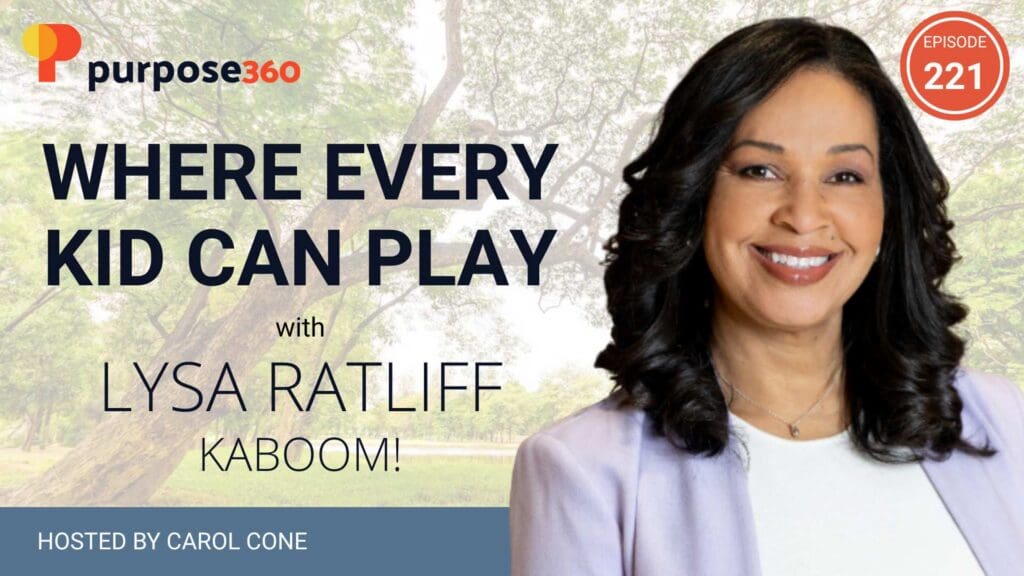
Today’s conversation is a very special one for me. I’m joined by Lysa Ratliff, CEO of KABOOM!, and this is an organization that’s very close to my heart. Years ago, I had the privilege of working with Kimberly-Clark when they were seeking a very special partner to celebrate their 125th anniversary. We learned of the emerging not-for-profit, KABOOM!, that helped communities design and build playgrounds to provide play equity for their children. Kimberly-Clark embraced this idea and built 38 playgrounds in just six months, including one at a national gathering of government leaders, including Vice President Al Gore and Colin Powell.
So this conversation comes full circle for me. In this episode, we dig into a bold idea: that play spaces are not a nice-to-have, but essential community infrastructure, and that playspace inequity has real consequences for childhood development, public health, equity, and long-term economic outcomes. Lysa shares how KABOOM! has evolved from building playgrounds one at a time—and let me tell you, it’s a lot of fun, and it gives you great satisfaction—to a leading strategic, data-driven approach to systems change, working with cities, school districts, and major corporate partners to scale impact. We talk about leadership when the work is hard, how collective action actually works in practice, and why investing in joy for children may be one of the smartest long-term strategies leaders can make.
If you care about purpose, partnerships, and how to turn bold ideas into lasting impact, this is a conversation that you’ll thoroughly enjoy. So let’s get started.
Lysa Ratliff
Oh, I am so happy to be here, Carol. I am a big fan, going way back, and it’s an honor. It is an absolute honor to be here with you and to be able to talk about my beloved work at KABOOM!
Carol Cone
Well, we love the work at KABOOM! So, congratulations. It’s your 30th anniversary this year, and I think you’ve probably got some things up your sleeve that we’re going to talk about in a bit. But let’s start with you. Tell us a little bit about yourself, and why you do the work that you do.
Lysa Ratliff
When I look back on my life, I look back to my childhood. That was really the first seed that was planted for me to show up here leading KABOOM!.
My first formed memory is that I was at the playground and wanted to be cool. All the kids knew how to jump off the swing—swing really high and then jump off. And I was like, “I’ll do it.” I was scared out of my body, but I did it. I landed on my stomach and I passed out. When I came to, the first thought was, “Oh my gosh, I’m never going to do that again.” I wanted to start crying. And the group of kids around me were like, “Yes! That was so cool!” I jumped up, got back on that swing, and I did it again. Anybody who knows me now knows I am willing to take risks. I’m really willing to jump when other people don’t. So I look back on my life to that first moment on the playground, recognizing that was the first of many moments along the way that allowed me to be in this space.
I love children. I believe that our life is finite, and that while we’re here, we need to leave a lasting legacy—leave something behind that’s better than we walked into. For me, that is wrapped up in investing in our kids. I’m here in the center of my purpose.
Carol Cone
So you were a risk-taker from a really early age. I always love to ask: what sort of influence did your parents have on you that contributed to this risk-taking, or your love of protecting childhood?
Lysa Ratliff
My parents were very young when they had me—15 and 16. They were kids raising a kid. My mom and her mother lived by a guiding principle: “Life isn’t forever. Love is.” That is on my mom’s headstone, that is on my grandmother’s headstone, and it is the thing she said throughout my life. That taught me about legacy, about loving, about seeing the best in people, and that when you engage with others, you show up with love and care. My mom taught me that, and it has influenced how I show up and how I lead.
My dad is the other side of that coin. My dad is resilient, tough—you can do hard things. The thing he taught me that sticks, and that I’m teaching my own children now, is: “There’s always a solution.” It doesn’t matter what the problem is. You’ve just got to look somewhere else, or think about it a different way, but there is always a way to solve a problem—and you have the unique abilities to be able to solve it. Those two lessons show up all the time. They’re the lessons I’m teaching my kids. They’re the way I lead the organization. They’re the way I live my life.
Carol Cone
It’s very interesting how our parents imprint on us. I would love to start this conversation out with KABOOM!’s origin story. Some of our listeners know you, some don’t, but if you could share it, that would be great.
Lysa Ratliff
Our origin story is a really powerful story. We were born in DC. We were born because a young brother and sister, Iesha and Clendon, wanted to play. Like kids will, they were looking for somewhere to play. They lived in a community that didn’t have any play spaces. The place they found to play was an abandoned car. It was August. It was hot. They got in that car and started playing, but they ended up losing their lives in the car. A reporter caught wind of the story and started investigating, and realized not only had the community been advocating and waving the flag that there was a problem—there was nowhere for kids—but in fact there was nowhere in this community to play. There had been no investments made in the infrastructure for kids.
We’re building communities and houses and places for people to live, and we’re not designing like kids live here. Our founder, Darell, caught wind of this story and recognized, “I can solve this. I can help. I can find a way to help. I can pull resources and friends and other like-minded people together, and we can figure out what’s needed in this community. We can roll up our sleeves and get to building.” That became the single spark to start a fire that has formed KABOOM! today.
The hard part is we’re still dealing with very similar issues where there’s inequitable investment in our kids’ childhood—infrastructure and resources—and our kids don’t have what they need for a thriving childhood. That founding story gave us the blueprint that has grown and evolved 30 years later—happy birthday to us—into the work that we do today.
Carol Cone
So let’s set the stage now. We have this incredible repertoire between the two of us. Why does access to play matter so deeply for children and communities?
Lysa Ratliff
Before I came to KABOOM!, I had been doing work in housing and education. I had been in Blackville, South Carolina, building a school library at an elementary school. Another August hot day—it was like 102 degrees. We were building this wonderful library for a school that really needed it. This little girl, Brianna—on my wall framed, I have a picture of that playground—she was so happy to see these 30 people from all over, with Save the Children, coming into the community doing something special. She took my hand and said, “Miss Lysa, can I show you our playground?”
I know she saw it as her opportunity to share what was important to her. She took me outside and said, “I love that you guys are building this library, but we really need a playground.” Before then, I knew childhood playgrounds were important because my memories of them are important. But I didn’t recognize, through a child’s eyes, how important those spaces are until Brianna showed me that playground. It was horrific. It was unusable. She said, “What I really want is to be able to play.”
For us, play space equity is about making sure we have an equal distribution of safe, accessible places for children to play. The issue of place-based inequity follows the same equity lines of other spaces of inequity across our country—around race and income and geography. Some people think play spaces are just “cute”—slides and swings. They think, “Aren’t those at schools?” No, they’re not. We have a real issue because we’re not prioritizing our kids. We’re not thinking about equal distribution of resources in spaces that matter to them. We’ve got schools that only have blacktops to play on. We have states that don’t even have recess policies where there’s mandatory recess. We have a real issue around making sure this critical community asset exists.
Carol Cone
As your mission is to end place-based inequity for good, can you talk about one or two pivot points where you got in front of legislators, or mayors, or municipal leaders, or corporations—you have great partners, by the way—and you helped shape this as an urgent issue? It’s not about a cute place with swings and colorful playgrounds and nice trees and gardens. This is urgent. What were some of those pivot points and key messages that you embedded in people to get them to recognize this is something bigger?
Lysa Ratliff
Our strongest conversation when we talk to municipal leaders, corporate leaders, and philanthropic investors is: there’s a big-picture issue we’re trying to solve. Essentially, the leaders that we are started when we were four and five years old. The investments—or lack of investments—that we’re making in our children will result in either strong abilities to lead in the future, or a deficit that we’re going to have to make up for that’s going to cause damage to our communities, our cities, our country. When we talk about play spaces, we talk in a couple of layers. One: this is a solvable issue. Our organization can now come in and, through what we call our Playspace Inequity Prioritization Index, we can tell you where the need is. We can provide a roadmap for where we need to solve this problem.
In solving the problem, we don’t just lean into making sure kids have a happy, healthy childhood. That links to critical outcomes like improved health, improved wellness, addressing mental health issues. It also shows better community and economic investment. And we’re building in a way that is not limited to driving outcomes, but is also bringing communities together at a time—
Carol Cone
At a time where we really need it. It’s like the city square, but a city square for the child, where the child can truly engage in their whole self, which I love. You’ve also taken play spaces down to zero to five, which I think is very astute. What caused that to happen?
Lysa Ratliff
Most people who look into this know that a child’s trajectory is set very early on. In fact, it starts with a healthy birth. It starts when a child is in the womb. For us, those habits and those things that develop a very early brain, very early habits, happen much younger than elementary school. They happen at two, three, four, and five years old. Kids learn through play. Think about all the things a child needs to learn at that age. They need to learn how to use their body to negotiate the world. They need to learn how to recognize letters, numbers, safety risks—just all the things that end up being usable in elementary school are actually happening at zero to five.
So for us, knowing the currency of kids is play, and how they learn, it became really important to extend where we build and the age group that we build for. Not just early childhood, but also youth. Youth often don’t have a place in their community. We build play spaces in elementary school, maybe middle school. There are some spaces for kids to go in their communities. But young people often don’t have a place, and it’s important for us to be thinking about them too. All these stages of childhood matter. We need to think clearly about how we design and respond to their needs—their developmental needs, their belonging needs—along the way.
Carol Cone
I would be remiss if I didn’t dial it back for a minute and talk about the process, because it’s quite unique. It’s co-creation. It’s not KABOOM! coming in with three models you can pick from. That’s not it at all. Share with our listeners how the process works.
Lysa Ratliff
I get asked this question all the time, and it’s sometimes difficult to answer because it’s always different. That’s why it works.
Our process: at a macro level, you think about our mission and making sure we have a path to achieve our mission—ending place-based inequity for good. Data is important. We’re always looking at the data across our country, within communities, within geographic boundaries, to see where the best use of our resources will be—because that community doesn’t have them and will not be able to solve this problem without us. But day to day, we build playgrounds. We build play spaces, and those play spaces can be nature exploration areas, traditional playgrounds, multi-generational spaces. They look different because we work with the community. Our job is to be responsive to what the kids want to see, what the communities want to see, and what our partners and municipalities and child-serving organizations want to see. We’re equipped to respond to them. So we hold a design day and different design sessions.
Carol Cone
I love those. They’re so fun. “I want a giant dinosaur!” “I want to dive off the dinosaur into the pool and splash around and not get wet!” Crazy stuff.
Lysa Ratliff
Yes. A lot of zip lines to the moon. But that’s part of our process, and it does a couple things. One, it makes sure our play spaces are unique. They are used and cherished and protected by the communities we build them with. It also makes sure that, for us, embedded in our theory of change, people actually use the play spaces. KABOOM! playgrounds are typically three to four times more used than just dropping in a playground. It’s because of that process. We ask the community, we recognize the assets that exist, and we respond as best as we can. We’re on a journey like everyone else, limited by resources, but we respond as best as we can.
Carol Cone
Talk about the build day, because it’s been designed, equipment’s ordered, land is prepared, land sometimes donated. What’s the essence and the magic? Usually it’s a day or a weekend. You start with a dirt lot, and then at the end there it is, and there’s a huge celebration. Share that. It’s so exciting.
Lysa Ratliff
It’s magic. I’m not going to lie. In some cases now, with some of the work we’re doing, we’re working for years with a community to build multiple spaces. But the more traditional work you’re describing is: we do that design day, we decide we’re all going to come together and build a play space in Baltimore, and we work with leaders of the school, the students, the mayor’s office, Parks and people, and we design that place together.
Then six weeks later, we organize a day where, with the blueprints, 150 of us are going to build this playground. There’s music playing. The community has mobilized assets. Lots of food. We’re a little zany at times. Sometimes there are little headbands with alien antennas. We’re here to have fun and play while we build play spaces. Within that day, there’s a lot of order and organization. Subgroups divide. They’re building swings. They’re painting benches. They’re moving mulch.
Then at the end of the day, usually around 2:30, everybody wipes the sweat off their face and they look back and it’s like, “Wait, we just built that playground.”
Carol Cone
It is absolutely magical. Is there one or two builds that you recall—a story you really want to tell?
Lysa Ratliff
I’ve spent a lot of time at our playground builds. It fuels me. Especially this past year. This past year has been really heavy, and all the joy of us is on a KABOOM! playground site. So they’ve been really special for me. We’ve done work in Uvalde, Texas. We’ve now built about 12 playgrounds there since the shooting at Robb Elementary. The first playground we built was shortly after the shooting. We went into a community that was raw with grief and anger and loss—just the worst possible things we can go through as parents and community members and caregivers. They lost children.
We went into that community and built our first play space, and we had to navigate working with families going through the loss and anguish of their children. This was four or five months later, and things were still very tense. We said, “If it’s helpful, we will create a space of safety and joy and legacy for the children that lost their lives here.” So we did that work and built that play space.
After we finished, we had a day where we just had the parents come. They brought these little plaques we had designed—symbols for each of their kids. Built within the playground would be a treasure hunt for anyone who played on it. There’s a sign when you walk into it, and it has the butterfly and the basketball and the symbols that would be found within the playground, representing the children who are no longer with us, but who in spirit live in this space.
In that moment, I was there with the families, and I stepped back and watched them with their little plaques finding a special spot on the playground. After weeks and months of building and planning and grieving with them, they found some small sense of peace and healing in that moment to honor their children. I have chills, and I want to cry thinking about it. We know play heals. We know the way that we work brings joy. But in the hardest of times, to be able to offer a little space of healing and hope meant something really special. It reminded us that the work we do can be fun and joyous and problem solving, but it can also help people heal by being connected to each other and honoring, in this case, the legacy of those they love.
Carol Cone
That’s a beautiful story. Congratulations for helping them in a very tough time. You talk a lot about collective action. I know you did this in Uvalde, and also in Oakland and Baltimore. You bring the different layers of groups together. That’s how you can scale. That’s how you go beyond a one-off to a citywide ecosystem that embraces not just the children, but their caregivers, parents, aunts and uncles, and grandparents. Can you share insights into how you get the various layers of collective action together? The issue is not always seen, many might not see it as urgent, and how you make that stick.
Lysa Ratliff
One of the reasons we’re able to do what we do, especially in these recent years where we’re doing hard work, is that we’re trying to make sure we don’t come in and out of a community. We come and help be a supportive problem solver. A big piece of it is humility—coming into a community, whatever it looks like, whether it’s community members, the mayor, municipal leaders, business leaders, and listening.
I’m sitting here in Maryland, and yet we’re doing work in Oakland, California, and doing great work there with strong partnerships almost like they’re right across the street. We come in and we listen. We make sure we understand the lay of the land. We don’t want to come in if we can’t stay. If you want a partner to lock arms with you and solve a problem, we’re trying to move into a chapter where we come in, understand your aspirations, your challenges, your opportunities, and the other people we can bring to the table—or that you already have at the table.
We want to stay. We want to help you realize the vision you have. A lot of it is listening, and then offering the best of us. We’re 30 years old, and we’ve been through some things. We bring the capability to bring people together. We bring the capability to work with the best playground manufacturers and designers and resources. In listening, and then offering the best of us—especially where resources might be strained, whether financial resources or human resources—communities can tap into our talent and knowledge and expertise. That’s really our ingredient for success: how can we add value, while also making sure that value is directed toward their aspirations and their needs and gaps.
Carol Cone
So I love it: humility, lots of listening, co-creation, adding significant value. That leads me to your long-term partners. We worked with The Home Depot, and they’re still an amazing partner. I also see you have a new partner that’s doing a lot, CarMax. For our listeners—senior executives, middle managers, not-for-profits, for-profits—looking for a way to express their values in action and get incredible employee engagement, what’s the secret sauce to not just getting the partner, but keeping the partner?
Lysa Ratliff
Our partners recognize that the work we do is tangible. There’s care in listening to the community and working with community leaders. There’s a little bit of a shortcut to problem solving in a collective way that companies and philanthropy appreciate. CarMax has been an extraordinary partner. What has really set a partner like CarMax—same with Eat. Learn. Play. Foundation on the West Coast—is Curry. They’re amazing. Stephen and Ayesha Curry. They’re incredible.
What has allowed us to evolve and transform and do better work, and bring more value to cities and mayors and municipalities, is investment from an organization like CarMax that says, “Yes, we’re going to do all these things that engage our employees and build tangible spaces for kids and communities, and we hear you when you say you want to innovate. We hear you when you say communities are asking for different types of play infrastructure.” We’re leaning into some pretty cool technology around measuring joy on the playground—AI. We have partners who say, “Yes, we’re going to invest in this and allow you to use some of our resources to make investments in your work that will provide better solutions over time.”
You look at our traditional work, which is a 2,200-square-foot play space, to the work we’re doing with Eat. Learn. Play. Foundation, where we’re renovating 15,000-square-foot schoolyards. That comes from partners who say, “I want to benefit from all these things. I want to have fun. I want to solve problems. I want to engage my employees. I want to contribute to better economic outcomes in the cities where our employees work. But I also understand that we can do better, and we’re going to invest in better.”
We’re fast and scrappy. Six months later, in walks a multi-generational space or a nature exploration area because we figured out how to do it, because a partner said it was okay for us to use some of their investment for it.
Carol Cone
You talk about engaging the environment and public health, wrapping into what your play spaces deliver. Can you talk about how you build toward environmental action, or how that’s baked in, and also the public health aspect?
Lysa Ratliff
On the public health and childhood health aspect, there are all the things that we know. More activity, more play reduces chronic disease, reduces healthcare costs. From a community investment perspective, better play spaces and better parks increase property values, reduce crime, strengthen social cohesion. Kids and their caregivers who are physically active, using the space as a space of wellness, stepping away from technology and addiction to devices—there are individual health outcomes that are really important.
From an environmental perspective, we’ve been leaning deeply into this. You can’t care about kids without caring about the environment. I think about the environment with a big E and a little e. Big E is the temperatures they will inherit, the green spaces that will exist 10 or 15 years from now. We’ve doubled down on an environmental overlay to our efforts. We’re building city infrastructure, and we’re building it in a way that is cool and joyous and fun and addresses play inequities, but it also needs to be built in responsible ways that provide more green cover.
Think about where we’re working—communities that have heat islands and not a lot of green space. As we get more resources, we’re thinking about stormwater runoff and integrating surfaces that support stormwater runoff. How do we make sure there’s greenery in that space to have a cooling effect? We made a commitment to the One Trillion Tree Campaign to plant 5,000 trees. There’s a practical side: our planet is heating up. In some parts of the country, if you don’t account for shade and green and trees, then play spaces aren’t usable.
Carol Cone
They burn their little bottoms on the slide.
Lysa Ratliff
Exactly. The lowercase e goes back to individual health. I pause because this is deep in my heart. Our babies are facing so much. And by babies, I mean our 15-year-olds, our 10-year-olds, our five-year-olds, our two-year-olds. Our babies are coming into a world that is quite frankly very toxic for them. At a critical brain development and physical development time, they are addicted to devices.
Within those devices are the experiences of the world. All you need is internet access and a couple of passwords, and you see all the trauma that’s going on out here. Take a step back as an adult and think about what that is doing to a young mind—a developing mind where brain growth is most rapid, how they see and negotiate the world, and how their space in it is being developed—yet they’re exposed to potentially traumatizing things.
You have to think about how you remedy that. How do you get them into real space that calms the temperature of their bodies and allows them physically to re-regulate by being exposed to nature, by being exposed to natural, pure things that reconnect them to our greatest source—the earth—and each other? We have to combat what they are facing. We have to protect their future. So we are leaning deeply into environmental design, and into the protection and care and wellness of our kids by rethinking what that design looks like.
Carol Cone
So you get a letter, a call, an email, something from MacKenzie Scott. She’s very thoughtful about where her funds are going, and I adore her. What happened when you found out? It was like, “Oh my God, $14 million.”
Lysa Ratliff
I started crying. I literally started crying. There was some due diligence. I had talked to some folks. I’d sent data and historical information and answered questions, so I knew it was a possibility. I’ve been leading the organization for four years. I’ve been here for 10 years. I took over leadership during the pandemic. I was like, “Okay, yes—go get it,” problem solver. Privately, I was afraid because playgrounds were closed. Volunteers weren’t coming together. This is the time this gift happened.
I was trying to figure out how to transform and pivot this organization to be better equipped to solve the problem. All these things were happening at once. I would wake up and go to sleep thinking about the staff and the people counting on us to do good work while playgrounds were closed. That weight was really, really heavy. I kept thinking two things. One: if only there was the breathing room to get through this moment. And then: if only there was the investment to become who we could become.
Carol Cone
You manifested it.
Lysa Ratliff
All of the stress released in that moment. I was like a sobbing baby—crying and relieved and excited—and then I had to roll up my sleeves and get to work.
Carol Cone
That’s wonderful. We’re winding down, but I want to ask about AI because I ask all of our guests: what’s the role of AI in your work?
Lysa Ratliff
A couple of things. One is the practical side. We’re using AI to improve efficiencies. We’re limited by resources, so we’re making self-investments and using AI to create efficiencies—all of those things we know at a basic level AI can do. It can help be a thought partner, analyze trends, take meeting notes.
But more innovatively, we’re leaning into using AI to help us design and imagine play spaces through a different lens. What do landscape solutions and deluxe design solutions look like, created with the support of AI, with overlays—environmental overlay, innovation overlay? What can design look like? What can the next stage of design look like by utilizing AI?
Carol Cone
As we get to the bottom of the show, I’m going to do some rapid questions. You get to answer with a word or two or a phrase. First: what’s one word that best describes the future you’re working toward at KABOOM!?
Lysa Ratliff
Equitable.
Carol Cone
Of course. “What’s true for one needs to be true for all.” What keeps you hopeful in the days this work feels heavy?
Lysa Ratliff
Undoubtedly, kids. All you’ve got to do is look at those giggles, hear those giggles, look at their joy, look at their resilience, how they problem solve. Actually, we learn something from it. Kids give me a lot of hope.
Carol Cone
What’s a leadership lesson you’ve learned from kids?
Lysa Ratliff
That joy is productive.
Carol Cone
I love it. What small action can people take to make their communities more equitable today?
Lysa Ratliff
Go beyond your zone. Whatever your zone looks like—your friendship zone, your geographic zone, your social bubble—go beyond your zone and see and experience and hear and listen and learn something different than what you know.
Carol Cone
Great answers. I always give the last word and hand the mic over to my guest. What would you like to conclude with? Something you’ve already said, something new, potential partners out there—last word or words.
Lysa Ratliff
We’re doing great work here, and we need partners. We’re 30 years old this year, and we’re going to be issuing a State of Our Kids report. We’re leaning deeply into making sure that our kids are acknowledged and seen, and we need partnership and support. No partners, no resources, no mission. I ask people to stop and pay attention, and see that what we’re doing—there’s a business case for it, there’s a social case for it, and it matters.
If you haven’t caught it, I’m very hopeful. It’s heavy out here, and we’re all watching and experiencing and being affected by the heaviness. Yet within it is the hope of us. I see it every day on a KABOOM! site. I see it in the communities and volunteers we work with. The best of us is out here with our sleeves rolled up, making things happen. More, please. And when it feels heavy, just know that there’s hope in our collective action.
Carol Cone
Thank you, Lysa Ratliff. You are amazing. I’m so thrilled we finally got together on this. Maybe when I bring you back, you’re going to go, “You know what, Carol? You flipped a switch and no one says no anymore.”
Lysa Ratliff
That would be great. I’m going big.
Carol Cone
I’m going big with my ask. Carol told me to. I heard that. Thanks for joining us, and keep up the wonderful work. I will make some introductions after our conversation is over.
Lysa Ratliff
Thank you so much, Carol.
Carol Cone
This podcast was brought to you by some amazing people, and I’d love to thank them: Anne Hundertmark and Kristin Kenney at Carol Cone on Purpose, Pete Wright and Andy Nelson, our crack production team at TruStory FM, and you, our listener. Please rate and rank us, because we really want to be as high as possible as one of the top business podcasts available, so that we can continue exploring together the importance and the activation of authentic purpose. Thanks so much for listening.