Pete Wright
Welcome to The Film Board. I’m Pete Wright. Each month we take on one new release. We put it on the table to figure out what it’s doing and why it matters. Spoilers ahead.
Pete Wright
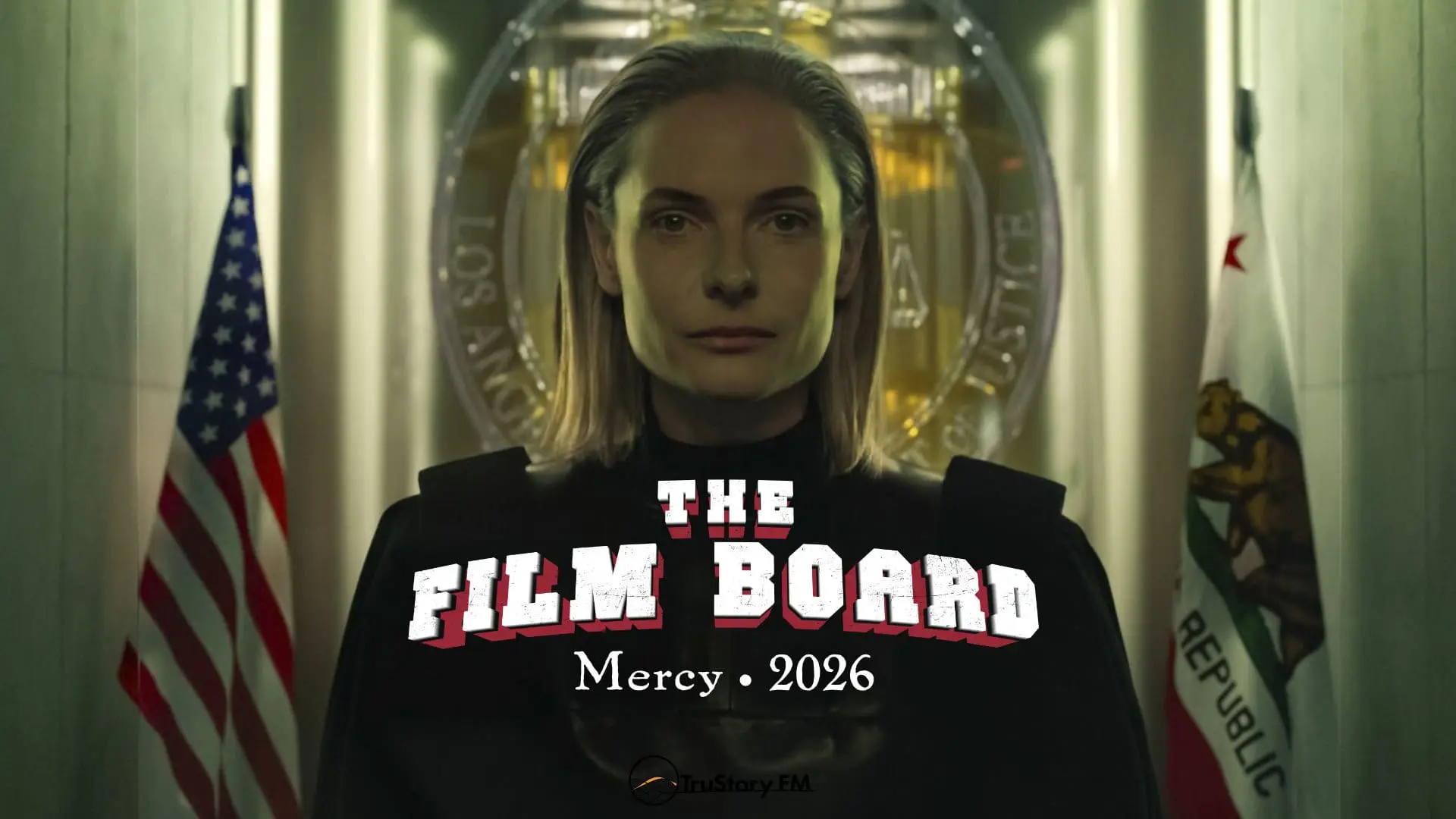
Welcome to the review chamber. I am your procedural facilitator, Pete Wright, and I will be monitoring tone, aggression, and general sense of spirit throughout this hearing. This session concerns the case of Mercy, starring Chris Pratt, in a chair, in an experiment in automated justice, total surveillance, and a study in what happens when your worst day becomes a searchable database. Joining me as counsel for the prosecution are Andy Nelson, Tommy Metz III, and Steve Sarmento. Listeners, welcome. The timer starts now.
Pete Wright
Hello, Film Board. I’m Pete Wright, and it’s Andy and Tommy and Steve, and I’m so glad that we’re here to talk about Mercy. I have to be honest with you: I didn’t know this movie existed until Andy texted me and said, “You’re gonna miss a month. We should do Mercy. Let’s do a bonus.” So we’re here talking about Mercy because otherwise we would skip a month. I just want the record to show, as long as we’re using court metaphors, that Andy owns Mercy in the legacy of this show. All the jokes will come back to Andy for the next decade.
Andy Nelson
I just want to say that this is what The Film Board is founded upon. I just want to make sure that we’re getting back into the source of the sorts of drek that make up so many of our conversations on this show.
Pete Wright
Yes. Thank you, Andy. You are, in fact, doing the Lord’s work.
Steve Sarmento
No, it’s the number one movie this weekend. What are you talking about? We picked the top movie and box office movie this weekend when everybody’s snowed in.
Andy Nelson
Didn’t it push Avatar out of the number one spot?
Steve Sarmento
It pushed Avatar out of the number one spot because nobody can get out.
Pete Wright
Yeah… which…
Tommy Metz III
Did it really? Wow.
Steve Sarmento
Nobody can get out to see movies because they’re frozen in their rooms. Yeah.
Pete Wright
Well, okay. All right. Then I think we should start talking about this movie. We should litigate the movie, if you don’t mind my saying. Let’s start with this. Andy, I’m gonna give it to you first, because I also did read your Letterboxd review before the movie. I would love it if you would describe the movie that Mercy thinks it is, and the movie that maybe it actually becomes.
Andy Nelson
Yeah, that’s a good question, because the movie I think wants to be a justice-system-as-software thriller. We’ve got a 90-minute trial that is kind of like this speedrun of how they’ve rebuilt the legal system in L.A., where your guilt is a live metric that they’re tracking.
And in an L.A. that I don’t know if I ever fully understood, but there’s a reform of some sort at work because there are red zones everywhere and riots and L.A. is just a problem.
On top of that, we have essentially a detective story of Chris Pratt playing Chris, who is trying to solve the case of his own murder. It’s a screenlife story, which is kind of interesting in the way that they use it.
And I think what they were trying to do is give a warning about giving systems a godlike access to things like our rights, but I don’t think it ever gets there because I don’t think the movie itself can control what it’s actually implying. Does that help in some capacity?
Pete Wright
Oh, that’s pretty good, Andy. And I think we’re going to come back around on that. Tom, your opening thoughts.
Tommy Metz III
It is funny that you said you didn’t know what this movie was, because whenever I brought up the fact that I was seeing it, everyone was like, “What?” Like, no one has heard of this movie. It’s so weird that no one has heard of this movie.
And whenever I would see… I just saw one ad for it and one poster, and it looks like the fake movie that exists in the background of a real movie. Like, the poster that’s by my house has Chris Pratt walking around in a bulletproof vest with a shotgun—an image that is not in the movie at all. They just threw it from other movies.
It’s a January release. This was not on my radar. I’m a big fan of screenlife movies, but this was not something that I probably would have seen in the theater had we not done this.
Steve Sarmento
It reminded me of a lot of, I guess it was late ’90s, when there was a lot of Philip K. Dick adaptations like Paycheck, where there’s a very interesting concept and it may be best left on the page rather than the screen because there are some things that just don’t translate well.
And I think there are a lot of interesting ideas, and maybe it was swinging for what Andy was describing. I don’t know if that’s the case, because it really felt a lot pulpier than that. It felt like it was an interesting idea of: let’s put this guy on trial and he’s got 90 minutes, and then we’ll just figure out the rest along the way.
These types of things appeal to me because there are some interesting ideas there. They’re never fully fleshed out. Things fall apart. But I’m always intrigued by the proposition of the world that they’re presenting and what’s going on.
And it fails in so many ways, but there are still bits and pieces there that I enjoy, and I latch onto those ideas of the speculative fiction: what would America be like if… And I don’t know if it was a critique of anything. I don’t know if it wanted us to ask anything or if it just wanted us to be entertained: here’s an interesting future and let’s just see what things would be like.
So, yeah, I enjoyed bits and pieces. I think I enjoyed it more than some of what I’m hearing from the rest of you, but I agree it’s a very flawed movie. And I’m surprised it’s in theaters because it’s Amazon. I figured this was something that was probably going to go straight to Prime and then, for whatever reason, I guess they decided, “Oh, let’s throw it into theaters.”
Andy Nelson
This was made for IMAX. It was actually like IMAX 3D. It was intended for big from the start.
Steve Sarmento
Oh, okay.
Tommy Metz III
And for the record, I have not said anything about what I felt about the movie yet.
Pete Wright
Okay. Do you want to insert that here, or do you want to hold your cards closer to your chest?
Tommy Metz III
It’s completely up to you. I’m always walking a tightrope about opening thoughts because I know that I own that segment.
Pete Wright
Yeah, I know. Even though that’s your segment.
Tommy Metz III
Yeah, I’ll go ahead, just to make this fun. I was expecting nothing from this movie. I’m a huge screenlife fan, as I said. I love the Unfriended series. I love both Searching and Missing.
I thought this movie was going to be a disaster, and I had so much fun. I really, really enjoyed this movie. I think its biggest problem is it’s coming out right now, so we’re expecting it to say something smart about AI because AI, within the last couple of years, has taken over the culture. If it was like five years ago, ten years ago, you could just sort of see it as a cheap Paul Verhoeven kind of knockoff and take some satire as you want.
Also, one other thing about this movie: I went in bargain basement. I was not gonna see it in IMAX. Are you insane? And I wasn’t gonna pay for 3D. Are you insane? My theater messed up and they showed it in 3D. We all had to run out. There were two people in the theater. We ran out and we were like, “Is this supposed to be in 3D?” They’re like, “Oh, I don’t know. Here’s glasses.” So we ran in, and we ended up watching it in 3D, and I think that made an enormous difference because it made it a ride. It made it a video game that you were a part of. I really, really liked it.
Andy Nelson
He’s literally in the chair, yeah.
Pete Wright
Yes. I thought it was full 4DX in the courtroom. I really did.
Andy Nelson
I think it is.
Tommy Metz III
Yeah.
Pete Wright
It’s like, this is your last ride. You know you’re gonna die. We’re gonna give you a trip on the way out.
Pete Wright
That is fantastic. I actually did see it in D-Box, because I always do now. I don’t like myself as a result of it, but I do it anyway. And I was really surprised at how much D-Box there is going on in this movie. It felt like, for a “guy in a chair” movie.
Tommy Metz III
In a movie about a chair.
Pete Wright
Yeah. Those screens cause the chair to swing around a lot. Let alone the fact that when she gets on the police hovercraft motorcycle, man, you’re flying around all the time.
Pete Wright
So it was actually really pretty active. It was more active than I expected it to be.
I think there is a really strong core idea in this movie. This whole idea of having an automated justice system as a pressure-cooker thriller, as putting a kind face in front of an algorithm that makes you think you’re really building a relationship with someone—but are you really? I think that is a fascinating thing to explore in movies right now.
The movie feels extremely impressed with its concept. I did not walk away feeling that it was as capable as it was impressed in executing it. It felt like it wandered. The experience quickly moved from super intriguing to more eye-rolling than I wanted it to be.
We’re gonna talk about the parade of coincidences that I really struggle with. And I think when we’re talking about how awesome the throwback is to early Paul Verhoeven, I feel like this movie may be dating itself with its exuberance for that class of film. For me, I rolled my eyes too much. I hurt walking out of the movie. It was too much. It could have been the D-Box.
Tommy Metz III
Was the D-Box rolling your eyes? Are you sure you were in control of that?
Pete Wright
I think we talk about major themes going on in this movie. We’ve got the automated certainty, right? He’s presumed really guilty, but he has the ability—the agency, when he’s in the chair—to review everything that has been recorded throughout his jurisdiction and history.
I thought that was fascinating: that surveillance is normal life. That, in the screenlife space, is the novelty in this movie. And I’d love to hear how you guys felt that angle worked: that surveillance is normal life, and the agency of being able to interact with it is the trick to make this a screenlife movie. How did it work for you? Steve, you want to go first?
Steve Sarmento
With anything like this: yes, we all have cameras, everything’s recorded, but there were so many times where I thought, there wouldn’t be footage of this. I’m struggling with that moment of: would somebody really have a camera to capture this exact moment?
But it was an interesting commentary, particularly as a parent. The whole discovery of “my daughter’s got a secret Instagram,” which should not be a surprise.
But it brought up the idea: it’s powerful for him to be able to review all of these things if you assume he’s gonna die. Otherwise, if he walks out of there having dug through his deceased wife’s stuff, his kids’ stuff, everything else, and being able to then walk out… private financial records, everything—like, I’m gonna now walk out on the street having seen all this stuff so I could prove myself innocent.
I thought, okay, that’s too big. We don’t have time. We’re gonna simplify that.
But it was an interesting idea. And I thought maybe, if anything, it was trying to get into: is all of this creating separation among people, or do we really know each other? Although we can see everything, do we really, really know each other?
So it’s fascinating, but it’s a genre that I think still struggles and grapples with. We need to get information to an audience, and we’ve tied our hands with this, so we can’t be omniscient. We’re tied to this. It puts some challenges in the storytelling that you just have to let go and say, okay, there’s no logical reason for this, but I’ll go along with it.
Andy Nelson
The thing that I find frustrating is that it ties into the entire premise of the story, which is this legal story. Suddenly now we’re in this world where Mercy can access proprietary invoices if it wants. It can do these… I actually quite enjoyed the look of it, but reconstructing these scenes from all this footage.
It creates this world where it’s like: are there limits to this system? And if there are none, does it end up being believable?
And for something that I thought was trying to create this system, I’m like, none of this is believable. It’s creating this world where we’ve got mandatory cloud access to civil rights, like everybody has to have a phone and everything they own is accessible to the cloud, which is crazy.
Which also, interestingly, creates an off-grid system, right? Because now we have these people who are buying burner phones. And that, in the end, is also revealing the futility of this system that they have now created, because it’s creating more crime.
And it doesn’t really get into it in this story, but inevitably it has to get into classism, because certain classes are going to be able to access these burner phones more easily.
So I think it’s confusing having more data with actually having more justice. And I don’t think that they created a story that ends up making sense. It’s a fascinating world where big brother is literally accessing everything, but I don’t think they figured out how to actually tell it the right way.
Tommy Metz III
If the original question was: how does the screenlife work, does it work with the delivery of the information?
For me, when I understood exactly what was going to be happening, I did ask myself: what if Minority Report was just him with the gloves throwing things around? Would you want to watch a whole movie of just that?
And the answer for me is yes, because that was my favorite part of that movie. So I was just like, look at that—woo! Like I was just having a ball with it.
Pete Wright
I am shook by this part of you.
Tommy Metz III
I really didn’t stop.
Pete Wright
I don’t think I ever would have expected this. Knowing how you feel—genuinely feel—about AI, what is happening right now?
Tommy Metz III
Because I didn’t take it as an argument about anything. I think the fact that I walked into it—Chris Pratt and January release—I think I just… it didn’t even occur to me to try to manage these theoretical, logistical, or ethical questions.
I knew I’d get the ugliness that I wanted because I was just having too much fun.
I mean, I think they set up a kind of cool situation: it was dead to rights, he did it. It was very convincing that he was guilty, and then to unravel that was a fun ride that I thought was very noir-ish. Like those noirs where someone wakes up and they can’t remember anything because they had a blow on the head. It’s one of those. It’s like a locked-room mystery.
Pete Wright
You mean when he literally woke up in this movie and couldn’t remember anything?
Andy Nelson
And he did have a blow on the head.
Tommy Metz III
That’s right.
Pete Wright
It’s like this movie and others, is what we’re saying.
Tommy Metz III
Yeah.
Pete Wright
I think movies right now… you’re catching me in a 36-hour window of seeing this movie, The Rip, and just watching the latest season of The Pitt. And these do the same thing with different degrees of success.
The Pitt is a medical drama. Sometimes I, in the audience, don’t know what’s going on, and so characters have to explain to each other what they both should know because they’re all doctors. But they’re explaining it as if one doctor knows a thing and the other does not know a thing. I’m okay with that.
Then I watch The Rip. The Rip is an objectively terrible movie because it just screams at me all the time: “Do you see? We’re doing crime right now! We’re doing crime! There’s crime right now, it’s happening, you’re watching crime.” Constantly explaining to each other—to the audience. It is so obviously Netflix’s wave of movies reminding you what we do because we know you’re on your phone. It makes it impossible to watch. It absolutely does not trust me in the audience.
I think this movie has a leg up on The Rip because it has an excuse. It has a valve. It releases pressure by way of all of these screens. And it still trips over its own shoelaces left and right because the screens only yield dumb coincidence, impossible coincidence.
So it can describe to me what’s happening, but it levels up into… I don’t know what they were doing, but I have these images of just fritzed-out mice writing the screenplay in a writing room, and they wrote themselves into a corner and they’re like, “What would be fun is if we could make him an alcoholic and back him into a corner.” And then they realized: we’re now in an impossible situation, we don’t know how to get out of it, so somebody get the Magic 8 Ball.
It seems incoherent—these incoherently connected coincidences that lead to the unraveling of this movie. And that made it wobble between super serious thriller and parody, because the staging tries so hard to be immersive that it loses its own credibility for me.
Steve, you’re nodding your head.
Steve Sarmento
No, I agree. I’m really on the fence. I don’t know that I had as much fun as Tommy, but I don’t think I was as frustrated as Andy.
Again, as you said, the wind, his hair, and I thought: oh, well, that’s why the room has to be so big, because there’s all that equipment we can’t see that’s going to generate heat when there’s fire and all that.
Because I thought: why does he need to be in this big of a room if it’s just him and the AI? It could be him in front of a laptop, but then we need all the screens and things to come up.
But it does trip over its shoelaces trying to resolve the story. And I think that’s the problem: it started off as one movie and it turned into something else because that’s a resolution they knew they could get to. Or they wanted. Or: we know how to write that type of thing. We don’t know how to answer the propositions we’re setting up at the beginning, so we’ll just throw in some coincidences to pivot this into something that’s familiar. It’s going to follow familiar tropes that will give people a satisfactory ending.
I wish it had done something as innovative as the proposition: we’re going to put somebody in a box and really jam them in a corner, and this may not have a happy ending. This is a desolate world out there. It is dark. So do we need a happy resolution? I don’t know. I probably would have enjoyed that more.
But it played to what it is: a pulpy B speculative sci-fi type of thing that has its weak spots. The coincidences do stick out like sore thumbs.
Tommy Metz III
What are some of these coincidences? I’m not saying there aren’t, but what are some of the ones that felt the most glaring to you? Just to put me back on the…
Andy Nelson
My biggest one is the fact that Rob is hiding in the basement for a day and a half, two days. What was his plan? The fact that he was relying on Nicole to discover Chris’s alcohol stash and have Chris come home so that he could make it look like Chris did it. I don’t understand how, in God’s name, he was planning on actually making it look like Chris did it.
I’m gonna hide out in the basement until the perfect moment. There’s nothing about that that makes any sense.
Steve Sarmento
Yeah.
Pete Wright
For like a whole weekend.
Andy Nelson
Yeah. He misses work on Monday and nobody’s like, “Oh, he didn’t even call in.”
Steve Sarmento
He just hung out in the basement, yeah.
Pete Wright
But, Andy, you’re forgetting the most important point. Supposedly he’s been planning this exact thing since his brother was sent to the Mercy program. Like, this is a two-year thing he’s been working on, and it ended with: I’m gonna hang out in the basement for two days.
Andy Nelson
Yeah. And Mercy enhances that video footage and sees a hand—puts the brackets around the hand—reaching for the doorknob. One: why is he such an idiot to be there at the top of the steps, right behind the door, right when the daughter is walking around the house with her camera? And two: Mercy’s just like, “Oh, it could have been a shadow.” And I’m like, you just bracketed a hand at the doorknob.
Steve Sarmento
But, Tommy, to your defense, it speaks to when you get swept up in it, the logic… you’ll buy into it, you suspend your disbelief, and you go with it.
You either buy into it and go along for the ride, or you step back and analyze this and say: if you’re trying to make a serious comment about something, I’m gonna look at all the pieces of your argument, and it’s gonna fall apart. I think that’s where Andy’s at: you’re trying to make a case about AI in this world and I’m going to analyze your argument and it’s falling apart. Whereas you went in for the ride and said: sure, whatever, take me away, I’ll ride the roller coaster.
Andy Nelson
My wife and I even talked about that after we watched it. We were like: it was definitely not for us. But she’s like, “Oh, my dad would love this movie.” There are people who are gonna love this movie. It’s one of these movies where you could call it standard average popcorn flavor that a lot of people are probably just gonna go out and enjoy.
But then I was like: is that a good thing? Or is it potentially dangerous to have this story about what it’s saying about AI that becomes just kind of a casual popcorn-y sort of movie?
I still haven’t figured out what they’re actually trying to say about the usage of AI in the film. I don’t know if it’s a good or a bad thing.
Steve Sarmento
I’m gonna say: I don’t know that they’re trying to say anything about AI. I think it’s just strictly a storytelling mechanism they used in place of something else to tell a story about a guy who prioritized work over his family.
I’d say that AI is not the focus of the story. It’s his journey of: I’m a horrible husband, I haven’t dealt with my partner’s death, and all of that. To me, that’s really the story, and the AI is just the thing of the moment that they slap on to tell the story.
Twenty years ago it might have been cell phones. It could have been something else. Technology du jour. It’s hardworking cop ignores his family, wife cheats on him, all of that. I think it’s window dressing.
Andy Nelson
But when the movie Cellular came out, I don’t think we were having ethical conversations about how cell phones are getting used these days. Whereas AI has created constant conversations in every aspect of our lives about how it’s being used. Is it being used well? It’s destroying the environment. There are so many conversations about AI right now.
I don’t know if it’s responsible to tell a story about AI that’s so casual B-movie.
Steve Sarmento
I don’t know that it’s responsible, but I think that was the motive: what’s the thing we can slap onto this? I don’t think there were concerns about the ethics of all the packaging that comes with using AI in your story and what that’s going to bring. That’s the blind spot. And I think that’s where people are going to take issue with this film.
Andy Nelson
Not to hijack all this, Pete, but I just have a question: how did you all read what it’s saying about AI and its usage in this film?
Pete Wright
I want Tom to go first.
Tommy Metz III
I didn’t. I think it hinted at a stance at times, but it never really… I mean at the very end, that idea of, “Oh, Chris”—or Raven, whatever your video game name was—“what have we done?” and “everything’s infallible, even computers,” that felt very slapped on.
I don’t really believe it was just a MacGuffin. It was the way to justify all of these screenlife effects. The director—he didn’t direct Unfriended, he didn’t direct Searching or Missing—but he’s had a huge hand in all of them, and he’s been exploring different ways to do it.
This time he took off the guardrails. He said: I can film whatever I want as long as it makes a teeny bit of sense that there would be a camera there, as long as there’s a situation where there are cameras everywhere, and then just runs with it.
I think one of the biggest problems is that it’s coming out right now. Everything is too turbocharged, lightning hot. It’s impossible not to bring baggage.
And if it is trying to say something, it’s completely unclear. Minority Report was very clear that this is a corruptible system and we have to throw it out. This, we don’t know. It sounds like they just have to clean up the lobby. It’s unclear what’s gonna happen with the future of Mercy.
Pete Wright
I’m really confused because I think we all saw a different movie. Or maybe I saw the same movie Andy did, but I would have expected you, Tom, to be screaming from the mountaintops after this movie.
I’m down with the irresponsible presentation of AI in this movie. The whole point of this movie is—and the threat of this movie is—that it’s impossible to get a truly just outcome using AI because it is fallible.
And the fact is, the threat of the movie is that he is going to be unable to prove his case unless the AI starts to break, unless it starts to hallucinate. That’s what’s happening at the end of the movie. The judge—Rebecca Ferguson, Judge Maddox—starts to hallucinate and let go of controls, which is exactly what happens with AI. And it is a threat to our systems. It is corruptible. It is fallible. It should be on lock. It should not be used for this.
It is so much… Minority Report kept its arm’s length from these concepts because they had the fake trope of the three precogs. The precogs were the AI, but they were also impossible. AI is here. Judge Maddox is right here.
And I guarantee you there are people in law enforcement who would love to see this happen right now, who would love to see this surveillance state enacted, who would love to see us enact justice quickly with authority and clear backlogs—cases and all the arguments they can make.
That’s what this movie is about. And if we watch it and internalize it and miss that point, we’re screwed. That’s bad news. I feel strongly about that.
Andy Nelson
But I don’t know if it’s even trying—if it’s making that point. That’s what I don’t get. It sets up AI is bad and all this stuff, but by the time we get to the end, we’re like: no, it’s actually humans that are bad. They’re the ones hiding information. And AI actually helped you and helped get you through all of this.
So I’m like: is it pro institution? Where are we by the end?
Pete Wright
I think the end of the movie comes back around to: hey, we just need to clean up the lobby and she’s gonna be fine. Judge Maddox will just reboot and we’ll start again.
I didn’t get a position statement that the movie is saying: we have a take on AI. But we are presenting you with a universe in which real people right now would love to implement in the real world. This is not a documentary, but it is an ideology.
Andy Nelson
And as we’ve seen from films like Fight Club and others, there will be people who view this as: oh, this is the next step. Let’s work on making this.
Steve Sarmento
The piece that has come up as you’ve talked about this, Pete, is: yeah, the AI hallucinates. But if we set aside the AI, there’s a part where she says: if you stay in that chair… you know, this is the problem. But he needs to continue to access this information.
The underlying proposition is: whether or not the AI is good or bad, he’s able to resolve things due to an extreme surveillance state. That is not up for debate.
Whether the AI helps him or not, it’s because he has access to everybody’s cameras and everything else. The only way justice can happen is if the police can see and know everything. To me, that’s far scarier than the AI piece.
Pete Wright
That’s the ideology.
Andy Nelson
Even if we’re calling justice “justice,” right?
Steve Sarmento
Yeah, right.
Andy Nelson
Because I don’t know if this system is actually a fair system. It’s designed to execute incredibly quickly, but I never saw it as adjudicating fairly.
Here we’ve created a system where you’re putting people like the first guy—Rob’s brother—who clearly isn’t somebody who would know how to defend himself. Even with ninety minutes on the clock, he’s gonna have no clue what to do.
So you pull lawyers out of the system and rely on self-defense for all of this, and then you give them a 90-minute ticking clock constantly in your field of vision with a sound effect like tick, tick, and I swear it probably gets louder over the course.
Pete Wright
Just like it did for Jack Bauer. That clock gets louder and louder.
Andy Nelson
Exactly.
Pete Wright
But you know, Andy, the very first case that we hear about in the third act—the brother being put to death—demonstrated that Mercy was corruptible by people. It made the countercase at the very beginning of the movie. That is an ideology. That is a perspective.
Andy Nelson
It is, and they’re cherry-picking cases, right? They expect to win. They’re engineering the kills, essentially.
And first of all, it’s like two years since Mercy’s been in and only 18, now 19 cases. I’m assuming it’s death-row cases, but still—this L.A., and that’s all they have over that many years?
Pete Wright
Nineteen cases in two years. It’s only ninety minutes a case.
Andy Nelson
And how many Mercies can be running at one point? They could have 20 of these rooms running 24 hours a day. They could be killing people left and right, which seemed like the entire point. I don’t know why they’re going so slow with this thing.
Pete Wright
Not enough water. You guys should see Lake Powell by the time this movie starts.
Andy Nelson
But they’re cherry-picking cases they expect to win. That’s a terrifying state that has created this system.
Pete Wright
I have to admit, I was confused by all of the wind that the digital screens were causing. But I do think there might have been some cool stuff going on here. It was fun to watch for a lot of it. How did you guys think the actual world worked for you?
Tommy Metz III
One of the things I’m slightly interested in about this movie is: with Searching and Missing, there’s always another story being told. If you pause screens and stuff—like in Searching, I think there’s a UFO sighting that you learn more and more—there are stories within stories, with this huge amount of text and information that you’re getting.
So he’s not taking it easy. It’s not just random numbers. He’s using it to tell different stories and have fun with it. I enjoy that a lot. It’s very effective for me.
I don’t think it’s great cinema, and it’s not what I usually go to the movies for, but if I want that kind of ride and that kind of experience, I think it’s really well done.
And with the 3D: when that house explodes and all of a sudden the fire is all around him, it felt like the fire was all around me. It was very immersive. Extremely immersive in a way that was really thrilling.
Pete Wright
That’s awesome. I love that for you.
I worry at times that the film confused sensory noise with stakes. There’s a certain virtual-reality kind of hysteria that goes on in certain periods of the movie, especially after he does his… with his neck, essentially what Henry Cavill does in Mission: Impossible when he cocks his arms. That’s what he does. He goes: neck-cock.
And then he goes into research-porn mode. His fingers on his touchpad start going crazy, in ways that any other criminal would probably not be able to do. He creates such a dizzying array of windows and screens and calls that it lost me a little bit on the stakes.
What was at stake? I felt like Chris Pratt—or Chris Raven—lost the thread that he was sitting in a death-row chair because he started an investigation on chemical theft. I know it was supposed to be tied together. But I never quite believed it because I was so dizzy with windows.
Maybe that would have been better had I seen it in 3D IMAX. I don’t know. Andy, Steve?
Andy Nelson
That speaks to the worldbuilding, and I really do admire what they did. That’s what I enjoyed: the way they tied in the screens and the usage and the future technologies, and made it frighteningly accessible—how everything can be at arm’s length.
I never figured… he always seemed to have issues with the typing. I just wanted the AI to speak it. You don’t need to bother.
But those elements were really effective.
The parts I struggled with: as much as I loved the visuals where it did the scenery creations—like the crime scene, where it showed all the bits of evidence everywhere—that’s really cool. But the one in the backyard is the one I really struggled with.
And you could argue the same thing with the fire. You’re relying on cameras to be everywhere, and it made me think of a recent Black Mirror episode, “Eulogy,” the one with Paul Giamatti, where he’s stepping into photos. He walks around a picture of her from the back of her head, but when you come around the other side, there’s no information. It disappears.
What I needed to buy into the tech for these scenery creations was having some spots where things just weren’t there, or it was fuzzy, because I could have bought: okay, the camera panned away, you don’t have accurate information for that section.
Instead, it felt like it pulled every single person’s camera to recreate an entire scene.
Pete Wright
That is the stretch in that sequence, and yet not impossible. And that’s what should be terrifying: a surveillance state that can reconstruct from everybody’s camera a fully realized 3D environment. That’s not impossible.
Steve Sarmento
Those are the parts that really pulled me out of it. I love the screens and access to information, but putting him in the backyard, putting him in the chair on the highway, putting him in the garage with the fire—I thought: what is the purpose of that? Why put him there?
For the backyard, sure: he’s trying to see who was there. But for the other moments, there’s no logical reason for him to be there when he just needs to talk to people. He’s not needing to see anything at those locations. It became spectacle because we’re now in an action movie.
But everything else in that chair—the screens, the access—I loved. It’s logical. I can follow it.
And the journey from waking up to getting to the point where he’s a detective piecing together his life: that worked very well for me. Then it became terrorism and chemical theft and all that, and I didn’t care about that movie.
Pete Wright
I think you just said it, Steve. The movie lacks constraint. There was an opportunity to tell an awesome story about infidelity and this person’s struggle with alcoholism without getting into the nonsense factory of terrorism and bombing. I didn’t feel like it needed it.
If we transition into something I really love: if we ever have an opportunity, Andy—production note—to interview cinematographer Khalid Motaseb on the show. I think he did the yeoman’s work on this movie. I would love to see a shot log from this movie. If we could export a clip log from Premiere—holy cow. They captured a lot of material, processed it fascinatingly, and created this universe of screens in a super inventive way. What a joy to work on a movie like this if you’re managing pictures. Thoughts on cinematography?
Tommy Metz III
It’s really well done. There are always constraints with these movies: there has to be a lot of people walking around shooting themselves from below just so you have something to look at—filming their own things when they’re looking around, not talking to you. There are always problems like that that are annoying.
But to handle so many different types of filming, and different types of making it look like different types of cameras—stationary, moving, jumping—all of that—it seems like a really thrilling thing to work on. And I thought the verisimilitude for most of it worked really well for me.
Andy Nelson
There’s a line in the camera work. I think they largely do a pretty good job, even if I don’t always buy why a person has a camera.
Like when his wife comes in and sees him drinking in the garage and he’s like, “Why are you filming me?” It’s like, yeah, why are you filming him? I’m not gonna walk in filming my wife when we’re about to have an argument. That seems dumb.
All that aside: they largely do a good job of keeping it consistent through the footage. I bought: okay, this is somebody’s body camera. I can see all of that.
And compared to the camera work—honestly, everything within the Mercy courtroom itself when we’re looking at Chris, everything him-related is just a camera so we can see what’s going on. Likewise, once he’s finally out of the chair and the finale.
I do think the cinematography does a good job of trying to keep the looks separate: more filmic for those bits. I appreciate that work.
Pete Wright
As a nerd, I appreciated what they did to build a user interface for all these computers that was crisp and clean and kind of a hybrid of Linux and Mac OS. It felt like a hybrid that could be real, mostly because they were still dealing with files and folders. And I low-key love that.
So many interfaces pretend to get rid of the fact that we still have files and folders, and they’re not going anywhere. This had a workaday bureaucratic operating system feel. I really liked that.
If there was an Academy Award for Files and Folders, it would go to Mercy.
Pete Wright
Ramin Djawadi is back on the score. Did anybody have the score stand out? The score does a lot of work.
Andy Nelson
I think it’s fine. I enjoyed it for what it was. It fit the tone of the movie.
Tommy Metz III
Same with me.
Pete Wright
Same here, other than the fact that there was a lot of music. It was propulsive for the kind of movie it is, but there were no themes I’m coming away humming.
Steve Sarmento
You didn’t see the little orchestras that were there just off camera in backyards and everywhere, so we always had scores for the actual footage of what was going on at these places?
Pete Wright
Yes. And all the little orchestras had cameras themselves, so you got a lot of POV.
Tommy Metz III
Can we talk about the acting for a second? I think Rebecca Ferguson is captivating. I love her all the time and I thought she was really neat.
At times I was like, wait, why is she acting so human in little moments—like, “Oop, did I just catch you?” But then I was like: AI does that. AI pretends to be human. AI says things like, “Let me think about it,” and it’s like, you don’t need to do that.
So I thought she was really neat. And to have to tamp down and underplay everything in order to be a robot lady, I thought she still was… I would just watch her do that forever.
Whereas unfortunately Chris Pratt has a pretty shallow bag of tricks at this point. I feel like he had a lot of moves before, and with all the movies he’s been making, it’s been sanded down. Like he’s got three options. But she was, I thought, a lot of fun.
Pete Wright
I agree.
Andy Nelson
She’s always great. And I think she works as the judge.
Not so much an acting performance, but the way the character is written: Jack was my biggest problem with the film. This is Chris’s current partner.
I struggle with that because if you’re gonna tell a ninety-minute real-time concept where we’re with you as you use all this screenlife stuff to solve your case, you’ve gotta do it well. And I don’t think they do.
It becomes more plot-oriented than character-oriented because Jack’s motivation—full spoilers—by the end is so out of nowhere. There’s nothing in the script that earned that.
Why was she so desperate to prove it was work? We know she wasn’t even involved in the situation with his partner getting killed the first time. That might have bought it more. There’s nothing there.
So this is a story that could have worked better if they’d given us more story beforehand, getting us to know these characters so we understood where they were by the time we got into this.
Pete Wright
But they did say she was the one that brought in the brother for Mercy the first time.
Andy Nelson
Yeah, but that’s a plot point. There’s no character element there. And then it becomes obvious: why is she suddenly shooting at the truck? It’s like, clearly she’s part of this. It was too obvious when she decided to open fire.
Pete Wright
I think that’s the same sad case for Rob, the AA sponsor who also works there. Chris Sullivan—I really like Chris Sullivan—no fault of his, apart from the fact that he was given a script that does the same thing to him that it does to her. It renders him another domino and a predictable outcome that didn’t need to go that way.
And of course, Annabelle Wallis plays Nicole Raven, who is dead.
Andy Nelson
Very briefly in the film.
Steve Sarmento
Briefly. Very briefly.
Pete Wright
Briefly in the film. But is well modeled on the floor in pixels.
Andy Nelson
With the knife going in and chipping her vertebrae.
Pete Wright
Yeah. And twisting and moving. Gruesome.
Pete Wright
All right, it’s time. We’ve reached the end. We need to talk about Letterboxd. Letterboxd.com/thenextreel. That’s where we apply all of the stars and the hearts to our reviews.
As always, the rules—which are sacrosanct—if you give it stars, you have to take the stars from somebody somewhere else. Nobody pays any attention to those rules. And so here we go. Andy, go ahead.
Andy Nelson
For those who looked at my Letterboxd review already know I gave it one star. No heart.
The reason it’s getting one and not half a star is because I genuinely enjoyed the hook. I thought the hook was really interesting, which is what drew me to want to watch it. And I really like the tech-forward visuals. I genuinely like all the stuff going on around Chris as we’re watching it.
But for the rest of it, it’s normalizing this court designed for speed and certainty, but there are no lawyers. It’s creating an interesting system, but then at the end it’s like, “Oh, but it’s actually humans are the problem and the system is actually okay.”
It didn’t know what it was trying to say, and I ended up really frustrated. So that’s where I stand. One star.
Pete Wright
One star. Steve.
Steve Sarmento
I’m still torn. I had to go back to my Letterboxd to see where I rate other things because this is falling in an in-between space.
I’m right there with Tommy. I had a lot of fun with this, but I see all the quibbles and the problems.
But I’m gonna lean one way. I’m gonna end up with three stars on this one.
There’s something about pulpy sci-fi. I love these types of smaller films that take a big idea and grapple with it and ultimately fail because you can’t translate some of that from the page to the screen. But to take a chance and bring that to the table, I give them credit for.
There’s a lot of things to enjoy about this and just have fun and not think too much about it.
Pete Wright
Is that a heart too then?
Steve Sarmento
Yeah, that’s a heart too. That was fun.
Pete Wright
Tom.
Tommy Metz III
Five stars, Pete. No, just kidding.
When I came into this, I was a three. I think I’m going to lower it actually below Steve, just to 2.5, because I’m thinking about the rewatchability of this movie in comparison to the other screenlife movies.
I think the 3D theater experience was so important that it’s falling into that Avatar syndrome for me, which is like: Avatar, of course I’ll see it in the theater. When it comes on HBO, I’m never watching these movies again personally because there’s nothing for me except that huge in-theater spectacle.
So I’m gonna say two and a half, but definitely a heart because I like screenlife and I want more of them.
Pete Wright
Okay. I came in at a position, then Andy started talking and I lowered it. Then Tommy started talking and I raised it again. Steve started talking and I lowered it and raised it.
I came back in exactly where I started: two stars, no heart. For the same reason. There is a lot that I liked about the presentation of the movie, but it’s such empty calories, and I’m not watching it again. I’m never gonna watch it again.
I guess there’s a chance I’ll forget what movie this was and somebody will say, “Hey, we should put this movie on,” and I’ll watch it and regret it because I’ll remember too late.
Tommy Metz III
It’s got a terrible title. You’re like, what is this, a World War II movie? It could be anything.
Pete Wright
Yeah. So I end up at two stars, no heart. That feels right for me, as a reminder of what this was.
I spent way too much time on my review. If anything, I need to go back and soften a little bit of my language after this conversation. I may have come in hot. So check Letterboxd later.
Let me ask you a closing question: how would this movie have changed for you if Chris hadn’t made it out of the chair?
Steve Sarmento
That’s where I was earlier in the movie. That first half, I thought it was gonna be the realization that I’m a piece of garbage, and whether or not I can prove it, it was going to be on the line, and he was going to end up dead. It was going to be a realization: I should have been a better person. End it.
But once it became the terrorist movie, I’m like, oh, he’s gonna live to save the day. I was hoping for the more character-driven piece of: I’m garbage, I should have lived a better life.
Andy Nelson
What told me it was never gonna be that movie is the fact that Chris Pratt was cast. Because I guarantee he’s not an actor who’ll be fine getting killed in that sort of capacity.
Steve Sarmento
No.
Pete Wright
I wonder what it would be like to live in a universe where Chris Pratt would be really willing to take those swings and create a movie that gives you all the intensity of replaying one’s life by way of screenlife and realizing: I’ve learned some lessons about myself.
And ultimately, maybe I’m found innocent, but for some reason I’m dead. Or maybe I can’t prove beyond a reasonable doubt for the court, but for myself I understand who I am now and it’s okay I end up dead.
Those kinds of hard things: I’d walk out of the theater and be like, I can’t believe they did that to me. I’m absolutely gonna watch this movie again. I’m absolutely gonna see how they build that case because it’s compelling and interesting and risky.
And the thing about this movie that feels kind of sad is that it’s not risky.
Tom, did you have any armchair quarterbacking?
Tommy Metz III
No. I lost interest once he got out of the chair because I was there for screenlife, not the rest of the stuff.
But I kind of did like Rebecca Ferguson being able to zap her way around town and be like, “I’m gonna give you a snack,” and “Look, I’m gonna help you out.”
Pete Wright
Now I’m on the lobby card.
Andy Nelson
And suddenly she can control the robot, like the little bomb robot.
Steve Sarmento
Yes.
Tommy Metz III
That’s kind of fun. I would give Rebecca Ferguson control of everything.
Pete Wright
All right, y’all. Thank you so much for hanging out.
If this conversation sent you down a rabbit hole or reminded you of other films circling the same ideas, we do a lot of that work across the films of The Next Reel family of film podcasts, where we dig into films and filmmakers that built the language this movie is speaking.
You can find all of everything we do as part of The Next Reel family of film podcasts at thenextreel.com. If this is your first time here because of this movie, stick around.
We only do this once a month, and while sometimes we like to say we’re picky on purpose… maybe not this time, but definitely next time. We’ll be back next month with Scream, the next number.
Tommy Metz III
Seven.
Steve Sarmento
Seven, seven.
Andy Nelson
Seven.
Pete Wright
Meeting adjourned.
Tommy Metz III
Do you think it would have been funny if every time he wanted to address Rebecca Ferguson, he’d have to say, “Hey, Your Honor”? Like, he would have to say, like you’re waking up: “Your Honor. Your Honor. Oh. Hey, Your Honor.” And then she’d be like, “Yes.”
Steve Sarmento
Oh, like Siri?
Tommy Metz III
Like, you’re waking up.