SECTION 1: CLEANED TRANSCRIPT
Marcie Maxwell:
Hello, hello. Welcome back to the P2P Soapbox. I’m your host and P2PBFF, Marcy Maxwell, and I am so happy to be back with you for the start of season six. And we have a great conversation to kick us off.
In the world of endurance fundraising, it’s easy to get caught up in the weeds of maxing out your allotment of race bibs, filling every team spot with a willing fundraiser, hitting the fundraising minimums, let alone getting runners to the start line. But what if we looked at it a little bit differently? What if every runner wasn’t just a participant, but the beginning of a long-term transformational relationship? Because as we often discuss on this podcast, when we shift from transactions to relationships, everything changes. How we recruit, how we coach, how we show up along the journey, and ultimately how people stay connected to our mission long after they cross the finish line.
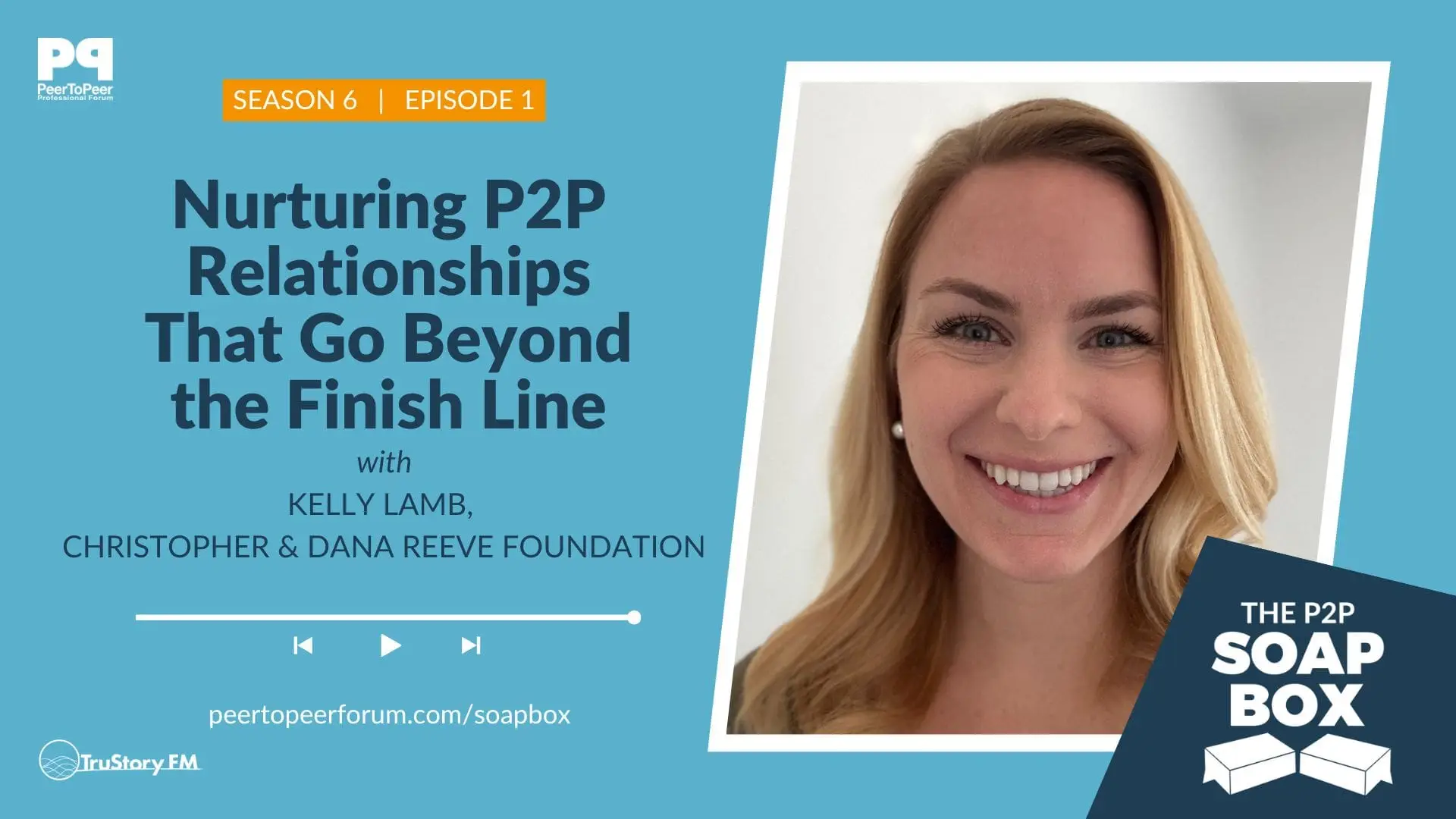
Today I’m joined by Kelly Lamb, Director of Development at the Christopher and Dana Reeve Foundation. The Reeve Foundation is dedicated to curing spinal cord injury through groundbreaking research and improving quality of life for individuals and families living with paralysis. Kelly leads Team Reeve, their endurance program that’s raised more than $12 million since 2005 and brought together over 1,500 runners, each carrying powerful personal stories and a deep connection to the cause.
In today’s episode, Kelly shares how her team approaches every runner like a major donor, starting with the application process and continuing through personalized coaching, community building, and long-term stewardship. From helping fundraisers see what’s possible beyond the minimums to creating moments that turn first-time runners into lifelong advocates, this conversation is full of practical and heart-forward insight. So let’s jump right in with Kelly Lamb from the Christopher and Dana Reeve Foundation. Kelly, welcome to the P2P Soapbox. So happy to have you.
Kelly Lamb:
Thank you so much for having me, Marcy.
Marcie Maxwell:
It’s our first episode of season six, so I couldn’t pick a better person to join us. Before we get started and jump into all things endurance, will you just tell us a little bit about your personal journey, your professional journey, that led you to your role at the Christopher and Dana Reeve Foundation?
Kelly Lamb:
Sure, I’d love to. I started as a marathon fundraiser in 2014 for the New York City Marathon with Team Reeve, which is the Christopher and Dana Reeve Foundation’s endurance arm of their organization. I had a close personal connection to spinal cord injury and really was just looking for community and decided I was going to run a marathon even though I was not a runner. I’d never run a 5K before I signed up for that first race.
The rest was kind of history. I ended up doing six marathons in five years with the Reeve Foundation. I fell in love with the organization and it was just so impactful to see what they were doing with the funds in real time towards their research programs, but also their resource programs. I really fell in love with fundraising too. It was not anything I ever thought I would do. I was really fortunate that in 2019 when this position opened up with Team Reeve, they called me. I’ve been there ever since building out our endurance programs, which have grown significantly, and really just fortunate to be able to support our disability community in general.
Marcie Maxwell:
So you joined us at our conference back in February, and one of the kind of thesis statements for your presentation was talking about how peer-to-peer fundraisers should be treated more like major donors. I completely agree — I often like to say the term “major gatherers.” But tell me a little bit about what changes when organizations really embrace that mindset. What changes about how they recruit, how they support, how they really steward their fundraisers?
Kelly Lamb:
I have to credit one of my former chief development officers. She told me, you have to look at these fundraisers like a portfolio of major donors. And that really shifted my thinking. Even though this individual may come to you for one event one time, I think you really have to get out of this transactional mindset — of them just signing up to do an event with you to get into that event.
That really changed the way we built our teams. We put in an application process that was really thorough. We had an online form and we asked a lot of questions. I think some people with online forms think brevity is the way to go. I completely disagree. Especially these world major marathon programs are so popular, and it warrants that extra touch of vetting and making sure you’re building out a really enthusiastic team from the get-go.
We put in great questions — even asking people what they do for work, where they work. Not only could that potentially open an opportunity in the future, say like a partnership with a company, but I liked it because I could see where other team members overlapped at the same company and didn’t know each other, and I could make those internal connections for them to build more camaraderie. We also ask what their capacity to fundraise is. This question is never a non-starter for me if someone tells me they think the minimum, or not far over the minimum, or even below the minimum. It still gives me an opportunity to go into that first phone interview and say, do you have apprehension about fundraising, and what is it? More times than not, they just really need help with how to build their story.
Putting in a strong application and then a phone interview — the feedback I’ve gotten from our athletes is that they appreciated that. They liked that we were not approving athletes just on a first-come, first-served basis. They liked the fact that we were actually considering who to put on this team. It goes both ways. I understand that depending on the event and the organization, you may not have the capacity to individually vet every single person. But you can still do it through email or set up those touch points afterward.
From there, the relationship really grows. Like a major gift donor that you’re trying to steward, you know that’s a long-term relationship. A lot of people go into that relationship knowing it’s going to take three years before you actually secure the gift. So what can you do to make sure that people know you actually care? I think it’s really small, human touch points. If I know an athlete’s daughter’s birthday is coming up, I put it on my calendar and send them a note. If I know they have a race coming up in the lead-up to the marathon — a smaller half marathon — I make sure I put that on my calendar the next day to check in. Hey, how’d the race go? These things really do move the needle.
I also give my athletes unfiltered access to me. If they want to text me on the weekends, I always tell them if I don’t respond, just give me a nudge. I think that goes so far. And it moves you away from this transactional relationship. Your teams start to build themselves because people have such a positive experience with your organization that they either want to come back, or if they don’t want to come back, they want their friends to do it and they want to be on the cheer squad with you the next year. We not only create fundraisers — we create amazing advocates for our organization.
Marcie Maxwell:
I love that. There’s so much I want to unpack there, Kelly. I want to hear more about the conversations about fundraising capacity. We talk a lot about goal setting, and there’s some vulnerability that happens in that — sometimes you have people who grossly overestimate their fundraising capacity, or grossly underestimate what they can do. So when you get that information, how do you start those conversations? What does that sound like?
Kelly Lamb:
The first thing I’m looking at is whether they have a personal connection to our cause. Because I know if they have a personal connection, even if they are apprehensive about fundraising, I can coach them on how to share their story and how it can resonate with donors. And I would say, if you don’t have a personal connection to the mission you’re working for, bring in individuals that do — peer colleagues, or those who have benefited from your mission — and have them share their stories right from the get-go so your athletes and fundraisers can understand how that can really help their fundraising.
I’ll give you a great example. I had a mother-daughter duo for our New York City Marathon last year, Anastasia and Stacy. Stacy had been paralyzed before Christopher Reeve was even paralyzed, and had been involved with our organization since before it was the Reeve Foundation. My advocacy colleague was the one who asked her if she’d ever thought about doing a marathon — hand cycling one. She said no but that it sounded kind of crazy and cool, and he suggested she talk to me.
We do have a high fundraising minimum for New York. It’s $6,000 per participant. She really wanted to do it, but she said if she was going to do it, she wanted to do it with her daughter. She was very apprehensive about that $12,000 fundraising target. I got on a call with her, heard her story, heard her background, and I told her: Stacy, you have a remarkable story. I have no fear about your ability to fundraise. If you listen to me, follow my steps, and have fun with it — and having fun with fundraising is a big thing I push with our team — you’re going to smash it.
And they did. They raised over $30,000. I was not surprised at all. More than just what I felt their fundraising capacity was, I knew they would create so much value within our team because of their personal story with the mission. They were one of our three award winners at our luncheon. Everybody on the team knew them. They were active participants in our WhatsApp group. They were cheerleaders for the whole team, and they were living the mission too.
I think even if someone comes to you who may not be the strongest fundraiser but has a really important story to tell, that is worth giving them space on your team. I’d much rather have someone like that — someone with a personal connection to my cause — than someone who comes to me and says they can just write a check for $20,000. Because that’s exactly what I don’t want. They’re not in it for the long run. They’re not in it for our community and our mission.
Marcie Maxwell:
One of the things I’ve noticed talking with you and a couple of other endurance program leaders on the smaller side — in terms of total number of bibs — as opposed to some of the largest programs in the industry that might have hundreds or thousands of bibs across events across the country, is just the real difference in approach. In those high-volume programs, the strategy might be we just need to make sure we sell every bib, whereas for you it’s we have only X number of bibs and we need to raise as much money as possible with those bibs. It’s a different approach.
Kelly Lamb:
It is a very different approach. I honestly think organizations in that 200-or-fewer-across-events range are in a really sweet spot, because you can still maximize your fundraising capacity while giving individual attention to your athletes.
The biggest thing I do is set clear expectations up front, and that starts on the application page. We’re actually starting something new this year. Our goal for every marathon program has never been our fundraising minimum times the number of participants. There is a reach goal every single season. That’s how we grow our revenue every year. And our athletes know that from the application page — they know they’re going to be asked to keep fundraising. We are not about hitting minimums on our team.
That is also a relationship-building thing. From a manager standpoint, you don’t want your athletes to feel like you’re just pushing them because your goals and metrics are on the line. It’s really important to share what raising that amount of funds actually does — does it point toward new research grants that can be awarded? Does it point toward new resource programs that can be implemented? What is the tangible impact on the community you’re serving?
As I was about to mention, we’re trying a new strategy this year on the fundraising side. Every major program has a fundraising minimum. For New York it’s $6,000. But on the fundraising application, when you create your fundraising page, it’s going to say $7,000. You’re not required to hit that, but it’s there to encourage more donations up front and to encourage you to keep fundraising past your goal. Of course we tell them we’d really like them to set it at $10,000 or higher. That’s to let them know: you are capable of doing more than the minimum.
I think this is really a psychological technique when it comes to fundraising. I’ve seen it in my own fundraising. The higher I start my goal, the more generous my donors are from the get-go. I’m running Boston with our team this year. Every year before this I’d get to a point where I was trying to raise $20,000 or more for each marathon and it was taking me 300-plus individual donors — and I love that, because I truly love a $5 donation. But this year I said I was going to try to raise $50,000, and I’m over $31,000 and it’s the easiest $31,000 I’ve ever fundraised. I think it’s because I started that goal so much higher from the get-go that people are giving $200 instead of $100.
Our team knows we share all season. As you’re nearing your goal, the expectation is you’re going to raise your goal. There is no tapping out. This is also why I caution people — give your fundraisers wiggle room in hitting those goals. I don’t like to set really hard benchmarks of you must be at this number by this date in the training or fundraising cycle. Sometimes when you implement that it creates a sense of stress, and once athletes finally hit the fundraising minimum, they’re like, okay, I’m done, I’m not asking for another dollar.
Obviously you have to put benchmarks in to protect your organization, but I think there is always room for individual application and for what individuals are experiencing. As long as you’re openly communicating with your fundraisers and you have a clear understanding of where they are, you can easily protect yourself and maximize your funds raised.
Marcie Maxwell:
Yeah, absolutely. We are sometimes stressed to hit our goals, and I think we do sometimes project that onto our fundraisers instead of thinking of it as: we are conduits through which they get to raise money for a cause they love, and we’re just here to say, you’ve got a great story, you’ve got a great connection — let us give you the infrastructure and a little bit of a plan. Because you don’t do this every day, and we do. In the same way that someone running a marathon for the first time is going to look for a running plan — that 12-week, 16-week, what do I eat — we’re arming them in the same way. It’s not all going to be on your shoulders. We’re going to give you that structure. It’s not about the stress. It’s about how do we make this fun for you?
How do we bring some joy into this? I used to — and I would, and this really dates me — but you’d get a donation and it was like when AOL would say, “You’ve got mail,” and you’re like, ooh, I got another donation. How do we feed that joy of: this is really fun when you get that notification that you’ve hit a goal or you’ve just gotten five more gifts? How do we celebrate and create that atmosphere of excitement around that, as opposed to you’re not at your goal yet, or when are you going to get there?
Kelly Lamb:
A lot of it comes in different forms of recognition. Every charity team, regardless of how many entries they have to a particular event, is looking for those whales — the people who are going to increase your fundraising averages because they can raise $50,000, $80,000, $100,000. You’re not going to have those people every year. So I don’t ever want the emphasis on my team to just be highlighting the highest fundraisers.
I make sure that when we hit a certain point in the season — usually when we start the 18-week training cycle — our athletes get an email every single Monday. Sometimes it’s really short. It’s just: here’s where we are for fundraising, here’s another fun idea we saw this week, or here’s some action you need to take with the marathon. I’m always finding new ways to recognize different fundraisers. One week it might be the top three fundraisers overall. The next week it might be the top fundraisers by number of individual donations, because some people may not have high-wealth networks but they can get $30 and $10 donations, and those individuals deserve to be recognized just as much because they’re putting in a lot of work.
Peer-to-peer is so fun and so cool because it’s not only an amazing fundraising vehicle — you have to look at it in tandem as an advocacy vehicle for your organization. Peer-to-peer fundraising is about supporting someone you care about. The individuals donating to these fundraisers may not have any connection to your organization whatsoever, but if you create that passion, commitment, and camaraderie with your athletes, that is going to extend to their network. They’re going to do their race recap, they’re going to talk about what a transformational experience this was for them, and then they’re going to be stewards of your organization even if they never do another fundraising event again.
For us, that’s always so critical. At the end of the day, we’re trying to help individuals with any mobility impairment through our resource programs. We’re trying to make their lives easier and less burdensome. The more people who know about our cause and can bring those individuals to us, the greater reach we can have.
Marcie Maxwell:
So you talked about having around 200 bibs around the country, which also means your participants and runners are all over the country. You’ve clearly built a strong sense of connection and mutual support. What’s been your most effective strategy for creating that camaraderie even when people aren’t in the same place and aren’t training together every weekend?
Kelly Lamb:
Two big things. We started a Zoom series with our team. If it’s a fall marathon, we kick off in April and bring both of our teams together — Chicago and New York. That first Zoom kickoff is heavy on the rah-rah. You’re doing this, it’s going to be so fun. It’s really focused on initial fundraising strategy, giving them all those strong initial tips and tricks. And of course we continue to feed that throughout the rest of the season, as well as covering base training for a marathon — so for anyone who doesn’t already have that three-to-five mile base, how to build that going into the start of the June and July training seasons.
We continue those meetings at least once a month for the rest of the season. The purpose is team camaraderie as well as arming them with as much information about our organization as possible. I’ll bring on the rest of the experts from my organization. We have a paralysis resource center, which is truly the lifeblood of our organization — a tangible center that people can call twelve hours a day to get the help they need, with truly transformational free resources for people going through the hardest time in their life. I bring my colleagues from that side of the foundation on to talk about everything they do every single day and the inquiries and stories they help with. The level of awe that our team walks away with is incredible. And then the next month I might have my chief scientific officer on to speak to the specific research programs we’re funding and the advancements we’ve seen in the field.
I think this is all really important information for your athletes to have. I also see in the fundraising space a lot of people who work for organizations and don’t know the specifics of what their own organization is doing. As a charity manager, it’s your responsibility to know every facet of your organization so that you can accurately give that information to your fundraisers and they can share it with their donors. When they make a fundraising appeal, they can say: this is why you should give to Team Reeve, and this is really why your money is going toward a good cause.
We record all of those Zoom meetings and they live in a Google Doc with all of our resources for the team all season. So if somebody can’t make it, they can still access it. I also do fun giveaways for those who are on the live call, and I hide giveaways in my email recaps so that if someone is reading the whole email, they get credit too. That could be swag, or maybe a matching gift if you have a donor willing to do that.
The other thing that has been really transformational for our team is a WhatsApp group. We break these groups up by marathon. And this is not a please-join-our-WhatsApp-group — this is a you-must-join-this-group. We make sure as we’re onboarding people that they got the message and are actually in the group.
When I have those interview calls, I emphasize to my athletes: every year I have athletes who join our team, do a fine job fundraising and training, but are kind of background lurkers — they don’t engage much. And then we have our race weekend events, they go through the race, they have this phenomenal experience, and they come back to me and say, Kelly, I want to run with Team Reeve again. I’m so sorry I wasn’t more engaged. I’m going to be way more engaged this year because it was just such an impactful experience. So I think when I tell people that up front, they realize they don’t need to be shy about sharing how miserable their long run was on Saturday. It’s just become really fun and a really great source of encouragement for our teams. We’d have things like, okay, who had the hottest run? And it would always be someone in Texas or Florida. Or everyone share a picture of your pet. It doesn’t have to be all about training, all about fundraising.
And it’s also been a really good way for our athletes to share fundraising ideas. Your athletes want to hear from more people than just you, the manager. They want to hear from their peers. They want to hear from people impacted by the mission. Anytime you can encourage or highlight that, I think it’s really successful.
Marcie Maxwell:
So you mentioned retention — you do see a strong number of people coming back year after year. What are those moments or experiences, beyond the WhatsApp group, that turn someone from a first-timer into a returning participant and long-term advocate for the mission?
Kelly Lamb:
I really think this comes down to support. And a lot of it comes down to how you activate on race weekend. This is something we are very passionate about. I tell all of our athletes: we are feral spectators on the course. And I don’t think they really get that until they get to race weekend.
We have a lot of fun. I truly feel so blessed that this is my job because it’s so fun. The people I get to work with are incredible humans. I’m raising money for an incredible organization. Why would you not have fun with this? And when you extend that enthusiasm to your athletes and their loved ones, it just feeds on itself.
I think it’s really important that you have an event on race weekend where everyone gets to come together. We have a lunch or dinner for every race we do. Some people might say that’s expensive, but I think it’s worth the investment. It’s the opportunity you’ve been communicating with these individuals all season, and you finally get to meet them in person. And if you have the capacity to allow them to bring a guest or a loved one who’s been affected by the mission, that’s really powerful too, because their family can see the commitment they put in and get to share in that joy.
On race day, we have multiple cheer stations. I know that comes down to the staff you have available within those cities and where your home base is, but that’s where you pull in your former fundraisers who aren’t running for you this year. You pull in their corporations. You say, I’m not looking for a check — do you want to do an employee engagement event around the marathon? Do you want to come be part of our cheer squad? And we just have a blast. We have cowbells and signs. I take snacks out there for everyone, and it’s not just for our athletes — it’s for all the runners, hand cyclists, and push-rim athletes. We take Biofreeze and licorice, we play music, and we just stay out there all day to celebrate everyone.
You would not believe the impact a confetti cannon can have on someone mid-race. I hear every year: I was dying, and then I saw you, and it just gave me a whole new wind. They remember those moments. They look forward to seeing you, and their families do too. The number of individuals who have come to spectate with us as part of our cheer squad and then as soon as it’s over say, okay, I’m running — I’ve seen it with my own colleagues every year in New York City. Someone on our staff spectating for the first time is like, okay, I’m running next year. It really just feeds on itself, and you have to lean into the celebration of it and having fun with it.
Last year in New York, I started my day at 3:45 a.m. and didn’t go in until 12:45 a.m. the following day, and I didn’t want the day to end. When you lead with that level of enthusiasm, it’s contagious toward your team.
Marcie Maxwell:
I always feel like if you don’t leave a marathon cheer station without bloody knuckles from the cowbell cutting into your fingers, you did not cheer hard enough for those runners.
Kelly Lamb:
Exactly.
Marcie Maxwell:
And this week you were spectating at the NYC Half, right?
Kelly Lamb:
Yeah, and it extends beyond your team. Just being out there for everyone participating in the event, staying out there dancing and cheering for them, means so much — especially those back-of-pack athletes. They deserve the cheers and the spectators just as much as the front. Those are my favorite parts of the day, when the crowds start to thin and those athletes come through. The number of people who say thank you for being out there is really moving, really touching. If you’re having a bad day, go spectate a race. It will turn it around.
Marcie Maxwell:
Oh, I usually cry at marathon finish lines. Well, Kelly, this has been great. If there are people listening who want to get involved, join Team Reeve, join a Team Reeve cheer station, or just get involved with the Christopher and Dana Reeve Foundation, where can we send them?
Kelly Lamb:
You can go to christopherreeve.org/events. Or you can reach out to me directly — my email is klamb@reeve.org. We’d love to hear from you and how you want to get involved. Thank you again, Marcy, for having me.
Marcie Maxwell:
Yes, and I think you should also send me your fundraising link for the Boston Marathon, because you never know how our peer-to-peer community might step up and say thank you for joining us on the podcast and help you get to that $50,000 goal. So thank you so much, and best of luck in Boston!
Kelly Lamb:
Thank you.