Marcie Maxwell:
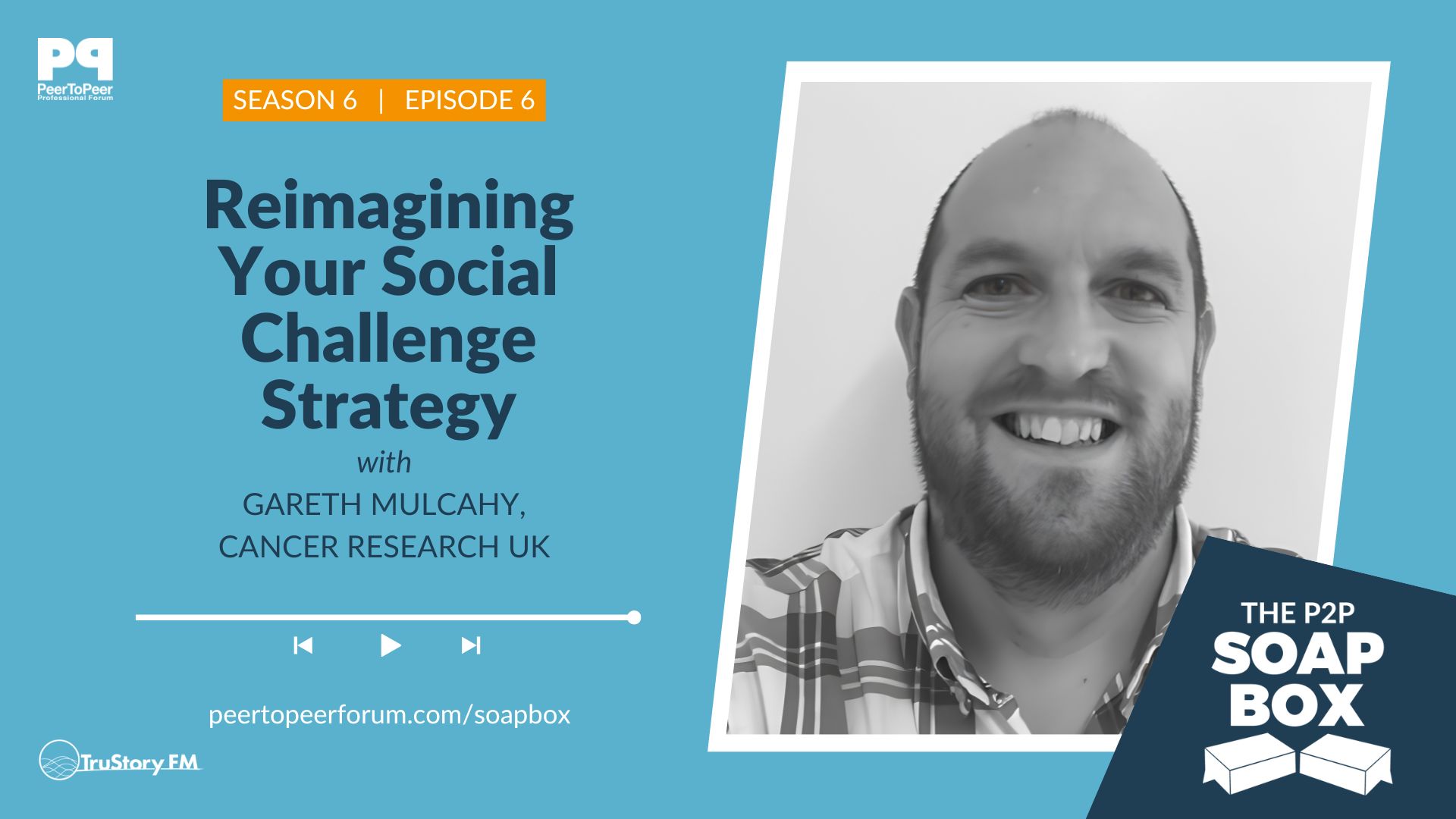
Hello, hello. Welcome back to the P2P Soapbox. I’m your host and P2P BFF, Marcie Maxwell. If you’ve been in the peer-to-peer space for a while, you remember the surge of social challenges. During COVID, these challenges took off in a huge way. They brought energy, connection, and a whole new wave of supporters into our communities at a time when we couldn’t physically be together. But here we are in 2026, and things look a lot different. Results have shifted, expectations have changed, and a lot of teams are asking where social challenges really fit moving forward. So here’s the question we’re digging into today: what does it look like to reimagine your social challenge strategy in a way that still feels relevant, meaningful, and worth the investment?
I’m joined by Gareth Mulcahy, Head of Proposition at Cancer Research UK, the world’s leading cancer charity, funding over half of all publicly funded cancer research in the UK. Everything they do is powered by their community, all in pursuit of bringing forward the day when all cancers are cured. Gareth shares why social challenges still matter, what it takes to operate at the speed these campaigns demand, and how to create experiences that feel authentic in a crowded space. We also get into the honest conversations about performance shifts and how to help leadership stay confident and clear on where these campaigns belong in your portfolio. So let’s jump into my conversation with Gareth Mulcahy from Cancer Research UK.
Gareth, welcome to the P2P Soapbox.
Gareth Mulcahy:
Thank you for inviting me.
Marcie Maxwell:
You are officially our first guest from over the pond.
Gareth Mulcahy:
Well, thank you. That’s an honor and a privilege.
Marcie Maxwell:
I love it. Well, let’s talk a little bit about your personal journey, your professional journey that led you to your role at Cancer Research UK.
Gareth Mulcahy:
Right. I’ve spent most of my career working on activities that connect people, have purpose, and encourage participation. I started off my career actually delivering an event series called Race for Life more than twenty-five years ago. That was literally turning up with a van of equipment at four in the morning, setting out courses, recruiting volunteers, and trying to market the event. It was a really hands-on beginning. And it really shaped how I lead today, trying to remember all those experiences. So when I talk to teams who deliver events and other activities for us, walking a mile in those shoes helps in some of my leadership decisions and decisions about how we set up products and how we fundraise.
That was my beginnings, and then over time I moved from operational roles into senior leadership, but always driven by the same focus, which is: how do you create experiences that ordinary people want to be part of, that feel inclusive, feel meaningful, and that generally move the needle to help fundraising and have impact to the cause? So that’s been my career.
I now lead our national portfolios, overseeing large scale transformation, and head up what we call our Do Proposition, which is for audiences who want to get out and actually go to an event or do a social challenge and fundraise — whether it’s Race for Life in our world or other things like, I think we’re going to talk today, social challenges. Bringing together our strategy, culture, and combining the purpose of what we’re trying to do with commercial rigor, and ensuring we have deep impact, which has led me here and why I’m still deeply committed to the work. So that’s who I am and that’s what I try and do.
Marcie Maxwell:
I love it. It’s so true — those of us that cut our teeth on the 3 a.m. wake-up calls, schlepping boxes, unloading, prepping for the event. It is a testament to getting your feet wet in this industry, and you’re jumping right into the process. So I love it. I think we all have a lot of war stories from events like that.
Gareth Mulcahy:
Oh my goodness, yes.
Marcie Maxwell:
We could have a whole other episode just talking about that. But as you mentioned, we wanted to talk a little bit about social challenges today, because that is something that you have been really making some great strides with and have a great approach to. So I think, as so many of us saw during COVID, during the pandemic, social challenges skyrocketed. They hit their peak. We saw this great growth across the sector. But now, as we look at 2026, I think a lot of orgs are trying to figure out, does this even fit in our portfolio? Does it succeed in the same way, and what should we be doing with it?
So I’d love to hear a little bit about why social challenges still matter at Cancer Research UK, and what your portfolio looks like today. Where are you seeing success? What’s helping you with your success?
Gareth Mulcahy:
Sure. Well, like every other charity, we’d been playing around in the social challenge space before COVID, and then, as they say, necessity is the mother of all inventions. COVID hit and everyone had to very quickly pivot, and the social challenge space really bore fruit in terms of giving experiences that members of the public can buy into and help us fundraise. And then it’s transitioning that from a moment of time into what is now a key offer in our portfolio and product.
The understanding about why it’s an offer for your organization is a really key question. What’s really clear is, after the COVID pandemic had passed and in-person events and other fundraising came back online, lots of charities saw issues with their social challenge performance. So it’s understanding what is your right to play in that space, and what helps you and what hinders you. The understanding of the core charity brand you have, and how big it is and how much power that brand has, is really a discussion about whether the social challenge space is right for you, because your brand needs to do a lot of heavy lifting for initial engagement.
To just think you can go in there and offer a challenge and get the same kind of results as other charities are getting is to make the mistake about how well your audience knows your brand, who you are and what you’re about, and what is the awareness behind it before we move into consideration about supporting you and actually people taking on a social challenge you might be offering. So luckily for Cancer Research UK here in the UK, we have those brand assets and that brand power, which has become a foundation from which we’ve been able to leverage the social challenge opportunity. But that’s why you should be in the market and how to be in the market, and if you don’t have that brand power, there’s lots of other fundraising challenges you can explore. So the first question for anyone considering it, or reconsidering social challenges as an option, is consider your brand power.
And then it comes into execution about how well set up your organization is to deliver something that has characteristics of a product that are different to a classic mass participation event that may take 18 months from initial concept to decide, to set up, to market, to recruit, and deliver. The speed of social challenges, particularly being in the social media world, start to finish, could be four months. Can you and can your organization operate at that speed? Understanding that, and if you want to operate in that space, one of the key questions is, how do I get my organization up to speed to meet the needs of the product so we can deliver quickly? Because the speed is an opportunity, but it is also a barrier. So you’ve got to understand how that works.
Marcie Maxwell:
No, I agree. We could unpack the speed piece of this for a while, Gareth. I agree that speed is critical, and I think for some, how do you plan to move quickly? I’ve spoken to people that say, yeah, we have systems in place so that when an opportunity arises, we kind of have ninety percent in the books, and then we just have to figure out the nuance. So what do you think it takes for an organization to ramp up that speed?
Gareth Mulcahy:
I think it’s understanding where your resources are in terms of marketing, in terms of fulfillment, in terms of performance measurement, and in terms of management oversight. Those are the four key areas I think are really, really important.
I think the need to understand what is rewrapping of key services that you need — and what are the key services? The magic trick is to have a pipeline of capability that is broadly the same for most challenges, but our ability to re-wrap in terms of marketing and positioning and offer multiple times with the same foundations. The more times you do stuff, the quicker it gets, and you get the efficiencies of scale. You can then focus on your rewrapping constantly and making sure that they’re distinctive in the market, distinctive in your portfolio.
Marcie Maxwell:
It reminds me of a conversation I had with the American Red Cross here about how they stand up these emergency campaigns where they said, whether it’s a tornado or a hurricane or a wildfire, the wrapping, to use your term, is going to be different. But the infrastructure, again, is ninety percent there. So they can go to market a lot faster when they want to seize the moment and capture the fundraising that they can in the time.
So I think the wrapping piece is so interesting because there are so many challenges that have started to feel interchangeable. If you go to your social media feed, run five miles a day for this charity, for this charity, for this charity. If you don’t have that affinity, sometimes the level of interest or what catches your eye can be the brand, and it can also be that wrapping, that activity of the challenge. So what are those elements that really make a campaign stand out and feel authentic to your supporters?
Gareth Mulcahy:
Can I just add something to that last point, which I think is really important, to your point about emergency campaigns and how they have to dial things up quickly? One thing I think is the distinction between responding to a moment in time where your staff will go the extra mile and work the extra hours to deliver. We ask that a lot of staff for reactive moments in time. The distinction between an always-on regular social challenge calendar and portfolio — they are fundamentally different. You cannot rely on the goodwill of staff for a moment in time for regular stuff.
So when people look at social challenges and see what appeals for responding to things in the moment, whether it’s an international crisis or anything else, the watch-out, from a leadership point of view, is some of that responsiveness, which is a characteristic of social challenges, needs to be more planned in and systematic, rather than a moment-in-time response. Because that’s where it falls down, and I’ve seen that in other organizations in the UK — the organization isn’t ready to sustain a prolonged period of quick turnaround. So whether we include that or not, but I think that’s a really strong point in the distinction.
Marcie Maxwell:
Sure, absolutely. So let’s go back to that wrapping piece. You’ve got your infrastructure in place. What are the elements that make one campaign, one social challenge, stand out to the supporters maybe over another?
Gareth Mulcahy:
That’s a really good point. And it is a crowded marketplace. There are some basic fundamental things about how you create a challenge. For example, being very clear on what the challenge is in the title of the challenge. That’s a pretty foundational piece. If people don’t know what you’re asking them to do — so “walk thirty days” or “thirty miles in May” as an example — really puts the challenge in the headline so it’s very clear.
In terms of accessibility, the classics of walk, jog, run, swim allow you to open up the biggest possible market, but everyone’s playing in that space. So there’s a wrapping piece there, and then you build on the things that need a bit of equipment, like a skipping challenge, and then do they have the equipment, or anything else like that? So splitting those two into the what’s very accessible and what you need a bit of equipment for is a good way to understand your portfolio as a whole.
If you look at the classics of run, walk, jog, swim, messing around with timing and distance is a great way to step out. Messing around with seasonality is a great way to stand out. But also a key differentiator for your organization through the others is what talent do you have a connection with, or your audiences, because you can use your talent’s story or connection with the audience as a driver to personalize your challenge.
I can give you a really good example. Here in the UK, we had a huge supporter of Cancer Research called Deborah James, who then became Dame Deborah James, who was a journalist and got diagnosed with bowel cancer, did lots of podcasts and a lot of promotion about early bowel cancer detection and everything else like that. Then unfortunately she lost her battle with cancer and passed away, and the Bowelbabe Fund — that was her brand, if you like, she was called the Bowelbabe — was set up to actually help carry on her legacy and carry on her work. So we did a social challenge around Dame Deborah James of what was going to be her 44th birthday, and it was walk 44 miles in October, which was her birthday month, and that raised over a million pounds in the month.
So understanding what relationships you’ve got, or the personal identity of an organization, and then putting that in as part of the character of the challenge helps you to stand out in the market, absolutely. And you get some good results. So that’s the classic way. And then if there is a bit of equipment you need, the skipping one is another classic example — you need a skipping rope. We actually offered the skipping rope as a free incentive to do it. Something new and something quirky. There’s a whole host of experiences like skipping challenges, X number of skips over the month or anything like that. So that’s a useful way of setting up challenges.
And then there’s also skill-based challenges, whether it’s learn to yo-yo or knit something or everything else. So there’s characteristics of challenges, and then what you can play from a brand identity, or distance, time, seasonality, that will help shape a really dynamic portfolio.
Marcie Maxwell:
As we mentioned earlier, social fundraising hit its first peak — but its peak during the pandemic. As results are evolving, how do you bring the leadership team at your organization along with you? Help them stay confident and invested in social challenges while also understanding that performance is just going to look different than it used to, and maybe we can’t expect the results we saw in 2021, but this is still a valuable source of funding.
Gareth Mulcahy:
I think what’s happening with social challenges — as it’s still quite a young product, people are comparing its performance and its trajectory against traditional fundraising channels, which is your classic product cycle of start-up, mass growth, mature, and then decline.
Now, one of the unique characteristics of social challenges is its main platform is Meta or TikTok — basically channels that we have less control of than traditional marketing channels, and channel resources. So it is particularly sensitive to changes to those platforms, changes to algorithms, changes to how Meta decides how it presents information or adverts, who they’re presented to. Based on that, it is not a straightforward trajectory of it’s going to get really big and then it’s mature and gone. You will have iterations of performance.
We’ve seen this in our world, where we’ve come from a height of about twenty-one million pounds, about twenty-five million dollars. Then it dropped considerably, then it’s gone back up again. So it’s more of a yo-yo performance. The issue isn’t it yo-yoing. The issue is knowing why it’s yo-yoing and how to respond, because one of the benefits of social challenges is it’s so quick that you can put interventions and optimizations in really, really quickly. So it comes back to the characteristics of the product, which is unique to social challenges, and not comparing it to traditional mass participation events or regular giving challenges, which are a completely different model.
Marcie Maxwell:
I think that’s a lesson across the board. We try to draw too many comparisons between different fundraising channels that are just strategically different ways of engaging people and modeling people, and we try to judge them all with the same lens. That is — as my podcast is called My Soapbox — that is one of the many that I think of: that we try to compare everything as if it’s apples to apples, when most fundraising channels are not.
So with that, you also said that social challenges just aren’t the right product for every organization. If leaders are trying to decide, is this a space I want to invest in, or should we be stepping back, what are the key things that our listeners and leaders should be looking at?
Gareth Mulcahy:
So the several questions you should be asking yourself are: Do we have clarity on the root causes of our current performance? Sometimes it’s difficult to get that data. What is the quality of the data you’ve got? You can make decisions on the back of that if it’s clean and clear, or you have to start making some assumptions.
If we take the example where you don’t have clear data of performance, the questions to be asking are: What is our brand performance in our market? Is it strong enough? Is it clear enough? Is our mission clear enough? Do audiences really know? Because my contention is, if your audiences don’t know clearly what the mission is, it’s really hard to launch a social challenges portfolio that will perform off the back of that. So you’ve got to either go upstream and improve it, or look at another fundraising product.
Secondly: Is my organization set up to meet the speed of social challenges? Are we failing because we’re not quick enough? Have we got dedicated resources? Quite often social challenges is a bolt-on to roles that do multiple other things, so it doesn’t have the time or attention. In my team, I’ve got a dedicated team who look at performance weekly, but also talk about optimizing campaigns week on week, or even day on day if we need it. What’s working? What do we turn on? What do we turn off? What creatives are working best?
We’re also, for the portfolio, changing what we’re going to deliver during the year. So you don’t set up a twelve-month calendar of challenges and just roll it out. We’ll look at almost quarter by quarter and say, well, we were going to do that again in quarter three as we did before, and we’re going to take that out and put something else in. So it’s that attention and speed to be able to deliver it.
And then the final question to pose is: What does this give you that other fundraising channels don’t? And how urgent is it? How urgent is the resource you potentially could apply to this, basically what you can do elsewhere? It’s a trade-off, or what other fundraising products you’ve got on your portfolio, how they’re doing, what they’re needing to grow. Are you sunsetting some of the activity so you need new stuff? So it’s the position of your fundraising portfolio. I think they’re probably the main questions you should be posing yourself to answer the question: do I stay and invest in social challenges, or do I exit?
Marcie Maxwell:
I think those are really great insights. Unfortunately what we see is so many people that it’s the fear of missing out. They’re like, well, everybody else is doing this, so we need to be in this space, instead of really asking, is this a good fit for us? And understanding it’s not a set-it-and-forget-it. It’s not, well, we just turned on a challenge, we’ll see what it does in a month. It actually takes, just like every other fundraising channel, time and investment. And for some orgs, that time and investment might be better put into their proprietary walk series — what could that time and effort do? And for others, this is opening up a new channel for them. So those are some really good insights there, Gareth.
I feel like we could talk for ages. I’m sure there’s going to be questions that are going to pop up, but if people are wanting to know more about Cancer Research UK, if they’re wanting to track along with some of your challenges, how can people get involved? Where can I direct them?
Gareth Mulcahy:
You can always go to our fundraising site, which is cancerresearchuk.org, and the links off the back of there. Or you can do what everyone else now is doing — ask Google, where’s Cancer Research UK’s latest social challenge? And AI will tell you.
Marcie Maxwell:
Exactly.
Gareth Mulcahy:
Which means nobody else is visiting your website, but you’re getting the answers on the top of Google, so that’s helpful.
Marcie Maxwell:
That’s a whole nother podcast topic, Gareth.
Gareth Mulcahy:
Yeah, sorry, we haven’t got time for that. But yeah, do Google us. That’s probably the quickest way. You’ll come to our website and go from there.
I think also have a look at what other people are doing. To the point you raised about the fear of missing out — in our sector in the UK, there’s only a few organizations who can be doing everything. Most charities are doing some things. So there will always be space and there will always be opportunity. So it’s an understanding from where you sit, from your vantage point as an organization. Where do you fit in the market? Where is your audience? What are they into? Because ultimately, if your audiences for your charity don’t really want to do social challenges, you shouldn’t be in them anyway. You need to meet the audiences where they are and meet their needs, and then you’ll find a connectivity to support frontline fundraising and develop longer lifetime journeys, which is what we’re all trying to do.
Marcie Maxwell:
Absolutely. Well, Gareth, masterclass in social challenges and what you need to be thinking about. So thank you so much for joining us and sharing your wisdom.
Gareth Mulcahy:
Thank you for having me. It’s been fun to have a chat.
Announcer:
The P2P Soapbox is produced in partnership with TruStory FM. Engineering by Pete Wright. Music this week is by Super Neato. If your podcast app allows ratings and reviews, we hope you’ll consider doing just that for our show. But the best thing you can do to support the P2P Soapbox is simply to share the show with a friend or colleague. Thank you for listening.