*This transcript is produced using transcription software and reviewed for quality. Despite our best efforts, some passages may be incomplete or contain errors due to audio quality or software limitations.*
Pete Wright:
I’m Pete Wright.
Andy Nelson:
And I’m Andy Nelson.
Pete Wright:
Welcome to The Next Reel when the movie ends.
Andy Nelson:
Our conversation begins.
Pete Wright:
Nightcrawler is over. I’d like to think if you’re seeing me, you’re having the worst day of your life
Andy Nelson:
That’s the other thing you always say to me every time we see each other.
Pete Wright:
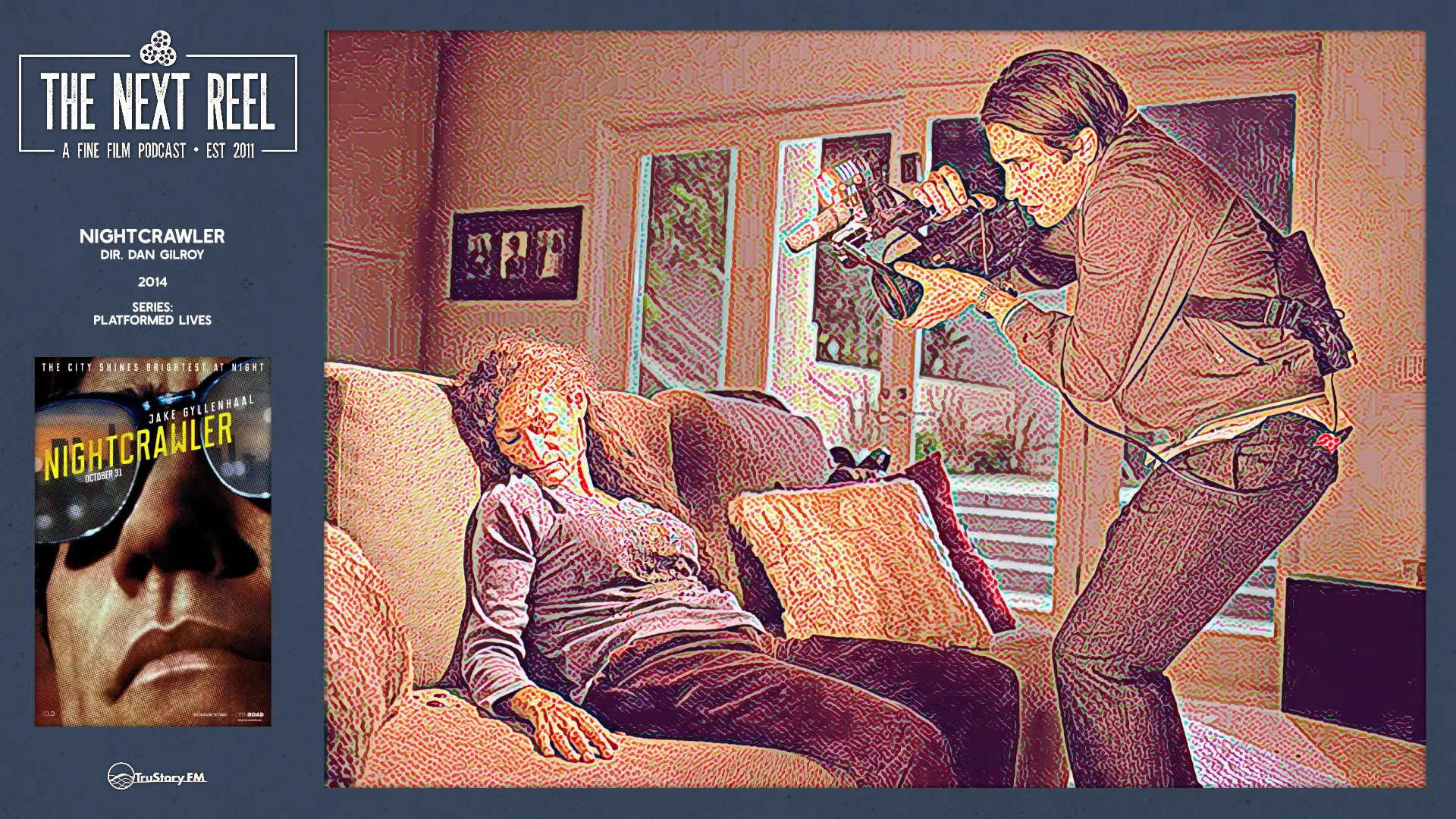
That’s not the thesis to the film, I don’t know what is Nightcrawler Andy, it’s the second of our season. It’s the second of our Platformed Lives series, and it was a delight to watch this movie again. Oh my god, Leo Bloom Not a good guy, Leo Bloom.
Andy Nelson:
Isn’t it Lou? Lou Bloom
Pete Wright:
Why do I call him Leo Bloom? Because I think Leo is actually a better, more rhythmic
Andy Nelson:
But then you can’t get the Louis joke.
Pete Wright:
Lou Bloom, yeah you’re right.
Andy Nelson:
Is Leo short for anything? Leonidas?
Pete Wright:
Leon Leonard Linus
Andy Nelson:
Oh Leonard, yeah, I guess. That’s a little more common than Leonidas.
Pete Wright:
yeah, Leonidas, his friend Ozymandias. I think we’re doing fine. So had you had this hit you watching it this round? You’re you’re already a fan of this movie
Andy Nelson:
Already a fan, absolutely. I think we’ve mentioned a number of times over the course of our show that we’re both fans of the Gilroy’s, the Brothers Gilroy, as a trio They’re all doing interesting things in the film industry, right? Like we’ve talked about oh gosh, did we talk about Dan I already? I think when we were talked about the Bourne Legacy, I believe, because he worked on the screenplay for that. we’ve certainly talked about Tony. I don’t know if we’ve talked that much about their brother. John who edits, but he’s certain he’s certainly another part of this project as he’s you know, they’re they’re all kind of doing their different things in the film industry. But I just think they’re such smart storytellers and filmmakers and This is such a dark, dark glimpse into just kind of like America and media and audience consumption and I think that it’s just a I mean it’s I loved it when I first saw it. It’s a hard film. I haven’t watched it since, but revisiting it, I actually was surprised how funny I also thought it was. And like this is actually not as hard a watch as I had painted in my head. I was I was really impressed with kind of like how darkly comedic I found this story.
Pete Wright:
It was interesting because they I so, you know, I did my time in local news. And I was for a long time was the guy holding the camera, but for a news truck and we didn’t go out on these kinds of things. you know, I guess sometimes we would go out to bigger catastrophes, but you know, not every traffic accident got a news van. And so I was always sort of thought that, you know, maybe they were overstating just how gross it is, the whole lifestyle. So I talk as you know, as listeners know, I’ve got a kid who’s an EMT, and I asked my EMT, how often do you see people like this at crime scenes? And they said, Oh, every time. I was like, oh, that’s horrible. And they said, yeah, why? And I explained the concept of this movie, which they did not watch with me. And they said, Oh God, no, that’s really gross. I did not know that there was this whole sort of economy. of people of independent people with cameras that are, you know, filming this stuff and selling it. And I and they said, you know, I always just put my body in front of the victim or victims, right? I just try to get in between
Andy Nelson:
Yeah,
Pete Wright:
the cameras and the victims to hide their faces. And I think that gets to this conversation about consent, the continuation of our conversation about consent from last week, talking about what platforms do with consent. And in this one, you know, obviously on one angle, consent is completely bypassed, right? Leo… Lou — I realize it’s Leo Bloom from The Producers. That’s why I can’t get this out of my head. Leo Bloom and Max Bialystock, and really we’re talking about Lou Bloom, Lou’s whole business runs on people who can’t consent, right? They’re dead, they’re dying, they’re bleeding out, you can’t get a release from them, they’re you know, essentially, you know, they’re public, they have no reasonable expectation of privacy. They’re on the street. If they can cat get the video can be captured, it’s captured. He films them because they can’t refuse. The other piece that this sort of the movie deals with is the coerced consent from Nina, which is really interesting because the incentives Allow her to be extorted, right? Sextortion at one point, extortion because her job is on the line, but the incentives for her in this whole economy of crisis allow her to give consent that she would not otherwise give. So the spectrum I think is really interesting and the where this sits in our little trio of Platformed Lives films. it’s kind of the only one of the three that has both manufactured or incentive-based consent and completely bypassed consent. So I find it a really interesting place that this movie holds.
Andy Nelson:
Well and I think in the scope of Platformed Lives I think it’s gonna also be valuable to talk about the actual platforms And the audiences that make these platforms worth anything, right? And Dan Gilroy said this. He said, I think to some degree It’s certainly an indictment of local television news, but I’d like to cast a wider net. Why do I watch these images? And how many of these images do I want to put into my own spirit? And I think that’s the thing. It’s like Truman show. That show is popular because there’s an audience that craves that and wants to continue watching the life of Truman and all the tedium that goes along with 24-hour broadcast. this movie, it’s all about the public feeding on wanting to see bloody images and that feel like raw and unfiltered and it’s kind of horrifying to look at, but the audience wants it and these producers know it and Lou learns that and he is there to feed on it. And I think That’s an interesting element in both of these films. It’ll be interesting to continue this conversation in next week’s Sorry to Bother You about like how w how this platform exists because there’s an audience that craves it and wants to feed on it.
Pete Wright:
Isn’t it also interesting though the other thing? Perspective from local news, right? Because you’re right. The producers know that you know the axiom, right? If it bleeds, it leads At the same time, there is legitimate conflict in the ranks of the production team, right? Rene Russo is the news director has the perspective that she needs more viewers, more viewers like more blood. and we have to get more blood on the air so the economy exists. But there are people around her saying, no, no, we have to stop doing this. This isn’t the story. This is in the way of the story. And she does not she generally does not abide by the conflict. And I think it’s interesting that the movie sneaks that perspective in I don’t know how nuanced those conversations are being inside, you know, the halls of local news right now, today in 2026.
Andy Nelson:
Yeah, that’s a good question. Like I feel like the voice, I’m not sure who that I can’t remember his name, Frank, I believe, who works at the station with her. who is that sole voice of, you know, there w it’s we’re where are our morals? Like this not something we should be doing. We should be asking questions. Like Did he break into that house to get this footage? Like the things that you should be thinking about when you’re having a situation like this present itself as a as a producer about what morals went into the thinking behind this stringer’s capturing of the these images. And it’s clear because of the place that Nina’s in, and it’s a fascinating conversation when Lou elucidates us that he understands to her position. She’s an older woman. Every two years she’s in a new studio and she’s her contract is about up at this one. She needs to prove it’s sweeps week. She needs to prove that she can get the numbers that they want, or she could potentially be out of this job and looking for another one. And he totally exploits that and he’s willing to do what he needs. And so she’s willing to do what she needs in order to get the great footage and put it out there. And it’s you know, it’s it’s a dark a dark story, but I think it speaks to the needs that these people are put into because of the job positions that they have.
Pete Wright:
Job positions, especially for Lou’s position, right? He starts the film as a petty thief, right?
Andy Nelson:
Yeah. It’s not like he takes a turn into a dark road by becoming a stringer. He’s always been a terrible human being.
Pete Wright:
Yeah, he’s a terrible human being already. Like his arc is he discovered that he can steal a watch pretty easily. And now he’s gonna start stealing people’s, you know, stories, the worst days of their lives. And that you know, in I think the movie paints this picture that those two things are the same. that he’s still just taking, just taking for his own you know, for his own good. And he just found a way to be consistently profitable at it.
Andy Nelson:
Additionally, you it make it what makes Lou all the more frightening and disturbing is he is clearly somebody who reads you know, every Tony Robbins book, who studies all of these online business classes, and like he has all of the sayings that he’s, you know he’s kind of gleamed from all these different courses that he’s doing that he’s repeating and living by and he’s created his own like he’s frightening at how good he is. at all of these different things he’s doing. Like he absorbs the information, he adapts himself to this new information and he improves himself. Like he’s constantly working to improve himself, make himself better. It’s just he has a complete lack of moral fiber. And so that’s what makes him extra frightening, because with the lack of moral fiber and that incredible business acumen that he kind of continues nurturing and growing He just he grows into continue like the worst version of this possible person.
Pete Wright:
Yeah, that’s a I’m really glad you brought that up because I didn’t I didn’t have that in my notes, but it’s really worth acknowledging that He took the stuff that millions of people digest. I don’t know what p percentage of those people actually ingest and actually digest. I’m using a lot of the jests. That sounds ridiculous. actually make it a part of their lives. Like I think most people read those things and take pieces of it that work for them for them. He takes the entire outline and integrates it into his own identity. And this is what happens when I mean I don’t think I don’t think Tony Robbins is out there saying Hey, if you do this, you’ll be a better criminal and a worse human being, but you’ll be super efficient at it. But that’s what happens, right? This is what happens when you put good intention behind ill will And he does. He d the movie demonstrates he gets better and better at building an organization. I think the only lesson we are to take out of the his next step and the closing of this film is that He’s built he’s building actively the organization that he set his sights on in the very beginning. When he first hired Riz Ahmed, he was he his eyes were on building an organization and doing it in a way that follows up on the legacy of the stuff that he spends all day in i integrating into his life. All of the self-help stuff, the you know, build a better self, build a better business, kind of stuff. So I don’t know if I’m sitting in his seat, I’m like, hey, I’m this is a very successful and land of opportunity kind of story. And it’s also it speaks the worst that there is an incentive structure that allows him to end this movie, the worst guy we know in this movie. And he now has three teams in three different vans that are all branded and taking off in different directions into the night. That’s so gross. That’s so gross.
Andy Nelson:
It just speaks to the darkness of the character. One of my favorite scenes in the film, actually, is when he is early like selling himself to Nina and why he’s so skilled and brilliant and The thing that he does, which I think is fascinating, is that well, the thing that Dan Gilroy, along with his actors, but He has that scene play almost like and I think i this might have been actually what he said, but it he’s like he’s talking to Nina and it’s almost like a marriage proposal. Like it’s a pitch. The way that he’s pitching to her and describing himself and his beliefs and his the way that he does his r handles his relationships. Like it’s it’s a fascinating glimpse into his psyche and how he how he views his everything in his world and it’s all just these transactions that he’s he’s creating and that develops into the more frightening version of the relationship with Nina when he says, I like you, this is after that, you know, date at the Mexican restaurant, and he’s like, I like you. And I we’re gonna start sleeping together. And this is why you’re gonna do what I ask you to do. This is why you’re gonna pay me the amount of money that I want. Like it suddenly shifts into the most frightening possible of conversations. And it’s because, again, he’s adapted himself to all of these different sales techniques and pitches and everything that he’s been learning. And it’s truly frightening.
Pete Wright:
Yeah, it i everything has become so matter of fact, and he all he does the entire movie is find leverage. And I think on Jake Gyllenhaal, I’m already a fan of Jake Gyllenhaal. I think he does generally really, really good stuff. This may be my favorite Jake Gyllenhaal experience, and I’m a fan of the breadth. Like, I liked his Mysterio. I liked his weird criminal in Prisoners. Like I that is
Andy Nelson:
It’s detective, the weird detective in Prisoners, yeah.
Pete Wright:
Is detective, right, right, right, and Prisoners. I feel like the scope of what he can do is really great. And this movie I think captures all of the stuff that I like about him the most.
Andy Nelson:
And how he does a great job of performing where he doesn’t blink very much.
Pete Wright:
Yeah, right.
Andy Nelson:
And he’s got such great eyes that get so big. And when he’s already losing weight for the role, like eating kale salad every day and running fifteen miles a day, whatever, he’s so gaunt in this film. And so his face is his eyes seem extra large when he just doesn’t blink and he has those stares. I mean it’s it’s it’s amazing what he puts into his performance both emotionally and physically.
Pete Wright:
Well, what apparently they were going for is his Lou Bloom as a coyote, right? He wanted he’s sort of manifested that you as you say, the gaunt look that he’s He’s just living on the fringes, you know, surviving on other people’s sort of carrion. I think he just nails that experience for me.
Andy Nelson:
Oh, it’s it’s just fantastic. We’ll definitely talk more about his him and everything when we get to the awards because the fact that he wasn’t nominated for an Oscar for this is such a that’s a Great example of disappointment with the Academy for not getting him nominated for this. It’s it’s amazing. But you know, sometimes dark performances just as great as they can be, they’re the sorts of performances that aren’t going to get the Oscar attention
Pete Wright:
Mm-hmm. Before we take our first break, can we just talk about the last major scene because the movie is broken up in, you know, Lou building his business and he’s doing that through Exchanges with emergency services. He makes enough money to buy a new car. He does the things you need to do to slowly but surely improve his station in this economy of tragedy. And so we see him at traffic accidents, we see him at you know, m stabbings, whatever, we see him actually at the accident of one of his competitors, late great Bill Paxton, wraps his van around a pole and he cov Lou covers that just like he covers everything else. ‘Cause he caused the accident. And he’s aware of the meta nature of the of the experience. But then we see him at the house, the murder house. And he captures enough footage. First, obviously he goes in the house when before the authorities arrive and captures all of the bodies, the murdered bodies throughout the house. He also captures the license plates and the faces of everybody of the criminals as they get away and then withholds that from the police. So It’s almost like every single step. I should add the other important building block is he gets to that first traffic accident and realizes the framing is off before the authorities get there. So he moves the body. so that it is more cinematic. So we know he is not an authentic agent of coverage for local news here, but it’s that final piece where He didn’t just move a body. He literally withholds evidence in an active investigation so that he can use it and create his own news later when he follows the truck and calls the cops. and stages cameras around an event that he knows is going to be combustible. And it spoiler, it is. Your that final scene, that final sort of payoff In the crossfire, actually it’s not even in the crossfire. At the very end, they think everybody’s dead. Our Riz Ahmed’s character, Rick, is killed, and Lou does nothing about it. How does this climactic final sequence, as the sort of exclamation point at the end of our time with Lou, how does that work for you?
Andy Nelson:
I mean, I think it is the culmination of everything that we’ve grown to expect with him as a character, as far as the way that he thinks. the desire that he has to capture like he’s learned what makes good footage. He’s he’s totally figured all this out. And as he tells Rick at a certain point earlier in the film, he’s just like We just wanna, you know, we’re gonna call the cops, but at the right time, when they’re at the right place to make it for an interesting scene. And so he waits until they’re at this diner and does it there where there are other potential victims. As it turns out, they’re actual victims of the of the gunfight that ends up ensuing between these two criminals and the police. All of this stuff makes for a more genuinely interesting footage that he can cut together because he has Rick get out of the car and go down to get another angle. So they have it all from these two different angles. And I think on top of all of this, it shows how Lou thinks as a businessman and he’s so pissed at Rick for having, as he thinks, exploited him by because Rick has figured out kind of w how Lou thinks and what Lou’s intentions are, that he essentially blackmails him for half the money. He says, I want half of what you’re gonna get out of this job. You’re not gonna pay me just $75 a night. You’re gonna pay me half of this potential, I don’t twenty, thirty thousand dollars that he’s gonna sell the footage for. Because of that, In the middle of all of this, of all of this footage and everything, when Lou out you know, they’ve got done the whole car chase, the criminal has crashed his car along with the police car. He knows that The guy’s alive, but he tells Rick that he’s dead. Go in there, get a shot while Lou stands back and films the entire thing of his guy getting shot by this guy. I mean, it’s just, it’s so dark, and it speaks to the place that Lou is as this dark, dark businessman who has spun this world and refuses to let anyone exploit him? He’s gonna be the one who comes out on top. And he does so. He uses this moment to get back at Rick. He doesn’t care. He now has great footage of Rick dying, you know, and that’s that’s how dark this person is. I think it’s a fitting climax to how this film has been building.
Pete Wright:
And Riz Ahmed through the entire film is really wonderful, right? He’s super understated, you can tell he’s an ashamed introvert, right? He doesn’t have a lot going for him and he’s really taking a step to take this job because he thinks it’s something that’s gonna that is more than it is, and then it becomes vastly more than it ever was, and he’s being asked to do things and is being compensated, you know, a little bit to do things that are outside of his of what he would I get the feeling would be his sort of ethical norm until he realizes what his own price is. Right. Like that scene in the car where he says, you know, I want half is him coming to terms with the fact that yes, he’s going to do these things. And he knows already that they’re wrong and he needs to be compensated at that level in order for him to be able to make sense of it in his head and heart. And I think that’s a I think that’s a really great turn for Ahmed. He’s such a nuanced actor and he’s done some really really interesting things over his career and this one is maybe one of my favorites of his too.
Andy Nelson:
Yeah, he’s fantastic, he really is. Okay, we’re going to take a quick break, but first you can find the show on YouTube and you can join us live when we record. We will even take your questions in the post-show chit-chat, and members get the full post-show conversation and always know what to listen to next. Subscribe to The Next Reel on YouTube, but the link to this episode is in the show notes. We’ll be right back.
Pete Wright:
So every time I think about this movie, I learn something new about the Gilroy family cinematic industrial complex.
Andy Nelson:
Okay
Pete Wright:
So, right, like all the Gilroy’s, like the whole family, I think, is on it. Rene Russo’s married to one of them.
Andy Nelson:
Yep, she married a Dan.
Pete Wright:
Robert Elswit is Academy Award-winning cinematographer for There Would Be Blood, and he’s on it, but he’s also Jake Gyllenhaal’s godfather. Is that true?
Andy Nelson:
That is correct. Yeah, because he has worked with Jake’s parent Jake’s dad when they were younger.
Pete Wright:
Wow. I mean, is that it? Am I missing any more? There might be, or probably more that we don’t that are unreported.
Andy Nelson:
Those are the things that I know. Yeah, that we’ve got all three brothers working on this. Dan’s directing and wrote it. Tony’s producing and John edited the film. And then yeah, Jake is working with his godfather.
Pete Wright:
Big family affair. The let I want to talk about elsewhere because there’s something really interesting about his camera and building this city that is somewhere between that kind of gritty, like no one would ever want to live here. cityscape that we often get and on the complete other end of the spectrum, Miami Vice, right? Like everything is Super saturated, succulent neon and that and brightly colored. This film kind of exists right in the middle And it makes me not want to not live there, but still be kind of repulsed what at what goes on in the city that we do have. I think it’s a really interesting landscape. What did you think of the of the Camera.
Andy Nelson:
Yeah, I mean I think it’s great. It’s a beautifully digitally shot night film that reminded me a lot of actually Collateral is the thing that I thought of quite a bit.
Pete Wright:
Yes.
Andy Nelson:
when I looked at this and also there are elements that I think of with Drive that also tap into just some of the night driving and everything like that I think that it fits well for kind of creating this space and this world and I like what he captures. both the seedier side of the city as well as the kind of the more ritzy glamorous side of the city. I just think it’s beautifully captured across the board. And what I love about it is, you know, by the time later in the film when Lou has earned enough money to buy himself a fantastic car that it’s bright red and it just pops all the more in a lot of these scenes because of that contrast.
Pete Wright:
Yeah. Yeah. Which is i it’s such an interesting choice, that car, first of all, because cinematically it looks incredible. narratively, it’s a reminder that Lou is fueled by a really kind of primal hyper masculine image of himself. Like I don’t I think if he were truly a hundred percent invested in his new life he would not buy that car that car makes him stand out in a way that probably is not what You know, I think Bill Paxton actually says something about it like nice car, but i y you could tell it’s it’s not the car that one would one should be driving around in. He I think m Lou looks at it as you know, it’s gonna get me where I need to go faster than everybody else. Very, very practical. But I think that’s a that he’s machining that justification because it’s not it is a weird choice.
Andy Nelson:
It is bold for sure, and it’s You know, they I think Rick says that later in the film when they are again, he’s manufacturing this moment at the end, and they are tailing the criminals in their SUV Rick is saying, don’t get so close. This is a very easy vehicle to spot. Like they’ll notice this bright red car tailing them. And I think that speaks to just the thinking behind that. Is and that’s I probably something that has never occurred to Lou in all of this is the fact that, oh yeah, if I’m actually tailing somebody, they can probably pinpoint that bright red car that’s that’s behind them over and over again.
Pete Wright:
And it’s one of the things that isn’t in all of the self help literature that he’s taking on, right? The specifics of this job, which are, you know, y you want to blend in as best you can. And Paxton actually you know gives him the opportunity to learn from a veteran in the field and he turns it down because of ego and his own sort of inflated expectation of what he’s gonna get out of it. And it turns out he learns the wrong lesson because he ends up being successful in spite of turning down. the offer from his own Yoda, which I think is another interesting turn. But anyway, all of that is to say that Lou Bloom’s Los Angeles is shot beautifully and compellingly, and that final car chase climax sequence is a really fun one. Like it’s fun to watch as they just careen down Los Angeles streets
Andy Nelson:
Yeah, and then, you know, crash and I mean it plays everything about that just really plays so well. It’s it’s great. Going back to the relationship with Nina, I you know, I want to talk just a little bit more about that because that’s an interesting this is an interesting story where Lou is essentially our a steadfast character through the film and kind of like changing those around him and pulling them down with him, really And Nina is an interesting one because again, he exploits her, he sexploits her. We’ve kind of already talked about that and how all of that plays. But then even after all those pitches and everything, that final scene between the two of them after this crash When he’s showing her the footage, and it is like a post-coital conversation between the two of them. as this footage is playing behind them and the way that they’re just looking at each other is just like raw passion and the words that they’re saying are all about like the sale of the footage and all this, but it’s really like this postcoital moment where it’s just the two of them head over heels for each other and what they’re able to achieve by working in this symbiotic relationship. That’s a dark dark journey that Nina ends up going on. Like she ends up in a dark place by the end of this film. And it’ll be interesting to see. I mean, yeah, maybe, maybe she’ll get through Sweeps Week and she’ll get a new contract. and be able to kind of continue her work. But where does she go from here? Like, does it continue down this dark road or what?
Pete Wright:
Yeah, she’s in an interesting spot because she becomes kind of our avatar for the marketplace of human catastrophe, right? Like he films and sells this stuff because there’s a market for it. She’s the buyer. We’re the audience. And what he is doing in his relationship is sort of systematically ensuring that she has completely lost all of her empathy. And we see that dynamic in the newsroom and we see I think when she is I think you’re right, when she starts to get physically, sensorially aroused. And there are sequences where she’s watching these things and they have this two shot on their faces kind of silhouetted in front of the wall of monitors in the control room and I’ve seen the movie a couple of times and I’m still not sure if they’re just gonna kiss in the control room, right?
Andy Nelson:
Yeah, right. Right. It totally feels like that. It’s coming.
Pete Wright:
Yeah, yeah.
Andy Nelson:
Yeah.
Pete Wright:
I think it’s really interesting to turn her job, her sort of principles into a victim for his he’s spreading his kind of aesthetic of the world like cancer and she is she is infected
Andy Nelson:
Yeah. Can we talk a little bit about the ending of this film? Because if there’s any spot that I have some issues with, it’s the way the film ends. I don’t know if you have any of the same issues.
Pete Wright:
Well, I don’t know, you’re kind of a contagion to me, so go ahead and tell me.
Andy Nelson:
And again, you know, if you haven’t seen this, why are why have you listened this far? But certainly we’re gonna be spoiling more here. The very end of the film, and this is like after this moment of the two of them in that it’s looking lovingly at each other while the footage plays, the detectives show up at the police or at the at the station and they want to talk more to Lou. They try to get him to pull the footage or the stu the studio to pull the footage. Like there’s a lot of stuff going on. They bring Lou down and she has this conversation. This is our detective has a conversation with Lou about the fact that he is withholding stuff. His he let his partner die. He filmed his partner die She thinks that and rightfully, although he denies it, that he captured the images, the footage of the criminals and knew who they were and it was able to set this whole thing up. And she tells him, she’s like, if somebody did that, it would be murder. But he gets off. Like he just he goes. Like the detectives are clearly pissed at him about all of this And the film ends in probably the more the darker version of the story, and perhaps the more cynical version of the story, where he gets away with it. and is able to now grow his empire. As we see the end of the film, he now has two vans that he and his team can run about with. They’ve he’s got three new employees that are working for him. And he has his little speech he gives to the end the dark comment that I wouldn’t won’t ask you to do anything I wouldn’t do myself, which we already know.
Pete Wright:
Yeah, that’s Grim.
Andy Nelson:
Yeah. It’s very grim. And then we see the two vans take off to head different directions in LA. So he wins. He it’s a dark victory for this story because this criminal is now out and about making even more money and capturing even darker footage, who knows, like doing more dark things. That’s the s the journey that the story takes where it ends on a very dark path. But does it feel authentic or does it feel like our writer director ended because he wanted the more cynical version of the story, as opposed to what I think is the more realistic version of the story, is that the detectives Assuming all of this about Lou would probably get a warrant, take all of his technology, all of his computers, all of his drives, you know, the cards with all the files on it and use all of that as evidence to potentially prosecute this guy. Like, does that seem like a more realistic version? Like I asked myself at the end of this, why aren’t they, why aren’t they just letting him get away with all of this? Does that does that something that strikes you at all?
Pete Wright:
Well okay. Yeah, I mean I guess if we’re if we’re living in the land of the real then the police probably would have more agency over the scenario and they would not be deterred by the station’s attempts to protect Leo, right? Because they know, right, the reality of our in-universe conversation is the station knows that Leo is a is a an asset and they’re gonna need him and they need to use him and they need to continue to get all of the resources that he provides. And I think that the police would care less about the station’s interpretation of their level of ability to protect this guy. But I don’t have a problem with it because I think it’s telling two important parts of the story. One is that It’s answering kind of the initial setup question, which is can these, you know, w how do these guys survive? These, you know, unethical stringers who are just out for the cash, how do they survive? And what does it look like when Nina’s role, when the station kind of loses its own sense of empathy because of, you know, commercial incentives, but also What happens when the authorities themselves are actually neutered? Because that’s that is a statement that the that the film kind of makes, but doesn’t actually have time to answer. which is the detectives don’t really have the resources that they need to deal with everything that has happened over the course of this movie, and they probably don’t understand it well enough. And crime is ongoing and things are complicated and I think the movie is talking about how the you know the nature of our capitalist tendencies gets in the way of our ethical and moral duty to one another. And the police are the vessel for that conversation. And the fact that they have it happen in the third act and then it sort of you know, Peter’s out, so to speak, is a testament both to that point and also the fact that we’re not in the real. Like that would be a different movie, I think. And I kind of I needed I hate this character. I hate that his he exists. And I needed him to win. Right? Because I needed the dark ending.
Andy Nelson:
Well, it fits. I mean, it fits for the story that Gilroy is telling. It absolutely makes sense to kind of go down this road. And this is my struggle because I mean, yeah, I agree with everything that you just said, but at the same time, it’s like if I’m going to buy into what he’s creating as this world Knowing that it’s a situation where police officers died because of his actions, I mean You know, I’ve seen you know, this is again, my thinking is based on way too many movies and TV shows and probably not enough real life, but Cops care about cops, and when cops die, they’re gonna do everything they can to put anyone involved to justice. And the fact that Lou orchestrated this entire thing and they don’t go after him, I just think that’s a that’s a little bit of a miss. And I think that Gilroy could have found a way to make that work where the cops weren’t able to get him for something, you know, and then we could still have that ending.
Pete Wright:
Is there any part of it and I’m I haven’t thought this through very well, but I’m It just occurs to me now that had Lou not orchestrated it, the actual criminals in the first place would not have been caught. I think that’s the position the movie is taking. Right. So Lou did orchestrate this whole thing and cops died, but they wouldn’t have gotten the guys at all if it weren’t for Lou.
Andy Nelson:
Well, you’re assuming that he then wouldn’t have turned in the footage revealing their license plate.
Pete Wright:
Yes, totally. Totally. I mean the fact that Lou is a part of this ecosystem is the statement maybe that the film is making the fact that you know in some small way there is a universe in which authorities recognize that this guy is a useful tool. And at some and sometimes that tool, the using that tool comes at a great cost.
Andy Nelson:
I think that’s a stretch. I again, if no
Pete Wright:
I didn’t tell I didn’t tell you it was a great idea, Andy. I told you it was a now idea.
Andy Nelson:
I know, I know. I like it, but again, if cops hadn’t died in the situation, like if there had been a shootout And the cops were able to get the guys. And the cops were pissed at Lou for having orchestrated all of this, but they still got the guys. And no one else was harmed, then yeah, I can see that being a situation where the cops are like, okay, we’re really pissed at you, but you’re serving a purpose. Because police die, because other people in this diner die, you know, I think that’s the thing that for me makes it harder to h harder to buy. And I just I, you know, I mean it’s it’s it’s a complaint I haven’t heard from many, but it’s that’s the thing that for me s I sticks with me and it makes it harder for me to really when I get to the end of this film I’m just like, ugh, I just I don’t know why he didn’t end up getting prosecuted.
Pete Wright:
Andy, you have just so thoughtfully articulated why this not going to be a five star movie for you. I just want to commend you on that. And I wish that you had g better arguments for all of the other movies that have stars fall. That was really perfect.
Andy Nelson:
Yeah, that’s funny, yeah. I guess I gave myself away. Oh my goodness. Yeah. No. But regardless, I still love it. I still love this dark ending of the film. I think it plays well. And you know, it just we haven’t talked, we’ve talked about kind of the cast and everything, but I think it’s worth just shouting out Rene Russo and how amazing she is. in this role as Nina. I love her so much. in this woman who’s stuck in this position where she has to make all these compromises. And I just I think that’s she plays that so well
Pete Wright:
I’m glad you brought that up because when was the last time we talked about Rene Russo? Do you remember? Have we talked about Rene Russo?
Andy Nelson:
I would probably say it was the in movies in the remakes series for the Thomas Crown Affair remake.
Pete Wright:
Yeah.
Andy Nelson:
That might be that might be the only time we’ve talked about her because we haven’t talked about the Lethal Weapon series.
Pete Wright:
Yeah
Andy Nelson:
Oh, obviously, well, not here, but on Marvel Movie Minute, we’ve talked about her in the Thor films.
Pete Wright:
Yeah, that’s true. Do you think you could take a stab at her top four? IMDb top four.
Andy Nelson:
Well, I feel like it’s gonna be Thor There’s gotta be at least one Thor film in there. And she’s in Thor, Thor the Dark World, and she’s in Avengers Endgame. I am going to say. I’m just gonna say Thor.
Pete Wright:
Okay. So you’ve got Thor on the board.
Andy Nelson:
I’m gonna say Thomas Crown Affair, I’m gonna say Nightcrawler, and I’m gonna say Lethal Weapon 2.
Pete Wright:
Okay. Okay. Those are your top four.
Andy Nelson:
Well they’re the they’re my four that I think IMDb will pick.
Pete Wright:
And you are half right. Exactly.
Andy Nelson:
Okay.
Pete Wright:
Thomas Crown Affair, absolutely. Nightcrawler, absolutely. I think that’s awesome, first of all.
Andy Nelson:
I love it, yeah.
Pete Wright:
The other two, one of them seeing it, I totally buy. I would have been right behind you on the Thor train, but none of the Thor’s, none of the MCU stuff gets on there.
Andy Nelson:
None of the Thor’s, okay. Is one of them the one with the gorilla, the animals?
Pete Wright:
No. One of them is Ransom, 1996.
Andy Nelson:
Oh, wow.
Pete Wright:
Okay.
Andy Nelson:
I forgot she was in that, yeah.
Pete Wright:
I know. I know. The other one is get shorty.
Andy Nelson:
Oh, I love that.
Pete Wright:
Right
Andy Nelson:
Oh, that’s awesome.
Pete Wright:
That is the way to go, IMDb, because that’s the perfect one to have on the list.
Andy Nelson:
That’s a great one.
Pete Wright:
And it makes me want to watch that movie again right now. What a great movie that was.
Andy Nelson:
Yeah. Great movie. Absolutely.
Pete Wright:
Yeah.
Andy Nelson:
Well, that’s a great that’s actually a solid list for her.
Pete Wright:
I know. I know. I indeed maybe they tweaked the algor algorithm. I think it actually works for Rene Russo. That’s great. She’s got twenty-nine other credits as an actor and those are the those are the big four I might have I might agree with.
Andy Nelson:
What’s Jake’s?
Pete Wright:
Oh.
Andy Nelson:
Yeah, let me guess on Jake.
Pete Wright:
Okay, go ahead and guess on Jake. This is hard.
Andy Nelson:
He’s gonna be hard because he’s in so many things. I’m gonna say Brokeback Mountain.
Pete Wright:
I should I should he has he only he has sixty-one credits.
Andy Nelson:
Yeah, he’s got a lot.
Pete Wright:
So Okay
Andy Nelson:
I’m gonna say Brokeback Mountain. Spider-Man Spider-Man: Far From Home
Pete Wright:
Okay.
Andy Nelson:
Would Okja be in there as a random one to throw in there? I would say Okja and Nightcrawler.
Pete Wright:
Okay.
Andy Nelson:
I feel way wrong on that one.
Pete Wright:
You’re exactly the same rate as you are with Rene Russo. You got Brokeback Mountain. That’s a no-brainer, right? Of course there is. Nightcrawler, you got that. That’s great. And I actually like that our two principles from this movie actually makes their top four. That’s a great sign. This is a great film. IMDb understands that.
Andy Nelson:
Is October Sky one of them?
Pete Wright:
Nope. Andy, you’re gonna Yes, Donnie Darko.
Andy Nelson:
Oh, Donnie Darko, Donnie Darko.
Pete Wright:
I was gonna say this is where you slap your head real, real hard. It’s Donnie Darko. And we’ve already mentioned the other. It’s Prisoners.
Andy Nelson:
Oh yeah, I was thinking about that when it was floating around, but Okay.
Pete Wright:
Yeah.
Andy Nelson:
Wow, okay, all right.
Pete Wright:
Yep. Not bad. Can just because we’re playing the game right now, I want to give you one more.
Andy Nelson:
Oh, is it gonna be Riz Ahmed?
Pete Wright:
No, it’s not. It’s gonna be the late great Bill Paxton
Andy Nelson:
Oh, okay. Twisters, Apollo thirteen, mmm, frailty. And I doubt it’s this. What else was a real standout Bill Paxton?
Pete Wright:
Oh, dude, come on.
Andy Nelson:
I know.
Pete Wright:
Come on.
Andy Nelson:
Oh, is it a simple a simple plan?
Pete Wright:
If no stop talking.
Andy Nelson:
Oh, damn, damn, damn it.
Pete Wright:
It is frailty. It is Apollo 13. It is twisters.
Andy Nelson:
Oh man, I was so good.
Pete Wright:
And because you didn’t get this It’s game over, man.
Andy Nelson:
Oh God, oh man.
Pete Wright:
Game over.
Andy Nelson:
Yeah. That’s embarrassing to leave aliens off.
Pete Wright:
It’s aliens. It is. Private Hudson. Yeah. That was that’s a tough one. You still did better than both the other two, although it is it’s not a great way to end
Andy Nelson:
Yeah, missing aliens, man. it could have been weird science. I mean, you never know with the algorithm, you know.
Pete Wright:
It could have been weird science. Right. It could have been weird science.
Andy Nelson:
Oh my gosh.
Pete Wright:
In this case I think they got it right.
Andy Nelson:
Yeah, yeah.
Pete Wright:
Okay.
Andy Nelson:
All right.
Pete Wright:
Anything else on your hot list here?
Andy Nelson:
I you know, I just this is just such an impressive film. you know, we didn’t mention James Newton Howard’s score, but I love that kind of electronic score that also kind of fits with Drive for me. Like so many things, just this Drive, Collateral feel like a great trilogy of LA night films, LA driving films. Like there’s just a lot of stuff going on in the stories that I think just taps into the world beautifully. And yeah, I love it. I mean, I again, this was so much funnier than I had remembered. And so in such a dark way, but it’s absolutely something I want to watch. more often. I just think it’s an incredible, incredible film. And more people need to be watching and talking about it.
Pete Wright:
Yeah. Yeah, for sure. It’s a it is a really great film. I want to watch it with everybody. And it also makes me want to go watch Andor again because it’s so cool to see Dan Gilroy’s pen behind so many episodes of such an incredible another family show, right?
Andy Nelson:
Yeah.
Pete Wright:
Like It’s a Gilroy family show.
Andy Nelson:
Cause Tony that’s a Tony show, right?
Pete Wright:
Yeah, but Dan wrote on six of the eight episodes of that first season. It’s just extraordinary. So I it this is really great. what a fantastic film to sit in this series and to kind of be in our opening salvo of this season.
Andy Nelson:
Yeah, and a really interesting one. Yeah, I love it.
Pete Wright:
Yeah.
Andy Nelson:
All right, well let’s move into the back half, but first let’s take a quick break
Pete Wright:
The Next Reel is a production of TruStory FM, engineering by Andy Nelson, music by Tzabutan, Solis, Oriol Novella, and Eli Catlin. And he usually finds all the stats for the awards and numbers at The-Numbers.com, BoxOfficeMojo.com, IMDb.com, and Wikipedia.org. Find the show and the full archive at TruStory.fm. You can follow us from there too. Plus, you can find out how to become a member and go further with every episode. Check out our merch store at thenextreel.com slash merch. And if your app allows ratings and reviews, please consider doing that for our show. All right, it’s award season, Andy. We let’s take us back. Take us back and let us know. I want the whole list. I can’t wait. I’d got my coffee. Go.
Andy Nelson:
This film did very well for itself, getting forty-six wins with 126 other nominations. The one to really complain about though is the Oscars, where the only thing it was nominated for was Best Original Screenplay, which lost to Birdman, which, you know, I mean, I think that’s also a great film. I think between the two
Pete Wright:
I would have given it to this.
Andy Nelson:
I may pick this one, yeah. And but the big one is obviously that Jake Gyllenhaal did not get nominated for anything for this one. So my question for you, Pete, is Who would you bump in order to put Jake Gyllenhaal on the list? The actor nominees are Eddie Redmayne for the Theory of Everything. He’s the one who won. Steve Carell in Fox Catcher, Bradley Cooper in American Sniper, Benedict Cumberbatch in The Imitation Game, and Michael Keaton in Birdman or The Unexpected Virtue of Ignorance.
Pete Wright:
Burley Cooper
Andy Nelson:
Bradley Cooper is who I would also cut. Yeah. I mean he was fine in America Sniper. It was a solid film, but absolutely Nightcrawler should have been in there for Jake Gyllenhaal. And I would probably pick him over Eddie Redmayne. as well.
Pete Wright:
A hundred percent, yes, that is true.
Andy Nelson:
Best picture though. what do you think? Birdman, American Sniper, Boyhood, The Grand Budapest Hotel, The Imitation Game, Selma, The Theory of Everything, Whiplash. I would still cut American Sniper off the list and put this in.
Pete Wright:
I would cut American Sniper, yeah
Andy Nelson:
Yeah. It’s also they were giving up to 10 and they only gave it 1, 2, 3, 4, 5, 6, 7, 8. Yeah.
Pete Wright:
Yeah, that’s like co that is the that maybe is the m biggest snub.
Andy Nelson:
So just throw it on there.
Pete Wright:
What are they doing?
Andy Nelson:
Yeah. Right.
Pete Wright:
Somebody at the accounting firm said we only do evensies. That’s a very strong line.
Andy Nelson:
It’s very frustrating. Birdman 1. It’s a great film. I Need to revisit it. would I pick Birdman? Would I pick Oh man, it’s also the year of Grand Budapest Hotel. I might just actually pick Grand Budapest overall thing. I know you would put whiplash.
Pete Wright:
Whiplash, man. Yeah, there is for me there is no contest.
Andy Nelson:
It’s a tough one. It’s a tough one.
Pete Wright:
And yet I would not put it I would not put Miles Teller in Best Actor. Like he was fantastic, but that movie is a s is the sum of its parts. And I th I know that, you know, J. K. Simmons got more notice in that movie than Teller did, but just in general it’s You know, the movie’s combustible because of all of its parts, but take any one of them out, and I recognize there are other better performances everywhere.
Andy Nelson:
Would you have put Riz Ahmed in the best supporting actor lineup?
Pete Wright:
Yeah, absolutely
Andy Nelson:
J. K. Simmons, Robert Duvall in the judge, Ethan Hawke in Boyhood, Edward Norton in Birdman, Mark Ruffalo, Foxcatcher.
Pete Wright:
Wow. What would you drop? Ru ruffalo, maybe?
Andy Nelson:
No, I’m trying to decide if I would add Ahmed to this lineup or not. It’s a solid list here. I don’t know. I don’t know. That’s a tough one for me. Or Rene Russo though, I would I would probably push to get her in the best actress in a supporting role lineup more than Riz Ahmed. Patricia Arquette won for boyhood, Laura Dernan Wilde, Keira Knightley in the Imitation Game, Emma Stone and Birdman, Meryl Streep and Into the Woods. I would drop Meryl Streep and I would put Rene Russo in here.
Pete Wright:
Yeah, that’s the that’s the call.
Andy Nelson:
Yeah. All right.
Pete Wright:
Well, we’ve we’ve solved years ago, Oscars.
Andy Nelson:
That’s right. over at the Saturn Awards, it was nominated for Best Thriller film, but lost to Gone Girl. Rene Russo won for Best Supporting Actress, and Jake Gyllenhaal was nominated for Best Actor, but lost to Chris Pratt in Guardians of the Galaxy. That is a silly one to lose to.
Pete Wright:
I can’t believe that exists, but it is also the Saturn Awards, so
Andy Nelson:
I know. It’s the Saturn Awards. Yeah, I know. And then over at the Film Independent Spirit Awards, it won Best First Feature, Best Screenplay, nominated for Best Editing, but lost to Whiplash. Best male lead, Jake Gyllenhaal was nominated but lost to Michael Keaton in Birdman. And Riz Ahmed was nominated for Best Supporting Mail, but lost to J. K. Simmons in Whiplash. And then these were just two interesting ones. the California on Location Awards. It was nominated for the Location Team of the Year for an independent feature film. But last two of all things, taken three.
Pete Wright:
What they came home, yeah, that’s weird.
Andy Nelson:
I guess I didn’t follow the taken films long enough to realize that by the time you got to the third one it was LA, not somewhere in Europe. And then the Location Manager’s Guild International Awards. It was nominated for Outstanding Locations in a Contemporary Film, but lost to Wild. So yeah, interesting, interesting set of films there.
Pete Wright:
I can I can totally see why it lost a while though.
Andy Nelson:
Oh yeah, yeah, absolutely.
Pete Wright:
That makes all the sense. All right. How to do at the box office. I’m sure you have some numbers this week.
Andy Nelson:
For Gilroy’s movie, he had a budget of eight and a half million, which is just under eleven point four million in today’s dollars. The movie premiered at the Toronto International Film Festival September 15, 2014, then opened wide on Halloween, October 31st, opposite Before I Go to Sleep. the limited release of Interstellar, and the 10th anniversary release of Saw. This easily took the number one spot and it stayed in the top 10 for three weeks. Apparently some of Open Road Films’ viral marketing strategies paid off. I guess they did like a whole thing where they made a fake like LinkedIn profile for Lou Bloom and all sorts of things. the movie went on to earn $32. 4 million domestically and $17. 9 million internationally for a total gross of just under $67. 5 million in today’s dollars. All told this was a massive win for everyone involved. It went on to earn almost six times its budget back, landing with an adjusted profit per finished minute of almost $480,000 and definitely amassed quite the following.
Pete Wright:
All right. I feel okay. I feel redeemed.
Andy Nelson:
I think it’s fantastic. It’s such a great film. It’s a tough film, but it is a funny film. It’s a really interesting glimpse into a criminal’s mind. one who is brilliant, who again feeds on that Tony Robbins style of business growth acumen and who’s completely lacking in morals. And I think the movie is all the better for it. It’s such a dark story. I love it.
Pete Wright:
You know what’s funny about this, about the whole conceit, is that it strikes me as completely normal. That somebody who is such an aficionado of the self-help genre would name his business video production news. Like that is the most banal. ridiculous name for the company. And weirdly, it’s a name that sort of begs somebody who for somebody who is like trying to blend in. Don’t notice me, don’t notice me. And then he gets that ridiculous car. I don’t even know man anymore in this movie. It’s it’s a hodgepodge, but I love it.
Andy Nelson:
Yeah, fantastic. All right, well that is it for our conversation about Nightcrawler. Next week we’re looking at Sorry to Bother You. Boots Riley’s twenty eighteen debut feature about a black telemarketer in Oakland who discovers a shortcut to success and finds himself pulled deeper and deeper into a system that’s far darker than anything he imagined. It’s surreal, furious, funny, and unlike anything else in the series. We’ll see you next time. Now let’s do our ratings.
Pete Wright:
Letterboxd.com/thenextreel is where you can find our HQ page. That’s where we review and rate all of the films that we talk about across the Next Reel family of film shows. What are you gonna do for this one? Mr. Half Stark.
Andy Nelson:
That’s right. I love this film. I always trip up at the ending, so it’s four and a half at a heart for me.
Pete Wright:
Guess see if you can guess what I am.
Andy Nelson:
I’m gonna say you’re five stars. Five stars in the heart, yeah.
Pete Wright:
I am very much a five-star. I have no excuses. I don’t mind the little mental leap I have to take. at the end of the movie that is decidedly not in favor of the police. That’s it maybe that’s a litmus test for my personality, but I’m okay with it. And it’s a great movie. I can’t wait I already can’t wait to watch it again.
Andy Nelson:
Yeah, no, it’s it’s brilliant. It’s such a great film.
Pete Wright:
Yeah.
Andy Nelson:
Well, that averages out to four point seven five, which rounds up to five stars in a heart anyway, Pete. So there you go.
Pete Wright:
I win
Andy Nelson:
You can buy the show on Letterboxd at the Next Reel. You can find me there @sodacreekfilm, and you can find Pete @petewright. So what did you think about Nightcrawler? We would love to hear your thoughts. hop into the show talk channel over in our discord community where we will be talking about the movie this week our conversation begins
Pete Wright:
When the movie ends Letterboxd giveth, Andrew.
Andy Nelson:
As Letterboxd always doeth.
Pete Wright:
Okay, my review isn’t really about the f the film.
Andy Nelson:
Okay
Pete Wright:
It’s it’s about just life in general. And I love it and because I think we relate to it. It’s four-star in a heart from Andrea, rose emoji. Freelancing is so scary, the only way to properly convey it in film is through a psychological thriller. Amen, Andrea. Amen.
Andy Nelson:
Nice.
Pete Wright:
What do you got?
Andy Nelson:
Well I have I’m gonna do two because they’re similar and they’re kind of related. the first is a five star in a heart by Sophie who says the only reason Jake wasn’t nominated for an Oscar is because he’s just like this anyway.
Pete Wright:
Oh
Andy Nelson:
I know. Well that’s followed by Lily’s four-starter heart that says, I wouldn’t be surprised if it turned out that this was a Jake Gyllenhaal biopic.
Pete Wright:
Wow.
Andy Nelson:
Apparently, yeah, some people Dark, I know
Pete Wright:
Wow. So much shade for Jake Holy smokes. I tell you, we wa so we’re in the middle of a of a Marvel rewatch, the back half of Marvel, because one of my kids. missed a lot of them like from the pandemic on. And we started because we just wanted to watch the Tom Holland Spider-Mans again… Spiders-Men? Spider-Man movies. And we watched a couple nights ago, we watched Spider-Man: Far From Home. And putting that Jake side by side with just this Jake is extraordinary. Like he is, he’s clearly one of the character actors we’re going to remember because they’re different guys. Right? He’s like he’s a different he’s one of those in a different class of Actor for me. I think he’s really terrific. All right. That’s all. That’s my whole pitch.
Andy Nelson:
He’s fantastic. I haven’t seen that since it was in theaters. I should check that one out again.
Pete Wright:
It’s really great. Best line. Sir, sir, I’d love to help. I’m very strong and I’m sticky. Okay, that’s it. Thanks, Letterboxd.