*This transcript is produced using transcription software and reviewed for quality. Despite our best efforts, some passages may be incomplete or contain errors due to audio quality or software limitations.*
Pete Wright:
I’m Pete Wright.
Andy Nelson:
And I’m Andy Nelson.
Pete Wright:
Welcome to The Next Reel. When the movie ends—
Andy Nelson:
Our conversation begins.
Pete Wright:
The Truman Show is over. “Somebody help me. I’m being spontaneous!” I had very sad lines prepared for that, the lines that really represent what this movie is about for me. But I decided that to open the new season, Andy, that would be inappropriate.
Andy Nelson:
Yeah, that would be dark. A dark way to kick things off.
Pete Wright:
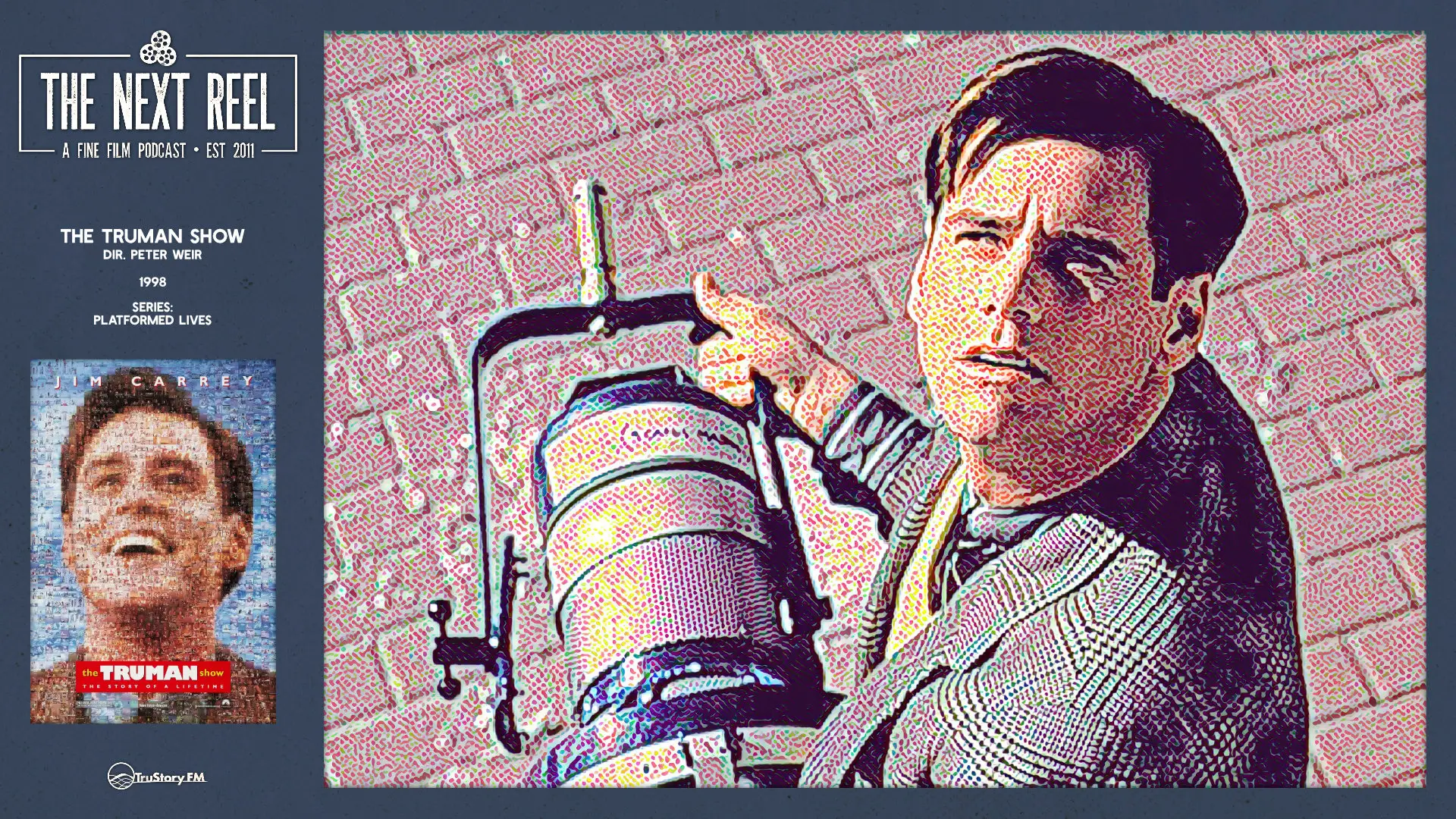
Yeah, yeah. Because that’s what we’re doing. This is season sixteen. We are doing this again, and we’ve got a whole new slate of movies for this year. I’m very excited about it. And we’re starting with The Truman Show as part of my series called Platformed Lives.
Andy Nelson:
Yeah, tell us about this series of yours. What’s the intention of it?
Pete Wright:
Did you have any thoughts about it? What do you think it means?
Andy Nelson:
Well, it’s performative. I feel like these are people who each—I guess you could say—have their own platform, their own space in which they’re performing, or they’re trying to capture performances. I mean, we’re talking about The Truman Show, Nightcrawler, where Jake Gyllenhaal is a reporter who’s totally okay going to dark places in order to get the story, and then Sorry to Bother You, where we have a man who learns he has to speak in his white voice to actually do his sales at this new job of his. So there’s an element of performing because of whatever the corporations, the media, whatever it is, need from us.
Pete Wright:
I love that. I love that so much that if my original idea doesn’t pan out, we’re just going to go with yours. But originally I had this idea about Platformed Lives being about consent—what platforms do to it and with it, right? It’s about how being watched stops being something we all agree to and becomes something that’s just plain done to us. And Truman is the purest case for that arc. Consent isn’t missing—it’s impossible. He could never have said no in this universe. It was just obvious that he was always going to be watched, because he was adopted by the corporation—the ultimate terms and conditions, adoption papers. And Nightcrawler is consent bypassed through tragedy. He’s not getting consent from these people who are injured, having the very worst day of their lives—he’s just taking it, and his excuse is news. But he’s still stealing consent from these people and using it for wealth and building his platform. And Sorry to Bother You, consent is manufactured. It’s industrial. You have to sign—what’s it called?—the WorryFree consent form, and then he ends up performing, and things go crazy in that movie as a result of what he agrees to do with his life as part of his partnership with this organization.
So all of these films are looking at our relationship to consent, and I’m curious what we end up being able to learn from these films about what platforms take from us today. As far as we know, you and I are not in The Truman Show, but our consent is definitely being manipulated. And I think these three films are an interesting look at how.
Andy Nelson:
I mean, I think that really says it. I’m actually curious—you made me just start thinking about it. There was that movie, I think it was called Not Okay, with Zoey Deutch, that came out a few years ago, about somebody who’s trying to be bigger on social media and ends up in some situation where there’s this big event that happens, like a big traumatic event, and she’s nearby, or somehow fakes that somebody she was with had died in it, and ends up creating this performative thing to gain popularity. It just seems like there are a lot of interesting stories, especially these days, as people are exploring how the changing landscape affects us, and how we change who we are because of it.
Pete Wright:
Well, I’ll shout out Cam, which we just did on Sitting in the Dark as part of the AI Girlfriend Experience series. A central tenet of Cam is the vileness that’s allowed to be inflicted on a user as a result of agreeing to terms and conditions. That’s all consent. And I think it makes for a really interesting thought experiment, and a day-to-day reminder—what am I saying yes to? What is just being inflicted? Because it’s every day. It’s every day.
Andy Nelson:
True, yeah.
Pete Wright:
So we start with Truman. And Truman is also a reckoning for us, because you and I—I think it’s fair to say—do adore this movie, and we’ve talked about it just between the two of us. We may have even seen it together, who knows. And then we’ve never talked about it on this show. So it’s also sort of a clearing of old debts. We can say we saw it, do the show, be done with it, and then we can move on with our lives.
Andy Nelson:
But Next Reel can finally end now that we will have covered The Truman Show. This is a great place to start off, and I think it’s such an interesting one in the scope of reality television, and how—I mean, reality TV had been around before this, with something like The Real World on MTV, that really kind of kicked things off, but really went from there into expanding with more and more things, including some things that were much more long-form, robust, like The Joe Schmo Show. That’s a hard one to say. What was the one with the Cyclops, where he’s the juror—it’s a much more recent one—where everybody on it is all—
Pete Wright:
Oh, that’s pretty recent. What was it—The Jury? They’re all actors but one guy.
Andy Nelson:
They’re all performing except for one guy, yeah.
Pete Wright:
Yeah.
Andy Nelson:
So I think the interesting element with these is how reality TV has kind of shifted in culture, and what we expect from it, how we attach ourselves to it. This is a fascinating example in how we cut to the audience a number of times and see how the audience is actually reacting and connecting to the story of Truman, and all the different moments throughout. We’ve got recurring moments at the bar—the Truman bar—the old women sitting at their house, the guy in the bathtub, the two guys at the parking booth, the security guards.
Pete Wright:
The security guards.
Andy Nelson:
So we see all these different people. But what’s fascinating is by the time we get to the end of it, and the show is cut and ends, they’re like, “Well, let’s see what else is on,” and they instantly flip. And I think that’s such an insight into how much we crave certain things, but how easy it is to change. I find that to be a fascinating element of this film.
Pete Wright:
I do too. I absolutely do. And you picked out one of the great indictments of the universe with that last scene—”Let’s see what else is on.” This whole movie is built up so big, everything’s so big, and it’s completely undone because of the fragility of the patience and interest of the audience. And it’s one of the reasons I think this movie is kind of magnificent in how well it has aged. This movie isn’t telling a dated story—it’s telling a story that still resonates right now. And that’s a feat, given how much technology has shifted. I think this movie is still telling an important story right now. And the fact that in nineteen ninety-eight this was just an extraordinary “what if” conversation, and now it’s like Tuesday—it’s Tuesday on YouTube. That’s an interesting mark.
Do you remember there have been the real-life attempts at—I say “real life,” that is absolutely not true—what was the one about the girl who was vlogging, one of the early vloggers? Lonelygirl15, yeah. It was the story of these kids who were telling this story for years. It turns out people fell for it, kind of a War of the Worlds sort of thing—they fell for the fact that they thought it was real, and it turns out it was not. It was created by Miles Beckett, Mesh Flinders, Greg Goodfried, and Amanda Goodfried, and it was released from June 16th, 2006 to August 1st, 2008. It told the story of this kid—it ended up moving into a science fiction kind of thriller scope, but early on it was just like a diary entry to get people interested. And it was enormously effective for a very short amount of time, doing a Truman Show kind of thing. She was a performer. But the actor—the character she was playing—was freely giving her consent to the platforms, to build interest in her life. That was another one I was really following at the time. I thought that was really interesting. Lonelygirl15.
Anyhow, I don’t remember how I got off track on this. The big question for me—and there are a couple of big questions wrapped in here. One: let’s just say Christof isn’t wrong. I don’t think it’s a real stretch to say that, as a thought experiment, the world outside is no more real than the one he built, and it’s probably not as safe. Is Truman’s walk through the exit door a triumph? Or is it just him walking into a new cage? And what is he actually choosing? And is it so obviously worth making that choice? And finally—what if he didn’t choose? As an audience member, would you stick around and watch the show after Truman is in on the gag? I think those three questions are interesting to me.
Andy Nelson:
Yeah, on that last one, then it becomes EDtv, right, where he willingly is being followed around by cameras. I’d assume then that they don’t have to necessarily be as careful with their camera placement—all the hidden cameras everywhere, it’s just cameras everywhere. And that may be a big shift. I think for Truman, walking out the exit door is still a triumph, because he’s never known anything but this space. So for him—sure, the world outside is much bigger, you could say it’s no more real than the one inside the space. It’s certainly going to be more dangerous outside, especially for Truman, who came from this bubble and is now going into a place where he’s going to be mobbed all the time, because everybody knows who he is, and that’s going to create a bit of an issue for him. But he’s also going into a space he’s never known before. So it’s hard for me to say it’s just a new cage, when I think for him he’s moving into a place where he now actively has so many more choices—things he can just do whenever, places he can go whenever. I think it’s going to be a very different experience for him. So it’s hard for me to say it’s just a new cage. That’s the first question, and a little bit of the third.
Pete Wright:
I think the cruel irony is that the most interesting television show is the one that happens after he leaves the dome. If I were Christof, I’d want to have ten thousand cameras immediately outside the dome.
Andy Nelson:
Like, all following him now.
Pete Wright:
Yeah. Yeah. Because now he gets to learn. He’s clearly over his water thing, right? All of the crises that they implanted in him, the psychological traumas they imbued in him to keep him in the town—now he gets to get over those things and figure out what living is all about. And he gets to learn that the people who said—I’m jumping ahead to one of my favorite, least favorite moments, which is the conversation between Marlon and Truman on the pier, when Marlon says, “I’d step in front of traffic for you, buddy. The one thing I would never do is lie to you.” And he’s saying that as Christof is reading him the line in his earbud. That is extraordinary betrayal. And maybe some of the biggest, straight-up emotional trauma for him to get over is figuring out how to trust humanity again, when his best friend for life has not told him the truth, ever.
Andy Nelson:
It speaks to the mental space that the actors themselves have to get into to perform on this show, day in and day out, for—at this point—thirty years. There are a lot of decisions they have to make, things they have to be okay with. Marlon has to be okay with—and Marlon is his character. I can’t remember what his actor’s name is.
Pete Wright:
Noah Emmerich.
Andy Nelson:
Noah Emmerich is the actor. But he has three names, right?
Pete Wright:
Right, he has three names.
Andy Nelson:
That’s what I couldn’t remember. But yes—anyway, Marlon had to be okay at some point saying, “I’m going to be okay with lying to this guy, for the good of the show.” All of these people have had to come to that space. Obviously Meryl hasn’t had too much of an issue with it—she’s clearly just there for the notoriety, the money, who knows—but she certainly seems okay with bailing, because when Truman starts cracking and she has to deal with those cracks as a performer, she’s just like, “I don’t want to deal with this stuff. You guys have got to be taking better care of your performers here.” Marlon seems a little better—we haven’t seen Truman attack Marlon, so who knows—but I think Marlon seems to be in a better place to say, “I’m okay with lying to this guy, because it’s the show that needs it, and that’s my job.” And that’s a break in the world, as far as people being able to say, “Yeah, we’re creating a massive lie for this guy, and everything we do is for the good of the show. None of it is for the good of the human being.”
Pete Wright:
Yeah, right. Yeah. So one of the things that was interesting to me—it’s been several years since I’ve watched the movie—but when you walk through the major beats of the unraveling of Truman’s reality, it was surprising to me this round just how fast the veil begins being lifted for him. You can tell he’s already curious—something is already a little amiss when the first light falls from the sky. How ahead of the movie do you think you are at that point, when that light falls?
Andy Nelson:
Well, that’s the inciting incident—that’s within the first ten minutes of the film. So it’s getting us to a place where we get a sense. And by this point, we’re walking into a movie we’ve seen the trailers for, so we already have a sense of where it’s going to go. It’s hard to say, especially thinking back to nineteen ninety-eight, walking into the theater—I feel like I pretty much already had a sense that the story was going to be about a guy who’s been living this for thirty years and slowly figures out that his reality is not what he’s always thought it was.
Pete Wright:
Yeah, yeah. I’m with you. I think that’s kind of where I am too—this whole idea that once that light falls, it kind of gives away everything, and then the trick of the movie is presenting artifice in a way that makes Truman’s journey of figuring it out, as an audience member, that much more exciting. He’s also putting us in the position—we’re right alongside the security guards and the guy in the bath. The guy in the bath—he’s in that bath for like seventeen hours, I think.
Andy Nelson:
It’s way too long.
Pete Wright:
Right? It’s a long bath.
Andy Nelson:
Way too long, yeah.
Pete Wright:
The women in the home—we’re right there, like we could look at each other and do our cutaways as we’re watching this movie. That is fantastic cinema on behalf of Peter Weir and Niccol—the fact that we’re complicit from the jump. And then these things happen, and we get to watch Truman unravel in a way that, for me, is super authentic. The fact that he notices things just slightly behind us noticing them makes this feel like an incredibly real adventure. The biggest—and I think probably the most important—experience for that is when we start seeing behind the scenes, where he begins his journey of spontaneity. He’s downtown, he tries running into the bank, and the elevator doors are open, and it’s clearly backstage.
Andy Nelson:
There’s craft service back there, right.
Pete Wright:
Craft services back there. And then the security guards throw him out for no reason.
Andy Nelson:
Yeah.
Pete Wright:
That ends up being, I think, a wonderful fast-forward on Truman’s awareness that keeps us right up to speed with the unraveling of the film. It ends up being a really well-structured script. I don’t need to remind you—this is Andrew Niccol coming right off of Gattaca. First script after Gattaca, produced, and not yet Simone, which we have talked about.
Andy Nelson:
Yeah. Yes, we have.
Pete Wright:
It may be worth a sidebar at some point on some of the parallels in terms of Platformed Lives between what Niccol is doing with these three movies—Gattaca, Truman Show, and Simone. I think he definitely is thinking some things through in these scripts, in an interesting way.
Andy Nelson:
That’s a great point—when you think about the performative nature that Ethan Hawke has to play, essentially subbing for Jude Law, genetically cleaning up after himself all the time. And then Simone—the work that Al Pacino goes through to create this fake actress. There’s a lot of work these people are doing. So it’s definitely something Andrew Niccol is tapping into for sure. It’s a pretty interesting space he’s in, that he’s thinking about.
Another element that speaks to the performative nature of this that I think is really interesting is—when the film starts, we see it kind of beginning with a news-story sort of piece, where we’re seeing interviews with some of the actors, and we’re getting a sense of how the whole thing is built. But we’re not actually seeing any of the machine as it goes—we just get a few little lines at the beginning, with even the fake credits, leading almost like leading into a new episode that we, as the audience, are now watching, and we’re kind of seeing how the whole thing plays. The cameras throughout are brilliantly designed to be all hidden cameras—we see a lot of really extreme wides from a button angle.
Pete Wright:
Oh, button angles are the best.
Andy Nelson:
And things like that. Or the trash can angle from the neighbor—I love that. You get all sorts of these different things throughout. But what I find so fascinating is that we don’t actually step into the world of Christof until almost a full hour into the movie—the halfway point—when suddenly we’re back in the moon studio, I guess we’ll call it, as they’re up in the sky overlooking everything that’s going on. And we get to see how he actually orchestrates it, in that scene where Marlon is talking to Truman, and that’s the moment we almost go through the earbud and hear Christof actually giving these directions to him. It’s an interesting moment to reveal that God angle—that someone else is the puppet master, pulling on all the strings to make everything go exactly the way he wants. I find that such a fascinating element of the story, that it takes so long for us to actually step into that backside of it.
Pete Wright:
Yeah, I was sort of thinking, is an hour too long to have waited? It’s really patient to make us wait that long, especially when the first light falls within that first ten minutes. We already know there’s going to be a puppet master at some point—we’ve got to imagine we’re going to see the infrastructure. I think they waited that long because of the cool shot when they zoom in on the moon and see that sort of translucence on the surface of the moon, and it’s Christof standing on that platform. It’s an interesting play to put him—what did they say, two hundred stories in the air, something like that?
Andy Nelson:
Something, yeah.
Pete Wright:
He’s at the top of this dome.
Andy Nelson:
Way up there.
Pete Wright:
And from Christof’s perspective, he’s over the ocean, looking down on this coastal town. It seems like a weirdly impractical location for the crew to be sitting, and for Christof to actually be living. Because, in a way, Christof is a mirror image of Truman, right? He lives in that space—he’s an enormous recluse, he never leaves. He comes out to the control room to run the most dramatic moments, but the show goes twenty-four seven, and he’s aware of his own situation, but in most other respects, he’s just as trapped.
Andy Nelson:
Yeah, that’s very true. He runs it all like God, and plays up there with his little puppets down below. But yeah, he never seems to leave—I mean, he obviously goes and sleeps and stuff, but he walks in in his robe at some point. So he clearly is just living and sleeping, and his life is the show. His show is his life, and he’s intrinsically tied to Truman just as much. It makes you wonder, at the end of it, what is he going to do?
Pete Wright:
Yeah.
Andy Nelson:
Does he know how to do anything else now?
Pete Wright:
Right. Because he has to walk through the exit door too. Part of his conversation at the end, begging Truman—and it’s not like a “bend the knee” kind of begging, it does seem like a genuine plea—is because he doesn’t want to leave either. He’s not ready, right? While Truman is ready, he’s not ready. There’s an argument to be made that that’s a clever way to introduce a father-son relationship—that he’s not ready for his creation to go out into the world and be free. I think that ends up being a pretty special trick of the performance, that we get that relationship.
Andy Nelson:
We get that relationship, but it’s a dark twist on that relationship, because it’s all about the need he has for running this. I mean, what’s the thing say—ten thousand, nine hundred ten days running? It’s never gone off the air until this one moment, finally, and that speaks to the fact that this guy is kind of obsessed.
Pete Wright:
Yeah.
Andy Nelson:
And it’s a little sick, how he views Truman and his need for him. In many ways, there’s kind of that father-son relationship, but you can also look at it as a father-son relationship when you have a child performer, and you’ve been working to train them as a performer, and suddenly they’ve turned eighteen and they no longer want you in their life, and you’ve been trying to manage them all this time, and it’s like, “You ungrateful little brat”—you’ve created your own identity from their identity.
Pete Wright:
Yeah, yeah. Well, so we’ve got a couple of opportunities for others who feel their way through Truman’s veil and feel like it’s unfair for Truman to live in this bubble. We should walk through those in just a bit.
Andy Nelson:
Yes, first let’s take a quick break. You can actually find the show over on YouTube, and you can join us live when we record. We will even take your questions in the post-show chit-chat, and members get the full post-show conversation and always know what to listen to next. Subscribe to The Next Reel on YouTube. The link to this episode is in the show notes. We’ll be right back.
Pete Wright:
Okay, so there are people who want to tell Truman the truth. And there are always people who want to tell the truth—some of them are real, well-meaning people, others just want the attention. And we get both in this movie. Do you have a favorite truth-sayer?
Andy Nelson:
I really enjoy the guy who pops out of the Christmas present, though.
Pete Wright:
It’s the guy in the box.
Andy Nelson:
He’s like, “Truman, you’re on TV! I did it! I’m on The Truman Show!” All of that was really funny—it played very well. You’ve got him, you’ve got the parachuting person, and then of course you have Sylvia, and I suppose in some way you could say Dad, who maybe just wanted to write himself back into the show.
Pete Wright:
Yeah, he may actually be one of the more interesting ones, briefly, because he started feeling bad and wanted to tell the truth, and got himself written off the show, and then decided he wanted to be complicit in this after all. So they wrote him back in, and it became complete soap opera pulp. I don’t know—that’s an interesting take. But Sylvia—Lauren is the actress’s name. The actual actor is Natasha McElhone. She’s great. She’s got the perfect face for collage.
Andy Nelson:
She’s always great. I think the only other film we’ve talked about her in is—on the show—is Ronin, is that right?
Pete Wright:
I think it is. I could watch that movie a hundred times again.
Andy Nelson:
Oh, that’s a great movie. I love Natasha McElhone. I think she plays this well. I think she’s a great foil for Meryl, Truman’s wife. The nature of that relationship in high school—I think in many ways, as an audience watching the film, we can see how written it feels. Meryl trips, “Oh, I hurt my leg,” and that whole thing, kind of like the written meet-cute they have. But what I love so much about that whole moment—when we get the brilliant design of the flashback, where Christof actually has it all edited already, and he does the little dissolve, and he has the composer right there to play all the music for it—I just think that’s so brilliant. But what I love about that is we actually see how real life works. They can’t just write all of this—they can’t change how certain things play. And the fact that Truman sees Sylvia across the school grounds, and just has that instant connection and falls for her, and that becomes such a key part of the story. I think that’s so great in his life, because of what it represents and the way that plays—when he bumps into her in the library, and she’s just like, “I can’t talk to you, I’m not supposed to talk to you—I’m just a background actor,” or whatever she says. That’s her world. “I’m not supposed to have written lines. With the SAG agreement, they’re going to have to do new paperwork to get me into the union, because now I’m being written in—I have lines on the show.” That’s the whole production side of it. But the fact is, that’s also not how they scripted it. I think it plays so perfectly, because of how real life just is—constantly throwing curveballs that you can’t see. And Christof can’t see all of these things.
Pete Wright:
Ah, man—I’m torn, because part of me watches this and thinks, she’s an actor who’s trying, at first, to increase her presence on screen. Is that bad of me to even imagine that—that she’s just like, “Maybe if I make eyes with Truman, I’ll get some lines”? But I don’t think it stays that way. I didn’t find her—it’s interesting, like, he starts flirting with her, and she could have not flirted back, right?
Andy Nelson:
She could have gotten up and walked away, like, “Ugh.”
Pete Wright:
She could have walked away, but instead she said, “Now, we have to go now,” and they run down to the beach.
Andy Nelson:
Yeah. Right.
Pete Wright:
“Now, or it’s never going to happen,” she says, something like that. And they escape to the beach, and her dad shows up driving on the beach and says, “She’s crazy—this is not the first time. You’re not the first. We’re moving away, we’re going to Fiji.”
Andy Nelson:
Yeah.
Pete Wright:
Yeah, and she’s horrified by this. It ends up being an authentic moment. She clearly becomes an advocate for Truman—she watches the show all the time, she’s rooting for him. And she obviously calls the show to levy her challenges with what they’re doing to Truman, and we get that incredibly pretentious Christof line when she calls in and he says, “No, no, no, no, no, no, no. I love engaging with past cast members.” What a jerk. What an incredible ass.
Andy Nelson:
That’s so funny.
Pete Wright:
Yeah.
Andy Nelson:
I also like, just as a side note, that her call to Christof comes in right after The Hague is calling. I’m like, knowing the relationship of The Hague and, like, history—I think that’s such an interesting—their calling, like, human rights and everything.
Pete Wright:
Yeah, right.
Andy Nelson:
This is pretty interesting. Yeah.
Pete Wright:
Yeah. So that’s one of his love interests. The other is Meryl, the other side. You already mentioned we had the manufactured meet-cute. We also have all the complications of a developing relationship, and then a marriage, and while also being a spokesperson for products in the kitchen—which gives us some of, I think, the most wryly funny moments in the movie, when she gets to tell Truman, “Hey, Truman, look what I got—it scrapes, it slices, it scoops, it—”
Andy Nelson:
Does everything, yeah.
Pete Wright:
“It does everything!” That’s so great for you. Wonderful moments. What did you think of the fantastic Laura Linney?
Andy Nelson:
I love Laura Linney, and she plays it so well—as somebody who loves Truman, wants to be part of this world, but only in the scope of a scripted, safe relationship. And I think that’s when things really shift, and Laura Linney plays that so well, when suddenly Truman is acting out of the ordinary, and she doesn’t know how to riff on the craziness he’s bringing to it. He hops in the car, and they drive off, and they spin around the circle a bunch of times, and then they head off in one direction, and suddenly Christof stages all this traffic to appear ahead of time. They go back and do the same thing, they go down the same road, and he’s like, “Look at that, nobody’s here.” And she’s clearly breaking, trying to figure out how to handle all this, and finally that moment where she calls out, “Help me,” or whatever.
Pete Wright:
“How can I work?”
Andy Nelson:
I think all of it plays so well for somebody who’s in this world.
Pete Wright:
It’s so unprofessional.
Andy Nelson:
I mean, let’s face it—it’s been relatively safe since she came on. It doesn’t seem like anything has really been a big problem since that initial meet-cute back in college. So, whatever, the decade or so they’ve been together has probably been okay, and probably a fairly cushy job for her—just kind of doing the same thing. I mean, granted, it’s twenty-four-seven living here, but still, you sign up, and it’s relatively safe. And suddenly it’s not. I think that’s the shift for her that works so well in the scope of the story.
My favorite moment of all of this, though, is actually not even her—it’s when Truman follows her to work to see if she’s really working at the hospital, and he sees the operating room, and you have the doctor, who clearly has never operated on anybody, about to cut into this poor person who’s just lying there pretending to be a patient. Oh, man, that plays so well. You can see them kind of watching, like, “When is he going to finally leave?” It’s brilliant. She does all of it so well. That’s one of the things they capture really well with the story.
Pete Wright:
I do too, and I think the relationship—they also deal with the fact that we never see them having sex, and yet she’s talking about having a baby. I’m trying to imagine the lengths they’ll go through to make that work so that Truman believes it, on a broadcast show. They never show anything. But have Truman and Meryl ever had sex? I assume so.
Andy Nelson:
They have—they’ve had sex, ’cause there are people talking about it at one point, where they’re like, “Oh, they never show anything.”
Pete Wright:
It’s—
Andy Nelson:
They always cut to the curtains blowing in the breeze, or things like that.
Pete Wright:
Right, the security guards are down for any sort of that content.
Andy Nelson:
Yeah. Yeah. Yeah.
Pete Wright:
Do you think that fingers crossed is enough to nullify a marriage?
Andy Nelson:
That was an interesting catch, and it’s one of those things—like, how did he never notice that, when they first got the wedding photos back, and things like that? I think I can buy it. It’s just not as strong as some of the other elements, you know.
Pete Wright:
Yeah, it just feels like—what is that? I mean, that’s clearly a thing that’s important to Truman, that it means something to him. And probably, from the perspective of growing up in this teeny-tiny town, not having been exposed to broader cultural dynamics, maybe fingers crossed is still an important thing for him as an adult—kind of a stunted adult. To me, I think it’s funny that that’s something that means so much to him, that he probably believes it nullifies a contract.
Andy Nelson:
Even if it doesn’t nullify a contract, it’s just a sign to him that, for her, she wasn’t taking it seriously. So whether it’s going to nullify it or not, I don’t know if it matters as much as how it fits in his scope of the reality of their relationship.
Pete Wright:
This town—what do we know about this town? And is there really a dome over it?
Andy Nelson:
Seaside, Florida. This is a real town. I think when Peter Weir—they took a while scouting, trying to find the right place. When he saw it, he was just like, “This is it, let’s move in.” It’s a perfect little cookie-cutter town that was essentially designed to have this very specific feeling, where you walk in and it’s like this master-planned community. It just feels like the sort of place—it has an old-timey sort of feel, it’s got the little square and everything, and that’s what they were going for with this. I think it was a perfect location for capturing everything here. I don’t believe it has a real dome over it, though.
Pete Wright:
I also don’t think it has a dome. However, interesting note—it turns out this house was disgraced Congressman and former Attorney General Matt Gaetz’s childhood home.
Andy Nelson:
Yes.
Pete Wright:
Yeah, it’s really funny. $2.7 million, this house.
Andy Nelson:
Wow.
Pete Wright:
Right?
Andy Nelson:
Yeah, I’m not surprised—with these master-planned communities, and Florida’s a place that has a lot of these sorts of things. I mean, even Disney built Celebration, their own master-planned community, within sight of all the Disney parks down there. So that whole concept—I think a lot of people genuinely crave that feel of that type of community.
Pete Wright:
“Pastel-Hued Charmer” features four bedrooms and four baths within twenty-one hundred and thirty-six square feet. Apparently Don and Vicky Gaetz actually have a sign on the white picket fence that says “The Truman House.” It’s very sweet.
Andy Nelson:
Wow. Yeah.
Pete Wright:
It’s very sweet.
Andy Nelson:
I didn’t know they still owned it. That’s interesting.
Pete Wright:
I mean, maybe they just didn’t take the sign down.
Andy Nelson:
Well, it’s a great location. I really like this space. I think the look, the production design, the town, everything pairs so well with this world that Peter Weir is creating. And again, just like with the camera work, finding a way to have cameras hidden everywhere—it’s just a really smart way to craft the story and put it together. I genuinely think it works in such an incredible way.
Pete Wright:
There’s a certain sort of Groundhog Day quaintness to this, any time Truman goes to work. I think my favorite of the encounters we get with Truman on the street is the twins, who are thinking about life insurance every day. That’s my favorite encounter with community, and also the overhead shot coming from the sign above Truman, down on those guys, is probably my favorite placement—that they’re so eager to always be in the same spot is a really nice touch.
Andy Nelson:
I always like how, when they pin Truman and hold him up against the wall, the camera always pans just enough to reveal the advertisement for the chicken next to where they’ve held him.
Pete Wright:
Yeah.
Andy Nelson:
I think that’s so funny—the way they’re always thinking about how they can get the product placements shown, how they can get the advertisements shown. All of that, I think, is just so perfectly crafted.
Pete Wright:
Yeah, yeah, it really is.
Andy Nelson:
This was an interesting journey with this one, because Andrew Niccol was originally wanting to direct it himself, and it was a darker story—it took place in New York. I think—we might have talked about this a little bit when we were talking about Simone—but this would have actually been his directorial debut, and they were like, “It’s a little too much,” because I think they had budgeted eighty million at the time for this, and that was too much for a new director. So they paid him some more money to have him step aside. They were talking to Brian De Palma for a while to direct this, and after he left, they were talking about possibly Tim Burton, Sam Raimi, Terry Gilliam, David Cronenberg, Barry Sonnenfeld, Steven Spielberg. A lot of interesting names—I can kind of see versions of this under each of those people.
Pete Wright:
That’s actually fascinating. I can even see a Cronenberg version of this.
Andy Nelson:
Yeah. Right, right. It would be really interesting. I think that would be cool.
Pete Wright:
Yeah. Tim Burton would be Scissorhands.
Andy Nelson:
Right, he’s totally already down for that style of community. And then, finally, Peter Weir signed on. He had seen Jim Carrey in Ace Ventura: Pet Detective and said, “This guy is like a Charlie Chaplin sort of performer, and I want him to play in this.” They signed him, but he was already committed to The Cable Guy and Liar Liar, and instead of finding a new actor, Peter Weir said, “I want to wait.” So they waited for over a year, before Jim Carrey was available, so that they could do this. And in that time, he had Andrew Niccol rework the script like twelve to sixteen times, trying to find the right tone, because he didn’t want it dark, like it was originally slated to be. He said, “I want this to feel like a show that people would actually watch regularly.” So they found kind of the more bright tone for the story. And I think it worked. It’s an interesting journey to see this finally coming around to getting the team it had.
Pete Wright:
Well, and we haven’t mentioned anything about Jim Carrey, right? Like, where were you on your Jim Carrey journey when you saw this movie? What did it do for you?
Andy Nelson:
Well, I think you’re the one to ask, because I think you had a real connection to what Jim Carrey was doing at this particular point in his career, with Ace Ventura and Dumb and Dumber, and Liar Liar, The Cable Guy. I really enjoyed Jim Carrey—I thought he was a lot of fun. He was an actor who was regularly talking about how he wanted to have the Tom Hanks path—start in comedy and move into more serious projects. This was really his first opportunity to do something a little more serious. There’s still certainly quite a bit of that goofy Jim Carrey-ness in it, but nowhere near what you get in Ace Ventura, Dumb and Dumber. I think he proved himself, and I really enjoy what he does here. He’s one of those actors—I think, with this and Man on the Moon, those are kind of his big dramatic roles around this time. I think he easily could have continued down that road—I don’t know if he was just kind of shifting and trying to find the right path for himself, or what, but I think he very easily could have continued down that road more. He did have more, like The Number 23 and The Majestic and things like that, but that direction never seemed to completely take off for him. Now he’s kind of retired, doing art, and pops up in the Sonic movies, which is kind of where he seems to be these days.
Pete Wright:
Yeah, I mean, really—who can blame him? I have not seen a single Sonic movie, but my understanding is his Robotnik is pretty great.
Andy Nelson:
Yeah, very fun.
Pete Wright:
He’s such an interesting guy, and I was definitely in the bag for Jim Carrey in this era, because this was all before—let’s see, this was before the stuff he was doing, The Cable Guy and Liar Liar and Dumb and Dumber, and even Batman Forever—I thought his Riddler was actually really great in Batman Forever. The Mask, of course, was kind of the big one—back in the day I had a reasonable-facsimile impersonation of Carrey’s Mask. I also think people forget his long run—nearly five years—on In Living Color, which is an underappreciated sketch comedy show of the era. I think it was really great, and had legs. He has some really enduring characters that directly influenced so many of the characters and faces he did on screen. But we get The Truman Show, and that gives us a chance for him to leave everything on the field, right—to really do something different. We get a little bit of his comedy, we get some of the faces—”Good afternoon, good evening, and good night.” We get all of those kinds of things. But all that leads to stuff like Man on the Moon, which was extraordinary—quite deeply damaging to him personally. Me, Myself & Irene—tough, tough movie to watch. But Bruce Almighty gets us back to some of his sweeter comedy. I actually think this era of him, from the nineties through the early two thousands, was just some of his greatest work. And you’re right, The Number 23 is out there, and it’s a good movie, but from then on, he’s a different kind of actor. I liked Yes Man to some degree, Mr. Popper’s Penguins was pretty great, but then he was just a different kind of actor, and he’s definitely entered a different phase in his life. And Eternal Sunshine of the Spotless Mind, of course, is the other one that I pair with this—
Andy Nelson:
Oh, sure, sure.
Pete Wright:
—as kind of my favorite efforts of Carrey’s to show different sides of his humanity. He clearly has many of them—he’s a complicated guy, and I really like what he’s put on film. I don’t know if I wish he’d had an easier run of it, or a better run of it. He’s clearly had a great career—he’s got sixty-seven credits, it’s a notable career, with some incredible highs and some, again, enduring character work. And I also feel like he arrived at it through a lot of pain.
Andy Nelson:
Yeah, but I think, to your point, films like this will always stand out as the highlights of what he’s done. I think it’s just going to be easy to always look back and say this was one of the greats he was in.
Pete Wright:
He also has a banger of a Joe Biden impression on SNL. So we’ll always have Carrey’s Joe Biden.
Andy Nelson:
We’ll always have that. Yeah.
Pete Wright:
Yeah.
Andy Nelson:
What do you think of Peter Weir? I think we’ve only talked about Gallipoli before, in our 1981 series. Where do you stand with him and his career?
Pete Wright:
I’m very fond of Peter Weir. My Peter Weir is Dead Poets Society Peter Weir—so I’m that guy. I’m also a Witness guy—I like Witness and The Way Back. I have seen Mosquito Coast. I’ve seen the films of Peter Weir—before I was really tracking, “Oh, this is a Peter Weir movie,” I was watching Peter Weir movies. I know he came to this at a real high point in his own career—he was already kind of legendary. I can’t think of a Peter Weir movie I haven’t liked—except, I have to say it out loud, I’ve never seen Master and Commander.
Andy Nelson:
What? Oh, Pete.
Pete Wright:
I don’t need to say it again. I’ve said it once. It’s okay.
Andy Nelson:
You would love it. It’s such a great film. You need to remedy that right quick, because it’s such a strong film. And after The Truman Show, he really slowed down, right? It was Truman Show in ’98, then Master and Commander in 2003, The Way Back in 2010, and he retires. He was really busiest from the ’70s into the early ’90s. But, like you, the bulk of the projects I’ve seen of his, I really enjoy.
Pete Wright:
Yeah.
Andy Nelson:
He’s an interesting director—I don’t know if I can say there’s a “Peter Weir style,” there’s a Peter Weir tone that I’m capturing. His stories seem very different. But I genuinely like most of the movies I’ve seen of his.
Pete Wright:
It’s funny, because I agree with you, but the other way works too—if I tell you Fearless, Green Card, Dead Poets Society, Mosquito Coast, et cetera, and then say Peter Weir directed those, I’m not surprised. But if you ask me to tell you what all the films Peter Weir directed are, I don’t know that I could tell you why they feel like a Peter Weir stamp.
Andy Nelson:
Interesting.
Pete Wright:
It’s incredible craft. We’re definitely in the bag for Gallipoli on this show, for sure—worth listening to, I think that was a great conversation. Maybe we could do a Peter Weir series at some point in the future.
Andy Nelson:
Yeah, yeah, we definitely need to get you to see Master and Commander, if that’s what it’s going to take.
Pete Wright:
That would be the anchor.
Andy Nelson:
There you go.
Pete Wright:
That would be the anchor. What is it—British ships at sea, that kind of thing? Is he chasing pirates?
Andy Nelson:
It’s not chasing pirates—they’re exploring. It’s based on a huge series of books that I’m surprised you haven’t read, because it seems like that would be right up your alley too. Just their ship battle books, really. And they end up facing some pretty tough opponents in Master and Commander. So it’s not pirates, but yeah.
Pete Wright:
At a minimum, a series about ships at sea—I could get down with that.
Andy Nelson:
Yeah. There you go.
Pete Wright:
Yeah. All right. Anything else?
Andy Nelson:
And I think that’s it. So let’s move into the back half, but first let’s take a quick break.
Pete Wright:
The Next Reel is a production of TruStory FM. Engineering by Andy Nelson. Music by Tzabutan, Young Rich Pixies, Oriol Novella, and Eli Catlin. Andy usually finds all the stats for the awards and numbers at The-Numbers.com, BoxOfficeMojo.com, IMDb.com, and Wikipedia.org. Find the show and the full archive at TruStory.fm. You can follow us from there too. Plus, you can find out how to become a member and go further with every episode. Check out our merch store at TheNextReel.com/merch. And if your app allows ratings and reviews, please consider doing that for our show.
All right, Andy—sequels and remakes.
Andy Nelson:
Believe it or not, Andrew Niccol has been talking a bit.
Pete Wright:
Wow.
Andy Nelson:
It’s been coming up about doing a sequel—show to The Truman Show. I’m going to read you his pitch. There’s been talk of doing a musical, believe it or not, or a series. “When it’s a different art form, I don’t think it takes anything away from the original. In my version of a series, I thought it would be fun if, after Truman walked through the sky, the audience clamored for more—which he sets up at the end of the film. I imagine there would be a network with multiple channels, all starring a subject born on the show. If I set it in New York City, there would be a girl living in the Upper East Side, a boy from Harlem, a kid from Chinatown, etc. Since they’re all on their own channel and move in their own circles, they’re never meant to meet. But at the end of the first season, the boy from Harlem and the rich girl find themselves drawn to each other. They both sense that the other is acting differently from anyone they’ve ever met, because for the first time they’ve met someone who is not acting. In the second season, the network would desperately try to kill off their romance.”
So I don’t know—I think it’s best left alone. I appreciate Andrew Niccol is trying to find opportunities, and probably being asked regularly, as studios are these days, “What about a sequel to this? What about a follow-up to that?” He’s already doing Lord of War 2, the sequel to Lord of War. So I just hope it never happens. I feel like it just doesn’t need it.
Pete Wright:
Wow. You know what, here’s the problem about the world I live in—I don’t think it needs it. I don’t think it needs to happen. But I’d watch it.
Andy Nelson:
And then at the end you’d say, “Well, let’s see what else is on.”
Pete Wright:
Yeah. All right. How’d it do at award season? Let me see—should I refresh my tea? This is a list.
Andy Nelson:
Yeah, forty-two wins with sixty-nine other nominations. Definitely a popular one. Over at the Oscars, Ed Harris was nominated for Best Supporting Actor, but lost to James Coburn in Affliction. This was the Oscars where they gave an honorary Oscar to Elia Kazan, and they cut to Ed Harris not applauding when Kazan came out—it was a very controversial Oscars. Steven Spielberg beat out Peter Weir for Best Director for Saving Private Ryan, and it lost Best Original Screenplay to Shakespeare in Love. Over at the Saturn Awards, it won Best Fantasy Film. Jim Carrey was nominated for Best Actor, but lost to—get this—James Woods in Vampires. What were they thinking? Oh, that movie—I do not like that movie.
Pete Wright:
Oh my God.
Andy Nelson:
Ed Harris was nominated for Best Supporting Actor, but lost to Ian McKellen in Apt Pupil. Best Director, Peter Weir, lost to Michael Bay for Armageddon.
Pete Wright:
What?
Andy Nelson:
And it did win Best Writer. Yeah, there are some crazy picks over there at the Saturn Awards.
Pete Wright:
This is crazy.
Andy Nelson:
I know. At the BAFTAs, it was nominated for Best Film, but lost to Shakespeare in Love. It won Best Director, Best Original Screenplay, and Best Production Design. Ed Harris was again nominated for Best Supporting Actor, but lost to Geoffrey Rush in Shakespeare in Love. Best Cinematography lost to Elizabeth, and Best Special Effects lost to Saving Private Ryan. And then, of course, the Golden Globes—it was nominated for Best Motion Picture, Drama, but lost to Saving Private Ryan. Peter Weir again lost Best Director to Steven Spielberg for Saving Private Ryan. Best Screenplay lost to Shakespeare in Love. But it did win Best Actor in a Drama for Jim Carrey. Ed Harris won Best Supporting Actor, and it won Best Original Score. So there you go.
Pete Wright:
Okay. I—that’s fair. Sounds like the lesson learned is: if you want to hit that Oscar high note, don’t come out in a year with Saving Private Ryan.
Andy Nelson:
That was a trick for sure. Or Shakespeare in Love, which kind of dominated.
Pete Wright:
Oh, Shakespeare in Love, yeah.
Andy Nelson:
Yeah.
Pete Wright:
Controversial, on all points. When you look back at any of these wins, do you feel like these are good wins? Do you think The Truman Show should have gotten more affection from any of these it lost?
Andy Nelson:
Yeah, I do. At the Oscars, for sure, I have a hard time not seeing it nominated for Best Picture. Best Picture was Shakespeare in Love, Elizabeth, Life Is Beautiful, Saving Private Ryan, The Thin Red Line. We talked about Life Is Beautiful, and that was that crazy one with Roberto Benigni that certainly has a lot of hate today—I would put The Truman Show up in place of that. I think the other nominees are all stellar and certainly worth being there. This was one of those years where The Truman Show was the film that didn’t get Best Picture but got Best Director. Man, Saving Private Ryan, I haven’t watched that in ages. Would I still pick Spielberg over Peter Weir? That’s a tough one for me, I don’t know. But here’s the thing—would you have put Jim Carrey in the lineup? I mean, Roberto Benigni, Life Is Beautiful—I feel like, sure, easy to just take that one out and put Jim Carrey in.
Pete Wright:
Yeah.
Andy Nelson:
Sure, why not? Tom Hanks, Saving Private Ryan; Ian McKellen, Gods and Monsters; Nick Nolte, Affliction; Edward Norton, American History X. It’s a solid lineup. But yeah, I’d say take Benigni out and put Carrey in.
Pete Wright:
Yeah, I think so too. And that’s the cruel irony of that year, because not only did Benigni win—because he was nominated—he was also a lousy winner.
Andy Nelson:
Oh, he was very fun. Everyone loved him.
Pete Wright:
Really?
Andy Nelson:
He was jumping on chairs. Everyone loved it.
Pete Wright:
I know. Enough. Enough with the chair jumping, Benigni. Enough.
Andy Nelson:
Anyway, so yeah, that’s the awards.
Pete Wright:
Okay. How’d it do at the box office?
Andy Nelson:
For Weir’s film, he had a budget of $60 million, or $116.4 million in today’s dollars. The movie opened June 5th, 1998, opposite A Perfect Murder, and the limited release of Beyond Silence. See, I guarantee we saw this together, and A Perfect Murder, probably that same weekend. This opened in the number one spot, which it held for two weeks, finally getting bumped to third by The X-Files and Mulan—two other movies we saw together.
Pete Wright:
Probably that same weekend.
Andy Nelson:
Yeah, probably that same weekend. This stayed in the top ten for seven weeks, and went on to earn $125.6 million domestically and $138.5 million internationally, for a total gross of $512.4 million in today’s dollars. All told, that means the film did quite well for itself, earning back more than four times its budget, and landing with an adjusted profit-per-finished-minute of $3.8 million—a great spot to land for Weir and Carrey.
Pete Wright:
Well, I’ll tell you what—this movie, my goodness, I really enjoy it. It’s a film whose entire change arc is about discovering that his consent ends up being his to take back. That’s a really great lesson. It’s just about him looking for the door. That’s a simple and beautiful journey for this character. I had a blast revisiting this movie.
Andy Nelson:
Yeah, absolutely. It feels so relevant—more and more relevant every time I watch it. And it’s just crazy that when the movie came out, the cultural zeitgeist was already pushing toward these stories. Because, I mentioned earlier, EDtv came out this same year, and all of that grew into this massive reality TV thing, where eventually our country is being run by a reality TV star. So—
Pete Wright:
Peak idiocracy is what we’ve done. We did it. We created it.
Andy Nelson:
Yeah. Oh, one last thing, as a side note—did you see that there’s now something called the Truman Show delusion?
Pete Wright:
Is that like spotlight syndrome?
Andy Nelson:
I don’t know what spotlight syndrome is, but this is—it’s not officially listed in the medical books, I guess, but it’s people who believe their lives are reality TV shows, and think they’re being followed by hidden cameras. There was one guy who apparently even went to the Statue of Liberty to climb it to the top, thinking he was going to finally be reunited with his high school girlfriend and get released from his responsibilities with the show. It’s crazy that this delusion is actually out there.
Pete Wright:
Wow.
Andy Nelson:
Yeah.
Pete Wright:
No, that’s—it’s not the same thing. I think spotlight syndrome is essentially narcissism—you just think you’re the center of the universe, but not that you’re being followed by cameras.
Andy Nelson:
Oh. Right, yeah.
Pete Wright:
Wow. Okay, good to know.
Andy Nelson:
Andrew Niccol said, “You know you’ve made it when you’ve had a disease named after you.”
Pete Wright:
Yeah. Good grief.
Andy Nelson:
Yeah, crazy. All right, well, that is it for our conversation about The Truman Show. Next week we’re looking at Dan Gilroy’s Nightcrawler, starring Jake Gyllenhaal as a nighttime freelance cameraman in L.A. who chases crime and accident scenes for the local news, with Rene Russo as the news director willing to buy whatever he brings back, and Riz Ahmed along for the ride. If Truman didn’t know he was being watched, Nightcrawler is about a man who knows exactly how the camera works, and uses that knowledge to claw his way up. All right, let’s do our ratings.
Pete Wright:
All right, Letterboxd.com/TheNextReel—that’s where you can find our HQ page, where we have our reviews and ratings for all the films we talk about on The Next Reel family of film podcasts. What are you going to do for this one?
Andy Nelson:
I just think this movie is so well-crafted and well put together. With that, I’m still at four and a half, which is pretty high—four and a half out of five. I know, I know.
Pete Wright:
Do I have to ask the question that’s going to come next?
Andy Nelson:
I don’t know why. It just feels like a four and a half. Isn’t that how this works?
Pete Wright:
Here’s my central problem, and I say this—I also looked at my initial—I’ve never reviewed this film on Letterboxd, I’ve never written a review for it. I just marked it as watched and put some stars on it when you first got me into Letterboxd, and I was doing that rapid-fire, and I had put this in at four stars. I can’t answer the question why. So I am revising it up to five stars. It’s a five-star film for me. It’s a hundred percent a five-star film for me. I can’t think of a reason to degrade it in any way—I have the same experience watching it every time. It feels like a new movie to me every time I see it. And I get such joy out of introducing it to other people. This is an awesome story, and it’s executed very, very well. So yeah, five stars.
Andy Nelson:
Five stars and a heart, fantastic. Well, that averages out to 4.75, which will round up to five stars and a heart anyway, so you still get your win, Pete. You can find the show on Letterboxd @thenextreel. You can find me there @sodacreekfilm, and Pete @petewright. So what did you think about The Truman Show? We would love to hear your thoughts. Hop into the Show Talk channel over in our Discord community, where we’ll be talking about the movie this week.
Pete Wright:
When the movie ends—
Andy Nelson:
Our conversation begins.
Pete Wright:
Letterboxd giveth, Andrew.
Andy Nelson:
As Letterboxd always doeth.
Pete Wright:
All right, there are some good gags in the Letterboxd reviews about this movie. What did you do with your review?
Andy Nelson:
I went just right to the top—the easy one. I picked the most-liked review, by shay: five stars and a heart. “if i lived in a town where everyone looked like a republican i’d wanna leave too.”
Pete Wright:
I think we went with a similar vibe. I went with a review from Jay—four stars and a heart—who said, “poor guy is gonna leave a world where everything revolved around him to learn about taxes.” Begs the question—do you think he had to pay taxes in his little town? Was that—what is his blind spot? Do you think he got to learn about everything in the real world?
Andy Nelson:
That’s actually funny, because—do you think, I mean, he’s owned by a corporation, but theoretically, is he still considered somebody who has to pay taxes? On the show, does he go meet a tax accountant and actually go through the process of filing his real taxes, without realizing they’re actually going to the real—he thinks they’re going to the government, and they are, but he’s only doing it for the reality of having to do it for the real world.
Pete Wright:
Right. And part of it is—what do you think they selectively could have just removed from the Truman universe, because it’s complicated and you’re not going to learn about it? Like, you don’t need to be exposed to STDs under the dome.
Andy Nelson:
I was thinking about that, like crime. [crosstalk: Pete: “Genocides?”] Does he even know what crime is?
Pete Wright:
Yeah.
Andy Nelson:
Because obviously it’s just a bunch of actors doing stuff. Or do they perform—has there been performative crime in the context of the show, so he knows crime is a real thing? In Andrew Niccol’s darker script, it was a much darker world, with all of these sorts of things. But it does make you wonder—in this little peaceful seaside town, is he completely oblivious to all of this stuff?
Pete Wright:
Yeah. I think we really—why didn’t we spend the last hour really litigating that stuff? Thanks, Letterboxd.