*This transcript is produced using transcription software and reviewed for quality. Despite our best efforts, some passages may be incomplete or contain errors due to audio quality or software limitations.*
Pete Wright:
I’m Pete Wright.
Andy Nelson:
And I’m Andy Nelson.
Pete Wright:
Welcome to The Next Reel. When the movie ends—
Andy Nelson:
—our conversation begins.
Pete Wright:
“Sorry to Bother You” is over. “Don’t listen to what I say. Listen to what I want.” The line I really wanted to use had some profanity in it, but—oh my god.
Andy Nelson:
There are a few of those. There are a few of those.
Pete Wright:
Yeah, there are some choice profane lines in this movie. We’re talking about “Sorry to Bother You.” It’s the next, and dare I say last, in our Platformed Lives series. I think I can say with great confidence that the first time I saw this movie was the first time you saw this movie.
Andy Nelson:
Great confidence is correct, yes. We saw it with Steve Sarmento, and the three of us enjoyed it. It’s a bonkers world that Boots Riley created, and now here we are returning to talk about it for the show.
Pete Wright:
That was also the first and last time I experienced a Harkins Theater. No—first time I experienced a Harkins Theater.
Andy Nelson:
Yeah, not the last.
Pete Wright:
There have been—there’s been one other. Anyway.
Andy Nelson:
Same day as when we saw “Eighth Grade.”
Pete Wright:
No, and then we went back and we went to the Icebox, right? That’s Harkins.
Andy Nelson:
Oh yes, yes, you’re right, you’re right.
Pete Wright:
Yeah, but it was the same day. We had a day of it. Okay. Platformed Lives—we did “The Truman Show” that you just heard, we did “Nightcrawler,” which was fantastic. So we talked about impossible consent with Truman, and Nightcrawler was bypassed consent and coerced consent.
Now we’re here with manufactured consent. And oh dear, this was a crazy, crazy movie. It was a really interesting rewatch, because I remember loving it for the emotional theatrical experience—the hard left turn that it makes is so crazy. I walked out of the theater and I had very, very high opinions of the movie. My opinions are less high on rewatch.
Andy Nelson:
Yeah, that’s where I sit.
Pete Wright:
Are we just in a real grumpy place right now, or is it real?
Andy Nelson:
I—
Pete Wright:
I think it’s real.
Andy Nelson:
I think it’s real. I’m curious—well, I’m definitely curious as to what it was that drew you to pick this one for this list, but I suppose in the scope of revisiting the story, I think it definitely feels like there are some strong ideas, especially as it relates to the series and Platformed Lives and everything. But I also feel that Boots Riley, as the writer-director—who I’ll just say is an incredibly unique and visionary director doing really interesting things with his stories—I found it fairly scattered, and I didn’t feel like all of the elements actually landed. On the rewatch, I was down from my high of the crazy exuberance of watching such a bonkers movie, and just looking at it, I really found it a lot to struggle with.
Pete Wright:
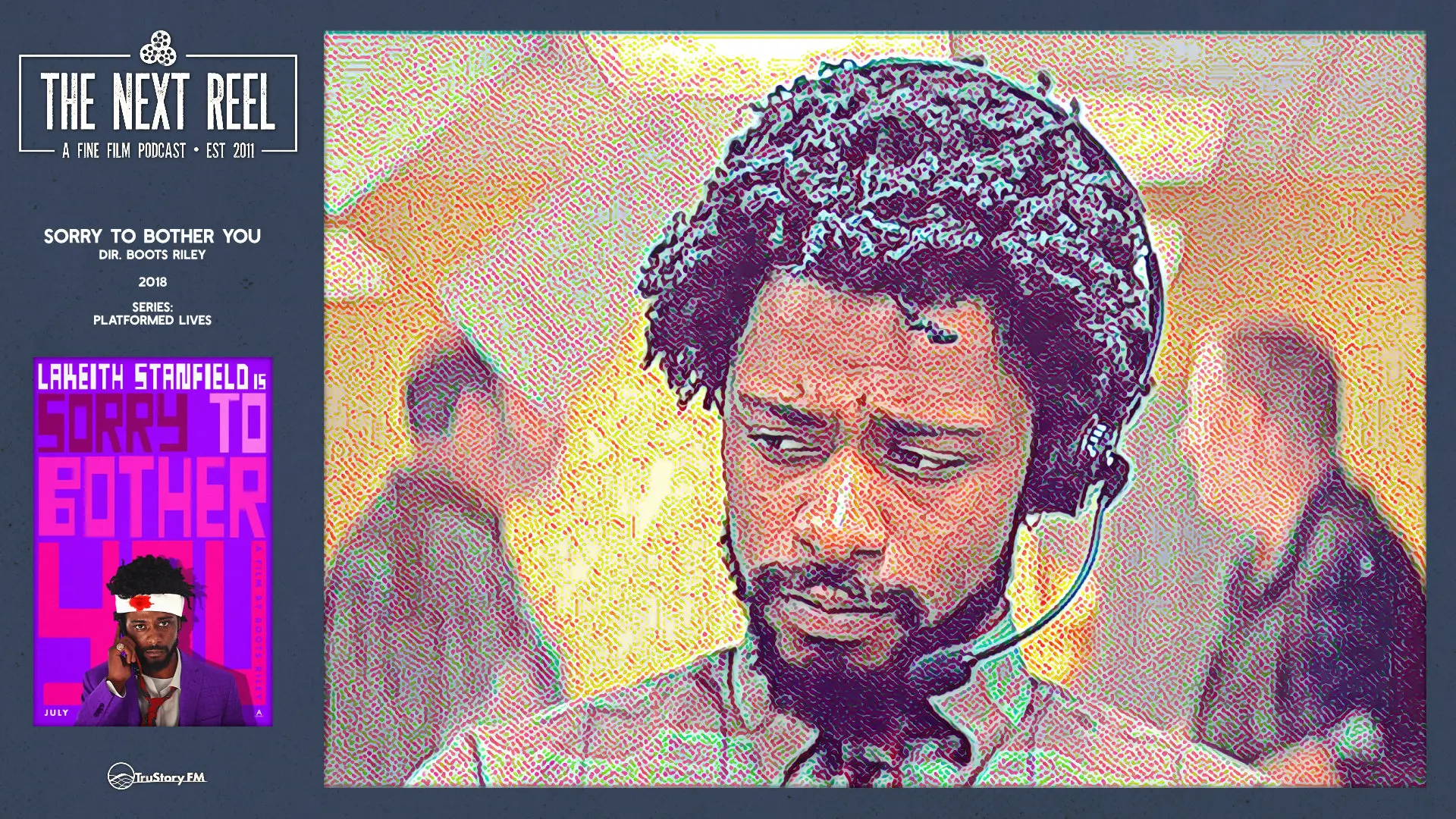
Yeah, I think so too. The story is about a broke telemarketer who discovers his white voice and climbs the ladder at this telemarketing outsourcing organization by selling out the entire world around him—his girlfriend, his colleagues at work—and meanwhile the rest of the organization is trying to eat him, and he discovers that, maybe too late. There are a couple of key mechanics in the very beginning that I adore. The first is the actual telemarketing—it’s fantastic, right? The fact that he’s trying to make these phone calls to people, and the way they demonstrate the calls: as the line rings, his desk drops into the location. Whether people are having dinner or having sex, when you hear the phone ring, his desk is suddenly falling into their lives.
I loved that, irrationally. I think that’s one of the best interpretations of that experience, from both sides, that I’ve ever seen put to screen. I think it’s wonderful. I also think the manufactured part of his job—this sort of corporate platform that he’s on. When Danny Glover’s character advises him to use his white voice to sell more, he invents a white voice that isn’t—it doesn’t even really sound like white people. Forgive me, I don’t remember exactly what Glover says—something about how that’s what white people aspire to sound like, or it is a voice that is more attuned to what white people expect. And it’s absurd, and it ends up working.
That mechanic of overdubbing Patton Oswalt and David Cross and Lily James over our principal characters when they’re speaking to and around white people is exceptional. Those two mechanics could be the major flow of the movie, right? That corporate platform that is saying so much about class and culture—it’s already swinging way, way broadly for the fences on this movie before it turns into the second half. So far, I’m absolutely on board.
Andy Nelson:
I agree with both of those points. I think the production design, the story construction, all of that paired together—camera work, editing, all of that—in the process of moving the telemarketer’s desk, dropping it into the spaces. My favorite is when, once he’s become a power caller, he makes the call and he’s talking to the Japanese guy who’s sitting on his bidet, and Cash actually reaches over and adjusts the settings on the bidet to hopefully help the guy out, so that he seals the deal. Just silly things like that. It puts them into the same space where they’re actually forced to interact. That’s what makes it so interesting—that journey that he has. The way Boots decides to depict it perfectly taps into that feeling of when a telemarketer calls you and they’re just crashing into your life, and that’s the last thing you want to deal with at that point, you know?
So I absolutely love that.
Pete Wright:
Yeah, and this plus my sense memory of it led me to talk my wife into watching it with me. So far, we’re both on board with this movie experience.
Andy Nelson:
Yeah, yeah. I think the white voice element is also a really clever element to add to the story, where you have these people learning to speak differently. Langston says it’s not really a white voice—it’s what they wished they sounded like, what they think they’re supposed to sound like.
Pete Wright:
Yes.
Andy Nelson:
That’s kind of the idea we hear. The way he describes it, I think, is perfect, because it’s like you’re about to finish the call as soon as you’re done—you’re gonna go hop into your Corvette and take off and go to the beach. Creating this casual sense of a voice.
I think that’s such a fascinating element, and it’s tapping into—I mean, Richard Pryor, Eddie Murphy, other comedians have done their own versions of the white voice in comedy history. It’s not the first time it’s been done. But I think it’s such a sharp way to actually modify it for the purpose of sales calls. I love that so much about what they’re doing here. And I think an interesting element—where it plays, we end up seeing it turn itself on its head, is when Cash goes to Lift’s, Steve Lift’s, party, and he’s like, “just do something.”
“Rap.” Because—right? And he’s like, “I don’t know how to rap,” and then he’s just saying the only black thing he knows what to say, which is just terrible, but all of the white people at the party totally get into it. I think that’s the interesting flip side—suddenly now he’s having to find a black voice to use in that particular moment to connect with that crowd. I love the way Boots gives us both versions of that over the course of the story.
Pete Wright:
The one that constantly sort of surprises me is the Lily James overdub for Detroit, because I know what Detroit’s accent is in real life, and it actually sounds kind of like Lily James. So I didn’t actually realize she was getting an overdub when she was speaking to white people in the rich art collectors’—the museum. I thought that was very affecting.
Andy Nelson:
The rich art collectors.
Pete Wright:
So subtle. And that’s the sort of commentary I think the movie does when it’s working at its best—a commentary on code switching in culture. I think it works really, really well. And I think how corporations count on employees to code switch for their own personal gain, that also directly serves corporate and capitalist gain.
I think that’s one of the things the movie does just brilliantly. And then it becomes something new. It takes all of these ideas and puts them in this great big blender, and now we introduce Armie Hammer—playing maybe himself, I don’t know. How does Steve Lift, the character of Steve Lift, hit you as you now meet the sort of corporate overlord of all of this?
Andy Nelson:
Yeah, it’s—Steve’s an interesting character because, just to kind of set up the world, we’ve got the telemarketing company, RegalView, where Cash works selling crap. Nobody wants to buy it—it’s like encyclopedias and junk that telemarketers and door-to-door salesmen were selling thirty years ago, fifty years ago. When he moves up the ranks to become a power caller, suddenly he’s selling things like—I can’t remember all of them, but weapon systems and things like that.
Pete Wright:
And labor.
Andy Nelson:
And labor, for WorryFree. He becomes a great seller there and ends up tapping into—so there’s this connective tissue between—
Pete Wright:
Yeah.
Andy Nelson:
—this big WorryFree company, which hires people essentially as slaves. People willingly sign up to work for WorryFree because, look, “I got this great place to eat and all this food and everything I need.” But they’re basically indentured servitude—that’s what’s happening here. That’s kind of the big corporation that we have here, and I think it paints an interesting picture of a corporate overlord who has crazy ideas. I think we’re certainly living in a world where some of these corporate leaders have crazy ideas as to how to make their workforce work better—avoiding unions, everything they can to create a system that gives them all the money they need without having to worry about the people working for them.
So to that end, I think it plays well. At this point, I think the story starts going a little too big and broad in how it’s painting things—there are times I’m just like, okay, it’s a little overdone. It’s not as interesting a satire, because it’s like—I’ve seen this.
Pete Wright:
Yeah, it’s kind of got a little bit of “Brazil,” a little bit of “12 Monkeys,” a little bit of, you know, the movie foundational movies we sort of grew up on, but it’s also doing them all at the same time. I think Steven Yeun’s character is an interesting one—he’s one of the more nuanced characters in the movie, because he comes in as an employee and subtly starts becoming a rabble-rouser. I think there’s one line in the movie that describes him as a serial rabble-rouser, a serial unionizer—he goes into places specifically to create a pro-labor kind of movement. I was really interested in his story, wanted to see more about him, but he’s definitely kind of a C-character.
Andy Nelson:
Yeah, right.
Pete Wright:
By the time you get into the second half of the movie, we’ve got a lot of things playing. One, we’ve got this rift between Detroit and Cash, because she’s advocating for him to get out of the power-caller role—you’re taking advantage of people, you’re abusing your friends by crossing the picket line. You’ve got the picket line, which is now a significant issue between labor and the telemarketing company. And you’ve got WorryFree, the CEO, who now has an opportunity to present Cash with an opportunity he just can’t pass up—he just has to take this, it’s going to be such a great opportunity. I actually think the pitch sequence is great—he brings Cash into this dark office and says, “you have to watch this video.” I think the video is crazy and funny, the act of getting him to watch the video.
There’s a lot going on between him needing to go to the bathroom and the discovery, ultimately, of the equisapiens. I don’t think it’s the equisapiens that I have a problem with—I low-key love the shock. This is the biggest swing in the movie: he’s trying to go to the bathroom, and what he discovers are half-horse, half-human creatures in this set of stalls, and they want help—”please help us, it hurts.” We see all of these equisapiens, just naked on the floor.
That’s what Lift wants to turn Cash into—to be his sort of Steven Yeun on behalf of the company characters. He says—
Andy Nelson:
Right. He’s Martin Luther King Jr.
Pete Wright:
Yeah.
Andy Nelson:
—for—
Pete Wright:
Right, it’s Martin Luther King Jr. on the inside, for just a little while, and then he’ll give him the serum—the antidote—so he’ll be a human again. I think that’s a big fantasy swing, and I think it’s the chaos leading up to it—the movie’s trying to do so much that by the time we get there, it’s the straw on the camel’s back. But I’m not a hundred percent sure. I still find myself reveling in the exuberance of a filmmaker willing to do this kind of stuff, that I give it maybe a pass on narrative structure.
Andy Nelson:
Yeah, I think that’s a little bit where I sit with it, because it’s such an interesting, out-there idea—suddenly, okay, that’s what the CEO is actually doing. He’s come up with a way to convert his workforce into half-horse, half-human hybrids, because as horses they’ll work that much harder, get the job done, less complaining, all of that sort of stuff. And I think that’s an interesting idea—perhaps you could say, in the scope of these corporate CEOs who are out of touch with the realities of workforces, that’s what they’re looking for: what can I do to just minimize the actual humanity in these humans that I’m working with, that I have to hire just so I can get them to work sixteen hours a day.
Like, why can’t I just do that? There’s a mentality there. But I do think it’s tricky. When you’re going this broad and big, and you’re coming up with an idea as crazy as these equisapiens, everything else really needs to line up just spot-perfect in order for it to still play okay, as opposed to being like, what the hell am I watching now? I think that’s the line I found, especially on the second watch, that Boots struggled with—there are so many ideas Boots is throwing into the story that when it comes to the idea of the equisapiens, it’s just like, I feel like maybe we’ve just crossed too many lines suddenly. There were some strong points that you were building to, and now it’s just kind of gotten really silly.
Pete Wright:
Yeah. I wonder if, if he takes some of the big swings leading up to the reveal of the equisapiens—I think the idea of the equisapiens is seeded interestingly throughout the movie. We get our first view of a horse and a person on Steve Lift’s book—the cover of his book is him, I think he’s riding a horse or standing next to a horse, but the design of that cover is such that it looks like horse and man are one. I think it’s leading us along the path really subtly. I wonder if the twenty minutes leading up to that reveal were less noisy—sort of conceptually noisy—if the equisapien reveal would have been more powerful, more impactful.
I think the ramp-up to it might be too steep, so we’re already sensorily exhausted by the time we get to this “oh my God” major shock. That’s kind of where I sit on it. Ultimately, I think your point is fair—after we introduce the equisapiens, all the other pieces fall into place in a rather predictable way. Again, don’t mind playing the hits—the hits are hits for a reason. It ends in a riot, and Cash doesn’t actually get to experience the riot directly.
He’s in an armored vehicle, but he gets to see that ultimately the equisapiens come to the rescue. He’s orchestrated it very, very well, and now the equisapiens are his buddies. He ultimately turns everything in, gives the fancy car to his buddy, and goes back to living in his garage with Terry Crews—but now the garage is super decorated, all of that kind of stuff. It was like, okay, I pretty much—that’s how I probably would have ended it too. But it wraps up really tidily right after so much we’ve been through.
Andy Nelson:
Yeah, well, until the denouement, which is a whole other element—suddenly it’s like, oh, wait a minute, what? Huh? Okay, I guess we were just throwing that in there, just that last little bit, to give us a chance to scratch our heads a little more, as far as—suddenly he does turn into a horse, an equisapien, and leads a revolt against Steve. I don’t know, I struggle with the ending also, because I’m like, why is this the ending that makes sense for this story? Is it because—did Cash learn a lesson? Is his lesson that it’s not all about the money?
I mean, that’s kind of the theme of the movie—capitalism. He wants to be making money, he wants to get out of this kind of crappy life that he has, find a way to have the good stuff. I mean, his name is Cash Green—it literally is his name, it couldn’t get more obvious than that. But at the end, it’s like, okay, so if he learned something, why does he have to go back and live in his uncle’s garage again? There are elements of it where I’m still just like, okay, I see we’re kind of going back to where he was, but I don’t know, story-wise, if it makes sense to me.
And I think the strongest part of the ending is the fact that he does this big reveal that Steve Lift is turning people into equisapiens, and what does it do? It spikes the stock for the company.
Pete Wright:
Of course. Right, of course.
Andy Nelson:
All these senators are thrilled, everybody’s getting involved in it, and it turns into this massive success. To me, that’s the most honest of the satire in all of this—yeah, that’s how a lot of this crap ends up going. Everything going on with Cash, though, I really struggled with the entire resolution of the story when it comes to him.
Pete Wright:
Yeah, it becomes a reminder that we live in the worst timeline, because it’s almost too believable. Of course Steve Lift is gonna be ringing the bell to open the market. Of course people are gonna be celebrating that we’re doing this human-horse hybrid thing. In many ways, this is one of my favorite expressions of prison, right—the best prison, and WorryFree looks like a prison. All of the advertisements are showing people who are so happy living in their bunks, eating their institutional meals, walking along straight lines, and living, ultimately, in cages.
But this is a prison, and the best prison is the prison that people don’t want to leave. They don’t want to leave because they were desperate on the outside, and this answers so many questions, gives them emotional relief. That’s another one of these elements in this movie that I think is really great—it lets us look at what are the things causing us great stress living in this society, what are the things causing us great grief, what are our financial, economic, labor woes in our everyday lives? And WorryFree is an example of, what if we went this far, as a salve, to make you feel better?
Is that too far? For some people, the answer is no, it is not too far. And suddenly we’re in “Black Mirror.” That’s one of the most interesting things this movie does, from the capitalist angle. I’m just not sure where it becomes too much, because individually, all of these elements are important—they’re important for the argument I think Boots is trying to make.
Andy Nelson:
Well, but then I think the problem is figuring out how to effectively work it all together into something that congeals as a whole. That’s the problem when we’re looking at stuff individually—this is a weird reference, but “A Dandy in Aspic” — it’s an old spy movie. Talking about aspic, right? We’ve got all of these pieces.
Pete Wright:
I was thinking the same thing. This is why we podcast together.
Andy Nelson:
Yeah, this is why we podcast. We’ve got all of these things floating in this gelatin, but they’re not together—they’re all individually floating, but they’re all in one big package. It’s just not blended in any way.
I think that’s my struggle with the film. I also ask myself, what is he saying about performance art when it comes to Detroit and her show?
Pete Wright:
Oh, my goodness.
Andy Nelson:
That’s a whole other thing I’m not really sure I understand. There’s a lot of things Boots is throwing in there, and I’m all for people just throwing everything in there, especially on a first film—you want to prove to the world that you can get stuff out there. That certainly feels like the case with what Boots is doing here. I just feel like nothing completely clicks for me.
Pete Wright:
I wanna talk about the performance art. Should we take a break?
Andy Nelson:
Yeah, let’s take a quick break and then we’ll come back. First, you can find the show on YouTube, and you can join us live when we record. We’ll even take your questions in the post-show chit-chat, and members get the full post-show conversation and always know what to listen to next. Subscribe to The Next Reel on YouTube—the link to this episode is in the show notes. We’ll be right back.
Pete Wright:
All right, the performance art piece. Detroit is making this case—I guess it’s a capitalist exploitation case. She stands up on the stage in the gallery, takes off her trench coat, and puts on a helmet. She’s wearing—a bikini? Would you call it a bikini? There’s a hand coming up between her legs, covering her pelvis, and hands covering her breasts, and the rest, she’s naked. She has cell phones in one bucket and water balloons full of sheep’s blood—
Andy Nelson:
Yep, and bullet casings in a third.
Pete Wright:
Right, right, right. As she’s reciting these lines from a movie, she asks the audience to hurl these things at her. Now, I’ve never been to one of these performance art—have you ever done anything like this? Have you ever been a party to it?
Andy Nelson:
I’ve not.
Pete Wright:
I don’t know that I would start.
Andy Nelson:
Maybe that’s what we’re missing.
Pete Wright:
Yeah, I don’t know that I would be complicit in the performance. I don’t know that I would pick up the phone and huck it at her. But people did—people got on board with hurling sheep’s blood, and she just went right on through it.
When Cash interrupts and says, “what are you people doing?”—she gets mad at him. They push him out like a virus and continue the sort of exploitative performance of the sheep’s blood and the phones and the casings.
Andy Nelson:
Yeah, unless Boots is just making a comment specifically on the absurdity of performance art. I don’t know if I understand it—I mean, okay, bullets and phones, sure, you’ve got the violence in the media, perhaps. She’s reciting a quote over and over from, I think, a kung fu movie, if I remember correctly, although I could be completely wrong. And then the phones—just like our connection to the media, our need to constantly be on them. But I don’t get it, I still feel like I have to walk through too many hoops to try to make sense of it. Especially because the rest of the art that she had—correct me if I’m wrong—was all Africa. Everything was—
Pete Wright:
Yeah.
Andy Nelson:
—taking different things and making a shape of the continent of Africa and hanging it on the wall. That was all over the place. So we had all that, but then there’s this, which I just don’t know if it even connects to the Africa art.
Pete Wright:
Well, I took it as—in order for our cell phones to exist, we have to mine rare earth minerals, which are largely in Africa. We have to take advantage of Africa. The bullets, taking advantage of Africa from generations of slaughter, blood diamonds, and now minerals, and the blood spilled is sort of in the sheep. So I feel like I can kinda get there, but I don’t know if I’m getting there or if the movie got me there.
Andy Nelson:
She does say something, now that you bring that up—I do remember, or maybe it’s some audio that’s playing at some point before she starts, about specifically the rare earth minerals you have to mine.
Pete Wright:
So maybe the movie did get me there, and I just—yeah, maybe it was sloppy, I don’t know.
Andy Nelson:
Sloppy. Maybe it’s just sloppy in how it was done. Yeah, yeah, yeah.
Pete Wright:
But it is a statement around Detroit. I think that’s the thing I wanna pull apart—what sort of utility is Detroit in the structure of the film? How useful is Detroit in the overall story moving us forward? It’s a juicy part, she has a lot to do—but is she doing the right stuff?
Andy Nelson:
Yeah, and I think that’s an important question when it comes to the story, because Tessa Thompson—yeah, she’s a great actress. We’ve talked about her a number of times on this show, we’ve talked about all the “Creed” films for sure. She’s somebody who can deliver strong performances. The question with this is: in the scope of the satire we’re getting, as it relates to Cash and this capitalistic system he’s become part of, what is that dance we have going on between her and her growing frustration with him—simply because he’s doing his job and making money, but he’s doing it by, as he gets better at it, having to start crossing the picket line, as Steven Yeun’s character raises everybody’s ire and they all start protesting.
She sides with them, and then eventually ends up sleeping with Steven Yeun’s character, goes back to Cash—there’s a lot of stuff going on. I’m just not sure how all of it ties in, unless there’s an element that also relates to the nature of—again, she’s a performance artist, you kind of have to be performative in these jobs. Putting on a white voice, and everything—she has to put on her Lily James voice when she’s talking to these rich art collectors. Is there something to be said about how, even in the art world, you still can’t escape having to put on these airs?
Pete Wright:
Put on the performance. Everybody’s performing. I actually don’t want to falsely claim white performance, because this movie is predominantly, I think, about the Black experience and code switching. But there’s also nothing authentic about Steve Lift’s character, right? He’s absolutely performing something. And the white manager, right—the very, very opening—
Andy Nelson:
The very, very opening, when he hires Cash.
Pete Wright:
Absolutely. He’s performing something. The two middle-level managers who are doing their team-building speech—one of the best sequences in the movie, and it’s very quiet, just watching two white people be awkward. I loved it, I absolutely love this experience of them trying to make the team feel good. The question comes from Cash: “are you going to pay us more money?” And she says no, and just feels awkward about it. That was fantastic. So much of this movie is about the switching that all of us do, and it’s anchored clearly in our protagonists’ Black experience of code switching, and what they’re required to do just to live.
And somewhere it becomes too much. So, thought experiment—take away just the equisapiens, what is this movie for you? Can you do that?
Andy Nelson:
Well, I think I’m gonna do that. Then the conflict at the end still boils down to: is he going to succumb to whatever the request is at that point that Steve Lift has of him, just helping him continue driving the train for the power callers? Maybe they’re not horse people, but he’s just pushing him to continue that road. I think there’s a sense that story makes a little more sense, because we’re getting a cleaner version of just this—a person climbing in the corporate world, only to realize that it’s terrible and he doesn’t want anything to do with it. That’s kind of the story we get there. Yeah, it might simplify it a little too much by taking the equisapiens out.
But I think—this is the thing—you already had created this world of WorryFree, where you have people living as slaves, happy little slaves living in these spaces.
Pete Wright:
Happy to be able to get it.
Andy Nelson:
And I think that gets completely sidelined because of the equisapiens. I think the story could have just continued in the WorryFree world, and seen how that all resolved itself, without having to go down the equisapien path.
Pete Wright:
Do you remember, you came up here and went to XOXO with me, right? One year, we did the XOXO conference together here in Portland. At lunch, we met someone who was talking about their new job—they happened to get a job at, let’s just say, a major platform company. It was a major platform company that was in the media for malfeasance, let’s just say, at the time. I remember, after she walked away, you and I got our box lunches and went over to eat, and we had this conversation about how hard it is to have a conversation with this person that doesn’t end in, why did you choose to work there? This movie is the encapsulation of that argument, right?
Why are you doing this with your blood and sweat and toil for a company that is objectively making things worse in the world? Why are you doing this for capitalism? This movie is all about the giant gap that exists between individual achievement and corporate achievement. That’s an uncomfortable place, and WorryFree has filled that gap with institutionalized slavery. I think that’s a great movie, a really cool, awesome story, and a thinker.
And the longer we talk about it right now, the thing that’s my favorite thing to talk about with the movie, which is the equisapiens, I think may be the movie’s biggest villain.
Andy Nelson:
Oh, I agree, I agree. I think it just pushes it—I’ll tell you, it makes you not forget the movie. You definitely remember the equisapiens when you watch this movie. But yeah, the problem is it just feels like a bridge too far. That’s the element that is frustrating, because I feel like we lose everything about WorryFree—I don’t even remember WorryFree by the time I get to the ending, I’m just thinking about these horse people running around.
I think that’s the struggle we really have throughout—trying to remember the journey Cash is on and what the point of all of this is, as far as the story. There are other things in here too, like the game show that pops up on TV all the time that Langston, Danny Glover’s character, loves to watch—he’s got the shirt, he says, “beat the crap out of me.” That felt very seventies Monty Python, to have that sort of game show on the TV. I didn’t know, other than just more commentary on, well, this is what people love watching—the most nonsensical stuff. But I feel like we’re getting so many threads of the story, in so many different aspects of this world, that we keep losing focus on the WorryFree story.
Pete Wright:
The problem with the game show is that it just screams of “Idiocracy.” What was the game show about, that they were watching in that show? It was just people getting kicked in the crotch.
Andy Nelson:
Oh, in “Idiocracy.”
Pete Wright:
In “Idiocracy” it was the same model—people watch the dumbest stuff when they’re the dumbest people. That felt a little bit too literal to me.
Andy Nelson:
Yeah, “How My Balls.”
Pete Wright:
Yeah, right. Good pull.
Boy, you remember that well.
Andy Nelson:
There was also “I Love Money,” I think, was something else. This sort of programming we see all the time—it’s been spoofed in—
Pete Wright:
Yes.
Andy Nelson:
—so many different things. So that’s why, when this show came up in the scope of everything else going on with this movie, I was like, okay, well, I’ve seen this before, it’s not that unique. Same thing when Cash gets struck in the head—I think it’s the second time he’s crossing the picket line, there’s the woman who throws a soda can at him and it clocks him in the head. Little does he know that video of her throwing it, hitting him in the head, turns into this YouTube viral sensation.
Everybody’s watching—it’s got hundreds of thousands of views, or millions of views. People, children, are dressing up as the guy who got hit in the head for Halloween. You’ve got them all—
Pete Wright:
In their afro with the can, yeah.
Andy Nelson:
And they’re afros with a can glued to their head. There’s the little old lady who has the homemaking show, showing you how to make your own version of the costume. It becomes a thing. So, does that tie into this capitalistic story and everything going on with WorryFree?
Or is it too loose?
Pete Wright:
I think it’s positive texture to the rest of the movie. And again, the more I think about removing the equisapien line, the more literal we get to take Cash’s complicity in helping Steve Lift’s company be successful, and the choices he gets to make. The rest becomes a much more even texture of the kind of culture he exists in, and the crazy, bonkers moment becomes the performance art piece—remember that time when Tessa Thompson stood on stage with the bikini hand-bikini and had people throw sheep’s blood at her? That’s the weird moment we talk about, not the naked horse people with the massive horse penises. It almost seems cheaper to talk about it in that regard—like, oh right, the horse costume was the thing to make us remember this movie.
Andy Nelson:
Yeah, did you see Boots’s latest movie, “I Love Boosters”?
Pete Wright:
I haven’t seen it yet, but my son saw it at a festival and said he actually really liked it.
Andy Nelson:
I liked it too, but as I think about it more and more, I really feel it’s gonna fall into the same trappings this film did. As I revisit it, I’m like, yeah, there are a lot of interesting ideas here, but it doesn’t congeal as well as it needed to. The ideas are fascinating, but it’s really scattered. I think that’s where I fall with this one. The more I sit on having seen “I Love Boosters,” I feel like that’s kind of where I’m landing with that one, too. I just think Boots is a creative director, and I love that he’s pushing boundaries and doing insane things, but I do think I wanna see him fine-tune that satire, so things feel stronger. Because what happens, for me at least, when I watch these or revisit these, is I just don’t think the satire is very strong anymore.
Pete Wright:
Interesting, that’s really interesting. Is it because the satire becomes too obvious?
Andy Nelson:
No, I just don’t know if he clearly has a sense of what he’s actually trying to satirize.
Pete Wright:
If you were to boil it down for this movie, what is this a satire of?
Andy Nelson:
I mean, I would say it’s a satire on the capitalist system. But even there, I start losing the thread, because it’s like, well, how does Tessa Thompson and the art world tie into that? Why do we keep cutting to his old football team, other than needing them?
Pete Wright:
Right, and their very principal role in the end of this movie, right?
Andy Nelson:
Yeah, right, exactly. So there are elements I think are interesting, but I still end up struggling.
Pete Wright:
None of that actually includes the cultural code-switching part, which is also the other thing we’re satirizing here. I think we just defined why this movie may be a collection of too many awesome ideas that come together in a way that’s a little bit haphazard.
Andy Nelson:
Yeah, yeah.
Pete Wright:
And with all of this, I still generally enjoy my time with it.
Andy Nelson:
I enjoyed my time less this time.
Pete Wright:
Yeah, for sure.
Andy Nelson:
Yeah.
Pete Wright:
But we were falling out of our chairs that one day at Harkins.
Andy Nelson:
Yeah. Well, I will say it’s a fun kind of movie to see with an energetic crowd.
Pete Wright:
For sure.
Andy Nelson:
That helps, that helps.
Pete Wright:
Oh yeah, if you want to really enjoy this movie—boy, this is a bad thing to say at the end of our conversation—but if you really want to enjoy this movie, introduce it to other people who haven’t seen it, in a group. You’ll have a blast watching them experience this movie.
Andy Nelson:
It really has to be the right sort of people, I think, because I definitely think this is one of these—
Pete Wright:
It has to be the right people, yeah.
Andy Nelson:
—off-the-wall bonkers movies that some people are just instantly gonna be turned off by. That’s a crowd, for sure.
Pete Wright:
I like to think, if you know your movie people—
Andy Nelson:
Yeah.
Pete Wright:
Again, I watched it with my wife. That was a mistake.
Andy Nelson:
Yeah, my wife hated both this and “I Love Boosters.”
Pete Wright:
Does “Boosters” have the same kind of third-act pivot like this one does?
Andy Nelson:
Yes.
Pete Wright:
Oh.
Andy Nelson:
Yes.
Pete Wright:
Okay. Is everybody aliens?
Andy Nelson:
No.
Pete Wright:
Okay.
Andy Nelson:
It’s definitely bonkers.
Pete Wright:
Okay, I’ll watch it.
Andy Nelson:
Definitely bonkers, yeah.
Pete Wright:
All right, what do you want to do now? Shall we do another break?
Andy Nelson:
Yeah, let’s move into the back half, but first, let’s take a quick break. The Next Reel is a production of TruStory FM. Engineering by Andy Nelson. Music by Tzabutan, Cruella, and ZISO featuring HEATHER, Oriol Novella, and Eli Catlin. Andy usually finds all the stats for the awards and numbers at The-Numbers.com, BoxOfficeMojo.com, IMDb.com, and Wikipedia.org. Find the show and the full archive at TruStory.fm. You can follow us from there, too, plus you can find out how to become a member and go further with every episode.
Check out our merch store at TheNextReel.com slash merch, and if your app allows ratings and reviews, please consider doing that for our show.
All right, Andy. It’s award season—how did it do at award season, “Sorry to Bother You”?
Andy Nelson:
It did okay for itself—20 wins, 56 other nominations. Over at the Saturn Awards, it was nominated for Best Sci-Fi Film but lost to “Ready Player One.” Boots Riley was nominated for the Legion M Breakout Director, but lost to Ari Aster for “Hereditary.” Are you familiar with Legion M?
Pete Wright:
I know that—
Andy Nelson:
Legion M is the world’s first fan-owned, and maybe still only, I don’t know, but fan-owned entertainment company. You can basically buy stock in films, help fund movies, TV shows, all of that, and then share in their financial upside. It’s been going on for, well, at least since 2018—it’s been something where a number of films have actually gotten funding through this crowdsourcing.
So it’s been pretty cool. At the DGA Awards, Boots Riley was nominated for Best First-Time Director, but lost to Bo Burnham for “Eighth Grade.” Likewise, at the Gotham Awards, he was nominated for Breakthrough Director, but lost to Bo Burnham. LaKeith Stanfield was nominated for Best Actor but lost to Ethan Hawke in “First Reformed,” and it was nominated for the Audience Award but lost to “Won’t You Be My Neighbor?” At the NAACP Image Awards, it was nominated for Outstanding Independent Motion Picture but lost to “If Beale Street Could Talk,” and it was nominated for Outstanding Writing in a Motion Picture but lost to “Black Panther.” At the Film Independent Spirit Awards, it was nominated for Best Screenplay, but—something we’ve talked about on the show—it lost to “Can You Ever Forgive Me?” And it did win Best First Feature.
At the Sundance Film Festival it was nominated for the Dramatic Award but lost to “The Miseducation of Cameron Post.” And last but not least, over at the Black Reel Awards, LaKeith Stanfield was nominated for Best Actor but lost to Chadwick Boseman in “Black Panther.” Riley was nominated for Best Director but lost to Ryan Coogler for “Black Panther.” It did win Best Screenplay, Best Emerging Director, and Best First Screenplay. It also lost Best Ensemble and Costume Design, also to “Black Panther.”
Pete Wright:
It seems like, with all that acclaim, it probably did fairly well at the box office.
Andy Nelson:
Yeah, Boots Riley had a budget of $3.2 million to create his crazy indie film, which is about $4 million in today’s dollars. The movie premiered at Sundance January 2018, then had a limited release July 6th, 2018, opposite “Ant-Man and the Wasp” and “Whitney.” It expanded in its second week, which bumped it to seventh place, but it never made it higher than that. Still, it did find its people, going on to earn $17.5 million domestically and $792,000 internationally. All told, the movie ended up earning back close to six times its budget, landing with an adjusted profit per finished minute of nearly $170,000. That’s a great place to land for Riley, and allowed him to continue crafting his crazy visions of the world.
Pete Wright:
I love it. Good for Boots, I think it’s fantastic.
Andy Nelson:
Yeah.
Pete Wright:
These are movies that—like I said, I relish the experience of having watched this film the first time. It was awesome.
Andy Nelson:
Yeah, and I mean, I still will probably seek out and watch other Boots Riley projects. I think Boots has a unique vision, a creative voice, is doing something new and different. Is it always landing? No. But I tell ya, I still found more to engage with with this, even if I didn’t really care for it this time—there’s still so much interesting stuff happening in the course of the story that made it worth my time. That’s how I saw it.
Pete Wright:
Absolutely, I can’t disagree with any of that. I think it’s absolutely worth watching, definitely worth watching once. And it’s one of those movies that is heavily detail-oriented, right? The production design is beautiful and precise, and it’s worth looking at closely. What was it, sixty-one locations in twenty-eight days he shot this movie? It’s an exhaustive story of production, and I think it has lots of wonderful reasons to be celebrated.
And frankly, LaKeith Stanfield, Tessa Thompson—there’s really, really wonderful work on their parts. Is it a five-star film for me? No, it’s not, but it’s really, really good.
Andy Nelson:
Well, and going back to something we brought up earlier—Jason Kisvarday was the production designer, and would also go on to do “Everything Everywhere All at Once.” You can see that thread in such creative production design work, with the desks and the way things were moving and everything. I think that’s another moment I thought was really creative—when we see, I guess you could just call it, it’s not really a montage, but the moment where everything in Cash’s apartment starts upgrading, and the TV just splits open—the old TV splits open and a brand new TV comes out of it. Things like that, I’m like, this is fun and clever and physical. Boots Riley, very into physical effects—like all of the equisapiens, we haven’t really talked about the fact that it’s all physical, real people in these crazy costumes. It’s very physical, very present, and I think that’s something Boots probably latches onto to enhance these crazy worlds of his.
Pete Wright:
Yes, absolutely. I couldn’t agree more.
Andy Nelson:
All right, well, that is it, I guess, for our conversation about Boots Riley’s “Sorry to Bother You.” Next week we’re kicking off a new series called Smoke and Mirrors—a look at how media and political spin get built and sold, timed to give us something to chew on ahead of the midterms—starting with Tim Robbins’s “Bob Roberts,” his 1992 mockumentary about a folk-singing conservative Senate candidate, and how easily campaign coverage can be turned into a weapon for the candidate wielding it. All right, let’s do our ratings.
Pete Wright:
Letterboxd.com slash The Next Reel—that’s where you can find our HQ page over on Letterboxd, where we track and review all the movies we’ve talked about across The Next Reel family of film podcasts. What are you gonna do? Five stars and a heart? What are you gonna do?
Andy Nelson:
I initially gave this three and a half stars and a heart. I can’t give it that. I was torn—is it two and a half? Is it three? I think I’m gonna go—I’m torn, is it two and a half and a heart, or three stars and no heart?
It is. I think I’ll do three stars, no heart.
Pete Wright:
I am gonna level up a little bit, with three stars and a heart. I had originally given this four stars and a heart, and I’m with you—I think this conversation has reminded me of all the areas I have more of a challenge with this movie, so I’m gonna drop it down to three stars. It’s right across the back—very middle ground. Still a good film, still totally worth seeing, a lot to appreciate. I don’t know how many times I’m gonna watch it from here on out.
Andy Nelson:
Yeah, here I am. Well, that averages out to three stars and a heart, and you can find the show on Letterboxd at @thenextreel. You can find me there at @sodacreekfilm, and Pete at @petewright. So what did you think about “Sorry to Bother You”? We would love to hear your thoughts. Hop into the Showtalk channel over in our Discord community, where we’ll be talking about the movie this week.
Pete Wright:
When the movie ends—
Andy Nelson:
—our conversation begins.
Pete Wright:
Letterboxd giveth, Andrew.
Andy Nelson:
As Letterboxd always doeth.
Pete Wright:
Oh, Andy, what did you think of the “Sorry to Bother You” collection? Did it offer you some goodness?
Andy Nelson:
There are a lot of funny ones. Obviously, there are a lot of them that are like, what the hell did I just watch? There’s plenty of that. But yeah, I had a good time with this—kind of just reading through some of people’s—
Pete Wright:
It’s hard to stop reading them, people really dig it. That’s what I like. I went with a four-star and a heart from Sophie, who says, “this movie has EVERYTHING… telemarketing, dick earrings, protesting, glenn from the walking dead, bad reality tv, fake cocaine, one of the twins from the facebook movie, weird bojack horseman people, the voice of that guy from alvin and the chipmunks, and terry crews.”
Andy Nelson:
The guy from Alvin and the Chipmunks.
Pete Wright:
I love that so much.
Andy Nelson:
I like that that gets thrown in there too.
Pete Wright:
I know.
Andy Nelson:
Oh my gosh, wow, I love yours—that’s actually a great one, because it really does have everything.
Pete Wright:
Where’d you land?
Andy Nelson:
I went with a three and a half and a heart, by Eli Hauser, who says, “in 15 years this is gonna be a hit broadway musical trust me.” And I was just like, a hundred percent—that is so going to happen.
Pete Wright:
That is so true. Can you see the chorus of horsemen—horse, horse sapiens—equestro sapiens?
Andy Nelson:
Yeah, it’ll be a whole musical number, I’m sure.
Pete Wright:
That’s gonna open the second act. It’s gotta. I think that would be the trick with structuring it—let’s get very serious now—they would have to move that forward, because the second act has to open. Well, it would open with the party, I think that’s where it would be. It would open with the party, and then the Equestra Sapiens would have a big intro number, and it’d be a song and dance and high-kicking.
Andy Nelson:
The equisapiens.
Pete Wright:
What did I call it?
Andy Nelson:
Equestro sapiens. Throwing a few extra syllables in there.
Pete Wright:
Yeah, I’m not gonna write it, who cares? Anyway, thank—yeah.
Andy Nelson:
I love it, I can’t wait to see it. I just saw that “Network” is freaking on Broadway—did you see that? It’s like insane, everything is turning into a Broadway show.
Pete Wright:
Wait, what? Right now? What are you saying, “Network”? “I’m mad as hell.”
Andy Nelson:
Yeah, guess who’s playing him?
Pete Wright:
I don’t know, Ned—
Andy Nelson:
Bryan Cranston. It’s actually brilliant casting.
Pete Wright:
That is so brilliant.
Andy Nelson:
Yeah.
Pete Wright:
I’m gonna have to go clip hunting, I need to see some of that.
Andy Nelson:
Yeah, me too, me too.
Pete Wright:
Okay, alright, well, thanks, Letterboxd.