*This transcript is produced using transcription software and reviewed for quality. Despite our best efforts, some passages may be incomplete or contain errors due to audio quality or software limitations.*
Pete Wright:
I’m Pete Wright.
Andy Nelson:
And I’m Andy Nelson.
Pete Wright:
Welcome to The Next Reel. When the movie ends—
Andy Nelson:
Our conversation begins.
Pete Wright:
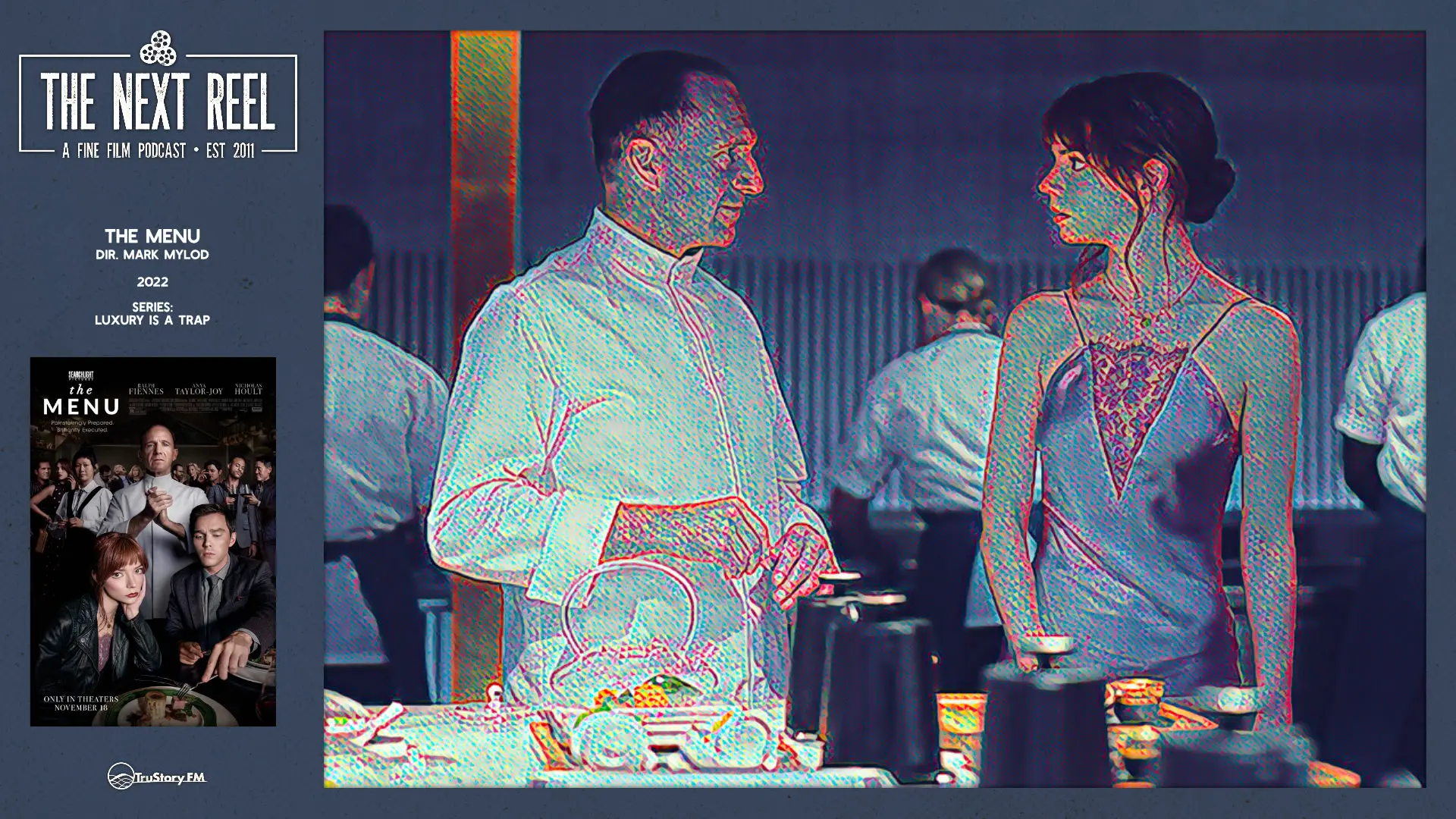
The Menu is over. You will eat less than you desire and more than you deserve.
Andy Nelson:
That sounds like Bilbo Baggins, like one of the lines that he would say, doesn’t it? Like when he’s doing his toast.
Pete Wright:
Just a little drunk. You will eat less than you desire and more than you deserve.
Andy Nelson:
Exactly, exactly.
Pete Wright:
Andy, this is our last movie in our Luxury Is a Trap series, and it may be the most on the nose of the four movies.
Andy Nelson:
Well, I don’t know, Triangle of Sadness was pretty on the nose.
Pete Wright:
Yeah, but see with Triangle of Sadness, there was no one person who was trying to trap the people, right? This movie it lures them with like luxury is bait and then closes the giant vault door and they are trapped
Andy Nelson:
It’s like a giant giant Venus flytrap, this restaurant.
Pete Wright:
It is a giant luxurious Venus flytrap. Would you eat at this restaurant?
Andy Nelson:
Not if they’re gonna kill me, but yeah, but any of the other nights I absolutely would have, yes.
Pete Wright:
Before tonight.
Andy Nelson:
I mean I would never have been able to say, yeah, let me drop $1,250 on a plate so I could go dine there. Like that to me would have been excessive and I would have said, you know, there’s probably better ways to spend my money, but
Pete Wright:
Yeah
Andy Nelson:
But I would still love the experience if someone said, hey, I’m gonna give you free free seats at this restaurant. I’d say sure.
Pete Wright:
There was a restaurant here in Portland and it was one of these restaurants that just served a tasting menu that would— that lasted all night. And we were given an evening, me and my wife, and we got to go do this. And the it wasn’t $1,250 a plate or a seat, but it was like $300 a seat before like booze and but it was exactly this kind of pretentious extraordinary. Like, you think every plate that sits before you is a joke, and then you put it in your mouth and realize that it is not a joke. It is in fact the most serious food you have ever tasted. And that is the cognitive dissonance that exists in this high-class like eating thing for me.
Like I love watching this movie. for the food and the decadence of the preparation and the m militaristic performance of the kitchen. There is so much wonderful structure to it. And I think it meets the needs of this series very well. And I also, to quote a great man, “I have some quibbles.”
Andy Nelson:
No, I do too. I had forgotten how funny the movie was.
Pete Wright:
Yes.
Andy Nelson:
Like I found myself like this is a dark, dark comedy. Like it’s dark satire. And I was just laughing out loud throughout a quite a lot of the film. And I just I didn’t remember that. I knew that there was the whole angle of this this we’ll just call him the mad chef who’s decided he’s he’s done with serving these these pompous rich people and is just gonna take ’em all down. I remembered all that, but I just I didn’t remember the laughs.
And so I it was a lot of fun to revisit this movie. I had a great time. And I still found that the issues that I had the first time I watched it I still had this time. And I also left as I do anytime I’m watching a movie like this, desperately wanting to eat.
Pete Wright:
Mm-hmm.
Andy Nelson:
Getting me very, very hungry, yes.
Pete Wright:
Everything. Yeah.
Andy Nelson:
I’ll— I was like, I’ll take sea foam, sure. Give me sea foam.
Pete Wright:
Yeah. I want foam. There is a thing about foaming foods. That is really extraordinary in these high-end things. Foaming foods is a deal. That’s a thing you do. And it works.
It’s legit.
Andy Nelson:
And what was the tool that the Pacojet
Pete Wright:
The Pacojet? Yeah, I have one. That was such a great line.
Andy Nelson:
Yeah, yeah.
Pete Wright:
Let me— for the record, I don’t have one.
Andy Nelson:
Yeah, not you, not you.
Pete Wright:
I don’t have a Pacojet.
Andy Nelson:
You’re quoting the movie.
Pete Wright:
Not me. That was a quote.
Andy Nelson:
For a brief second, I was like, you do?
Pete Wright:
Yeah, no, nobody has a Pacojet.
Andy Nelson:
You almost almost
Pete Wright:
Home, home Pacojet. It’s just right next to my SodaStream, my toaster oven.
Andy Nelson:
Just fits right in.
Pete Wright:
Yeah, yeah. And this there is I we should call out a certain sense of irony that so much of this movie about artists, creators, about people who pour their souls into things and other people who rip it to shreds. And we’re making a podcast about this movie, which was a labor of love and passion for Mark Mylod and a lot of people.
Andy Nelson:
Do you think he’ll come at us now?
Pete Wright:
I don’t think he’ll come at us. I think he’s I think he’s a kinder, gentler spirit than that.
Andy Nelson:
I don’t know.
Pete Wright:
You don’t think so?
Andy Nelson:
I think I think the chef was at one point and over the course of his career turned that way. It’s possible. Give Mark time.
Pete Wright:
Yeah.
Andy Nelson:
He could he could turn into this.
Pete Wright:
Yeah, yeah. So it’s best for us to get this out now
Andy Nelson:
Yeah, right, exactly.
Pete Wright:
Yeah, no, and I think that’s I think that’s a really interesting statement because this movie is a bit of a cornucopia of ideologies, right? It is first and foremost a commentary on well, I should say first, a commentary on wealth and privilege and the kinds of things people take for granted. That’s all that’s going on in this movie. It’s like there’s only one dude who really takes this whole thing seriously. As seriously as it deserves to be taken. Everybody else is just taking it for granted. They’re able to throw you know, for them $1,250 per seat is trivial and it is as that is as trivial as they will take the experience. And it’s hard to watch that part.
But— and then the second part of the movie is about this artists and creators and being burnt out on you know, devoting your life to a thing. And that is less about, I think, eat the rich. It’s less about luxury as a trap in the second half of the movie, and much more about this character’s journey toward, as you say, toward burnout. And I think the movie intends those two ideologies to be in collaboration with one another, in partnership. And at times it is in conflict as we get toward the s’mores.
Andy Nelson:
Yeah, well, sure. I and I do think that there are some some complexities with the way that all unfolds as far as each of the different groups of people that we have who are here of the twelve patrons that we have at the restaurant on this particular night paired with the chef and how all of that is kind of interwoven as far as like the chef is doing this because he’s kind of burned out and he’s tired of people like this this rich couple who have been here eleven this is their eleventh time here and they can’t name a single thing they’ve eaten here.
Pete Wright:
But it was also Judith Light, right?
Andy Nelson:
Like it’s
But it was Judith Light. And she tried. She tried to remember that it was the cod, but it wasn’t.
Pete Wright:
It was the cod.
Andy Nelson:
It was the halibut.
Pete Wright:
It was not the cod.
Andy Nelson:
But then you also have like a washed out actor who has shown up here and you know it sounds like he’s potentially here because he’s thinking about a possible idea for a food related show to kind of be a comeback sort of thing for him. I like there’s a line he said earlier like very at the beginning and it’s not even when he’s on screen it’s just something in passing as a as we’re looking at I think Tyler and Margot and you just hear him say, I’m something like, I’m entering the awards presentation part of my career or something like that. It’s just like giving out awards.
I thought that was very funny.
Pete Wright:
Yeah, that actually his corner of the room may be the most deliciously self-aware, right? Like he knows exactly where he is, and he’s a complete fraud, and he knows it coming in.
Andy Nelson:
Yeah, right.
Pete Wright:
But they all all all the people in there are such extremes of their identities. They’re all caricatures, and it lends to the satire.
Andy Nelson:
It lends to the satire, and then one of the issues that I kind of have with it is it also sometimes turns more to a farce. And that’s where I think it slips a little bit, is it becomes kind of too too much fun in the way that it’s playing and I don’t buy some of the stuff going on with the characters and it’s more of kind of this farcical behavior and attitudes that we’re watching and it lets the satire slip a little bit and that’s one of the things that kind of frustrates me with it because it just it doesn’t make the satire as strong as I’d like it to be.
Pete Wright:
The first time I watched this movie, I had a distinct idea of where the movie was going. And I really wanted it to get there. And I finished the movie and it hadn’t gone there. And the second time I watched the movie, I thought I want this to be the same thing that I thought the first time. I wonder if the movie’s changed since the last time I said it had not. I wanted the movie to take the satire and pick a l a darker lane. Like I thought the satire was going to lead us into the most obvious direction, which was literally eat the rich.
Like when he says we’re all going to die, and they keep leaning in on foods of like you know, tartared meats and things like that. Like I expected us to be ex— watching these people eat essentially themselves before they’re killed and fed to the next table. That’s what I thought the machine was. And I really wanted that. And I find the end of the movie is less satisfying as a result. Is did that did anything like that ever enter your consciousness?
Andy Nelson:
Well yeah, and I think that is a part of the issue with it because it ends up becoming so much of a story really about Margot, or should we say Erin, and her journey to kind of like figure out what’s going on because she doesn’t belong here as we kind of uncover that part of the story, right? And so it ends up becoming how is she going to get away And less about how is the chef gonna take this down an even darker road where he’s feeding these people themselves or something, you know.
Pete Wright:
Yeah. That’s the problem I have with the last act of the movie that we don’t get any sort of satisfaction that there is a comeuppance for these people’s, you know, misdeeds or these people’s lackadaisical attitude toward their own wealth. Like there’s no vindication because the engine ends, because the chef is so sad that he ends the entire thing and I think it’s trying to be a commentary on taking art for granted, taking someone else’s life for granted and their passion for granted, without giving us the satisfaction of, say, of an ongoing you know, machine of death for these rich people. Like their complicity in this movie is just that they sit still when the marshmallows and the chocolate hats are put on them at the end and they’re turned into s’mores. Nobody reacts. And that’s a statement on their complicity in the you know, in this relationship of wealth.
And it’s awful. It’s really bad. But then the chef and the kitchen end too, and I think that’s where the movie loses me, right? At the very end, because I, as someone who is not made of that wealth, find it satisfying to watch wealth taken down a peg. And in this case, when the machine ends too, there’s nothing left to take anything down a peg anymore. And that makes a less satisfying dark ending for me. This is not a dark ending. This is just an ending.
Andy Nelson:
That’s a really interesting point because it does make you wonder, like, would it have worked had the chef and his staff survived and just ended up killing each of these people or feeding them themselves or whatever the case may be. And would it have worked, leaving us with the question in our heads, well, they’re all just gonna be put in jail now? Like, is that the right way to end this or like what’s going to happen?
Pete Wright:
I’m gonna rewrite the ending for you.
Andy Nelson:
And I guess
Pete Wright:
Can I rewrite the ending for you?
Andy Nelson:
Please, please.
Pete Wright:
Okay. It’s sunrise. It’s morning. Margot’s on the boat. She’s eating a bite of her cold cheeseburger. Which is by then disgusting, right? I mean, who wants to do that? Bread would fall right apart.
And as she is drifting toward the mainland, another boat full of rich people passes her and goes to the island. The island doesn’t get destroyed, right? They clean it up and they’re ready to start again. That’s the machine. That’s the darkness that I wanted.
Andy Nelson:
Yeah, right. I mean the question perpetually will be, and I and this would make it you it would start falling into more of kind of the allegorical tales that we had, like with High-Rise or The Platform. Where it’s like, okay, so is this just an island where no like everyone goes but nobody comes back? And like why is that? But nobody asks the question. And like I would have I don’t know, I it would have left me scratching my head and it would have bugged me. Yeah, I wouldn’t it’s not the sort of thing I could handle. I would have bought it if I saw Like, say one couple flew in on their helicopter and they didn’t come on boat, like the first rich couple or something. And if at the end, as Margot is on her boat eating her cheeseburger, we see the chef and his people in the helicopter flying off.
Like they’re gonna they’re escaping. Like, yeah, I mean I could have bought something like that. Like maybe they’re gonna go down to Brazil and open up a new restaurant there.
Pete Wright:
Or maybe it’s that one couple that becomes meat for the future food. And what we see at the end is the chef staff blowing up the helicopter as if they died at sea. Right. Like creating a story. All of these endings allow the story to perpetuate in a way that is more satisfying than the one we got.
Andy Nelson:
Well yeah, and I think I mean it’s a trick of a of a writing assignment that our our writers had with this because they were You know, the goal of the script I think was to create this story where everybody goes down. And I think the idea, at least, with the chef is that he has recognized in himself not just the fact that he is no longer enjoying this service industry job that he has because he’s he’s gotten himself to such a high place that these people just don’t care about what he’s actually doing But he also has recognized in himself, I’m here because I also became an obsessive A-hole and that was my own problem and he’s he’s looking at himself like I have these weaknesses and I’m part of the problem and so he decides to take himself down. We know that at least with I think it’s Jeremy, the one sous chef who blows his head off, we know that the idea with that is that Jeremy’s never going to be as good as our Chef Slowik. And he recognizes that.
And his whole thing is like, now I gotta blow my head off. And that’s my you know, the way I’m gonna deal with it. And so But is that the case for every single person here? Like all of these chefs? Like Hong Chau’s character? Like what did she do that she feels like, yeah, this is totally my thing too?
Pete Wright:
Yeah, the it just that moves the movie into sort of its third ideology, which was the cult of the kitchen, right? They are all true believer cultists behind this guy, they’ll do whatever he says. And that is fundamentally unexplored in the movie, right? It’s only teased by these moments, the mess when he shoots himself and but everybody else is just doing what Chef says.
Andy Nelson:
Yeah. And we do see some like some faces where they look like they’re teary-eyed, like I don’t really want to do this, but I have to because Chef is telling me to. Like there’s some there’s some moments like that where you’re like, okay, are they happy that they’re doing this? And the way that you described it just now, I think, is perfect because a cult is exactly what we have here. Like they don’t seem to recognize themselves as their own individuals anymore. They are only doing this because of the cult of whatever Chef Slowik says, and they will do and s they will do everything that he says, they will follow him every step that he requests. All the way to the point of killing themselves. And that is that you’re right, that is an a really interesting element that isn’t explored well enough.
And if you think about it too long, it does make you really wonder, like, why are all of these people so willing to do this? Like maybe I would have bought it more if there was one of these these cooks who is just like I don’t want to be here and that’s part of the story of like helping Margot escape or something, who knows, but
Pete Wright:
Yeah, yeah. I think that’s I mean, I think that’s it. Like a way to show complicity in both in the form of the a of the audience, the guests at the restaurant, they are all complicit. We see that very, very clearly. But there’s complicity in the kitchen too. And I don’t think we get an even hand of why of how that culture exists. We’re just supposed to sort of take it as writ that’s where we are. I think it’s funny. So the writers, Seth Reiss and Will Tracy are both Onion alum. They wrote for The Onion.
They’re both Seth Meyers and John Oliver alum. They both wrote for those shows. And they also both wrote for Succession.
Andy Nelson:
Which is surely where Mike or Mark connected with them
Pete Wright:
Yes, y for sure. Tracy actually wrote Tern Haven. The episode specifically that’s where that Mark directed and Mylod calls it dress rehearsal for this movie. So I think all of those things, you put all those in a blender, and I think you do get this movie You get this movie that is you know, ostensibly a comedy that is also wrapped up in, you know, a tasty dose of gore and privilege.
Andy Nelson:
Well, and I think also the fact that Adam McKay and Will Ferrell are two of the three producers, I think speaks to the fact that it fits in with this all very well. It’s interesting because This script when they first wrote it, it wasn’t attached with Mark as the director, but it was actually I think the conversations were that Alexander Payne was the first person signed on to direct the film. And I think also could have carried it well. You know, I think that could have worked well. And then it seems that he kind of fell off the radar. He had other projects that he was working on. And this script ended up in the Black List as one of the scripts that, you know, everyone in Hollywood is talking about. It comes out every year.
as great script, it’s still in development, somebody needs to do something with it. And I think at that point, that’s when Mark came on to direct it. But it does make me wonder How did that circle around to Mark? Was it specifically because the writers and like they knew him from Succession and were like, hey, what about Mark? And Mark’s like, yeah, I’ll do it, you know?
Pete Wright:
Yeah, right. I want to make sure we at least say the words Dominique Crenn and Kendall Gensler. Dominique Crenn was is a three-star Michelin, three Michelin star chef who is the culinary consultant, the apparently the writers drafted the menus and then her team designed the dishes and sent back a mood board. And then Kendall Gensler was lead of a four-person food stylist team. The food is, I mean, if you’re a foodie, this is a st a good movie. The food is lovely.
Andy Nelson:
It is. I mean, in the scope of the story that the Chef Slowik is telling with the food. Sometimes I would find some of it less appetizing than others. Like here’s a rock with a few little tiny plants on it that you get to eat.
Pete Wright:
With like and a scallop, one scallop on top
Andy Nelson:
Yeah, one scallop. Or here is a plate, no bread, it’s just the dips. Like there are things I would have been like, I would have been kind of like Margot, like, you know what? I don’t want this. I really just don’t want to eat this.
In all of that, you also forgot to mention that the second unit director was David Gelb, who was brought on.
Pete Wright:
Yeah.
Andy Nelson:
He does the Netflix docuseries Chef’s Table. And so he was brought on to do all the second unit directing to help kind of recreate that style of all of that, so I think that’s interesting.
Pete Wright:
Boy, you can feel it too. It’s right off of Chef’s Table or British Bake Off, or I mean, it’s beautiful.
Andy Nelson:
The way they plate everything. It’s it is definitely luscious. Yeah. Even though I wouldn’t be excited by a board of s of dips for bread that non-existent bread, it looked great.
Pete Wright:
You haven’t eaten the dips
Andy Nelson:
I’m just saying it looked great.
Pete Wright:
Look, have you ever approached a dip only lifestyle? I don’t think you have. I think it’s just like if you see a dip, you want to put a hot dog in it. That’s what I think.
Andy Nelson:
I’m the cheeseburger guy, probably.
Pete Wright:
You’re the cheeseburger guy. Andy, I’m the cheeseburger. We’re all the cheeseburger guy. That’s the point.
Andy Nelson:
All right, we’re gonna take a quick break, but first you can find the show on YouTube and you can join us live when we record. We will even take your questions in the post show chit chat and members get the full post show conversation and always know what to listen to next. Subscribe to The Next Reel on YouTube. The link to this episode is in the show notes. We’ll be right back.
Pete Wright:
Okay, let’s talk about Nicholas Hoult, who once again, he’s great in this role and I think it’s made better. If we remember that every role that Nicholas Hoult plays as an adult is in the same universe as About a Boy, he’s come a long way.
Andy Nelson:
That’s just one of these futures.
Pete Wright:
Yeah.
Andy Nelson:
They’re all just different multiverse futures of his About a Boy character.
Pete Wright:
They’re all this is where it started with About a Boy. He’s amazing.
Andy Nelson:
I’d love it. So wait a minute. Does that mean in Juror #2 that his mom went on to become like the prosecuting attorney and like they just Okay.
Pete Wright:
You heard me? I stand by it
Andy Nelson:
Okay, all right. Fascinating, fascinating.
Pete Wright:
It have you ever been the Nicholas Hoult in the room? Have you ever been the Tyler in the room? I’m asking because I already know the answer.
Andy Nelson:
My wife told me as I was watching this, I brought up some little factual things. No, it was it was a camera technique where she, Margot, at late in the movie, she goes into the chef’s house and she’s looking around at his stuff and she sees a newspaper clipping in a frame on the wall, right And but what’s interesting, because that’s a flat plane that we’re looking at, but the camera does a rack focus from the title over to the photo and I called out and said, that’s really f Did you notice that? How there’s a rack focus, but it’s on a flat object. But we’re racking from one to the other.
Pete Wright:
Yeah.
Andy Nelson:
And she’s like
Pete Wright:
Here, let me back this up ten seconds.
Andy Nelson:
Yeah, she’s like, you’re the Tyler of movies. Yes.
Pete Wright:
Yes. Oh, it’s so clear. I did not watch this with anybody. I watched it in the headset. And the whole time I’m thinking, oh God, I’ve been that guy about so many different things. I that is the curse of, you know, life as a podcaster, right?
Andy Nelson:
Yeah.
Pete Wright:
You know a lot of stuff about or you know a little little stuff about a lot of things. And you contribute in that way. This is just another layer of sort of personal commentary that I get in Tyler that I that I feel very heard, very seen.
Andy Nelson:
Yeah. But what an interesting character though. Like As we learn late in the film, like the actual story of Tyler and why Margot is here as opposed to who he was supposed to bring, like all of that unfolds.
Pete Wright:
Diabolical
Andy Nelson:
Yeah, it’s horrifying the way that it unfolds, especially when you realize that he has known all along what’s going to happen here. But is so excited about the being able to experience it that he tells nobody. Like it’s crazy and it’s fascinating and it’s it also is interesting that he bothers taking pictures of his food if he knows he’s going to die. Like why? But yeah that’s him.
Pete Wright:
But speaking of complicity, though, like yet another layer of, you know, I’m complicit in my own ends, but I can’t not participate photographically.
Andy Nelson:
I still have to do it.
Pete Wright:
I have to do it. I am compelled to do it. It’s fascinating. It really I mean that some of that stuff, especially early on in the movie as it starts to unpeel, is incredible. And then we lose. I mean, you know, go watch the movie. We lose Nicholas Hoult. What, f— fifty minutes into the movie?
Andy Nelson:
It’s longer than that, I think, isn’t it?
Pete Wright:
Is it longer than that?
Andy Nelson:
Yeah, it felt like I don’t know, it’s right. It was close to the end of Act Two was about where I’d put it.
Pete Wright:
Yeah, that’s right, because they already get through the chase.
Andy Nelson:
Yeah, right.
Pete Wright:
He’s part of the chase.
Andy Nelson:
And they exactly.
Pete Wright:
Yeah.
Andy Nelson:
Yeah, because he really doesn’t kind of want to go. And the chef is like, you too.
Pete Wright:
Yeah.
Andy Nelson:
Yeah.
Pete Wright:
Yeah.
Andy Nelson:
No, he’s fascinating.
Pete Wright:
I think he’s perfect for the role. I think he’s absolutely believable as sort of our anchor, you know, one of our anchor characters. And I think it’s bold to lose him the way we do, to write him out the way we do lose him as this sort of instigating factor toward Margot’s ultimate choice d you know, set of choices and her discovery. So it leads to Margot. She is or Erin, she’s not meant to be there. She’s given multiple opportunities to get out.
Andy Nelson:
Is she
Pete Wright:
Well, I feel like well that’s a good point. She’s she’s given choices about how to die, right?
Andy Nelson:
Yeah, she’s not given a choice to leave.
Pete Wright:
She’s you could either become a server and help us in the kitchen, or you can die with the takers And then she manages to get out by conjuring up some food memories of Chef as a young burger hustler. That it obviously leads to him making a fantastic cheeseburger. And let me just say, as soon as I get back on the griddle, I am going to be doing what he did with the onions.
Andy Nelson:
Just cutting it on the burger like that.
Pete Wright:
Never done that before. Is that a thing you do? Do you do that?
Andy Nelson:
I’ve never done that either. And but I was also impressed at how how like thinly sliced they were.
Pete Wright:
Oh, he’s yeah.
Andy Nelson:
And I’m like, okay, I need to be better with my onion slicing.
Pete Wright:
Yeah. Oh yeah, yeah.
Andy Nelson:
Because that was beautiful.
Pete Wright:
Ceramic knife is the trick. You have a ceramic knife?
Andy Nelson:
I do have a ceramic knife.
Pete Wright:
I’m gonna send you a ceramic knife. You do?
Andy Nelson:
Yeah, I do, but I don’t know if I don’t think I am.
Pete Wright:
Well then maybe you’re not attentive to your wits.
Andy Nelson:
I that’s what I’m saying. Like I have I have other problems other than my utensils.
Pete Wright:
Okay, so I’m gonna do that with the onions. That’s amazing. American cheese is the best cheese, he says, the chef says, and that I’ll okay. I usually don’t use American cheese, but now I’m going to because chef says do it. Two slices per patty, smash burger style. Very impressed with the cheeseburger. Taking that as brilliant cheeseburger, no no other toppings either. I mean there’s no like slathered and ketchup, is it?
Andy Nelson:
It wasn’t when it was served to her, but when he was cooking it, there was a little board next to him that had little cups of things on it. And I thought I saw something that looked like ketchup and something else that might have been like a mayonnaise sort of thing.
Pete Wright:
Oh
Andy Nelson:
So it’s possible that he cooked it into the burger itself.
Pete Wright:
Something fancy like an aioli mayonnaise. I’ll bet it was aioli mayonnaise.
Andy Nelson:
Yeah, something, probably.
Pete Wright:
All right. How did that scene work for you in the scope of resolving this movie? And I’ll say starting that scene where she says, I don’t like your food. I wanna ta I wanna send it back and make me a cheeseburger to her on a boat eating the burger because the burger becomes a symbol of something more and I want to know how that entire sort of resolution worked for you.
Andy Nelson:
Especially in the scope of our conversation about the theme, the whole luxury is a trap concept with the film and how it kind of slips a little bit. I mean, I do think that there is something like she smartly recognizes I have to find something to get him happy again. And the way that she approaches that I think is actually pretty smart. You know, she sees in that photo of him as a burger hustler a huge smile on his face. He clearly enjoyed his time when he was young and starting out. And by tapping into that and essentially gifting that to him of an opportunity to actually just enjoy cooking again.
It actually plays in a really interesting way because she knows by this point how unhappy he is doing all of this. And all of this is because of all of that. And so she taps into something at his core elemental needs as a chef and gives he kind of gives him a gift, I think. And I think only because of that Does he end up letting her go? And the whole way that it plays out, where she’s like, I’d like a takeout bag, because I’m not hungry right now. My eyes are bigger than my stomach. I thought it worked. It kind of played into the world of restaurants.
And I it’s so interesting watching him because you’re looking at Ralph Fiennes, who I think is great in this part, and you’re just wondering, like, is he lost in the world of happy server again and not fully recognizing what’s happening?
Pete Wright:
Yes.
Andy Nelson:
Or is he recognizing the game she’s playing? And playing along with it because again, she’s kind of given him this last gift of having one final moment of joy before he goes down with the ship, essentially. And I prefer looking at it the with the latter idea. You know, that’s kind of where I lean.
Pete Wright:
I think I do too. The actual transformation I think there it’s complicated because it’s part of it feels like she has is entrancing him or at least breaking his trance. And that there is something else going on that he is being taken to a different place to the point that I’m wondering why doesn’t everybody else stand up and ask for it to go back? Are you kidding me? That’s all I had to do was say I wanted to take it to go.
Andy Nelson:
Yeah, right.
Pete Wright:
And so I’m actually I agree with you. I like the idea that he’s given this one last opportunity for joy before it all ends. And then we get her on the boat taking a bite of the cheeseburger.
And I’m not sure how we’re meant to read that, right? One, she takes a healthy bite of the cheeseburger as she’s watching the place blow up.
Andy Nelson:
She’s that’s because she’s hungry
Pete Wright:
Is that’s o one, she’s very hungry, okay. Two, she’s she is that is a sign of relief that she escaped something that was truly diabolical, that she found herself wrapped up in and should not have been. So many questions about her are unanswered. And three, that maybe she’s kind of a little sociopath and she has not a care in the world about about what just happened there, that she is not going to actually she tried to help and she’s not gonna do anything else to help because clearly that didn’t work.
Andy Nelson:
Yeah, and I think that’s a trick where You know, there are some some of the issues I have with the way the story plays out is the fact that nobody does really try doing anything else, right? And they all kind of succumb to their fate. And it’s Like why because I mean and you know the chef does bring it up at some point, like why didn’t any of you try harder? Do you ever ask yourselves that? You probably could have overpowered us. But to the point that he had earlier, it’s like there’s no boat, there’s no way to communicate. I mean, it turned out there was a way to communicate, but I don’t know, maybe maybe only with their own
Pete Wright:
Yeah, and a boat.
Andy Nelson:
People, but yeah, the boat, I mean assuming it’s a Coast Guard boat, but his people have it.
Pete Wright:
But it’s not a Coast Guard boat. I mean, maybe it was laid it was labeled a Coast Guard boat, but it was run down. Once she got into the into the engine house, it was it was an old boat.
Andy Nelson:
Yeah, yeah. So maybe it’s just labeled Coast Guard. So the whole thing is it does play Like maybe they’re recognizing that there’s no way we can get out of here. I don’t know. I still struggle with the fact that nobody tries fighting, especially by the time they’re all getting the little marshmallow outfits and the little chocolate fezzes put on their heads. And they’re just sitting there. And Judith Light kind of looks at as Margot kind of looks back, Judith Light kind of like nods, like waves her on, like, go on, we’re fine. We’re we’re all gonna die here. And so It is a strange ending.
And so I don’t know. Does Margot recognize that these people have come to their own realization like the chef has and said I don’t deserve to be here anymore and they’re just gonna all die and I mean what w And what can she do anyway?
Pete Wright:
Whatever happens next, we deserve it.
Andy Nelson:
Like w so I guess the question is, should we have just seen her racing to shore in the in the boat and like sitting maybe in the back of an ambulance with kind of the fireman’s jacket over her, eating the burger while the rescue teams are trying to figure out what to do with the island. Like would that have satisf satisfied you more?
Pete Wright:
I don’t think so. I honestly, I mean, I think that a lot of this movie is this is where the movie is sort of subversively related to The Platform, right? That you have to let go. Like in The Platform it’s really easy because we have a magically floating platform that’s moving up and down three hundred floors in an impossible concrete prison, right? It ev there’s so many things that are impossible, you have to just put that out of your mind. And this movie tries to walk the line that says, we want you to put a lot of stuff out of your mind, but not everything, right? We’re gonna be grounded in a way that feels totally believable and you audience are represented somewhere in here. You have to sit complicit too. And yet we also want you to let go of the fact that, you know, these characters chose not to do anything because that’s part of the thing.
Like that’s the metaphor doesn’t work if the characters are not complicit. And so I think that’s a that’s a fair ask, but I can also I relate to those who watch this movie and think this is there’s too much impossible stuff. Like this would not have could could not have happened the way it happened. Take the finance bros, right? Like The movie wants them to be complicit because we need them to die, right? We need them. They’ve already earned it before they got in, right?
Andy Nelson:
They’re the easiest to hate.
Pete Wright:
And yet those were the bros who probably would have done something.
Right? If i you know, or or maybe not. Maybe they would have just taken a spoonful of protein powder and creatine and put the marshmallows on.
Andy Nelson:
Well, and maybe that’s the point. Like, these people are so rich that they don’t they’re not at a point where they are are willing or mentally able to actually stand up for themselves in a like physically, you know, maybe that’s part of the point.
Pete Wright:
Right, right. Everything in the room is performance. Right. Everything in the room is performance, except for maybe Tyler, who was performance, but not in his performance of wisdom or knowledge. He knew a lot about it, but clearly could not perform. Like he was tasked to perform, which was the most cringe inducing, humiliating sequence when they made him make a dinner and he chose shallots and leeks and undercooked pork chops.
Andy Nelson:
Lamb, it’s lamb, yeah.
Pete Wright:
Or lamb chops, yeah. Anyway.
Andy Nelson:
Can I do a quick IMDB game with you, Pete?
Pete Wright:
Oh God. I you can try.
Andy Nelson:
Ralph Fiennes.
Pete Wright:
Ralph Fiennes. Okay.
Andy Nelson:
Ninety-eight films with five upcoming, or ninety-eight projects, I’ll say.
Pete Wright:
Okay. All right. Quite fond of Ralph Fiennes, and 98 is a lot. We just did Grand Budapest. I’m gonna say Grand Budapest. And what are the other big Ralph Fiennes movies? The King’s Man, ma— Kingsman movies? Maybe there’s a Kingsman? No, that maybe not.
That did that just No, I maybe I don’t agree with that.
Andy Nelson:
Okay.
Pete Wright:
Was this on there?
Andy Nelson:
I’m not telling you yet. You’re you’re guessing.
Pete Wright:
Schindler’s List.
Andy Nelson:
Okay
Pete Wright:
Okay, okay. Do you want to give me a year?
Andy Nelson:
Two thousand five
Pete Wright:
Two thousand five, he was so busy.
Andy Nelson:
He was. This was directed by the filmmaker behind one of your favorite films, Blindness. Also directed, also directed City of God, two popes. Takes place in Africa And he is yeah, I was gonna say he’s a gardener.
Pete Wright:
Constant gardener. So all I was Okay, I would have gotten that. Let’s just say that would have that would have been away. I was saying, is it one of the Harry Potter movies on there? I mean the dude’s Voldemort.
Andy Nelson:
He is Voldemort. So is that your fourth guess?
Pete Wright:
Yeah. But I don’t know which one. It would probably be the last. The Order, one of the Order of the Phoenix movies.
Grand Budapest.
Andy Nelson:
Grand Budapest. Okay, so you’re correct with Grand Budapest and Schindler’s List. Constant Gardener. And the last one is 2011. And it comes from a Shakespeare story and Ralph Fiennes directed it. Does that help at all? Do you remember he’s directed three films. This is one of them. Him and Gerard Butler and Brian Cox are.
Pete Wright:
Oh, it’s not one of the oh my god, is it the one that he Didn’t I didn’t see it? I didn’t see it, but I think I there is didn’t he go like full paramilitary that on I don’t remember which one it was.
Andy Nelson:
Coriolanus.
Pete Wright:
Coriolanus. Okay. All right.
Andy Nelson:
That’s the— that is his fourth.
Pete Wright:
All right.
Andy Nelson:
And probably because I think it was his first Is that the first film he directed? Let me see. Yeah, it was. Yeah.
Pete Wright:
I just remember I have this vision of him trying to go full Brando, but not fat enough.
Andy Nelson:
Oh, gotcha. Yeah. I haven’t seen that one. So it piques my curiosity though.
Pete Wright:
Yeah. Totally. Man, that’s fascinating. Okay. I can’t believe I kind of can’t believe a Harry Potter isn’t on there. Just because of the money it made.
Andy Nelson:
I wouldn’t be surprised if in the past there was a Harry Potter on there, but I think it’s been a while since those Harry Potter films wrapped up, and I think Now that there’s a whole new Harry Potter universe out there, I’m wondering if it’s less popping up on people’s known for’s, you know?
Pete Wright:
Yeah, fair. Okay. Well, that was a terrible game, but I think I did pretty well.
Andy Nelson:
You did okay.
Pete Wright:
So there you have it.
Andy Nelson:
But Ralph Fiennes, I think, is fantastic in the film. I think that he brings a lot.
Pete Wright:
And you know, this the movie was written with him in mind. It was like written for him as this chef.
Andy Nelson:
Was it really?
Pete Wright:
And I think he
Andy Nelson:
I don’t think I knew that.
Pete Wright:
just nail yeah, yeah, he just nails it, right? I mean the every clap, you know, getting the attention of people, his sort of I it’s probably offensive to call his demeanor gentle, but it kind of is. And I think that conflict is so interesting in the kitchen because everybody else is wound so tight around him and he is so casual in his demanding sort of persona. And I think that just really plays in the kitchen environment.
Andy Nelson:
And you see that like with his mom, who is one of the twelve guests, drinking herself to oblivion over in the corner. He’s very gentle with his mom and the way that he talks about her and talks to her. But at the same time, when he’s talking, he’s he’s talking about how she was useless in helping him with hi their abusive father and stuff. And so it’s interesting. It’s that whole thing of like, you know, when you’re talking to your dog and you’re saying like You’re such a terrible dog and all this stuff, but you’re saying it in the cutest voice possible. Your dog is gonna just be wagging their tail and happy as a clam, right?
Pete Wright:
Yeah.
Andy Nelson:
And it’s that sort of thing. Like he’s so sensitive and gentle in the way that he speaks, but he’s not necessarily always saying the nicest things.
That I think is a fascinating way that his character comes across.
Pete Wright:
Yeah, I think so too. Okay, so you mentioned Hong Chau.
Andy Nelson:
I really like her. I like her.
Pete Wright:
Oh man, right?
Andy Nelson:
Yeah.
Pete Wright:
Like she’s so interesting and it and wields so much authority, like him actually, wield so much authority front of house without using the kind like demanding authoritarian language. She has like I the that was the line that stuck with me, right? In the beginning that we talked about that she whispers in his ear at the table, which I think is f fascinating and I don’t know what she means.
Andy Nelson:
Bilbo Baggins again or
Pete Wright:
Bilbo Baggins, right Right.
But it doesn’t matter. I mean it doesn’t matter to me.
Andy Nelson:
Yeah, no, yeah, yeah.
Pete Wright:
I just know he sits down again and just does what she says.
Andy Nelson:
Right. I will say something I learned in researching this film. I did not know, like I knew that what a maître d’ was at a ho— at a restaurant and stuff, like the head of the staff who’s kind of dealing with seating everybody, the front face. But I didn’t know that maître d’ was short for maître d’hôtel, or I’m not sure how you say it in French, but
Pete Wright:
Master of the hotel, yeah.
Andy Nelson:
Yeah, like D apostrophe hotel.
Pete Wright:
D’hôtel.
Andy Nelson:
D’hôtel. Maître d’hôtel.
Pete Wright:
Maître d’hôtel.
Andy Nelson:
Like I had no idea. And I was I was like, what is that? And then I was like, or it might be just maître d’. I’m like, oh I had no idea that’s what the maître d’ was.
That it’s actually maître d’hôtel.
Pete Wright:
I think you would now that you’ve watched this movie again, you should go watch not all of I know you’re not gonna watch the whole thing of The Bear. But there is a season of The Bear where they open a fine dining restaurant. And it’s fascinating to look at how they put these these people in place and how they train to do their job. And it is it is an equally exuberant celebration of restauranteering as any I’ve I’ve seen and certainly you they get more episodes to do it. It’s fascinating.
Andy Nelson:
Yeah. Who else? Janet McTeer, John Leguizamo, Judith Light, we’ve mentioned. Some some faces that I think all do their parts really well. I enjoy what they’re bringing to the table in each of their different roles. I think they play in the sort of people well and it’s interesting because They’re not necessarily all like, oh, just the hoity-toity rich. Like Janet McTeer is the food critic for a magazine Now, sure, she may be making good money from it, but she’s not necessarily here because he’s trying to take her down a peg because she’s just a rich person. He’s taking her down a peg because specifically of her being a food like a well-respected food critic who has destroyed a number of chefs in the process of tearing their restaurants apart.
Pete Wright:
Yes. And I love the sort of interstitial where they serve the tortillas that have all been laser-burned personal messages and those were signs of all the restaurants that she got to literally eat the path of her destruction Which was incredible. She was seated opposite a particularly well bearded Paul Adelstein, who is Wonderful in this movie as her sycophant. He’s playing Ted, I think the editor of one of the magazines that she’s
Andy Nelson:
Yeah, the magazine he works at, right, yeah.
Pete Wright:
working for. Yeah. And he’s he’s just wonderful.
He’s another one of those faces. Do you remember when you first saw him?
Andy Nelson:
No, but I feel like I’ve seen him in all sorts of things. Like if you tell me like some of the movies, like I’m looking at his list now. I obviously saw him in The Grifters, his film debut. But I wouldn’t have been able to tell you he was in that. So
Pete Wright:
He was in he’s been in a lot of series television, but not just a lot of series television where he’s just done one episode walk-ons. He’s had his fair set of that. He did Cupid, ten episodes in Cupid, in the late nineties. He did eight episodes on Hack and then He was very, very busy in film and television until he got Private Practice, where he did 111 episodes of that show. And then one after another, Chance, 10 episodes. Scandal, 18 episodes. Prison Break, 51 episodes.
He did on that show. Girlfriends’ Guide to Divorce, 31 episodes. Like he has done significant runs in many different shows as j he’s just a fantastic utility player. He can do just about anything. And I think he’s I think he’s fantastic. It was so fun to see him show up in this movie. And he’s currently in The Audacity eight episode run so far, I guess. It’s a show I haven’t even heard of.
Andy Nelson:
It’s interesting that the chef is— like, I don’t think he has anything against Ted specifically. Like it doesn’t come up. The reason Ted is here is because Lillian is here.
Pete Wright:
Well, he looks at him at one point and says, You have enabled her bile or whatever it is, right?
Andy Nelson:
I guess that’s true, yeah.
Pete Wright:
Like, yeah
Andy Nelson:
So that’s that’s why. But like the funniest one is John Leguizamo’s assistant.
Pete Wright:
Or the best
Andy Nelson:
She’s like, what have I done? And he’s just like, where did you go to school? Brown, did you have college do you have any loans? No, it’s paid for.
Pete Wright:
No, you’re gonna die
Andy Nelson:
She’s like, You’re not you’re not leaving. Yeah, you’re gonna die.
So good. I want to say what going back to Janet McTeer, one of my favorite moments when it comes to the food is when she’s looking at the Bread not bread dippings, and she’s just like, oh, this emulsion has separated. That’s not very classy, you know, whatever. And Then they bring her a giant bowl. Here’s some more emulsion that’s separated. And they keep doing that. Like they do it two more like one or two more times. And it’s so funny when they do that as just like A knife in the gut for Yeah.
Pete Wright:
Here’s a trough
Andy Nelson:
It played so well.
Pete Wright:
Judith Light was sitting across from who was that was Reed Birney?
Andy Nelson:
Was it Richard her husband?
Pete Wright:
Yeah.
Andy Nelson:
Yeah. The dark story with his with Margot, yeah, that was pretty dark.
Pete Wright:
Tell tell me I’m a tell me I’m a good person.
She’s her his daughter, awful. He’s another one that’s been in, you know, just about everything for a very long time, you know, 17 episodes on House of Cards. That’s where I kind of picked him up. But I think he was on so many things, just like walk-ons and on and sitcoms. I feel like when I was little, I kept thinking he was a dad of something on something that I would have known. He just felt so much more familiar. Or a soap opera? Does he ring any bells?
Andy Nelson:
He didn’t ring a huge bell. I mean, I’ve seen him at a lot of things, but he wasn’t somebody that screamed like, Oh, it’s the dad from such and such. So I don’t know.
Pete Wright:
Yeah. It just felt like an inside joke to put Judith Light and Reed Birney at the same table because they would have been parents to kids watching TV who are Gen Xers
Andy Nelson:
I just thought it was funny seeing Judith Light because I feel like I mean she’s in more than I realize. Like when I look at her filmography, I’m like, she’s been in a lot of movies that I just I’m not watching the movies she’s in and TV movies and TV series and stuff. I’m just like, oh, it’s the mom from Who’s the Boss? Like that’s the only place I know her from, which I feel bad because she’s been Very busy. So it’s just it’s funny that my brain just goes there and I just I’m just not familiar with anything else that she’s done.
Pete Wright:
Yeah.
I think that was, you know, I don’t I think she may have been a part of American Crime Story the season that our our JJ did the ran the cable cam on that legendary five-minute oner in the opera house.
Andy Nelson:
Oh. Yeah.
Pete Wright:
Anyway, just like it’s funny to see her given that I’m with you, like my memory of her is two hundred episodes of Who’s the Boss?
Andy Nelson:
That’s pretty much where I go, so Yeah.
Pete Wright:
So much other work. Anyway. And what about our our our friend, good good friend of the show we’ve never met with, Mark Mylod. What do you what do you stand on our our fair director?
Andy Nelson:
I mean I know that Mark is a largely a TV director. The films, starting with Ali G Indahouse, The Big White, What’s Your Number?, this is his fourth film that he’s directed. Otherwise, it’s a lot of TV and I’ve seen you know very little of his work. But I have seen some of it. I just haven’t seen much of it. So
Pete Wright:
I’m with you. It’s hard to hard to nail down a fingerprint though it with work on Succession and this film, it does it does emerge.
Andy Nelson:
Well, I think what you do see is with Succession and Entourage a draw to stories of rich people and the interactions of class, right? You’re kind of seeing that. Like even Entourage you with a movie star and all of his buddies who are just clinging on, right? And that’s kind of clearly something that he’s interested in. And so I think it works that he’s telling this story. And I’m not really sure like Peter Deming is the cinematographer. Is he somebody who he has worked with before on a number of his other projects. I know he’s kind of been a David Lynch cinematographer.
So but I mean I think the film looks great. And again, I was caught by the weird Rack focus. And so it’s interesting the way that it was put together for sure.
Pete Wright:
Yeah, me too. I loved it. I mean I that all that the individual components it is beautifully shot, it is well architected, it’s cleanly blocked for a movie that takes place largely in a single space. And yeah, I really enjoyed it. I do I do th wonder what was going on in Chef’s house. That felt like a thread that wasn’t really resolved.
Andy Nelson:
Which thread? What we saw in there or when Hong Chau attacks Margot?
Pete Wright:
Nobody’s allowed in Chef’s house, but what was so bad about Chef’s house?
Andy Nelson:
I think it was just his sacred space. I don’t think anything was necessarily bad about it. I just think the idea was that you don’t, you know, you don’t cross the threshold into his sacred space.
Pete Wright:
Because they told us at the beginning what’s over there and they made us look at Chef’s house as if something diabolical was going to happen at Chef’s house. Like we’re gonna go in and the yet again, my read of the movie, I wanted rich people’s bodies hanging in there in a meat locker.
Andy Nelson:
I think the idea was just that it’s it is his personal space and Margot, because she went in there when she wasn’t supposed to She ends up finding the key that allows her to actually escape, right?
Pete Wright:
Yeah, the happy burger boy.
Andy Nelson:
Exactly. I think that’s that’s the way I read it. So
Pete Wright:
Yeah, okay, that’s fair. Just felt like I needed a I wanted a little bit more oomph.
Andy Nelson:
I mean I can see that. Alright, well let’s move into the back half, but first, let’s take a quick break.
Pete Wright:
The Next Reel is a production of TruStory FM. Engineering by Andy Nelson. Music by Roie Shpiegler, ANBR, Oriol Novella, and Eli Catlin. Andy usually finds all the stats for the awards and numbers at The-Numbers.com, BoxOfficeMojo.com, IMDb.com, and Wikipedia.org. Find the show and the full archive at TruStory.fm. You can follow us from there too.
Plus you can find out how to become a member and go further with every episode. Check out our merch store at TheNextReel.com/merch. And if your app allows ratings and reviews, please consider doing that for our show.
Andy, awards. How’d it do? Did it rack up the awards? Best finger.
Andy Nelson:
Best finger. Chopping, yeah. That’s something that should have been served on a plate to somebody. And here is your finger, sir. Yeah. Gruesome. Yeah, I mean, it’s the sort of film that gets a lot of nominations but doesn’t get a lot of wins. Two wins with sixty-eight other nominations. At the Saturn Awards, it was nominated for Best Thriller but lost to Oppenheimer, everyone’s favorite thriller of the year. Ralph Fiennes was nominated for Best Actor, but lost to Harrison Ford in Indiana Jones and the Dial of Destiny.
Anya Taylor-Joy was nominated for Best Actress, but lost to Margot Robbie and Barbie. It was nominated for Best Film Direction and Best Writing, but lost both to Avatar: The Way of Water. At the American Cinema Editors Awards, it was nominated for Best Feature Film Editing for Comedy, but lost to Everything Everywhere All at Once. The Golden Globes, Fiennes again was nominated for Best Actor in a Musical or Comedy, but lost to Colin Farrell and The Banshees of Inisherin. And Anya Taylor-Joy again nominated for Best Actress in Musical or Comedy, but lost to Michelle Yeoh in Everything Everywhere. And then over at the Makeup Artists and Hairstylist Guilds Awards, nominated for Best Contemporary Hairstyling in a Feature Length Motion Picture, but lost to Black Panther: Wakanda Forever, and Best Contemporary Makeup also lost to Everything Everywhere. Last but not least, the Fangoria Chainsaw Awards nominated for Best Screenplay, but lost to The Black Phone.
Pete Wright:
Oh, I can see that.
Andy Nelson:
Yeah, lots of nominations, but not a lot of wins.
Pete Wright:
All right. How to do at the box office. To make any money
Andy Nelson:
Well, for Mylod’s film, he had a budget of $30 million or $32.4 million in today’s dollars. The movie premiered at TIFF, September 2022, then opened wide November 18th, opposite Strange World, Glass Onion, She Said, Devotion, Bones and All, and the very popular Fathom Events’ The Chosen, Season Three, Episodes One and Two. This landed in second place. I know. Hey, it made a lot of money. This landed in second place and stayed in the top ten for eight weeks, going on to earn thirty eight and a half million domestically and forty one point one million internationally for a total gross of eighty six million in today’s dollars. All told that lands the film with an adjusted profit per finished minute of $501,000 going to show audiences love their thrills as much as they love their delicious food shots.
Pete Wright:
No. What can we say? Like, this movie could have just been, you know, ninety minutes of the food shots and we would have probably given it five stars.
Andy Nelson:
Probably
Pete Wright:
And then the last one is a finger on a plate. That’s the whole movie. It’s just food porn, and then a finger on a plate.
Andy Nelson:
Yes, exactly.
Pete Wright:
With a cranberry drizzle.
Andy Nelson:
Of course, course.
Pete Wright:
Yeah. I really enjoy my time with this movie. I’m I really have enjoyed the entire arc of Luxury Is a Trap movies, in spite of our relationship with the first one in the series. I think most of them are are trying to tell interesting stories and are only becoming more resonant as the as the years pass. And this one I think is j is a joy to watch even if it is even if it’s got some some problems toward the end that make it that make me stop and think too hard.
Andy Nelson:
Yeah, no, I agree. I do have a lot of fun with it. I mean like I said I found myself laughing out loud more than I remembered. I had a great time watching it but it does raise a lot of questions in my head that I leave me scratching. But still is fun.
Pete Wright:
Yeah.
Andy Nelson:
All right. Well that is it for our conversation about The Menu. Next week we switch gears and take a trip to Panem. That’s right.
We are starting our Hunger Games series. But remember, we are watching it chronologically in the Panem timeline. So that means we kick things off with Coriolanus Snow’s backstory during the 10th Annual Hunger Games, when he has to coach a scruffy singer from District 12, Mrs. Ms. Lucy Gray Baird, in the hopes that she might survive the games. It’s the first part of our journey through the Panem timeline. Tune in next week. And now let’s do our ratings.
Pete Wright:
Letterboxd.com/thenextreel, that’s where you can find our HQ page for all the movies that we’ve rated and reviewed across the films or across The Next Reel family of film shows. And here we have. We have our five stars and our heart up for grabs. Put them in for consideration. Andy, what are you gonna do?
Andy Nelson:
I am gonna leave this where I sat the first time I watched it with three and a half stars and a heart. I have a lot of fun with it. I do have a lot of questions and some issues with it, but it’s a fun watch. I’ll watch it again.
Pete Wright:
I you know, I think that’s where I land too. And I’m because— when I came in here, I had three on my mind. And I think I’m gonna knock it up to four. It’s close to where you are. I think the extra half star comes on just the raw presentation. I think it really is a beautiful film and it’s a celebration of not just food, but architecture and beauty. And I think that conflict that exists between its presentation and its subject matter is easily worth the half star. So I’m gonna knock it up.
Andy Nelson:
So four stars and a heart from you, huh?
Pete Wright:
Yep.
Andy Nelson:
All right. Well that averages to 3.75, which will round up to four stars and a heart. You can find the show on Letterboxd at @thenextreel. You can find me there @sodacreekfilm, and Pete @petewright. So what did you think about The Menu? We would love to hear your thoughts. Hop into the Show Talk channel over in our Discord community where we will be talking about the movie this week.
Pete Wright:
When the movie ends
Andy Nelson:
Our conversation begins.
Pete Wright:
Letterboxd giveth, Andrew.
Andy Nelson:
As Letterboxd always doeth.
Pete Wright:
This is one of those movies where it’s like the first three pages of reviews are just one-liners.
Andy Nelson:
Yeah, right. I know. Ever everybody has fun with those little ones, yeah.
Pete Wright:
Yeah. Yeah, it is a movie that is exceptional for one-liners. Let’s just say that. On reflection, maybe that’s what that extra half star is worth is its one-liner.
Andy Nelson:
Yeah, potenti Yeah, right.
Pete Wright:
Appeal. What do you what do you got? Where’d you go?
Andy Nelson:
I went with the I guess it is the most popular one, so I’m not being very original, but Sophie gave it four stars and a heart and said, “Never thought I would leave a film being surprised that cannibalism wasn’t involved.” And I think that’s both very funny and also kind of fits into our thinking. So
Pete Wright:
Right, right. Sophie has it. Oh my god, that’s exactly where I was. How did I not write that in my review? No. I got Grace’s three stars who says, “This would never happen at an Olive Garden.” When you’re there, you’re family, Andy.
Andy Nelson:
That’s right. You’re not eating your family. That’s right.
Pete Wright:
Nope, you’re not eating your family. No matter how much you want to.
Andy Nelson:
That’s right. And you get free breadsticks with it.
Pete Wright:
And free breadsticks. Thanks, Letterboxd.