*This transcript is produced using transcription software and reviewed for quality. Despite our best efforts, some passages may be incomplete or contain errors due to audio quality or software limitations.*
Pete Wright:
I’m Pete Wright.
Andy Nelson:
And I’m Andy Nelson.
Pete Wright:
Welcome to The Next Reel. When the movie ends.
Andy Nelson:
Our conversation begins.
Pete Wright:
High-Rise is over. You look much better without your clothes on. You’re lucky. Not many people do.
That’s so hot. It’s just so, what a compliment. Right?
Andy Nelson:
It helps that it’s directed toward Tom Hiddleston, which—
Pete Wright:
He’s doing all right.
Andy Nelson:
Yeah. He’s not having too many problems with that.
Pete Wright:
Right. He’s doing all right. The least believable thing in this movie is when Elisabeth Moss tries to take his clothes off him and he says, “No, I’m happy here.” Dude, if I looked like that, I’d be naked all the time. Are you kidding me?
Andy Nelson:
Right. It’s like, yeah, just take it all off, just do it.
Pete Wright:
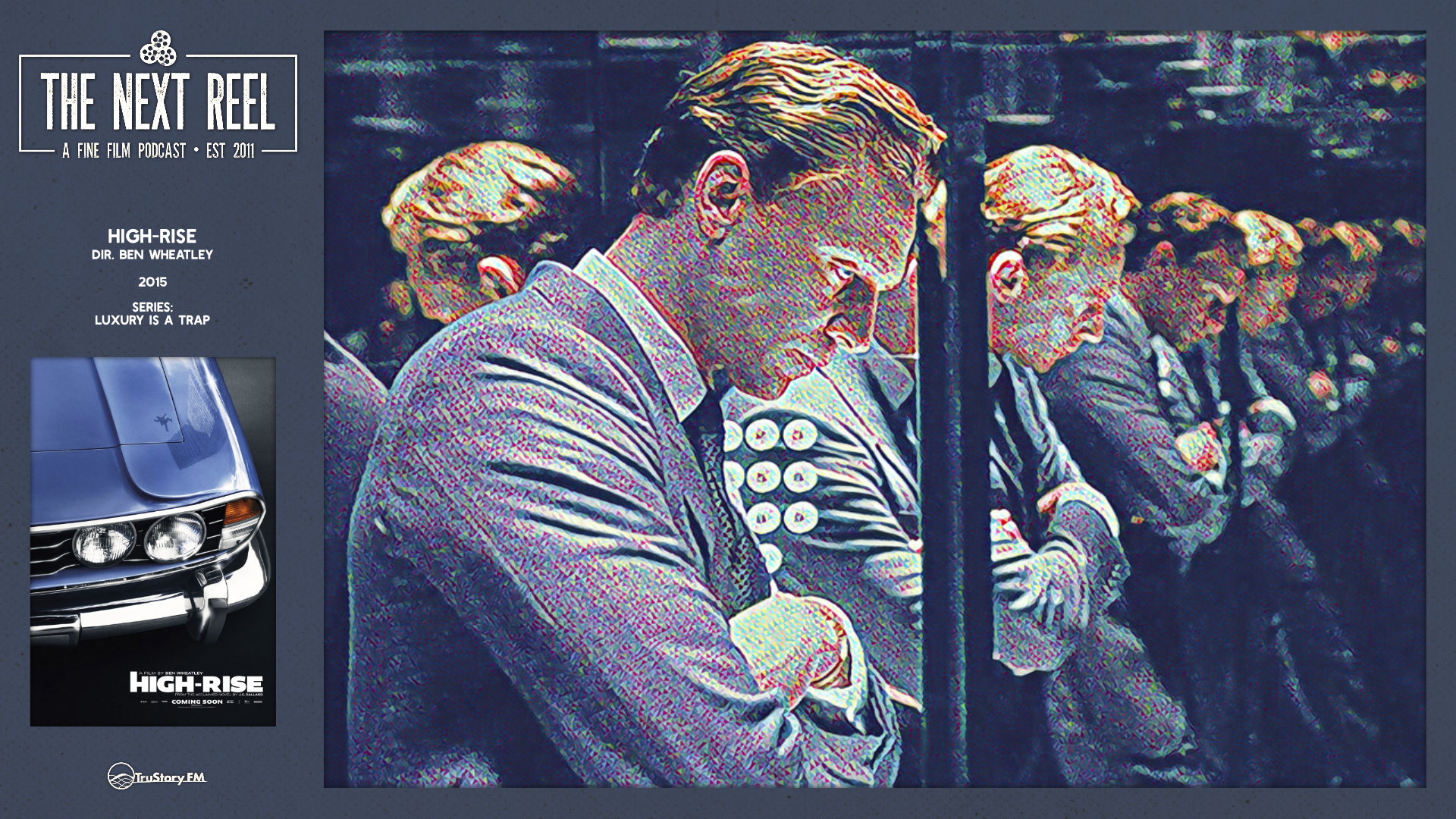
We are talking about High-Rise today, and it opens a new series, and it is my pick, and it’s called Luxury Is a Trap. And we’re gonna be talking about four films about class and hierarchy and about how walls between people stop being just metaphors and expand into floors and decks and dining rooms. And we’re gonna be talking about The Platform, which is a Spanish film set in a vertical prison where a single platform of food comes down level by level, and people at the top eat first. Awesome. Then Ruben Östlund’s Triangle of Sadness, which loads models and millionaires and crew who serve them on a super yacht. Hijinks ensue. And we will finish with The Menu, which is a private island restaurant where the chef has some plans for his guests. But we start today with the 1970s and High-Rise, an expensive tower block where rich people live at the top, and the floors go to war. Every one of these movies, the entire conceit here, locks people at the top of the social and financial caste in with the people below them and just watches what happens when systems stop pretending to be fair.
That was the entire idea. And so we started with High-Rise. And I giggle because this was not your favorite movie of the series, which we have not watched any other movies of yet.
Andy Nelson:
Right, right. Which, I mean, obviously you read ahead in the notes, but no, I hated this movie.
Pete Wright:
Actually, I read your review first, and you included nothing, which is always, that’s your tell. If you say nothing in your review, then I know where we’re gonna go.
Andy Nelson:
Yeah.
Pete Wright:
So you didn’t care for it.
Andy Nelson:
Well, I was torn. It is funny because I actually thought about that. I’m like, what can I do with my review so Pete doesn’t get it clued in? And I couldn’t think of anything, because I’m like, if I say something, he’ll know. If I don’t say something, he’s gonna know. Like, the only way I could have done it is if, oops, I forgot to log it. Like, you know, and—
Pete Wright:
Honestly, and before that was what I thought. He should have just, quote, forgotten to log it. And then plausibly you have one shot at that, because now we’ve talked about it and now I’ll know for sure.
Andy Nelson:
Yeah, right. Yeah, right now it’s out. Yeah.
Pete Wright:
So you can’t win, that’s okay.
Andy Nelson:
But yeah, but then if I put it in the notes, then you’re gonna know anyway. So it’s like—
Pete Wright:
And as I do. I did read ahead, and I’m gonna say this right now. It’s okay that you didn’t love this movie. I don’t love this movie either. This is my second watch of it, and I don’t know what was wrong with me the first time I watched it. I didn’t love it the first time. But I appreciated it. And I think I still appreciate it. I appreciate what he’s trying to do.
And I appreciate it in particular because of the era of the British social and political structure that the book originally is working to capture. There are things that I think the setup does very, very well. And then the movie happens and it’s pretty muddy. It is a pretty muddy experience of violence and doesn’t really get to, I think, the heart of the systems that I think it’s trying to poke holes in.
Andy Nelson:
You’re right. There’s some interesting setup going on here. I mean, it’s a film that you really have to walk into and go, okay, I’m going to be watching a film that is just a pure allegory, because there’s really no logic ever set up in the story as to why the building would be operating this way. Right? It’s just, okay, this is purely allegorical. Rich people live up top. If you want to move to a higher floor, you have to have more money. And the poorer people, I mean, it’s not like homeless or anything.
It’s not like super poor at the bottom who can’t even afford living, but it is poorer people, right? Like—
Pete Wright:
Yeah.
Andy Nelson:
Helen and her husband Wilder, who have a lot of kids. Well, not a lot, but, like, three—two kids with a third on the way. He works as a documentary maker. They don’t make a lot of money. They’re definitely on the lower floors and they kind of resent that they are down there. But it’s not like people can’t intermix. And so it’s an interesting, there are interesting elements within it. But yeah, just, I don’t think so. Ben Wheatley directed it, and I just don’t think that he was able to pull it off.
And this is working on a script that his wife wrote, Amy Jump. They always work together, based on J. G. Ballard’s book from the 70s, and then the film is set in the 70s. So did you ever read the book? Are you familiar with that? Okay.
Pete Wright:
No, I didn’t read the book. In reading up on it, what I understand it’s capturing is pre-Thatcher, right? So it is sort of encapsulating the social gestalt from post-war 1945 through the 70s and Thatcher’s cry for capitalism. And the building itself is apparently representative of exactly what the forties, fifties, I’d say the fifties and sixties did in Britain, right? These giant blocks of middle class, lower middle class to upper middle class, but middle class people. And they did not go well. They were poorly maintained.
They blew up all the time from gas leaks. Like, they were just not good for people. And that it took no time at all for this, according to the London Museum website, the Streets in the Sky image that they were trying to cultivate early on in this era were shredded because this building type was so just bad for people, and it ends up just sort of destroying the image that they had of themselves in this period. The movie as a snapshot of the book, which is a snapshot of this period, apparently, is trying to capture something that I think, I don’t know. It’s easy for me to watch this and think, well, this is straight-up class war, but it’s actually a war within the class. Like, the biggest battle that goes on for the bulk of this movie is middle class on middle class.
It’s just, these people can’t live together, right? The gradient between lower middle class to upper middle class is such that everybody just finds a way to hate each other immediately after the debauchery starts. Then they take it to the architect and you get this sort of Lord of the Flies, take-down-the-leader sort of mentality, and that ends up feeling to me like an empty battle. I never quite felt the stakes that should be obvious in a movie where everybody is either having sex with each other or killing each other. It should have been more obvious to me. They end up eating dogs and—
Andy Nelson:
And a horse.
Pete Wright:
And a horse.
And a horse. And I just feel like the point should have been sharper than it was in this movie.
Andy Nelson:
Yeah, and I think that’s, I mean, yeah, there are a lot of frustrations with it, but that is certainly one of them. And the fact that the point never really comes across, you know? I mean, we get a sense of this story that it’s, you know, these people are frustrated with each other. They dislike people above them or below them, right? Or they’re jealous of people above them. They don’t like the people below them. And yeah, they’re all, like you said, they’re all kind of within the same class, lower middle class to upper middle class, but there’s this—
Pete Wright:
Wheatley says they all work at the BBC. So he flattens the classes by saying, all the people who live below the top floors, they all work for the BBC.
Andy Nelson:
Okay.
Pete Wright:
I think that’s very funny.
Andy Nelson:
Yeah, and so you get this sense that there is this division, but I just couldn’t figure out how the division really gets started. Like, I understand some things, like Laing doesn’t really seem to like Munrow, right? His student that he’s teaching in the class where he’s teaching the students how to slice open a human head from a cadaver and rip its skin off and all of that and hammer through its brain, and Munrow is there and passes out. And later he finds out Munrow actually lives in the building and lives on floors above him, like the thirty-ninth floor out of forty. So he’s way up there. And so he decides, I have to take him down a peg, and lies to him and says, when you passed out, we did a brain scan and found, essentially, found a tumor.
And the guy kills himself. He throws himself off the building because he doesn’t want his father to be disappointed. And so that might be the most direct element we have of somebody from one floor deciding to do something very specifically against someone from another floor. Otherwise, some of it is just very small and I’m like, why? Who is that person and why are they against that other person? And that continues through the film. Like, there are so many people, and I hit a point where, like, well, I know that’s a richer person because they were at the fancy party, and I know that’s a poorer person, and I don’t know why they’re kidnapping people. I don’t know why they took Helen and that other guy hostage.
Like, there were things that just kept happening. I’m like, I don’t understand what they’re trying to say or how they’re trying to say it. I get that there’s this class thing going on here, but between all of the sex that was going on with everybody and then all of the fighting, I’m like, I just don’t know where we’re going with this or why it’s taking this path. Yeah. So, I mean, that was a big frustration for me.
Pete Wright:
Although I wanna celebrate when Munrow throws himself off the building, because that high-speed slow-mo of him hitting the car was fantastic.
Andy Nelson:
But why? It kind of bothered me that they did that, because I’m like, they already did it in Dredd, much better. And I couldn’t figure out what the point of showing that in super slow-mo was as Munrow kind of hits the car. I mean, it looked great. I completely agree with that. I just, in the context of the story, I’m like, but why that? Why are we suddenly cutting to that in super slow-mo in this story? And I guess that’s, for me, it just didn’t fit.
Pete Wright:
The way I read it in hindsight, and this is only after watching the film for the second time and then reading all this Brit-centric stuff, which is generally unclear to me because I’m not a student of the history of British social state. My understanding is, if you are a Brit, you probably have a better and more insightful understanding of that gradient of the social order that takes place in this building. That those people are going to make more sense to you, not as just a giant mob, which is kind of how I see it, but as something that has more nuance to it. And that stopping time to watch Munrow fall becomes an inciting incident for what comes next. To me, I’m watching this movie and I see what comes next, and it looks an awful lot like just turning the volume up on what came immediately before it.
Andy Nelson:
Yes, exactly.
Pete Wright:
Right? But I want to leave room. I want to leave the door open for recognizing that this movie was not made for me. I think that’s part of the challenge, though, because it wasn’t made for me and it didn’t teach me a damn thing. Right? Like, at no point did I come away from this movie having a better understanding of the life and times of the British civil servant in the 1970s. Not at all. I mean, it’s just a blank slate. We saw The Social Reckoning this weekend, and one of the things that works exceptionally well in The Social Reckoning, whatever you end up thinking of the movie,
is what you don’t understand about the technology, the movie does explain well. You come away having learned something about the algorithms that are defining our day. I wanted that for this movie. And because I saw these two movies back to back, all I could think about was, why didn’t they teach me anything? This movie was just all id.
Andy Nelson:
Right, exactly. Yeah, and as somebody who isn’t British like you, who doesn’t have an understanding of the British social classes of the seventies and how that led to the Thatcher era and everything, I just was not able to pull anything out of this as to why these people are acting this way. I understand, like, in large part we’re following, well, in the book, we’re following three people, right? We’re following Dr. Laing, that’s Tom Hiddleston’s character. We’re following Wilder, who is Luke Evans. And we’re following Royal, the architect, who is Jeremy Irons.
Those three are kind of the core three characters that the story is based on or follows.
Pete Wright:
And there are class markers.
Andy Nelson:
Yeah, right, exactly. Wilder is on the lower floor. We’ve got Dr. Laing kind of right in the 25, close to the middle, a little above, and then Royal up at the top. Yeah, we do follow those three people in the film. We see them. I mean, it certainly is set up with Dr. Laing as our protagonist of the story. But none of them are likable. Like, there’s nothing about any of them that I could connect with.
There’s decisions sometimes, I’m like, I don’t understand why they’re making this decision and doing this thing. Like, there was a point when Royal really wanted to play squash with Laing, right? And so they’re on the squash court and they’re having fun. And then Royal says something that kind of, like, Laing suddenly is really angry about and kind of just blows up at him, and Royal falls and his head’s all bloody and Laing is kind of going off on him, and I’m like, wait, where did this come from? I thought they were kind of playing a friendly game of squash, and I didn’t realize that he was gonna suddenly blow up and get so angry, and then he’s fine and he’s helping him up, and, like, there were moments and I’m just like, I just don’t understand these characters or what their motivations are. And, like, was there a changed character?
Hard to tell. It just felt like sloppy characterization. Maybe that is how it is in the book. I don’t know. But and again, maybe they’re meant to be allegorical characters representing those points of British society in the 70s. But for me, I just couldn’t pull anything out of it.
Pete Wright:
Yeah, and I think you’re putting your finger on the thing that I too linger on, which is that the movie did not address, or did not address with any sort of clarity, the motivations behind these characters, even their deep-seated cultural motivations that they aren’t even aware of. Fine. I keep longing for this answer from the book, right? Like, I shouldn’t want the book so hard
Andy Nelson:
Right.
Pete Wright:
after watching a movie. I shouldn’t need it quite so much as I feel like I need it and am hanging my hat on. I do love that this is the first movie in what is bound to be a series in coming years of just movies that include people playing squash. That’s right.
We’re gonna celebrate squash someday. And Tom Hiddleston’s got a good arm. He’s got a good hand.
Andy Nelson:
Yeah, he does. Squash is always a game that I kind of wish I learned. But I enjoy racquetball, and I’m sure I could pick squash up, so—
Pete Wright:
Yeah, I don’t know, man. As a squash player, I don’t know if you’re a racquetball person, there’s a rift. Let me just say, yeah, this is racquetball’s down on the eighteenth floor.
Andy Nelson:
Is this our own dividing line?
Pete Wright:
Squash is clearly twenty-five and above.
Andy Nelson:
Okay. I gotcha.
Pete Wright:
That’s all I’m saying.
Andy Nelson:
I gotcha.
Pete Wright:
I’m just saying, like, it is funny that squash is the game that they choose, that nobody down below Royal seems to play squash unless Royal has invited them to play. It’s definitely a penthouse game.
Andy Nelson:
Yeah, it really is. It’s very funny. All right, we’re gonna take a quick break, but first, you can find the show on YouTube and you can join us live when we record. We will even take your questions in the post-show chit-chat, and members get the full post-show conversation and always know what to listen to next. Subscribe to The Next Reel on YouTube. The link to this episode is in the show notes. We’ll be right back.
Pete Wright:
Okay. Let’s, can we just walk through some of the specific performances you called out, the big three that I was interested in? Everybody else becomes a muddy mess, but Hiddleston, we already acknowledged, keeping it tight.
Andy Nelson:
Yes, he is. Yes, he is.
Pete Wright:
One of the challenges I have with Hiddleston is not in his performance. I think his performance for the material is fine. The material is the problem. See before the break. I think he actually does a fairly good job of being the muddy middle representation of this class battle. He is a guy who has no problem hanging out with the lower class and having sex with them and has no problem hanging out at the upper-class, upper-tier parties, even if he shows up in a suit where he should be wearing costumed regalia.
He tows his own. Everybody likes him. He is just sort of neutral gray, which is a little bit of a fine point when he paints his entire everything in his apartment neutral gray. Do you find things that are likable in Hiddleston’s performance of an unlikable character?
Andy Nelson:
One of the smart things that any filmmaker does when he has an unlikable character that the audience needs to find some connection with is cast a really likable actor, right? We’ve seen that done many times. And I think it’s very smart to cast Tom Hiddleston in this role, because he is such a likable actor. And I think there’s a lot of fun in the character. And I mean, we’ve seen him do quite a variety of roles. And I think clearly he’s somebody who can have a lot of fun doing devious sorts of stuff, like when he’s playing Loki, but can also be a very kind of clean-cut businessman, like in The Night Manager or things like that. And so I think Hiddleston is able to kind of walk the line well of somebody who is well to do.
Honestly, I will say, and again, maybe this is a problem with the book, I kind of picture Hiddleston as somebody who would be on an even higher floor. And maybe that’s also because of his role working as a doctor, you’d think that, okay, this is somebody who should be higher up. You know, twenty-five seems a little low for him, and maybe he just took it because that was what was available. It seems like this place was already full and he kind of was grabbing the last room. I don’t know if that’s an accurate read, but that’s kind of how it seemed. And so it’s entirely possible. I mean, he certainly seems to get along with everybody from the upper floors. It’s just there are some people like Munrow and whoever that guy is who is like Royal’s guard or Royal’s right-hand man.
I don’t know who that guy is, but he seems to have a real issue with Laing for some strange reason. So yeah, I mean, I think largely I think Hiddleston plays the role well. Like, I can see him on twenty-five, but I do see him as somebody who it’s fair to say should be higher, and perhaps why he seems to get along so well with all those people. So yeah, I can see that. Do I see him as a character who then also can kind of go the other way and connect with people on the lower floors? I think so. And maybe that’s, again, maybe that’s kind of the Loki side of Tom Hiddleston, who comes out as somebody who can kind of connect with a little more of the debauchery and the ribald humor and things like that and kind of finds a way to have an easy connection with Wilder, is drawn to Helen.
Like, there are things about him that I can see plays in all of that.
Pete Wright:
Yeah, yeah. I agree with all of that. I think he has a natural charisma on screen and with other actors and other characters, and he just plays that sort of chameleon role really, really well. To the point where at one point in the movie you think that Laing and Wilder are going to be friends. Wilder comes off the rails, though, and I look at Luke Evans’ portrayal of Wilder and I think, I don’t know that there’s, I think he’s hand to glove for this character. I think as for a character that I don’t necessarily care for, he is fantastic at it. He is riveting. His intensity is riveting.
His screaming brief monologue at Laing’s door is riveting to me, as he is pounding his hand in remnants of his own spit on the door from screaming at it in extreme close-up. I thought he was great. What’d you think of Luke Evans?
Andy Nelson:
I mean, I like Luke Evans and I think that he really fit the role here. I mean, fantastic hair. Man, the most seventies of all the hairdos on all the men. Like, it was just a brilliant, brilliant bit of hair that they did. And I don’t know, it didn’t seem like it was a wig, because he’s in the pool at one point. And I guess maybe a wig can handle underwater well, but anyway, it seemed to work quite well for him. And yeah, his performance goes off the rails quite well, to the point where he becomes the mad documentarian who pursues his story on the tower and kills the architect, only to be slaughtered by all the architect’s women in some crazed moment that was all shot through a kaleidoscope.
Pete Wright:
All captured in camera. Lovely.
Andy Nelson:
Yeah, the kaleidoscopic bit.
Pete Wright:
Just lovely.
Andy Nelson:
Yeah, it was a weird, you know, but I liked him. I did like him quite a bit.
Pete Wright:
Brief sidebar. Will you indulge me?
Andy Nelson:
Sure.
Pete Wright:
I would like to play the IMDb game with Luke Evans.
Andy Nelson:
Oh my gosh.
Pete Wright:
Fifty-six credits on the board. Fifty-six credits.
Andy Nelson:
I hate to say I can’t think of anything other than the three, or the two Hobbit films he’s in.
Pete Wright:
Hmm. I wonder if you should start with one of those.
Andy Nelson:
Well, yeah, I feel like, you know, starting with, I’ll start with The Battle of Five Armies, because I think his big battle with Smaug starts that film off. I guess I’ll save this, and I guess I’ll say the other Hobbit movie, which is The Desolation of Smaug. And what else has Luke Evans been in? I’m blanking. I’m blanking. Was he in Free Fire? He wasn’t in Free Fire, was he? I know that Ben Wheatley did that right after this.
Pete Wright:
No. I don’t believe he was.
Andy Nelson:
I’m blanking. There’s gonna be some, you’re gonna call out some titles that I’m gonna feel really stupid for forgetting.
Pete Wright:
Well, I’m going to go ahead and tell you that this one isn’t it. This one didn’t make the cut.
Andy Nelson:
Oh, okay. I would think it would have, but okay.
Pete Wright:
Yeah, you picked the wrong Hobbit. It’s The Desolation of Smaug that made it for The Hobbit.
Andy Nelson:
Okay. I said all three. I did say all three.
Pete Wright:
Well, but then you said, I guess I’ll go with this one. So that was locking in your pick, right?
Andy Nelson:
But then I said as my third pick, because I have to do four.
Pete Wright:
You—
Andy Nelson:
I said, well, I guess I’ll throw The Desolation of Smaug in there.
Pete Wright:
Oh, the other—you’re right. You’re okay. Then you’ve got The Desolation of Smaug. One that I haven’t seen, which is called No One Lives, from 2012, where he played Driver.
Andy Nelson:
Yeah, I haven’t seen it. I haven’t even heard of that one.
Pete Wright:
All right. One that we have done on Sitting in the Dark. We were doing our Dracula series. And we did Dracula Untold.
Andy Nelson:
Oh, oh, oh, oh, oh, Dracula 2000. Dracula Untold. Yeah, I knew, yeah, it’s one of those.
Pete Wright:
Outstanding.
Andy Nelson:
Yeah.
Pete Wright:
And finally, Andy, if I were to tell you that no one fights like Gaston.
Andy Nelson:
Oh God, yeah, he was in Beauty and the Beast. I totally spaced that, right.
Pete Wright:
Yeah. Given your Disney lineage, I thought maybe that would be the easy one, but—
Andy Nelson:
Yeah. Well, it’s a live action. I kind of forgot about it. Yeah. But yes, you’re right.
Pete Wright:
Yeah, that’s it. Sidebar ended. That is the IMDb game on Luke Evans.
Andy Nelson:
Okay, excellent.
Pete Wright:
I was gonna do it on Tom Hiddleston, but guess what? It’s this movie and all Marvel, so who cares?
Andy Nelson:
There’s a bunch of Marvel, yeah.
Pete Wright:
Yeah. Okay, that brings us, of course, to the great Jeremy Irons.
Andy Nelson:
Okay, I have a question about Jeremy Irons for you. How do you find it as far as ranking Jeremy Irons’ performances, when it feels like so many of the roles that people want him to play are, hey, can you do a variation on Reversal of Fortune? Because that’s what, like, we need you to play a pompous rich guy who might be a little suspect. And I feel like he’s been playing that role for decades and he’s great at it, but Reversal of Fortune is such a fantastic performance. One of my favorite ending moments in a film is in that movie, and that is one that I could not get out of my head as I watched this. I’m like, I’d rather just go watch Reversal of Fortune again.
Pete Wright:
I think that does become problematic, because at least for me, I like Jeremy Irons in roles like this. And I find that when I’m watching Jeremy Irons in roles like this, it’s like I’m anesthetized to what he’s doing and I’m just watching how he’s doing it. And that’s problematic, because it turns out that the character isn’t written
Andy Nelson:
Yeah.
Pete Wright:
as thoroughly as I would want. His motivations are all just a little bit empty. His participation and non-participation in what is happening in the penthouse is kind of like, why is he there? He’s like the appendix to the rest of the organ system. Nobody, like, who cares that he’s there?
If you’re gonna make him a vapor, then don’t show him at all. Like, make him the mysterious architect that no one ever meets and no one can ever see. That would have been a more compelling version of this character.
Andy Nelson:
Like the Ed Harris at the end of Snowpiercer.
Pete Wright:
Yes, right, right. Which is, let’s just say, a better example of this movie. And it got to move—
Andy Nelson:
Hundred percent, hundred percent.
Pete Wright:
Okay, so that’s my problem with Jeremy Irons in this movie, is that he didn’t get a full Irons, right? He’s half Irons.
Andy Nelson:
He’s just, yeah, he’s just playing himself. Playing himself in these better roles, yeah.
Pete Wright:
Right, right.
Andy Nelson:
What about the two women leads? We’ve got Elisabeth Moss and Sienna Miller. And in some aspects, I actually think that they’re more interesting than the men. I don’t know. How did you see them?
Pete Wright:
Yeah, I think our introduction to Sienna Miller is awesome. Again, she kind of plays the chameleon from the lower decks, right?
Andy Nelson:
Well, she’s on twenty, she’s one above him, though, right? She’s on twenty-six.
Pete Wright:
Right, that’s how she meets him, by looking down at his gloriously sculpted bod. But she gets to move between floors more fluidly than—
Andy Nelson:
Okay.
Pete Wright:
You know what I mean? Like, she is also that chameleon character, kind of lives in the high middle and can go pretty much wherever she wants. But what is the movie saying about how she can move wherever she wants? Whenever she’s moving, she’s having sex with somebody or another, right? I mean, she’s using sex and her body as a vector of identity. She also has her son, who ends up being an interesting appendix on her, right?
I’d say more useful than an appendix. Let’s say gallbladder. He’s more useful than an appendix, but can still be removed fine. And so I find her really fascinating. I like the way she performs her role. I like that she gets to have, I think you say she’s in many ways more interesting than any of the male leads that we’re talking about. I think you’re exactly right. I think she is more interesting to watch than anybody else in the principal roles. Why did you say that?
Andy Nelson:
I mean, I think a lot of what you just said, like there was something mysterious about her, like I could never quite put my finger on her, like you said, as far as the flexibility and ease with which she seemed to kind of have in connecting to different areas of the building. Like, there was an element of that that I found really interesting as far as the way that she performed it. And I liked her. And it got dark, you know, as we get toward the end, ’cause Wilder has had such a crush on her for so long that, he finally ends up, it just gets dark, we’ll just say, as far as where that story goes. And I think that for my money, it became a more compelling, maybe one of the only compelling relationships in the film that I was always kind of wanting to come back to and see where it would go.
Pete Wright:
Yeah, I think so too. I think so too. And I feel like we never got any sort of fulfillment in any of those relationships at all. So I totally agree.
Andy Nelson:
Well, and you brought up the whole point with the son. And I felt like, okay, it’s set up for an interesting point, that’s a reveal that happens late in the film, which then went nowhere. And I’m like, well, why are you telling us this and giving us that reveal if it doesn’t turn into something?
Pete Wright:
Well, let’s describe the reveal.
Andy Nelson:
Well, okay. I mean, the reveal is that the son is actually, spoiler alert, Royal’s son. We find that out and it takes us nowhere. So it was strange to me. Like, that was the reveal. I guess maybe the only thing, I think it’s the maid that tells Wilder that, right? And so maybe it’s just the thing that flips Wilder’s switch finally and forces him to go up there and rape her and then go kill Royal. But still, it’s just like, I was wanting that to take us somewhere and it didn’t.
Pete Wright:
Yeah. That bit of duplicitousness, I think I understand the point, right, in having this penthouse elite not acknowledge his own offspring in the middle class. We’ve been doing that since, oh, let me see if I can find a word for it. The Royals. But—right, right.
Andy Nelson:
As the other royals, not this Royal.
Pete Wright:
All the royals.
Andy Nelson:
All royals.
Pete Wright:
All the royals. And so, I do appreciate that they’re trying to make that incisive point. It ends up going nowhere and being so on the nose that it doesn’t have as much sort of weight for it as a surprise.
Andy Nelson:
Yeah.
Pete Wright:
Yeah. All right, so Elisabeth Moss.
Andy Nelson:
Sidebar, we’re gonna do the IMDb game with Elisabeth Moss, Pete.
Pete Wright:
Oh no.
No, no. Okay. I mean, sure.
Andy Nelson:
All right.
Pete Wright:
I assume you have it open.
Andy Nelson:
I’m ready for you to start guessing.
Pete Wright:
You don’t want me to do it? You want me to run it?
Definitely The Handmaid’s Tale. That’s gotta be. Even though it’s not a movie that IMDb has to acknowledge. That’s her thing.
Andy Nelson:
Yeah, right, right, right, okay.
Pete Wright:
What else do I know that she’s been in, Andy? What else do I know that she’s been in?
Andy Nelson:
Let me know when you want some hints.
Pete Wright:
She—
Andy Nelson:
I will say The Film Board covered one.
Pete Wright:
Oh, The Invisible Man.
Andy Nelson:
The Invisible Man, okay.
Pete Wright:
Okay. All right. There’s two. How do we stand on something like The French Dispatch?
Andy Nelson:
True, she is in it.
Pete Wright:
We just did that recently.
Andy Nelson:
Yeah. Yeah.
Pete Wright:
I’m assuming what you’re telling me is that’s not one of the words.
Andy Nelson:
That’s not one of them. I will say you’re two for two for two with your guesses so far. The Handmaid’s Tale and The Invisible Man are both.
Pete Wright:
I think I’m gonna need, I think I’m gonna need a—
Andy Nelson:
Okay, I will give you a clue. One is a—do you want years or directors or co-stars?
Pete Wright:
Let’s do co-stars first.
Andy Nelson:
Okay. That’s the biggest—Ted Danson.
Mark Duplass.
Pete Wright:
Ted Danson? Wait, what?
Andy Nelson:
Mark Duplass.
Pete Wright:
Oh, there’s, like, the watercolor poster with Mark Duplass on the cover, and I guess that’s her next to it. It’s, what’s it called, though? It involves water play.
Andy Nelson:
They’re on a getaway at a kind of a retreat. It’s called The What I Love.
Pete Wright:
Yeah, that’s the one. The One I Love.
Andy Nelson:
Yeah, I could tell that’s where you’re going.
Pete Wright:
Yeah.
Andy Nelson:
It’s kind of a—
Pete Wright:
I haven’t seen it.
Andy Nelson:
Well, you should watch it, because it’s a really, it’s kind of a mumblecore—
Pete Wright:
Mark Duplass is in it, Andy, really.
Andy Nelson:
Sci-fi. Yeah, I know, I know, real surprise. But it’s like a funky, like, high-concept, weird sci-fi story. So there’s a whole sci-fi element that actually is a surprise. So I think you’d enjoy it quite a bit. Last but not least, 2019. If I say the director, you’re gonna be able to figure it out. I’ll do co-stars.
Pete Wright:
Okay.
Andy Nelson:
Let’s start with Yahya Abdul-Mateen II, Winston Duke.
Pete Wright:
What? Okay, give me another. Us?
Andy Nelson:
Us, yeah. Lupita Nyong’o was gonna be my last one, yeah.
Pete Wright:
Damn. I should have gotten that faster. I should have known that off the bat, for crying out loud. We just did Get Out.
Andy Nelson:
I thought that you would have had that one. Yeah, I thought you would have had that one.
Pete Wright:
Ugh, God, that’s embarrassing.
Andy Nelson:
So, but if I said Jordan Peele, it also would have given it away right away.
Pete Wright:
Yeah, that would have been it.
Andy Nelson:
So, yeah.
Pete Wright:
Yep.
Andy Nelson:
All right. So back to Elisabeth Moss. I actually really enjoy her in this film. One, I thought she did a great job with playing a Brit. And I thought it was an interesting character, somebody who was pregnant, who again kind of is moving amongst the floors, and I couldn’t quite figure out the kidnapping plot at the end. Like, why did they take her and then they just kind of locked her in a room, and then she had her baby and all the wives were like, “Oh, here’s your baby.”
And it was just a weird thing. I couldn’t figure out where it was going, but I thought she was good in the part. I thought it was an interesting role for her.
Pete Wright:
At any point did you have, even in the smallest, darkest recesses of your imagination, did you think they were going to eat the baby?
Andy Nelson:
I didn’t go there. I did not go there. Is that where you went?
Pete Wright:
I mean, I didn’t either, of course. I didn’t either. I would never have thought that.
Andy Nelson:
Well, the film opens with him eating a dog, so I guess I wouldn’t have been surprised.
Pete Wright:
Eating the dog. Yeah. I agree with you. I think of all the characters, as much as, and I think Elisabeth Moss is great in this role. I also think the role is one of the, like, straight-across-the-bow characters. She has played more varied, more interesting characters on stage, on screens large and small, in almost everything she’s done. This felt like this was written to be something that everybody’s gonna understand. You just see her, and you’re gonna understand exactly what she represents in the film.
And so it feels like a small, ideologically small swing. And yet I like her. I think that it’s a small swing, and they don’t deliver on the full mystery of why they all kidnap her at all. And I just don’t get it. So I think maybe it was a big swing. It was such a big swing that it’s way above my head, which would not be the first time. So—
Andy Nelson:
I mentioned something a moment ago and I want to talk about it. There’s actually two points that I want to make that are both complaints with the film. The first is, and two more complaints. The first is, I mentioned earlier we start by seeing Laing eating the dog. Like, the film starts at the end with him walking around, he’s covered in blood. There’s this dog. He’s talking to somebody else who’s gone crazy and he says, “Oh, so-and-so’s in the other room,” and you go and you just see this guy whose head is like in this cage, and it’s kind of a gruesome way to start. And then we do a flashback to three months earlier, and that sets up the story that builds to this point.
Why? This is an issue that I have with films where it’s a storytelling style where it’s like, oh, we gotta start with something that’s gonna provoke the audience. Let’s start late in the game and then we’ll flash back and tell the story that brought us there. But why? What does that give us in this particular film? I couldn’t figure it out. And it just did nothing for me to start that way. Did you have any issues, or did it work for you?
Pete Wright:
Yeah, I feel like this is a movie that spoils itself, right? It’s a movie that spoils itself, and it takes three minutes of screen time for us to recognize that this is a combustible building. That we get what the entire ideology of the movie is from jump. Let the mystery of how it gets there unfold. Don’t give us the roasting a dog’s leg on a spit in the opening sixty seconds. It makes me crazy. I don’t understand why we needed that framing mechanism. And I agree with you. It feels like a studio note.
It feels like somebody didn’t have confidence in the film and they gave us the most sort of gruesome imagery right up front and fast. It happened to me kinda like a dream or a nightmare, right? I just didn’t truck with it at all.
Andy Nelson:
No, yeah, I didn’t either.
Pete Wright:
Yeah, okay. That’s complaint number one.
Andy Nelson:
My other issue, and this is not so much an issue, but I think it’s a point that I have noticed when I am reading about a film. And I hear that, oh, this has been a passion project, so-and-so has been trying to get it off the ground for years, right? Jeremy Thomas is the producer of this. He has been wanting to adapt High-Rise since the 1970s. It has been tried, had various near moments to have it happen. I think Nicolas Roeg was gonna direct it in the late seventies at one point, and then it was on again and off again and on again and off again. And then finally Ben Wheatley was interested, reached out, and found out Jeremy Thomas had the rights, and they decided to make it, and this is what we get. My theory is that when there’s somebody who has a passion project that they’ve been trying for years to get the money for, to get off the ground, maybe they need to start realizing, if people don’t want to give you money for it, maybe it’s just not gonna actually be that good.
Barry Levinson had the same thing when he was trying to make Toys. He had that as his passion project forever. And that movie was just so dumb. And I think it’s Barry Levinson. I want to check that. But it was a terrible, terrible film. And yeah, it was Barry Levinson. Gangs of New York, Martin Scorsese was trying for years to get that made. And then he finally made it. And hey, I mean, it was well received.
It ended up getting Oscar nominations and it was received a lot better than a lot of passion projects, but for my money, it was kind of a snooze. I just didn’t care about the film very much. So—
Pete Wright:
But Scorsese has had more than his share of passion projects, right? Silence was a passion project, The Irishman was a passion project, like they all took decades for him to make.
Andy Nelson:
Yeah, he seems to be somebody, and I mean, maybe his passion projects end up better than other people’s passion projects. But still, I would argue that it seems like if you’re trying for a very, very long time and no one will give you money, maybe just take it as a sign that maybe it’s not worth actually making.
Pete Wright:
So that implies my next question, though. Do you think there is a version of this movie that would have satisfied you?
Andy Nelson:
That’s a hard question to ask without knowing the book at all. I feel like I have to know how the book unfolds better to have a sense if this could be actually adapted in a way that worked. I mean, I’d have to say, yeah. There has to be a way that somebody could adapt it. I mean, you can do all sorts of crazy adaptations. I mean, Adaptation proved that. I think that you could find a way to do an adaptation of this that strengthens some of the characters and finds a better path forward for the story. And so, I mean, sure, I think there probably is a way, but, you know, and I know J. G. Ballard is one for dystopian fiction.
So there might be elements in there that work better on screen and others that don’t, and somebody could find a better way to kind of work through all the different parts of it, but I don’t know. As it was, it would be hard for me to find the right way to actually tell this.
Pete Wright:
I have an imagination that there is a version of this movie. I think so many of the issues that I bring up, I recognize are me issues, right? That it’s possible that so much of the movie would be more incisive if I had grown up in Britain in the sixties. And that’s a me thing. The movie exists for a different audience than me. And maybe all of those sort of incisive issues of social nuance as the building decays would be completely clear and truly insightful observations of British civilization falling apart. Which implies also that in order to make the movie that would be better for me would mean dumbing it down to, like, an American political level, which is the most obvious sort of stupid robot boxing game that you could ever possibly imagine.
And I don’t necessarily know that I would love that movie either, because it’s too dumb. So I don’t know. And then what was the great movie that I love so much about the, God, we did it on, I think we did it on Sitting in the Dark too. It was about the building that had layoffs and they had everybody kill each other.
Andy Nelson:
Oh, yeah, that was shot in Colombia. The something project, or something. The—
Pete Wright:
Oh yeah, the Someth—for—no, The Forbin Project, no.
Andy Nelson:
The S—no, S—yeah. Anyway, yeah, what is that called?
Pete Wright:
You get what I’m saying. The point is, there are movies about lock-ins that are better and that I think make clearer, salient points more quickly. The last thing that I have on my list for this movie, which I think makes it super challenging, and again, maybe I just am missing a point, it’s quite possible, is that nobody ever leaves. But they can. They can come and go as they please. Right? People go to work.
Andy Nelson:
We do see a few people leaving to go to work. I think we see the guy who is the other newscaster, we see him leaving to go to the office. Laing obviously leaves a few times to go to his office.
Pete Wright:
So is that the point? Like, some people in certain floors have the freedom to leave. One guy with the mustache, he leaves and when he comes back, he’s kidnapped and brutalized. So maybe that’s the thing. His parade of confidence through the lobby gets him nowhere when civilization falls. Maybe that’s the point the movie’s making.
Andy Nelson:
Yeah, I don’t know.
Pete Wright:
You think you’re free.
Andy Nelson:
Yeah, like, what is it? And I guess I don’t know, in the book it sounded like, or it sounds like from the book, this is a building where everybody can essentially have everything they need in this building. They don’t need to leave. A lot of people actually work here, but there are a few people who do leave to go to work. But then by the time they’re toward the end of the film, almost all of the cars are gone.
Pete Wright:
And those that are left are destroyed.
Andy Nelson:
Yeah, and the parking lot itself practically is on fire. So it’s like, have people been going out into the parking lot and leaving or destroying cars? I don’t know. A lot of questions. Did some people leave? I don’t know. It doesn’t make any sense.
Pete Wright:
Okay, well, that’s it.
Andy Nelson:
The Belko Experiment, Pete.
Pete Wright:
The Belko Experiment. Outstanding.
Andy Nelson:
Yeah.
Pete Wright:
Good. Now you can leave that whole part in. And this is a callback. I will just say that there’s a lot of orgying in this movie and I did find this really funny. The orgy, Game of Thrones, apparently, had completely buffed the per-person cost of nudity through the roof. So nobody would get—no, this is Wheatley.
Nobody would get naked in Northern Ireland for under a thousand pounds or a thousand euros. Pounds? A thousand pounds. So Wheatley ended up going to local swingers groups and asking people to come be in his movie orgy.
Andy Nelson:
Oh my gosh, that is funny.
Pete Wright:
That may be the best thing you’ve learned about this movie today, right?
Andy Nelson:
Yeah, yeah.
Pete Wright:
Come on.
Andy Nelson:
Yeah, interesting. Very interesting. Yeah, there was some of it I was like, okay, so this is Ben Wheatley’s Eyes Wide Shut that we have here.
Pete Wright:
That was good.
Andy Nelson:
Yeah.
Pete Wright:
That was good.
Andy Nelson:
Oh my gosh.
Pete Wright:
Eyes Wide Shut, man, it just keeps giving.
Andy Nelson:
All right. It does, yeah. All right. Well, let’s move into the back half, but first, let’s take a quick break.
Pete Wright:
The Next Reel is a production of TruStory FM. Engineering by Andy Nelson. Music by Roie Shpigler, Flint, Oriol Novella, and Eli Catlin. Andy usually finds all the stats for the awards and numbers at The-Numbers.com, BoxOfficeMojo.com, IMDb.com, and Wikipedia.org. Find the show and the full archive at TruStory.fm. You can follow us from there too. Plus, you can find out how to become a member and go further with every episode.
Check out our merch store at TheNextReel.com/merch. And if your app allows ratings and reviews, please consider doing that for our show.
All right. I guess now we talk about all the other stuff. The grand High-Rise connected universe.
Andy Nelson:
Yeah, right, right. Obviously this isn’t a story that is—the film has not had any sequels, but the book itself has been very influential. There’s a Doctor Who serial called Paradise Towers in 1987 that was an influence, or influenced by the book. This is an interesting one that I don’t think, I can’t remember if this came up when we talked about Shivers, David, in our David Cronenberg series, but there are similarities in the two stories. That one also is tenants in this big isolated building descend into a whole bunch of orgies and anarchic violence. So I think that’s interesting that there is a potential hint that Cronenberg at the very least was influenced by the book as he was putting that film together. And it’s interesting because obviously Cronenberg has a connection with J. G. Ballard, having adapted the novel Crash for his 1996 film.
Joy Division singer Ian Curtis says the book is one of his favorites. A lot of bands love it. Hawkwind used the book for a song of the same name, “High-Rise.” And Canadian post-rock band Godspeed You Black Emperor put it on their recommended reading list when they would appear in 2010. So a lot of people do really connect with it.
Pete Wright:
That it’s interesting that you bring up music, and it was a point I forgot to make, like the use of SOS, of ABBA’s SOS, using it twice, both covers, the first one a tidy opening version and the second one the Portishead edition of it. And those were intentionally to mirror the collapse of the tower, because the Portishead version just feels like it starts to come apart, and that was the sonic metaphor. Did you get it?
Andy Nelson:
You know, I remember SOS playing in there. I don’t know if I was paying enough close attention to what the music was doing in those particular scenes, but that’s interesting.
Pete Wright:
That may have made the movie for you. Had you been paying attention, that may have been what unlocked it.
Andy Nelson:
Had I paid it more attention, yeah.
Pete Wright:
Yeah, all right. How’d it do at awards season?
Andy Nelson:
You know, minor. It did six wins with fifteen other nominations at the British Independent Film Awards. Hiddleston was nominated for Best Actor, but lost to Tom Hardy in Legend. The film was nominated for Best Screenplay, but lost to Ex Machina. Luke Evans was nominated for Best Supporting Actor, but lost to Brendan Gleeson in Suffragette. Sienna Miller was nominated for Best Supporting Actress, but lost to Olivia Colman in The Lobster. Then at the London Critics Circle Film Awards, it was nominated for Best British Irish Film of the Year, but lost to I, Daniel Blake. And the film was nominated for Technical Achievement of the Year. I think it’s interesting that the London Critics Circle does this. They have Technical Achievement of the Year, and then a variety of different departments can submit.
And in this case they submitted for production design, but they lost to Cinematography for the film Victoria, which is a one-camera, like a oner. The entire film was a oner. At the British Film Designers Guild Awards, it won for Best Production Design for an Independent Film. And at the Yoga Awards, which are always kind of a funny award, Jeremy Irons won for Most Overexposed Actor of the Year, because this year he was in this film, Assassin’s Creed, Batman versus Superman, Department of—Department of Justice, whatever it’s called.
Pete Wright:
I think there’s a new logo and name coming to the Department of Justice, so yeah.
Andy Nelson:
Right. Correspondence and The Man Who Knew Infinity and Race. So one, two, three, four, five, six films this year. Most overexposed actor. I wonder how many of them were variations of his Reversal of Fortune character.
Pete Wright:
I think all of them, even Alfred.
Andy Nelson:
Even Alfred, yeah, right?
Pete Wright:
All right, how’d it do at the box office?
Andy Nelson:
Well, for Wheatley’s film, he had a budget of 6.1 million pounds, which is 8 million US dollars or about 10.5 million in today’s dollars. The movie premiered at TIFF in September 2015, followed by a festival run before opening in the UK March 18th, 2016, then day-and-date VOD and theatrical in the US May 13th, 2016, opposite Money Monster, which we’ll be talking about later this season, and The Darkness. You can imagine with its VOD the same day that it did not help the box office. This earned just under $350,000 domestically. Yeah.
Pretty low. It did better internationally, earning a bit over five million, and that landed the film with a total gross of 7.1 million in today’s dollars. As far as theatrical goes, landing with an adjusted loss per finished minute of $29,000. But with VOD sales, it’s entirely possible it made its money back, but no one’s going to tell us who live on the lower floors. We’re not in a place to know.
Pete Wright:
So, after this movie, I still, I’m not able to shake my love of a good, tidy, planned community. Would I move into this building, Andy? Absolutely. Would I invite any of these people over for dinner? Not at all. Not at all.
Andy Nelson:
Right, right, very right. It’s too brutalist for me. Like, the building was so just brutal. I could not live in that building.
Pete Wright:
It’s very austere.
Andy Nelson:
But it looked cool. It did look cool, yeah.
Pete Wright:
There’s something about having, like, a grocery store every three floors and, like, you know, let’s go to the mid-level pool. I just, it’s so tidy. Oh, it’s so tidy.
Andy Nelson:
Yeah, no, I agree. There are elements. Yeah.
Pete Wright:
Yeah.
Andy Nelson:
Well, this was a hard watch for me. I think it’s gonna be a hard watch for a lot of people. It’s definitely not like a Hollywood film, since it’s less storytelling than actual allegory and just a lot of fighting and a lot of debauchery. So this is a film I would tell people, only watch it if you’re curious and you’re really in the mood to try something a little off the wall. But it’s definitely not gonna work for everybody.
Pete Wright:
Well, and if you’re maybe over sixty and British.
Andy Nelson:
Well, yeah, maybe.
Pete Wright:
You might get it.
Andy Nelson:
Maybe. You might still be a little put off by it.
Pete Wright:
Yeah, right.
Andy Nelson:
Yeah.
Pete Wright:
Hey, they’re talking about me.
Andy Nelson:
Yeah, right. See too much of myself, yeah.
Pete Wright:
But mostly, if you really, really want this movie, go watch Shivers is what I think we’re saying.
Andy Nelson:
There you go.
Pete Wright:
Yeah.
Andy Nelson:
There you go. I like that.
Pete Wright:
All right.
Andy Nelson:
All right. Well, that is it for our conversation about High-Rise. Next week we are looking at The Platform, the 2019 Spanish dystopian thriller from director Galder Gaztelu-Urrutia. It takes place in a vertical prison where a platform loaded with a lavish feast descends through the levels one at a time. Whoever is on the top level eats their fill, and whoever is below gets whatever is left. Each month the inmates wake up on a different level, so today’s glutton could be tomorrow’s scavenger. It’s another tall building where your floor decides what you get, which makes it a natural next stop in Luxury Is a Trap.
Pete Wright:
Have you seen it, first of all?
Andy Nelson:
I have not. Not.
Pete Wright:
Oh man. Now I’m nervous. I started low. I’m really nervous.
Andy Nelson:
Well, I’m gonna say it can only go up from here, so we’ll see. Yeah.
Pete Wright:
I don’t know, Andy. The platform only goes down.
Andy Nelson:
Yeah. Yeah.
Pete Wright:
Platform only go down.
Andy Nelson:
Hey, which it reminds me, just as a side note, did you watch the Korean show that was on Netflix, but it’s a game show that is very much like this, about there’s eight floors in this room that everybody’s trapped in, and depending on what card you picked, that’s your room and it determines how much money you get every hour. And, you know, the lowest floor is obviously getting the least amount of money, is the smallest apartment. Eighth floor is lavish.
Pete Wright:
That seems familiar to me. I never, obviously never watched it.
Andy Nelson:
It’s called The 8 Show.
Pete Wright:
Oh.
Andy Nelson:
Yeah, well, anyway.
Pete Wright:
Speaking of on the nose.
Andy Nelson:
Yeah, it is a little on the nose. It’s a fun show. It’s worth checking out. So The 8 Show. All right, let’s do our ratings.
Pete Wright:
Letterboxd.com/thenextreel, that’s where you can find our HQ page where we rate and review all the films across the shows of The Next Reel film shows. What are you gonna do for this one, Andy? You’ve only got five stars. Settle down. You cannot do six. You only have five. What are you gonna do?
Andy Nelson:
But I have ten options, because I do half stars.
Pete Wright:
Ah, the nerve.
Andy Nelson:
I know. I’m gonna say one star, no hearts.
Pete Wright:
Wow.
Andy Nelson:
Really, really could not truck with this. I know a lot of people get things out of it, but not me. I just could not with this one.
Pete Wright:
All right. I think I’m gonna land at two stars. I’m also not gonna give it a heart, because I think I can use that love elsewhere.
Andy Nelson:
Yeah. And it’s honestly disappointing to me, because I really liked Kill List when we covered that in a previous series, that would have been Wheatley’s films. Free Fire I didn’t love, but I had enough fun with it at least. So I was feeling like, okay, after Kill List, I’m like, wow, okay, Ben Wheatley, maybe I need to check out more of his films. And then I watched this, which I had been excited for, because I was always curious about the story, the poster design I thought was fantastic, great cast.
Pete Wright:
Awesome.
Andy Nelson:
So I’m like, okay, this could be a really fun one. And it really disappointed me that it just was really something that just did not work at all for me.
Pete Wright:
Well, I’m sorry to hear it. I’m also sorry that my memory of it, having watched it closer to when it came out, was so much better than my experience with it this time. I watched this movie. I was like, what did I love?
Andy Nelson:
Yeah, yeah, right, right.
Pete Wright:
Yeah. Well, that was pre-pandemic.
Andy Nelson:
Yeah, well, and regardless, I do think that it’s an interesting way to kick the series off, so.
Pete Wright:
Good. Good, good, good. All right. Well, on to next week.
Andy Nelson:
That’s right. Well, that averages out to one and a half stars with no heart. And that will be over on our account on Letterboxd, @thenextreel. You can find me there @sodacreekfilm, and Pete @petewright. So what did you think about High-Rise? We would love to hear your thoughts, especially if you loved this one. Hop into the Showtalk channel over in our Discord community, where we will be talking about the movie this week.
Pete Wright:
When the movie ends.
Andy Nelson:
Our conversation begins.
Pete Wright:
Letterboxd giveth, Andrew.
Andy Nelson:
As Letterboxd always doeth.
Pete Wright:
All right, what did you do? What was your criteria this week?
Andy Nelson:
I just wanted one that I could enjoy better than the movie.
Pete Wright:
All right. All right. Go ahead.
Andy Nelson:
I went with CinemaVoid’s two-star, no heart. “I’ll never forgive Ben Wheatley for using ABBA as the soundtrack for the rich. ABBA is for the people!” Pumping fist emoji, fire emoji. Yes.
Pete Wright:
Oh, that’s pretty good.
Andy Nelson:
I love it.
Pete Wright:
Well, given how we felt about the movie, I went high, just to see what it was that people were loving about the movie. And so here’s a five-star and a heart from Aurora Borealass. Aurora Borealis.
Andy Nelson:
Or Aurora Borealis.
Pete Wright:
Yeah. Wow. Wow. I just didn’t expect to get all the way to the end of the show before I crapped a bed. Awesome.
“Ben Wheatley is one of those directors people tend to either love or hate, with little to no in between. I’ve only seen two of his films thus far, but I have to say, from what I’ve seen, his work really does it for me. I love this film. Regrettably, haven’t checked out the book it’s based on yet, so really need to get on that ASAP. Visually, I think this is one of the most stunning films I’ve seen in a while. It’s just so stylish and experimental.”
And I think I could say the same exact thing and land on two stars.
Andy Nelson:
Yes.
Pete Wright:
So, but the higher review, even higher than that, is, I think, what celebrates the clearest love of this movie. It’s five stars from den_io, who says, “Tom Hiddleston is hot.”
Andy Nelson:
That’s just that.
Pete Wright:
Just that.
Andy Nelson:
Five stars just for Tom Hiddleston.
Pete Wright:
Yep.
Andy Nelson:
Oh my gosh, too funny.
Pete Wright:
What are you gonna do?
Andy Nelson:
What are you gonna do? Yeah.
Pete Wright:
Thanks, Letterboxd.