*This transcript is produced using transcription software and reviewed for quality. Despite our best efforts, some passages may be incomplete or contain errors due to audio quality or software limitations.*
Pete Wright:
I’m Pete Wright.
Andy Nelson:
And I’m Andy Nelson.
Pete Wright:
Welcome to The Next Reel. When the movie ends
Andy Nelson:
Our conversation begins.
Pete Wright:
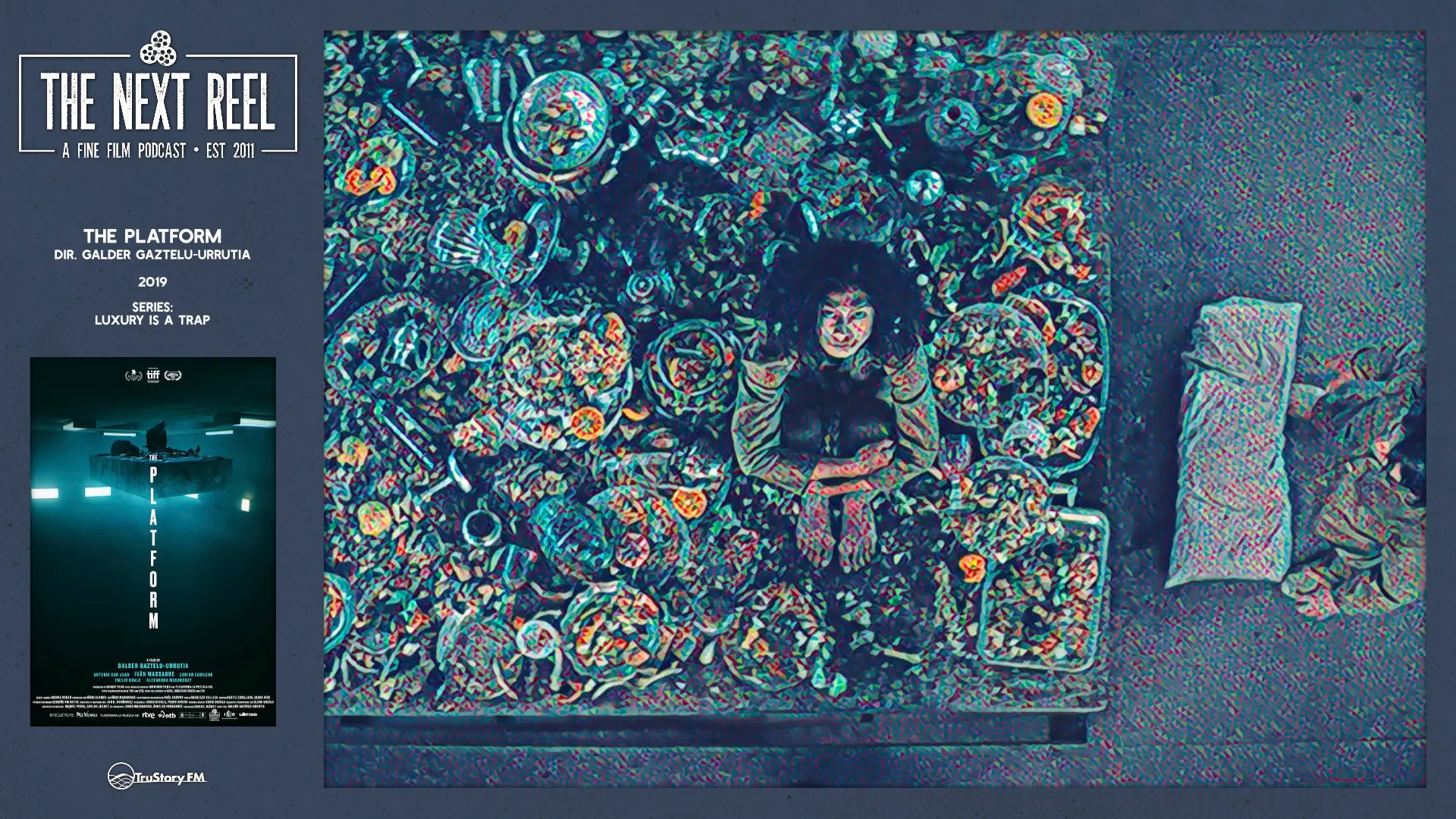
The Platform is over. There are three kinds of people: the ones above, the ones below, and the ones who fall.
Andy Nelson:
Doesn’t that imply there’s a fourth kind of person? Like
Pete Wright:
What do you mean?
Andy Nelson:
You, you the person who’s on the middle level.
Pete Wright:
Oh yeah.
Andy Nelson:
If there’s someone above and below you and you’re not falling, then you have to be the fourth person. I’m just saying.
Pete Wright:
And the ones who live to tell the tale also are there for people.
Andy Nelson:
And then there’s also the people in the basement who like to feed on body parts.
Pete Wright:
And don’t forget the trash child living under the last bed
Andy Nelson:
Okay, so five types of people.
Pete Wright:
So five people, maybe six. And there’s the warden. Seven. We have seven people. Okay, we’re doing great. Okay, The Platform. Stop doing this, Andy. Just stop it. The Platform is part two of the Luxury Is a Trap series.
We started with High-Rise, which put the rich at the very top of the tower, and then we just get to see what trickles down. This movie is about what rich people eat and how it trickles down. And I am fascinated to hear your take on this movie. I do know that you texted me and said, spoiler, I liked it better than High-Rise. Which is I mean High-Rise didn’t connect as well. Okay, it’s fine. We move on. We learn a lesson and we move on.
Andy Nelson:
One star. This one didn’t have hard to climb. Didn’t have far, yeah.
Pete Wright:
Okay, so how’d you end up on this one?
Andy Nelson:
I enjoyed this one. This was a lot more entertaining. It was an interesting concept. It definitely has some issues that I’m sure we’re gonna discuss and some points that I’m still not completely sure of like the logic and the way that everything is working within this prison system. If we’re calling it a prison system, right? We could be calling it a, what is it, a vertical self-management center.
Pete Wright:
Yes, that’s good.
Andy Nelson:
Yes, vertical self-management center. And I certainly have questions about that aspect as well. Is it a prison or is it really a vertical self-management center?
Pete Wright:
Well, and my question to your question would be, does it matter?
Andy Nelson:
Well, in some capacities, I think it should, I think. But we’ll talk about that. But I did find it very enjoyable. I really enjoyed the conceit I enjoyed kind of this weird like science fiction slash fantastical space that they created for all of this in which to happen. And so yeah, I had a lot of fun with it. I really enjoyed kind of what the director was doing and the whole team.
Pete Wright:
Yeah. I think this movie is less useful as a narrative film than it is as it to be seen as a thought experiment. Because it’s ridiculous. It’s a ridiculous premise if you take it as there’s someplace in Spain that has this 330-story prison where at the top is actually luxury living and is really designed to torture people, two people at a time. Like it’s a horrible idea. But if you take it as a thought experiment that’s like part prisoner’s dilemma, part trolley problem, then you start seeing this as a real social experiment and a social critique. In a way that allows the filmmakers to explore how people think and to do so in a contained, constrained environment that I think is ultimately fascinating, right?
You get the same this is this fits in the same area as Cube, right? Here’s a shape. And we’re gonna torture people in and around shapes for a while.
Andy Nelson:
Yes.
Pete Wright:
So I really like it. It is not so much the battles between the haves and the have nots, because the haves won, right? The haves have until they’re done. It’s—people are starving because the have nots are all fighting one another.
And in that regard, it kind of picks up where High-Rise left off, like the middle class battling the middle class. This is people who are choosing their good over the good of others, and what does that say about humanity? That’s what the film is all about. And if you’re not in it for the thought experiment, I can see how this might be a tedious watch, but for me I thought it was fascinating.
Andy Nelson:
Well, and to that end, like I mean, one of my complaints about High-Rise last week is that it was like designed to be an allegory and it couldn’t get past that. It was just so allegorical I couldn’t connect with any characters. There was nothing. There was no logic, like little logic in the way the story was constructed for me, and it just it didn’t play at all. I mean, there are interesting elements in it for sure, but largely I just could not connect to this. You could say a lot of that about this too. Like it’s very allegorical. Like the whole conceit is kind of nonsensical. Like, why would somebody actually build this thing?
And how is it that it has this levitating platform that floats through it? And I certainly would then have more questions once you watch the prequel, because suddenly it puts the whole thing into it raises a lot more questions about where is this actually. And so yeah, I think there is a lot of that design to the way the story unfolds that makes it very allegorical, but in ways that it still works more. Like I actually connect with these characters. There’s a logic to the way things unfold. You can see why when our hero Goreng, the protagonist of our story, when he wakes up. He’s just like, Oh, I’m not hungry, I’m not gonna eat and he’s kind of thinking like I you know, I just I don’t eat every time food is presented in front of me And then he gets to a place where once he understands the system, thanks to his roommate Trimagasi, the first old man that he’s living with.
He understands, oh, there’s people above, they get to eat first, there’s people below, they get to eat after. I’m not gonna eat as much so that people below me can have more food and Trimagasi is like, you’re an idiot. You’re stupid. That’s not how it works. You’re gonna wake up on one of the lower floors and you’ll understand why. And they do. The interesting thing about continuing kind of the thread of what you’re talking about with the way that this works is, yeah, you might be one of the rich, one of the people on the upper floors. For a month. But then you could wake up and suddenly you’re on the 250th floor and you’re never getting food.
And how do you then survive? And what does that do for the way you think when you end up on the sixth floor. Are you going to not eat as much so those people might get food? Or are you gonna now stuff yourself and say, Screw you, I had to spend a month with no food, so I’m gonna eat whatever I want. And I think that’s the interesting game that they’re playing here.
Pete Wright:
Yeah, because it ends up being like if you separate the fact that luxury, the people who are on the top floor are living the life of luxury and that appears as opulence, right? It’s beautiful, the kitchen’s beautiful, everything’s great. You never hear anything up there, right? There’s no there they there’s no sound. There’s a lot of, you know head chefs screaming at serving people and I mean it’s. Yeah, level zero, right.
Andy Nelson:
Like level zero, the kitchen area, yeah, yeah, right.
Pete Wright:
But if you separate that, what becomes currency is the food. So the tower becomes a criticism of both, you know, capitalism, the people at the top, who are trickling down, you know, their leftovers to the people at the bottom. And socialism, right?
The fact that nobody can figure out, nobody can restrain themselves naturally from eating more than their share when they’re at the top. And so the movie actually uniquely gets it both ways. It gets to critique these two ideologies at the same time, and they’re all terrible. Like they’re just terrible. I’m a I asked the question when I watch this movie, like, does it imply that it itself believes the people that it puts in this tower are capable, truly capable of rationing authentically, like against their best interests or for their best interests and for the best interests of the people below. And what’s interesting about it is right when you think they get it, like there’s a montage of building plates and some people maybe start to build plates and it’s all well and good with plates. But then the movie changes gears and it becomes a movie about a messianic symbol that they have to find. And could it be the result of their delusions of you know, of not having eaten enough, maybe, right?
But the movie changes gears. So I’m not actually sure if the movie has any internal belief. That it’s possible for a group of people to, as the tower indicates, self-organize and self-manage Do you I mean did you walk away with the movie having any sort of point? And I will say, you did extra homework. I chose not to watch the prequel because I kind of thought that maybe the first movie would be better if I didn’t know.
Andy Nelson:
But and you’ve never seen it, I’m taking it
Pete Wright:
Never seen it. I didn’t know it existed until I saw your Letterboxd come through.
Andy Nelson:
Oh really?
Pete Wright:
Yeah.
Andy Nelson:
That’s funny. It was promoted as heavily by Netflix as the first one was when it came out. So I you know, I don’t know if it ended up being quite as successful as the first one, but I is like I heard about it so often. Every time I’d log into Netflix, it was like when it came out they were advertising it. So I knew it had existed. And I decided I wanted to watch it. And it’s interesting because it does tackle some of the questions that you’re asking more than this one does. Does it completely succeed?
I don’t think so, but it is interesting in those sequences when it’s having that story unfold as far as like Are people able to start figuring something out as far as how they can actually make this work?
Pete Wright:
But does it answer the questions that are best left unanswered? That’s the thing that all that I worry about. Right? Because the movie works. I think platform works because you don’t, you can, it can exist as a fantastical thing. Right. You don’t ever have to think about it as grounded. Like how does the platform levitate? Who cares? That’s not the point, right?
Like I this is about Goreng and Trimagasi and the Samurai Plus knife and their choices. But then, you know, you get you end up with a prequel sequel that ends up answering questions or attempting to answer questions that are best left ignored. That’s my fear.
Andy Nelson:
I don’t think it does. I don’t think it does. But I also and in a lot of ways it ends up kind of retreading some of the elements from the first film. And it also ends up kind of confusing itself, I think, a little bit, like the first one does. I think by the time in this first film we end up dealing with you know, the potential of a child and like you said, the messianic symbols and things like that, it can become a little messy for me. Like I don’t know if it’s quite getting to the point. Like I As we get to the end of the film, I’m like, I’m not really sure and maybe you had a better reading of it than I did, but I didn’t really have a clear sense as to what they were trying to say anymore.
Pete Wright:
Yeah, no, I’m a hundred percent with you. And that’s where this thing sorta falls apart.
Andy Nelson:
Okay.
Pete Wright:
That’s why I say like I feel like when it becomes the search for the messianic symbol to answer all of our questions, right? It’s this the story of what the little girl means and then what the panna cotta means, you know, they find this one dish. And I you know, I get the dish. Like the idea behind the dish is, you know, it is if the rest of the entire food system is torn asunder. But they managed to send back one thing that says, No matter what, we won’t eat this. That’s a form of rebellion, I guess. I mean, maybe I’m totally misreading that, but that seemed to be what was on its sleeve.
Andy Nelson:
Or proof that like we can actually do this. We can take this system, we can make it work where something actually can make it all the way to the bottom and still survive its way back up.
Pete Wright:
Yeah. So I guess what other what choices did the narrative part of the film have? Right. D is this a movie where they have to tear down the system? Did you expect them to tear down the system of the platform? Or is this a movie where it ends hopelessly where, you know, the system is going to continue indefinitely because systems are what they do?
Andy Nelson:
Well, and that’s a big question that I have, not just from this one, but the second one as well, because it’s like there’s a child that you know there’s the mystery of the child happens for a part of the film because we do meet this character Miharu who never speaks and she is she goes down the platforms apparently once like every month, every time she wakes up somewhere. She kills her roommate to like feed on them and then goes down and to the bottom looking for her child. And that’s kind of The conceit of what’s happening here, right? And then we have this whole thing when Goreng ends up with a different roommate, Imoguiri, Imoguiri, Imoguiri, who says. She’s never she’s she came here and she doesn’t have any children. She’s childless. And so now we’re questioning, okay, is Miharu crazy?
Like what’s going on? Is this whole thing of a child, search for a child just as this thing that she has kind of created because she’s gone mad here. And then we end up seeing a child and the child becomes this message and the goal is to okay, well we’re gonna send the child out. But to like to what avail? Like and they have that whole thing at the end is like the child is a message, we’re gonna send the child out. But like what do they prove? Okay, we figured out that there’s a kid here. I mean, somebody always seems to have to be able to know that there’s a child if there are three hundred thirty-three levels. And somebody’s on 332, they potentially, I know granted, they might kill themselves kill their roommate, but I’m assuming one of them would know there’s a child there below me.
I mean, and how is the child getting food? Like, there’s so many questions that I have that don’t make sense, but then I don’t know why like what happens when they send the child out? Is that like Yay, we win. Like I couldn’t figure out what that proved
Pete Wright:
I think that’s a great question because you know, I one read on it is that she came childless because she was pregnant at the time, right? Like somehow she had a baby in there. I don’t know. I don’t know how. But ended up now and she’s been there so long that now she has a kid that’s like six years old, I guess. Somewhere in there I’m not good at children’s age. I had two of them and then I forgot.
Andy Nelson:
Based on the second movie, I’m gonna say that’s not what happened.
Pete Wright:
Damn it. Damn it.
Okay, so that’s a terrible read, and ignore that. I take it back. We’ll fix it in post.
Andy Nelson:
The read on the children, I’m just gonna say, is it gets even weirder when you get to the second movie. I don’t even know if I wanna bring it up here, but it just made it even more confusing for me because I’m like Now I really don’t know what you’re doing with the kids.
Pete Wright:
There are more kids?
Andy Nelson:
Yeah, I kind of spoiled it.
Pete Wright:
Now you’ve done it. Now you’ve done it. Just say it. You have 60 seconds.
Andy Nelson:
There’s a whole room full of kids. There’s a whole room full of kids like a hundred kids.
Pete Wright:
Oh my god.
Andy Nelson:
They’re all just playing on this Giant playground. And then they do like you know King of the Castle sort of game. And the kid who’s at the top, when I don’t know, at certain point The people who run this vertical self-management center, they come in and they whisper to this kid who’s on the top and they take him out. And they take him down and put him in the room, in the bottom room. And so now he’s the kid in the bottom room.
Pete Wright:
Oh my God. Andy, see
Andy Nelson:
And we see in that room of children, we see the kid who’s at the bottom of the bottom of the platform in this movie. So I don’t understand what the kids represent. It makes no sense to me why there are these there’s a whole room of children and they’re using it as something to like, okay. It’s time to pick a new kid and put them in the bottom and then what? Like it just it didn’t make any sense to me.
Pete Wright:
All right. This is you just defined why we don’t watch prequels like this. That’s it. That’s exactly my problem. Like the move that that why do I want to watch that? That like breaks the awesome stuff that The Platform is trying to explore by just welding in this weird like kids make people sad thing. Let’s put kids in danger with no purpose.
Andy Nelson:
Well, the first half of it was really interesting. I really thought it was very compelling for a good chunk of the story. And then. Yeah, then there’s a Messiah character and there’s a like a war and I don’t know.
Pete Wright:
So at right about forty-two minutes, I should shut it off.
Andy Nelson:
It got a little crazy, but
Pete Wright:
It sounds like the same movie, but more.
Andy Nelson:
Same movie, but more.
Pete Wright:
Damn it.
Andy Nelson:
Yeah, yeah.
Pete Wright:
All right. Well, I meanwhile, back to this movie. Do you want to take a break?
Andy Nelson:
Yeah, let’s take a break. But first you can find the show on YouTube and you can join us live when we record. We’ll even take your questions in the post-show chit-chat and members get the full post-show conversation and always know what to listen to next. Subscribe to The Next Reel on YouTube. The link to this episode is in the show notes. We’ll be right back.
Pete Wright:
I want to talk about our man Goreng and Trimagasi, his buddy who becomes ghost buddy.
Andy Nelson:
Yes, Ghost Buddy
Pete Wright:
How did that entire mechanic work for you? So the entire the idea is we’ve got Goreng, who is our main guy, wakes up. He is he enters into the platform as a way to get his degree, I guess it’s
Andy Nelson:
Okay, can we before we talk about these two men, because I definitely want to talk about them, but this is a prison
Pete Wright:
Sorta
Andy Nelson:
Because Trimagasi is here for manslaughter, right? And he’s supposed to be held in this place for six months. But then there are people like Goreng who says I want to get my degree, so I’m going to enter this place and use it as a it’s almost like when people used to check themselves into sanitariums just to say, I need a mental break. I need to come in here and just kind of cleanse my mind. And it seems like he’s kind of checking himself into this place without really knowing what it is. And same thing when Imoguiri checks herself in because. She finds out that she has cancer and is just like, well, I just am gonna go check in and use it as a place to kind of say goodbye to things or whatever it is she’s doing, right?
Pete Wright:
I don’t understand her at all. See, now I thought she was somehow committed. Like she had done something wrong and it was being used for her as a prison.
Andy Nelson:
I didn’t think so. I mean, she says she admits herself because she had terminal cancer and just was like With her dog also. Like, because everyone gets to bring one item with them. And that’s the other thing. If it’s a prison, why are you letting people come in with samurai swords? Or kitchen knives or dogs or I mean, I can guess a book, sure. That’s not a threat, but like so many of these other things, it’s like, man, like that’s just crazy. And so I guess that’s the weird thing. It’s like the vertical self-management center, like I get it, but at the same time it’s like these people clearly don’t have an understanding as to what they’re checking themselves into.
But there’s still there’s enough of a marketing campaign out in this world that say, hey, if you’re feeling blue, if you need to come find yourself, check yourself into the vertical self-management center. Down on ninth street, we’re gonna, you know, help you out, you know, and it feels like that’s kind of the way that it’s set up. And it’s strange, because then there are also prisoners in here. And so I’m just not really sure I mean it’s an interesting conceit because it does mix people, but at the same time it creates this very strange system that it’s one of those parts as like an allegory that I’m like, I’m not a hundred percent sure. That part works.
Pete Wright:
I don’t think that it works. I think it’s asking too much of one metaphor, right? Like we have this one conceit and let us just parse how people behave. I think there’s enough movie to go through all of the options and of all of the choices that our main people make together. That would be an entertaining experience. And I think the movie starts to strive for increasing significance of complications in the second half that actually detract from the experience of the exercise and try to make it too much. So I don’t know, that’s that is where it sort of falls apart. Because she I mean, as his intake agent, you would think she would know everything that goes on.
Andy Nelson:
Yeah, right. Yeah. And so is she only checking herself in because of the cancer and she’s just like, I’m gonna die anyway. I’m just gonna go die in the pit.
Pete Wright:
Or is she trying to bring down the system by trying to introduce a more rational socialist system to it?
Andy Nelson:
You’re right, exactly.
Pete Wright:
But I mean if that’s the case, did she?
Andy Nelson:
She does try. She does try, right?
Pete Wright:
She introduces our montage of plates.
Andy Nelson:
Yeah, right.
Pete Wright:
It just doesn’t none of it ends up feeling very successful. And so, well, you know, so we end up with Baharat and the messianic segment of the film. But first, I gotta talk about Ghost Trimagasi.
Andy Nelson:
Okay.
Pete Wright:
Yeah, because that as I was kind of reading about the responses to the film, Ghost Trimagasi ends up being a character that introduces some conflict to people’s read on the movie, and I want to know how it worked for you. The idea is so people end up so he Goreng. They think Goreng and Trimagasi are doing fine. They’re obviously doing fine, saying obviously a lot to each other, and that’s controversial. But then they end up after one significant gassing, they end up waking up on one of the very low floors.
And Trimagasi has tied up Goreng. And said, you know, I’m really sorry to have to do this. You know, it’s you or me and I just I have my samurai plus knife here and I’ll tell you what I’m gonna do. I when I get hungry, I’m gonna eat you, but so slowly, and I will feed you yourself too, so that we could both stay alive as long as we can, and I will heal you every time. But you’re essentially gonna be a big old steak for me. And I am gonna eat your genitals, but I am gonna save those for last. You get the feeling that Trimagasi was maybe spent some time in the luxury suites because he knows his choice meets.
Andy Nelson:
He know exactly, yeah, right? Yeah.
Pete Wright:
Gross. So that’s the idea, and then at one point Miharu sees that Trimagasi is eating Goreng and she comes down on the platform in one of her rides and she well, she ends up you know, knocking Goreng or Trimagasi off, and then Goreng himself ends up killing Trimagasi. And then we have Trimagasi as kind of a central Force ghost for Goreng
Andy Nelson:
But not until Goreng has eaten him.
Pete Wright:
That’s a good point. So he’s ingested the spirit of Trimagasi and now he sees him.
Andy Nelson:
That’s kind of the conceit is he says, you’ve eaten me now, so I am gonna be with you now forever.
Pete Wright:
I get it
Andy Nelson:
And that’s why then later Imoguiri also shows up because. He ends up when they end up on a really low floor, she hangs herself and he feeds herself. He feeds himself with her flesh. And that becomes the reason that these Force ghosts appear. Which makes you question the Jedi. Like what happened, like to why are people seeing Force ghosts?
Pete Wright:
Yeah
I feel like that’s the next shirt that we need. One is like Han shot first and Luke ate Ben.
Andy Nelson:
All right.
Pete Wright:
We’ll see how that goes from the Lucas organization.
Andy Nelson:
Okay. So we’ll see. It will see.
Pete Wright:
Disney, I’m sure, is gonna be thrilled when we get that shirt out there.
Andy Nelson:
The they always said there was a darker side to the Jedi that we knew
Pete Wright:
The that is such a good bit that it unfortunately takes like many levels of explanation and people have to all have watched this movie in order to get it.
Andy Nelson:
Right, to really get it.
Pete Wright:
Damn.
Andy Nelson:
Oh, it does.
Pete Wright:
Okay, I see that
Andy Nelson:
Well, it’s an interesting conceit, I guess. I think I actually don’t mind it, you know, especially because by the time people are in a place where they’re having to succumb to cannibalism. They’re in these lower floors and they are at a point where they’re like, I’m starving to death and I mean, I think that Goreng, who otherwise seemed like a perfectly sane, healthy individual before he started his time here, I think he was probably going a little mad because not only are you in a place where everybody around you is likely dead. I mean I’m assuming I don’t know. I guess it we don’t really get a sense, but I’m assuming like the floor above the floor below when you’re on floor two fifty. Either they’ve killed themselves or one of them has killed the their roommate and is just eating them.
You know, there’s a lot of probably kind of madness going on with all of these people. They’re kind of living by themselves and just sitting there. Feeding on a dead body trying to keep it from rotting over the course of a month. And I think that probably just drives everybody a little crazy. So I think there’s an element of like pushing people into insanity when you end up in these places. And I think there’s a read that potentially Goreng also is just kind of going a little mad.
Pete Wright:
Yeah, I get that. And I think, you know, he only had the one book.
Andy Nelson:
Yeah, right. There’s only so many times.
Pete Wright:
There are limits. Eventually he started eating the book. That did I miss did he start seeing images
Andy Nelson:
Did Cervantes show up?
Pete Wright:
Yeah, did he be did he get any of the book material?
Andy Nelson:
I don’t. Yeah, right. That would have been good.
Pete Wright:
He just devoured a book. His takes on a whole new meaning.
Andy Nelson:
Yeah, see Don Quixote and Sancho Panza start hanging out in the rooms with him. Trimagasi looked a little bit like Sancho Panza, and Goreng could have been
Pete Wright:
Yes
Andy Nelson:
Don Quixote, yeah.
Pete Wright:
Yeah, I think so.
Andy Nelson:
I’m sure there’s some way to read it into that.
Pete Wright:
It’s been a long time
Andy Nelson:
Yeah, likewise.
Pete Wright:
Okay. So in terms of our filmmaking, how do you how do you think the movie holds up? This one is it is a very simple structural premise, production premise, right? They ended up building just two floors of this thing and everything else is done in post and it’s lovely.
Andy Nelson:
Very cube-like. Yeah, I think. It’s smart. Like this type of production I think is always clever when they come up with a single space that they can kind of do something with. And I mean the same thing with Cube. They did that exactly when they built Cube. They built kind of just the two rooms and then they were able to kind of shoot everything there. And same thing here. They kind of created this one space and then they would have a platform kind of dropping through it periodically, which was just a lift, like a scissor lift basically.
And then that was it. And so it plays. I thought it was actually a kind of a strong way to kind of create a story. They built a world Very quickly and very effectively. Like we get the rules pretty quick. We kind of understand it. Little other things pop up over the course of it, but largely. It made sense to me and I loved the actors. Like I thought all of the actors brought a lot to the table as far as kind of how they fit into the space.
And I you know, I don’t know. I just I enjoyed what how this world felt. I mean, it was gritty, it was violent, it was you know, it there was a struggle to find humanity for the people within it, and I bought that. I think that. It plays nicely.
Pete Wright:
The other thing that I think served the movie is they shot it in order over six weeks.
Andy Nelson:
Yeah.
Pete Wright:
The knock on benefit of that, especially as we follow Goreng, is that he ends up losing a lot of weight over the course of that six weeks. And his like there was no effect, no makeup needed really to give us that sense that this guy is fading away over the course of this month and a half. And I think it ended up looking really, really good. It’s a super modest production that shoots way above its class in terms of production design
Andy Nelson:
Well, and very smart use of special effects. Like they found a way to do it simply, but created something completely believable. And I think that’s an incredible strength. And I think for I mean I don’t know if I want to call this like an independent production, but for smaller budget productions, they’re finding very clever ways to use the effects to help make this world very effective, you know? Like the simplicity of a scissor lift that just is lowering down with kind of a big table over and over again, does what it needs to in order to kind of create this space for me. And then just the digital effects of creating like when they look up and you just see all the way up, you know, dozens of floors and down likewise. Like I think it plays, I think all of that works really nicely.
Pete Wright:
Yeah, I do too. I do too. What do you know of Gaztelu-Urrutia, our director?
Andy Nelson:
I believe that Galder Gaztelu-Urrutia was a commercial director for a long time, and I think that was primarily what he did for work. And I think that then periodically was doing short films and stuff. And then this ended up being his feature debut. And so it’s pretty impressive to kind of have this as your first film. But again, you’re doing it smartly, picking a simple space and premise in order to do something really creative. And I think also getting a Capturing a theme and a message in a unique way. And I think that’s what plays well.
And that’s why kind of a more allegorical, fantastical story done like this works better for me than something like High-Rise.
Pete Wright:
Yeah. Yeah. So you know, I you look at other movies that have done that have done similar things, like Snowpiercer, right? Take, you know, we talked about Snowpiercer last week as kind of the same discussion of this fixed location where we have essentially everybody’s locked in and choices are made and it gets to critique you know, capitalism and socialism alike. Within each of the castes of the capitalist structure of the location, everybody has to be socialist or die. And so this movie ends up being a much more simple production. They don’t have to build a train. They don’t have to build like, you know, sets or cars.
What’s interesting to me is this thing was originally perceived conceived as a play, but where nobody ever goes up or down. It just takes place on a floor. I can visualize that, and I can visualize deeply enjoying it. As a two-hander on stage with voices coming in from other levels. I can absolutely see this. It is a one of those pickups from Netflix that makes a ton of sense. What do you think about it, you know, his directing? Do you feel like the second movie ended up hurting him?
Andy Nelson:
It’s so hard to say. I mean the first one
Pete Wright:
It’s really recent.
Andy Nelson:
Yeah, the first yeah, I and he already has made the third movie afterward that came out I think actually it came out the same year as Platform 2, which is pretty interesting.
Pete Wright:
Did not do very well, you know, critically.
Andy Nelson:
The third yeah, Rich Flu. No, yeah. And then a fourth movie that I think is I don’t know, it’s under production right now. So I mean he’s keeping busy. I don’t think it’s hurt him in a way where he’s not been able to kind of find another gig. Right. I think that he’s he kind of keeps himself moving, keeps things going, so that he always has another project. You know, it’s always smart for directors to have another project in the works before the movie releases just in case it’s a flop. Then you’re at least already are onto another thing, right?
And so I think that’s critical. And so I think that’s kind of the case where he’s just kind of cranking away. And so but so far the three films have all been you know, critiques of a system, right? They’re all looking at the same type of luxury as a trap sort of thing. And so clearly that is an important message for the director, right? He clearly has a view of you know as he said the film’s key message is that humanity will have to move towards the fair distribution of wealth. And I mean that’s kind of essentially what it is.
And it’s further explored in the second one. And I think Rich Flu also is, you know, essentially that same thing. And so I find it interesting that he’s doing this. And I think he does I think he’s capturing it well. So I have faith in watching Galder Gaztelu-Urrutia and his career moving forward. Like it I think that he’s somebody who is worth kind of continuing along with, even if some of the things have not quite hit as well as others.
Pete Wright:
I of course will watch Platform 2, even though I protest. But and I actually really feel like I want to watch Rich Flu. It’s a story about a deadly virus that only targets the 1%. And wealth is, as it says in the log line, wealth becomes a death sentence. I’m fascinated by that, as a con as a conceit.
Andy Nelson:
All right.
Pete Wright:
Because it’s the other side of this story, right? It’s the other side of this is what happens to all of the poor people. But what happens when the system actually does get to invert and we get to see what happens to the wealthy. And the very, very wealthy. And I think that’s a fascinating area.
Andy Nelson:
Yeah, where they’re panicking trying to get rid of their money so that they are no longer quite as wealthy and can actually not die from this disease.
Pete Wright:
Right.
Andy Nelson:
I it sounds very interesting.
Pete Wright:
And he builds in this mechanism in this movie too, right? Like. You I am sure, even having not seen it, that there will be an entire sequence in the movie where the wealthy are trying to hide their money, right? And so that they can’t be caught or can’t be catch the virus. But they will catch the virus and it will be horrible, right? That’s I could write it myself. I know it’s in the movie. Haven’t seen it.
This movie, the same thing happens. If you try to keep food off the platform. They know, and they’ll kill you anyway, by either baking you to death or freezing you to death, which is diabolical. Diabolical
Andy Nelson:
It really is.
Pete Wright:
Right? So I think he’s got a really interesting eye. And I wonder, now that I say these the second two movies were not you know, as critically well acclaimed, I wonder if it’s, you know, still some really, really interesting concepts that he’s playing with. I’m in as I say it, I’m more interested in More of his work.
Andy Nelson:
Well, I mean we had a similar complaint, I guess I would say, when it came to Train to Busan, right? Like the director for that it seems to have a real struggle. Like when we watched Train to Busan and then Peninsula we skipped the animated prequel, which we still need to add to that series one of these days, Seoul Station. But those two films we talked about and we love what Yeon Sang-ho did with Train to Busan. We weren’t as much fans of what he did with Peninsula, right? We’re like, ooh, that was a rough one. But now, like. He has this new film that just came out that everybody is saying go see Colony.
It’s a really creepy new shift in the world of zombie movies and everything. And so yeah, I so I know first-time directors can sometimes struggle with their second film, especially if it ends up being a sequel, but. You know, I’m inclined to give them another chance and kind of continue investing my time with what they’re doing because they’re I can already see that they’re doing more thinking and work than some other directors and they’re trying to capture something really unique. And so that makes me excited. So you know, I yeah, I’m excited to see Colony. I’m excited to see what Gaztelu-Urrutia does next because I’m I think that he’s a filmmaker who is telling interesting stories. So I want to give him a chance.
Pete Wright:
A little bit you get the you get the feeling like he’s trying to exercise a demon, right? That he has this perspective and he just has to get to the right message, the right people, the right vehicle to actually tell it before he can move on. Because we have three movies that are all dealing with the same kind of thing and it just doesn’t feel like he’s done.
Andy Nelson:
Yeah, right? No kidding. And what is he’s got a new movie already. What is the new one? Banquet is the new film that he’s slated to be working on.
Pete Wright:
That sounds like something he’s going to be messing with us on, right? Like that that fits right in
Andy Nelson:
Yeah.
It does. It totally just sounds exactly like his version of The Menu or something, you know?
Pete Wright:
Yeah
Andy Nelson:
Yeah, so I’m curious. We’re just gonna kill some.
Pete Wright:
I don’t see I don’t see any big cast in coming in Banquet, some folks I’m not familiar with, but you know, Rich Flu. Ends up having Mary Elizabeth Winstead in it and Rafe Spall. Lorraine Bracco.
Andy Nelson:
Yeah, which was I mean I think that was his first English language film. So I’m curious if Banquet is going back to Spanish, you know?
Pete Wright:
Yeah.
Andy Nelson:
Well, actually, no, it’s got Alfie Williams in it, Meghann Fahy. So yeah.
Pete Wright:
Yeah.
Andy Nelson:
Well, I don’t know. I guess we’ll see.
Pete Wright:
Fascinating. All right. Well, I’m down. Overall, the movie, you know, I’m I am relieved that you liked this movie certainly more than High-Rise, because I think it’s taking some big swings and I think our cast is really good. Iván Massagué.
Andy Nelson:
Massagué
Pete Wright:
I really buy what he’s doing as our Don Quixote.
That’s gonna stick.
Andy Nelson:
Yeah. I know, it totally is, yeah.
Pete Wright:
I really buy what he’s doing. I buy how he performs his curiosity, how he performs his destitution, how he performs his hunger. And his rage and his fear, I buy it. I think that guy is fantastic.
Andy Nelson:
Well, and it’s interesting, like the filmmaker Gaztelu-Urrutia specifically picked Iván Massagué and Zorion Eguileor, who plays Trimagasi. As the two leads and they’re known for comedy. Like neither of them are or no, not Zorion Eguileor, but Antonia San Juan, who’s been in a number of, I think, of films by Pedro Almodóvar like Todo sobre mi madre. And so I think that both of those actors are more known for comedy. And so he kind of chose them against type to boost kind of the humor with kind of the situation. You know, I mean it’s not like they’re telling jokes or anything, but just to kind of play into the surrealism more, which I think is smart. I think it works.
Pete Wright:
Well, and the sort of fierceness of Emilio Buale as Baharat, who is. He’s just muscle. And he was somebody who was who so ably, you know, came to the aid of Goreng and in that mission. And somebody literally poops on his face. Like that was rough.
Andy Nelson:
That was pretty awful.
Pete Wright:
So yeah, there are some things in this movie that are unpleasant.
Andy Nelson:
Oh my gosh. Yeah. It’s it is definitely like I mean, it’s full of blood, it’s full of violence, it’s full of gore, you know, things that you don’t necessarily want to see, but it all fits in the world. Like that’s the thing. And so yeah, to that end, it’s may not be for everybody, but I think largely it plays quite well.
Pete Wright:
I gotta ask an a question that may be too influenced by your experience with the prequel. Do you think this is an optimistic ending or a downer ending?
Andy Nelson:
I was torn on that because what would have happened had Goreng gone up with the child? Would they have just taken him and said, Thank you, gassed him, and he’d have waken up on one of the floors again, you know, or would he is that a route to freedom? Like we don’t really know what the result would be if he went up with the kid. You know, so it’s hard to say it’s just a complete downer of an ending because we don’t know that there’s success on the other end. I and again, I think this is why it’s a little confusing, because it’s like, why is the child the message? What does that mean that the child is the message? What is going on in the basement, whatever we’re calling this lowest level, level 334, which is just this massive dark space where all the dead bodies or all the bodies that all the suicides basically end up down here and are fed upon, I guess by The dwellers of the deep. I’m not really sure.
So and now he’s down here living with his ghosts and others?
Pete Wright:
So is that I mean I don’t is that the that’s the we get that in the prequel? Because in this
Andy Nelson:
We do have more in the prequel. Yes. There are a lot more people living down here. Apparently anytime you ride the platform and you go to the bottom and I like I don’t know if it would even go up if you don’t get off. Like I’m not really sure but there are other people down here
Pete Wright:
Well, it does because the girl goes up.
Andy Nelson:
But if he stayed on it, like is it like The Mist? You know, would The Mist have cleared if he didn’t kill everybody in the car, you know?
Pete Wright:
Oh god, that’s why you bring up that horrible thing.
Andy Nelson:
Right
Right, I know.
Pete Wright:
I just shook that
Andy Nelson:
So well, just happy to bring it back for you. Mike Flanagan’s bringing it back anyway, so you’ll have more chances to think about it.
Pete Wright:
Yeah. Oh my god.
Andy Nelson:
But it’s that same thing. And so yeah, there are a lot of people in the pit and when suicides, when bodies fall, they swarm and just feed on all the flesh. So it’s like a little cannibalistic society in the dark down there.
Pete Wright:
Awful. Okay. That’s horrible.
Andy Nelson:
It is. And he now lives there, so
Pete Wright:
Yeah. Well, so I you know, not having seen that, the way this movie ends, he just walks into the darkness, right? We don’t get that, that there are people about to feed on him.
Andy Nelson:
No, and it does seem like, okay, he’s in the dark. Well, I can’t remember. Do we hear anything down there? See, I now I watch them so close. Now I’m conflating the two, and I’m like, did we hear some stuff down there? But maybe not. So it’s just him in the dark. And he walks into the darkness, which in many ways could just be seen as death, right?
Pete Wright:
Yeah.
Andy Nelson:
He’s just succumbed to death.
Pete Wright:
Which is kind of why I love it. Like he is down experiencing oblivion. And he sends her up with the same level of uncertainty. Who knows what’s gonna happen when the rich people discover that there’s a child down there? Maybe according to the universe of this movie. They didn’t even know and they’re gonna freak out. Maybe that’s what breaks the system and he sacrificed his own existence in order to send this message. I, you know, that could be hopeful, even though it’s a glorious downer of an ending because he gets the we see him alone in nothingness.
Right? That is anxiety fuel if I’ve ever seen it.
Andy Nelson:
And it’s the complete opposite of the beginning, which is like, I mean, this kitchen where they’re preparing all the food, I mean they have their own like string quartet playing music while they’re prepping the food. Like, I’m not even sure why. Like just to inspire the chefs to make everything even that much better.
Pete Wright:
Well, you need live music is better when you’re cooking than canned.
Andy Nelson:
That’s yeah, that’s true. That’s true. But then they and obviously the chef is very picky because there’s a hair in the panna cotta before it goes down and he has to
Pete Wright:
It was so good
Andy Nelson:
Reprimand everybody a little bit. So I mean it’s a very particular place. And it is glowing with light. And everything is the complete opposite of where we leave our protagonist at the end of the film. So it is. I guess you could say it is a bit of a downer ending, but at the same time you could say there’s a little bit of an uplift to it because hey, he’s found his way out in his own way, right?
It’s like the Brazil ending. Like he’s you know, there’s happiness in his head.
Pete Wright:
We’ll take you exactly so far.
Andy Nelson:
Hey, if you’re crazy, maybe that’s all you need.
Pete Wright:
Yeah, right. Pray for some sort of dementia
Andy Nelson:
Yeah Oh my gosh, yeah. Well, that’s an interesting one. I had and I think the thing that makes it exciting for me, even if I find so many things that don’t work, is I had a lot of fun with it. Like I just enjoyed this world. I enjoyed what Gaztelu-Urrutia built and it’s something that I would watch again because it was an enjoyable, gory, fun watch.
Pete Wright:
That’s awesome. I’m so glad. So, so glad that you had a good watch with this. So I’m thrilled. Who knows what next week’s gonna be like? But I’ll celebrate this week.
Andy Nelson:
There you go. All right, well let’s move into the back half, but first, let’s take a quick break.
Pete Wright:
The Next Reel is a production of TruStory FM, engineering by Andy Nelson, music by Roy Spiegel, Gal Lev, Oriol Novella, and Eli Catlin. Andy usually finds all the stats for the awards and numbers at The-Numbers.com, BoxOfficeMojo.com, IMDb.com, and Wikipedia.org. Find the show and the full archive at TruStory.fm. You can follow us from there too. Plus, you can find out how to become a member and go further with every episode.
Check out the merch store at TheNextReel.com/merch, and if your app allows ratings and reviews, please consider doing that for our show.
All right, I feel like we’ve talked a lot about The Platform 2 in terms of our sequels and remakes and prequels. Is there a three on the way?
Andy Nelson:
I could not find anything about them planning a third one, and maybe it’s just because I don’t know if the second one performed quite as well. As the first and I’ll also maybe they realized like we don’t really know how to keep moving with this story. Maybe we should stop here, you know. I mean I don’t think the two playwrights who worked on the original one, I think they were frustrated anyway with the writers yeah on that first one because he said they defended their artistic vision and did not want some of the changes to be made. It didn’t work with them on the second one, I don’t believe. And so I it could just be one of these things where he’s just like, I’m done, let’s move on. I’m gonna I have other stories to tell now
Pete Wright:
Okay. So I shouldn’t hold my breath, is what we’re saying.
Andy Nelson:
Don’t hold your breath. Don’t hold your breath.
Pete Wright:
All right. How did it do at award season?
Andy Nelson:
It was minor, and perhaps it was because of the streaming world in which it was released. 13 wins with 24 other nominations. I will say it was released in theaters in Spain. And that is largely what we have with the awards at the Sitges Catalonian Film Festival. It won Best of Visual Effects. It won for the official Fantastic competition for Best Motion Picture, it won. It won the Audience Award for Best Feature Film, and Gaztelu-Urrutia won the Citizen Kane Award for Best Directorial Revelation. Quite the title for an award, yeah.
At the Cinema Writers Circle Awards for Spain, he was nominated for Best New Director, but lost to Salvador Simó for Buñuel and the Labyrinth of the Turtles. At the Goya Awards, which are Spain’s Oscars, he was nominated for Best New Director, but lost to Belén Funes for A Thief’s Daughter. The best original screenplay, but lost to Pain and Glory, and it did win Best Visual Best Special Effects. And at the Gaudi Awards, it was nominated for Best Non-Catalan language film, but lost to a thief’s daughter. It was nominated for best screenplay, but also lost to a thief’s daughter. And again, it won for best visual effects. Running theme in the awards.
Pete Wright:
You know, I think it’s funny that it was nominated in the Goya Awards and didn’t win because one of the stated inspirations for the story was Goya’s. Saturn devouring his child painting. Have you seen that painting?
Andy Nelson:
Oh, I love that. Yeah. It’s one of my favorites of his, yeah.
Pete Wright:
Gruesome.
Andy Nelson:
Yeah, yeah. Crazy.
Pete Wright:
Painted that on the walls of his house, Andy. Just on the what do you paint on your house?
Andy Nelson:
I’m gonna start right here. I’m gonna do my own.
Pete Wright:
It’s just gonna be dolls.
Andy Nelson:
I just gotta figure out what it’s gonna be.
Pete Wright:
It’s just dolls. The wall of dolls. Just painting horror dolls on your house.
Andy Nelson:
Creepy horror dolls.
Pete Wright:
Okay, well I have something to look forward to for a background then.
Andy Nelson:
There you go.
Pete Wright:
That’s great. All right. How’d it do at the Netflix box office? Do you have any numbers?
Andy Nelson:
Well for Gaztelu-Urrutia’s film, he had a budget of 1 million euros or about 1.2 million US dollars, which is about 1.46 million in today’s dollars. The movie premiered at TIFF September 2019, then opened wide in Spain, November 2019, but here is where it gets tricky. The film secured a worldwide streaming deal with Netflix at TIFF, and you know what that means. Basically it means that it performed well there, but we’ll never really know how that translates to box office. Netflix released the film internationally March 20th, 2020, where it did really well for itself, likely because of a little thing called COVID that we were all hiding indoors from. By July, Netflix had revealed that it was watched by 56 million households over its first four weeks of release, making it one of the highest viewing figures ever for one of their, quote, original films. For our purposes, we are just gonna have to assume it was a lot. But on its theatrical release in Spain it did earn one point one million, which is one point three five million in today’s dollars, so on paper, it landed in the red with an adjusted loss per finished minute of just under twelve hundred.
But based on their accounting and the fact that it got a sequel greenlit right away, we’re going to assume it’s a success. But we would just never know.
Pete Wright:
Somebody knows.
Andy Nelson:
Somebody knows.
Pete Wright:
Somebody out there knows.
Andy Nelson:
Yeah. I’m looking forward to the day and I don’t know when that day will come, but there is going to be a release of like all sorts of crazy information.
Pete Wright:
A tranche. Yeah.
Andy Nelson:
Yeah, just of all the grosses and everything the way that Netflix categorized everything.
Pete Wright:
Yeah. God, you would, I mean, I just would want to watch how crazy you go with a spreadsheet. Extraordinary.
Andy Nelson:
Glorious, glorious days.
Pete Wright:
Well, I’ll tell you, I really enjoy this movie. It was a great rewatch. I’m so glad to be able to introduce it to you.
Andy Nelson:
Yeah, I me too. I mean it’s one that I’ve been it had been on my list forever, and so I’m glad I had the excuse to finally push play. So
Pete Wright:
Perfect
Andy Nelson:
I yeah, I wish the ending resolved better, but regardless, I had a lot of fun with it.
Pete Wright:
Cool, very cool.
Andy Nelson:
All right, well that is it for our conversation about The Platform. Next week we are looking at Triangle of Sadness, Ruben Östlund’s 2022 satire where models, influencers, and billionaires board a luxury yacht, and the pecking order doesn’t survive the trip. And now let’s do our ratings.
Pete Wright:
Letterboxd.com/thenextreel. That’s where you can find our HQ page where we rate and review all the films we talk about across the shows of the Next Reel family of film podcasts. Andy, what are you gonna do? You got five stars, you got one heart, how will you allocate them?
Andy Nelson:
Oh I
Pete Wright:
This is a hard one. That was a big sigh.
Andy Nelson:
Yeah, I’ve been torn. I feel like I feel like three and a half and a heart is where I’m gonna sit with this one. Like I you know, some of the story just I really kind of scratched my head with, but I still had such a fun time with it that I think. That’s where I’m gonna sit. Three and a half and a heart.
Pete Wright:
Well, I will be your ghost of Christmas Future, and I hope that when you re-watch it, you are able to shed the mantle of that missing half star and give it a full four stars on a heart.
Andy Nelson:
Look at you. Look at you.
Pete Wright:
Yeah.
Andy Nelson:
As the man who gives no half stars, I’m not surprised that that’s where you landed. So
Pete Wright:
It could I could be you one day.
Andy Nelson:
You could be.
Pete Wright:
You could be me one day, wait. You could be me.
Andy Nelson:
Oh god no, I prefer the other way around. Let’s work on having you come back to normalcy with half stars.
Pete Wright:
Nope, no half stars, no half stars.
Andy Nelson:
Those stars, all right.
Pete Wright:
I was so upset. Let me just say as a sidebar, I was so upset when I think Goodreads just recently added quarter stars. Come on.
Andy Nelson:
Oh my gosh, wow.
Pete Wright:
Why do you do that?
Andy Nelson:
That’s like these people on Letterboxd who not only do they give a star rating, but then they say, I graded this as an 86%. And I’m like, how look how like how are you figuring that out? Do you have a whole a breakdown of all the points that you award a film? And then you like determine, well, it got this, it didn’t it do that to determine like I mean how do you figure out such a specific percentage? Like I couldn’t do that.
Pete Wright:
I would very much like it if Letterboxd just went to tenths.
Andy Nelson:
Don’t say that out loud, Pete. Somebody will make it happen. Oh my gosh.
Pete Wright:
I can’t wait. I would like to rate this four point one three stars.
Andy Nelson:
That’s a hundredths, man.
Pete Wright:
Let’s just go all the way. Yeah, let’s go all the way to hundreds.
Andy Nelson:
Oh God. Stop it now. All right.
Pete Wright:
You’d have to redo your entire catalog. You’d hate it, but you know you would.
Andy Nelson:
Oh, I would like to think I wouldn’t, but
All right, well this averages out to 3.75 and a heart, which rounds up to four stars. So look at that, you still get your four. You can find the show on Letterboxd at @thenextreel. You can find me at @sodacreekfilm and Pete at @petewright. So what did you think about The Platform? We would love to hear your thoughts. Hop into the Showtalk channel over in our Discord community where we will be talking about the movie this week.
Pete Wright:
When the movie ends,
Andy Nelson:
Our conversation begins.
Pete Wright:
Letterboxd giveth, Andrew.
Andy Nelson:
As Letterboxd always doeth.
Pete Wright:
I mean, this was just like we are level zeroing this one
Andy Nelson:
Pretty much, yeah.
Pete Wright:
All right, go for it.
Andy Nelson:
All right, I went with four stars by Lucy, who has this to say. “location: underneath jeff bezos’ house.”
Pete Wright:
It’s still there. There’s like level zero under his house, and then right next to it is like a blue origin launch pad, and he’s just got everything.
Andy Nelson:
I wouldn’t be surprised if it’s under Musk’s house now that he’s inventing levitating cars. He’s like, but what if a levitating platform?
Pete Wright:
Oh my god. But it is the platform would be loaded with food and then it would just do a kickflip and flip over.
Andy Nelson:
Yeah, right. Screw you all.
Pete Wright:
Find some way to screw everybody over.
Andy Nelson:
Yep, yeah.
Pete Wright:
I went with a three-star from hollie amanda, who says what I think is the best joke of the, of The Feast, “the communist maniFEASTo.”
Yeah, that was a real level three.
Andy Nelson:
I love it.
Pete Wright:
Thanks, Letterboxd.